front seat LINCOLN MKZ 2014 Owner's Guide
[x] Cancel search | Manufacturer: LINCOLN, Model Year: 2014, Model line: MKZ, Model: LINCOLN MKZ 2014Pages: 468, PDF Size: 4.49 MB
Page 137 of 468
WARNINGS
The head restraint is a safety
device. Whenever possible it
should be installed and properly
adjusted when the seat is occupied.
Install the head restraint properly
to help minimize the risk of neck
injury in the event of a crash.
Note: Adjust the seatback to an
upright driving position before adjusting
the head restraint. Adjust the head
restraint so that the top of it is level
with the top of your head and as far
forward as possible. Make sure that you
remain comfortable. If you are
extremely tall, adjust the head restraint
to its highest position.
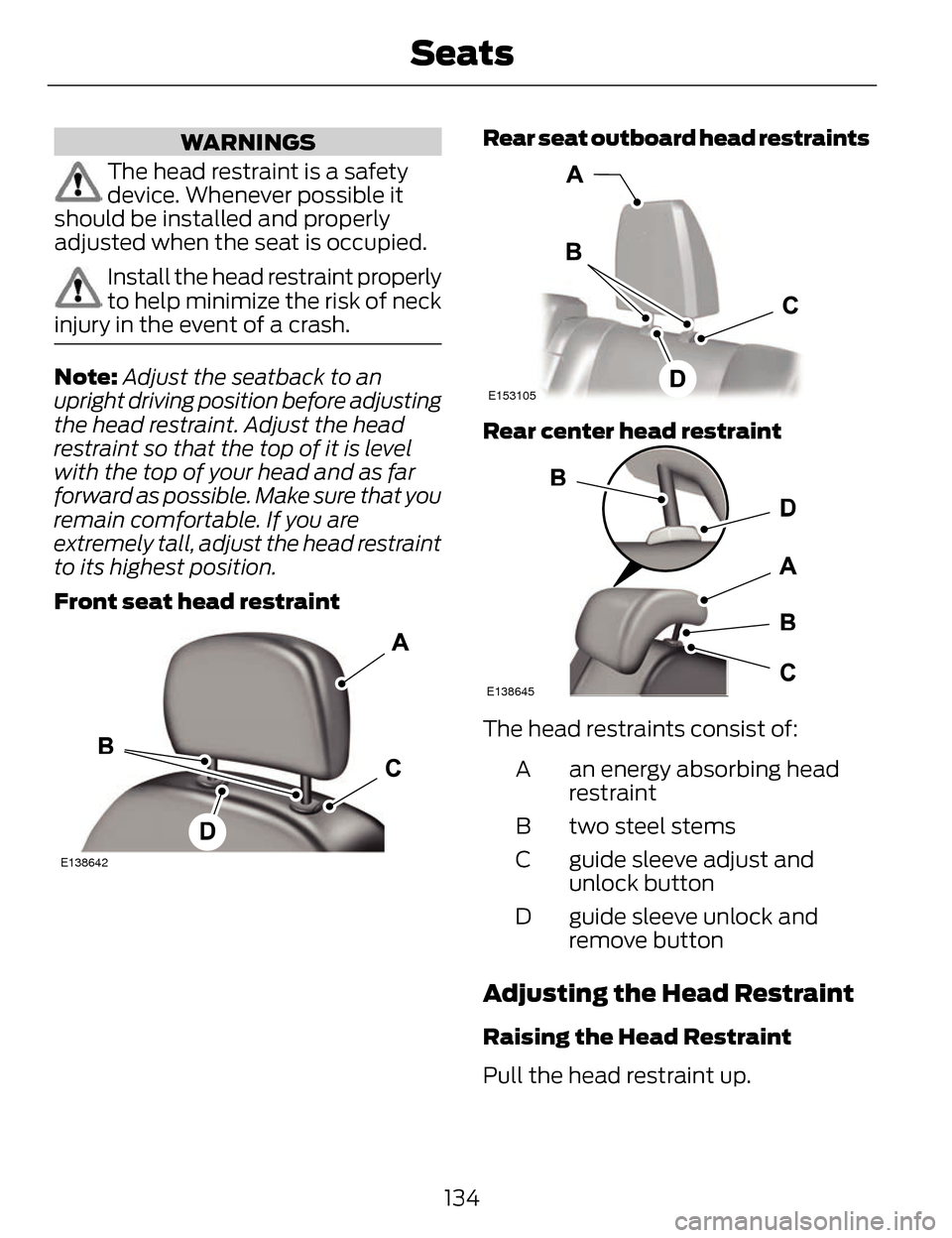
Front seat head restraint
E138642
Rear seat outboard head restraints
E153105
Rear center head restraint
E138645
The head restraints consist of:
an energy absorbing head
restraint
A
two steel stems
B
guide sleeve adjust and
unlock button
C
guide sleeve unlock and
remove button
D
Adjusting the Head Restraint
Raising the Head Restraint
Pull the head restraint up.
134
Seats
Page 138 of 468
Lowering the Head Restraint
1. Press and hold button C.
2. Push the head restraint down.
Removing the Head Restraint
1. Pull the head restraint up until itreaches its highest position.
2. Press and hold buttons C and D.
3. Pull the head restraint up.
Installing the Head Restraint
Align the steel stems into the guide
sleeves and push the head restraint
down until it locks.
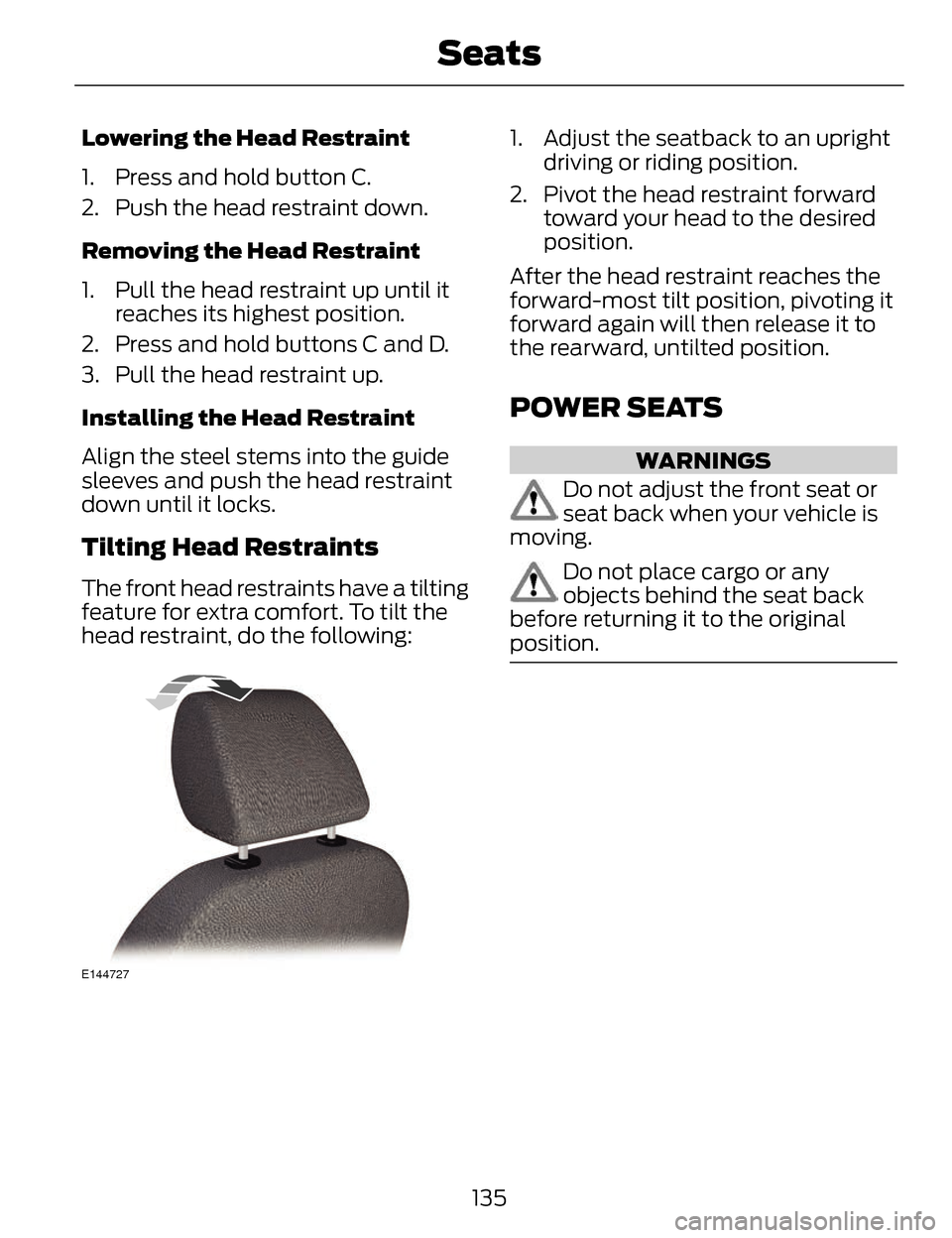
Tilting Head Restraints
The front head restraints have a tilting
feature for extra comfort. To tilt the
head restraint, do the following:
E144727
1. Adjust the seatback to an upright driving or riding position.
2. Pivot the head restraint forward toward your head to the desired
position.
After the head restraint reaches the
forward-most tilt position, pivoting it
forward again will then release it to
the rearward, untilted position.
POWER SEATS
WARNINGS
Do not adjust the front seat or
seat back when your vehicle is
moving.
Do not place cargo or any
objects behind the seat back
before returning it to the original
position.
135
Seats
Page 139 of 468
E144632
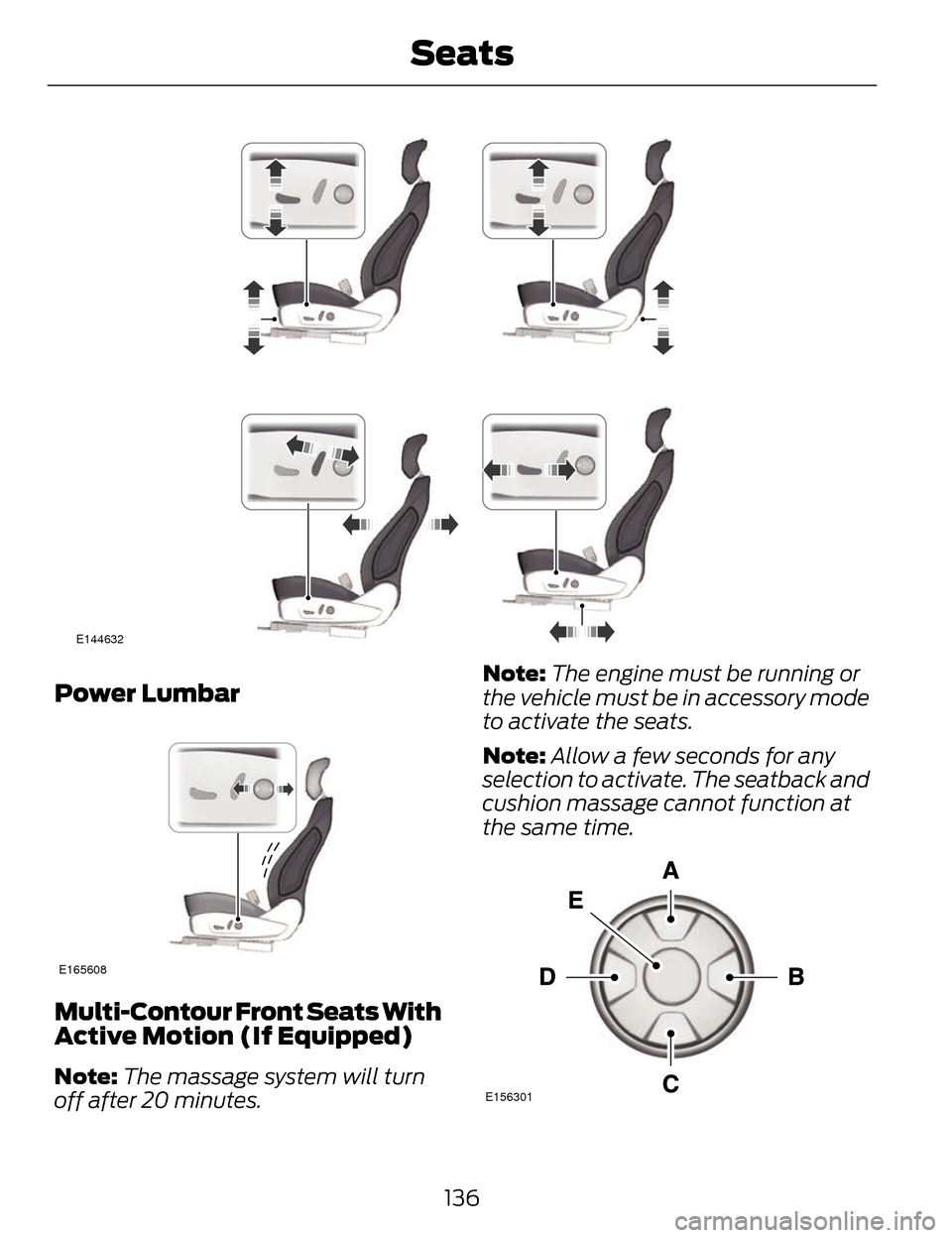
Power Lumbar
E165608
Multi-Contour Front Seats With
Active Motion (If Equipped)
Note:The massage system will turn
off after 20 minutes. Note:
The engine must be running or
the vehicle must be in accessory mode
to activate the seats.
Note: Allow a few seconds for any
selection to activate. The seatback and
cushion massage cannot function at
the same time.E156301
136
Seats
Page 143 of 468
E164098
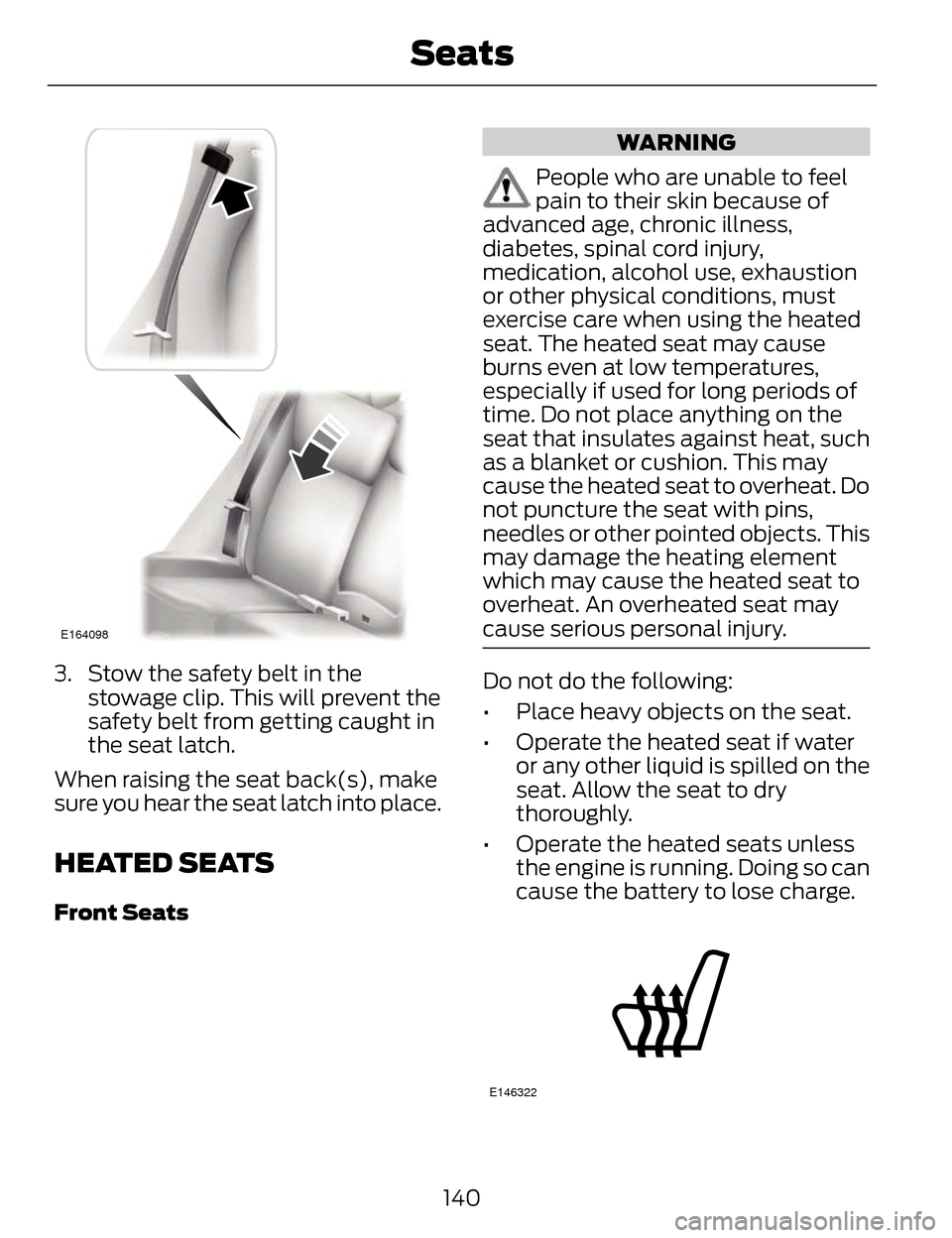
3. Stow the safety belt in thestowage clip. This will prevent the
safety belt from getting caught in
the seat latch.
When raising the seat back(s), make
sure you hear the seat latch into place.
HEATED SEATS
Front Seats
WARNING
People who are unable to feel
pain to their skin because of
advanced age, chronic illness,
diabetes, spinal cord injury,
medication, alcohol use, exhaustion
or other physical conditions, must
exercise care when using the heated
seat. The heated seat may cause
burns even at low temperatures,
especially if used for long periods of
time. Do not place anything on the
seat that insulates against heat, such
as a blanket or cushion. This may
cause the heated seat to overheat. Do
not puncture the seat with pins,
needles or other pointed objects. This
may damage the heating element
which may cause the heated seat to
overheat. An overheated seat may
cause serious personal injury.
Do not do the following:
• Place heavy objects on the seat.
• Operate the heated seat if water or any other liquid is spilled on the
seat. Allow the seat to dry
thoroughly.
• Operate the heated seats unless the engine is running. Doing so can
cause the battery to lose charge.
E146322
140
Seats
Page 188 of 468
PRINCIPLE OF OPERATION
WARNINGS
Vehicle modifications involving
braking system, aftermarket roof
racks, suspension, steering system,
tire construction and wheel and tire
size may change the handling
characteristics of the vehicle and may
adversely affect the performance of
the AdvanceTrac system. In addition,
installing any stereo loudspeakers
may interfere with and adversely
affect the AdvanceTrac system.
Install any aftermarket stereo
loudspeaker as far as possible from
the front center console, the tunnel,
and the front seats in order to
minimize the risk of interfering with
the AdvanceTrac sensors. Reducing
the effectiveness of the AdvanceTrac
system could lead to an increased risk
of loss of vehicle control, vehicle
rollover, personal injury and death.
Remember that even advanced
technology cannot defy the laws
of physics. It’s always possible to lose
control of a vehicle due to
inappropriate driver input for the
conditions. Aggressive driving on any
road condition can cause you to lose
control of your vehicle increasing the
risk of personal injury or property
damage. Activation of the
AdvanceTrac system is an indication
that at least some of the tires have
exceeded their ability to grip the road;
WARNINGS
this could reduce the operator’s ability
to control the vehicle potentially
resulting in a loss of vehicle control,
vehicle rollover, personal injury and
death. If your AdvanceTrac system
activates, SLOW DOWN.
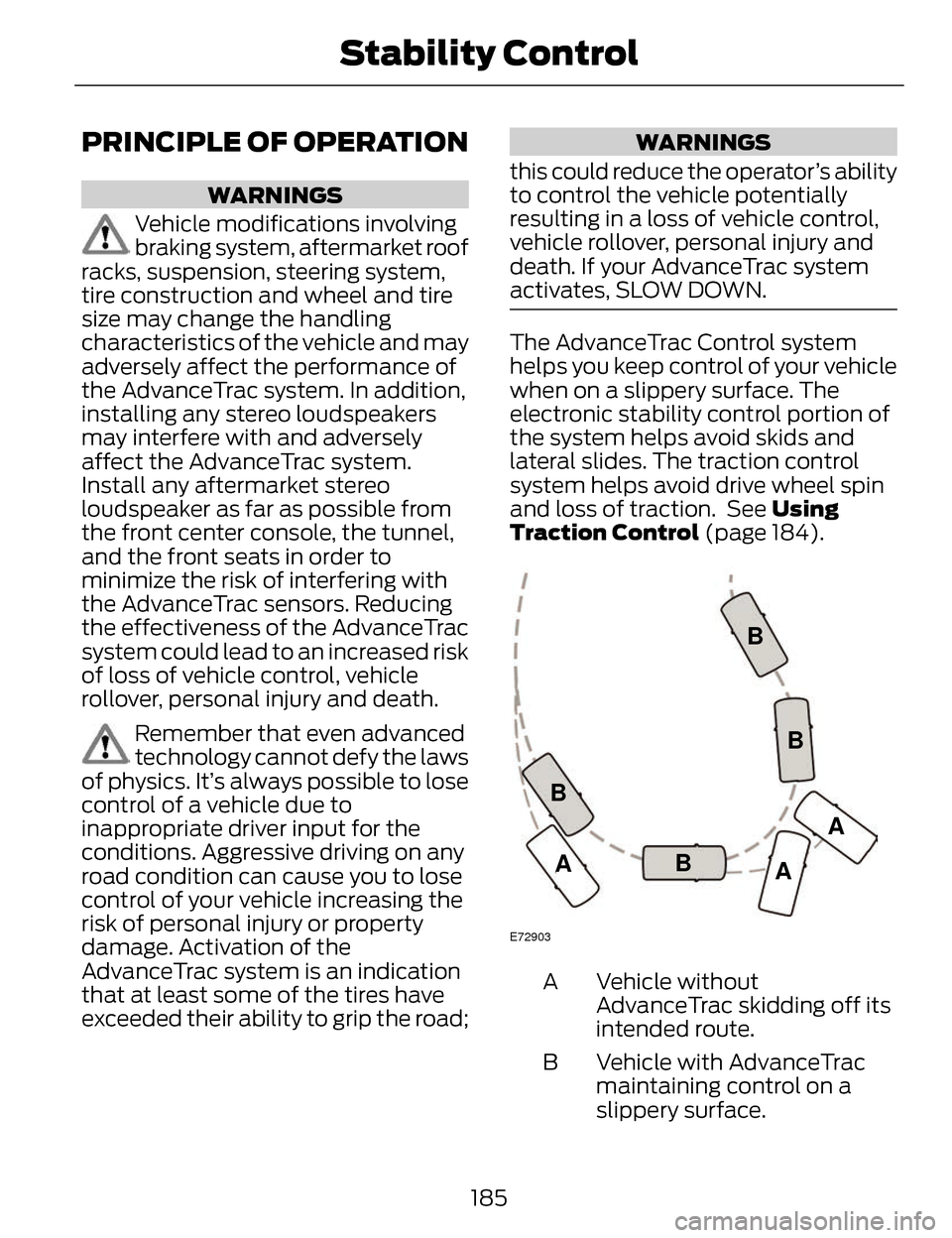
The AdvanceTrac Control system
helps you keep control of your vehicle
when on a slippery surface. The
electronic stability control portion of
the system helps avoid skids and
lateral slides. The traction control
system helps avoid drive wheel spin
and loss of traction. See Using
Traction Control (page 184).
E72903
A
AA
B
BB
B
Vehicle without
AdvanceTrac skidding off its
intended route.
A
Vehicle with AdvanceTrac
maintaining control on a
slippery surface.
B
185
Stability Control
Page 229 of 468
E142517
E143817
CARGO
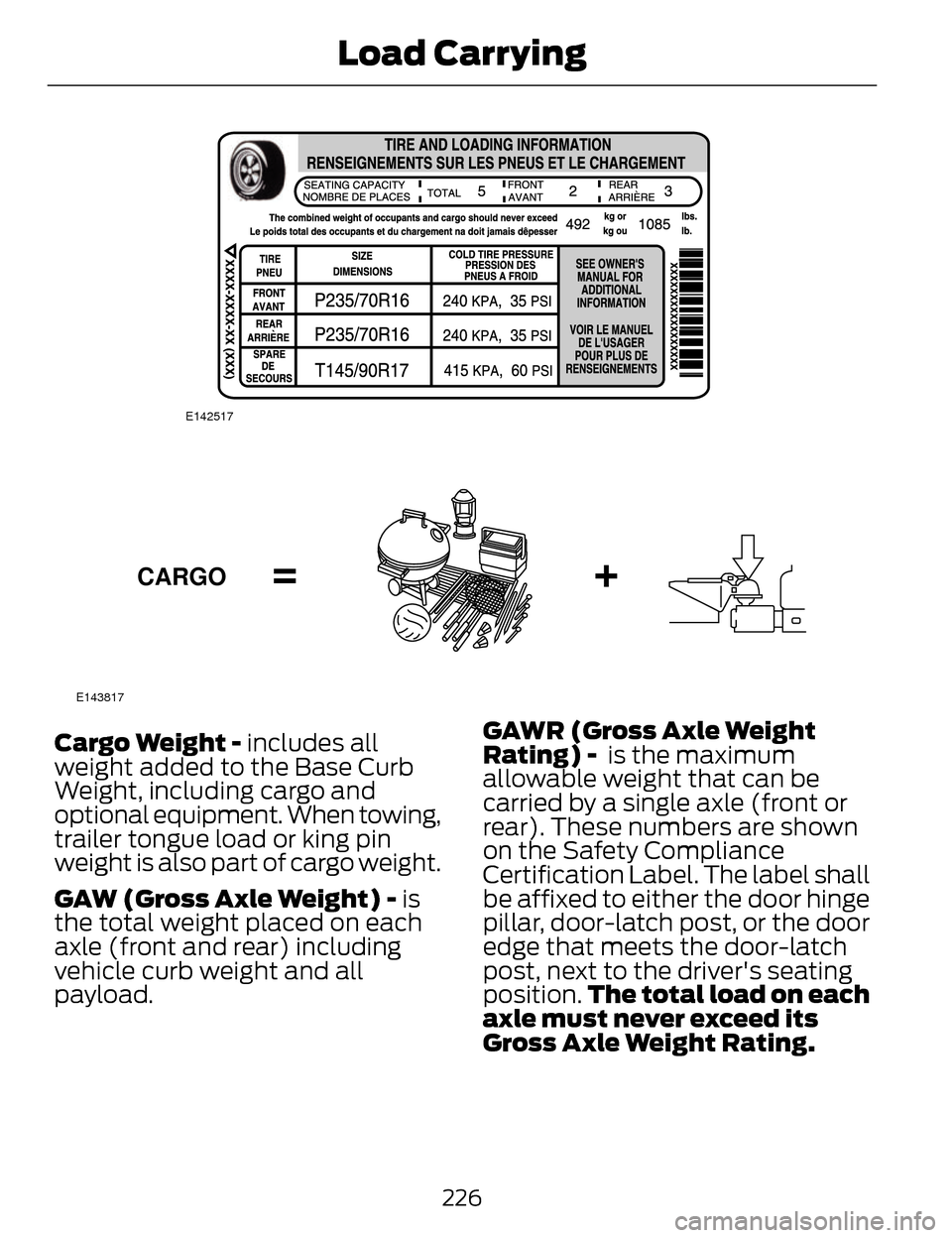
Cargo Weight - includes all
weight added to the Base Curb
Weight, including cargo and
optional equipment. When towing,
trailer tongue load or king pin
weight is also part of cargo weight.
GAW (Gross Axle Weight) - is
the total weight placed on each
axle (front and rear) including
vehicle curb weight and all
payload.GAWR (Gross Axle Weight
Rating) - is the maximum
allowable weight that can be
carried by a single axle (front or
rear). These numbers are shown
on the Safety Compliance
Certification Label. The label shall
be affixed to either the door hinge
pillar, door-latch post, or the door
edge that meets the door-latch
post, next to the driver's seating
position.
The total load on each
axle must never exceed its
Gross Axle Weight Rating.
226
Load Carrying
Page 234 of 468
metric units, the calculation would
be: 635 kilograms - (2 x 99
kilograms) - (12 x 45 kilograms) =
635 - 198 - 540 = -103 kilograms.
You will need to reduce the load
weight by at least 240 pounds
(104 kilograms). If you remove
three 100-pound (45-kilogram)
cement bags, then the load
calculation would be: 1400 - (2 x
220) - (9 x 100) = 1400 - 440 -
900 = 60 pounds. Now you have
the load capacity to transport the
cement and your friend home. In
metric units, the calculation would
be: 635 kilograms - (2 x 99
kilograms) - (9 x 45 kilograms) =
635 - 198 - 405 = 32 kilograms.
The above calculations also
assume that the loads are
positioned in your vehicle in a
manner that does not overload
the Front or the Rear Gross Axle
Weight Rating specified for your
vehicle on the Safety Compliance
Certification Label. The label shall
be affixed to either the door hinge
pillar, door-latch post, or the door
edge that meets the door-latch
post, next to the driver's seating
position.
231
Load Carrying
Page 265 of 468
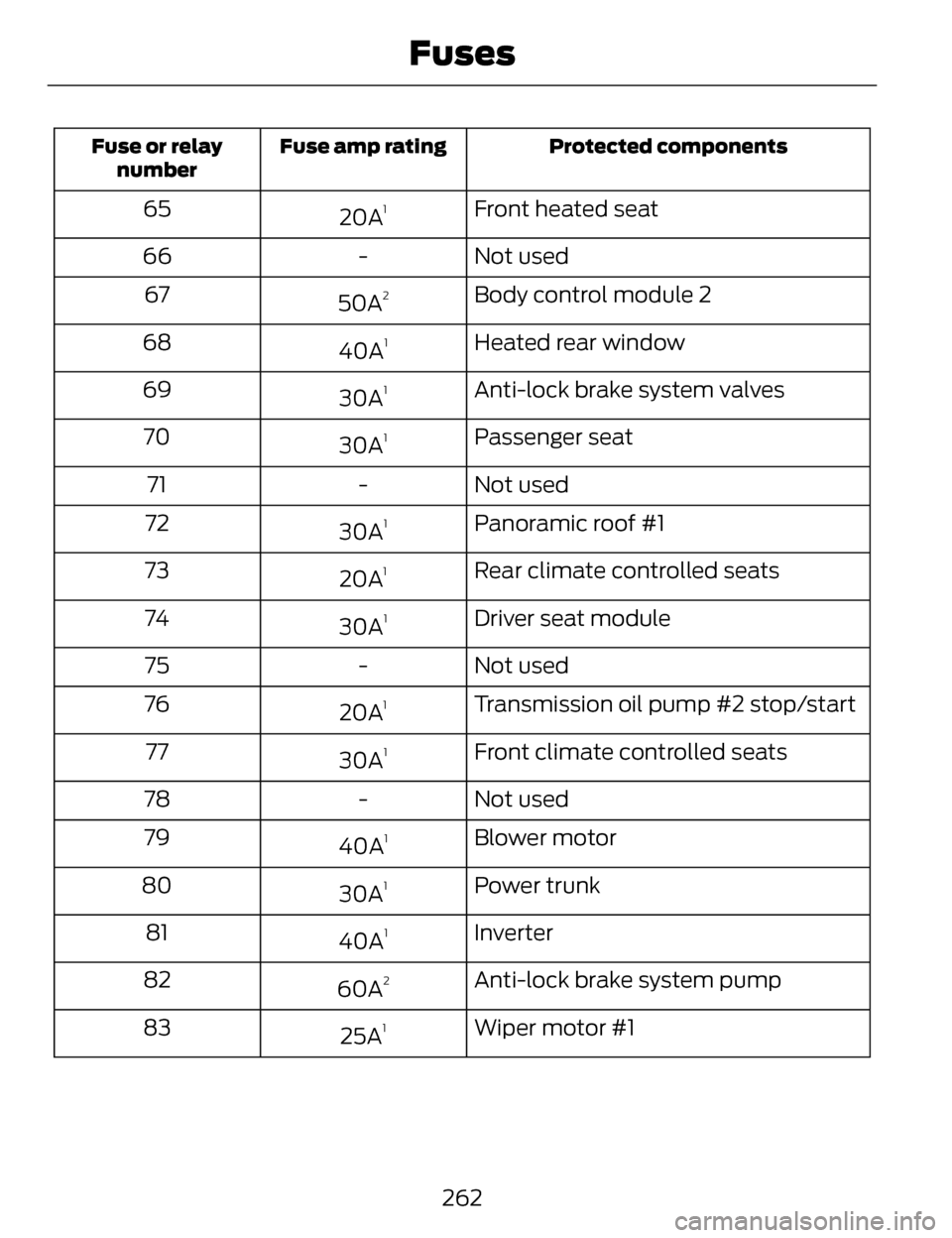
Protected components
Fuse amp rating
Fuse or relay
number
Front heated seat
20A165
Not used
-
66
Body control module 2
50A
267
Heated rear window
40A
168
Anti-lock brake system valves
30A
169
Passenger seat
30A
170
Not used
-
71
Panoramic roof #1
30A
172
Rear climate controlled seats
20A
173
Driver seat module
30A
174
Not used
-
75
Transmission oil pump #2 stop/start
20A
176
Front climate controlled seats
30A
177
Not used
-
78
Blower motor
40A
179
Power trunk
30A
180
Inverter
40A
181
Anti-lock brake system pump
60A
282
Wiper motor #1
25A
183
262
Fuses
Page 268 of 468
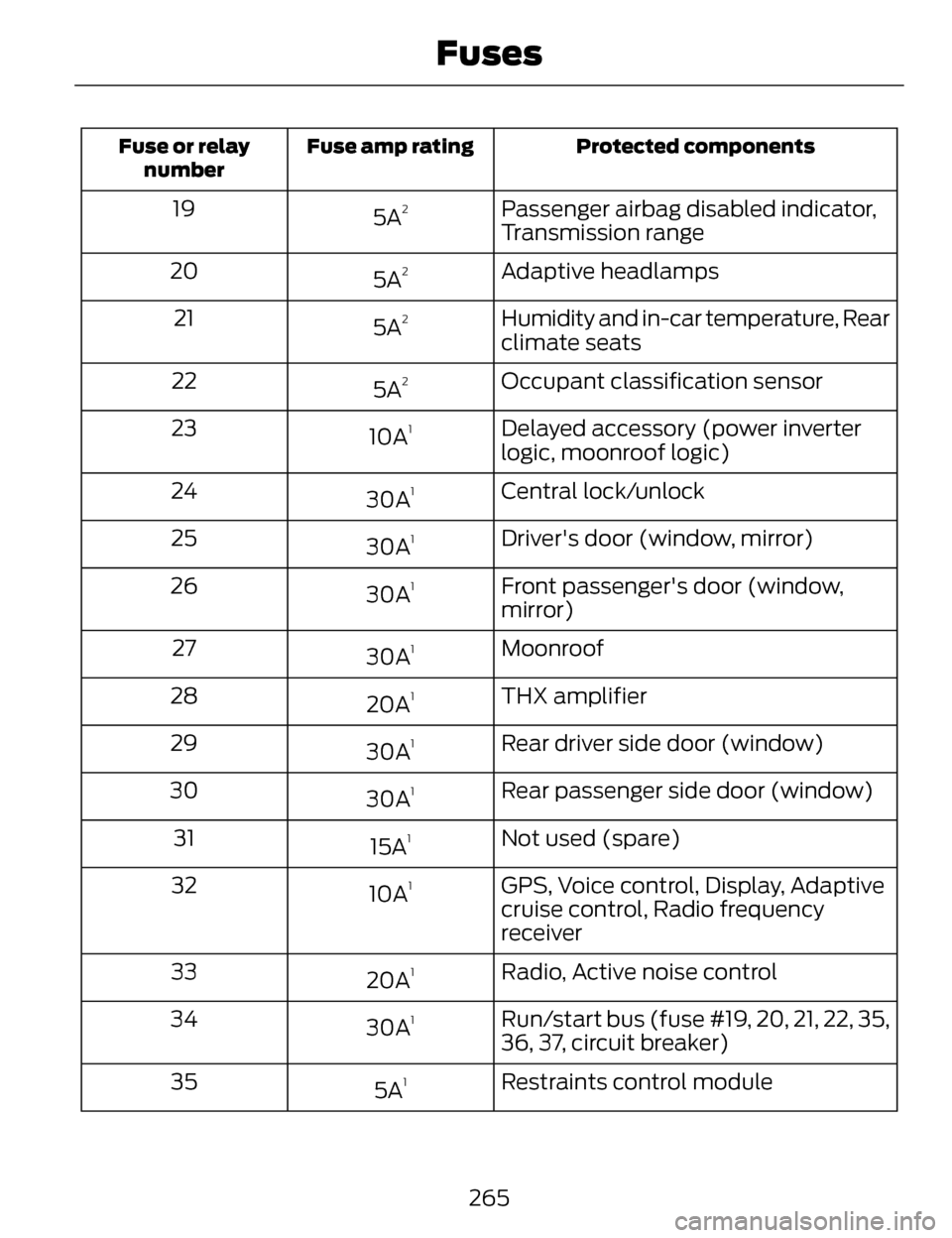
Protected components
Fuse amp rating
Fuse or relay
number
Passenger airbag disabled indicator,
Transmission range
5A219
Adaptive headlamps
5A
220
Humidity and in-car temperature, Rear
climate seats
5A
221
Occupant classification sensor
5A
222
Delayed accessory (power inverter
logic, moonroof logic)
10A
123
Central lock/unlock
30A
124
Driver's door (window, mirror)
30A
125
Front passenger's door (window,
mirror)
30A
126
Moonroof
30A
127
THX amplifier
20A
128
Rear driver side door (window)
30A
129
Rear passenger side door (window)
30A
130
Not used (spare)
15A
131
GPS, Voice control, Display, Adaptive
cruise control, Radio frequency
receiver
10A
132
Radio, Active noise control
20A
133
Run/start bus (fuse #19, 20, 21, 22, 35,
36, 37, circuit breaker)
30A
134
Restraints control module
5A
135
265
Fuses
Page 281 of 468
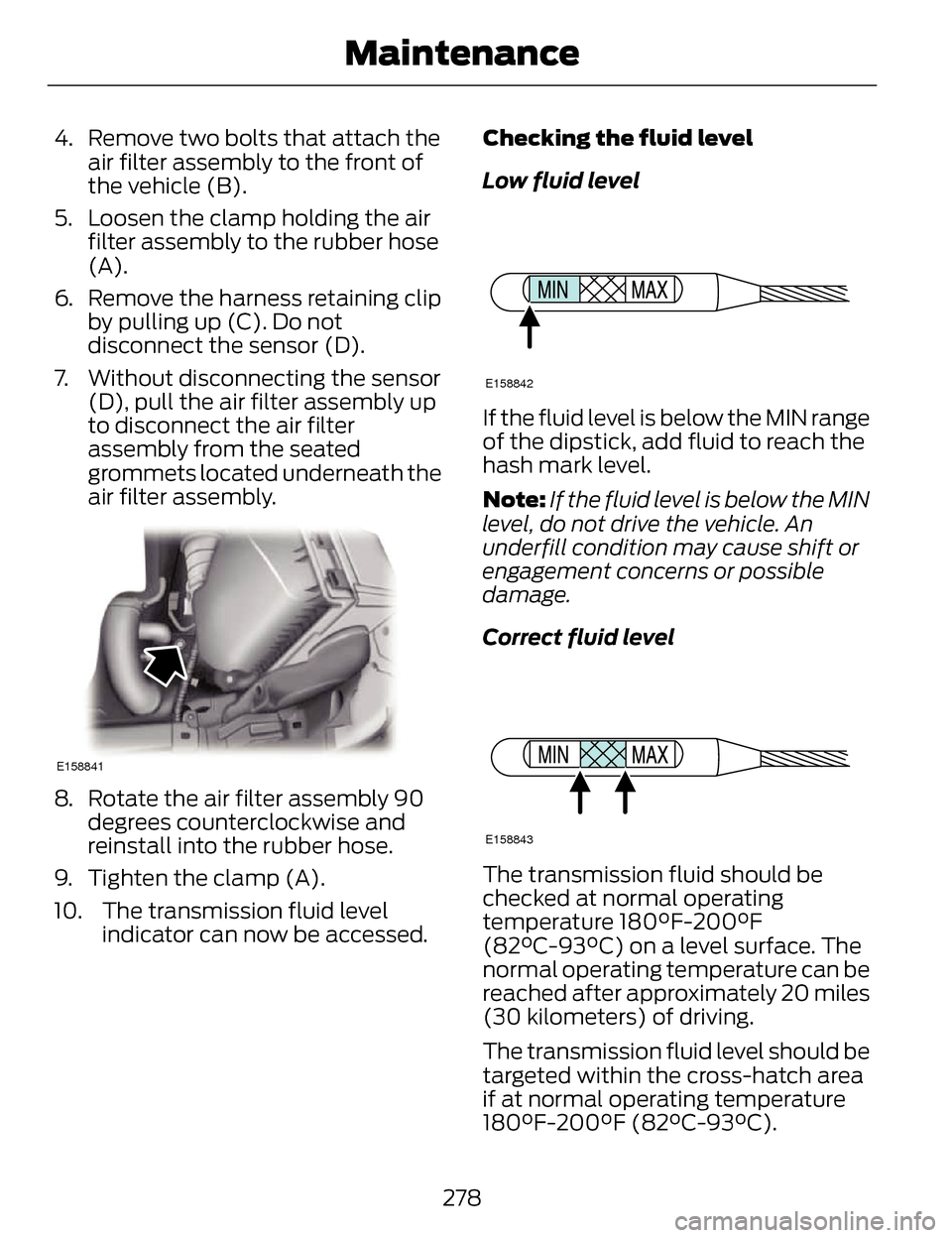
4. Remove two bolts that attach theair filter assembly to the front of
the vehicle (B).
5. Loosen the clamp holding the air filter assembly to the rubber hose
(A).
6. Remove the harness retaining clip by pulling up (C). Do not
disconnect the sensor (D).
7. Without disconnecting the sensor (D), pull the air filter assembly up
to disconnect the air filter
assembly from the seated
grommets located underneath the
air filter assembly.
E158841
8. Rotate the air filter assembly 90degrees counterclockwise and
reinstall into the rubber hose.
9. Tighten the clamp (A).
10. The transmission fluid level indicator can now be accessed. Checking the fluid level
Low fluid level
E158842
If the fluid level is below the MIN range
of the dipstick, add fluid to reach the
hash mark level.
Note:
If the fluid level is below the MIN
level, do not drive the vehicle. An
underfill condition may cause shift or
engagement concerns or possible
damage.
Correct fluid level
E158843
The transmission fluid should be
checked at normal operating
temperature 180°F-200°F
(82°C-93°C) on a level surface. The
normal operating temperature can be
reached after approximately 20 miles
(30 kilometers) of driving.
The transmission fluid level should be
targeted within the cross-hatch area
if at normal operating temperature
180°F-200°F (82°C-93°C).
278
Maintenance