front seat LINCOLN MKZ 2014 Owner's Manual
[x] Cancel search | Manufacturer: LINCOLN, Model Year: 2014, Model line: MKZ, Model: LINCOLN MKZ 2014Pages: 468, PDF Size: 4.49 MB
Page 48 of 468
certain crash and occupant
conditions, the driver’s and
passenger’s knee airbag may deploy
(individually or both) but the
corresponding front airbag may not
activate. As with front and side
airbags, it is important to be properly
seated and restrained to reduce the
risk of death or serious injury.
Make sure the knee airbags
are operating properly. See
Crash Sensors and Airbag
Indicator (page 50).
FRONT PASSENGER
SENSING SYSTEM
WARNINGS
Even with Advanced Restraints
Systems, children 12 and under
should be properly restrained in a rear
seating position. Failure to follow this
could seriously increase the risk of
injury or death.
Sitting improperly out of position
or with the seat back reclined too
far can take off weight from the seat
cushion and affect the decision of the
front passenger sensing system,
resulting in serious injury or death in a
crash. Always sit upright against your
seat back, with your feet on the floor.
Any alteration or modification to
the front passenger seat may
affect the performance of the front
passenger sensing system which
could seriously increase the risk of
injury or death.
This system works with sensors that
are part of the front passenger’s seat
and safety belt to detect the presence
of a properly-seated occupant and
determine if the front passenger’s
frontal airbag should be enabled (may
inflate) or not.
E151849
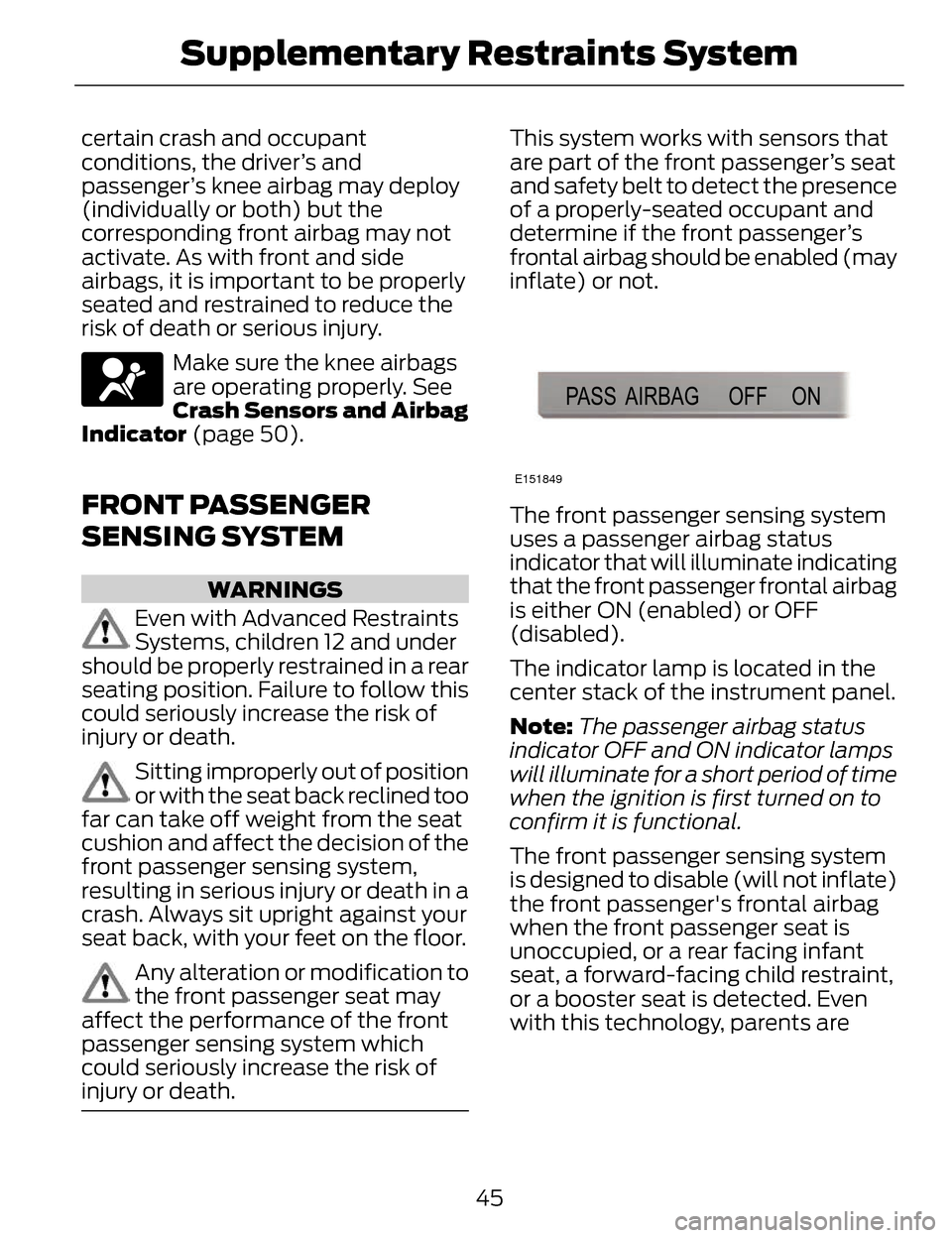
The front passenger sensing system
uses a passenger airbag status
indicator that will illuminate indicating
that the front passenger frontal airbag
is either ON (enabled) or OFF
(disabled).
The indicator lamp is located in the
center stack of the instrument panel.
Note: The passenger airbag status
indicator OFF and ON indicator lamps
will illuminate for a short period of time
when the ignition is first turned on to
confirm it is functional.
The front passenger sensing system
is designed to disable (will not inflate)
the front passenger's frontal airbag
when the front passenger seat is
unoccupied, or a rear facing infant
seat, a forward-facing child restraint,
or a booster seat is detected. Even
with this technology, parents are
45
Supplementary Restraints System
Page 49 of 468
strongly encouraged to always
properly restrain children in the rear
seat. The sensor also turns off the
passenger front airbag and
seat-mounted side airbag when the
passenger seat is empty.
• When the front passenger sensingsystem disables (will not inflate)
the front passenger frontal airbag,
the passenger airbag status
indicator will illuminate the OFF
lamp and stay lit to remind you
that the front passenger frontal
airbag is disabled.
• If the child restraint has been installed and the passenger airbag
status indicator illuminates the ON
lamp, then turn the vehicle off,
remove the child restraint from the
vehicle and reinstall the restraint
following the child restraint
manufacturer's instructions.
The front passenger sensing system
is designed to enable (may inflate)
the front passenger's frontal airbag
anytime the system senses that a
person of adult size is sitting properly
in the front passenger seat. • When the front passenger sensing
system enables the front
passenger frontal airbag (may
inflate), the passenger airbag
status indicator will illuminate the
ON lamp and remain illuminated.
If a person of adult size is sitting in the
front passenger’s seat, but the airbag
off indicator lamp is lit, it is possible
that the person isn’t sitting properly
in the seat. If this happens:
• Turn the vehicle off and ask the person to place the seat back in
the full upright position.
• Have the person sit upright in the seat, centered on the seat cushion,
with the person’s legs comfortably
extended.
• Restart the vehicle and have the person remain in this position for
about two minutes. This will allow
the system to detect that person
and enable the passenger’s frontal
airbag.
• If the indicator OFF lamp remains lit even after this, the person
should be advised to ride in the
rear seat.
Passenger airbag
Passenger airbag status
indicator
Occupant
Disabled
OFF: Lit
Empty
ON: Unlit Disabled
OFF: Lit
Child
46
Supplementary Restraints System
Page 50 of 468
Passenger airbag
Passenger airbag status
indicator
Occupant
ON: Unlit
Enabled
OFF: Unlit
Adult
ON: Lit
Note: When the passenger airbag
status indicator OFF light is illuminated,
the passenger (seat mounted) side
airbag may be disabled to avoid the
risk of airbag deployment injuries.
After all occupants have adjusted
their seats and put on safety belts, it
is very important that they continue
to sit properly. A properly seated
occupant sits upright, leaning against
the seat back, and centered on the
seat cushion, with their feet
comfortably extended on the floor.
Sitting improperly can increase the
chance of injury in a crash event. For
example, if an occupant slouches, lies
down, turns sideways, sits forward,
leans forward or sideways, or puts one
or both feet up, the chance of injury
during a crash is greatly increased.
The conditions listed above may
cause the weight of a properly seated
occupant to be incorrectly interpreted
by the front passenger sensing
system. The person in the front
passenger seat may appear heavier
or lighter due to the conditions
described in the list above.
To know if the front
passenger sensing system is
operating properly, See
Crash Sensors and Airbag
Indicator (page 50). Do not attempt to repair or service the
system. Take your vehicle
immediately to an authorized dealer.
If it is necessary to modify an
advanced front airbag system to
accommodate a person with
disabilities, contact the Ford
Customer Relationship Center. See
Getting the Services You Need
(page 248).
SIDE AIRBAGS
WARNINGS
Do not place objects or mount
equipment on or near the airbag
cover, on the side of the seatbacks (of
the front seats), or in front seat areas
that may come into contact with a
deploying airbag. Failure to follow
these instructions may increase the
risk of personal injury in the event of
a crash.
Do not use accessory seat
covers. The use of accessory
seat covers may prev ent the
deployment of the side airbags and
increase the risk of injury in an
accident.
47
Supplementary Restraints System
Page 51 of 468
WARNINGS
Do not lean your head on the
door. The side airbag could injure
you as it deploys from the side of the
seatback.
Do not attempt to service, repair,
or modify the airbag, its fuses or
the seat cover on a seat containing an
airbag as you could be seriously
injured or killed. Contact your
authorized dealer as soon as possible.
If the side airbag has deployed,
the airbag will not function again.
The side airbag system (including the
seat) must be inspected and serviced
by an authorized dealer. If the airbag
is not replaced, the unrepaired area
will increase the risk of injury in a
crash.
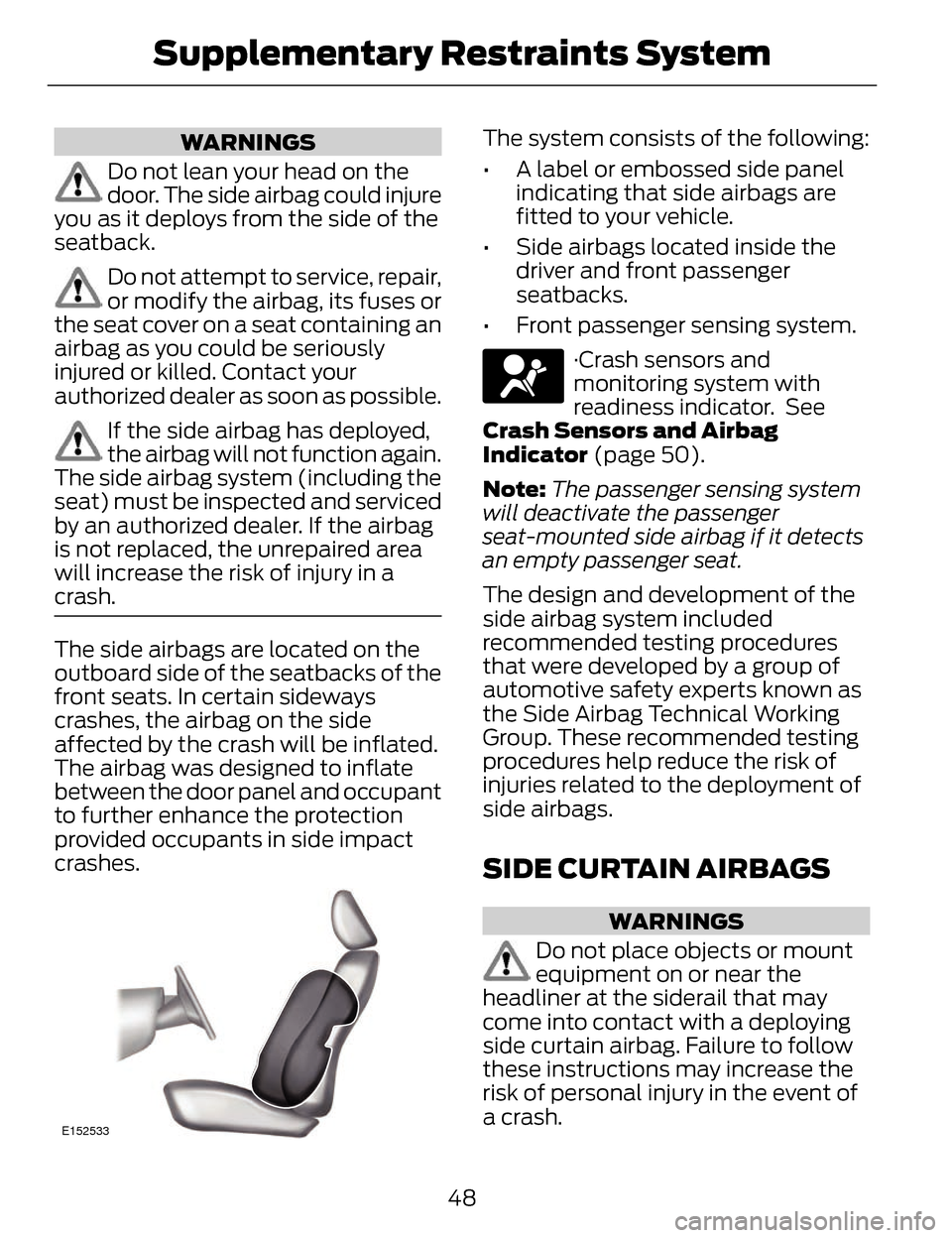
The side airbags are located on the
outboard side of the seatbacks of the
front seats. In certain sideways
crashes, the airbag on the side
affected by the crash will be inflated.
The airbag was designed to inflate
between the door panel and occupant
to further enhance the protection
provided occupants in side impact
crashes.
E152533
The system consists of the following:
• A label or embossed side panel indicating that side airbags are
fitted to your vehicle.
• Side airbags located inside the driver and front passenger
seatbacks.
• Front passenger sensing system.
·Crash sensors and
monitoring system with
readiness indicator. See
Crash Sensors and Airbag
Indicator (page 50).
Note: The passenger sensing system
will deactivate the passenger
seat-mounted side airbag if it detects
an empty passenger seat.
The design and development of the
side airbag system included
recommended testing procedures
that were developed by a group of
automotive safety experts known as
the Side Airbag Technical Working
Group. These recommended testing
procedures help reduce the risk of
injuries related to the deployment of
side airbags.
SIDE CURTAIN AIRBAGS
WARNINGS
Do not place objects or mount
equipment on or near the
headliner at the siderail that may
come into contact with a deploying
side curtain airbag. Failure to follow
these instructions may increase the
risk of personal injury in the event of
a crash.
48
Supplementary Restraints System
Page 52 of 468
WARNINGS
Do not lean your head on the
door. The side curtain airbag
could injure you as it deploys from the
headliner.
Do not attempt to service, repair,
or modify the side curtain
airbags, its fuses, the A, B, or C pillar
trim, or the headliner on a vehicle
containing side curtain airbags.
Contact your authorized dealer as
soon as possible.
All occupants of the vehicle
including the driver should
always wear their safety belts even
when an airbag supplemental
restraint system and side curtain
airbag is provided.
To reduce risk of injury, do not
obstruct or place objects in the
deployment path of the side curtain
airbag.
If the side curtain airbags have
deployed, the side curtain
airbags will not function again. The
side curtain airbags (including the A,
B and C pillar trim and headliner)
must be inspected and serviced by an
authorized dealer. If the side curtain
airbag is not replaced, the unrepaired
area will increase the risk of injury in a
crash.
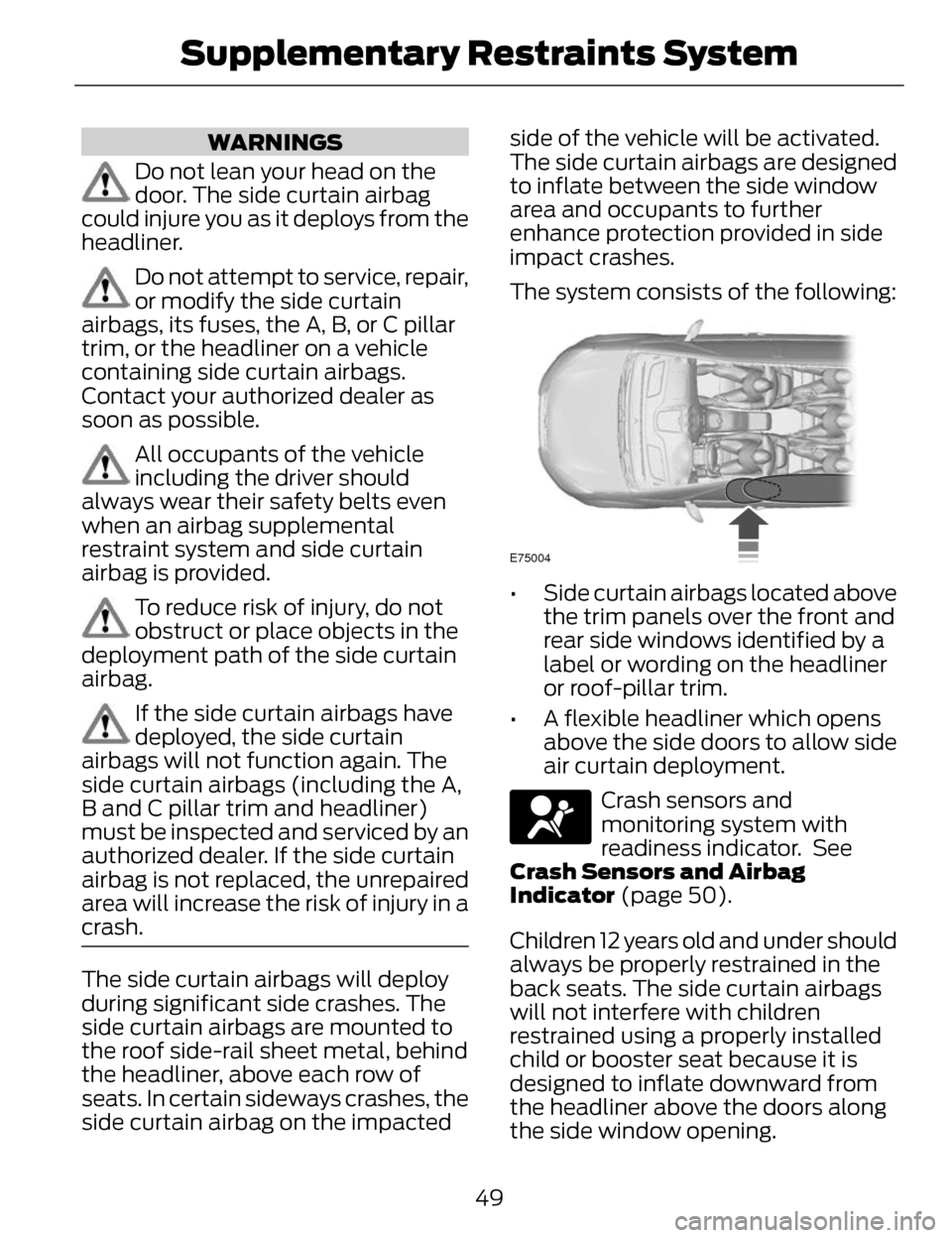
The side curtain airbags will deploy
during significant side crashes. The
side curtain airbags are mounted to
the roof side-rail sheet metal, behind
the headliner, above each row of
seats. In certain sideways crashes, the
side curtain airbag on the impacted side of the vehicle will be activated.
The side curtain airbags are designed
to inflate between the side window
area and occupants to further
enhance protection provided in side
impact crashes.
The system consists of the following:
E75004
• Side curtain airbags located above
the trim panels over the front and
rear side windows identified by a
label or wording on the headliner
or roof-pillar trim.
• A flexible headliner which opens above the side doors to allow side
air curtain deployment.
Crash sensors and
monitoring system with
readiness indicator. See
Crash Sensors and Airbag
Indicator (page 50).
Children 12 years old and under should
always be properly restrained in the
back seats. The side curtain airbags
will not interfere with children
restrained using a properly installed
child or booster seat because it is
designed to inflate downward from
the headliner above the doors along
the side window opening.
49
Supplementary Restraints System
Page 53 of 468
The design and development of the
side curtain airbags included
recommended testing procedures
that were developed by a group of
automotive safety experts known as
the Side Airbag Technical Working
Group. These recommended testing
procedures help reduce the risk of
injuries related to the deployment of
side curtain airbags.
CRASH SENSORS AND
AIRBAG INDICATOR
WARNING
Modifying or adding equipment
to the front end of the vehicle
(including frame, bumper, front end
body structure and tow hooks) may
affect the performance of the airbag
system, increasing the risk of injury.
Do not modify the front end of the
vehicle.
The vehicle has a collection of crash
and occupant sensors which provide
information to the restraints control
module which deploys (activates) the
front safety belt pretensioners, driver
airbag, passenger airbag, knee
airbag(s), seat mounted side airbags,
side curtain airbags and optional rear
inflatable safety belts. Based on the
type of crash (frontal impact or side
impact), the restraints control module
will deploy the appropriate safety
devices. The restraints control module also
monitors the readiness of the above
safety devices plus the crash and
occupant sensors. The readiness of
the safety system is indicated by a
warning indicator light in the
instrument cluster or by a backup tone
if the warning light is not working.
Routine maintenance of the airbag is
not required.
A difficulty with the system is
indicated by one or more of the
following:
The readiness light will not
illuminate immediately after
the ignition is turned on.
• The readiness light will either flash or stay lit.
• A series of five beeps will be heard. The tone pattern will repeat
periodically until the problem, the
light or both are repaired.
If any of these things happen, even
intermittently, have the supplemental
restraint system serviced at an
authorized dealer immediately. Unless
serviced, the system may not function
properly in the event of a crash.
The safety belt pretensioners and the
front airbag supplemental restraint
system are designed to activate when
the vehicle sustains frontal
deceleration sufficient to cause the
restraints control module to deploy a
safety device.
50
Supplementary Restraints System
Page 54 of 468

The fact that the safety belt
pretensioners or front airbags did not
activate for both front seat occupants
in a crash does not mean that
something is wrong with the system.
Rather, it means the restraints control
module determined the accident
conditions (crash severity, belt usage)
were not appropriate to activate these
safety devices.
• The design of the front airbags isto activate only in frontal and
near-frontal crashes (not rollovers,
side impacts or rear impacts)
unless the crash causes sufficient
frontal deceleration.
• The safety belt pretensioners and optional rear inflatable safety belts
are designed to activate in frontal,
near-frontal and side crashes.
• The knee airbag(s) may deploy based on crash severity and
occupant conditions.
• The design of the side airbags and side curtain airbags is to inflate in
certain side impact crashes. Side
airbags and side curtain airbags
may activate in other types of
crashes if the vehicle experiences
sufficient sideways motion or
deformation.
AIRBAG DISPOSAL
Contact your authorized dealer as
soon as possible. Airbags must be
disposed of by qualified personnel.
51
Supplementary Restraints System
Page 60 of 468
PRINCIPLE OF OPERATION
MyKey allows you to program keys
with restricted driving modes to
promote good driving habits. All but
one of the keys programmed to the
vehicle can be activated with these
restricted modes.
Any keys that have not been
programmed are referred to as
administrator keys or admin keys.
These can be used to:
• create a MyKey
• program configurable MyKeysettings
• clear all MyKey features.
When you have programmed a MyKey,
you can access the following
information using the information
display:
• How many admin keys and MyKeys are programmed to your vehicle.
• The total distance your vehicle has traveled using a MyKey.
Note: All MyKeys are programmed to
the same settings. You cannot program
them individually.
Note: For vehicles with intelligent
access with push-button start, when
both a MyKey and an admin intelligent
access key fob are present, the admin
fob will be recognized by the vehicle
while switching the ignition on to start
the vehicle.
Non-configurabl e Settings
The following settings cannot be
changed by an admin key user: • Belt-Minder. You cannot disable
this feature. The audio system will
mute when the front seat
occupants’ safety belts are not
fastened.
• Early low fuel. The low-fuel warning activates earlier, giving the
MyKey user more time to refuel.
• Driver assist features, if equipped on your vehicle, are forced on:
parking aid, blind spot information
system (BLIS) with cross traffic
alert, lane departure warning and
forward collision warning system.
Configurabl e Settings
With an admin key, you can configure
certain MyKey settings when you first
create a MyKey and before you recycle
the key or restart the vehicle. You can
also change the settings afterward
with an admin key.
• A vehicle speed limit can be set.
Warnings will be shown in the
display followed by an audible
tone when your vehicle reaches the
set speed. You cannot override the
set speed by fully depressing the
accelerator pedal or by setting
cruise control.
• Vehicle speed minders of 45, 55 or 65 mph (75, 90 or 105 km/h).
Once you select a speed, it will be
shown in the display, followed by
an audible tone when the
preselected vehicle speed is
exceeded.
57
MyKey™
Page 110 of 468
Action
Message
Displayed when the automatic braking has been
disabled.
Normal Cruise Active
Automatic Braking Turned Off
Displayed when a radar malfunction is preventing theACC from engaging.
Front Sensor Not
Aligned
Displayed when the adaptive cruise has reinstatedcontrols to the driver.
Adaptive Cruise -
Driver Resume Control
Displays when the vehicle speed is too slow to activate the adaptive cruise.
Adaptive Cruise
Speed Too Low to Activate
Displays when the adaptive cruise is automatically
adjusting the gap distance and the driver needs to shift the transmission into a lower gear.
Adaptive Cruise Shift
Down
AdvanceTrac™
Action
Message
Displays when the system detects a malfunction due
to a blocked sensor.
Service AdvanceTrac
Displayed when the traction control has been disabledor enabled by the driver.
AdvanceTrac Off On
Airbag
Action
Message
Displays when the system detects a malfunction due
to a blocked sensor.
Occupant Sensor
BLOCKED Remove Objects Near
Passenger Seat
107
Information Displays
Page 132 of 468
A/C: Press the button to turn on or turn off the air conditioning system.
To improve air conditioning when starting your vehicle, drive with the
windows slightly open for two to three minutes. Use A/C with
recirculated air to improve cooling performance and efficiency.
F
MAX A/C: Press the button to switch on. Recirculated air flows through
the instrument panel air vents, air conditioning automatically adjusts
to the highest speed and the temperature dial returns to the full cool
position. This re-cooling of the interior is more economical and efficient.
G
AUTO: Press the button to switch on. Recirculated air flows through
the instrument panel air vents, air conditioning automatically adjusts
to the highest speed and the temperature dial returns to the full cool
position. This re-cooling of the interior is more economical and efficient.
H
Heated rear window: Turns the heated rear window on and off. See
Heated Windows and Mirrors (page 130).
I
Defrost: Distributes air through the windshield defroster vents and
de-mister vents. You can also use this setting to defog and clear the
windshield of a thin covering of ice.
J
HINTS ON CONTROLLING
THE INTERIOR CLIMATE
General Hints
Note:
Prolonged use of recirculated
air may cause the windows to fog up.
Note: You may feel a small amount of
air from the footwell air vents
regardless of the air distribution setting.
Note: To reduce humidity build-up
inside your vehicle, do not drive with
the system switched off or with
recirculated air always switched on.
Note: Do not place objects under the
front seats as this may interfere with
the airflow to the rear seats. Note:
Remove any snow, ice or leaves
from the air intake area at the base of
the windshield.
Automatic Climate Control
Note: Do not adjust the settings when
your vehicle interior is extremely hot or
cold. The system automatically adjusts
to the previously stored settings. For
the system to function efficiently, the
instrument panel and side air vents
should be fully open.
Note: At low ambient temperatures
with AUTO selected, the system directs
air toward the windshield and side
windows for as long as the engine
remains cold.
Note: When you switch the system off,
outside air cannot enter your vehicle.
129
Climate Control