key LINCOLN MKZ HYBRID 2013 Service Manual
[x] Cancel search | Manufacturer: LINCOLN, Model Year: 2013, Model line: MKZ HYBRID, Model: LINCOLN MKZ HYBRID 2013Pages: 475, PDF Size: 3.89 MB
Page 164 of 475
The keyless starting system has three
modes:
•
Off: Turns the ignition off.
• Without applying the brake
pedal, press and release the
button once when the ignition
is in the on mode, or when the
engine is running but the
vehicle is not moving.
• On:
All electrical circuits are
operational and the warning lamps
and indicators illuminate.
• Without applying the brake
pedal, press and release the
button once.
• Start:
Starts the vehicle. The
engine may not start when the
vehicle starts.
• Press the brake pedal, and then
press the button for any length
of time. An indicator light on the
button illuminates when then
ignition is on and when the
engine starts.
STARTING A GASOLINE
ENGINE
When the engine starts for the first
time on your drive, the idle speed
increases, this helps to warm up the
engine. If the engine idle speed does
not slow down automatically, have
your vehicle checked by an authorized
dealer. Before starting the vehicle, check the
following:
•
Make sure all occupants have
fastened their safety belts.
• Make sure the headlamps and
electrical accessories are off.
• Make sure the parking brake is on.
• Put the transmission in
P .
Note: Do not touch the accelerator
pedal.
1. Fully press the brake pedal.
2. Press the button.
Note: The green ready indicator
illuminates letting you know that the
vehicle is ready for driving. Since your
vehicle is equipped with a silent key
start, the engine may not start at the
time of the vehicle start. See
Hybrid
Electric Vehicle (page 166).
The system does not function if:
• The key frequencies are jammed.
• The key battery has no charge.
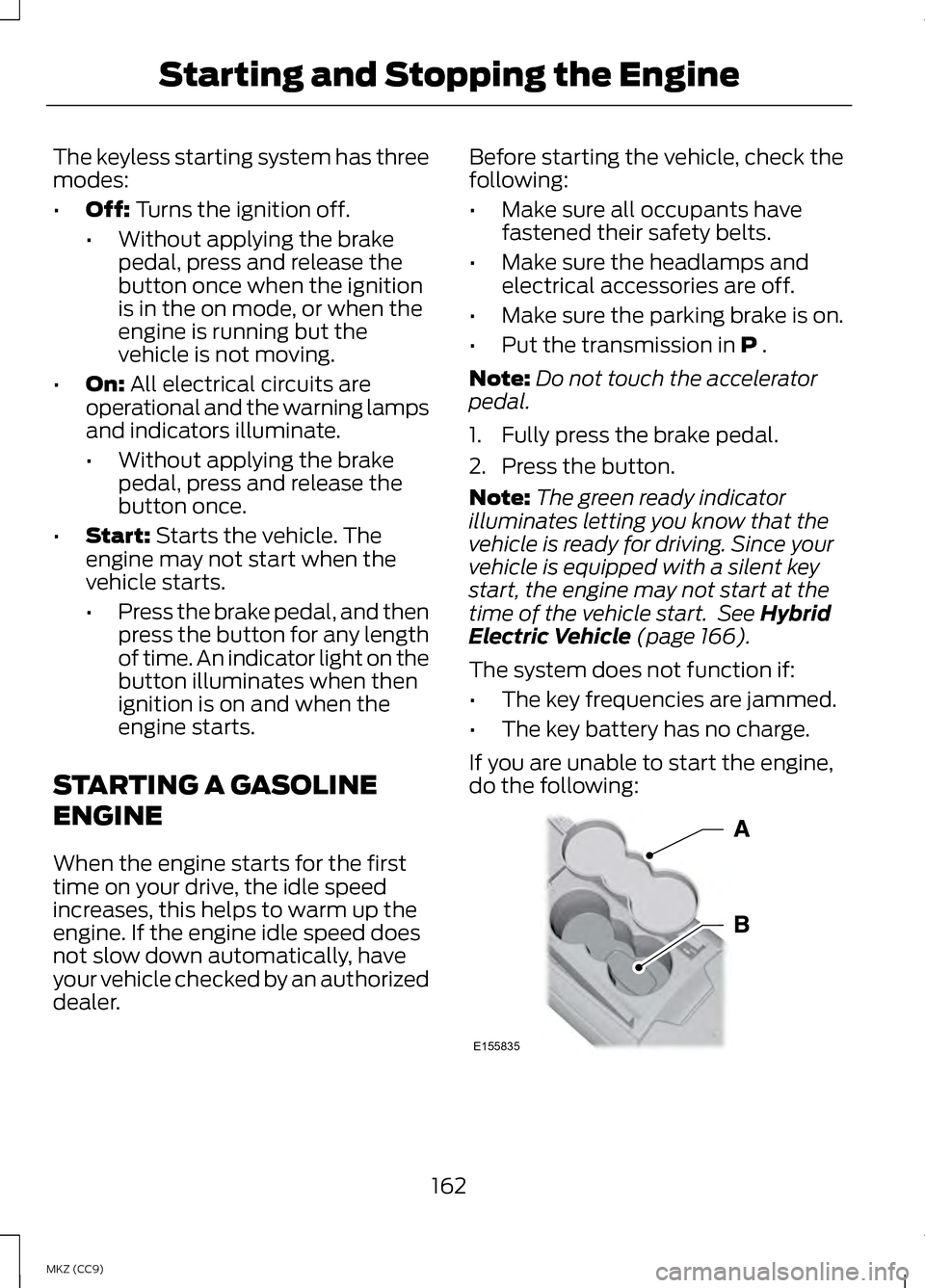
If you are unable to start the engine,
do the following: 162
MKZ (CC9) Starting and Stopping the EngineE155835
Page 165 of 475
1.
Remove the rubber covering (A) in
the cupholder. Place the remote in
the backup slot (B) at the bottom
of the cupholder.
2. With the key in this position, press
the brake pedal, then the START
button to switch the ignition on
and start your vehicle.
Fast Restart
The fast restart feature allows you to
restart the engine within 20 seconds
of switching it off, even if a valid key
is not present.
Within 20 seconds of switching the
engine off, press the brake pedal and
press the button. After 20 seconds
have expired, you can no longer restart
the vehicle without the key present
inside your vehicle.
Once the vehicle has started, it
remains running until you press the
button, even if the system does not
detect a valid key. If you open and
close a door while the vehicle is
running, the system searches for a
valid key. You cannot restart the
engine if the system does not detect
a valid key within 20 seconds.
Switching Off the Vehicle
When It Is Stationary
1. Put the transmission in position P.
2. Press the button once.
3. Apply the parking brake.
Note: This switches off the ignition, all
electrical circuits, warning lamps and
indicators. Note:
If the engine is idling for 30
minutes, the ignition and engine
automatically shut down.
Switching Off the Vehicle
When It Is Moving WARNING
Switching off the engine when
the vehicle is still moving will
result in a loss of brake and steering
assistance. The steering will not lock,
but higher effort will be required.
When the ignition is switched off,
some electrical circuits, warning
lamps and indicators may also be off. 1.
Put the transmission in position N
and use the brakes to bring your
vehicle to a safe stop.
2. When your vehicle has stopped, put the transmission in position P.
3. Press and hold the button for one second, or press it three times
within two seconds.
4. Apply the parking brake.
Guarding Against Exhaust
Fumes WARNING
If you smell exhaust fumes inside
your vehicle, have your vehicle
checked by your authorized dealer
immediately. Do not drive your vehicle
if you smell exhaust fumes. Carbon
monoxide is present in exhaust fumes.
Take precautions to avoid its
dangerous effects. 163
MKZ (CC9) Starting and Stopping the Engine
Page 168 of 475
HYBRID ELECTRIC VEHICLE
This hybrid vehicle combines electric
and gasoline propulsion to provide
performance and efficiency. It requires
no special fuels and you never have
to plug it in.
Note:
You may notice higher engine
speeds upon start-up. This temporary
condition is normal and necessary to
heat up the cabin and minimize
emissions. Starting: Switch the ignition
on while your transmission
selector is in position P. The
green ready indicator light will appear
in the instrument cluster, letting you
know that the vehicle is ready for
driving.
The engine may not start because this
vehicle is equipped with silent key
start. This fuel saving feature allows
your vehicle to be ready to drive
without requiring the gas engine to be
running. This indicator will remain on
while the vehicle is on, whether the
engine is running or not to indicate the
vehicle is capable of movement (using
its electric motor, engine, or both).
Typically, the engine will not start
unless the vehicle is cold, you make a
climate control change, or you press
the accelerator. Driving:
The gas engine
automatically starts and stops to
provide power when needed and to
save fuel when not needed. While
coasting at low speeds, coming to a
stop, or standing, the gas engine
normally shuts down and the vehicle
operates in electric-only mode.
Conditions that may cause the engine
to start up or remain running include:
• Considerable vehicle acceleration
• Vehicle speed above 85 mph (137
km/h) However, the maximum
speed for electric –only operation
may be lower while driving in hot
temperatures or on hilly terrain.
• Ascending a hill
• Charge level of high voltage
battery is low
• Very high or low outside
temperature (to provide system
cooling or heating)
• Engine not warm enough to
provide passenger requested cabin
temperature.
Stopping:
The gas engine may shut
off to conserve fuel as you come to a
stop. Restarting the vehicle is not
required. Simply step on the
accelerator when you are ready to
drive.
Transmission Operation: Due to the
technologically advanced,
electronically-controlled continuously
variable transaxle, you will not feel
shift changes like those of a
non-hybrid vehicle.
166
MKZ (CC9) Unique Driving CharacteristicsE144692
Page 170 of 475
During certain events (such as vehicle
servicing) your low voltage 12-volt
battery may become disconnected or
disabled. Once the battery is
reconnected and after driving the
vehicle, the engine may continue to
operate for three to five seconds after
the key is turned to off. This is a
normal condition.
Braking: Your hybrid is equipped with
standard hydraulic braking and
regenerative braking. Regenerative
braking is performed by your
transmission and it captures brake
energy and stores it in your high
voltage battery.
Driving to optimize fuel economy
Note:
Having your engine running is
not always an indication of inefficiency.
In some cases, it is actually more
efficient than driving in electric mode.
Your fuel economy should improve
throughout your hybrid's break-in
period. As with any vehicle, your
driving habits and accessory usage
can significantly impact your fuel
economy. For best results, keep in
mind these tips: •
Keep the tires properly inflated and
only use the recommended size.
• Aggressive driving increases the
amount of energy required to move
your vehicle. In general, you can
achieve better fuel economy with
mild to moderate acceleration and
deceleration. Moderate braking is
particularly important since it
allows you to maximize the energy
captured by the regenerative
braking system.
Additional Tips:
• Do not carry extra loads.
• Be mindful of adding external
accessories that may increase
aerodynamic drag.
• Observe posted speed limits.
• Perform all scheduled
maintenance.
• There is no need to wait for your
engine to warm up. The vehicle is
ready to drive immediately after
starting.
EV+ Mode
Your vehicle will recognize your
frequent destinations and allow for
more EV driving as you approach
them. For example, when nearing your
home it should be easier to stay in
electric mode. The EV indicator will
display EV+ when this mode is active.
You should see this about 1/8 mile
(200 meters) from a frequent
destination. See Information
Displays (page 103).
168
MKZ (CC9) Unique Driving Characteristics
Page 171 of 475
Note:
Frequent destinations are
learned by your vehicle after two to
four weeks of use. You can clear these
destinations with a Driving History reset
through the Settings menu. Note:
The EV+ feature can be turned
on or off through the Driver Assist
section of the Settings menu.
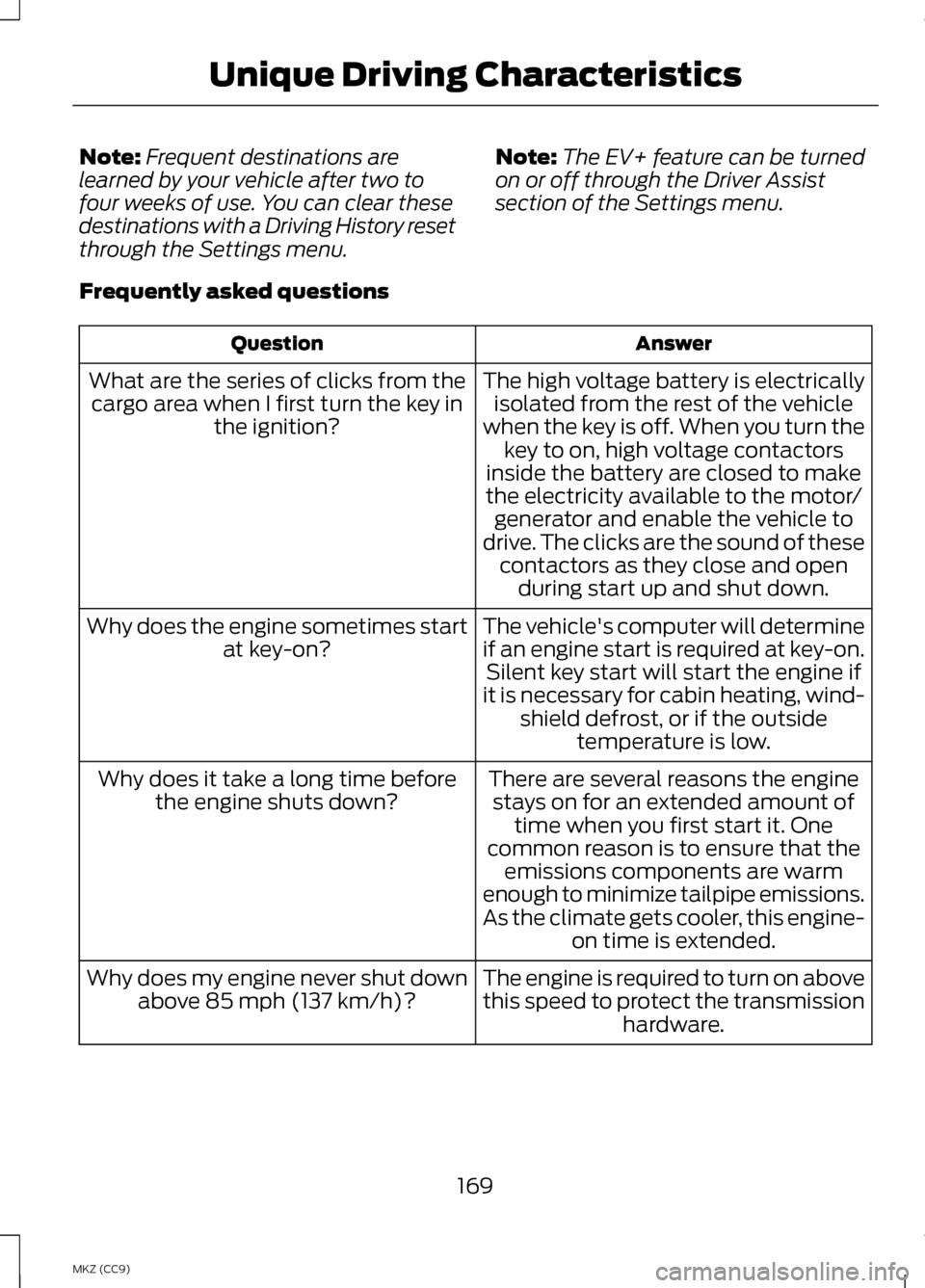
Frequently asked questions Answer
Question
The high voltage battery is electricallyisolated from the rest of the vehicle
when the key is off. When you turn the key to on, high voltage contactors
inside the battery are closed to make
the electricity available to the motor/ generator and enable the vehicle to
drive. The clicks are the sound of these contactors as they close and open during start up and shut down.
What are the series of clicks from the
cargo area when I first turn the key in the ignition?
The vehicle's computer will determine
if an engine start is required at key-on.Silent key start will start the engine if
it is necessary for cabin heating, wind- shield defrost, or if the outside temperature is low.
Why does the engine sometimes start
at key-on?
There are several reasons the enginestays on for an extended amount of time when you first start it. One
common reason is to ensure that the emissions components are warm
enough to minimize tailpipe emissions.
As the climate gets cooler, this engine- on time is extended.
Why does it take a long time before
the engine shuts down?
The engine is required to turn on above
this speed to protect the transmissionhardware.
Why does my engine never shut down
above 85 mph (137 km/h)?
169
MKZ (CC9) Unique Driving Characteristics
Page 176 of 475
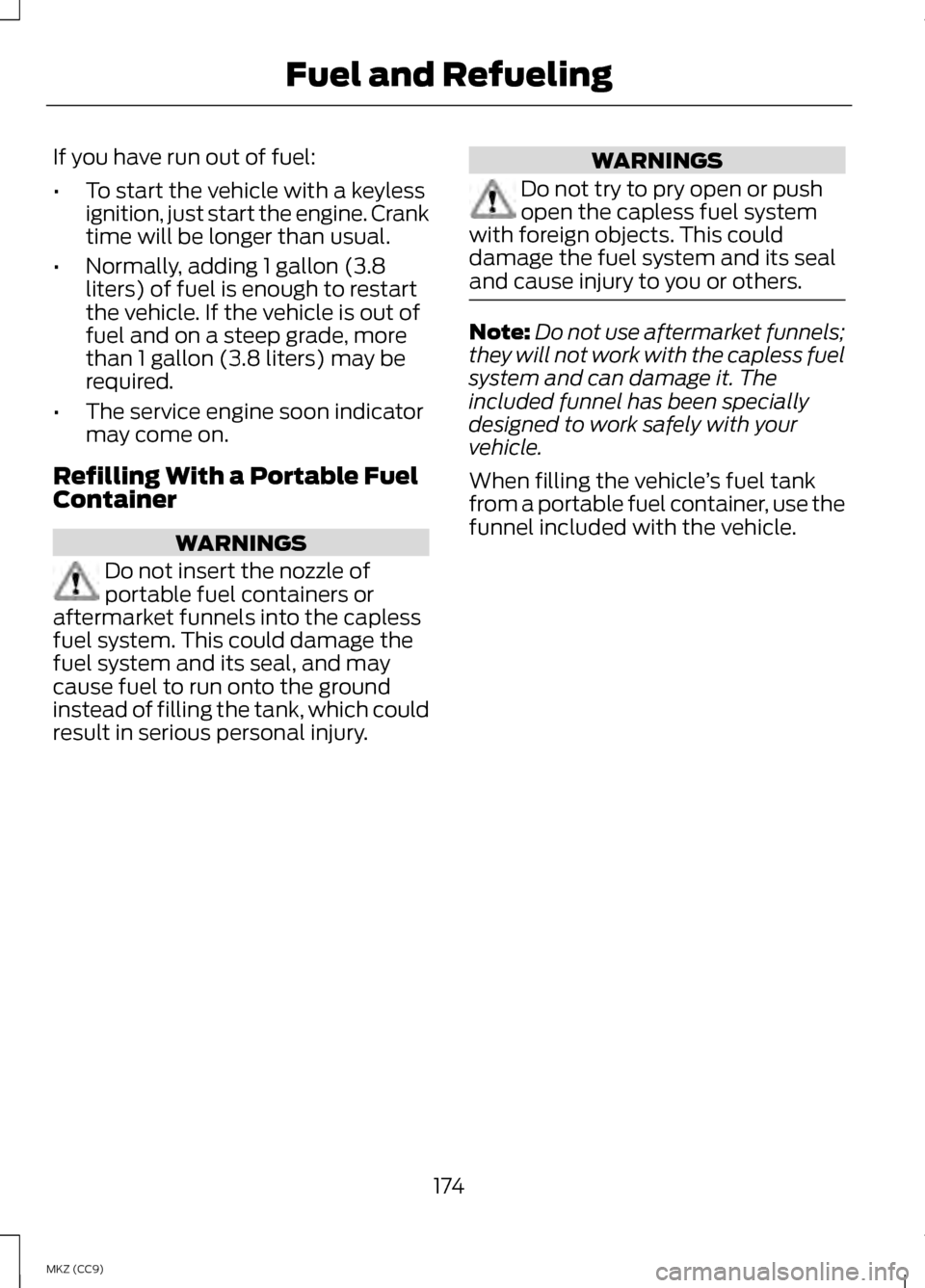
If you have run out of fuel:
•
To start the vehicle with a keyless
ignition, just start the engine. Crank
time will be longer than usual.
• Normally, adding 1 gallon (3.8
liters) of fuel is enough to restart
the vehicle. If the vehicle is out of
fuel and on a steep grade, more
than 1 gallon (3.8 liters) may be
required.
• The service engine soon indicator
may come on.
Refilling With a Portable Fuel
Container WARNINGS
Do not insert the nozzle of
portable fuel containers or
aftermarket funnels into the capless
fuel system. This could damage the
fuel system and its seal, and may
cause fuel to run onto the ground
instead of filling the tank, which could
result in serious personal injury. WARNINGS
Do not try to pry open or push
open the capless fuel system
with foreign objects. This could
damage the fuel system and its seal
and cause injury to you or others. Note:
Do not use aftermarket funnels;
they will not work with the capless fuel
system and can damage it. The
included funnel has been specially
designed to work safely with your
vehicle.
When filling the vehicle ’s fuel tank
from a portable fuel container, use the
funnel included with the vehicle.
174
MKZ (CC9) Fuel and Refueling
Page 183 of 475
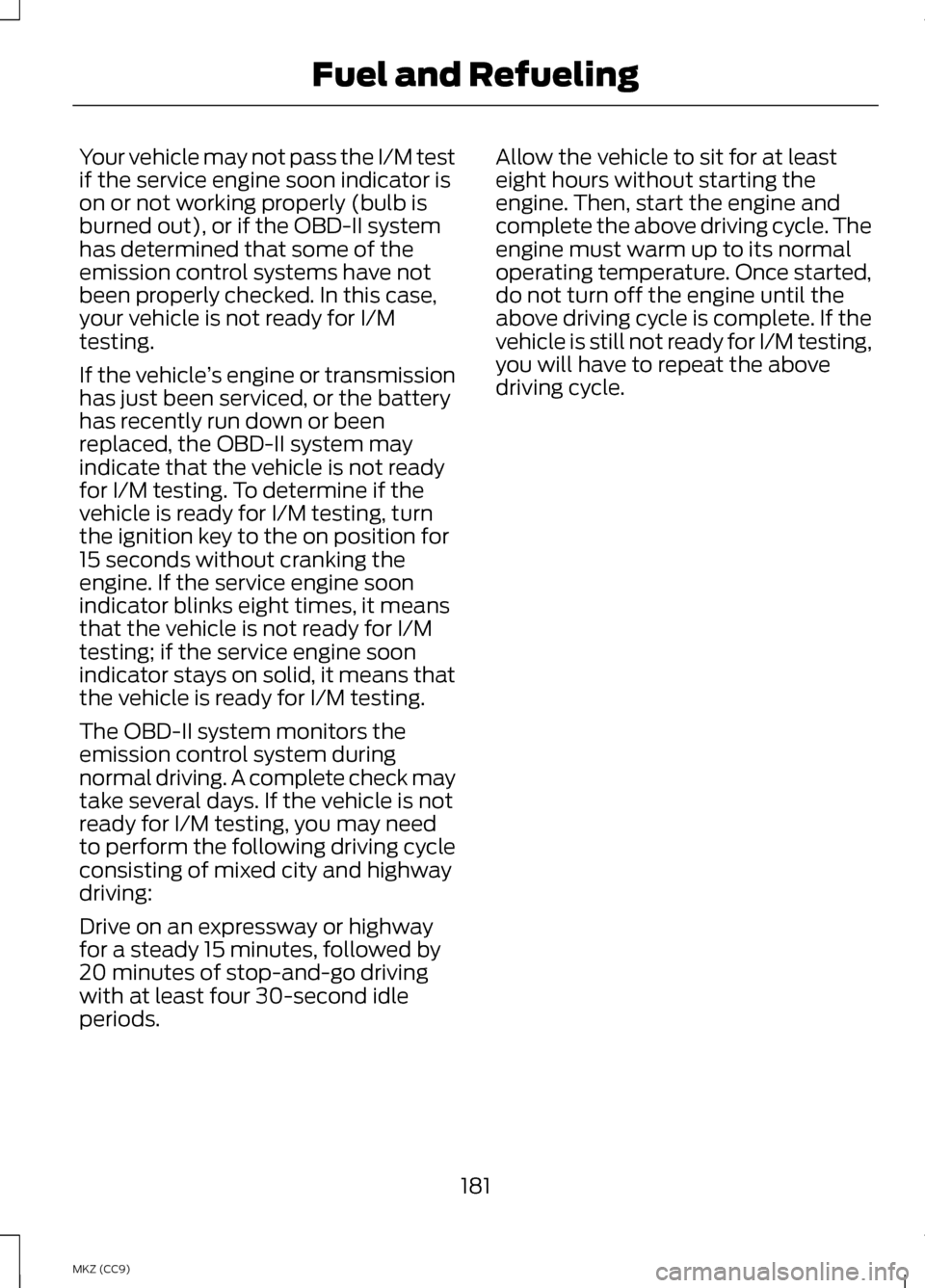
Your vehicle may not pass the I/M test
if the service engine soon indicator is
on or not working properly (bulb is
burned out), or if the OBD-II system
has determined that some of the
emission control systems have not
been properly checked. In this case,
your vehicle is not ready for I/M
testing.
If the vehicle
’s engine or transmission
has just been serviced, or the battery
has recently run down or been
replaced, the OBD-II system may
indicate that the vehicle is not ready
for I/M testing. To determine if the
vehicle is ready for I/M testing, turn
the ignition key to the on position for
15 seconds without cranking the
engine. If the service engine soon
indicator blinks eight times, it means
that the vehicle is not ready for I/M
testing; if the service engine soon
indicator stays on solid, it means that
the vehicle is ready for I/M testing.
The OBD-II system monitors the
emission control system during
normal driving. A complete check may
take several days. If the vehicle is not
ready for I/M testing, you may need
to perform the following driving cycle
consisting of mixed city and highway
driving:
Drive on an expressway or highway
for a steady 15 minutes, followed by
20 minutes of stop-and-go driving
with at least four 30-second idle
periods. Allow the vehicle to sit for at least
eight hours without starting the
engine. Then, start the engine and
complete the above driving cycle. The
engine must warm up to its normal
operating temperature. Once started,
do not turn off the engine until the
above driving cycle is complete. If the
vehicle is still not ready for I/M testing,
you will have to repeat the above
driving cycle.
181
MKZ (CC9) Fuel and Refueling
Page 186 of 475
Note:
In the event the vehicle does not
reactivate after the second key cycle,
contact an authorized dealer.
184
MKZ (CC9) High Voltage Battery
Page 201 of 475
PARKING AID (IF EQUIPPED)
WARNINGS
To help avoid personal injury,
please read and understand the
limitations of the system as contained
in this section. Sensing is only an aid
for some (generally large and fixed)
objects when moving in reverse on a
flat surface at parking speeds. Traffic
control systems, inclement weather,
air brakes, and external motors and
fans may also affect the function of
the sensing system; this may include
reduced performance or a false
activation. To help avoid personal injury,
always use caution when in R
(Reverse) and when using the sensing
system. This system is not designed to
prevent contact with small or
moving objects. The system is
designed to provide a warning to
assist the driver in detecting large
stationary objects to avoid damaging
the vehicle. The system may not
detect smaller objects, particularly
those close to the ground. Certain add-on devices such as
large trailer hitches, bike or
surfboard racks and any device that
may block the normal detection zone
of the system, may create false beeps. Note:
Keep the sensors, located on the
bumper or fascia, free from snow, ice
and large accumulations of dirt. If the
sensors are covered, the system ’s
accuracy can be affected. Do not clean
the sensors with sharp objects.
Note: If your vehicle sustains damage
to the bumper or fascia, leaving it
misaligned or bent, the sensing zone
may be altered causing inaccurate
measurement of obstacles or false
alarms.
Note: If your vehicle is equipped with
MyKey®, it is possible to prevent
turning the sensing system off. See
MyKey ™
(page 57).
The sensing system warns the driver
of obstacles within a certain range of
the bumper area. The system turns on
automatically whenever the ignition
is switched on.
When receiving a detection warning,
the radio volume is reduced to a
predetermined level. After the warning
goes away, the radio volume returns
to the previous level.
The system can be switched off
through the information display menu
or from the pop-up message that
appears once the transmission is
shifted into
R. See General
Information (page 103).
If a fault is present in the system, a
warning message appears in the
information display and does not
allow the driver to switch the faulted
system on. See
(page 103).
199
MKZ (CC9) Parking Aids
Page 219 of 475
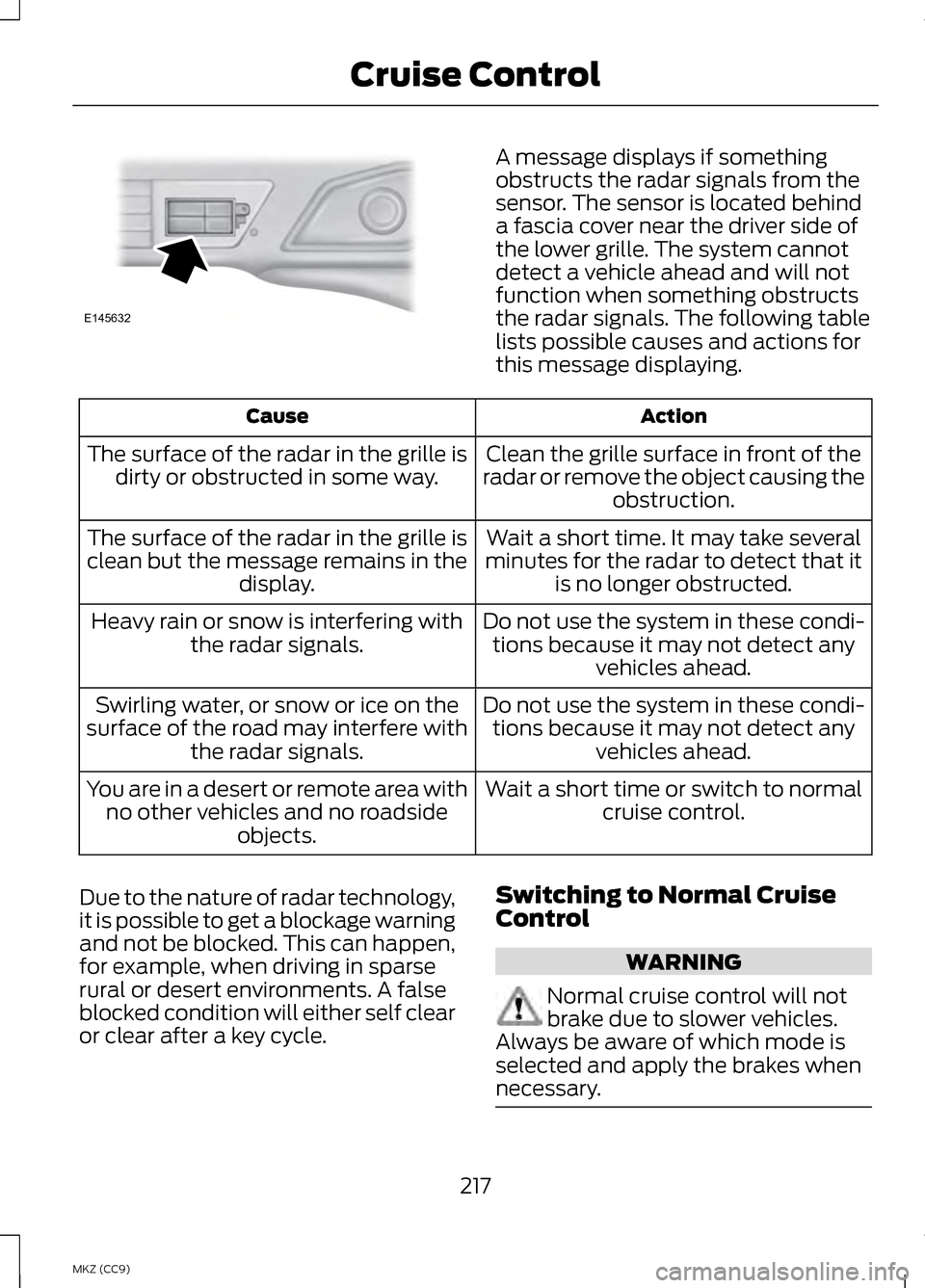
A message displays if something
obstructs the radar signals from the
sensor. The sensor is located behind
a fascia cover near the driver side of
the lower grille. The system cannot
detect a vehicle ahead and will not
function when something obstructs
the radar signals. The following table
lists possible causes and actions for
this message displaying.
Action
Cause
Clean the grille surface in front of the
radar or remove the object causing the obstruction.
The surface of the radar in the grille is
dirty or obstructed in some way.
Wait a short time. It may take several
minutes for the radar to detect that it is no longer obstructed.
The surface of the radar in the grille is
clean but the message remains in the display.
Do not use the system in these condi-tions because it may not detect any vehicles ahead.
Heavy rain or snow is interfering with
the radar signals.
Do not use the system in these condi-tions because it may not detect any vehicles ahead.
Swirling water, or snow or ice on the
surface of the road may interfere with the radar signals.
Wait a short time or switch to normalcruise control.
You are in a desert or remote area with
no other vehicles and no roadside objects.
Due to the nature of radar technology,
it is possible to get a blockage warning
and not be blocked. This can happen,
for example, when driving in sparse
rural or desert environments. A false
blocked condition will either self clear
or clear after a key cycle. Switching to Normal Cruise
Control WARNING
Normal cruise control will not
brake due to slower vehicles.
Always be aware of which mode is
selected and apply the brakes when
necessary. 217
MKZ (CC9) Cruise ControlE145632