warning LINCOLN NAVIGATOR 2022 Owners Manual
[x] Cancel search | Manufacturer: LINCOLN, Model Year: 2022, Model line: NAVIGATOR, Model: LINCOLN NAVIGATOR 2022Pages: 646, PDF Size: 7.29 MB
Page 217 of 646
6. Clean the fuel filler funnel and place it
back in your vehicle or correctly dispose
of it.
Note: If your vehicle runs out of fuel add a
minimum of 1.3 gal (5 L) of fuel to restart the
engine.
Note: You may need to switch the ignition
from off to on several times after refueling
to allow the fuel system to pump the fuel
from the tank to the engine. When restarting,
cranking time takes a few seconds longer
than normal.
Note: Extra funnels can be purchased from
an authorized dealer if you choose to
dispose of the funnel. REFUELING
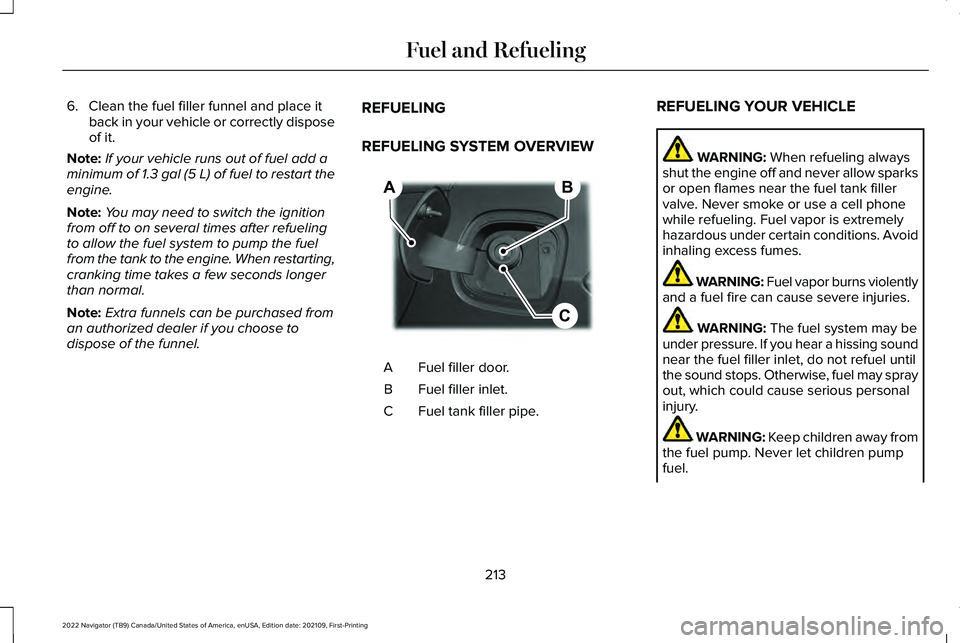
REFUELING SYSTEM OVERVIEW Fuel filler door.
A
Fuel filler inlet.
B
Fuel tank filler pipe.
C REFUELING YOUR VEHICLE WARNING: When refueling always
shut the engine off and never allow sparks
or open flames near the fuel tank filler
valve. Never smoke or use a cell phone
while refueling. Fuel vapor is extremely
hazardous under certain conditions. Avoid
inhaling excess fumes. WARNING: Fuel vapor burns violently
and a fuel fire can cause severe injuries. WARNING:
The fuel system may be
under pressure. If you hear a hissing sound
near the fuel filler inlet, do not refuel until
the sound stops. Otherwise, fuel may spray
out, which could cause serious personal
injury. WARNING: Keep children away from
the fuel pump. Never let children pump
fuel.
213
2022 Navigator (TB9) Canada/United States of America, enUSA, Edition date: 202109, First-Printing Fuel and RefuelingB
C
A E267248
Page 218 of 646
WARNING: Do not pry open the fuel
tank filler valve. This could damage the fuel
system. Failure to follow this instruction
could result in fire, personal injury or death. WARNING: Stay outside your vehicle
and do not leave the fuel pump unattended
when refueling your vehicle. WARNING:
Do not remove the fuel
pump nozzle from its fully inserted position
when refueling. WARNING:
Stop refueling when the
fuel pump nozzle automatically shuts off
for the first time. Failure to follow this will
fill the expansion space in the fuel tank and
could lead to fuel overflowing. WARNING:
Do not overfill the fuel
tank. The pressure in an overfilled tank
may cause leakage and lead to fuel spray
and fire. WARNING: Wait at least five seconds
before removing the fuel pump nozzle to
allow any residual fuel to drain into the fuel
tank.
1. Fully open the fuel filler door.
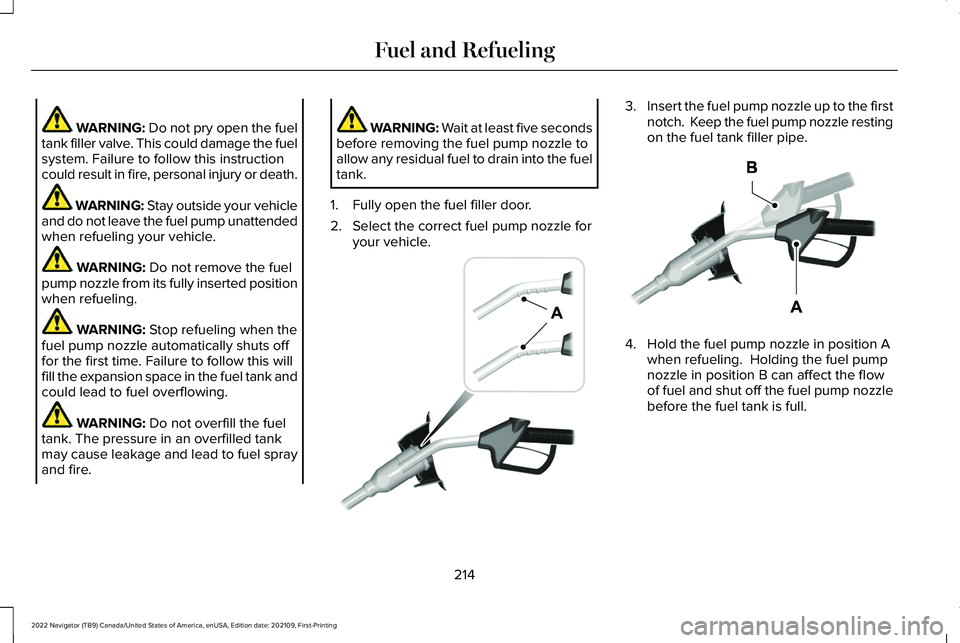
2. Select the correct fuel pump nozzle for your vehicle. 3.
Insert the fuel pump nozzle up to the first
notch. Keep the fuel pump nozzle resting
on the fuel tank filler pipe. 4. Hold the fuel pump nozzle in position A
when refueling. Holding the fuel pump
nozzle in position B can affect the flow
of fuel and shut off the fuel pump nozzle
before the fuel tank is full.
214
2022 Navigator (TB9) Canada/United States of America, enUSA, Edition date: 202109, First-Printing Fuel and RefuelingE139202 E327438
Page 220 of 646
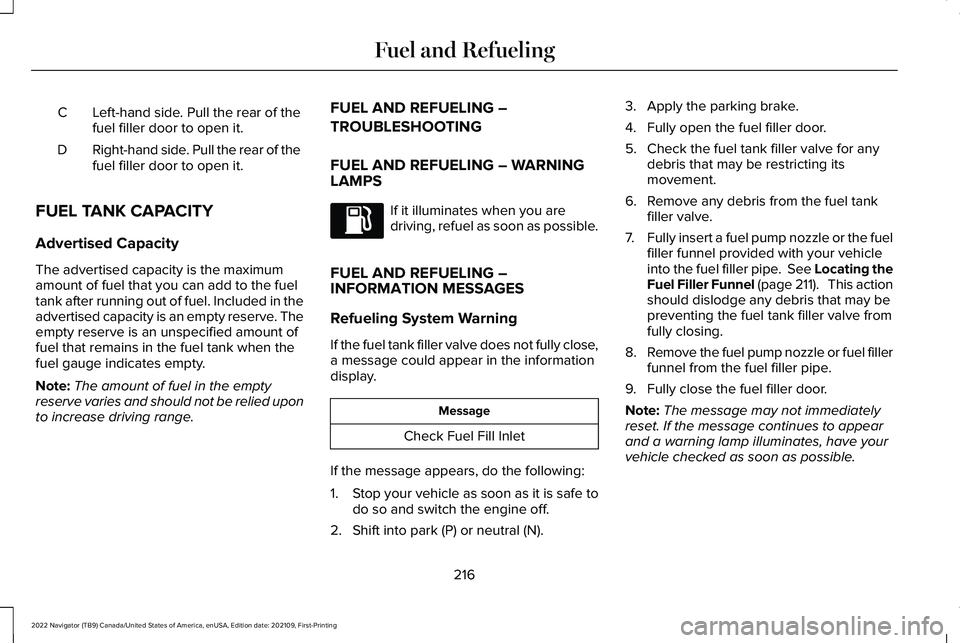
Left-hand side. Pull the rear of the
fuel filler door to open it.
C
Right-hand side. Pull the rear of the
fuel filler door to open it.
D
FUEL TANK CAPACITY
Advertised Capacity
The advertised capacity is the maximum
amount of fuel that you can add to the fuel
tank after running out of fuel. Included in the
advertised capacity is an empty reserve. The
empty reserve is an unspecified amount of
fuel that remains in the fuel tank when the
fuel gauge indicates empty.
Note: The amount of fuel in the empty
reserve varies and should not be relied upon
to increase driving range. FUEL AND REFUELING –
TROUBLESHOOTING
FUEL AND REFUELING – WARNING
LAMPS If it illuminates when you are
driving, refuel as soon as possible.
FUEL AND REFUELING –
INFORMATION MESSAGES
Refueling System Warning
If the fuel tank filler valve does not fully close,
a message could appear in the information
display. Message
Check Fuel Fill Inlet
If the message appears, do the following:
1. Stop your vehicle as soon as it is safe to
do so and switch the engine off.
2. Shift into park (P) or neutral (N). 3. Apply the parking brake.
4. Fully open the fuel filler door.
5. Check the fuel tank filler valve for any
debris that may be restricting its
movement.
6. Remove any debris from the fuel tank filler valve.
7. Fully insert a fuel pump nozzle or the fuel
filler funnel provided with your vehicle
into the fuel filler pipe. See Locating the
Fuel Filler Funnel (page 211). This action
should dislodge any debris that may be
preventing the fuel tank filler valve from
fully closing.
8. Remove the fuel pump nozzle or fuel filler
funnel from the fuel filler pipe.
9. Fully close the fuel filler door.
Note: The message may not immediately
reset. If the message continues to appear
and a warning lamp illuminates, have your
vehicle checked as soon as possible.
216
2022 Navigator (TB9) Canada/United States of America, enUSA, Edition date: 202109, First-Printing Fuel and Refueling
Page 221 of 646
WHAT IS THE CATALYTIC
CONVERTER
The catalytic converter is part of your
vehicle's emissions system and filters harmful
pollutants from the exhaust gas.
CATALYTIC CONVERTER
PRECAUTIONS
WARNING: Do not park, idle or drive
your vehicle on dry grass or other dry
ground cover. The emission system heats
up the engine compartment and exhaust
system, creating the risk of fire. WARNING:
The normal operating
temperature of the exhaust system is very
high. Never work around or attempt to
repair any part of the exhaust system until
it has cooled. Use special care when
working around the catalytic converter.
The catalytic converter heats up to a very
high temperature after only a short period
of engine operation and stays hot after the
engine is switched off. WARNING: Exhaust leaks may result
in entry of harmful and potentially lethal
fumes into the passenger compartment. If
you smell exhaust fumes inside your
vehicle, have your vehicle inspected
immediately. Do not drive if you smell
exhaust fumes.
To avoid damaging the catalytic converter:
• Do not crank the engine for more than
10 seconds at a time.
• Do not run the engine with a spark plug
lead disconnected. •
Do not push-start or tow-start your
vehicle. Use booster cables. See Jump
Starting the Vehicle (page 392).
• Use the correct fuel.
See Fuel and
Refueling (page 210).
• Do not switch the ignition off when your
vehicle is moving.
• Avoid running out of fuel.
• Have the items listed in scheduled
maintenance information performed
according to the specified schedule.
Note: Do not make any unauthorized
changes to your vehicle or engine. By law,
vehicle owners and anyone who
manufactures, repairs, or services a fleet of
vehicles are not permitted to intentionally
remove an emission control device or
prevent it from working.
217
2022 Navigator (TB9) Canada/United States of America, enUSA, Edition date: 202109, First-Printing Catalytic Converter
Page 222 of 646
CATALYTIC CONVERTER –
TROUBLESHOOTING
CATALYTIC CONVERTER – WARNING
LAMPS
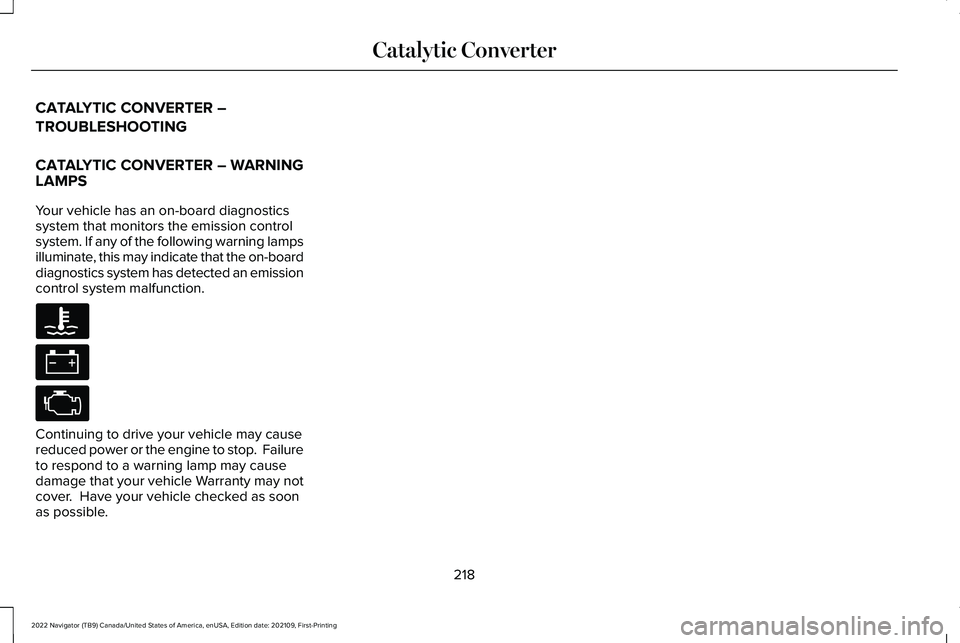
Your vehicle has an on-board diagnostics
system that monitors the emission control
system. If any of the following warning lamps
illuminate, this may indicate that the on-board
diagnostics system has detected an emission
control system malfunction.
Continuing to drive your vehicle may cause
reduced power or the engine to stop. Failure
to respond to a warning lamp may cause
damage that your vehicle Warranty may not
cover. Have your vehicle checked as soon
as possible.
218
2022 Navigator (TB9) Canada/United States of America, enUSA, Edition date: 202109, First-Printing Catalytic Converter
Page 223 of 646
AUTOMATIC TRANSMISSION
PRECAUTIONS
WARNING: Apply the parking brake,
shift into park (P), switch the ignition off
and remove the key before you leave your
vehicle. Failure to follow this instruction
could result in personal injury or death. WARNING: When your vehicle is
stationary, keep the brake pedal fully
pressed when shifting gears. Failure to
follow this instruction could result in
personal injury, death or property damage. WARNING:
Do not apply the brake
pedal and accelerator pedal
simultaneously. Applying both pedals
simultaneously for more than a few
seconds will limit engine performance,
which may result in difficulty maintaining
speed in traffic and could lead to serious
injury. AUTOMATIC TRANSMISSION
POSITIONS
PARK (P)
This position locks the driveline and prevents
the wheels from turning. Come to a complete
stop before putting your vehicle into and out
of park (P).
The electric parking brake could apply when
you shift to park (P) without the brake pedal
fully pressed. The electric parking brake
applies when you shift to park (P) on large
slopes. The electric parking brake releases
with the drive away release function or
manually as described in the Releasing the
Electric Parking Brake section. See Electric
Parking Brake (page 236).
Note: A warning tone sounds if you open the
driver door and you have not shifted the
transmission selector to park (P). REVERSE (R) WARNING:
Shift into reverse (R) only
when your vehicle is stationary.
In reverse (R) power is transmitted to the
driven wheels.
NEUTRAL (N) WARNING: In neutral (N) your vehicle
is free to roll.
In neutral (N) power is not transmitted to the
driven wheels.
DRIVE (D)
In drive (D) power is transmitted to the driven
wheels.
219
2022 Navigator (TB9) Canada/United States of America, enUSA, Edition date: 202109, First-Printing Automatic Transmission
Page 226 of 646
HOW DOES AUTOMATIC RETURN TO
PARK (P) WORK
Your vehicle shifts into park (P) when your
vehicle is stationary and any of the following
occur:
•
You switch the vehicle off.
• You open the driver door with your
seatbelt unlatched.
• You unlatch the driver seatbelt when the
driver door is open.
Note: Do not use automatic return to park
(P) when your vehicle is moving, except in
an emergency. See Starting and Stopping
the Engine (page 200).
AUTOMATIC RETURN TO PARK (P)
LIMITATIONS
Automatic return to park may not work if the
door ajar switch is malfunctioning.
See an authorized dealer if any of the
following occur: •
Door ajar indicator does not illuminate
with the driver door open.
• Door ajar indicator illuminates with the
driver door closed.
• Transmission not in park message
appears with the driver door closed, after
you shift out of park (P).
AUTOMATIC TRANSMISSION
AUDIBLE WARNINGS
Transmission Not In Park (P) Audible
Warning
Sounds if you open the driver door before
shifting into park (P).
Park Selection Audible Warning
Sounds when you shift into park (P).
222
2022 Navigator (TB9) Canada/United States of America, enUSA, Edition date: 202109, First-Printing Automatic Transmission
Page 227 of 646
HOW DOES FOUR-WHEEL DRIVE
WORK
Using the 1-Speed Automatic Four-
Wheel Drive System
The 1-speed automatic four-wheel drive
system utilizes an electronically controlled
on-demand 1-speed transfer case. This
system monitors various vehicle sensory
inputs to provide an increased level of
performance. This system offers the driver
two-wheel drive high, four-wheel drive auto
and four-wheel drive high as available modes
of operation via the selectable drive mode
switch. When four-wheel drive auto is
selected, the system continuously varies
power to the front wheels for optimum
performance for all on-road conditions. When
four-wheel drive high is selected, the system
provides power to the front and rear wheels
for use in off-road or slippery conditions such
as deep snow, sand or mud. There is further
information on driving in unique driving
conditions. See Driving Hints (page 384).
Using the 2-Speed Automatic Four-
Wheel Drive System
(If Equipped)
The 2-speed automatic four-wheel drive
system utilizes an electronically controlled
on-demand 2-speed transfer case. This
system monitors various vehicle sensory
inputs to provide an increased level of
performance. This system offers the driver
two-wheel drive high, four-wheel drive auto,
four-wheel drive high, and four-wheel drive
low as available modes of operation. When
four-wheel drive auto is selected, the system
continuously varies power to the front wheels
for optimum performance for all on-road
conditions. When either four-wheel drive high
or four-wheel drive low are selected with the
appropriate drive modes , the four-wheel
drive system provides electronically locked
power to the front and rear wheels for use
in off-road or slippery conditions such as
deep snow, sand or mud. Selecting slow
climb also provides additional gearing for
increased torque multiplication for conditions
like deep sand, snow, steep slopes, or pulling heavy objects.
See Slow Climb (page 296).
Additionally, the system is capable of
recreational flat towing by putting the
transfer case into neutral (N).
See
Recreationally Towing Your Vehicle (page
397).
There is further information on driving in
unique driving conditions. See Driving Hints
(page
384).
FOUR-WHEEL DRIVE
PRECAUTIONS WARNING:
Vehicles with a higher
center of gravity (utility and four-wheel
drive vehicles) handle differently than
vehicles with a lower center of gravity
(passenger cars). Avoid sharp turns,
excessive speed and abrupt steering in
these vehicles. Failure to drive cautiously
increases the risk of losing control of your
vehicle, vehicle rollover, personal injury
and death.
223
2022 Navigator (TB9) Canada/United States of America, enUSA, Edition date: 202109, First-Printing Four-Wheel Drive
(If Equipped)
Page 228 of 646
WARNING: Do not become
overconfident in the ability of four-wheel
drive vehicles. Although a four-wheel drive
vehicle may accelerate better than a
two-wheel drive vehicle in low traction
situations, it won't stop any faster than
two-wheel drive vehicles. Always drive at
a safe speed.
Truck and utility vehicles can differ from
some other vehicles. Your vehicle could be
higher to allow it to travel over rough terrain
without getting stuck or damaging
underbody components. The differences that
make your vehicle so versatile also make it
handle differently than an ordinary passenger
car. Always maintain steering wheel control,
especially in rough terrain. Since sudden
changes in terrain can result in abrupt
steering wheel motion, make sure you grip
the steering wheel from the outside. Do not
grip the spokes. Drive cautiously to avoid
vehicle damage from concealed objects such as rocks and stumps. Drive slower in strong
crosswinds which can affect the normal
steering characteristics of your vehicle. Be
extremely careful when driving on pavement
made slippery by loose sand, water, gravel,
snow or ice.
Note:
Do not use four-wheel drive high or
four-wheel drive low mode on dry, hard
surfaced roads. Doing so can produce
excessive noise, increase tire wear and can
damage drive components.
FOUR-WHEEL DRIVE LIMITATIONS
Operating Four-Wheel Drive with a
Spare or Mismatched Tires
(If Equipped)
On four-wheel drive vehicles, the size of the
spare tire can affect the four-wheel drive
system. If there is a significant difference
between the size of the spare tire and the
remaining tires, you could have limited
four-wheel drive functionality. When driving
with the full-size dissimilar spare wheel and
tire assembly, we recommend that you do
not: •
Exceed
50 mph (80 km/h) with a
four-wheel drive mode turned on.
• Use a four-wheel drive mode on dry
pavement.
Driving with the full-size dissimilar spare
wheel and tire assembly can limit four-wheel
drive functionality. You can experience the
following:
• Additional noise from the transfer case
or other drive components.
Use of a dissimilar spare wheel and tire
assembly can lead to impairment of the
following:
• Comfort and noise.
• Winter weather driving capability.
• Wet driving capability.
• Four-wheel drive capability.
Note: Your vehicle could have a front air
dam that can become damaged, due to
reduced ground clearance, when taking your
vehicle off-road. You can remove this air
dam by removing the eight bolts that secure
it.
224
2022 Navigator (TB9) Canada/United States of America, enUSA, Edition date: 202109, First-Printing Four-Wheel Drive
(If Equipped)
Page 229 of 646
Note:
Your vehicle could have side steps
that can become damaged, due to reduced
ground clearance, when taking your vehicle
off-road. Remove side steps before driving
your vehicle off-road.
SELECTING A FOUR-WHEEL DRIVE
MODE
To select a specific four-wheel drive mode
please select one of the desired drive
modes. For additional information. See
Selecting a Drive Mode (page 294).
Note: When shifting to and from four-wheel
drive information display will show shifting
in progress message indicating that the
system is in the process of making a shift.
Note: Do not perform this operation if the
rear wheels are slipping or while applying
the accelerator pedal.
If the system detects a fault, a warning
message appears in the information display.
See
Four-Wheel Drive – Information
Messages (page 229). Note:
Do not use SLIPPERY, DEEP
CONDITIONS or SLOW CLIMB on dry, hard
surfaced roads. Doing so produces
excessive noise, increases tire wear and may
damage drive components. The 4X4 system
in these modes is only intended for
consistently slippery or loose surfaces.
Shifting to or from Slow Climb (4L)
To select or exit SLOW CLIMB (4L):
1. Bring your vehicle to a speed of
3.1 mph
(5 km/h) or less.
2. Place the transmission in neutral (N).
3. Select SLOW CLIMB on the drive mode control switch.
The information display will display a
message indicating a four-wheel drive shift
is in progress. If any of the above shift
conditions are not present, the shift will not
occur and the information display will display
information guiding the driver through the
proper shifting procedures. If there is a
transfer case tooth blockage a message will display in the information display. To alleviate
this condition, place the transmission in a
forward gear, move your vehicle forward
approximately
4.9 ft (1.5 m), and shift the
transmission back to neutral (N) to allow the
transfer case to complete the range shift.
Note: You could hear some noise as the
system shifts or engages which is normal. If
the system detects a fault, a warning
message appears in the information display.
See
Four-Wheel Drive – Information
Messages (page 229).
FOUR-WHEEL DRIVE MODES
TWO-WHEEL DRIVE HIGH
2H turns on when you select NORMAL or
CONSERVE. Two-wheel drive high is for
general on-road driving. Power is sent to the
rear wheels only.
Note: Two-wheel drive high can turn on or
off based on Drive Mode selection See Drive
Mode Control
(page 293).
225
2022 Navigator (TB9) Canada/United States of America, enUSA, Edition date: 202109, First-Printing Four-Wheel Drive
(If Equipped)