ECU LINCOLN NAVIGATOR 2022 Owners Manual
[x] Cancel search | Manufacturer: LINCOLN, Model Year: 2022, Model line: NAVIGATOR, Model: LINCOLN NAVIGATOR 2022Pages: 646, PDF Size: 7.29 MB
Page 7 of 646
Liftgate
Liftgate Precautions
......................................98
Opening the Liftgate .....................................
98
Setting the Liftgate Opening Height .......
100
Closing the Liftgate .....................................
100
Stopping the Liftgate Movement .............
103
Liftgate Obstacle Detection ......................
103
Opening and Closing the Liftgate Window .......................................................................
103
Liftgate – Troubleshooting ........................
104
Security
Passive Anti-Theft System .........................
106
Anti-Theft Alarm System ............................
106
Anti-Theft Alarm System Settings ............
107
Security – Troubleshooting .......................
108
Power Running Boards
Power Running Board Precautions ..........
110
Power Running Board Settings .................
110
Deploying and Stowing the Power Running Boards .........................................................
110Power Running Boards – Troubleshooting
........................................................................\
.
111
Steering Wheel
Adjusting the Steering Wheel ....................
112
Resetting the Stopping Position ................
112
Horn ..................................................................
112
Switching the Heated Steering Wheel On and Off .........................................................
112
Adjustable Pedals
Adjusting the Pedals ....................................
113
Wipers and Washers
Wipers ..............................................................
114
Autowipers ......................................................
114
Switching the Rear Window Wiper On and Off .................................................................
115
Reverse Wipe .................................................
115
Checking the Wiper Blades ........................
116
Replacing the Front Wiper Blades ............
116
Replacing the Rear Wiper Blades .............
117
Washers ...........................................................
117Wipers and Washers – Troubleshooting
........................................................................\
119
Exterior Lighting
Exterior Lighting Control ............................
120
Headlamps ....................................................
120
Headlamps – Troubleshooting ..................
121
Autolamps .......................................................
121
Exterior Lamps ..............................................
122
Automatic High Beam Control ..................
123
Automatic High Beam Control – Troubleshooting .......................................
126
Glare Free Lighting ......................................
126
Glare Free Lighting – Troubleshooting .......................................................................
129
Adaptive Front Lighting ..............................
129
Interior Lighting
Switching All of the Interior Lamps On and Off .................................................................
131
Switching the Front Interior Lamps On and Off .................................................................
131
Switching the Rear Interior Lamps On and Off .................................................................
131
3
2022 Navigator (TB9) Canada/United States of America, enUSA, Edition date: 202109, First-Printing Table of Contents
Page 43 of 646
CHILD SAFETY PRECAUTIONS
WARNING: Always make sure your
child is secured properly in a device that
is appropriate for their height, age and
weight. Child safety restraints must be
bought separately from your vehicle.
Failure to follow these instructions and
guidelines may result in an increased risk
of serious injury or death to your child. WARNING:
All children are shaped
differently. The National Highway Traffic
Safety Administration and other safety
organizations, base their recommendations
for child restraints on probable child height,
age and weight thresholds, or on the
minimum requirements of the law. We
recommend that you check with a NHTSA
Certified Child Passenger Safety
Technician (CPST) to make sure that you
properly install the child restraint in your
vehicle and that you consult your
pediatrician to make sure you have a child
restraint appropriate for your child. To
locate a child restraint fitting station and CPST, contact NHTSA toll free at
1-888-327-4236 or go to
www.nhtsa.dot.gov. In Canada, contact
Transport Canada toll free at
1-800-333-0371 or go to www.tc.gc.ca to
find a Child Car Seat Clinic in your area.
Failure to properly restrain children in child
restraints made especially for their height,
age and weight, may result in an increased
risk of serious injury or death to your child.
WARNING:
On hot days, the
temperature inside the vehicle can rise
very quickly. Exposure of people or animals
to these high temperatures for even a short
time can cause death or serious heat
related injuries, including brain damage.
Small children are particularly at risk. WARNING:
Do not place a rearward
facing child restraint in front of an active
airbag. Failure to follow this instruction
could result in personal injury or death. WARNING:
Properly secure children
12 years old and under in a rear seating
position whenever possible. If you are
unable to properly secure all children in a
rear seating position, properly secure the
largest child on the front seat. If you must
use a forward facing child restraint on the
front seat, move the seat as far back as
possible. Failure to follow these
instructions could result in personal injury
or death. WARNING:
Always carefully follow
the instructions and warnings provided by
the manufacturer of any child restraint to
determine if the restraint device is
appropriate for your child's size, height,
weight, or age. Follow the child restraint
manufacturer's instructions and warnings
provided for installation and use in
conjunction with the instructions and
warnings provided by your vehicle
39
2022 Navigator (TB9) Canada/United States of America, enUSA, Edition date: 202109, First-Printing Child Safety
Page 44 of 646
manufacturer. A safety seat that is
improperly installed or utilized, is
inappropriate for your child's height, age,
or weight or does not properly fit the child
may increase the risk of serious injury or
death.
WARNING: Do not allow a passenger
to hold a child on their lap when your
vehicle is moving. Failure to follow this
instruction could result in personal injury
or death in the event of a sudden stop or
crash. WARNING: Do not use pillows, books
or towels to boost your child's height.
Failure to follow this instruction could result
in personal injury or death. WARNING: Properly secure child
restraints or booster seats when they are
not in use. They could become projectiles
in a sudden stop or crash. Failure to follow
this instruction could result in personal
injury or death. WARNING:
Do not put the shoulder
section of the seatbelt or allow the child to
put the shoulder section of the seatbelt
under their arm or behind their back.
Failure to follow this instruction could
reduce the effectiveness of the seatbelt
and increase the risk of injury or death in
a crash. WARNING:
Do not leave children or
pets unattended in your vehicle. Failure to
follow this instruction could result in
personal injury or death.
When installing a child restraint with
seatbelts:
• Place the vehicle seat in the upright
position before you install the child
restraint.
• Use the correct seatbelt buckle for that
seating position.
• Insert the belt tongue into the buckle.
Make sure the tongue is securely
fastened in the buckle. •
Keep the buckle release button pointing
up and away from the child restraint, with
the tongue between the child restraint
and the release button, to prevent
accidental unbuckling.
• Put the seatbelt in the automatic locking
mode.
CHILD RESTRAINT ANCHOR POINTS
WHAT ARE THE CHILD RESTRAINT
ANCHOR POINTS
Anchor points allow you to quickly and safely
install a child restraint.
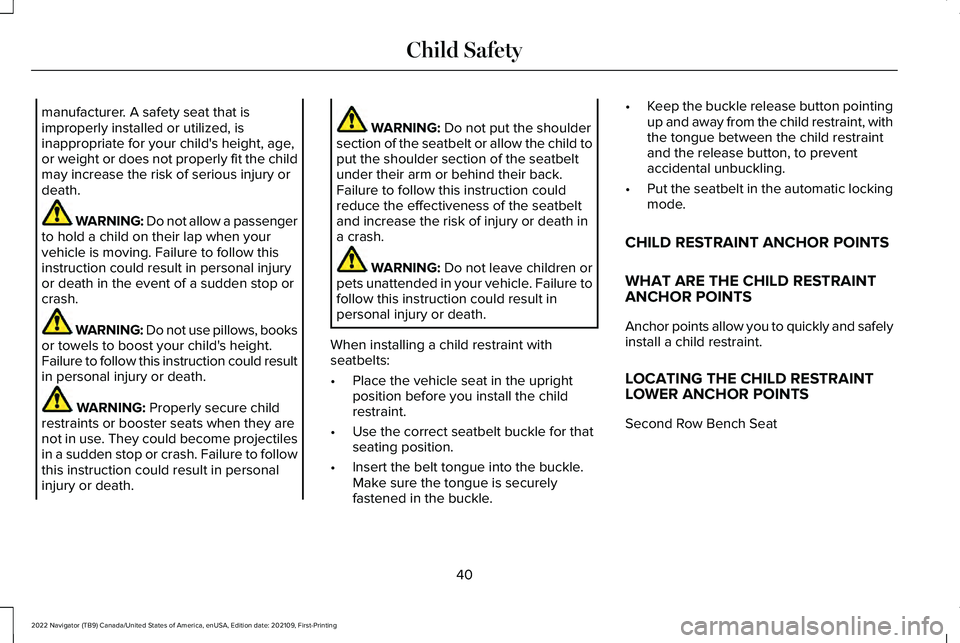
LOCATING THE CHILD RESTRAINT
LOWER ANCHOR POINTS
Second Row Bench Seat
40
2022 Navigator (TB9) Canada/United States of America, enUSA, Edition date: 202109, First-Printing Child Safety
Page 48 of 646
INSTALLING CHILD RESTRAINTS
USING SEATBELTS
WARNING: Depending on where you
secure a child restraint, and depending on
the child restraint design, you may block
access to certain seatbelt buckle
assemblies and LATCH lower anchors,
rendering those features potentially
unusable. To avoid risk of injury, make sure
occupants only use seating positions
where they are able to be properly
restrained.
Note: Although the child restraint illustrated
is a forward facing child restraint, the steps
are the same for installing a rear facing child
restraint.
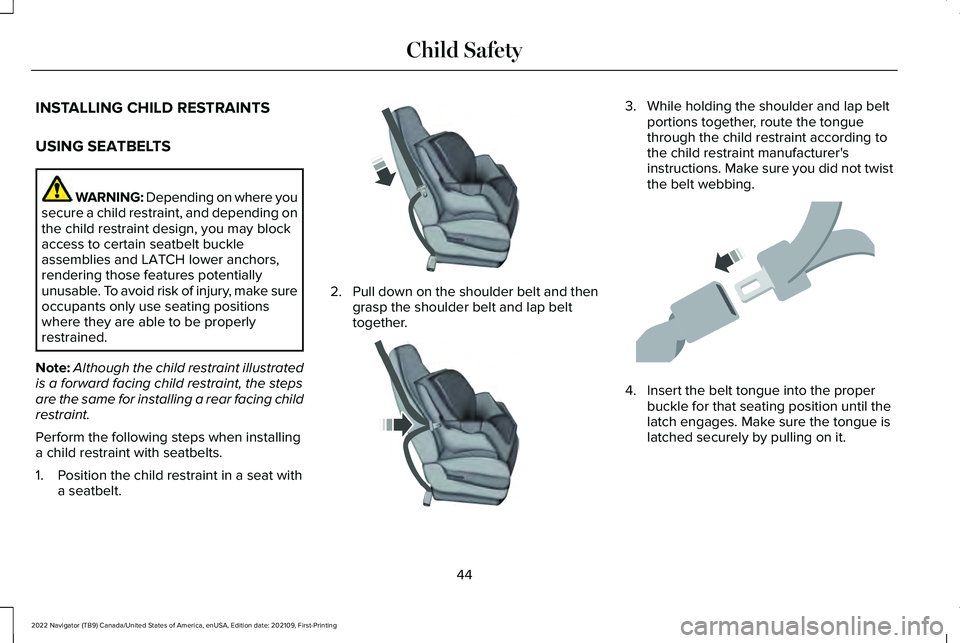
Perform the following steps when installing
a child restraint with seatbelts.
1. Position the child restraint in a seat with a seatbelt. 2.
Pull down on the shoulder belt and then
grasp the shoulder belt and lap belt
together. 3. While holding the shoulder and lap belt
portions together, route the tongue
through the child restraint according to
the child restraint manufacturer's
instructions. Make sure you did not twist
the belt webbing. 4. Insert the belt tongue into the proper
buckle for that seating position until the
latch engages. Make sure the tongue is
latched securely by pulling on it.
44
2022 Navigator (TB9) Canada/United States of America, enUSA, Edition date: 202109, First-Printing Child SafetyE142529 E142530 E142531
Page 49 of 646
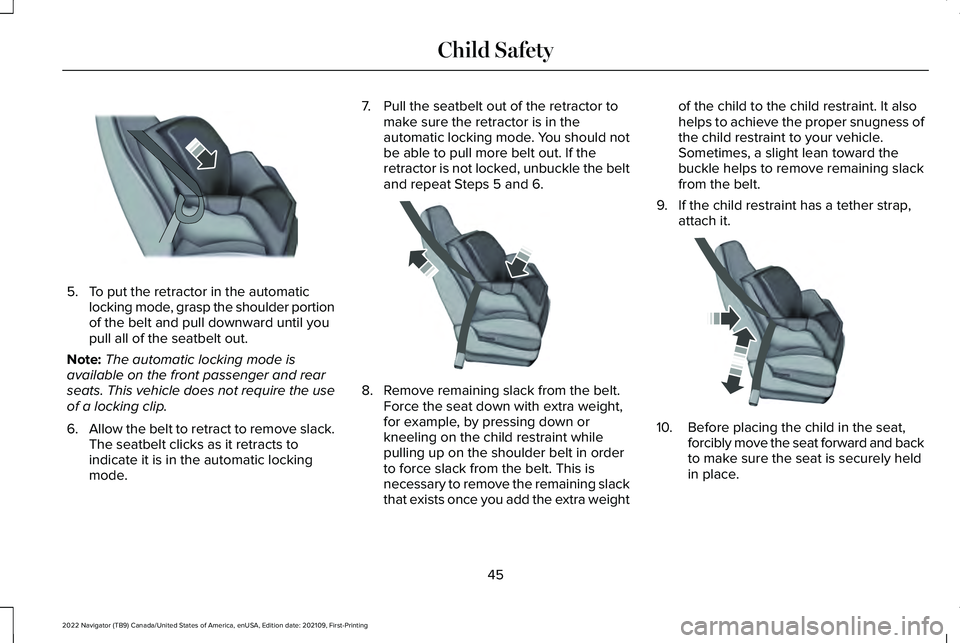
5. To put the retractor in the automatic
locking mode, grasp the shoulder portion
of the belt and pull downward until you
pull all of the seatbelt out.
Note: The automatic locking mode is
available on the front passenger and rear
seats. This vehicle does not require the use
of a locking clip.
6. Allow the belt to retract to remove slack.
The seatbelt clicks as it retracts to
indicate it is in the automatic locking
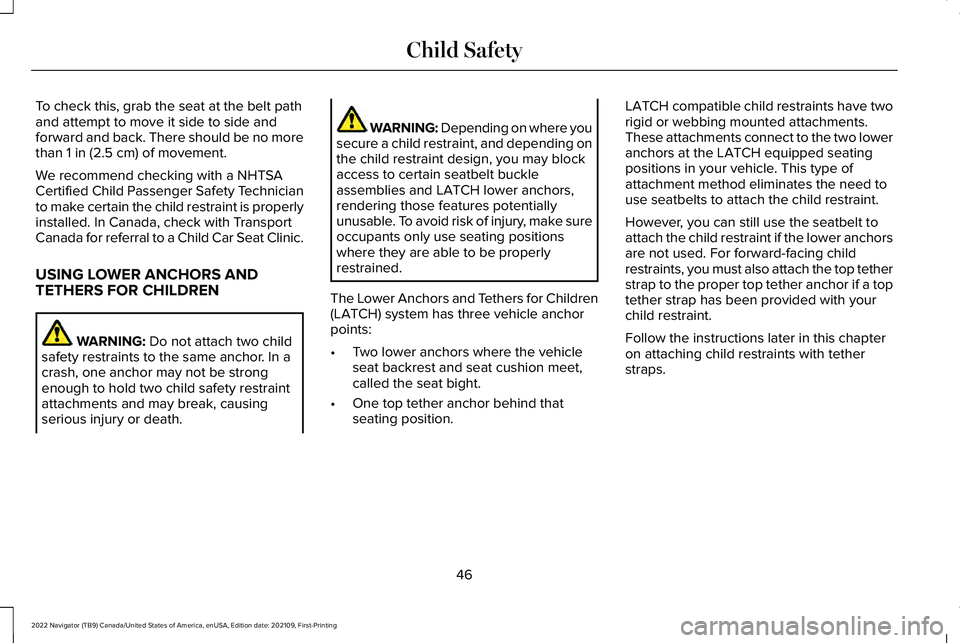
mode. 7. Pull the seatbelt out of the retractor to
make sure the retractor is in the
automatic locking mode. You should not
be able to pull more belt out. If the
retractor is not locked, unbuckle the belt
and repeat Steps 5 and 6. 8. Remove remaining slack from the belt.
Force the seat down with extra weight,
for example, by pressing down or
kneeling on the child restraint while
pulling up on the shoulder belt in order
to force slack from the belt. This is
necessary to remove the remaining slack
that exists once you add the extra weight of the child to the child restraint. It also
helps to achieve the proper snugness of
the child restraint to your vehicle.
Sometimes, a slight lean toward the
buckle helps to remove remaining slack
from the belt.
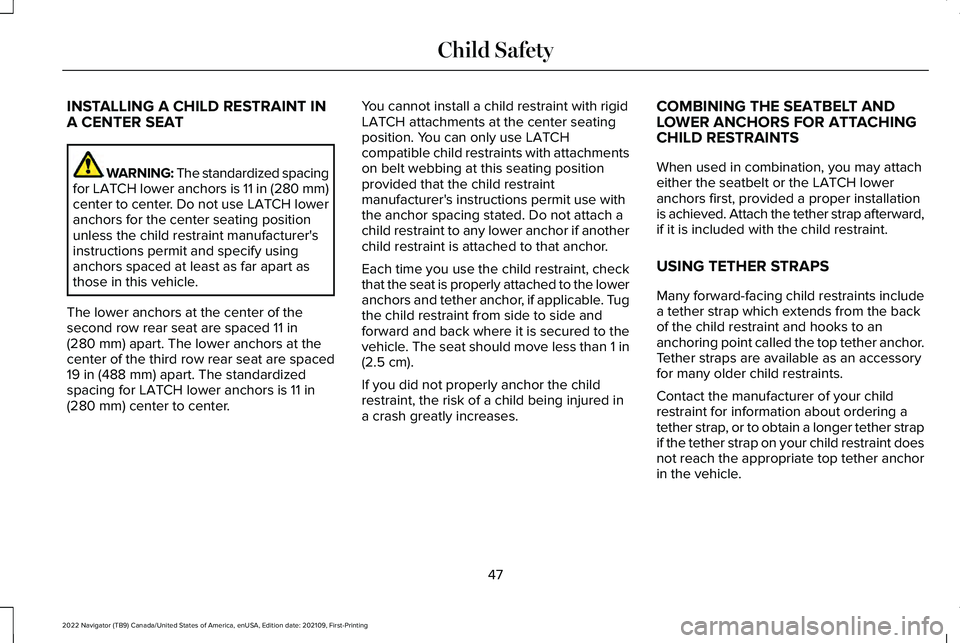
9. If the child restraint has a tether strap, attach it. 10. Before placing the child in the seat,
forcibly move the seat forward and back
to make sure the seat is securely held
in place.
45
2022 Navigator (TB9) Canada/United States of America, enUSA, Edition date: 202109, First-Printing Child SafetyE142875 E142533 E142534
Page 50 of 646
To check this, grab the seat at the belt path
and attempt to move it side to side and
forward and back. There should be no more
than 1 in (2.5 cm) of movement.
We recommend checking with a NHTSA
Certified Child Passenger Safety Technician
to make certain the child restraint is properly
installed. In Canada, check with Transport
Canada for referral to a Child Car Seat Clinic.
USING LOWER ANCHORS AND
TETHERS FOR CHILDREN WARNING:
Do not attach two child
safety restraints to the same anchor. In a
crash, one anchor may not be strong
enough to hold two child safety restraint
attachments and may break, causing
serious injury or death. WARNING: Depending on where you
secure a child restraint, and depending on
the child restraint design, you may block
access to certain seatbelt buckle
assemblies and LATCH lower anchors,
rendering those features potentially
unusable. To avoid risk of injury, make sure
occupants only use seating positions
where they are able to be properly
restrained.
The Lower Anchors and Tethers for Children
(LATCH) system has three vehicle anchor
points:
• Two lower anchors where the vehicle
seat backrest and seat cushion meet,
called the seat bight.
• One top tether anchor behind that
seating position. LATCH compatible child restraints have two
rigid or webbing mounted attachments.
These attachments connect to the two lower
anchors at the LATCH equipped seating
positions in your vehicle. This type of
attachment method eliminates the need to
use seatbelts to attach the child restraint.
However, you can still use the seatbelt to
attach the child restraint if the lower anchors
are not used. For forward-facing child
restraints, you must also attach the top tether
strap to the proper top tether anchor if a top
tether strap has been provided with your
child restraint.
Follow the instructions later in this chapter
on attaching child restraints with tether
straps.
46
2022 Navigator (TB9) Canada/United States of America, enUSA, Edition date: 202109, First-Printing Child Safety
Page 51 of 646
INSTALLING A CHILD RESTRAINT IN
A CENTER SEAT
WARNING: The standardized spacing
for LATCH lower anchors is 11 in (280 mm)
center to center. Do not use LATCH lower
anchors for the center seating position
unless the child restraint manufacturer's
instructions permit and specify using
anchors spaced at least as far apart as
those in this vehicle.
The lower anchors at the center of the
second row rear seat are spaced
11 in
(280 mm) apart. The lower anchors at the
center of the third row rear seat are spaced
19 in (488 mm)
apart. The standardized
spacing for LATCH lower anchors is 11 in
(280 mm) center to center. You cannot install a child restraint with rigid
LATCH attachments at the center seating
position. You can only use LATCH
compatible child restraints with attachments
on belt webbing at this seating position
provided that the child restraint
manufacturer's instructions permit use with
the anchor spacing stated. Do not attach a
child restraint to any lower anchor if another
child restraint is attached to that anchor.
Each time you use the child restraint, check
that the seat is properly attached to the lower
anchors and tether anchor, if applicable. Tug
the child restraint from side to side and
forward and back where it is secured to the
vehicle. The seat should move less than 1 in
(2.5 cm)
.
If you did not properly anchor the child
restraint, the risk of a child being injured in
a crash greatly increases. COMBINING THE SEATBELT AND
LOWER ANCHORS FOR ATTACHING
CHILD RESTRAINTS
When used in combination, you may attach
either the seatbelt or the LATCH lower
anchors first, provided a proper installation
is achieved. Attach the tether strap afterward,
if it is included with the child restraint.
USING TETHER STRAPS
Many forward-facing child restraints include
a tether strap which extends from the back
of the child restraint and hooks to an
anchoring point called the top tether anchor.
Tether straps are available as an accessory
for many older child restraints.
Contact the manufacturer of your child
restraint for information about ordering a
tether strap, or to obtain a longer tether strap
if the tether strap on your child restraint does
not reach the appropriate top tether anchor
in the vehicle.
47
2022 Navigator (TB9) Canada/United States of America, enUSA, Edition date: 202109, First-Printing Child Safety
Page 67 of 646
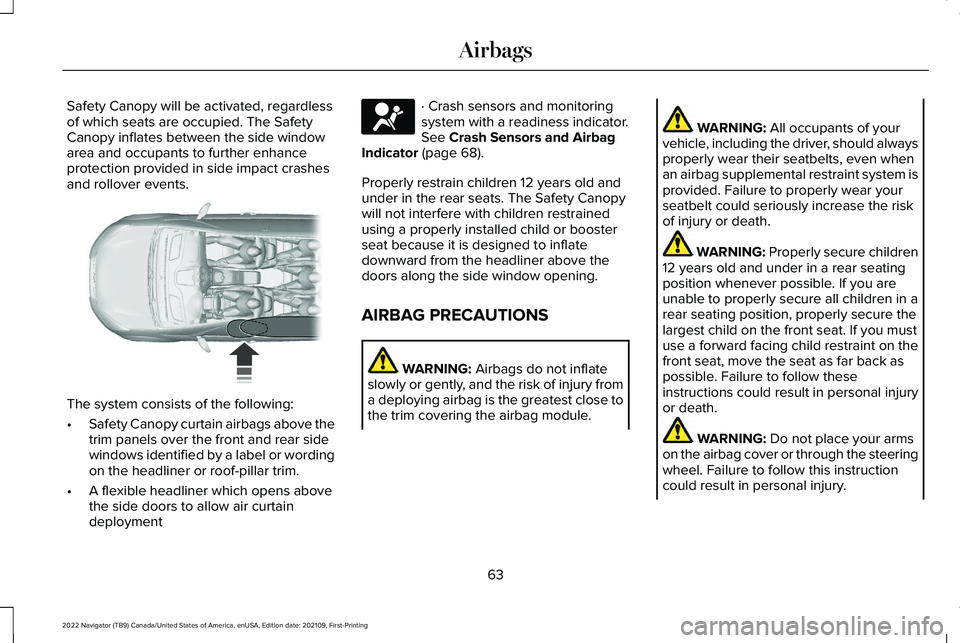
Safety Canopy will be activated, regardless
of which seats are occupied. The Safety
Canopy inflates between the side window
area and occupants to further enhance
protection provided in side impact crashes
and rollover events.
The system consists of the following:
•
Safety Canopy curtain airbags above the
trim panels over the front and rear side
windows identified by a label or wording
on the headliner or roof-pillar trim.
• A flexible headliner which opens above
the side doors to allow air curtain
deployment · Crash sensors and monitoring
system with a readiness indicator.
See Crash Sensors and Airbag
Indicator (page 68).
Properly restrain children 12 years old and
under in the rear seats. The Safety Canopy
will not interfere with children restrained
using a properly installed child or booster
seat because it is designed to inflate
downward from the headliner above the
doors along the side window opening.
AIRBAG PRECAUTIONS WARNING:
Airbags do not inflate
slowly or gently, and the risk of injury from
a deploying airbag is the greatest close to
the trim covering the airbag module. WARNING:
All occupants of your
vehicle, including the driver, should always
properly wear their seatbelts, even when
an airbag supplemental restraint system is
provided. Failure to properly wear your
seatbelt could seriously increase the risk
of injury or death. WARNING:
Properly secure children
12 years old and under in a rear seating
position whenever possible. If you are
unable to properly secure all children in a
rear seating position, properly secure the
largest child on the front seat. If you must
use a forward facing child restraint on the
front seat, move the seat as far back as
possible. Failure to follow these
instructions could result in personal injury
or death. WARNING:
Do not place your arms
on the airbag cover or through the steering
wheel. Failure to follow this instruction
could result in personal injury.
63
2022 Navigator (TB9) Canada/United States of America, enUSA, Edition date: 202109, First-Printing Airbags E75004 E67017
Page 74 of 646
WHAT IS 911 ASSIST
911 Assist is a SYNC system feature that can
call for help.
For more information, visit
www
. owner . ford. com .
HOW DOES 911 ASSIST WORK
If a crash deploys an airbag, excluding knee
airbags and rear inflatable seatbelts, or
activates the fuel pump shut-off, your vehicle
may be able to contact emergency services
by dialing 911 through a paired and
connected Bluetooth®-enabled phone.
Not all crashes will deploy an airbag or
activate the fuel pump shut-off. If a
connected cell phone sustains damage or
loses its connection to SYNC during a crash,
SYNC will search for and try to connect to a
previously paired cell phone. SYNC will then
attempt to call the emergency services. Before making the call:
•
SYNC provides about 10 seconds to
cancel the call. If you fail to cancel the
call, SYNC attempts to dial 911.
• SYNC says the following, or a similar
message: "SYNC will attempt to call 911,
to cancel the call, press Cancel on your
screen or press and hold the phone
button on your steering wheel."
If you do not cancel the call and SYNC makes
a successful call a pre-recorded message
plays for the 911 operator. The occupants in
your vehicle are able to talk with the
operator. Be prepared to provide your name,
phone number and location immediately
because not all 911 systems are capable of
receiving this information electronically.
During an emergency call the system
transmits vehicle data to the emergency
service. EMERGENCY CALL
REQUIREMENTS WARNING: Do not wait for 911 Assist
to make an emergency call if you can do
it yourself. Dial emergency services
immediately to avoid delayed response
time which could increase the risk of
serious injury or death after a crash. If you
do not hear 911 Assist within five seconds
of the crash, the system or phone may be
damaged or non-functional. WARNING: Always place your phone
in a secure location in your vehicle so it
does not become a projectile or get
damaged in a crash. Failure to do so may
cause serious injury to someone or
damage the phone which could prevent
911 Assist from working properly. WARNING:
Unless the 911 Assist
setting is set on before a crash, the system
will not dial for help which could delay
response time, potentially increasing the
risk of serious injury or death after a crash.
70
2022 Navigator (TB9) Canada/United States of America, enUSA, Edition date: 202109, First-Printing 911 Assist
Page 77 of 646
REMOVING THE KEY BLADE
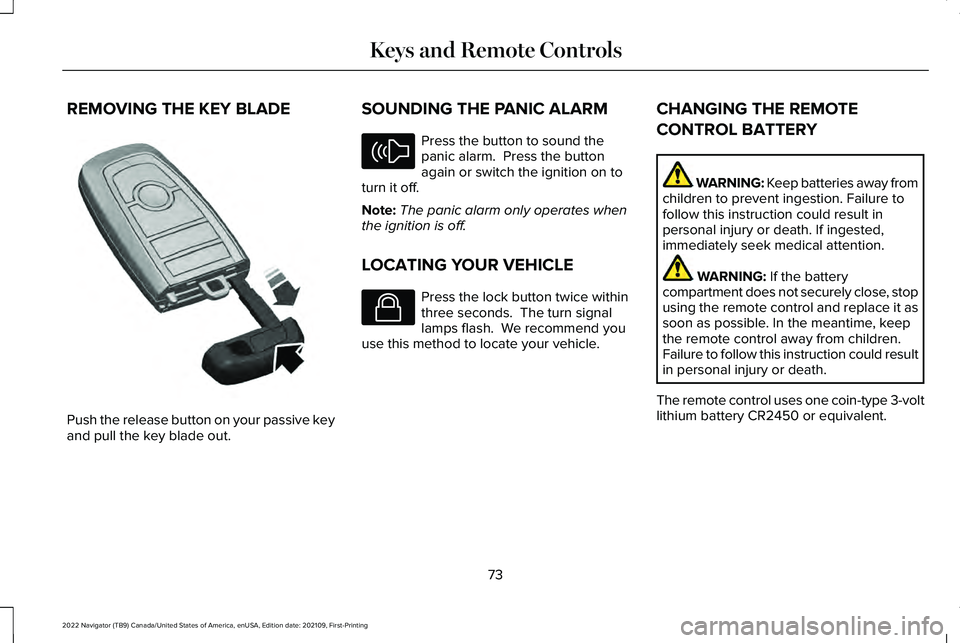
Push the release button on your passive key
and pull the key blade out. SOUNDING THE PANIC ALARM Press the button to sound the
panic alarm. Press the button
again or switch the ignition on to
turn it off.
Note: The panic alarm only operates when
the ignition is off.
LOCATING YOUR VEHICLE Press the lock button twice within
three seconds. The turn signal
lamps flash. We recommend you
use this method to locate your vehicle. CHANGING THE REMOTE
CONTROL BATTERY WARNING: Keep batteries away from
children to prevent ingestion. Failure to
follow this instruction could result in
personal injury or death. If ingested,
immediately seek medical attention. WARNING: If the battery
compartment does not securely close, stop
using the remote control and replace it as
soon as possible. In the meantime, keep
the remote control away from children.
Failure to follow this instruction could result
in personal injury or death.
The remote control uses one coin-type 3-volt
lithium battery CR2450 or equivalent.
73
2022 Navigator (TB9) Canada/United States of America, enUSA, Edition date: 202109, First-Printing Keys and Remote ControlsE322866 E138624 E138623