lock LINCOLN TOWN CAR 1997 Owner's Guide
[x] Cancel search | Manufacturer: LINCOLN, Model Year: 1997, Model line: TOWN CAR, Model: LINCOLN TOWN CAR 1997Pages: 305, PDF Size: 2.68 MB
Page 151 of 305
147
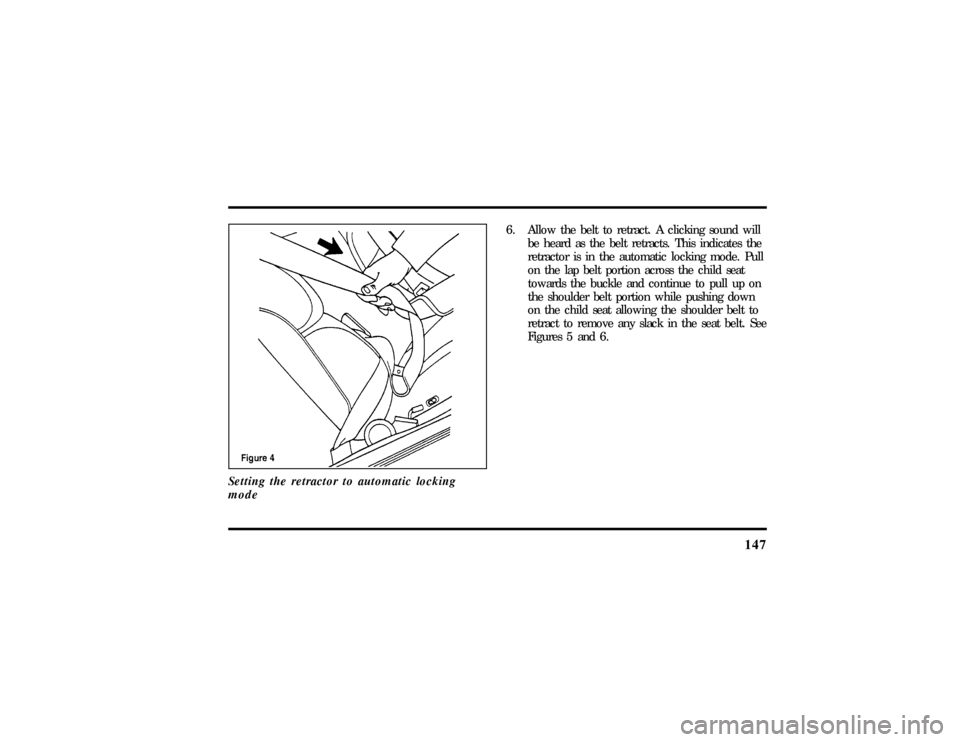
Setting the retractor to automatic locking
mode
6. Allow the belt to retract. A clicking sound will
be heard as the belt retracts. This indicates the
retractor is in the automatic locking mode. Pull
on the lap belt portion across the child seat
towards the buckle and continue to pull up on
the shoulder belt portion while pushing down
on the child seat allowing the shoulder belt to
retract to remove any slack in the seat belt. See
Figures 5 and 6.
File:06fnsst.ex
Update:Fri Jun 21 08:57:53 1996
Page 154 of 305
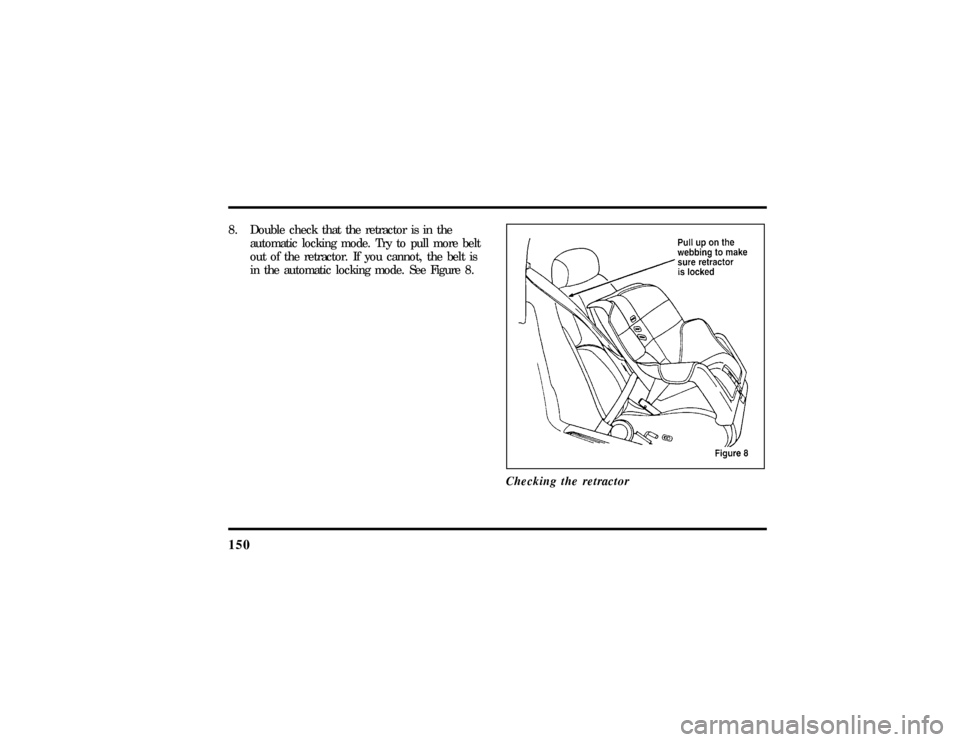
1508. Double check that the retractor is in the
automatic locking mode. Try to pull more belt
out of the retractor. If you cannot, the belt is
in the automatic locking mode. See Figure 8.
Checking the retractor
File:06fnsst.ex
Update:Fri Jun 21 08:57:53 1996
Page 155 of 305
151
9. Check to make sure that the child seat is
properly secured prior to each use. If the
retractor is not locked, repeat steps 6 through
8.
NOTE:To remove the retractor from automatic
lock mode, allow seat belt to retract fully to its
stowed position and the retractor will automatically
switch back to the vehicle sensitive locking mode
for normal adult usage.Installing Child Safety Seats in the Rear
Outboard Seating PositionsYour rear outboard seating positions are equipped
with a cinch tongue on the safety belts. Use the
following procedure for installing a child safety seat
in these locations.
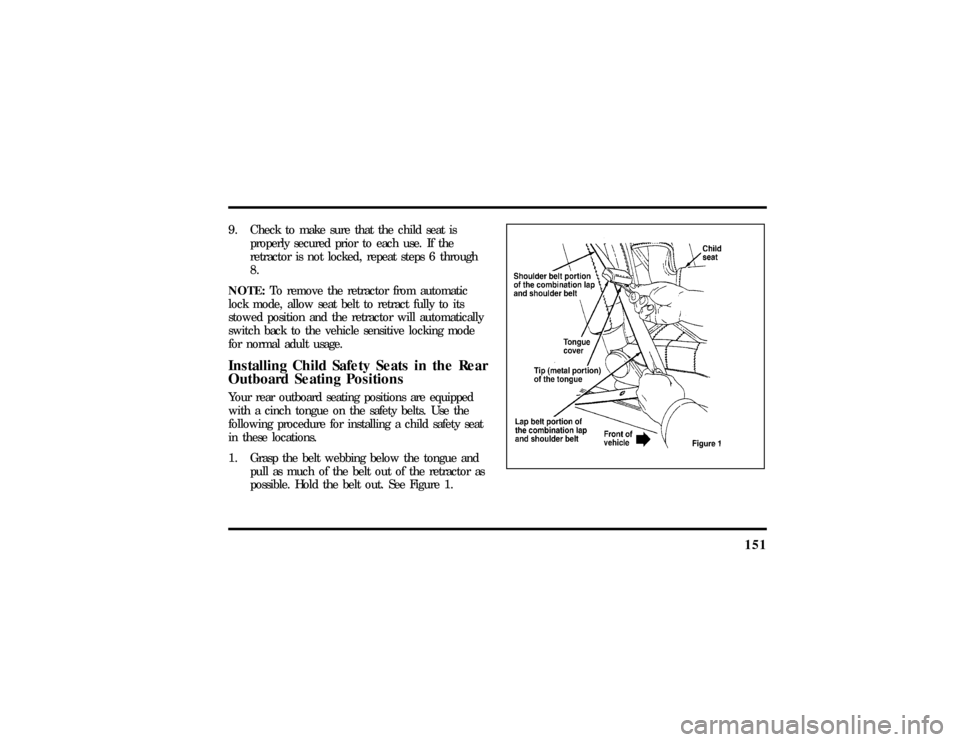
1. Grasp the belt webbing below the tongue and
pull as much of the belt out of the retractor as
possible. Hold the belt out. See Figure 1.
File:06fnsst.ex
Update:Fri Jun 21 08:57:53 1996
Page 166 of 305

163
For a warm engine:
q
Do not hold the key in the START position for
more thanfive (5) secondsat a time. If the
engine does not start within five (5) seconds on
the first try, turn the key to the OFF position.
Wait a few seconds after the starter stops, then
try again.
Whenever you start your vehicle, release the
key as soon as the engine starts. Excessive
cranking could damage the starter.
After you start the engine, let it idle for a few
seconds. Keep your foot on the brake pedal and
put the gearshift lever in gear. Release the
parking brake. Slowly release the brake pedal
and drive away in the normal manner.
NOTE:Your vehicle has an interlock that
prevents you from shifting out of P (Park)
unless your foot is on the brake pedal.If the engine does not start after two
attempts:
1. Turn the ignition key to the OFF position.
2. Press the accelerator all the way to the floor
and hold it.
3. Turn the ignition key to the START position.
4. Release the ignition key when the engine starts.
5. Release the accelerator gradually as the engine
speeds up.
If the engine still does not start, the fuel pump
shut-off switch may have been activated. For
directions on how to reset the switch seeFuel
Pump Shut-Off Switchin the index.
File:08fntot.ex
Update:Mon Jun 17 13:51:45 1996
Page 170 of 305

167
DrivingBrakesApplying the BrakesYour vehicle has anti-lock disc brakes on all four
wheels. They adjust automatically as the brake pads
wear down.
When you press down hard on the brake pedal, the
wheels will not lock and slide. The Anti-lock Brake
System (ABS) automatically starts releasing and
reapplying the front brakes independently and the
rear brakes together whenever your wheels start to
lock. When this happens, you will feel the brake
pedal pulsate. This is an indication that the ABS is
working correctly and is normal.
Do not drive with your foot resting on the brake
pedal; you will wear out the linings and increase
your vehicle's stopping distance. Brake rotor damage
may also eventually occur.NOTE:If you are driving down a long or steep hill,
shift to a lower gear and do not apply your brakes
continuously. If you apply your brakes continuously,
they may overheat and become less effective.
Occasional brake squeal during light to moderate
stops does not affect the function of the brake
system and is normal. However, if the squeal
becomes louder or more frequent, have your brakes
inspected by your dealer or a qualified service
technician.
Ford Motor Company has not found any
detrimental effects of popular mobile radio
transmitting equipment installed on vehicles with
the anti-lock brake system, if the equipment is
installed according to the manufacturer's
instructions. However, if mobile radio transmitting
equipment is installed in your vehicle and, if either
the anti-lock brake system cycles or the ANTI-LOCK
File:09fngft.ex
Update:Mon Jun 17 13:52:03 1996
Page 173 of 305

170Traction Assist
TM
(If equipped)
Your vehicle may be equipped with the optional
Traction Assist
TM
system. This system helps prevent
wheel spin in order to improve tire traction and is
an especially useful feature when you drive in hilly
areas or on slippery, icy or snowy roads.
Traction Assist
TM
works automatically by rapidly
applying and releasing the brakes to prevent one or
both of the rear drive wheels from spinning during
acceleration.
During the Traction Assist
TM
function, which most
often occurs during low speed acceleration on
slippery surfaces, a noise may be heard coming from
the engine compartment. This is normal and may
last for a few seconds during the acceleration of the
vehicle.
In general, this system improves your vehicle's
stability and acceleration performance when road
conditions warrant. Traction Assist
TM
is fully
effective up to approximately 25 mph (40 km/h).At 25 mph (40 km/h) the function begins to taper
off until it no longer operates above 34 mph
(55 km/h).
If the Traction Assis;
TM
system is cycled excessively,
the system will shut down to prevent the rear
brakes from overheating. A cooling down period is
required to prevent damage to the brakes. This time
period varies and depends on brake usage during
the cooling down period. Anti-Lock braking is not
affected and will function normally during the cool
down period.
After the cool down period, the Traction Assist
TM
function is restored.%Rear Air Suspension SystemYour vehicle is equipped with an automatic load
leveling rear air suspension system. This system
maintains the rear vehicle height at a constant level
by automatically adding air or releasing air from the
rear air springs to offset changes in vehicle loads.
File:09fngft.ex
Update:Mon Jun 17 13:52:03 1996
Page 179 of 305

176Overdrive is the usual driving position for an
automatic overdrive transmission. It works the same
way Drive works, automatically upshifting or
downshifting as the vehicle speeds or slows.
However, Overdrive also shifts into a fourth gear Ð
an overdrive gear Ð when your vehicle cruises at
an appropriate consistent speed for any length of
time. This fourth gear will increase your fuel
economy when you travel at cruising speeds.When to use Drive (jÐ with
Transmission Control Switch activated)Overdrive may not be appropriate for certain
terrain. If the transmission shifts back and forth
between Third and Fourth gears while you are
driving on hilly roads or if your vehicle does not
have adequate power for climbing hills, depress the
TCS.
You can depress the TCS at any speed.
When to use 2 (Second)Use 2 (Second) for start-up on slippery roads or to
give you more engine braking to slow your vehicle
on downgrades.When to use 1 (Low)Use 1 (Low) when driving down steep grades. It
gives more engine braking to slow your vehicle than
2 (Second) on the downgrades. You can upshift
from 1 (Low) to 2 (Second) or from 1 (Low) to
Overdrive at any speed.P (Park)Always come to a complete stop before you shift
into P (Park). Make sure that the gearshift is
securely latched in P (Park). This locks the
transmission and prevents the rear wheels from
rotating.
File:09fngft.ex
Update:Mon Jun 17 13:52:03 1996
Page 196 of 305
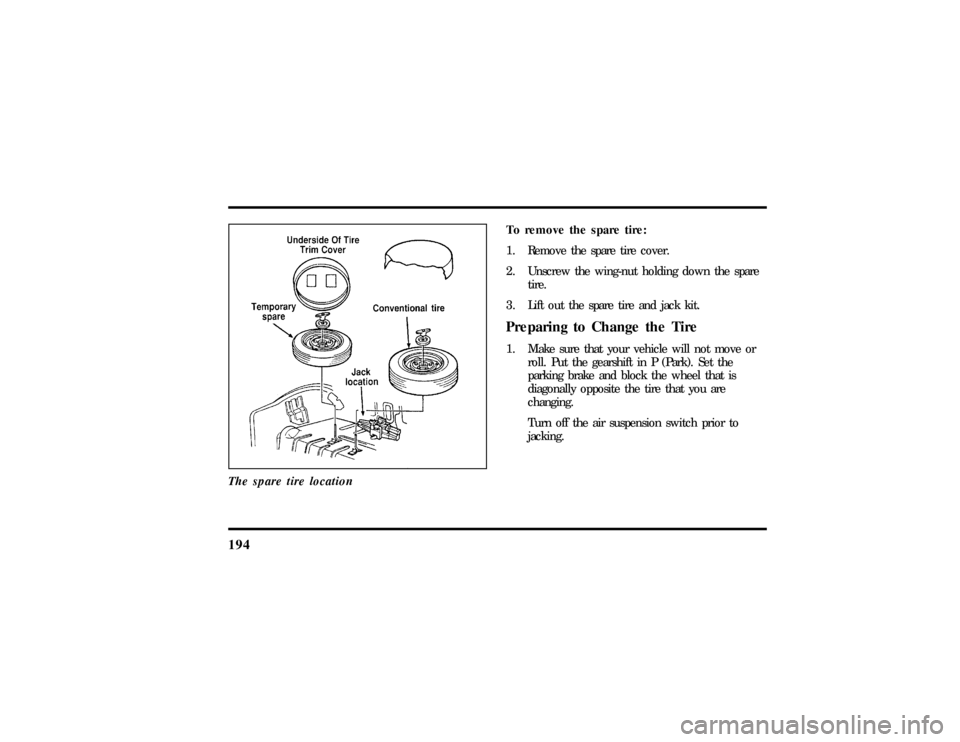
194The spare tire location
To remove the spare tire:
1. Remove the spare tire cover.
2. Unscrew the wing-nut holding down the spare
tire.
3. Lift out the spare tire and jack kit.Preparing to Change the Tire1. Make sure that your vehicle will not move or
roll. Put the gearshift in P (Park). Set the
parking brake and block the wheel that is
diagonally opposite the tire that you are
changing.
Turn off the air suspension switch prior to
jacking.
File:10fnert.ex
Update:Thu Jun 20 15:16:36 1996
Page 200 of 305
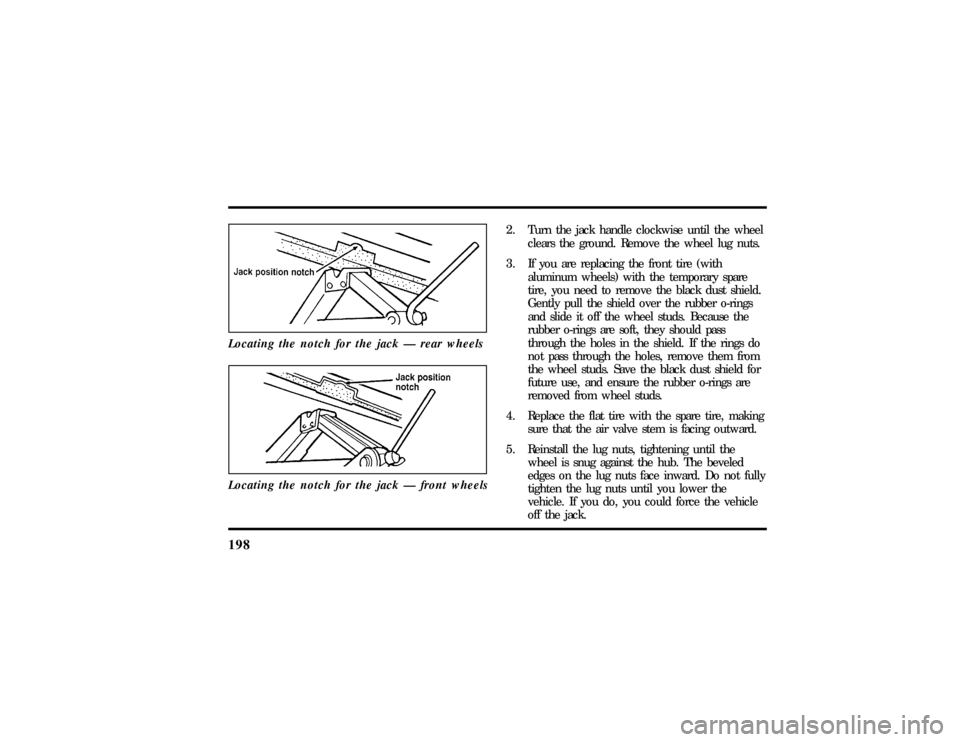
198Locating the notch for the jack Ð rear wheelsLocating the notch for the jack Ð front wheels
2. Turn the jack handle clockwise until the wheel
clears the ground. Remove the wheel lug nuts.
3. If you are replacing the front tire (with
aluminum wheels) with the temporary spare
tire, you need to remove the black dust shield.
Gently pull the shield over the rubber o-rings
and slide it off the wheel studs. Because the
rubber o-rings are soft, they should pass
through the holes in the shield. If the rings do
not pass through the holes, remove them from
the wheel studs. Save the black dust shield for
future use, and ensure the rubber o-rings are
removed from wheel studs.
4. Replace the flat tire with the spare tire, making
sure that the air valve stem is facing outward.
5. Reinstall the lug nuts, tightening until the
wheel is snug against the hub. The beveled
edges on the lug nuts face inward. Do not fully
tighten the lug nuts until you lower the
vehicle. If you do, you could force the vehicle
off the jack.
File:10fnert.ex
Update:Thu Jun 20 15:16:36 1996
Page 201 of 305
199
6. Lower the vehicle by turning the jack handle
counterclockwise.
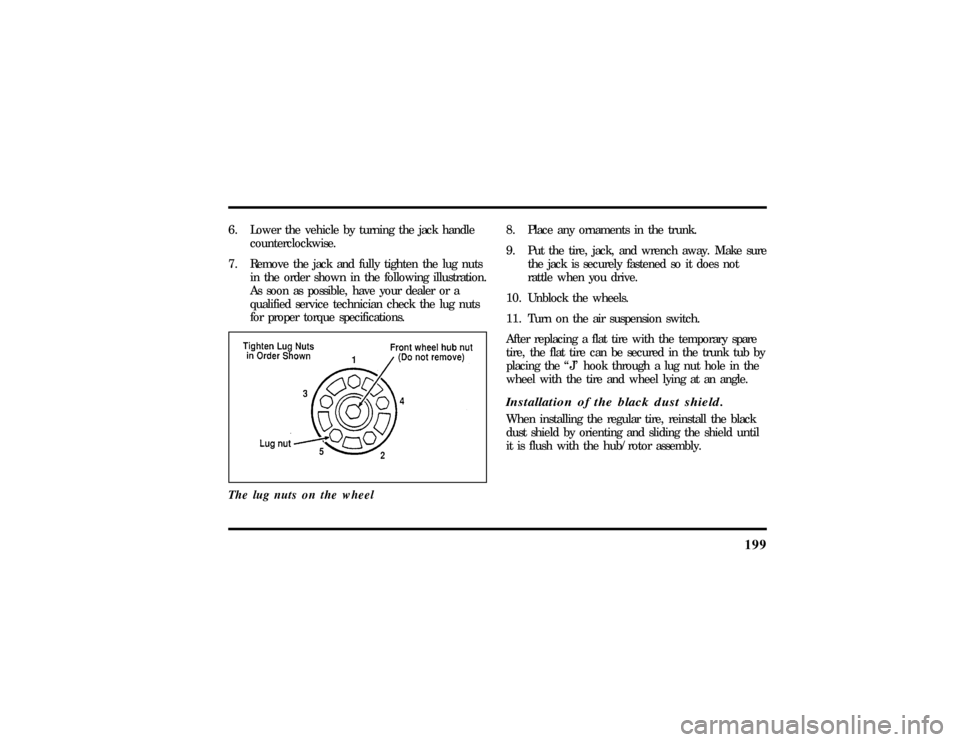
7. Remove the jack and fully tighten the lug nuts
in the order shown in the following illustration.
As soon as possible, have your dealer or a
qualified service technician check the lug nuts
for proper torque specifications.
The lug nuts on the wheel
8. Place any ornaments in the trunk.
9. Put the tire, jack, and wrench away. Make sure
the jack is securely fastened so it does not
rattle when you drive.
10. Unblock the wheels.
11. Turn on the air suspension switch.
After replacing a flat tire with the temporary spare
tire, the flat tire can be secured in the trunk tub by
placing the ªJº hook through a lug nut hole in the
wheel with the tire and wheel lying at an angle.Installation of the black dust shield.When installing the regular tire, reinstall the black
dust shield by orienting and sliding the shield until
it is flush with the hub/rotor assembly.
File:10fnert.ex
Update:Thu Jun 20 15:16:36 1996