rear LOTUS ELISE 2005 Owner's Manual
[x] Cancel search | Manufacturer: LOTUS, Model Year: 2005, Model line: ELISE, Model: LOTUS ELISE 2005Pages: 205, PDF Size: 4.51 MB
Page 67 of 205
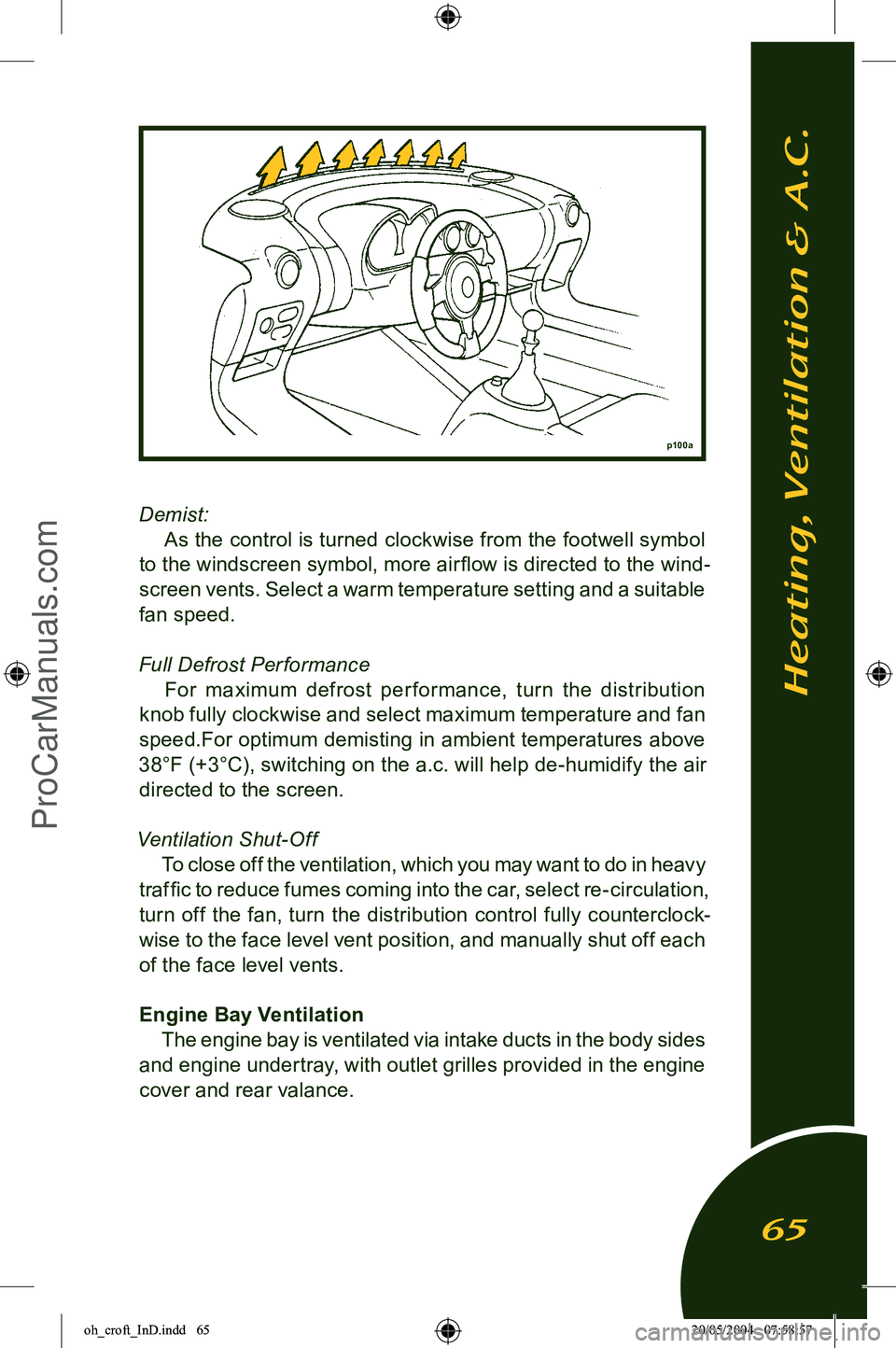
Demist:
As the control is turned clockwise from the footwell symbol
to the windscreen symbol, more air flow is directed to the wind
-
screen vents. Select a warm temperature setting and a suitable
fan speed.
Full Defrost Per formance For maximum defrost per formance, turn the distribution
knob fully clockwise and select maximum temperature and fan
speed.For optimum demisting in ambient temperatures above
38°F (+3°C), switching on the a.c. will help de-humidify the air directed to the screen.
Ventilation Shut-Off To close off the ventilation, which you may want to do in heavy
traffic to reduce fumes coming into the car, select re-circulation,
turn off the fan, turn the distribution control fully counterclock
-
wise to the face level vent position, and manually shut off each of the face level vents.
Engine Bay Ventilation The engine bay is ventilated via intake ducts in the body sides
and engine undertray, with outlet grilles provided in the engine
cover and rear valance.
p100a
Heating, Ventilation & A.C.
65
oh_croft_InD.indd 6520/05/2004 07:58:57ProCarManuals.com
Page 68 of 205
DRIVING CONTROLS
Foot PedalsThe clutch pedal, brake pedal and accelerator pedal are ar
-
ranged in the usual positions, and are grouped closely together for ready access and refined driving technique.
WARNING: Do not attempt to drive the car without suitable narrow
soled, flat heeled footwear. Bare feet may inhibit the ap
-
plication of full pressure to the brake pedal, and adversely affect your control of the car. Bare feet could also suffer
burns from sun heated metal surfaces in the car
Footwell Carpets
WARNING: It is essential that any floor covering in the footwell is
properly secured. Loose mats can interfere with the opera
-
tion of the pedals causing possible loss of control and a crash in which you or others could be killed or seriously
injured.
The carpets fitted in the footwells of the Elise are secured by
two button screws at the rear, and Velcro strips beneath the front edge. Always ensure that the carpets are replaced and secured
correctly, and never fit any loose mats on top.
Clutch Pedal NOTICE:
• To avoid unnecessary clutch wear, do not, for more than
a few moments, slip the clutch to ‘hold’ the car on a slope;
apply the parking brake until ready to drive off.
• The clutch pedal must be fully depressed during each
gear shift.
• Do not drive with the left foot resting on the clutch pedal, as
rapid wear of the clutch components can result. A left foot rest
is provided for comfort and convenience.
Driving Controls
66
oh_croft_InD.indd 6620/05/2004 07:58:57ProCarManuals.com
Page 69 of 205
FootbrakeVentilated disc brakes are fitted to all four wheels of the
Elise. These are operated by separate front and rear hydraulic
circuits, supplied from a tandem master cylinder with vacuum
servo. Anti-lock control is provided by a microprocessor based
electro-hydraulic unit, integrated into the base braking system. The braking system is designed to provide good pedal feed
-
back, with efficient disc cooling to inhibit brake fade. With a
new car, or new brake system components, maximum braking
efficiency will be achieved if, for the first few hundred miles, needless heavy braking is avoided. Allow the brake pads and discs to ‘bed in’ fully before using the brakes to their full potential.
Pedal effort will reduce as the brakes are bedded in, and as they
are warmed from cold to normal working temperature. Note that
the hard grade pad material may give rise to a certain amount of brake noise under some conditions; such noise is not harmful
and does not affect the life or efficiency of the brakes.
WARNING:
• After driving through a ford, or a flooded road, some loss of braking response may be experienced until the brakes
have dried out. As soon as it is safe to do so after such an encounter, apply the brakes until normal operation
is restored. Failure to do so may result in an accident in
which you or others may be killed or seriously injured.
• The brake assistance servo uses vacuum supplied from the engine intake plenum, such that assistance is avail
-
able only when the engine is running. Never coast down
-
hill with the engine stopped. If this situation accidently arises, avoid repeated application of the brakes, or the
stored vacuum supply will be rapidly used up. Greater
pedal pressures will be required. This may adversely affect performance of the brakes which may result in an
accident in which you or others may be killed or seriously
injured.
Anti-lock Brake System The Anti-lock Brake System (ABS) is used to optimise brake
performance in extreme conditions and reduce the potential
for any wheel to lock up. Under most conditions, the maximum braking force is provided by a wheel which is rotating at about
90% of road speed. Apart from the likelihood of increasing the
Driving Controls
67
oh_croft_InD.indd 6720/05/2004 07:58:57ProCarManuals.com
Page 72 of 205
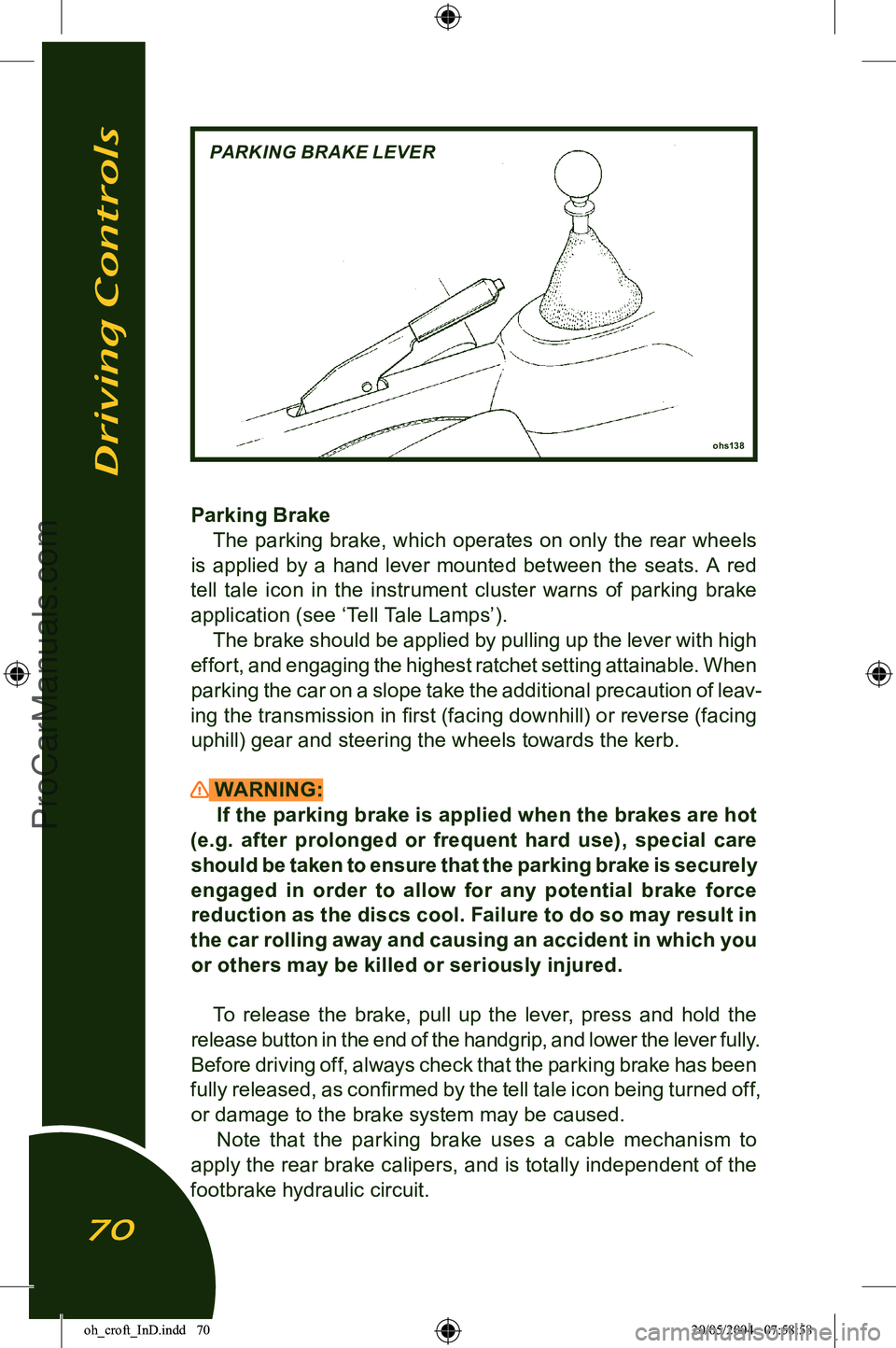
Parking BrakeThe parking brake, which operates on only the rear wheels
is applied by a hand lever mounted between the seats. A red
tell tale icon in the instrument cluster warns of parking brake application (see ‘Tell Tale Lamps’). The brake should be applied by pulling up the lever with high
effort, and engaging the highest ratchet setting attainable. When
parking the car on a slope take the additional precaution of leav
-
ing the transmission in first (facing downhill) or reverse (facing uphill) gear and steering the wheels towards the kerb.
WARNING: If the parking brake is applied when the brakes are hot
(e.g. after prolonged or frequent hard use), special care
should be taken to ensure that the parking brake is securely engaged in order to allow for any potential brake force
reduction as the discs cool. Failure to do so may result in
the car rolling away and causing an accident in which you
or others may be killed or seriously injured.
To release the brake, pull up the lever, press and hold the
release button in the end of the handgrip, and lower the lever fully.
Before driving off, always check that the parking brake has been
fully released, as confirmed by the tell tale icon being turned off,
or damage to the brake system may be caused. Note that the parking brake uses a cable mechanism to
apply the rear brake calipers, and is totally independent of the
footbrake hydraulic circuit.
Driving Controls
70
ohs138
PARKING BRAKE LEVER
oh_croft_InD.indd 7020/05/2004 07:58:58ProCarManuals.com
Page 79 of 205
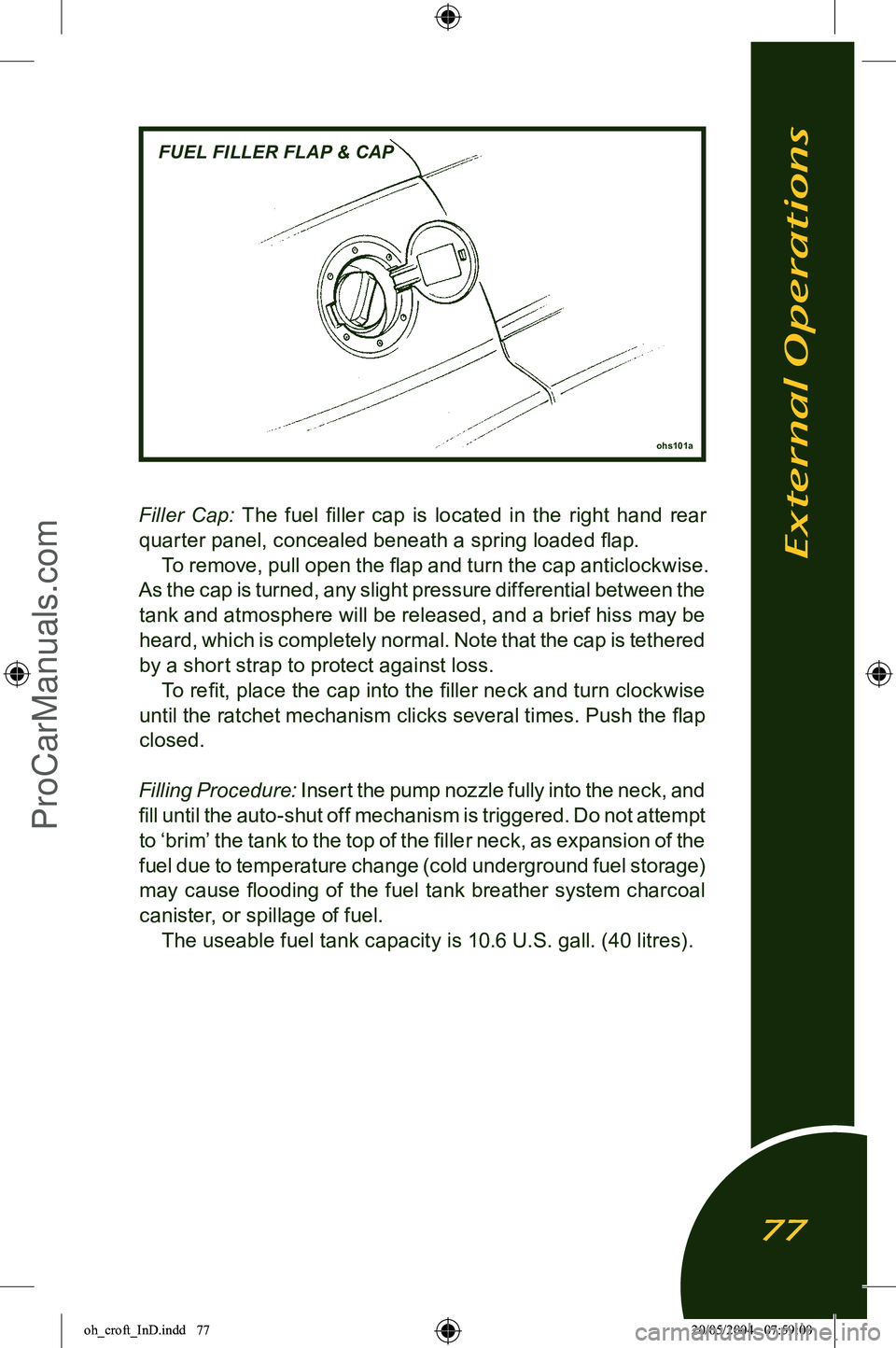
Filler Cap: The fuel filler cap is located in the right hand rear
quarter panel, concealed beneath a spring loaded flap. To remove, pull open the flap and turn the cap anticlockwise.
As the cap is turned, any slight pressure differential between the tank and atmosphere will be released, and a brief hiss may be heard, which is completely normal. Note that the cap is tethered by a short strap to protect against loss.
To refit, place the cap into the filler neck and turn clockwise
until the ratchet mechanism clicks several times. Push the flap closed.
Filling Procedure:
Insert the pump nozzle fully into the neck, and
fill until the auto-shut off mechanism is triggered. Do not attempt to ‘brim’ the tank to the top of the filler neck, as expansion of the
fuel due to temperature change (cold underground fuel storage) may cause flooding of the fuel tank breather system charcoal
canister, or spillage of fuel. The useable fuel tank capacity is 10.6 U.S. gall. (40 litres).
ohs101a
FUEL FILLER FLAP & CAP
External Operations
77
oh_croft_InD.indd 7720/05/2004 07:59:00ProCarManuals.com
Page 80 of 205
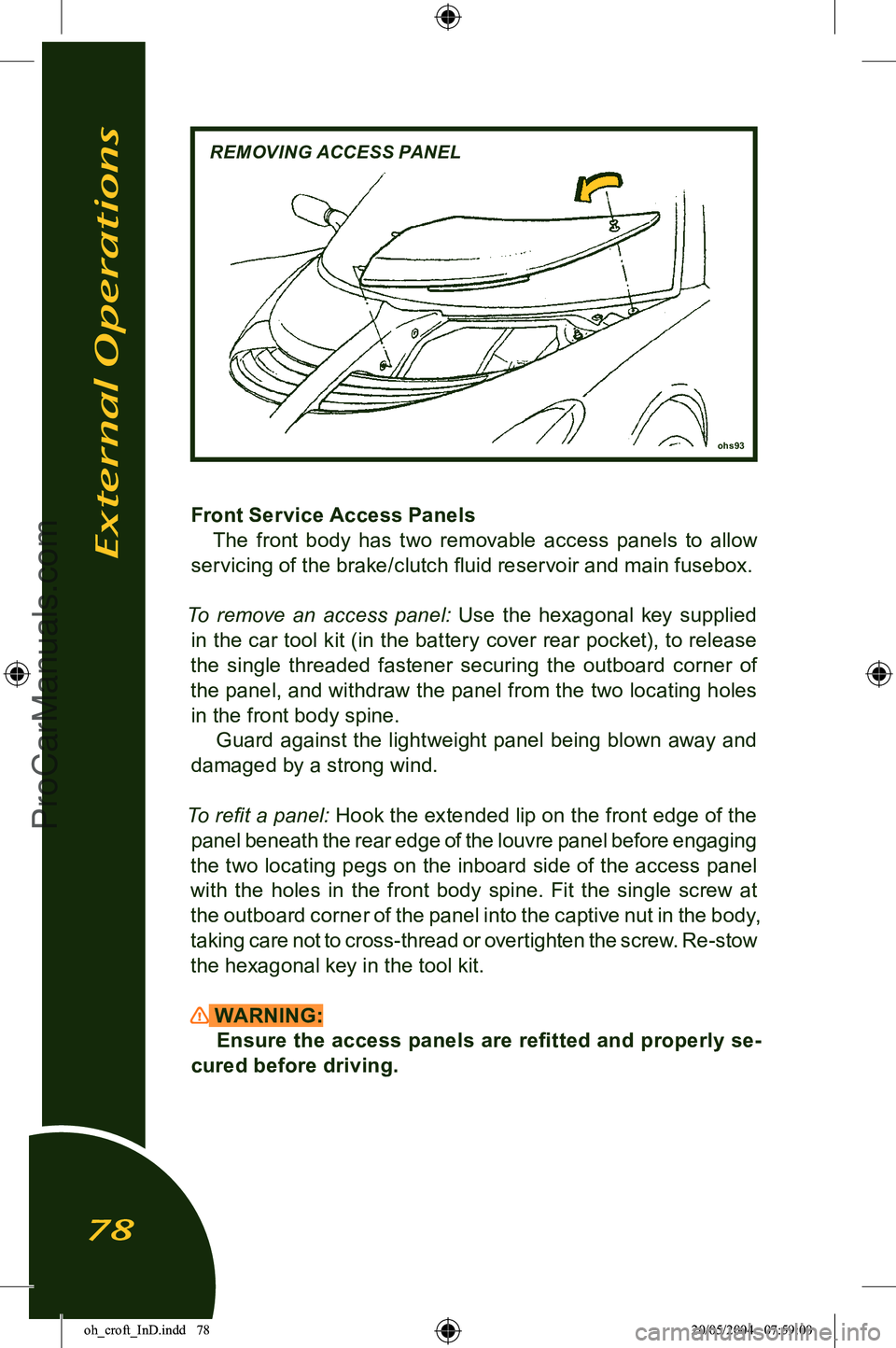
ohs93
REMOVING ACCESS PANEL
Front Service Access PanelsThe front body has two removable access panels to allow
servicing of the brake/clutch fluid reservoir and main fusebox.
To remove an access panel:
Use the hexagonal key supplied
in the car tool kit (in the battery cover rear pocket), to release
the single threaded fastener securing the outboard corner of
the panel, and withdraw the panel from the two locating holes in the front body spine. Guard against the lightweight panel being blown away and
damaged by a strong wind.
To refit a panel: Hook the extended lip on the front edge of the panel beneath the rear edge of the louvre panel before engaging
the two locating pegs on the inboard side of the access panel
with the holes in the front body spine. Fit the single screw at
the outboard corner of the panel into the captive nut in the body,
taking care not to cross-thread or overtighten the screw. Re-stow
the hexagonal key in the tool kit.
WARNING: Ensure the access panels are refitted and properly se
-
cured before driving.
External Operations
78
oh_croft_InD.indd 7820/05/2004 07:59:00ProCarManuals.com
Page 81 of 205
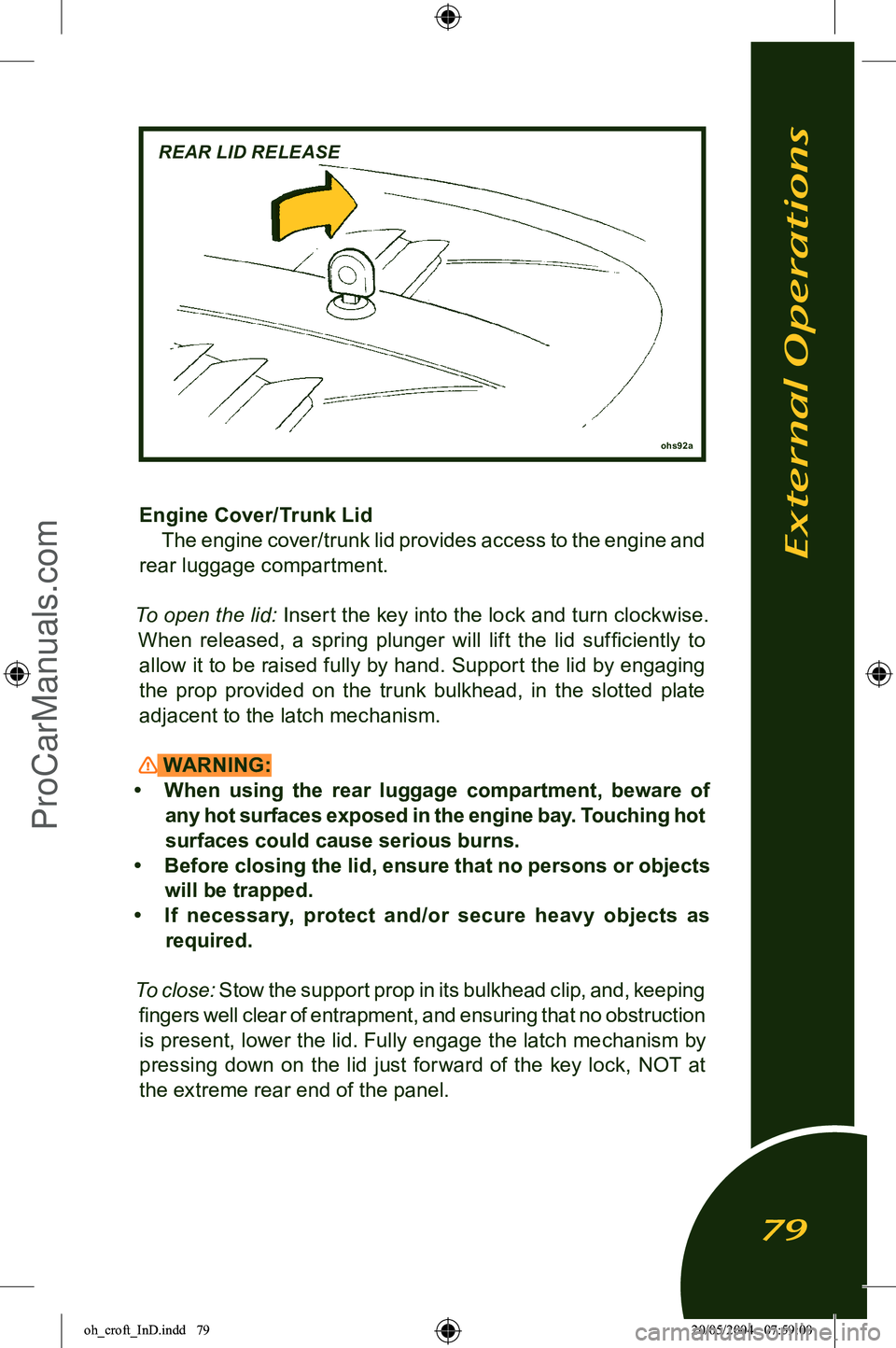
Engine Cover/Trunk LidThe engine cover/trunk lid provides access to the engine and
rear luggage compartment.
To open the lid: Insert the key into the lock and turn clockwise. When released, a spring plunger will lift the lid sufficiently to allow it to be raised fully by hand. Support the lid by engaging
the prop provided on the trunk bulkhead, in the slotted plate adjacent to the latch mechanism.
WARNING:
• When using the rear luggage compartment, beware of any hot surfaces exposed in the engine bay. Touching hot
surfaces could cause serious burns.
• Before closing the lid, ensure that no persons or objects
will be trapped.
• If necessary, protect and/or secure heavy objects as required.
To close: Stow the support prop in its bulkhead clip, and, keeping
fingers well clear of entrapment, and ensuring that no obstruction is present, lower the lid. Fully engage the latch mechanism by pressing down on the lid just forward of the key lock, NOT at
the extreme rear end of the panel.
ohs92a
REAR LID RELEASE
External Operations
79
oh_croft_InD.indd 7920/05/2004 07:59:00ProCarManuals.com
Page 82 of 205
ohs148
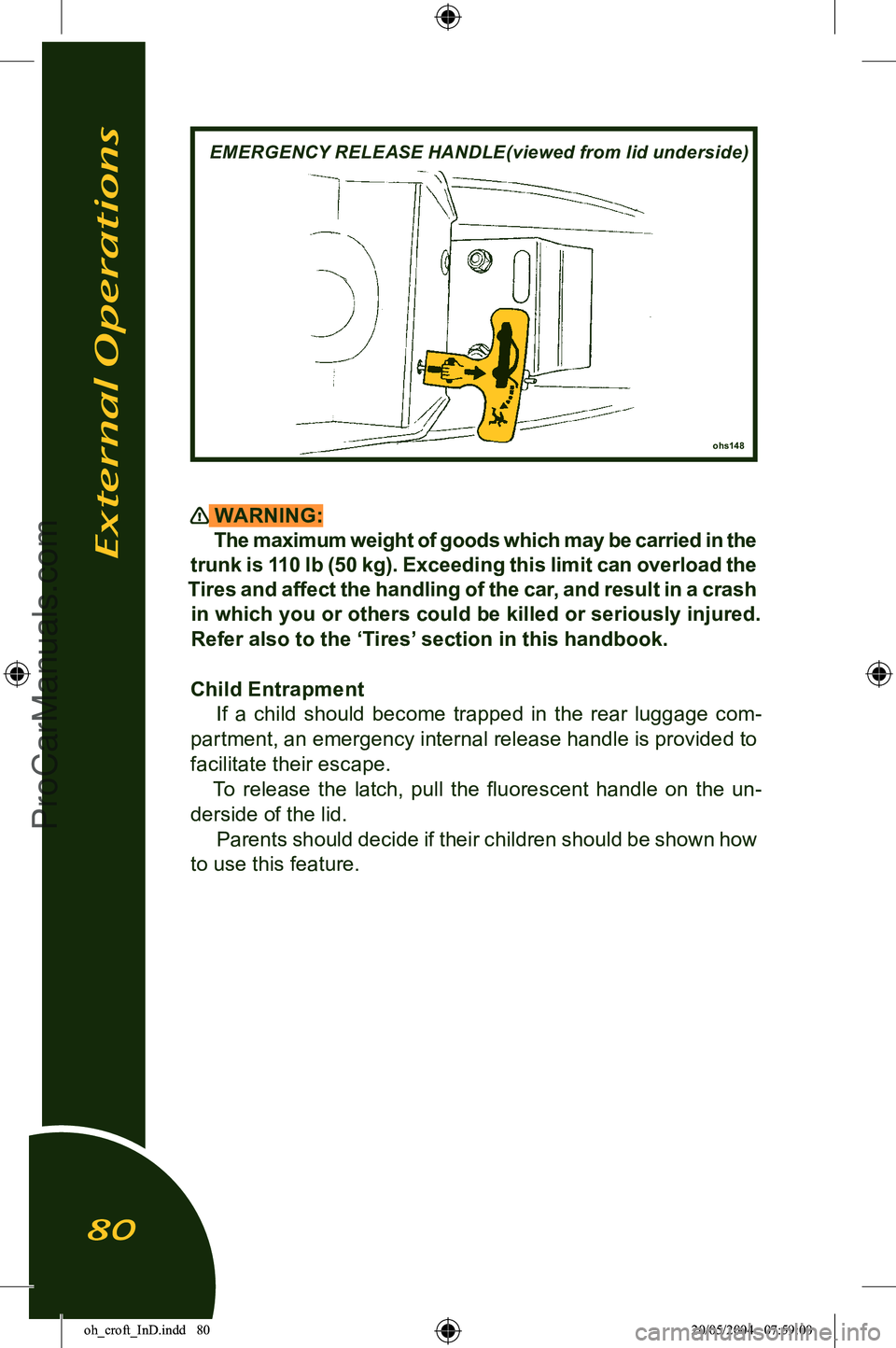
EMERGENCY RELEASE HANDLE (viewed from lid underside)
WARNING:The maximum weight of goods which may be carried in the
trunk is 110 lb (50 kg). Exceeding this limit can overload the
Tires and affect the handling of the car, and result in a crash in which you or others could be killed or seriously injured.
Refer also to the ‘Tires’ section in this handbook.
Child Entrapment If a child should become trapped in the rear luggage com
-
partment, an emergency internal release handle is provided to facilitate their escape.
To release the latch, pull the fluorescent handle on the un
-
derside of the lid. Parents should decide if their children should be shown how
to use this feature.
External Operations
80
oh_croft_InD.indd 8020/05/2004 07:59:00ProCarManuals.com
Page 84 of 205

b332
FITTING ROOF STAYS
Soft Top Roof - Fitting
WARNING:Do not attempt to fit the soft top roof whilst the car is in
motion. This could cause a crash in which you or others
could be killed or seriously injured.
1. From its stowage bag in the rear luggage compartment, with-
draw the roof assembly and support stays. Lower both door
windows, or open both doors.
2. Insert the two, identical, roof support stays, with the arrows pointing forwards, into the slots above the rear window, and
in the windscreen header rail. Note that the slots are keyed
to allow fitment of the stays in only the correct orientation.
3. Lay the soft top roof across the centre of the roof space with
the arrows on the side rails pointing forwards.
External Operations
82
Arrows
point for ward
Rear end keyway
oh_croft_InD.indd 8220/05/2004 07:59:01ProCarManuals.com
Page 85 of 205
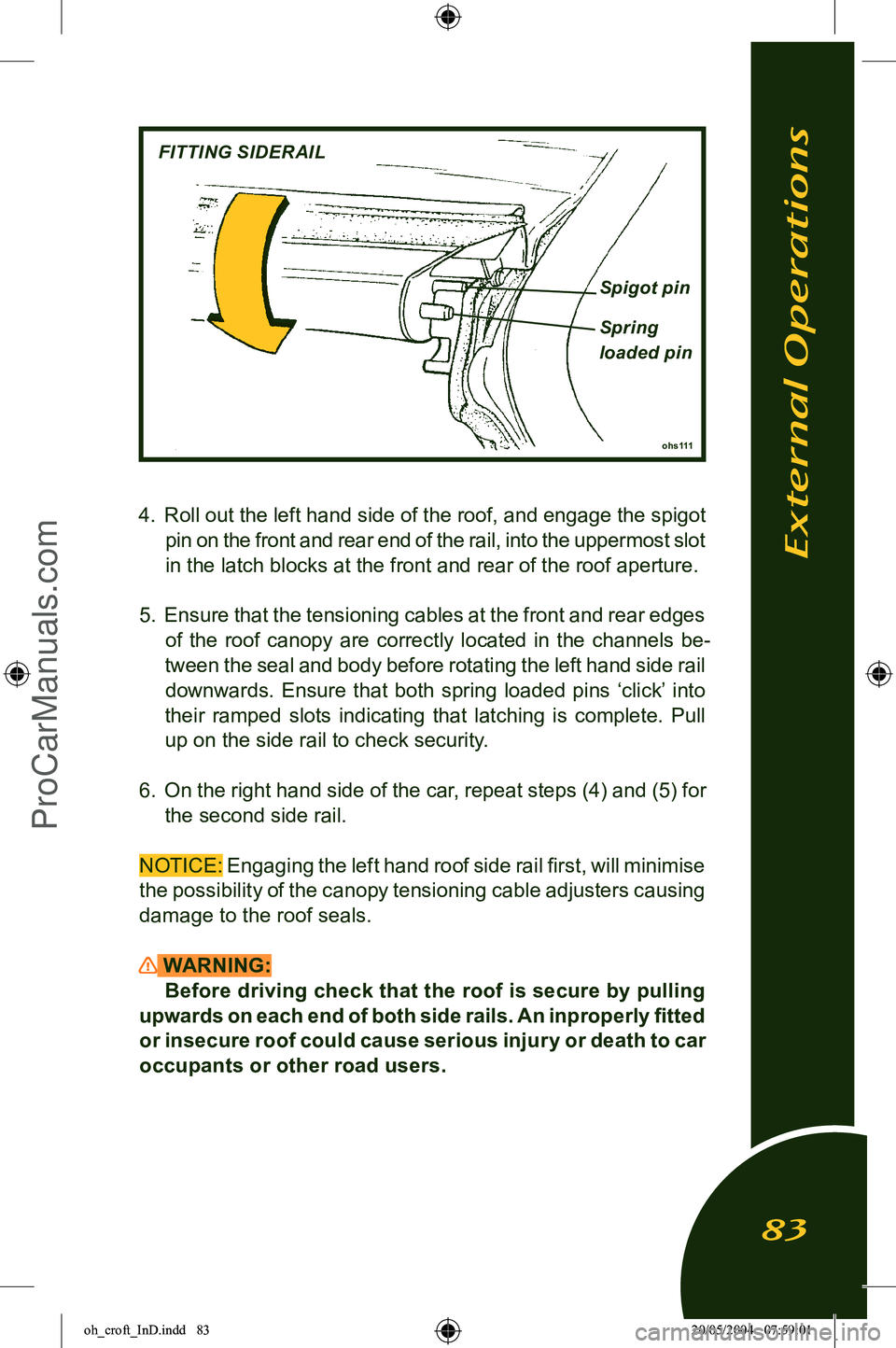
4. Roll out the left hand side of the roof, and engage the spigot
pin on the front and rear end of the rail, into the uppermost slot
in the latch blocks at the front and rear of the roof aperture.
5. Ensure that the tensioning cables at the front and rear edges of the roof canopy are correctly located in the channels be
-
tween the seal and body before rotating the left hand side rail downwards. Ensure that both spring loaded pins ‘click’ into
their ramped slots indicating that latching is complete. Pull up on the side rail to check security.
6. On the right hand side of the car, repeat steps (4) and (5) for
the second side rail.
NOTICE: Engaging the left hand roof side rail first, will minimise
the possibility of the canopy tensioning cable adjusters causing damage to the roof seals.
WARNING: Before driving check that the roof is secure by pulling
upwards on each end of both side rails. An inproperly fitted
or insecure roof could cause serious injury or death to car
occupants or other road users.
External Operations
83
ohs111
FITTING SIDERAIL
Spigot pin
Spring
loaded pin
oh_croft_InD.indd 8320/05/2004 07:59:01ProCarManuals.com