rear LOTUS ELISE 2005 Owner's Guide
[x] Cancel search | Manufacturer: LOTUS, Model Year: 2005, Model line: ELISE, Model: LOTUS ELISE 2005Pages: 205, PDF Size: 4.51 MB
Page 86 of 205

ohs149
RELEASING ROOF SIDE RAIL
Soft Top - Removal
WARNING:Do not attempt to remove the soft top roof whilst the
car is in motion. This could cause a crash in which you or
others could be killed or seriously injured.
1. With the car stationary, open both doors or lower both door windows.
2. On the inside face of the right hand roof side rail, locate the
two latch release levers: Pull the two lever handles towards each other to release the side rail latches (press down on the
side rail if necessary to relieve the load on the latch pins), and rotate the rail upwards to release the canopy tension.
3. Repeat step (2) for the
left hand side rail.
NOTICE: Releasing the right hand roof side rail first, will minimise
the possibility of the canopy tensioning cable adjusters causing damage to the roof seals.
4. Free the front and rear tensioning cables from the gutters be
-
fore carefully rolling up each side of the roof canopy towards the centre. Lift the roof assembly off the car, and pack in the
roof bag.
External Operations
84
oh_croft_InD.indd 8420/05/2004 07:59:01ProCarManuals.com
Page 87 of 205
5. Unhook the two roof stays and pack in the roof bag. Stow the
bag in the rear luggage compartment.
NOTICE: If the roof is not fully dry, it should be stowed for no longer than 1 or 2 days before unrolling or refitting and allowing
to air dry completely. Prolonged stowage of a wet or damp roof
will promote rotting of the fabric.
HARD TOP ROOF
NOTICE:
• The hard top roof has been designed to provide a seasonal,
rather than single trip option. Some owners may prefer to
entrust the fitting and removal of the hard top roof to their
dealer.
• When stowing the roof off the car, care should be taken to
avoid damage to the roof corners; e.g. use a suitable soft
floor covering on which to stand the roof. Note that there is
no provision for on-board hard top roof stowage.
• Fitment or removal of the hardtop is made considerably easier
with the assistance of a second person.
• Use only the ‘Torx’ tool supplied in the car tool kit (in the
battery cover rear pocket), to tighten or release the roof
fixing screws.
• The hardtop roof fixings are tethered to the roof panel to guard
against their loss.
WARNING:
Take care to avoid trapping hands or fingers when fitting
or removing the hard top.
External Operations
85
oh_croft_InD.indd 8520/05/2004 07:59:01ProCarManuals.com
Page 88 of 205

b330
FRONT SPIGOT BRACKET
Hard Top - Fitting
1. Open both doors, and preferably with the aid of an assistant, lower the roof onto the car holding aside the loose tethered
fixings to avoid their entrapment or their causing paint damage. Position the rear edge of the roof first before locating the front
edge against the windscreen header rail.
2. Locate a front spigot bracket into its latch plate lower slot (lifting the roof slightly to allow this) and retain to the roof with the Torx bolt. Use only the special Torx tool supplied in the car tool kit (stowed in the battery cover pocket), and do not
fully tighten at this stage.
3. Repeat step (2) for the opposite front spigot bracket.
External Operations
86
oh_croft_InD.indd 8620/05/2004 07:59:02ProCarManuals.com
Page 89 of 205

4. Engage a rear hook bracket with the lower tongue on its rear latch plate, and retain to the roof with the Torx bolt. Use only
the special tool supplied, and do not fully tighten at this stage.
Ensure that the hook is fully located onto the tongue.
5. Repeat step (4) for the opposite rear hook bracket. 6. Push the roof fully forwards before tightening the front spigot brackets using only the special Torx tool supplied. Hold each
rear hook bracket in alignment whilst tightening the single
fixing screw for each bracket. Do not overtighten.
h2
FITTING REAR HOOK BRACKET
External Operations
87
oh_croft_InD.indd 8720/05/2004 07:59:02ProCarManuals.com
Page 90 of 205

REAR CORNER COVER PANEL
7. Fit the trimmed cover panels to each rear corner of the roof, noting that the panels are handed for left and right sides. Press
the panels firmly into position fully to engage the ‘Velcro’ fixing
patches.
WARNING: Do not drive the car with the cover panels removed.
Injury could result from contact with the roof brackets in
a car collision.
External Operations
88
oh_croft_InD.indd 8820/05/2004 07:59:02ProCarManuals.com
Page 94 of 205
ohs149
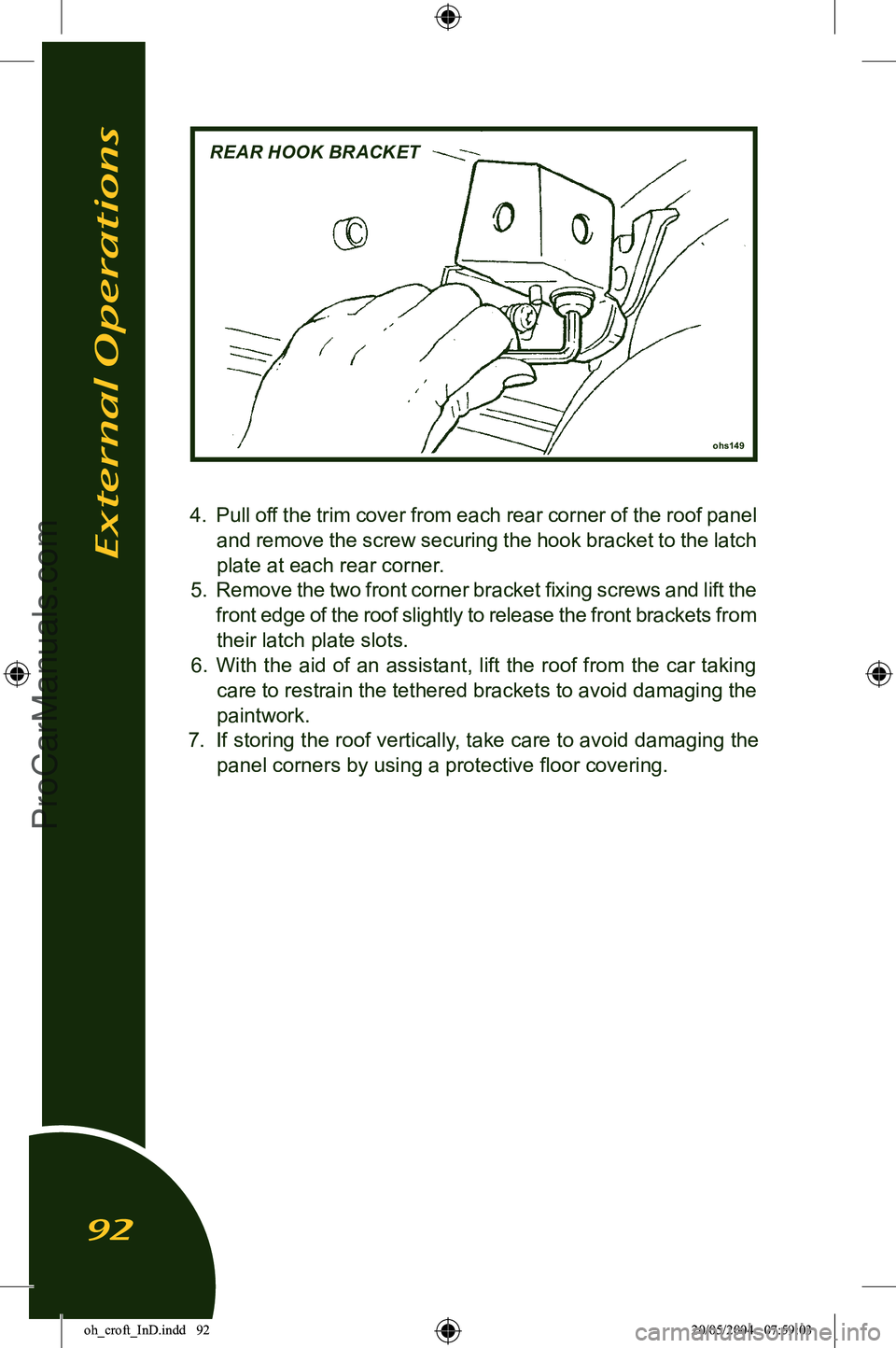
REAR HOOK BRACKET
4. Pull off the trim cover from each rear corner of the roof panel and remove the screw securing the hook bracket to the latch plate at each rear corner.
5. Remove the two front corner bracket fixing screws and lift the
front edge of the roof slightly to release the front brackets
from
their latch plate slots.
6. With the aid of an assistant, lift the roof from the car taking care to restrain the tethered brackets to avoid damaging the
paintwork.
7. If storing the roof vertically, take care to avoid damaging the panel corners by using a protective floor covering.
External Operations
92
oh_croft_InD.indd 9220/05/2004 07:59:03ProCarManuals.com
Page 95 of 205
SERVICING AND MAINTENANCEBODYCARE
Body Features Lotus are among the world leaders in the field of automotive
composite moulding design and manufacturing techniques.
Composite materials have major advantages for specialist car bodies, and these brief notes introduce some features of the
construction and service properties of automotive composite bodies. The manufacturing process enables the thickness of com
-
posite mouldings to be varied in order to provide ef ficient structures of high strength and low weight. Composites will not
corrode, so the strength of composite components is retained regardless of age, unless physical damage is sustained. On
the Elise, the body construction utilises several mouldings to
form a single unit for the whole of the nose and front wings, and
a second unit for the whole of the rear body aft of the doors.
These two moulded assemblies are fixed using threaded fasten
-
ers to permit easy removal for access to chassis or powertrain
components, or to allow simple and economic accident repair.
Other composite mouldings include the door shells, sills, front access panels, windscreen frame and rear bulkhead, some panels being bonded to the aluminium alloy chassis with an
elastomeric adhesive.
Several different processes are used to manufacture the
various panels depending on the functional requirements, with the main outer panels using an injection compression mould
-
ing technique which eliminates the ‘gelcoat’ used on the outer
surface of conventionally manufactured composite panels. This
process provides considerably increased resistance to surface
damage from minor knocks, where a conventional composite panel would suffer cracking of the gel coat, or a steel panel be
-
come dented. If severe damage is caused to a composite panel
where the underlying structure is broken, repairs may take the
form of panel replacement, or of panel repair using techniques
where new composite material is integrated with the old to result in undiminished panel strength.
Servicing & Maintenance
93
oh_croft_InD.indd 9320/05/2004 07:59:03ProCarManuals.com
Page 102 of 205
pressing firmly to ensure that the handle is fully seated. With-
draw the dipstick again to inspect the oil level, which should lie between the two dimples on the end of the stick. The oil level
should be maintained at the upper of these two marks in order
to provide optimum engine protection.
Topping Up
: If topping up is necessary, unscrew the oil filler cap
from the left hand end of the cam cover. Add a suitable quantity of the recommended engine oil (see ‘Recommended Lubricants’)
taking care not to spill any oil onto engine or electrical compo
-
nents; use a funnel if necessary. The difference between high and low dipstick marks is equiv
-
alent to 1.6 U.S. quarts (1.5 litre). Allow several minutes for the oil to drain through to the sump before re-checking the oil level.
Do NOT over fill, or lubrication will be degraded and consump
-
tion increased as the oil becomes aerated. Refit the filler cap,
turning clockwise until secure.
Engine Oil Change The use of high quality oil, renewed at the specified intervals,
is the key to engine longevity and sustained performance. Ad
-
here strictly to the engine oil and filter change intervals specified
in the Maintenance Schedule.
For access to the engine sump and filter, the engine bay
undertray must first be removed. This is most easily achieved
with the car raised on a garage hydraulic lift, or alternatively, parked over an inspection pit.
The drain plug is located at the rear of the sump, and should
be removed to drain the sump immediately after a run when
the oil is warm and the impurities are still held in suspension.
On cars fitted with front mounted oil coolers, it is not necessary routinely to attempt to drain the cooler circuit. Servicing & Maintenance
100
oh_croft_InD.indd 10020/05/2004 07:59:05ProCarManuals.com
Page 111 of 205

Washer ReservoirThe windscreen washer reservoir is situated at the left hand
rear of the engine bay, and should be kept topped up with clean
water and a suitable proprietary solvent.
NOTICE:
Do NOT use radiator antifreeze in the reservoir as
this could seriously damage the paintwork and/or some plastic components.
The washer jets are mounted each side of the wiper spindle,
and may, if necessary, be cleared or adjusted using a suitable pin.
Wiper Blade To replace the single wiper blade, lift the arm away from the
‘screen, swing the blade through 90°, depress the retaining tab and slide the blade down the arm to unhook and release.
When refitting, ensure that the retaining clip is re-engaged
in the wiper arm slot.
ohs36a
ohs130
WASHER RESERVOIR CAPWIPER BLADE FITMENT
Servicing & Maintenance
109
Retaining tab
Wiper arm
oh_croft_InD.indd 10920/05/2004 07:59:08ProCarManuals.com
Page 112 of 205
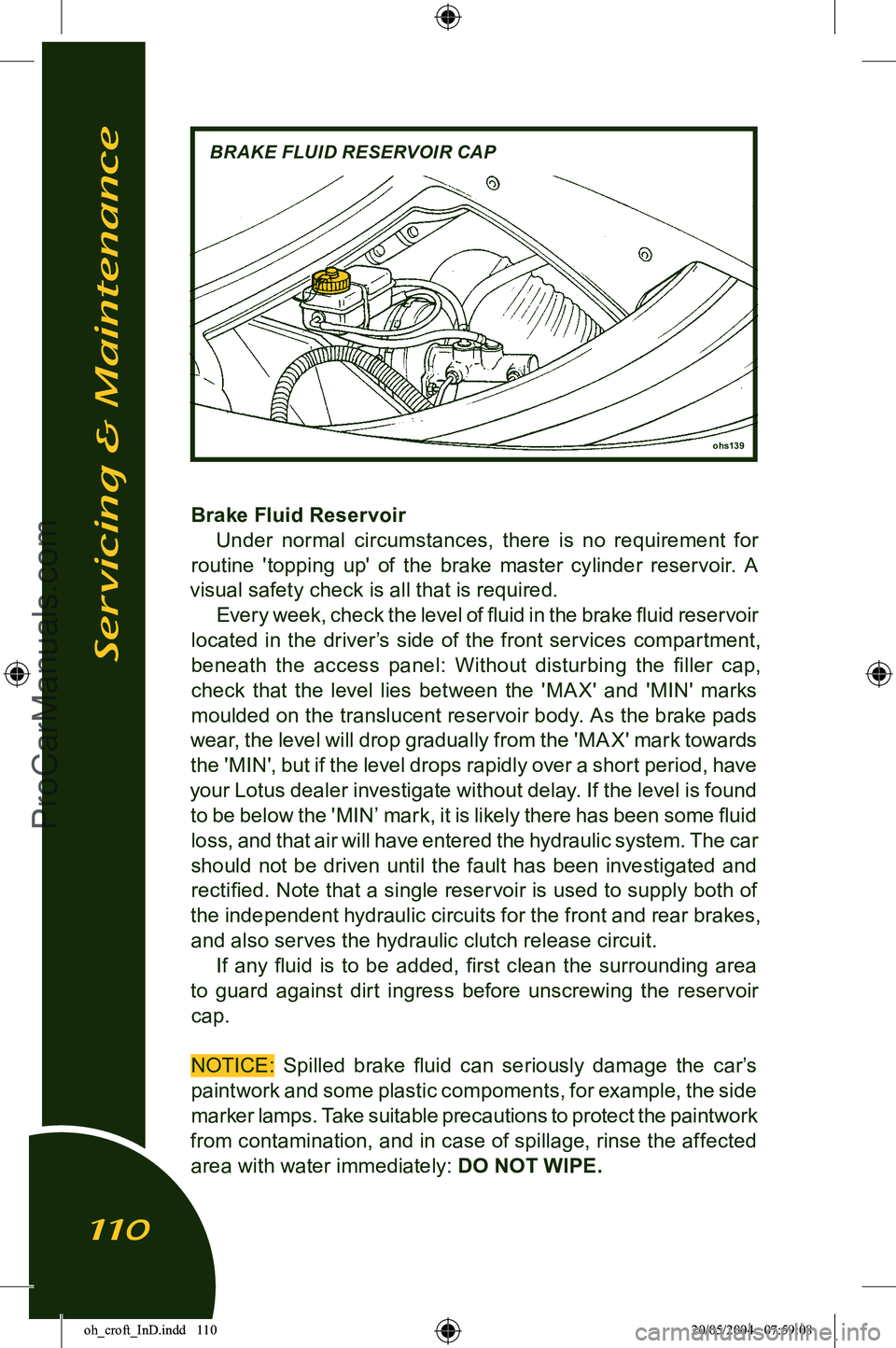
Brake Fluid ReservoirUnder normal circumstances, there is no requirement for
routine 'topping up' of the brake master cylinder reservoir. A
visual safety check is all that is required. Every week, check the level of fluid in the brake fluid reservoir
located in the driver’s side of the front services compartment, beneath the access panel: Without disturbing the filler cap,
check that the level lies between the 'MA X' and 'MIN' marks moulded on the translucent reservoir body. As the brake pads
wear, the level will drop gradually from the 'MA X' mark towards the 'MIN', but if the level drops rapidly over a short period, have
your Lotus dealer investigate without delay. If the level is found
to be below the 'MIN’ mark, it is likely there has been some fluid loss, and that air will have entered the hydraulic system. The car
should not be driven until the fault has been investigated and rectified. Note that a single reservoir is used to supply both of
the independent hydraulic circuits for the front and rear brakes, and also serves the hydraulic clutch release circuit. If any fluid is to be added, first clean the surrounding area
to guard against dirt ingress before unscrewing the reservoir cap.
NOTICE: Spilled brake fluid can seriously damage the car’s paintwork and some plastic compoments, for example, the side
marker lamps. Take suitable precautions to protect the paintwork
from contamination, and in case of spillage, rinse the affected area with water immediately: DO NOT WIPE.
ohs139
BRAKE FLUID RESERVOIR CAP
Servicing & Maintenance
110
oh_croft_InD.indd 11020/05/2004 07:59:08ProCarManuals.com