rear LOTUS ELISE 2005 Workshop Manual
[x] Cancel search | Manufacturer: LOTUS, Model Year: 2005, Model line: ELISE, Model: LOTUS ELISE 2005Pages: 205, PDF Size: 4.51 MB
Page 145 of 205
High beam bulb: Disconnect the two cables from the bulb, re-
lease the spring wire clip, and withdraw the 55W H7 bulb. On re
-
fitting, note that the bulb is keyed to allow only one orientation.
Parking lamp: Twist the bulb holder counterclockwise to release
from the main beam lamp, and withdraw the bayonet fitting T4
W bulb.
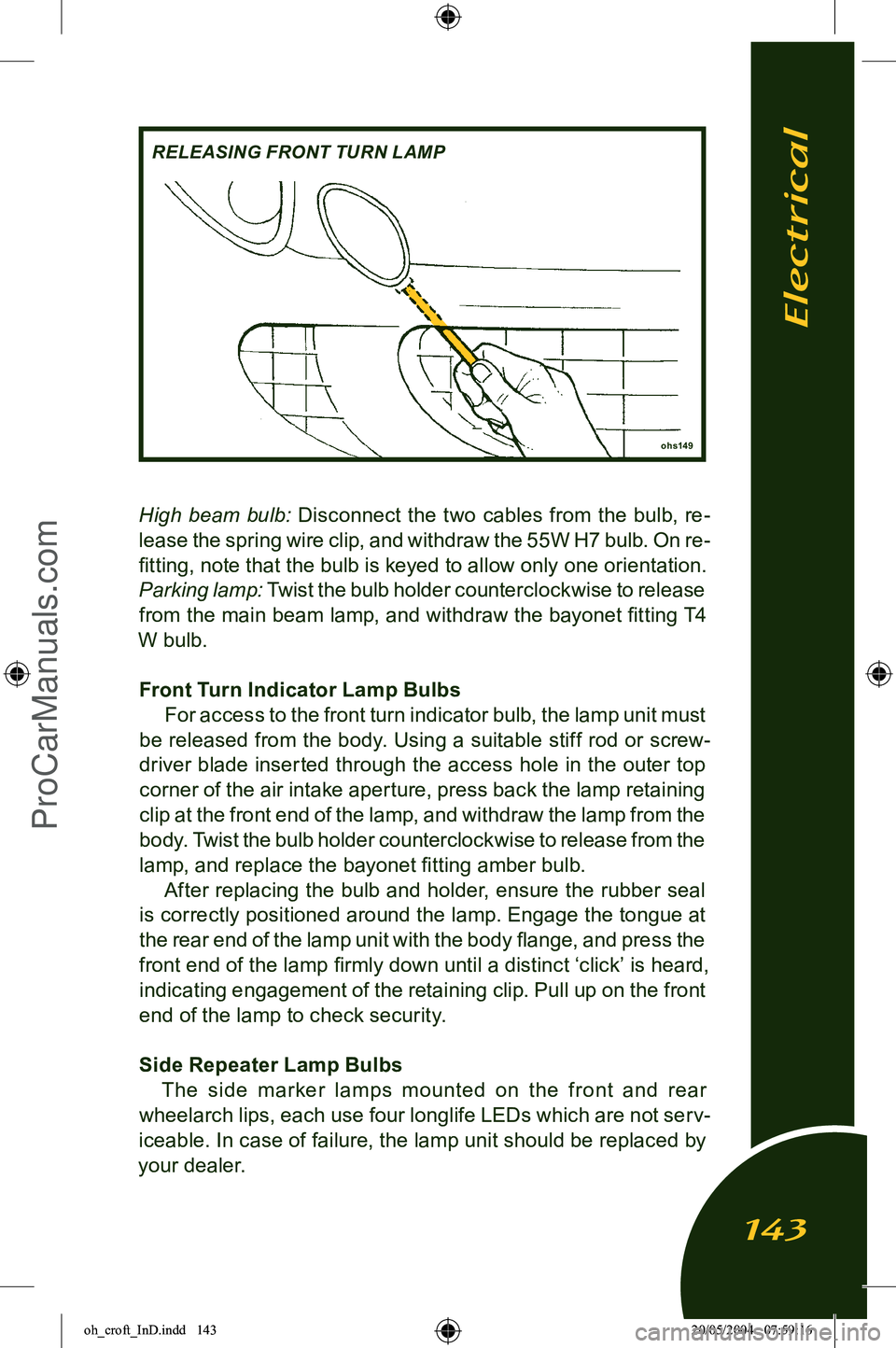
Front Turn Indicator Lamp Bulbs For access to the front turn indicator bulb, the lamp unit must
be released from the body. Using a suitable stiff rod or screw
-
driver blade inserted through the access hole in the outer top
corner of the air intake aperture, press back the lamp retaining
clip at the front end of the lamp, and withdraw the lamp from the body. Twist the bulb holder counterclockwise to release from the
lamp, and replace the bayonet fitting amber bulb. After replacing the bulb and holder, ensure the rubber seal
is correctly positioned around the lamp. Engage the tongue at
the rear end of the lamp unit with the body flange, and press the
front end of the lamp firmly down until a distinct ‘click’ is heard, indicating engagement of the retaining clip. Pull up on the front
end of the lamp to check security.
Side Repeater Lamp Bulbs The side mar ker lamps mounted on the front and rear
wheelarch lips, each use four longlife LEDs which are not serv
-
iceable. In case of failure, the lamp unit should be replaced by
your dealer.
ohs149
RELEASING FRONT TURN LAMP
Electrical
143
oh_croft_InD.indd 14320/05/2004 07:59:16ProCarManuals.com
Page 146 of 205
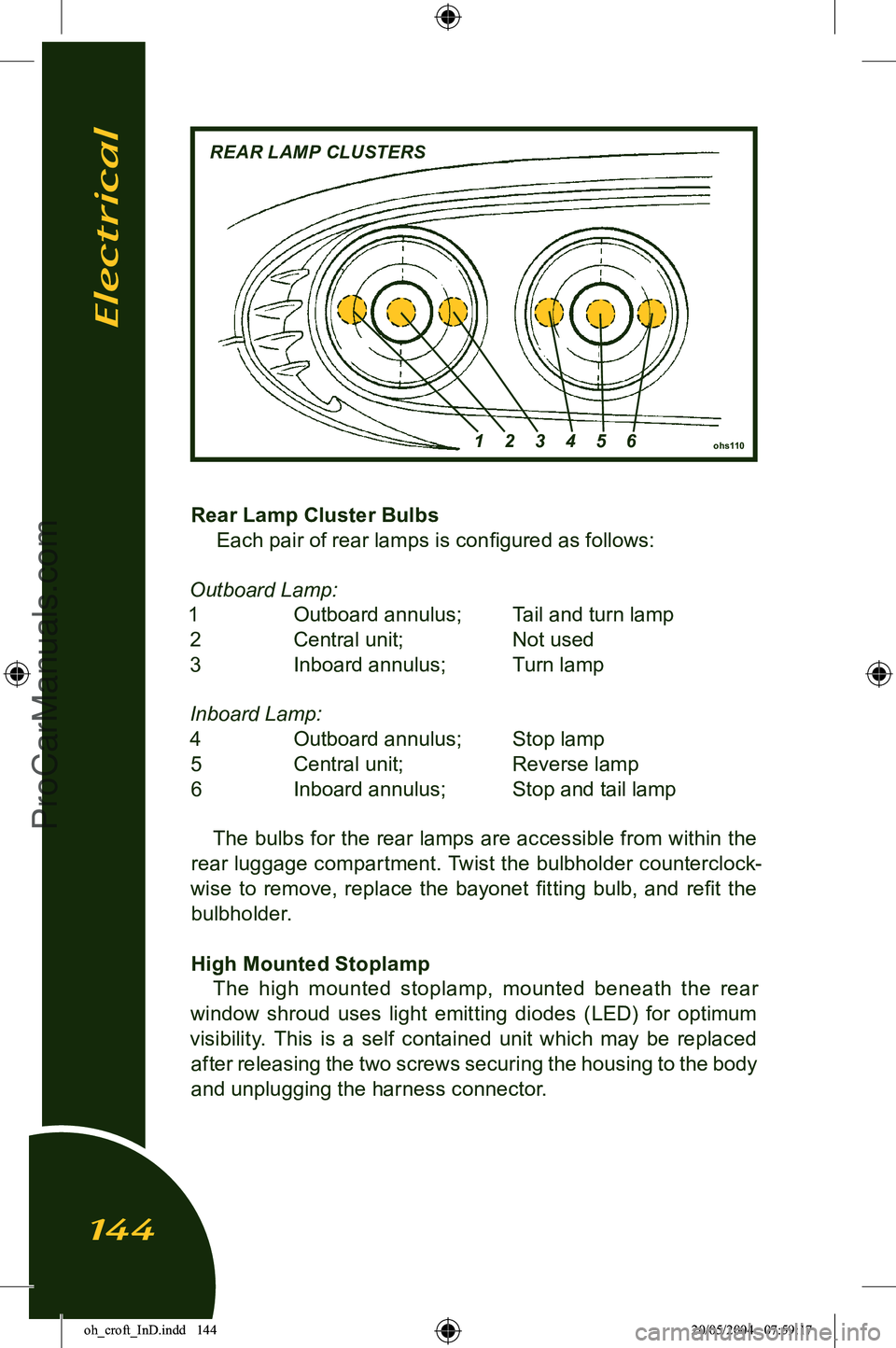
Rear Lamp Cluster BulbsEach pair of rear lamps is configured as follows:
Outboard Lamp:
1 Outboard annulus; Tail and turn lamp 2 Central unit; Not used
3 Inboard annulus; Turn lamp
Inboard Lamp: 4 Outboard annulus; Stop lamp 5 Central unit; Reverse lamp
6 Inboard annulus; Stop and tail lamp
The bulbs for the rear lamps are accessible from within the
rear luggage compartment. Twist the bulbholder counterclock
-
wise to remove, replace the bayonet fitting bulb, and refit the bulbholder.
High Mounted Stoplamp The high mounted stoplamp, mounted beneath the rear
window shroud uses light emitting diodes (LED) for optimum
visibility. This is a self contained unit which may be replaced after releasing the two screws securing the housing to the body
and unplugging the harness connector.
ohs110
REAR LAMP CLUSTERS
1 2 3 4 5 6
Electrical
144
oh_croft_InD.indd 14420/05/2004 07:59:17ProCarManuals.com
Page 147 of 205
Licence Plate Lamps To replace a bulb in a licence plate lamp, first remove the two
screws securing the lamp, and withdraw. Replace the festoon
bulb, and refit the lamp.
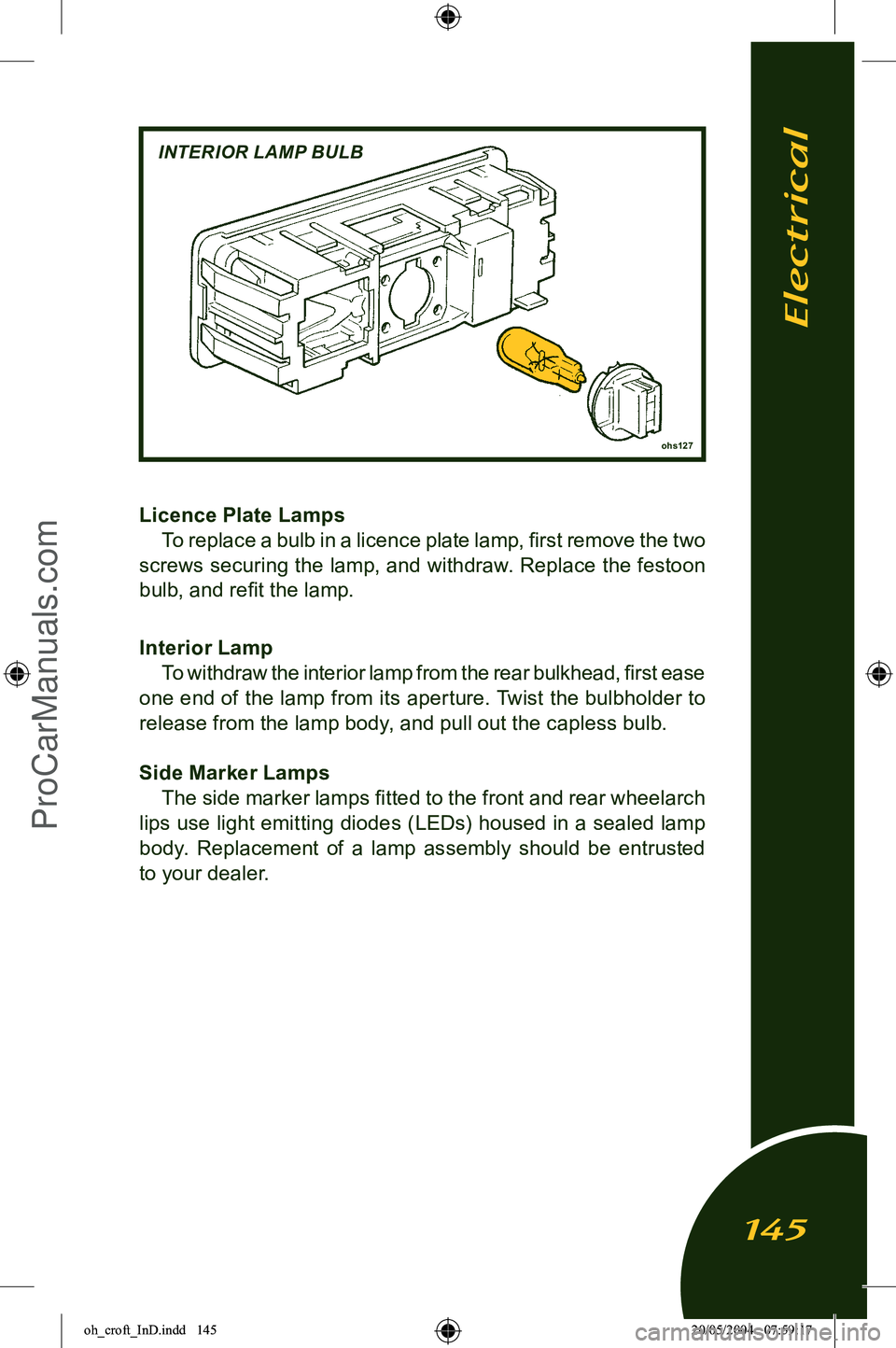
Interior Lamp To withdraw the interior lamp from the rear bulkhead, first ease
one end of the lamp from its aperture. Twist the bulbholder to release from the lamp body, and pull out the capless bulb.
Side Marker Lamps The side marker lamps fitted to the front and rear wheelarch
lips use light emitting diodes (LEDs) housed in a sealed lamp
body. Replacement of a lamp assembly should be entrusted
to your dealer.
ohs127
INTERIOR LAMP BULB
Electrical
145
oh_croft_InD.indd 14520/05/2004 07:59:17ProCarManuals.com
Page 148 of 205
LIFTING AND TOWING
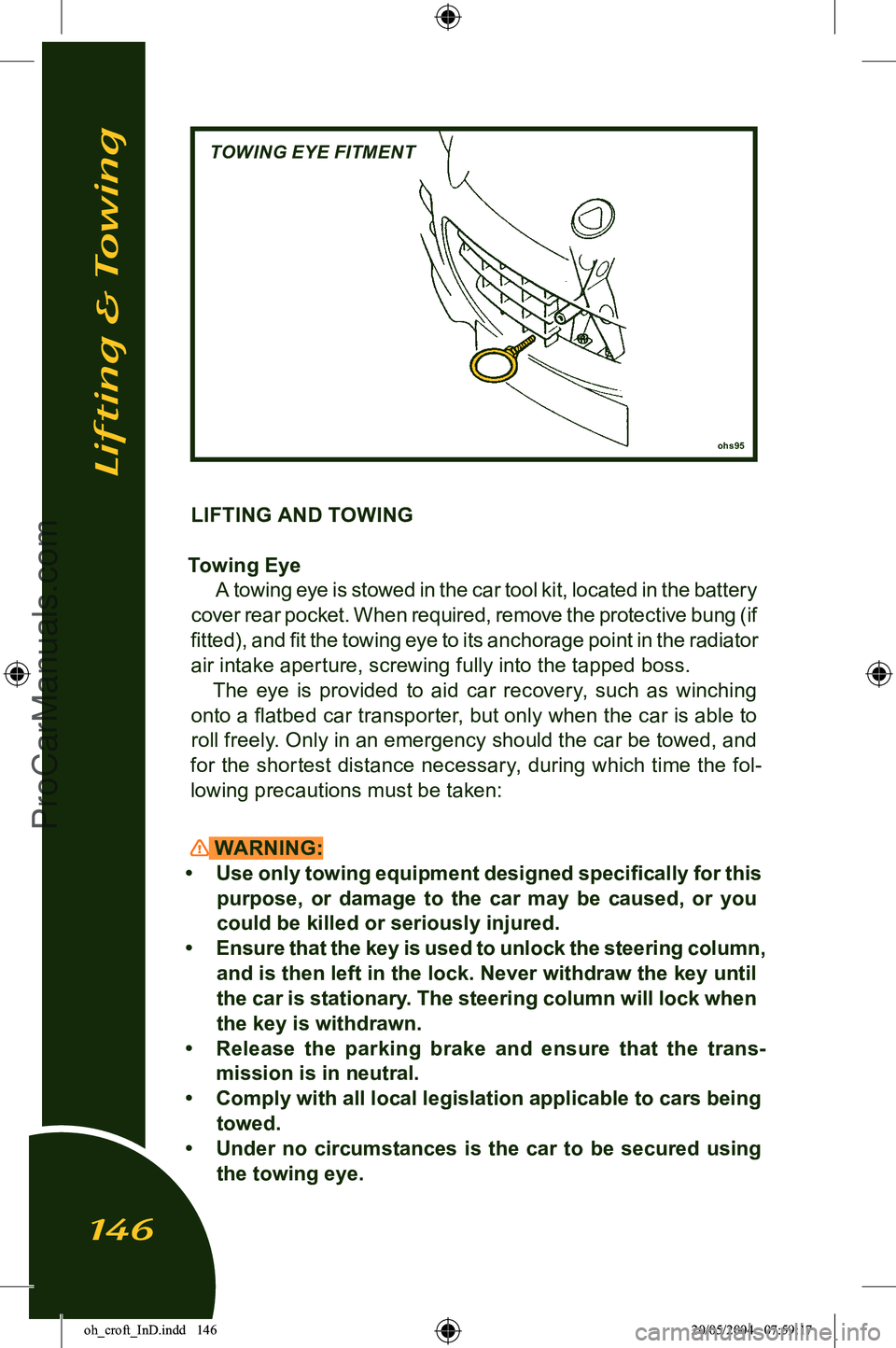
Towing Eye A towing eye is stowed in the car tool kit, located in the battery
cover rear pocket. When required, remove the protective bung (if
fitted), and fit the towing eye to its anchorage point in the radiator air intake aperture, screwing fully into the tapped boss.
The eye is provided to aid car recovery, such as winching
onto a flatbed car transporter, but only when the car is able to roll freely. Only in an emergency should the car be towed, and
for the shortest distance necessary, during which time the fol
-
lowing precautions must be taken:
WARNING:
• Use only towing equipment designed specifically for this purpose, or damage to the car may be caused, or you
could be killed or seriously injured.
• Ensure that the key is used to unlock the steering column, and is then left in the lock. Never withdraw the key until
the car is stationary. The steering column will lock when
the key is withdrawn.
• Release the parking brake and ensure that the trans
-
mission is in neutral.
• Comply with all local legislation applicable to cars being
towed.
• Under no circumstances is the car to be secured using
the towing eye.
ohs95
TOWING EYE FITMENT
Lifting & Towing
146
oh_croft_InD.indd 14620/05/2004 07:59:17ProCarManuals.com
Page 151 of 205
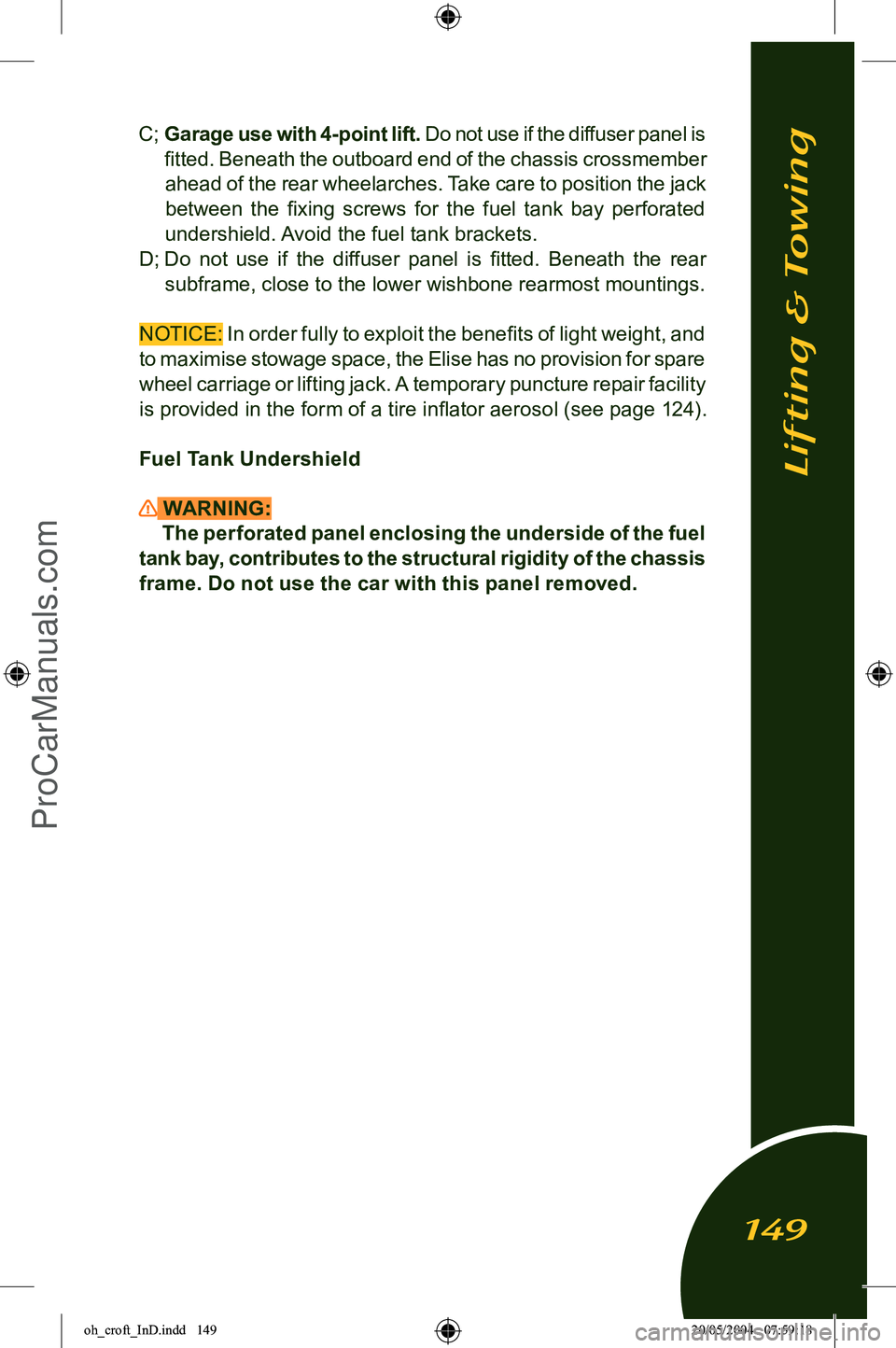
C; Garage use with 4-point lift. Do not use if the diffuser panel is
fitted. Beneath the outboard end of the chassis crossmember ahead of the rear wheelarches. Take care to position the jack
between the fixing screws for the fuel tank bay perforated
undershield. Avoid the fuel tank brackets.
D; Do not use if the diffuser panel is fitted. Beneath the rear
subframe, close to the lower wishbone rearmost mountings.
NOTICE: In order fully to exploit the benefits of light weight, and
to maximise stowage space, the Elise has no provision for spare
wheel carriage or lifting jack. A temporary puncture repair facility is provided in the form of a tire inflator aerosol (see page 124).
Fuel Tank Undershield
WARNING: The perforated panel enclosing the underside of the fuel
tank bay, contributes to the structural rigidity of the chassis
frame. Do not use the car with this panel removed.
Lifting & Towing
149
oh_croft_InD.indd 14920/05/2004 07:59:18ProCarManuals.com
Page 157 of 205
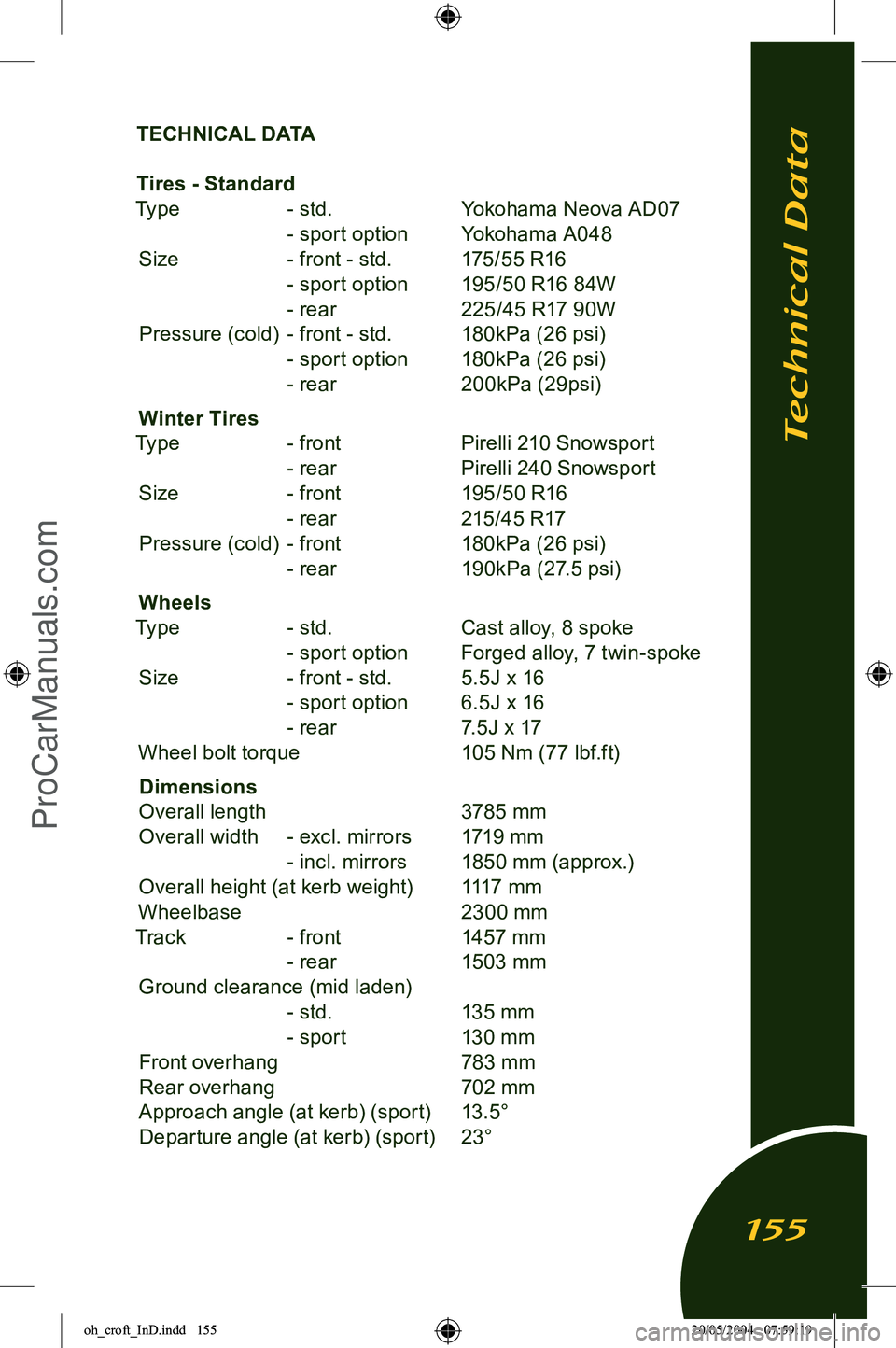
TECHNICAL DATA
Tires - Standard
Type - std. Yokohama Neova AD07
- sport option Yokohama A048
Size - front - std. 175/55 R16
- sport option 195/50 R16 84W
- rear 225/45 R17 90W
Pressure (cold) - front - std. 180kPa (26 psi)
- sport option 180kPa (26 psi)
- rear 200kPa (29psi)
Winter Tires
Type - front Pirelli 210 Snowsport
- rear Pirelli 240 Snowsport
Size - front 195/50 R16
- rear 215/45 R17
Pressure (cold) - front 180kPa (26 psi)
- rear 190kPa (27.5 psi)
Wheels
Type - std. Cast alloy, 8 spoke
- sport option Forged alloy, 7 twin-spoke
Size - front - std. 5.5J x 16
- sport option 6.5J x 16
- rear 7.5J x 17
Wheel bolt torque 105 Nm (77 lbf.ft)
Dimensions
Overall length 3785 mm
Overall width - excl. mirrors 1719 mm
- incl. mirrors 1850 mm (approx.)
Overall height (at kerb weight) 1117 mm
Wheelbase 2300 mm
Track - front 1457 mm
- rear 1503 mm
Ground clearance (mid laden)
- std. 135 mm
- sport 130 mm
Front overhang 783 mm
Rear overhang 702 mm
Approach angle (at kerb) (sport) 13.5° Departure angle (at kerb) (sport) 23°
Technical Data
155
oh_croft_InD.indd 15520/05/2004 07:59:19ProCarManuals.com
Page 158 of 205
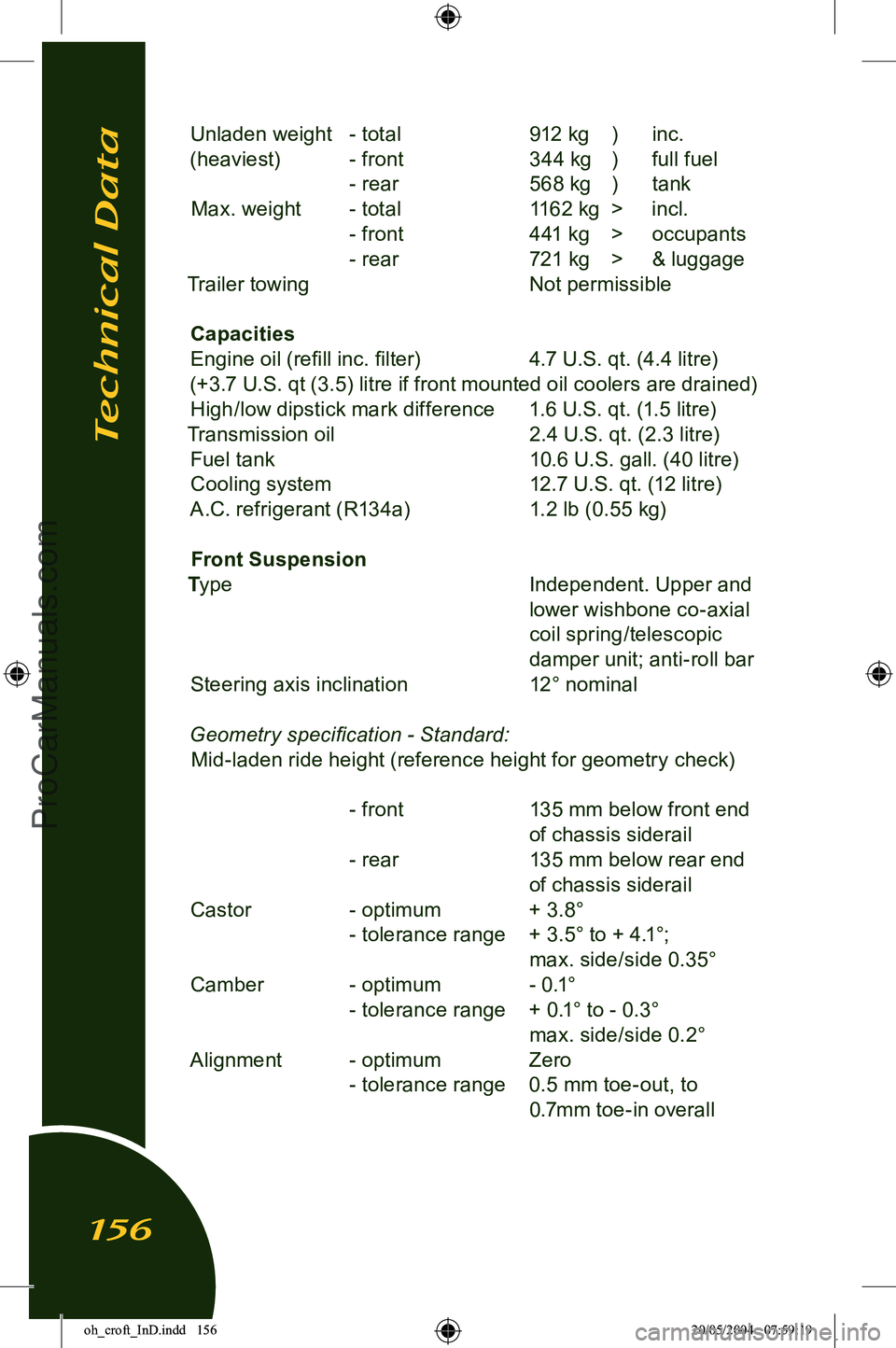
Unladen weight - total 912 kg ) inc.
(heaviest) - front 344 kg ) full fuel
- rear 568 kg ) tank
Max. weight - total 1162 kg > incl.
- front 441 kg > occupants
- rear 721 kg > & luggage
Trailer towing Not permissible
Capacities Engine oil (refill inc. filter) 4.7 U.S. qt. (4.4 litre)
(+3.7 U.S. qt (3.5) litre if front mounted oil coolers are drained) High/low dipstick mark difference 1.6 U.S. qt. (1.5 litre)
Transmission oil 2.4 U.S. qt. (2.3 litre)
Fuel tank 10.6 U.S. gall. (40 litre)
Cooling system 12.7 U.S. qt. (12 litre)
A.C. refrigerant (R134a) 1.2 lb (0.55 kg)
Front Suspension
T ype Independent. Upper and
lower wishbone co-axial
coil spring/telescopic
damper unit; anti-roll bar
Steering axis inclination 12° nominal
Geometry specification - Standard: Mid-laden ride height (reference height for geometry check)
- front 135 mm below front end
of chassis siderail
- rear 135 mm below rear end
of chassis siderail
Castor - optimum + 3.8°
- tolerance range + 3.5° to + 4.1°;
max. side/side 0.35°
Camber - optimum - 0.1°
- tolerance range + 0.1° to - 0.3°
max. side/side 0.2°
Alignment - optimum Zero - tolerance range 0.5 mm toe-out, to
0.7mm toe-in overall
Technical Data
156
oh_croft_InD.indd 15620/05/2004 07:59:19ProCarManuals.com
Page 159 of 205
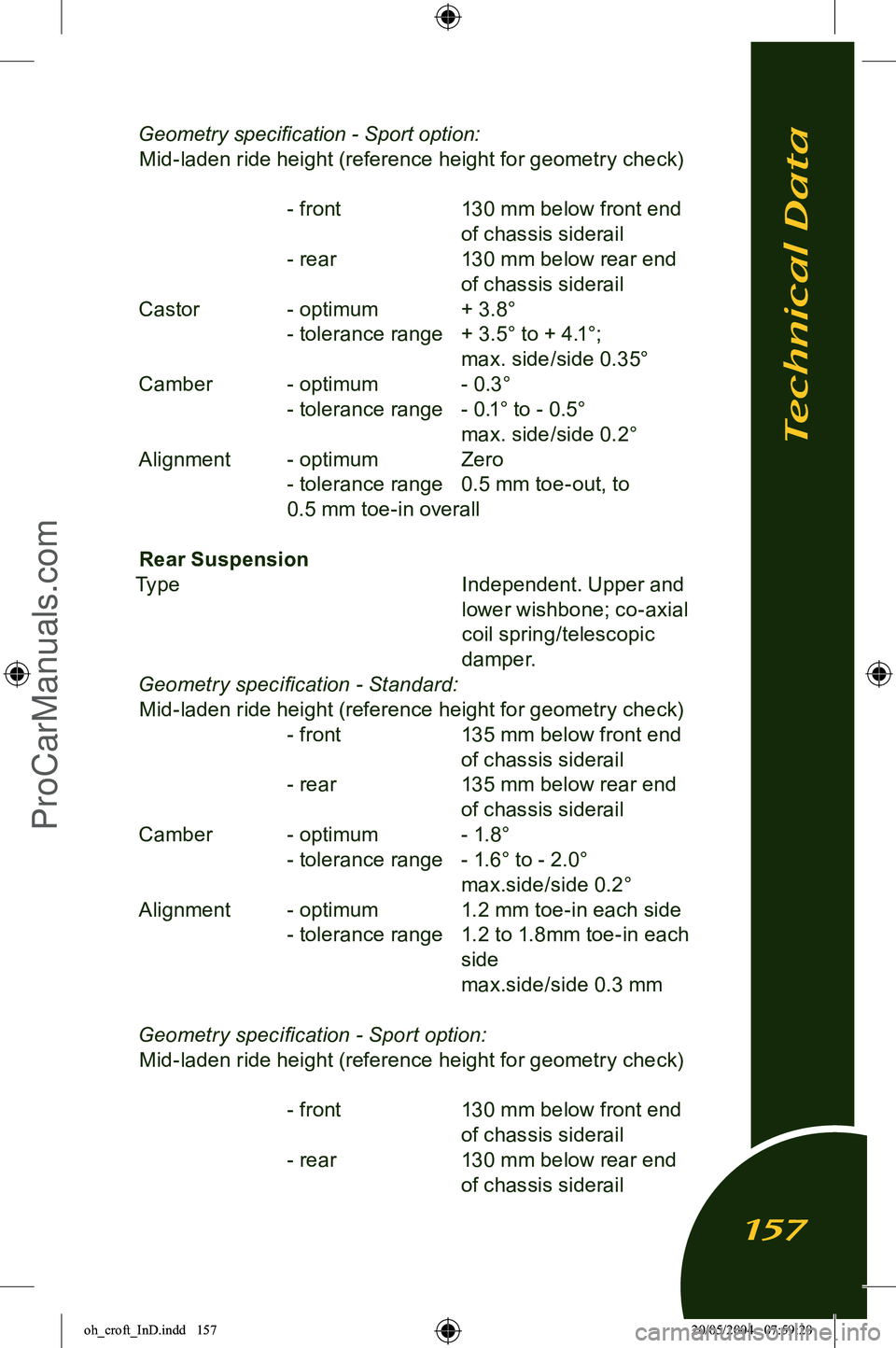
Geometry specification - Sport option:Mid-laden ride height (reference height for geometry check)
- front 130 mm below front end
of chassis siderail
- rear 130 mm below rear end
of chassis siderail
Castor - optimum + 3.8°
- tolerance range + 3.5° to + 4.1°;
max. side/side 0.35°
Camber - optimum - 0.3°
- tolerance range - 0.1° to - 0.5°
max. side/side 0.2°
Alignment - optimum Zero - tolerance range 0.5 mm toe-out, to
0.5 mm toe-in overall
Rear Suspension
Type Independent. Upper and
lower wishbone; co-axial
coil spring/telescopic
damper.
Geometry specification - Standard: Mid-laden ride height (reference height for geometry check)
- front 135 mm below front end
of chassis siderail
- rear 135 mm below rear end
of chassis siderail
Camber - optimum - 1.8°
- tolerance range - 1.6° to - 2.0°
max.side/side 0.2°
Alignment - optimum 1.2 mm toe-in each side - tolerance range 1.2 to 1.8mm toe-in each
side
max.side/side 0.3 mm
Geometry specification - Sport option: Mid-laden ride height (reference height for geometry check)
- front 130 mm below front end
of chassis siderail
- rear 130 mm below rear end
of chassis siderail
Technical Data
157
oh_croft_InD.indd 15720/05/2004 07:59:20ProCarManuals.com
Page 160 of 205
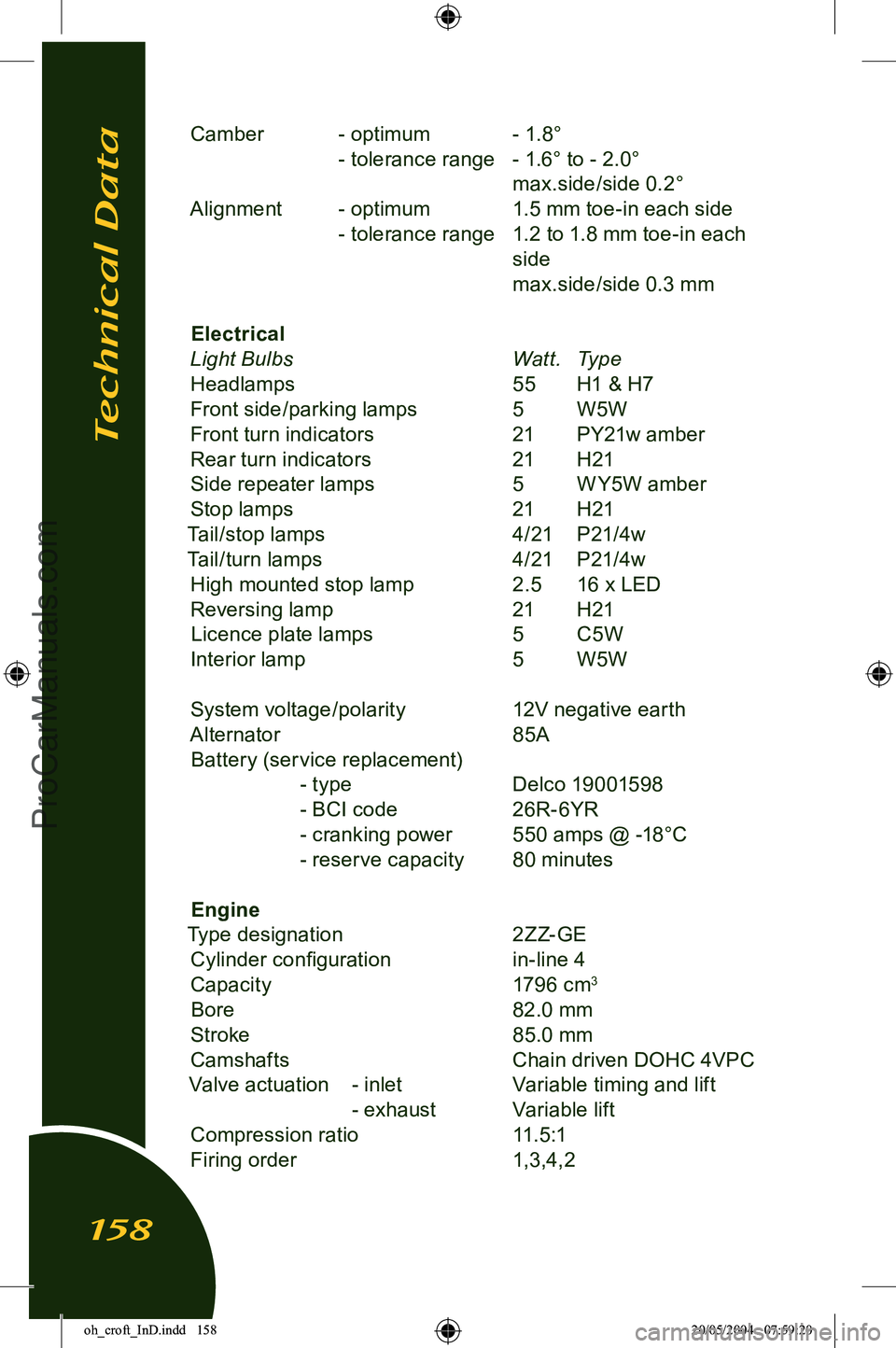
Camber - optimum - 1.8°
- tolerance range - 1.6° to - 2.0°
max.side/side 0.2°
Alignment - optimum 1.5 mm toe-in each side - tolerance range 1.2 to 1.8 mm toe-in each
side
max.side/side 0.3 mm
Electrical
Light Bulbs Watt. Type
Headlamps 55 H1 & H7
Front side/parking lamps 5 W5W
Front turn indicators 21 PY21w amber
Rear turn indicators 21 H21
Side repeater lamps 5 W Y5W amber
Stop lamps 21 H21
Tail/stop lamps 4/21 P21/4w
Tail/turn lamps 4/21 P21/4w
High mounted stop lamp 2.5 16 x LED
Reversing lamp 21 H21
Licence plate lamps 5 C5W
Interior lamp 5 W5W
System voltage/polarity 12V negative earth
Alternator 85A
Battery (service replacement)
- type Delco 19001598
- BCI code 26R- 6YR
- cranking power 550 amps @ -18°C
- reserve capacity 80 minutes
Engine
Type designation 2ZZ-GE
Cylinder configuration in-line 4
Capacity 1796 cm
3
Bore 82.0 mm
Stroke 85.0 mm
Camshafts Chain driven DOHC 4VPC
Valve actuation - inlet Variable timing and lift
- exhaust Variable lift
Compression ratio 11.5:1
Firing order 1,3,4,2
Technical Data
158
oh_croft_InD.indd 15820/05/2004 07:59:20ProCarManuals.com
Page 161 of 205
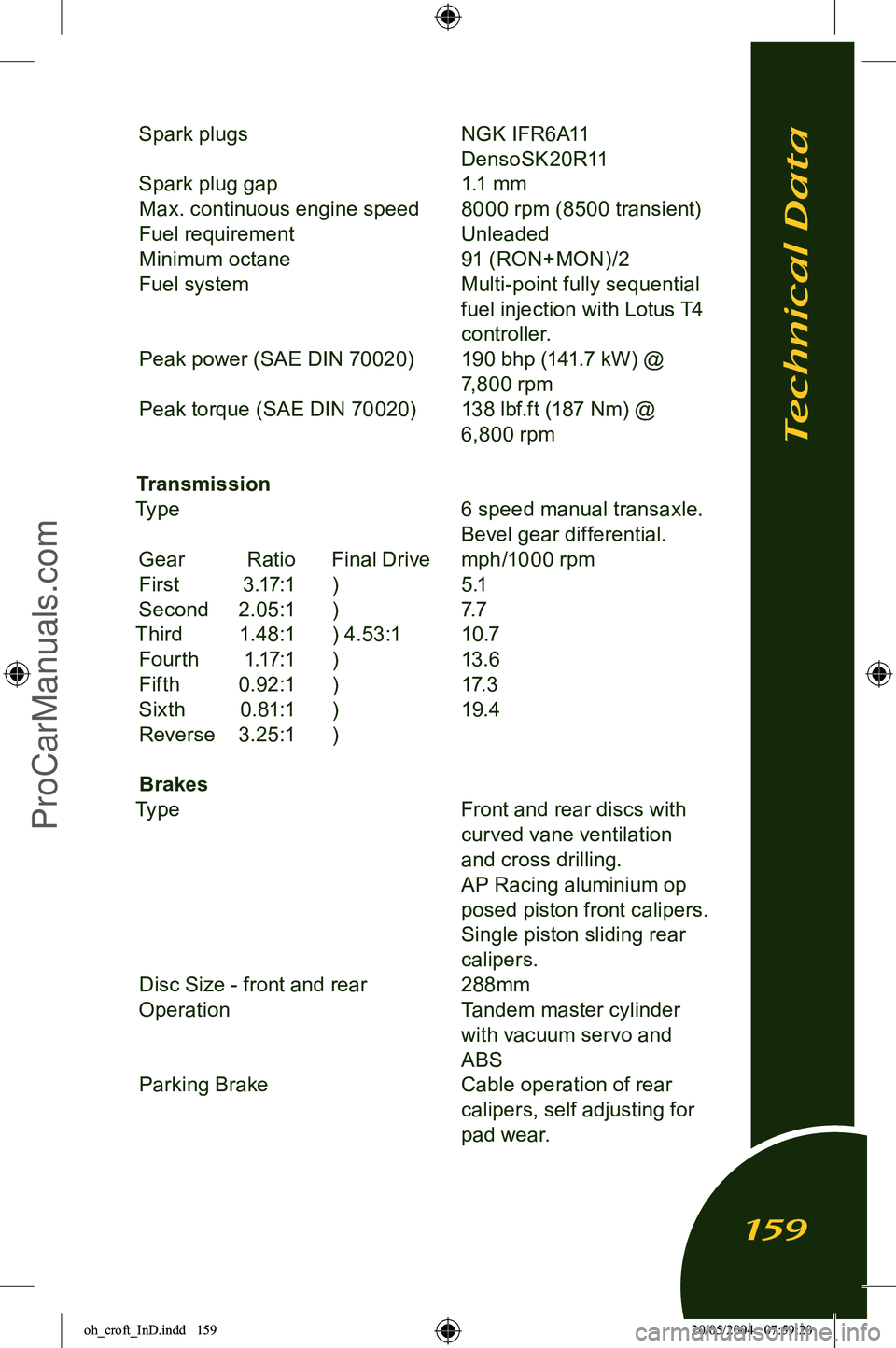
Spark plugs NGK IFR6A11
DensoSK20R11
Spark plug gap 1.1 mm
Max. continuous engine speed 8000 rpm (8500 transient)
Fuel requirement Unleaded
Minimum octane 91 (RON+MON)/2
Fuel system Multi-point fully sequential
fuel injection with Lotus T4
controller.
Peak power (SAE DIN 70020) 190 bhp (141.7 kW) @
7,800 rpm
Peak torque (SAE DIN 70020) 138 lbf.ft (187 Nm) @
6,800 rpm
Transmission
Type 6 speed manual transaxle.
Bevel gear differential.
Gear Ratio Final Drive mph/1000 rpm First 3.17:1 ) 5.1
Second 2.05:1 ) 7.7
Third 1.48:1 ) 4.53:1 10.7
Fourth 1.17:1 ) 13.6
Fifth 0.92:1 ) 17.3
Sixth 0.81:1 ) 19.4
Reverse 3.25:1 )
Brakes
Type Front and rear discs with
curved vane ventilation
and cross drilling.
AP Racing aluminium op
posed piston front calipers.
Single piston sliding rear
calipers.
Disc Size - front and rear 288mm
Operation Tandem master cylinder
with vacuum servo and
ABS
Parking Brake Cable operation of rear
calipers, self adjusting for
pad wear.
Technical Data
159
oh_croft_InD.indd 15920/05/2004 07:59:20ProCarManuals.com