rear LOTUS ELISE 2005 Service Manual
[x] Cancel search | Manufacturer: LOTUS, Model Year: 2005, Model line: ELISE, Model: LOTUS ELISE 2005Pages: 205, PDF Size: 4.51 MB
Page 115 of 205
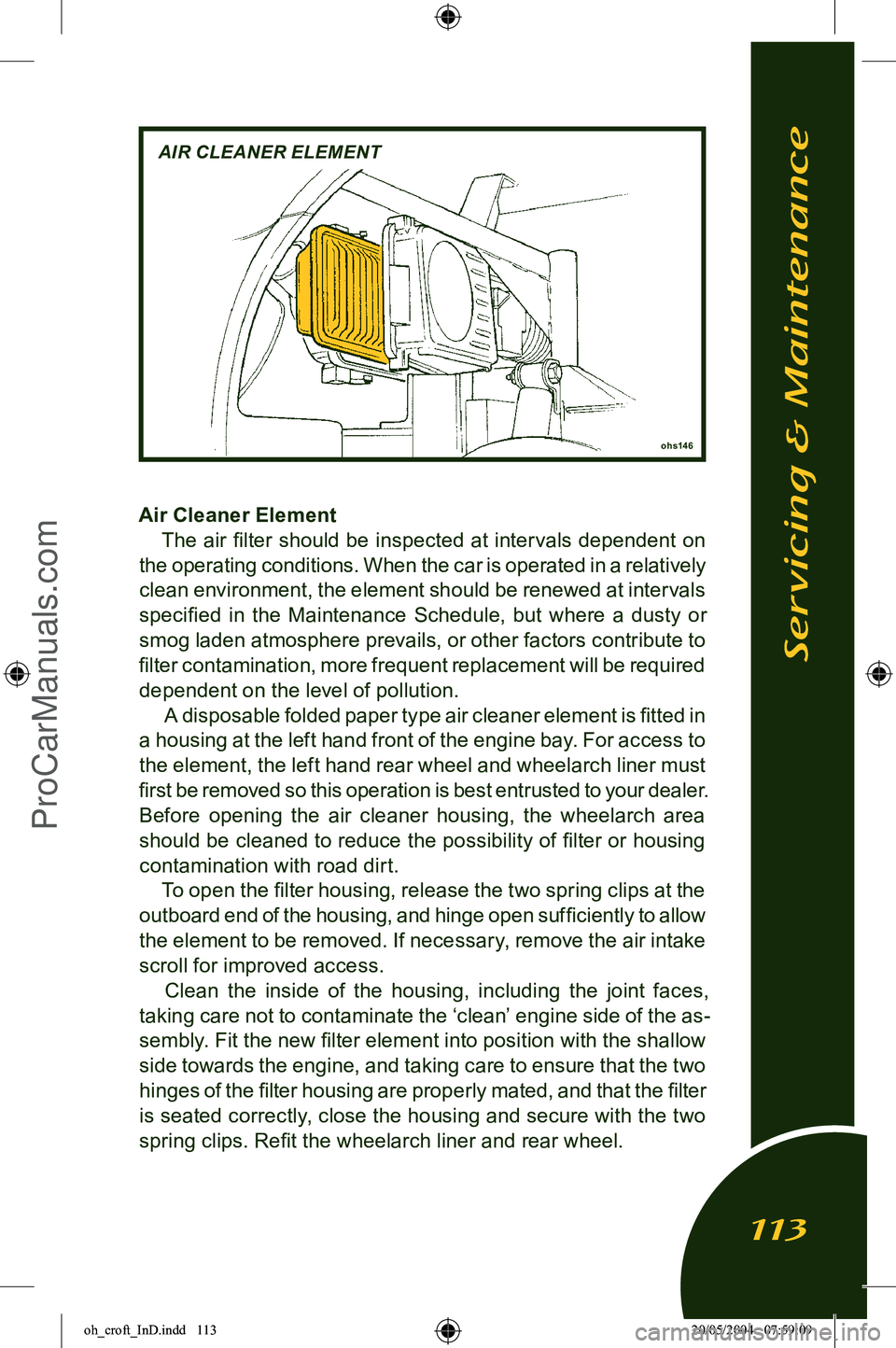
Air Cleaner ElementThe air filter should be inspected at intervals dependent on
the operating conditions. When the car is operated in a relatively
clean environment, the element should be renewed at intervals
specified in the Maintenance Schedule, but where a dusty or
smog laden atmosphere prevails, or other factors contribute to
filter contamination, more frequent replacement will be required
dependent on the level of pollution. A disposable folded paper type air cleaner element is fitted in
a housing at the left hand front of the engine bay. For access to
the element, the left hand rear wheel and wheelarch liner must
first be removed so this operation is best entrusted to your dealer.
Before opening the air cleaner housing, the wheelarch area
should be cleaned to reduce the possibility of filter or housing contamination with road dirt. To open the filter housing, release the two spring clips at the
outboard end of the housing, and hinge open sufficiently to allow
the element to be removed. If necessary, remove the air intake scroll for improved access. Clean the inside of the housing, including the joint faces,
taking care not to contaminate the ‘clean’ engine side of the as
-
sembly. Fit the new filter element into position with the shallow
side towards the engine, and taking care to ensure that the two
hinges of the filter housing are properly mated, and that the filter
is seated correctly, close the housing and secure with the two
spring clips. Refit the wheelarch liner and rear wheel.
ohs146
AIR CLEANER ELEMENT
Servicing & Maintenance
113
oh_croft_InD.indd 11320/05/2004 07:59:09ProCarManuals.com
Page 117 of 205
TIRES AND WHEELS
TiresGlossary of Terms:Recommended inflation pressure: The cold tire inflation pressure which is recommended for this car and is speci
-
fied in the ‘Technical Data’ section of this handbook.
Cold tire inflation pressure: All tires must be cold, meaning
that the car has been stationary for a minimum of 3 hours, or has been driven less than 1 mile. Adjust pressures only
in ambient conditions.
Maximum inflation pressure: The maximum inflation pres
-
sure to which the tire should be subjected. For the Elise,
use only the recommended inflation pressure.
Lotus engineers have worked with tire manufacturers
to produce tire specifications for the Elise which optimise performance on both road and track. To ensure that any
replacement tires are to the correct Lotus specification,
always refer to your Lotus dealer, who will have the latest recommendations.
WARNING: In order to achieve the optimum handling char
-
acteristics, the wheel and tire sizes on the Elise are different front and rear. This means that interchanging
of wheels and tires between axles is not permissible.
Failure to adhere to this requirement will adversely affect the handling of the car and may result in an
accident in which you or others could be killed or seriously injured,
The tires should be regularly inspected for signs of cuts,
abrasions or other damage, and for any uneven tread
wear patterns. Uneven treadwear may indicate that the suspension geometry or dampers require attention from
your dealer.
Tires & Wheels
115
oh_croft_InD.indd 11520/05/2004 07:59:09ProCarManuals.com
Page 121 of 205
handling feel and minimum steering wheel shake, it is very
important that the radial and lateral run out of the Tires are to the high standard required by Lotus Cars. If any difficulty is experienced with replacement Tires, refer to
the tire manufacturer.
Tire Characteristics The Yokohama AD07 or A048 Tires fitted to the Elise
are suitable for all normal weather conditions, but are optimised for dry road sports driving. The constructions
of both tire types have been specially tailored for the
Elise and are identified by the letters ‘LTS’ moulded on the tire sidewalls. Ensure that any replacement Tires are similarly marked. The tire characteristics include good
feedback (‘feel’) from the road surface to the steering
wheel, a high level of steering linearity and response, and little performance degradation with the high temperatures
which may be reached in sports use. However, tire performance will decrease at low ambi
-
ent temperatures, resulting in reduced levels of grip and
an increased susceptibility to damage from impacts. In
these conditions, especially below 15°F (-10°C), it is recommended to fit a car set of the recommended winter
Tires (see below).
Winter Tires If the car is to be used in ver y cold territories, or
driven on snow covered roads, it is recommended to fit a
car set of winter Tires developed specifically for such
conditions. Lotus approves the use of Pirelli 210 (front)
and 240 (rear) Snowsport winter Tires in sizes specified
in ‘Technical Data’. These Tires should be fitted on regular
Elise wheels.
WARNING:
• Winter Tires are optimised for use on snow covered roads. When used on roads free of snow, winter
Tires will produce different handling characteristics and less grip compared with regular Tires.
• When winter Tires are fitted, a maximum speed of 118 mph (190 km/h) must be observed.
• Pirelli Snowsport Tires are NOT suitable for stud
-
Tires & Wheels
119
oh_croft_InD.indd 11920/05/2004 07:59:10ProCarManuals.com
Page 122 of 205
ding.
Tire Chains In extreme weather conditions, Lotus approves the fit
-
ment of Pewag Neon X3 - NX373 snow chains, used only in conjunction with winter Tires (see above) and fitted only on the rear wheels. Close attention should be paid
to the fitting and tensioning instructions supplied with the chains, and the chains should be removed as soon as
road conditions allow.
Uniform Tire Quality Grading Quality grades can be found where applicable on the
tire sidewall between tread shoulder and maximum section
width. For example:
Treadwear 200 Traction AA Temperature A
The following information relates to the system de
-
veloped by the United States National Highway Traffic
Safety Administration, which grades Tires by treadwear, traction and temperature performance (This applies only
to cars sold in the United States). The grades are moulded on the sidewalls of most
passenger car Tires. The Uniform Tire Quality Grading system does not apply to deep tread, winter-type snow
Tires, space-saver or temporary use spare Tires, Tires with nominal rim diameters of 10 to 12 inches (25 to 30 cm), or to some limited-production Tires. While the Tires available on Lotus cars may vary with
respect to these grades, they must also conform to federal safety requirements.
Treadwear The treadwear grade is a comparative rating based
on the wear rate of the tire when tested under controlled
conditions on a specified government test course. For example, a tire graded 150 would wear one and a half
(1.5) times as well on the government course as a tire graded 100. The relative performance of Tires depends
upon the actual conditions of their use, however, and may depart significantly from the norm due to variations in
driving habits, service practices, and differences in road
Tires & Wheels
120
oh_croft_InD.indd 12020/05/2004 07:59:10ProCarManuals.com
Page 124 of 205
sure of tires to be used on the Elise. It also specifies the total weight the car can carry, called the car capacity
weight. This includes the weight of driver, passenger and luggage. Also to be found on the driver’s door jamb is the Cer
-
tification label (‘Manufactured by Lotus Cars Ltd.’) which stipulates the Gross Car Weight Rating (GV WR). The
GVWR includes the weight of the car, occupants, fuel and luggage. Never exceed the GVWR or the Gross Axle
Weight Rating (GAWR) for either the front or rear axle. The maximum load which may be carried in the rear luggage compartment is 110 lb (50 kg). Note that the Elise is not designed to tow a trailer, and no such attempt should be
made.
WARNING: Do not exceed the GVWR, or front or rear GAWR.
Exceeding these limits may cause unstable handling or car or tire damage which could cause a crash
in which you or others could be seriously injured or killed.
The Elise should never be used to tow a
trailer.
Federal Motor Car Safety Standards require Lotus to in
-
clude the following verbatim statement in this handbook:
Steps for Determining Correct Load Limit:
1) Locate the statement “The combined weight of occupants and cargo should never exceed XXX pounds”
on your car’s placard.
2) Determine the combined weight of the driver and pas
-
senger that will be riding in your car.
3) Subtract the combined weight of the driver and pas
-
senger from XXX kilograms, or XXX pounds.
4) The resulting figure equals the available amount of cargo and luggage load capacity. For example, if the
“XXX” amount equals 1400 lbs. and there will be five 150 lb. passengers in your car, the amount of available cargo and luggage load capacity is 650 lbs. (1400 - 750
(5 x 150) = 650 lbs.)
Note: Maximum load to be carried in the Elise rear lug-
gage compartment is 110 lb (50 kg).
Tires & Wheels
122
oh_croft_InD.indd 12220/05/2004 07:59:11ProCarManuals.com
Page 126 of 205
Uniform Tire Quality Grading Standard: Example; Tread-
wear 60 Traction A A Temperature A. See page 120
Other tire markings are self explanatory.
Tire Inflator Aerosol (if fitted) In order fully to exploit the benefits of light weight, and
to maximise stowage space, the Elise has no provision for spare wheel carriage or lifting jack. A temporary puncture
repair facility is provided in the form of a tire inflator aerosol
which is mounted in spring clips at the extreme right hand front corner of the rear luggage compartment. If possible avoid driving on a deflated tire, or irreparable damage to
the tire may be caused. When the aerosol is connected to the tire valve, and the
button pressed, a mixture of liquid latex and propellant is
injected into the tire, such that the solidifying latex is forced
into the puncture site at the same time as the tire is inflated, effecting a temporary repair and enabling the car to be driven at low speed to the nearest tire repair facility.
WARNING:
• Use of the aerosol does not constitute a permanent repair, but is designed to allow the car to be driven
to the nearest tire repair facility. At the earliest op
-
portunity, the tire should be either professionally repaired or replaced dependent on the severity of
the damage.
• Until the tire is repaired or replaced, the car should be driven in a moderate manner, not exceeding 30
mph (45 km/h).
• Do not use the aerosol for large holes or repairs, or when the tire sidewall has been damaged, or if the
tire has been displaced from the rim.
• For safety reasons, the aerosol should at all times be carried only in the designated secure stowage
position. Never carry loose in the passenger com
-
partment.
Tires & Wheels
124
oh_croft_InD.indd 12420/05/2004 07:59:11ProCarManuals.com
Page 131 of 205
ELECTRICAL
BATTERY
WARNING:
POISON/DANGER - CAUSES SEVERE BURNS KEEP OUT
OF REACH OF CHILDREN.
• Contains sulphuric acid - avoid contact with skin, eyes or clothing. If in contact with skin or eyes; flush with copious amounts of water. Remove contaminated clothing. Seek
immediate medical attention. If ingested; seek immediate
medical attention. Do not induce vomiting or give fluids
to drink.
• Batteries produce explosive gases. Keep sparks, flames and cigarettes away. Ventilate when charging or using in
enclosed space. Always shield eyes when working near
batteries.
RISK OF SHORT CIRCUIT AND FIRE
• Observe all warning notes on the battery.
• Disconnect the battery during all work on the electrical system.
• Do not lay tools or other metal objects on the battery as they could cause a short circuit across the battery
terminals.
Battery Access The ‘maintenance free’ battery is located at the left hand
front of the rear luggage compartment. No routine inspection or topping up of the electrolyte is required, but at inter vals
specified in the Maintenance Schedule, the battery terminals
should be checked for security and condition, and protected
with petroleum jelly. For access to the terminals, first unclip the battery cover
from the floor and ease the cover from around the left hand rear corner of the battery.
Disconnecting the Battery
WARNING: Failure to follow the correct battery disconnection pro
-
cedure detailed below could result in serious burns.
Electrical
129
oh_croft_InD.indd 12920/05/2004 07:59:13ProCarManuals.com
Page 137 of 205
WARNING:Inexper t modifications or additions to the electrical
system could jeopardise safety.
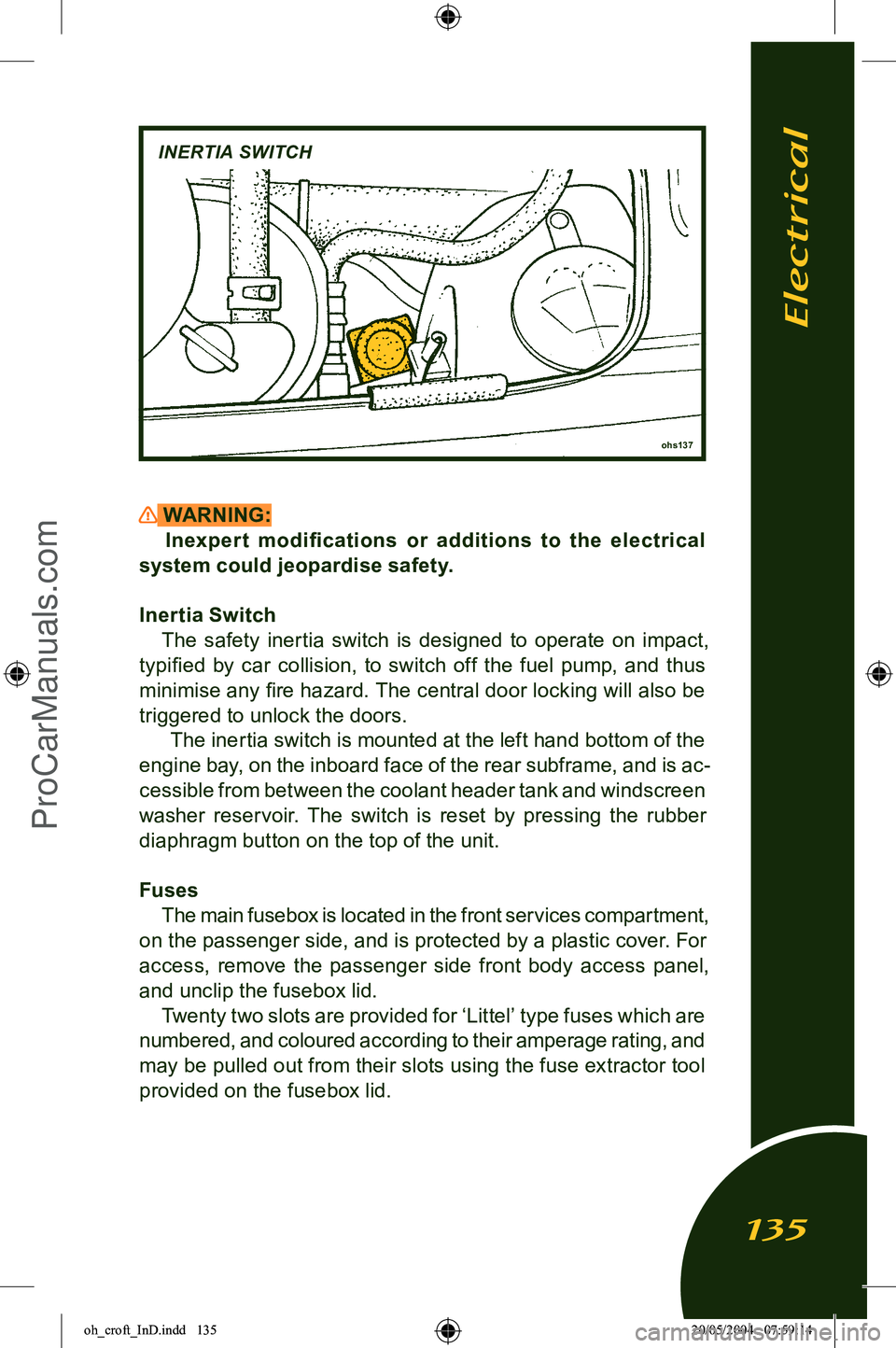
Inertia Switch The safety inertia switch is designed to operate on impact,
typified by car collision, to switch off the fuel pump, and thus
minimise any fire hazard. The central door locking will also be
triggered to unlock the doors. The inertia switch is mounted at the left hand bottom of the
engine bay, on the inboard face of the rear subframe, and is ac
-
cessible from between the coolant header tank and windscreen
washer reservoir. The switch is reset by pressing the rubber
diaphragm button on the top of the unit.
Fuses The main fusebox is located in the front services compartment,
on the passenger side, and is protected by a plastic cover. For
access, remove the passenger side front body access panel,
and unclip the fusebox lid. Twenty two slots are provided for ‘Littel’ type fuses which are
numbered, and coloured according to their amperage rating, and
may be pulled out from their slots using the fuse extractor tool provided on the fusebox lid.
ohs137
INERTIA SWITCH
Electrical
135
oh_croft_InD.indd 13520/05/2004 07:59:14ProCarManuals.com
Page 139 of 205
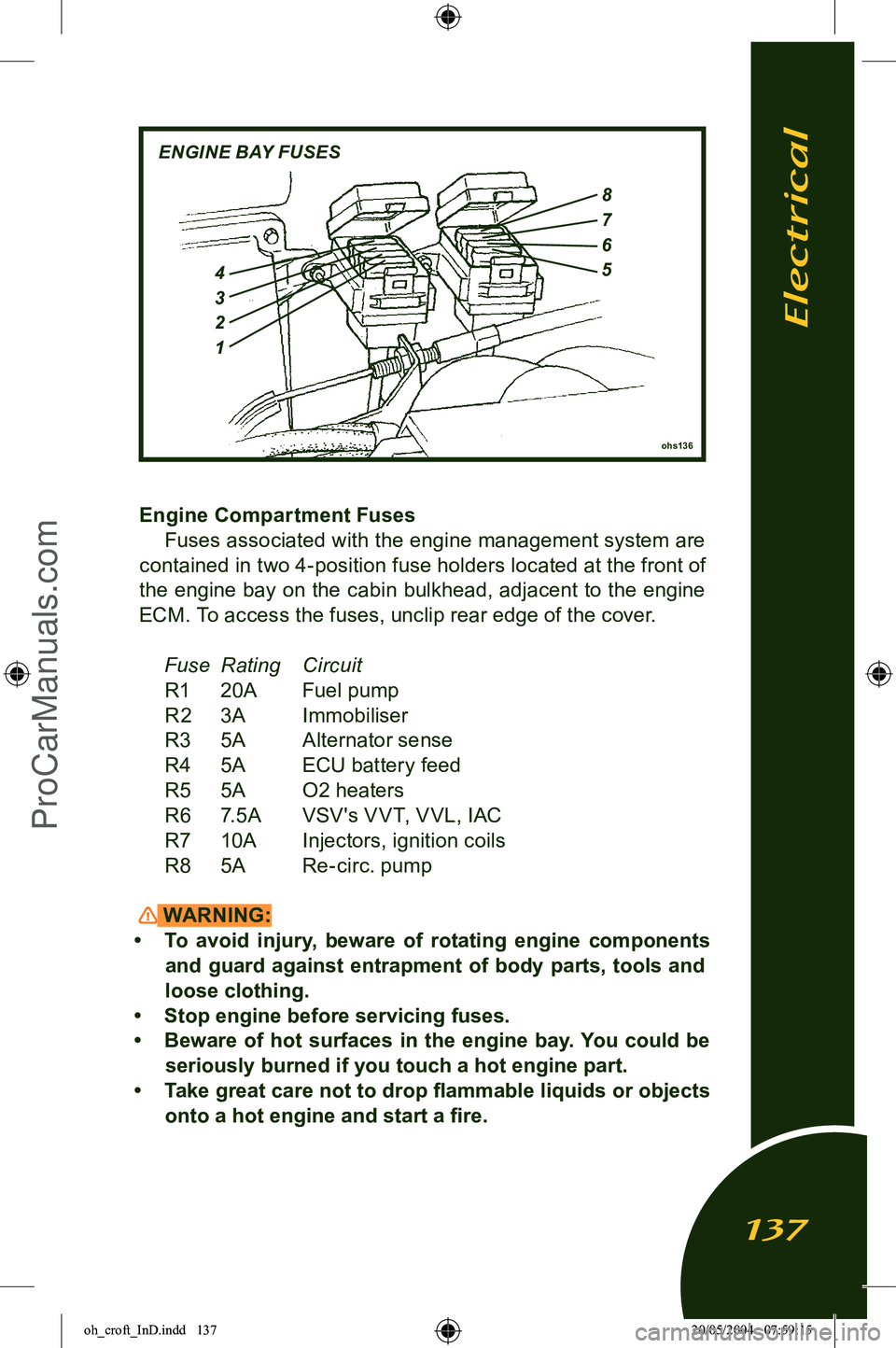
Engine Compartment FusesFuses associated with the engine management system are
contained in two 4-position fuse holders located at the front of
the engine bay on the cabin bulkhead, adjacent to the engine ECM. To access the fuses, unclip rear edge of the cover.
Fuse Rating CircuitR1 20A Fuel pump
R2 3A Immobiliser
R3 5A Alternator sense
R4 5A ECU battery feed
R5 5A O2 heaters
R6 7.5A VSV's V VT, V VL, IAC
R7 10A Injectors, ignition coils
R8 5A Re-circ. pump
WARNING:
• To avoid injury, beware of rotating engine components and guard against entrapment of body parts, tools and
loose clothing.
• Stop engine before servicing fuses.
• Beware of hot surfaces in the engine bay. You could be seriously burned if you touch a hot engine part.
• Take great care not to drop flammable liquids or objects onto a hot engine and start a fire.
ohs136
ENGINE BAY FUSES
4
3
2
1
8
7
6
5
Electrical
137
oh_croft_InD.indd 13720/05/2004 07:59:15ProCarManuals.com
Page 142 of 205
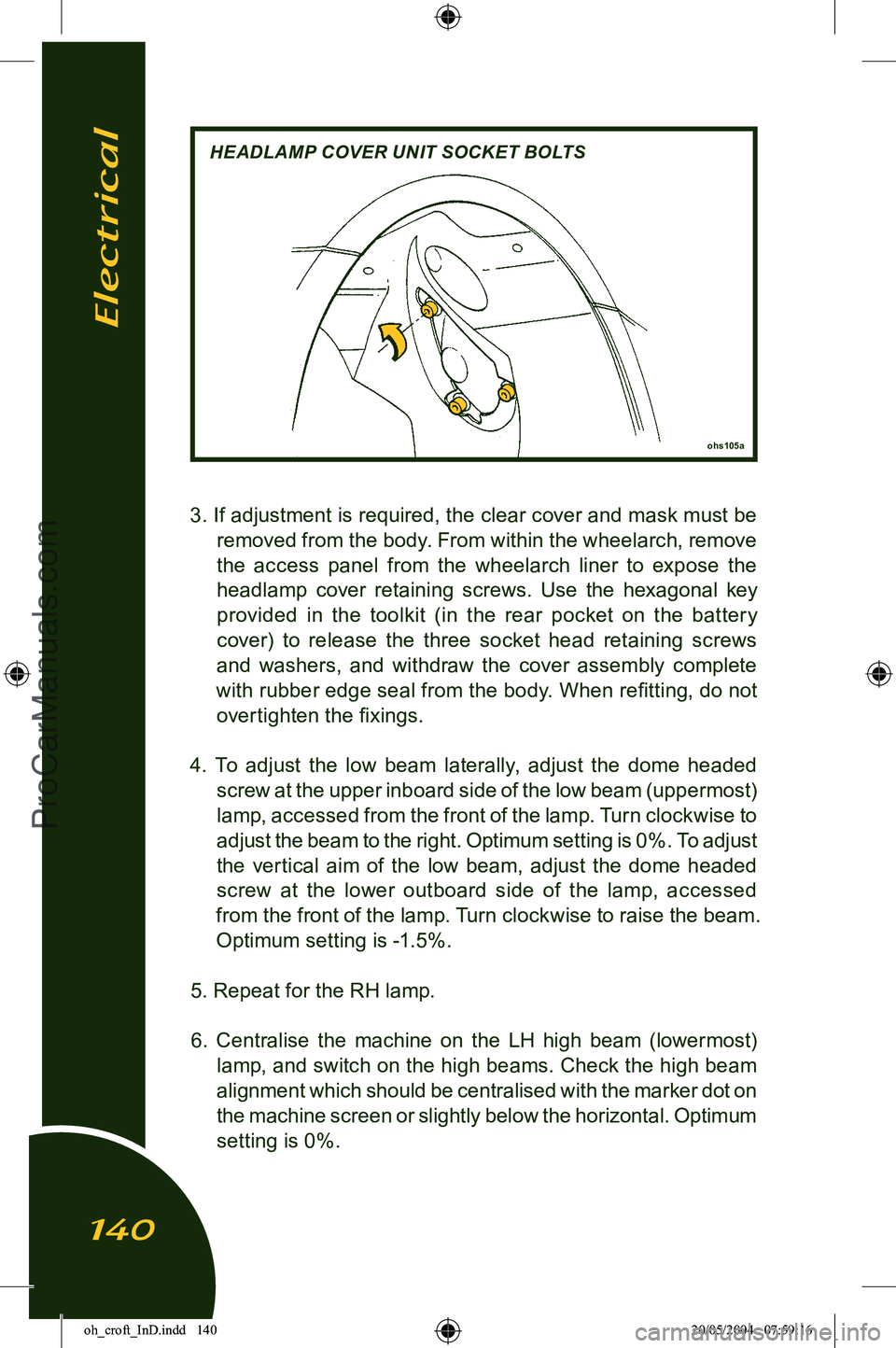
3. If adjustment is required, the clear cover and mask must be removed from the body. From within the wheelarch, remove
the access panel from the wheelarch liner to expose the
headlamp cover retaining screws. Use the hexagonal key provided in the toolkit (in the rear pocket on the batter y
cover) to release the three socket head retaining screws and washers, and withdraw the cover assembly complete
with rubber edge seal from the body. When refitting, do not overtighten the fixings.
4. To adjust the low beam laterally, adjust the dome headed screw at the upper inboard side of the low beam (uppermost)
lamp, accessed from the front of the lamp. Turn clockwise to
adjust the beam to the right. Optimum setting is 0%. To adjust
the vertical aim of the low beam, adjust the dome headed screw at the lower outboard side of the lamp, accessed
from the front of the lamp. Turn clockwise to raise the beam.
Optimum setting is -1.5%.
5. Repeat for the RH lamp. 6. Centralise the machine on the LH high beam (lowermost) lamp, and switch on the high beams. Check the high beam
alignment which should be centralised with the marker dot on
the machine screen or slightly below the horizontal. Optimum
setting is 0%.
ohs105a
HEADLAMP COVER UNIT SOCKET BOLTS
Electrical
140
oh_croft_InD.indd 14020/05/2004 07:59:16ProCarManuals.com