steering LOTUS ELISE 2005 Owners Manual
[x] Cancel search | Manufacturer: LOTUS, Model Year: 2005, Model line: ELISE, Model: LOTUS ELISE 2005Pages: 205, PDF Size: 4.51 MB
Page 4 of 205
8. INSTRUMENTS & SWITCHES
Ignition Switch/Steering Lock ..........................................
44
Engine Start Button .........................................................
45
Warning ‘Tell Tale’ Lamps ...............................................
46
Bulb Check ................................................................
46
Turn Tell Tale .............................................................
46
Seat Belt Tell Tale ......................................................
47
Brake Tell Tale ...........................................................
47
Oil Pressure Tell Tale ................................................
47
Low Fuel Level Tell Tale ............................................
48
ABS Tell Tale ............................................................
48
High Beam Tell Tale ..................................................
48
Airbag Tell Tale ..........................................................
48
Battery Charging Tell Tale .........................................
48
Engine Malfunction Indicator Lamp ...........................
49
Security/RPM Tell Tale ..............................................
49
Instruments .................................................................
51
Speedometer .............................................................
51
Tachometer ...............................................................
51
LCD Display Panel ....................................................
52
Fuel Level Display ...............................................
52
Coolant Temperature Display ..............................
53
Odometer ............................................................
53
Trip Recorder .......................................................
53
Dashboard Switches .......................................................
54
Parking Lamp Switch ................................................
54
Headlamp Switch ......................................................
54
Lights-on Buzzer .......................................................
55
Hazard Warning Lamps Switch .................................
55
Instrument Illumination ..............................................
56
Auxiliary Power Socket .............................................
57
Column Switches & Horn ................................................
58
Headlamp High/Low Beam/Flasher/Turn Indicators .
58
Windscreen Wiper/Washer .......................................
59
Horn .................................................................
60
Audio Equipment ............................................................
60
9. HEATING, VENTILATION & AIR CONDITIONING
Air Conditioning ..............................................................
61
Air Re-circulation ............................................................
62
Heater Temperature ........................................................
62
Fan Speed .................................................................
62
Air Distribution ................................................................
63
Engine Bay Ventilation ....................................................
65
Contents
2
oh_croft_InD.indd 220/05/2004 07:58:39ProCarManuals.com
Page 10 of 205
properly restrained. Children, and short adults are at the great-
est risk. Be sure to follow all instructions and warnings in the handbook (See page 21 to 27).
Don’t Drink and Drive Alcohol and driving don’t mix. Even one drink can reduce your
ability to respond to changing conditions, and your reaction time
gets worse with every additional drink. So don’t drink and drive,
and don’t let your friends drink and drive, either.
Control Your Speed Excessive speed is a major factor in crash injuries and deaths.
Generally, the higher the speed the greater the risk, but serious accidents can also occur at lower speeds. Never drive faster
than is safe for current conditions, regardless of the maximum speed posted.
Keep Your Car in Safe Condition Having a tire blowout or a mechanical failure can be extremely
hazardous. To reduce the possibility of such problems, check
your tire pressures and condition frequently, and perform all
regularly scheduled maintenance (see separate Maintenance
Record booklet).
Safety Features Your car is equipped with many features that work together
to protect you and your passenger during a crash. The Lotus Elise has been designed to comply with applicable safety regulations. The Elise has passive safety features which include:
• A cockpit tub surrounded by substantial chassis side
frames.
• Energy absorbing front
composite ‘crash structure’.
• Energy absorbing rear steel
‘crash structure’.
• Side sill foam pads.
• A seat belt mounting frame incorporating a roof hoop
• Extruded aluminium door beams.
• A collapsible steering column.
• Airbags for both driver and passenger. Active safety features include:
• Lap and diagonal inertia reel seat belts with impact sensing
pre-tensioners.
Safety Information
8
oh_croft_InD.indd 820/05/2004 07:58:41ProCarManuals.com
Page 11 of 205
• Powerful anti-lock four wheel disc brakes.
• High geared responsive steering requiring only small steering
wheel movements to alter course
• Exceptional road holding with optimised handling character
-
istics
You and your passenger cannot take full advantage of these
safety features unless you remain sitting in a proper position
and always wear your seat belt properly. In fact, some safety
features can contribute to injuries if they are not used properly. Drivers should be aware of their own limitations as well as
those of the car, and ensure that all road driving is conducted
well within both sets of capabilities, particularly on wet roads, or under adverse weather conditions.
Remember:
Driving a car requires:
• Care;
• Attention; and
• Sensible judgement.
Be aware that any motor car has the potential to cause death
or injury both to its occupants and/or other persons, and must
be used only in a responsible and cautious manner. This entire
handbook is filled with important safety information.
Please
read it carefully.
Remember:
• ALWAYS WEAR YOUR SEAT BELT.
• Never drive while under the influence of alcohol or drugs.
• Never drive when excessively tired.
• Never use mobile phones, map read or attempt other distract
-
ing activities whilst driving.
• Always obey all speed and traffic laws and regulations and never drive faster than the posted speed limit or than condi
-
tions allow.
• Be particularly careful driving on slippery or wet surfaces.
• Familiarise yourself with the car and always drive prudently, being aware of your own limitations and the limitations of the
car. Failure to operate the car properly can result in an ac
-
cident and serious injury.
Safety Information
9
oh_croft_InD.indd 920/05/2004 07:58:41ProCarManuals.com
Page 19 of 205
SEATING & SAFETY RESTRAINTS
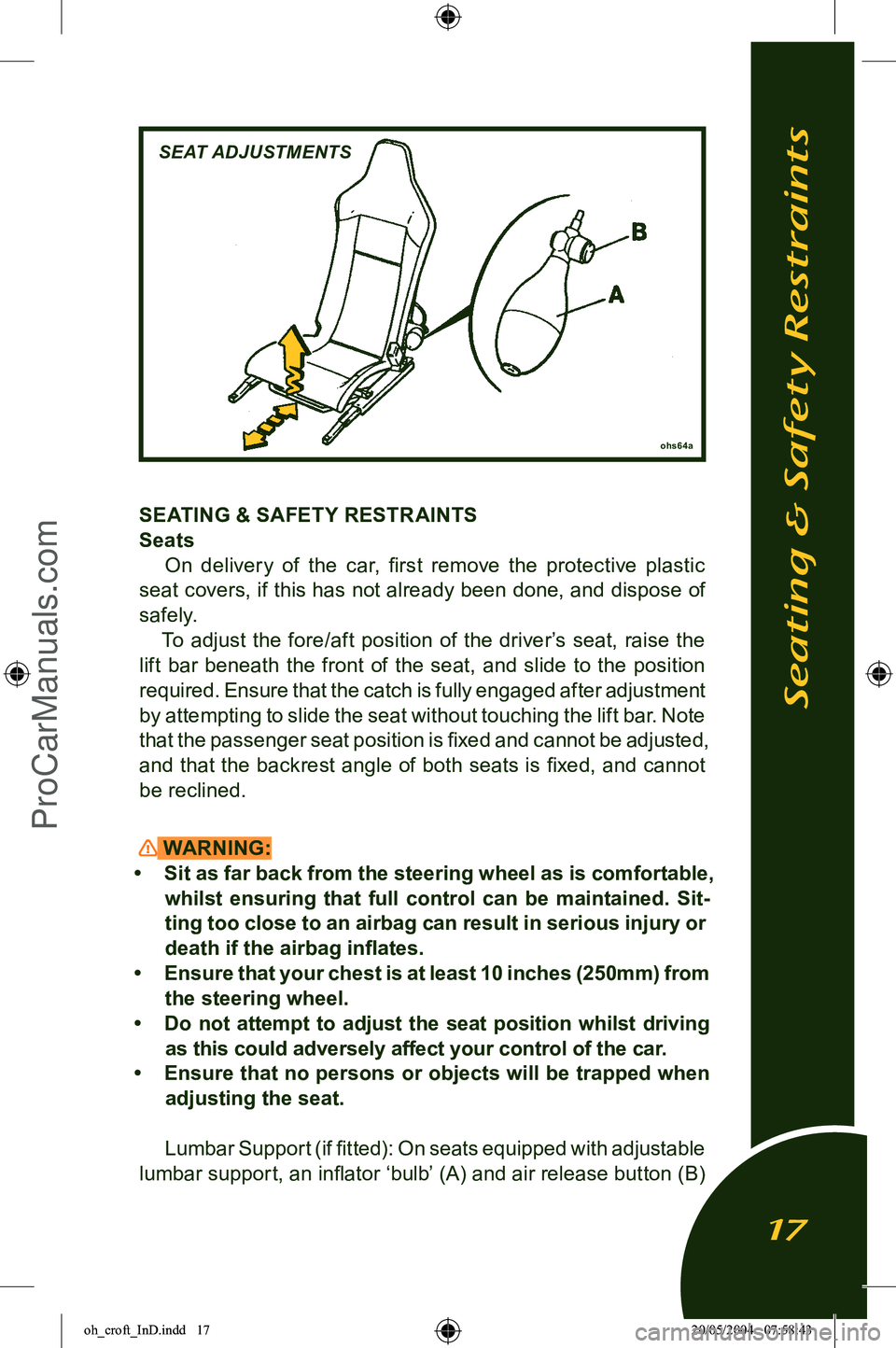
SeatsOn delivery of the car, first remove the protective plastic
seat covers, if this has not already been done, and dispose of
safely. To adjust the fore/aft position of the driver’s seat, raise the
lift bar beneath the front of the seat, and slide to the position
required. Ensure that the catch is fully engaged after adjustment
by attempting to slide the seat without touching the lift bar. Note
that the passenger seat position is fixed and cannot be adjusted, and that the backrest angle of both seats is fixed, and cannot be reclined.
WARNING:
• Sit as far back from the steering wheel as is comfortable, whilst ensuring that full control can be maintained. Sit
-
ting too close to an airbag can result in serious injury or death if the airbag inflates.
• Ensure that your chest is at least 10 inches (250mm) from
the steering wheel.
• Do not attempt to adjust the seat position whilst driving as this could adversely affect your control of the car.
• Ensure that no persons or objects will be trapped when adjusting the seat.
Lumbar Support (if fitted): On seats equipped with adjustable
lumbar support, an inflator ‘bulb’ (A) and air release button (B)
ohs64a
SEAT ADJUSTMENTS
Seating & Safety Restraints
17
oh_croft_InD.indd 1720/05/2004 07:58:43ProCarManuals.com
Page 23 of 205
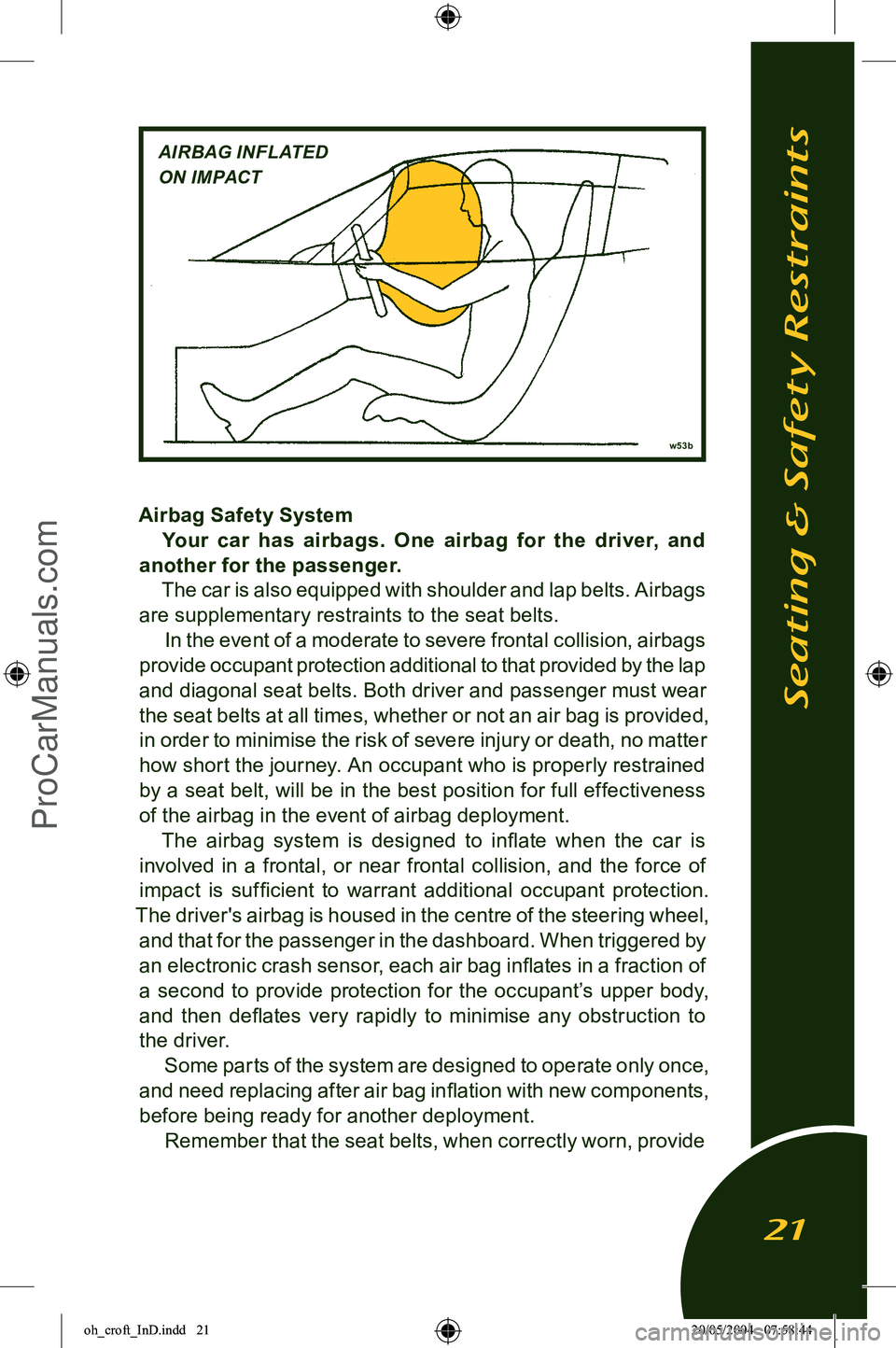
Airbag Safety SystemYour car has airbags. One airbag for the driver, and
another for the passenger.
The car is also equipped with shoulder and lap belts. Airbags
are supplementary restraints to the seat belts. In the event of a moderate to severe frontal collision, airbags
provide occupant protection additional to that provided by the lap
and diagonal seat belts. Both driver and passenger must wear
the seat belts at all times, whether or not an air bag is provided, in order to minimise the risk of severe injury or death, no matter how short the journey. An occupant who is properly restrained by a seat belt, will be in the best position for full effectiveness
of the airbag in the event of airbag deployment. The airbag system is designed to inflate when the car is
involved in a frontal, or near frontal collision, and the force of
impact is sufficient to warrant additional occupant protection.
The driver's airbag is housed in the centre of the steering wheel, and that for the passenger in the dashboard. When triggered by
an electronic crash sensor, each air bag inflates in a fraction of
a second to provide protection for the occupant’s upper body,
and then deflates very rapidly to minimise any obstruction to
the driver. Some parts of the system are designed to operate only once,
and need replacing after air bag inflation with new components, before being ready for another deployment.
Remember that the seat belts, when correctly worn, provide
Seating & Safety Restraints
21
w53b
AIRBAG INFLATED
ON IMPACT
oh_croft_InD.indd 2120/05/2004 07:58:44ProCarManuals.com
Page 25 of 205
belt, even with airbags. Sit as far back from the steering
wheel as is comfortable, whilst ensuring that full control can be maintained.
• Airbags plus lap-shoulder seat belts offer the best protection for adults, but not for young children and
infants. Neither the car ’s seat belt system nor its
airbag system is designed for them. Young children and
infants need the protection that a child restraint system can
provide. See later section on ‘Child Restraints’.
• If an object is between a person and an airbag, the bag
might not inflate properly or it might force the object into
that person causing death or serious injury. The path of an inflating airbag must be kept clear. Don’t put anything between an occupant and an airbag, and don’t attach or
put anything on the steering wheel hub or on or near any
passenger dashboard air bag covering.
• Do not lean against the inside of the doors; always hold the steering wheel by the outer rim; never rest your hands
on the airbag panel.
• Never transport heavy objects on or in front of the pas
-
senger seat.
• Give your passenger all of the information in this sec
-
tion.
• Do not attempt to de-activate the airbags, or make any other changes to the wiring or components of the airbag
system. Do not undertake any wiring for electrical ac
-
cessory equipment in the vicinity of the airbag wiring harnesses. Doing so may disable the airbag system, or
cause its unintended deployment.
• Adjust the driver’s seat to ensure that your chest is at
least 10 inches (250mm) from the steering wheel.
• If the airbag trim cover on the passenger side of the dash
-
board is accidently knocked off, the passenger airbag will
not operate correctly. Improper protection could result
in death or serious injury to a passenger in a crash. Do
not attempt to refit or repair the trim cover, but have the
fault rectified immediately by your dealer.
Airbag Tell Tale There is an airbag warning light (‘tell tale’) on the instrument
panel which shows the airbag symbol. The system checks the
following airbag electrical circuits for malfunction:
Seating & Safety Restraints
23
oh_croft_InD.indd 2320/05/2004 07:58:45ProCarManuals.com
Page 31 of 205
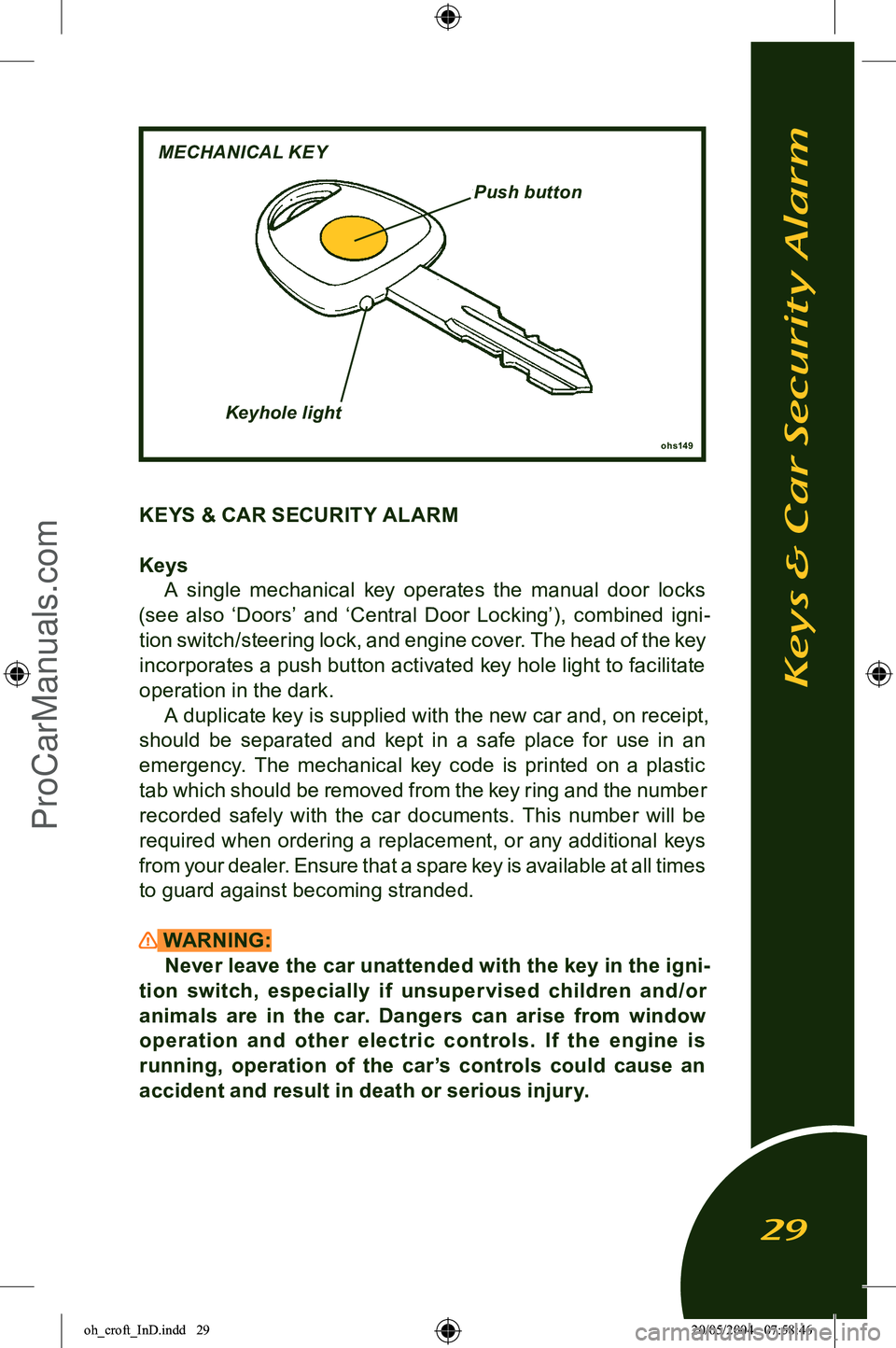
KEYS & CAR SECURITY ALARM
KeysA single mechanical key operates the manual door locks
(see also ‘Doors’ and ‘Central Door Locking’), combined igni
-
tion switch/steering lock, and engine cover. The head of the key incorporates a push button activated key hole light to facilitate
operation in the dark. A duplicate key is supplied with the new car and, on receipt,
should be separated and kept in a safe place for use in an emergency. The mechanical key code is printed on a plastic
tab which should be removed from the key ring and the number recorded safely with the car documents. This number will be
required when ordering a replacement, or any additional keys
from your dealer. Ensure that a spare key is available at all times to guard against becoming stranded.
WARNING: Never leave the car unattended with the key in the igni
-
tion switch, especially if unsuper vised children and /or animals are in the car. Dangers can arise from window
operation and other electric controls. If the engine is running, operation of the car’s controls could cause an
accident and result in death or serious injury.
ohs149
Keys & Car Security Alarm
29
MECHANICAL KEY
Push button
Keyhole light
oh_croft_InD.indd 2920/05/2004 07:58:46ProCarManuals.com
Page 46 of 205
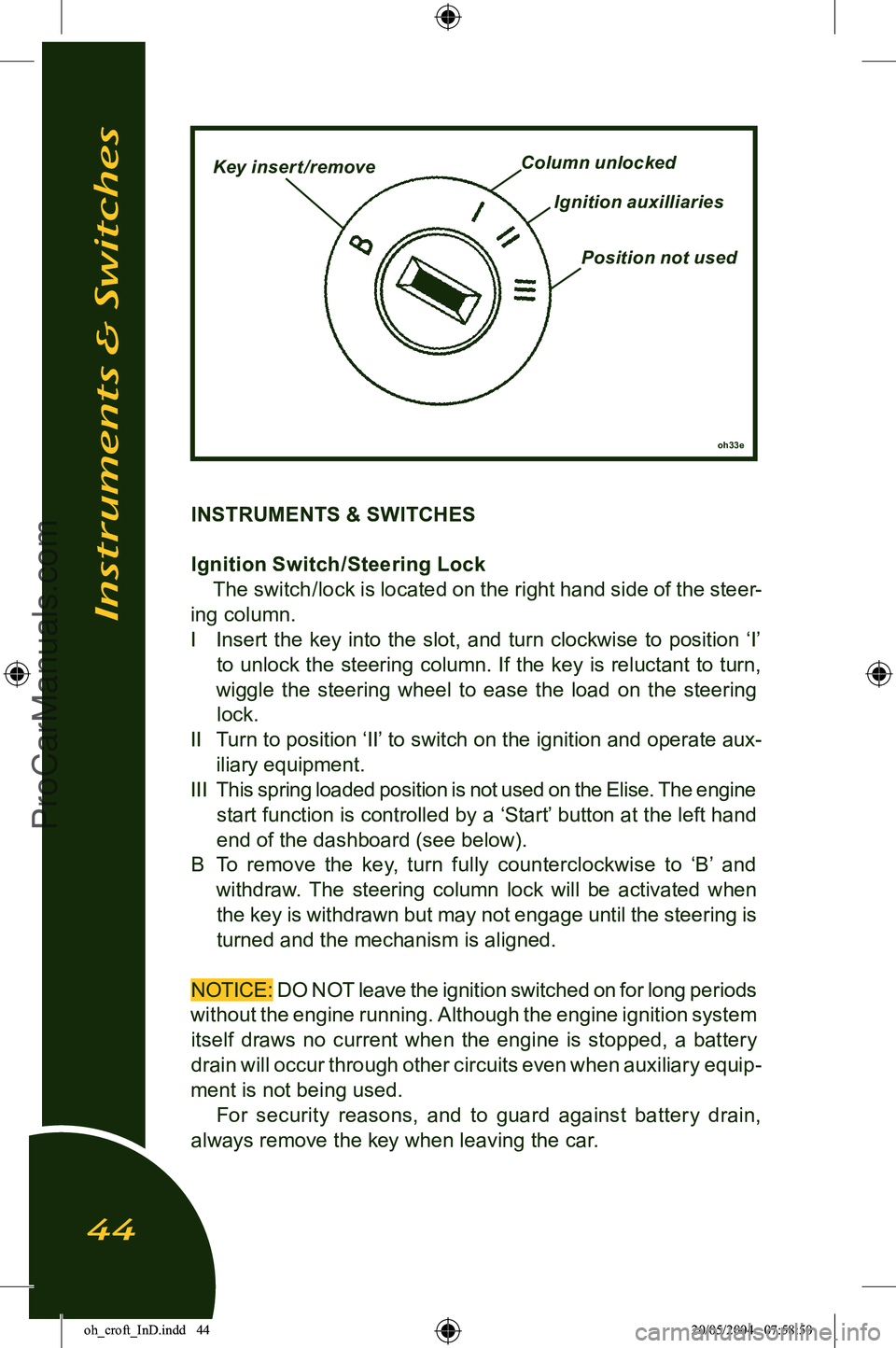
oh33e
Key insert /removeColumn unlocked
Ignition auxilliaries
Position not used
INSTRUMENTS & SWITCHES
Ignition Switch /Steering LockThe switch/lock is located on the right hand side of the steer
-
ing column.
I Insert the key into the slot, and turn clockwise to position ‘I’ to unlock the steering column. If the key is reluctant to turn,
wiggle the steering wheel to ease the load on the steering
lock.
II Turn to position ‘II’ to switch on the ignition and operate aux-
iliary equipment.
III This spring loaded position is not used on the Elise. The engine
start function is controlled by a ‘Start’ button at the left hand
end of the dashboard (see below).
B To remove the key, turn fully counterclockwise to ‘B’ and withdraw. The steering column lock will be activated when the key is withdrawn but may not engage until the steering is
turned and the mechanism is aligned.
NOTICE: DO NOT leave the ignition switched on for long periods
without the engine running. Although the engine ignition system itself draws no current when the engine is stopped, a battery drain will occur through other circuits even when auxiliary equip
-
ment is not being used. For security reasons, and to guard against battery drain,
always remove the key when leaving the car.
Instruments & Switches
44
oh_croft_InD.indd 4420/05/2004 07:58:50ProCarManuals.com
Page 47 of 205
WARNING:
• Do not push or tow the car unless the key is first used to unlock the column and is then left in the lock. With
-
drawing the key will cause the steering to lock.
• Never remove the key from the ignition switch or turn off the ignition while the car is moving. Withdrawing the key
will cause the steering to lock and may cause an accident
resulting in serious injury or death.
• To reduce the risk of theft, or danger to a child remaining in the car, always remove the key when leaving a parked
car.
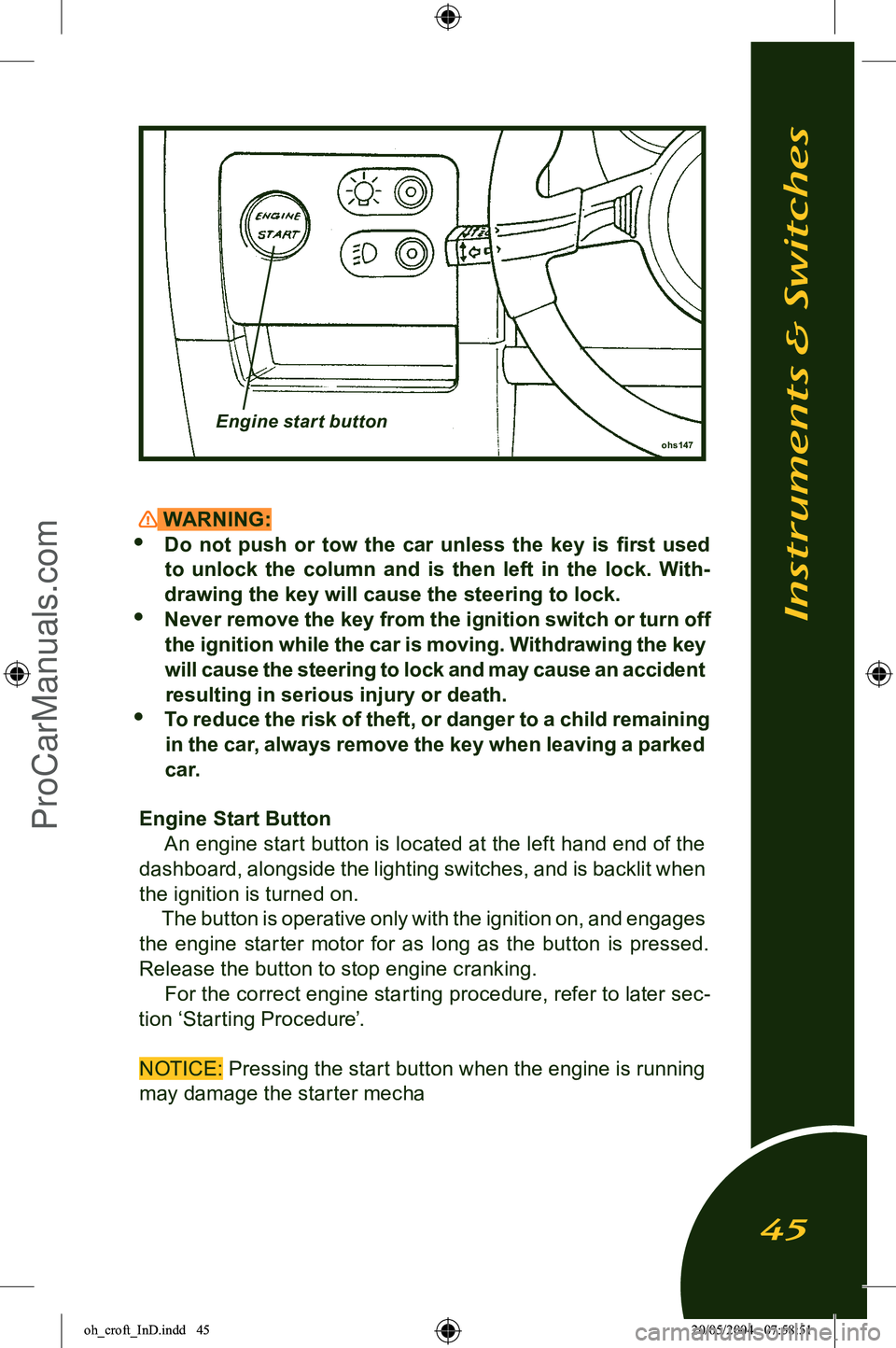
Engine Start Button An engine start button is located at the left hand end of the
dashboard, alongside the lighting switches, and is backlit when
the ignition is turned on. The button is operative only with the ignition on, and engages
the engine starter motor for as long as the button is pressed. Release the button to stop engine cranking.
For the correct engine starting procedure, refer to later sec
-
tion ‘Starting Procedure’.
NOTICE: Pressing the start button when the engine is running may damage the starter mecha
ohs147Engine start button
Instruments & Switches
45
oh_croft_InD.indd 4520/05/2004 07:58:51ProCarManuals.com
Page 54 of 205
engine speed is being approached. When exploiting full accel-
eration, gearchange upshifts should be made immediately the
tell tale comes on.
Note that this lamp also functions as a security system tell
tale (see ‘Car Security’). Recalibration of the speedo and tacho needle zero positions
will occur during a 3 second period following ignition switch on,
but if a needle becomes ‘stranded‘ outside of the re-calibration
range, the following procedure should be followed:
With the car stationary;
• Open driver‘s door;
• Press and hold trip reset button on steering column shroud;
• Turn on ignition.
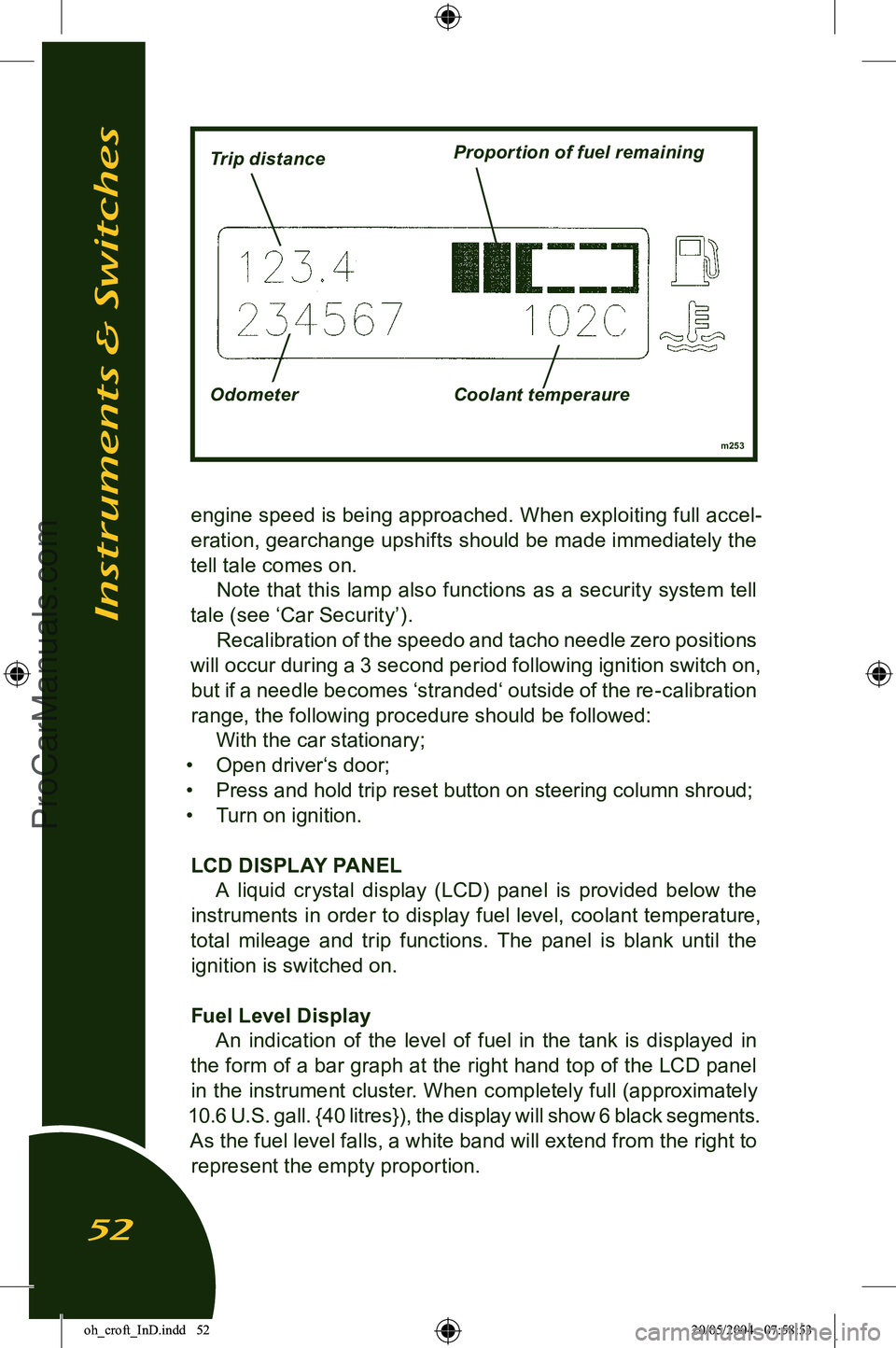
LCD DISPLAY PANEL A liquid crystal display (LCD) panel is provided below the
instruments in order to display fuel level, coolant temperature,
total mileage and trip functions. The panel is blank until the ignition is switched on.
Fuel Level Display An indication of the level of fuel in the tank is displayed in
the form of a bar graph at the right hand top of the LCD panel in the instrument cluster. When completely full (approximately
10.6 U.S. gall. {40 litres}), the display will show 6 black segments. As the fuel level falls, a white band will extend from the right to represent the empty proportion.
Instruments & Switches
52
m253
Trip distanceProportion of fuel remaining
Odometer Coolant temperaure
oh_croft_InD.indd 5220/05/2004 07:58:53ProCarManuals.com