cruise MAZDA 6 2002 Suplement Owner's Manual
[x] Cancel search | Manufacturer: MAZDA, Model Year: 2002, Model line: 6, Model: MAZDA 6 2002Pages: 909, PDF Size: 17.16 MB
Page 217 of 909
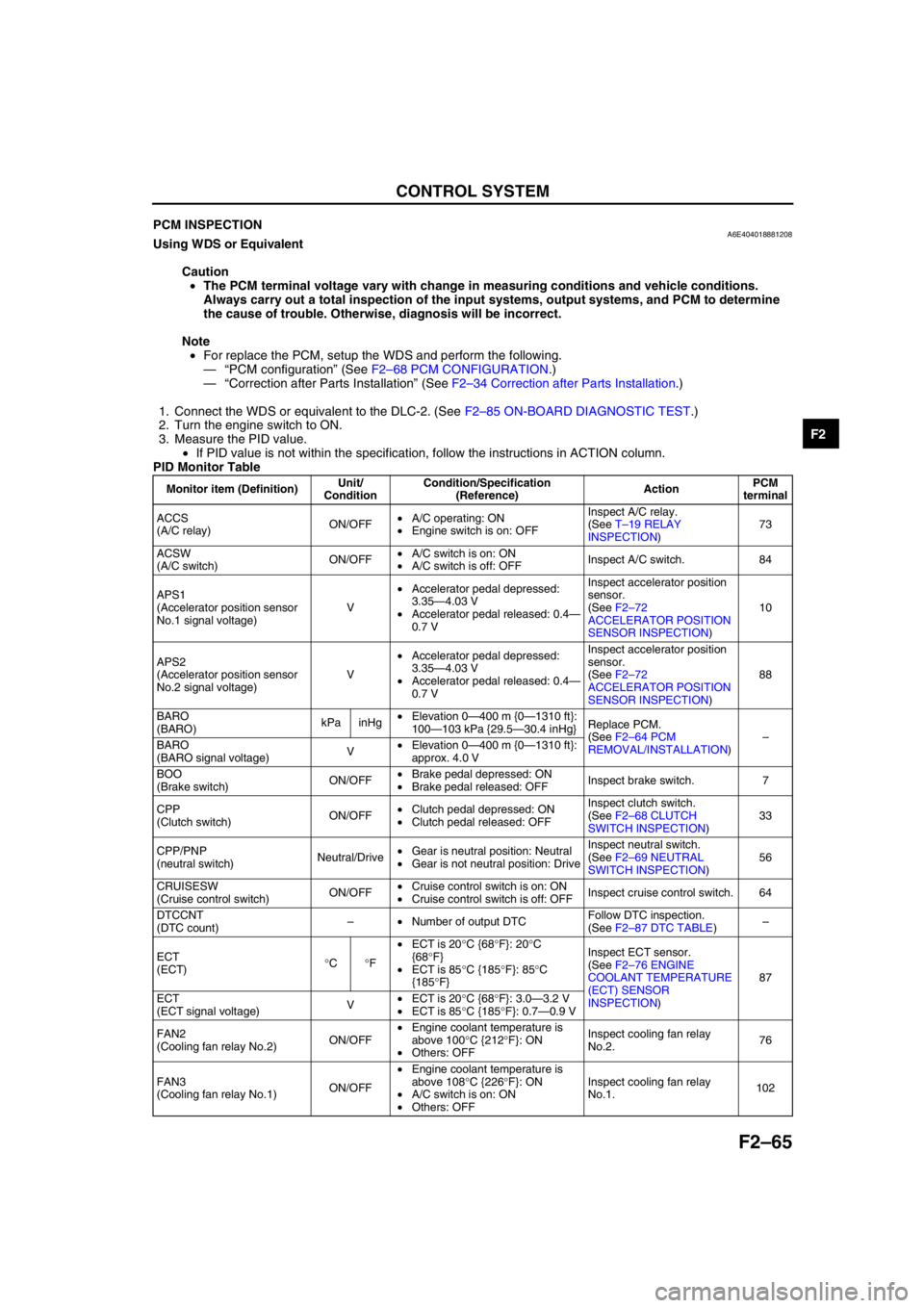
CONTROL SYSTEM
F2–65
F2
End Of SiePCM INSPECTIONA6E404018881208Using WDS or Equivalent
Caution
•The PCM terminal voltage vary with change in measuring conditions and vehicle conditions.
Always carry out a total inspection of the input systems, output systems, and PCM to determine
the cause of trouble. Otherwise, diagnosis will be incorrect.
Note
•For replace the PCM, setup the WDS and perform the following.
—“PCM configuration” (See F2–68 PCM CONFIGURATION.)
—“Correction after Parts Installation” (See F2–34 Correction after Parts Installation.)
1. Connect the WDS or equivalent to the DLC-2. (See F2–85 ON-BOARD DIAGNOSTIC TEST.)
2. Turn the engine switch to ON.
3. Measure the PID value.
•If PID value is not within the specification, follow the instructions in ACTION column.
PID Monitor Table
Monitor item (Definition)Unit/
ConditionCondition/Specification
(Reference)ActionPCM
terminal
ACCS
(A/C relay)ON/OFF•A/C operating: ON
•Engine switch is on: OFFInspect A/C relay.
(See T–19 RELAY
INSPECTION)73
ACSW
(A/C switch)ON/OFF•A/C switch is on: ON
•A/C switch is off: OFFInspect A/C switch. 84
APS1
(Accelerator position sensor
No.1 signal voltage)V•Accelerator pedal depressed:
3.35—4.03 V
•Accelerator pedal released: 0.4—
0.7 VInspect accelerator position
sensor.
(See F2–72
ACCELERATOR POSITION
SENSOR INSPECTION)10
APS2
(Accelerator position sensor
No.2 signal voltage)V•Accelerator pedal depressed:
3.35—4.03 V
•Accelerator pedal released: 0.4—
0.7 VInspect accelerator position
sensor.
(See F2–72
ACCELERATOR POSITION
SENSOR INSPECTION)88
BARO
(BARO)kPa inHg•Elevation 0—400 m {0—1310 ft}:
100—103 kPa {29.5—30.4 inHg}Replace PCM.
(See F2–64 PCM
REMOVAL/INSTALLATION)–
BARO
(BARO signal voltage)V•Elevation 0—400 m {0—1310 ft}:
approx. 4.0 V
BOO
(Brake switch)ON/OFF•Brake pedal depressed: ON
•Brake pedal released: OFFInspect brake switch. 7
CPP
(Clutch switch)ON/OFF•Clutch pedal depressed: ON
•Clutch pedal released: OFFInspect clutch switch.
(See F2–68 CLUTCH
SWITCH INSPECTION)33
CPP/PNP
(neutral switch)Neutral/Drive•Gear is neutral position: Neutral
•Gear is not neutral position: DriveInspect neutral switch.
(See F2–69 NEUTRAL
SWITCH INSPECTION)56
CRUISESW
(Cruise control switch)ON/OFF•Cruise control switch is on: ON
•Cruise control switch is off: OFFInspect cruise control switch. 64
DTCCNT
(DTC count)–•Number of output DTCFollow DTC inspection.
(See F2–87 DTC TABLE)–
ECT
(ECT)°C°F•ECT is 20°C {68°F}: 20°C
{68°F}
•ECT is 85°C {185°F}: 85°C
{185°F}Inspect ECT sensor.
(See F2–76 ENGINE
COOLANT TEMPERATURE
(ECT) SENSOR
INSPECTION)87
ECT
(ECT signal voltage)V•ECT is 20°C {68°F}: 3.0—3.2 V
•ECT is 85°C {185°F}: 0.7—0.9 V
FAN2
(Cooling fan relay No.2)ON/OFF•Engine coolant temperature is
above 100°C {212°F}: ON
•Others: OFFInspect cooling fan relay
No.2.76
FAN3
(Cooling fan relay No.1)ON/OFF•Engine coolant temperature is
above 108°C {226°F}: ON
•A/C switch is on: ON
•Others: OFFInspect cooling fan relay
No.1.102
Page 239 of 909
ON-BOARD DIAGNOSTIC
F2–87
F2
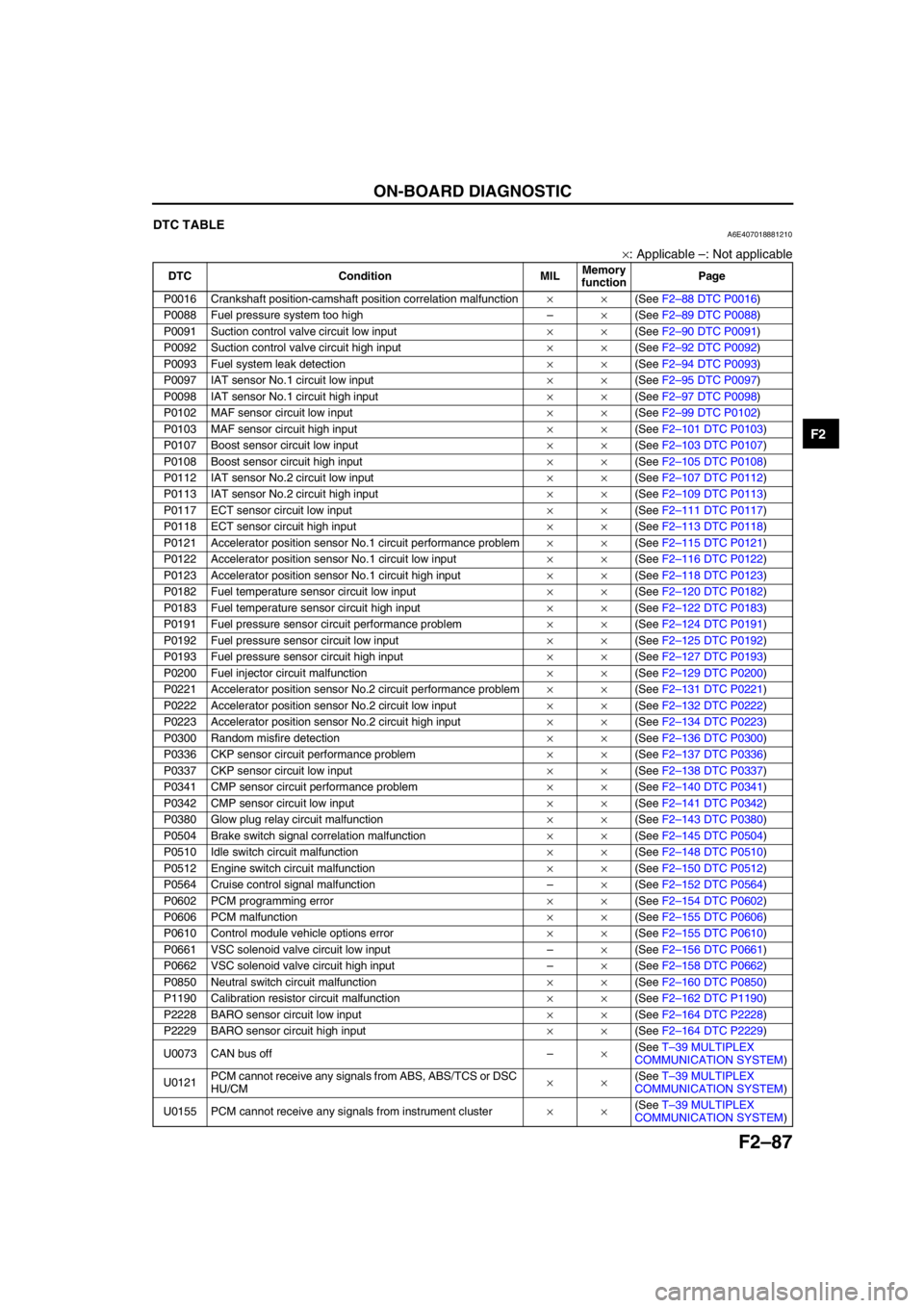
End Of SieDTC TABLEA6E407018881210
×: Applicable –: Not applicable
DTC Condition MILMemory
functionPage
P0016 Crankshaft position-camshaft position correlation malfunction××(See F2–88 DTC P0016)
P0088 Fuel pressure system too high–×(See F2–89 DTC P0088)
P0091 Suction control valve circuit low input××(See F2–90 DTC P0091)
P0092 Suction control valve circuit high input××(See F2–92 DTC P0092)
P0093 Fuel system leak detection××(See F2–94 DTC P0093)
P0097 IAT sensor No.1 circuit low input××(See F2–95 DTC P0097)
P0098 IAT sensor No.1 circuit high input××(See F2–97 DTC P0098)
P0102 MAF sensor circuit low input××(See F2–99 DTC P0102)
P0103 MAF sensor circuit high input××(See F2–101 DTC P0103)
P0107 Boost sensor circuit low input××(See F2–103 DTC P0107)
P0108 Boost sensor circuit high input××(See F2–105 DTC P0108)
P0112 IAT sensor No.2 circuit low input××(See F2–107 DTC P0112)
P0113 IAT sensor No.2 circuit high input××(See F2–109 DTC P0113)
P0117 ECT sensor circuit low input××(See F2–111 DTC P0117)
P0118 ECT sensor circuit high input××(See F2–113 DTC P0118)
P0121 Accelerator position sensor No.1 circuit performance problem××(See F2–115 DTC P0121)
P0122 Accelerator position sensor No.1 circuit low input××(See F2–116 DTC P0122)
P0123 Accelerator position sensor No.1 circuit high input××(See F2–118 DTC P0123)
P0182 Fuel temperature sensor circuit low input××(See F2–120 DTC P0182)
P0183 Fuel temperature sensor circuit high input××(See F2–122 DTC P0183)
P0191 Fuel pressure sensor circuit performance problem××(See F2–124 DTC P0191)
P0192 Fuel pressure sensor circuit low input××(See F2–125 DTC P0192)
P0193 Fuel pressure sensor circuit high input××(See F2–127 DTC P0193)
P0200 Fuel injector circuit malfunction××(See F2–129 DTC P0200)
P0221 Accelerator position sensor No.2 circuit performance problem××(See F2–131 DTC P0221)
P0222 Accelerator position sensor No.2 circuit low input××(See F2–132 DTC P0222)
P0223 Accelerator position sensor No.2 circuit high input××(See F2–134 DTC P0223)
P0300 Random misfire detection××(See F2–136 DTC P0300)
P0336 CKP sensor circuit performance problem××(See F2–137 DTC P0336)
P0337 CKP sensor circuit low input××(See F2–138 DTC P0337)
P0341 CMP sensor circuit performance problem××(See F2–140 DTC P0341)
P0342 CMP sensor circuit low input××(See F2–141 DTC P0342)
P0380 Glow plug relay circuit malfunction××(See F2–143 DTC P0380)
P0504 Brake switch signal correlation malfunction××(See F2–145 DTC P0504)
P0510 Idle switch circuit malfunction××(See F2–148 DTC P0510)
P0512 Engine switch circuit malfunction××(See F2–150 DTC P0512)
P0564 Cruise control signal malfunction–×(See F2–152 DTC P0564)
P0602 PCM programming error××(See F2–154 DTC P0602)
P0606 PCM malfunction××(See F2–155 DTC P0606)
P0610 Control module vehicle options error××(See F2–155 DTC P0610)
P0661 VSC solenoid valve circuit low input–×(See F2–156 DTC P0661)
P0662 VSC solenoid valve circuit high input–×(See F2–158 DTC P0662)
P0850 Neutral switch circuit malfunction××(See F2–160 DTC P0850)
P1190 Calibration resistor circuit malfunction××(See F2–162 DTC P1190)
P2228 BARO sensor circuit low input××(See F2–164 DTC P2228)
P2229 BARO sensor circuit high input××(See F2–164 DTC P2229)
U0073 CAN bus off–×(See T–39 MULTIPLEX
COMMUNICATION SYSTEM)
U0121PCM cannot receive any signals from ABS, ABS/TCS or DSC
HU/CM××(See T–39 MULTIPLEX
COMMUNICATION SYSTEM)
U0155 PCM cannot receive any signals from instrument cluster××(See T–39 MULTIPLEX
COMMUNICATION SYSTEM)
Page 304 of 909
F2–152
ON-BOARD DIAGNOSTIC
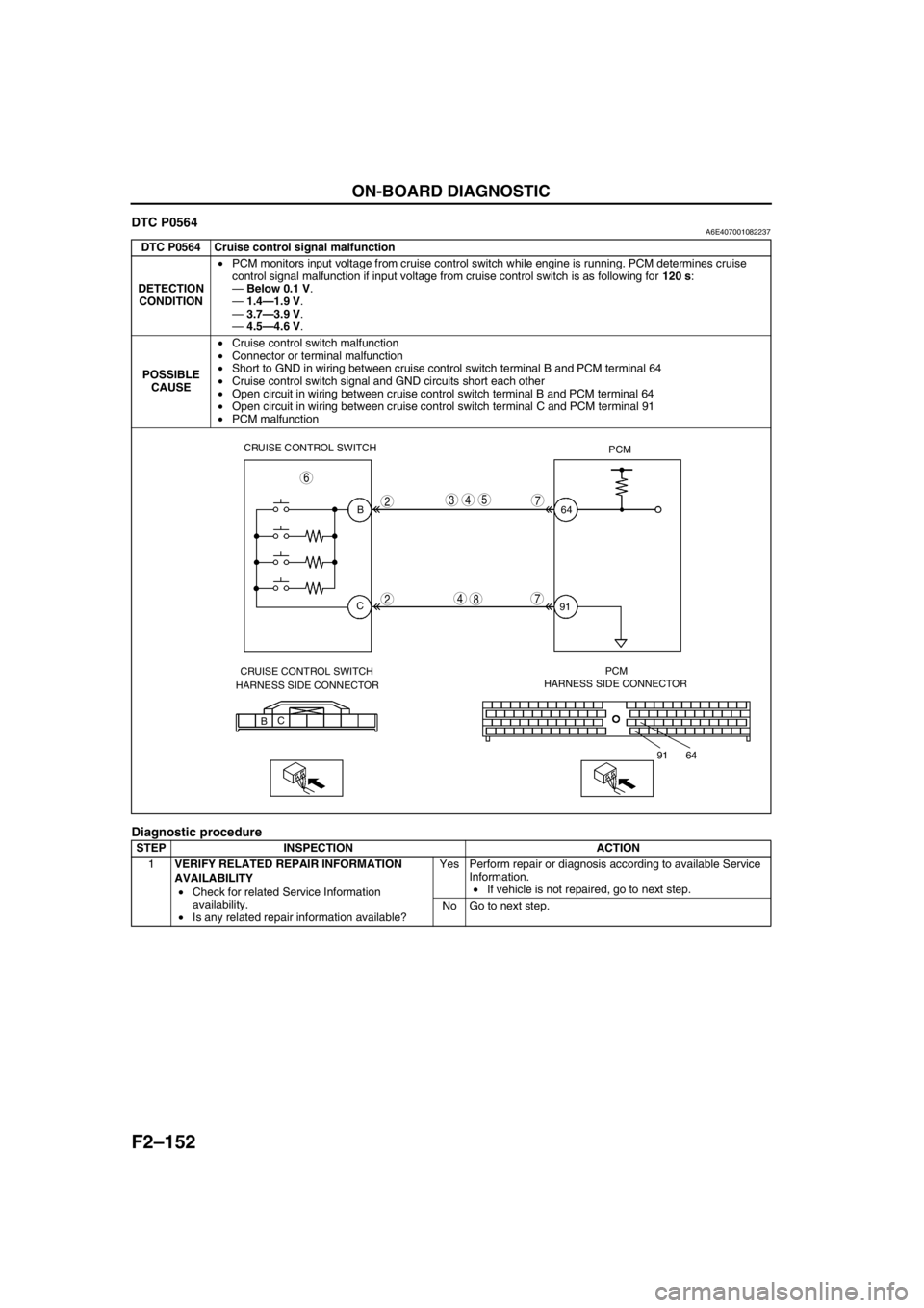
DTC P0564A6E407001082237
Diagnostic procedure
DTC P0564 Cruise control signal malfunction
DETECTION
CONDITION•PCM monitors input voltage from cruise control switch while engine is running. PCM determines cruise
control signal malfunction if input voltage from cruise control switch is as following for 120 s:
—Below 0.1 V.
—1.4—1.9 V.
—3.7—3.9 V.
—4.5—4.6 V.
POSSIBLE
CAUSE•Cruise control switch malfunction
•Connector or terminal malfunction
•Short to GND in wiring between cruise control switch terminal B and PCM terminal 64
•Cruise control switch signal and GND circuits short each other
•Open circuit in wiring between cruise control switch terminal B and PCM terminal 64
•Open circuit in wiring between cruise control switch terminal C and PCM terminal 91
•PCM malfunction
STEP INSPECTION ACTION
1VERIFY RELATED REPAIR INFORMATION
AVAILABILITY
•Check for related Service Information
availability.
•Is any related repair information available?Yes Perform repair or diagnosis according to available Service
Information.
•If vehicle is not repaired, go to next step.
No Go to next step.
CRUISE CONTROL SWITCH
PCM
B
C64
91
CRUISE CONTROL SWITCH
HARNESS SIDE CONNECTORPCM
HARNESS SIDE CONNECTOR
BC
64 91
2
2
543
4
7
6
78
Page 305 of 909

ON-BOARD DIAGNOSTIC
F2–153
F2
End Of Sie
2INSPECT POOR CONNECTION OF CRUISE
CONTROL SWITCH CONNECTOR
•Turn engine switch to OFF.
•Inspect for poor connection (damaged, pulled-
out terminals, corrosion, etc.).
•Is there any malfunction?Yes Repair or replace suspected terminal, go to Step 9.
No Go to next step.
3INSPECT CRUISE CONTROL SWITCH SIGNAL
CIRCUIT FOR SHORT TO GND
•Turn engine switch to OFF.
•Inspect continuity between cruise control
switch terminal B and body GND.
•Is there continuity?Yes Repair or replace harness for short to GND, go to Step 9.
No Go to next step.
4INSPECT CRUISE CONTROL SWITCH CIRCUIT
FOR SHORT WITH EACH OTHER
•Turn engine switch to OFF.
•Inspect continuity between cruise control
switch terminals B and C.
•Is there continuity?Yes Repair or replace harness for short with each other, go to
Step 9.
No Go to next step.
5INSPECT CRUISE CONTROL SWITCH SIGNAL
CIRCUIT FOR OPEN
•Turn engine switch to ON. (Engine OFF)
•Inspect voltage at cruise control switch terminal
B (harness side).
•Is voltage below 1.0 V?Yes Repair or replace harness for open, go to Step 9.
No Go to next step.
6INSPECT CRUISE CONTROL SWITCH
•Inspect cruise control switch.
•Is there any malfunction?Yes Replace cruise control switch, go to Step 9.
No Go to next step.
7INSPECT POOR CONNECTION OF PCM
CONNECTOR
•Turn engine switch to OFF.
•Inspect for poor connection (damaged, pulled-
out terminals, corrosion, etc.).
•Is there any malfunction?Yes Repair or replace suspected terminal, go to Step 9.
No Go to next step.
8INSPECT CRUISE CONTROL SWITCH GND
CIRCUIT FOR OPEN
•Turn engine switch to OFF.
•Inspect continuity between cruise control
switch terminal C and PCM terminal 91.
•Is there continuity?Yes Go to next step.
No Repair or replace harness for open, go to next step.
9VERIFY TROUBLESHOOTING OF DTC P0564
COMPLETED
•Make sure to reconnect all disconnected
connectors.
•Clear DTC from PCM memory using WDS or
equivalent.
•Start engine.
•Is same DTC present?Yes Replace PCM, go to next step.
(See F2–64 PCM REMOVAL/INSTALLATION)
No Go to next step.
10VERIFY AFTER REPAIR PROCEDURE
•Perform “After Repair Procedure”.
(See F2–86 AFTER REPAIR PROCEDURE)
•Is there any DTC present?Yes Go to applicable DTC inspection.
(See F2–87 DTC TABLE)
No Troubleshooting completed. STEP INSPECTION ACTION
Page 317 of 909

TROUBLESHOOTING
F2–165
F2
SYMPTOM DIAGNOSTIC INDEXA6E408018881201
TROUBLESHOOTING
No. TROUBLESHOOTING ITEM DESCRIPTION PAGE
1 Melting of main or other fuses—(See F2–173 NO.1 MELTING
OF MAIN OR OTHER FUSES)
2 MIL illuminates MIL is illuminated incorrectly.(See F2–174 NO.2 MIL
ILLUMINATES)
3 Will not crank Starter does not work.(See F2–174 NO.3 WILL NOT
CRANK)
4Hard start/long crank/erratic start/
erratic crankStarter cranks engine at normal speed but
engine requires excessive cranking time
before starting.(See F2–176 NO.4 HARD
START/LONG CRANK/
ERRATIC START/ERRATIC
CRANK)
5 Engine stalls After start/at idleEngine stops unexpectedly at idle and/or
after start.(See F2–178 NO.5 ENGINE
STALLS-AFTER START/AT
IDLE)
6 Cranks normally but will not startStarter cranks engine at normal speed but
engine will not run.(See F2–181 NO.6 CRANKS
NORMALLY BUT WILL NOT
START)
7 Slow return to idleEngine takes more time than normal to
return to idle speed.(See F2–184 NO.7 SLOW
RETURN TO IDLE)
8 Engine runs rough/rolling idleEngine speed fluctuates between specified
idle speed and lower speed and engine
shakes excessively.(See F2–186 NO.8 ENGINE
RUNS ROUGH/ROLLING
IDLE)
9 Fast idle/runs onEngine speed continues at fast idle after
warm-up.
Engine runs after engine switch is turned to
OFF.(See F2–189 NO.9 FAST
IDLE/RUNS ON)
10 Low idle/stalls during decelerationEngine stops unexpectedly at beginning of
deceleration or recovery from deceleration.(See F2–190 NO.10 LOW
IDLE/STALLS DURING
DECELERATION)
11Engine stalls/quitsAcceleration/
cruiseEngine stops unexpectedly at beginning of
acceleration or during acceleration.
Engine stops unexpectedly while cruising.
(See F2–192 NO.11 ENGINE
STALLS/QUITS, ENGINE
RUNS ROUGH, MISSES,
BUCK/JERK, HESITATION/
STUMBLE, SURGES) Engine runs roughAcceleration/
cruiseEngine speed fluctuates during acceleration
or cruising.
MissesAcceleration/
cruiseEngine misses during acceleration or
cruising.
Buck/jerkAcceleration/
cruise/
decelerationVehicle bucks/jerks during acceleration,
cruising, or deceleration.
Hesitation/stumble AccelerationMomentary pause at beginning of
acceleration or during acceleration.
SurgesAcceleration/
cruiseMomentary minor irregularity in engine
output.
12 Lack/loss of powerAcceleration/
cruisePerformance is poor under load (e.g. power
down when climbing hills).(See F2–195 NO.12 LACK/
LOSS OF POWER-
ACCELERATION/CRUISE)
13 Knocking/pingingExcessive shrilly knocking sound from
engine.(See F2–199 NO.13
KNOCKING/PINGING)
14 Poor fuel economy Fuel economy is unsatisfactory.(See F2–202 NO.14 POOR
FUEL ECONOMY)
15 Emissions compliance Fails emissions test.(See F2–205 NO.15
EMISSION COMPLIANCE)
16 High oil consumption/leakage Oil consumption is excessive.(See F2–209 NO.16 HIGH OIL
CONSUMPTION/LEAKAGE)
17Cooling system
concernsOverheatingEngine runs at higher than normal
temperature/overheats.(See F2–210 NO.17 COOLING
SYSTEM CONCERNS-
OVERHEATING)
Page 319 of 909

TROUBLESHOOTING
F2–167
F2
SYMPTOM QUICK DIAGNOSIS CHARTA6E408018881202
×: Applicable
Troubleshooting item
1 Melting of main or other fuses
2 MIL illuminates
3 Will not crank×× ×× × ×
4 Hard start/long crank/erratic start/erratic crank×× ×
5 Engine stalls After start/at idle××
6 Cranks normally but will not start××
7 Slow return to idle
8 Engine runs rough/rolling idle××
9 Fast idle/runs on
10 Low idle/stalls during deceleration××
11Engine stalls/quits Acceleration/cruise××
Engine runs rough Acceleration/cruise××
Misses Acceleration/cruise××
Buck/jerk Acceleration/cruise/ deceleration××
Hesitation/stumble Acceleration××
Surges Acceleration/cruise××
12 Lack/loss of power Acceleration/cruise××
13 Knocking/pinging××
14 Poor fuel economy××
15 Emissions compliance×× ×
16 High oil consumption/leakage××××
17 Cooling system concerns Overheating××
18 Cooling system concerns Runs cold
19 Excessive black smoke×
20 Fuel odor (in engine compartment)
21 Engine noise×× × ×
22 Vibration concerns (engine)×
23 A/C does not work sufficiently
24 A/C always on or A/C compressor runs continuously
25 A/C does not cut off under wide open throttle conditions
26 Constant voltage
Starter motor malfunction (Mechanical or electrical)Starter circuit including engine switch is openImproper engine oil levelLow or dead bateryCharging system malfunctionLow engine compressionImproper valve timingHydrolocked egineImproper engine oil viscosityImproper dipstickBase engine malfunctionSeized flywheelImproper tension or damaged drivebelts
Page 320 of 909

F2–168
TROUBLESHOOTING
×: Applicable
Troubleshooting item
1 Melting of main or other fuses
2 MIL illuminates
3 Will not crank
4 Hard start/long crank/erratic start/erratic crank×××
5 Engine stalls After start/at idle×××
6 Cranks normally but will not start××
7 Slow return to idle×
8 Engine runs rough/rolling idle××××
9 Fast idle/runs on×
10 Low idle/stalls during deceleration××
11Engine stalls/quits Acceleration/cruise××××
Engine runs rough Acceleration/cruise×××× ×
Misses Acceleration/cruise××××××
Buck/jerk Acceleration/cruise/ deceleration××××××
Hesitation/stumble Acceleration××××××
Surges Acceleration/cruise××××××
12 Lack/loss of power Acceleration/cruise×××××××
13 Knocking/pinging×××××
14 Poor fuel economy××××
15 Emissions compliance× ××××××
16 High oil consumption/leakage
17 Cooling system concerns Overheating×× × ×
18 Cooling system concerns Runs cold××
19 Excessive black smoke××××
20 Fuel odor (in engine compartment)
21 Engine noise××
22 Vibration concerns (engine)×× ×
23 A/C does not work sufficiently
24 A/C always on or A/C compressor runs continuously
25 A/C does not cut off under wide open throttle conditions
26 Constant voltage
Improper engine coolant levelWater and anti-freeze mixture is improperCooling system malfunction (Radiator, hose,
over-flow system, thermostat, etc.)Cooling fan system malfunctionEngine or transaxle mounts are improperly installedCooling fan No.1 or No.2 seat are improperFuel qualityEngine overheatingIntake-air system clogging or restrictionAir leakage from intake-air systemVSC system malfunctionVacuum leakage
Page 321 of 909

TROUBLESHOOTING
F2–169
F2
×: Applicable
Troubleshooting item
1 Melting of main or other fuses
2 MIL illuminates×× × ×
3 Will not crank
4 Hard start/long crank/erratic start/erratic crank×× ×××××××
5 Engine stalls After start/at idle×× ×××××××
6 Cranks normally but will not start×× ×××××××
7 Slow return to idle××××××××
8 Engine runs rough/rolling idle×××××××××
9 Fast idle/runs on×
10 Low idle/stalls during deceleration××××××××××
11Engine stalls/quits Acceleration/cruise× × ×××××××
Engine runs rough Acceleration/cruise× ××××××××××
Misses Acceleration/cruise× ××××××××××
Buck/jerk Acceleration/cruise/ deceleration× ××××××××××
Hesitation/stumble Acceleration× ××××××××××
Surges Acceleration/cruise× ×× ×××××××
12 Lack/loss of power Acceleration/cruise××× ×××××××××
13 Knocking/pinging××××× ××× × ×
14 Poor fuel economy××× ×××××× ×
15 Emissions compliance×××××××××××××
16 High oil consumption/leakage×
17 Cooling system concerns Overheating×
18 Cooling system concerns Runs cold
19 Excessive black smoke××× × ××× ×××
20 Fuel odor (in engine compartment)××
21 Engine noise× ××× ×
22 Vibration concerns (engine)
23 A/C does not work sufficiently
24 A/C always on or A/C compressor runs continuously
25 A/C does not cut off under wide open throttle conditions
26 Constant voltage
Turbocharger malfunctionCarge air cooler malfunctionVBC system malfunctionGlow system malfunctionIncorrect fuel injection timingIncorrect idle speedCKP sensor is damaged (e.g.: open or short circuits)CKP sensor pulse wheel is damagedImproper gap between CKP sensor and pulse wheelSupply pump malfunctionSuction control valve malfunctionFuel pressure limiter malfunctionFuel line restriction or clogging
Page 322 of 909
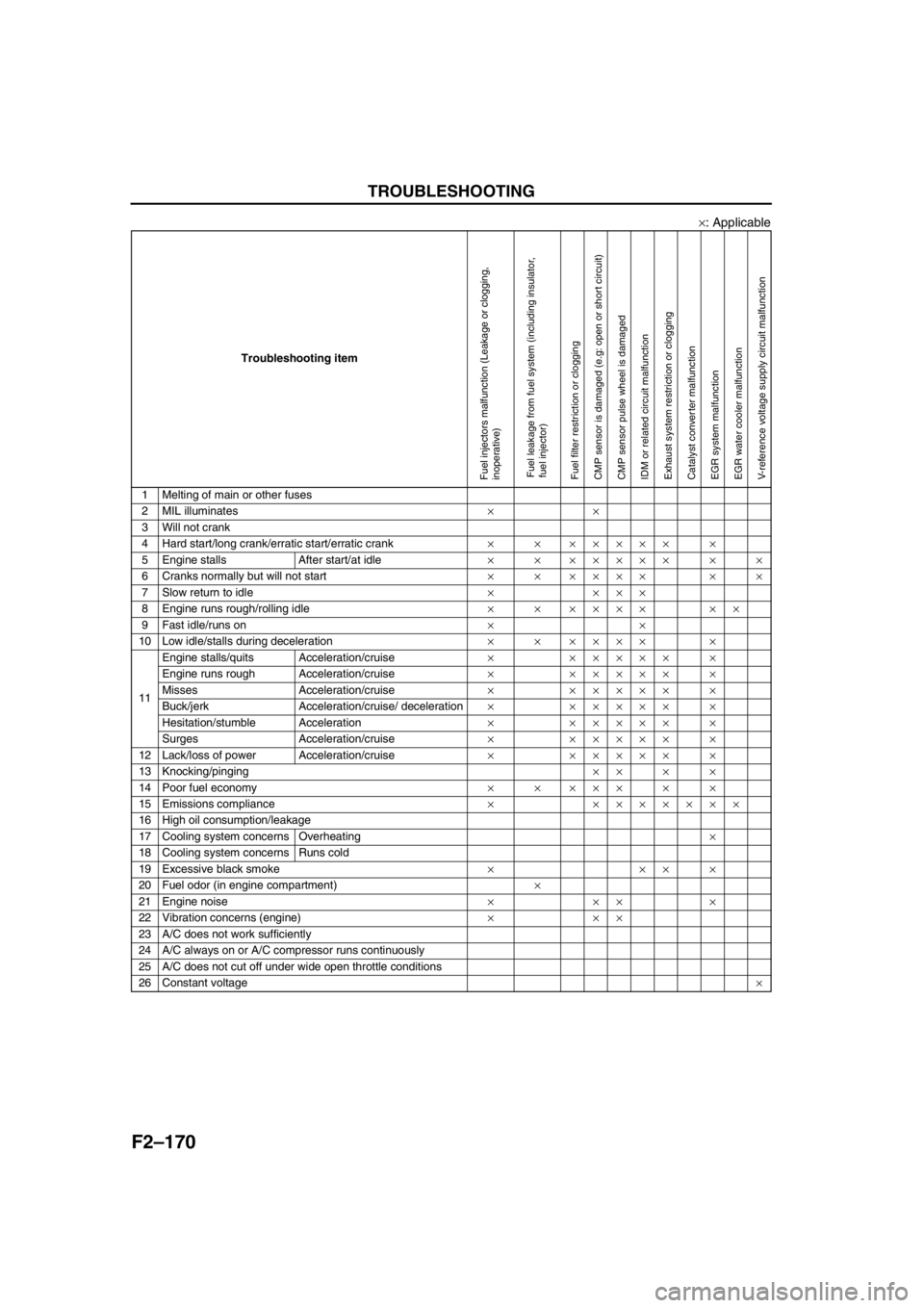
F2–170
TROUBLESHOOTING
×: Applicable
Troubleshooting item
1 Melting of main or other fuses
2 MIL illuminates××
3 Will not crank
4 Hard start/long crank/erratic start/erratic crank× × ××××× ×
5 Engine stalls After start/at idle×××××××××
6 Cranks normally but will not start× × ×××× × ×
7 Slow return to idle××××
8 Engine runs rough/rolling idle× × ×××× ××
9 Fast idle/runs on××
10 Low idle/stalls during deceleration× × ×××× ×
11Engine stalls/quits Acceleration/cruise× ××××× ×
Engine runs rough Acceleration/cruise× ××××× ×
Misses Acceleration/cruise× ××××× ×
Buck/jerk Acceleration/cruise/ deceleration× ××××× ×
Hesitation/stumble Acceleration× ××××× ×
Surges Acceleration/cruise× ××××× ×
12 Lack/loss of power Acceleration/cruise× ××××× ×
13 Knocking/pinging××××
14 Poor fuel economy×××××××
15 Emissions compliance× ×××××××
16 High oil consumption/leakage
17 Cooling system concerns Overheating×
18 Cooling system concerns Runs cold
19 Excessive black smoke××××
20 Fuel odor (in engine compartment)×
21 Engine noise××××
22 Vibration concerns (engine)×××
23 A/C does not work sufficiently
24 A/C always on or A/C compressor runs continuously
25 A/C does not cut off under wide open throttle conditions
26 Constant voltage×
Fuel injectors malfunction (Leakage or clogging,
inoperative)Fuel leakage from fuel system (including insulator,
fuel injector)Fuel filter restriction or cloggingCMP sensor is damaged (e.g: open or short circuit)CMP sensor pulse wheel is damagedIDM or related circuit malfunctionExhaust system restriction or cloggingCatalyst converter malfunctionEGR system malfunctionEGR water cooler malfunctionV-reference voltage supply circuit malfunction
Page 323 of 909
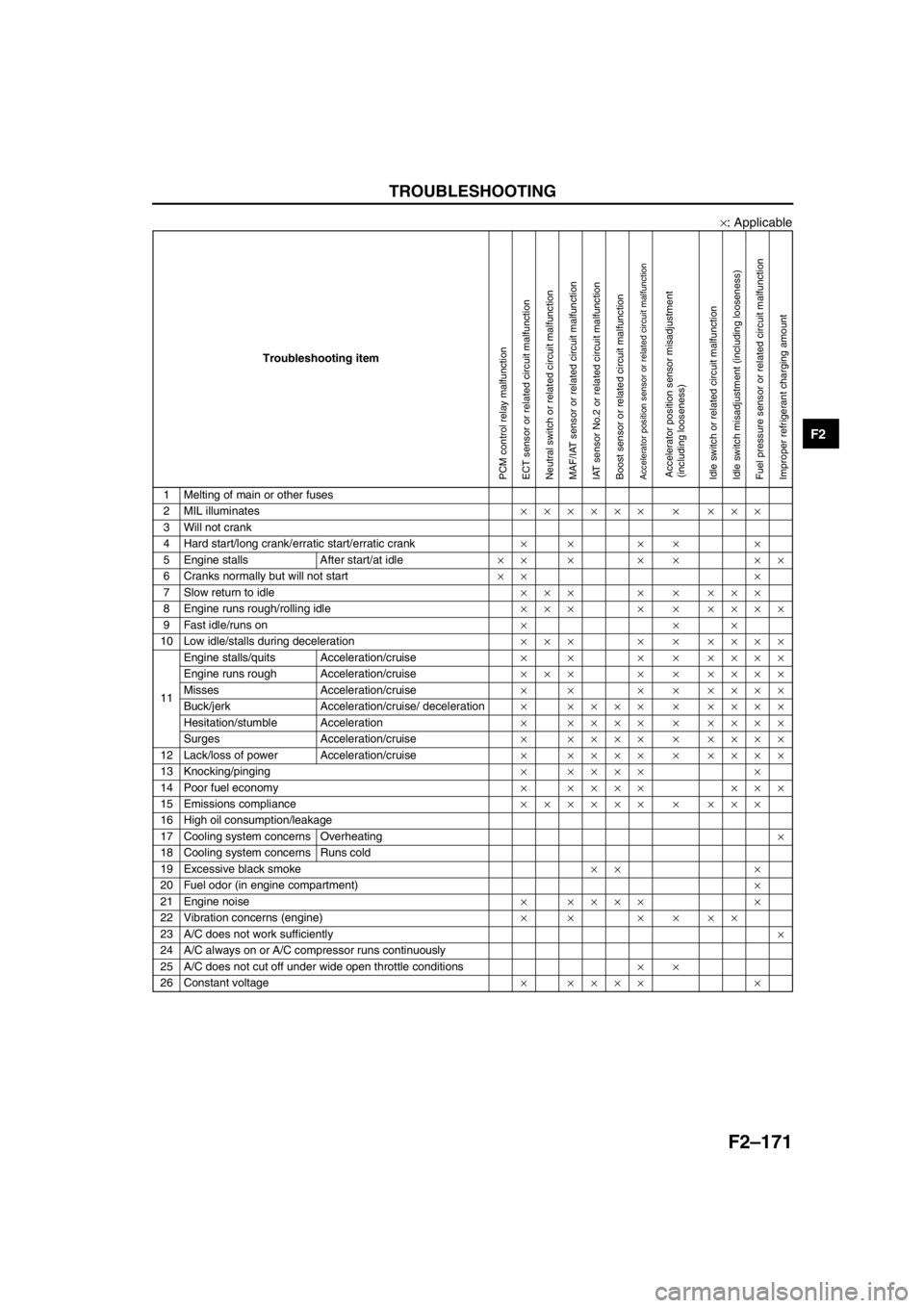
TROUBLESHOOTING
F2–171
F2
×: Applicable
Troubleshooting item
1 Melting of main or other fuses
2 MIL illuminates×××××× × ×××
3 Will not crank
4 Hard start/long crank/erratic start/erratic crank×× ×× ×
5 Engine stalls After start/at idle×× × × × ××
6 Cranks normally but will not start×× ×
7 Slow return to idle××× × × ×××
8 Engine runs rough/rolling idle××× × × ××××
9 Fast idle/runs on×××
10 Low idle/stalls during deceleration××× × × ××××
11Engine stalls/quits Acceleration/cruise× × × × ××××
Engine runs rough Acceleration/cruise××× × × ××××
Misses Acceleration/cruise× × × × ××××
Buck/jerk Acceleration/cruise/ deceleration× ×××× × ××××
Hesitation/stumble Acceleration× ×××× × ××××
Surges Acceleration/cruise× ×××× × ××××
12 Lack/loss of power Acceleration/cruise× ×××× × ××××
13 Knocking/pinging××××× ×
14 Poor fuel economy× ×××× ×××
15 Emissions compliance×××××× × ×××
16 High oil consumption/leakage
17 Cooling system concerns Overheating×
18 Cooling system concerns Runs cold
19 Excessive black smoke×× ×
20 Fuel odor (in engine compartment)×
21 Engine noise××××× ×
22 Vibration concerns (engine)×× ××××
23 A/C does not work sufficiently×
24 A/C always on or A/C compressor runs continuously
25 A/C does not cut off under wide open throttle conditions××
26 Constant voltage××××× ×
PCM control relay malfunctionECT sensor or related circuit malfunctionNeutral switch or related circuit malfunctionMAF/IAT sensor or related circuit malfunctionIAT sensor No.2 or related circuit malfunctionBoost sensor or related circuit malfunctionAccelerator position sensor or related circuit malfunctionAccelerator position sensor misadjustment
(including looseness)Idle switch or related circuit malfunctionIdle switch misadjustment (including looseness)Fuel pressure sensor or related circuit malfunctionImproper refrigerant charging amount