oil change MAZDA 626 1987 User Guide
[x] Cancel search | Manufacturer: MAZDA, Model Year: 1987, Model line: 626, Model: MAZDA 626 1987Pages: 1865, PDF Size: 94.35 MB
Page 327 of 1865
OUTLINE 2B
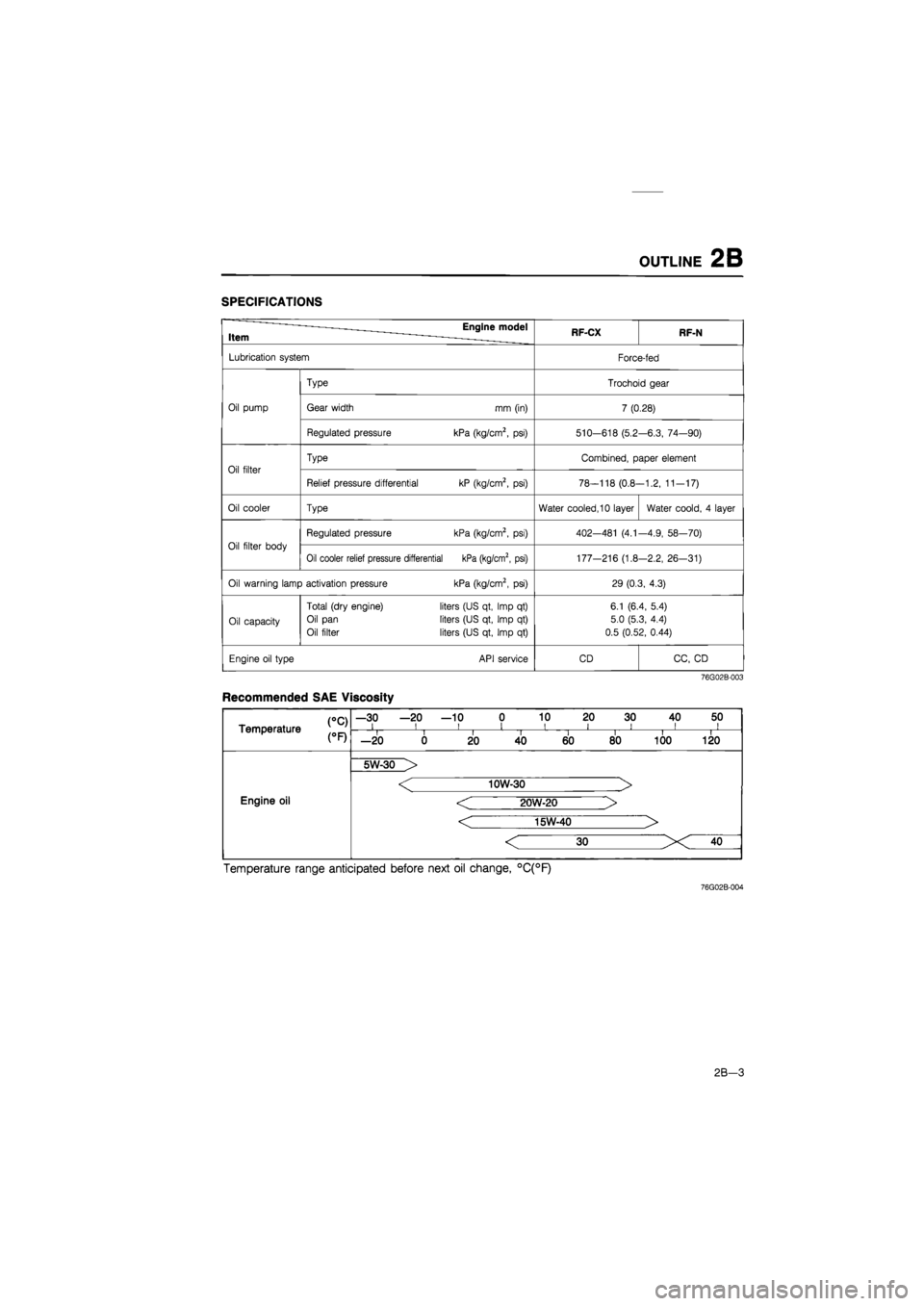
SPECIFICATIONS
Item Engine model RF-CX RF-N
Lubrication system Force-fed
Type Trochoid gear
Oil pump Gear width mm (in) 7 (0.28)
Regulated pressure kPa (kg/cm2,
psi)
510-618 (5.2 -6.3, 74—90)
Oil filter
Type Combined, paper element
Oil filter
Relief pressure differential kP (kg/cm2,
psi)
78-118 (0.8--1.2, 11-17)
Oil cooler Type Water cooled, 10 layer Water coold,
4
layer
Oil filter body
Regulated pressure kPa (kg/cm2,
psi)
402—481
(4.1
-4.9, 58—70)
Oil filter body
Oil cooler relief pressure differential kPa (kg/cm2, psi) 177-216 (1.8 -2.2, 26-31)
Oil warning lamp activation pressure kPa (kg/cm2,
psi)
29 (0.3, 4.3)
Oil capacity
Total (dry engine)
Oil pan
Oil filter
liters (US qt, Imp
qt)
liters (US qt, Imp
qt)
liters (US qt, Imp
qt)
6.1 (6.4, 5.4)
5.0 (5.3, 4.4)
0.5 (0.52, 0.44)
Engine oil type API service CD CC,
CD
76G02B-003
Recommended SAE Viscosity
CC) Temperature
—30 —20 —10 0 10 20 30 40 50 i i i i i i i ii CC) Temperature i i II i i i i —20 0 20 40 60 80 100 120
Engine oil
5W-30 >
Engine oil
< 10W-30 >
< 20W-20 >
< 15W-40 >
Engine oil
Temperature range anticipated before next oil change, °C(°F)
76G02B-004
2B-3
Page 726 of 1865

5 IGNITER
(FE
DOHC)
76G05X-018
IGNITER
INSPECTION
1. Disconnect the center high tension lead from the
distributor cap.
2. Hold it with insulated pliers approx. 5—10 mm
(0.20—0.39 in) from a ground.
3. Turn th ignition switch ON.
4. Remove the rubber seal from the igniter connector.
5. Apply battery voltage to terminal A (LR) with a jum-
per wire.
6. Check that a strong blue spark is visible when the
wire is disconnected.
76G05X-019
If no spark is seen, connect a voltmeter between
terminal B (B) and terminal C (YL), and check for
battery voltage.
76G-05X-020
8. Repeat steps 5 and check
that
the voltage changes
to 2—3V.
9.
If
the voltage is not as specified, replace the igniter.
10.
If
the voltage is as specified, check the ignition coil
and high tension lead.
76G05X-021
5-20
Page 811 of 1865

TROUBLESHOOTING GUIDE 7A
TROUBLESHOOTING GUIDE
Problem Possible cause Remedy Page
Change lever won't Seized change lever ball Replace 7A-58 shift smoothly, or is Seized change control rod joint Replace 7A-58
hard to shift Bent change control rod Replace 7A-58
Too much play in Worn change control rod bushing Replace 7A-58 change lever Weak spring of ball or change lever Replace 7A-58 Worn bushing of ball or change lever Replace 7A—58
Difficult to shift Bent change rod Replace 7A—58
No grease in transmission control Lubricate with grease 7A-58
Insufficient oil Add oil 7A-6
Deterioration of oil quality Replace with oil of 7A-6 specified quality
Wear or play of shift fork or shift rod Replace 7 A—18
Wear of synchronizer ring Replace 7A-27
Wear of synchronizer cone of gear Replace 7A-27
Bed contact of synchronizer ring and cone of Replace 7A-27 gear
Excessive longitudinal play of gears Replace 7A-22
Wear of bearing Adjust or replace 7A—22
Wear of synchronizer key spring Replace 7A-27
Excessive shaft gear bearing preload Adjust 7A-37
Improperly adjusted change guide plate Adjust 7A-20
Won't stay in gear Bent change control rod Replace 7A-58
Worn change control rod bushing Replace 7A-58
Weak change lever ball spring Replace 7A-58
Improperly installed extension bar Tighten 7A-58
Wear of shift fork Replace 7A—22
Wear of clutch hub Replace 7A-27
Worn clutch hub sleeve Replace 7A-27
Worn gear sliding part of both shaft gears Replace 7A-26
Worn gear sliding part of each gear Replace 7A-26
Worn steel sliding groove of control end Replace 7 A—18
Weak spring pressing against steel ball Replace 7A-18
Excessive thrust clearance Replace 7A—33,35
Worn bearing Replace 7A—22
Improperly installed engine mount Tighten 7A—49
Abnormal noise Insufficient oil Add oil 7A-6
Deterioration of oil quality Replace 7A-6
Worn bearing Adjust or replace 7A-22
Worn gear sliding surface of both shaft gears Replace 7A—26
Wear of sliding surfaces of gears Replace 7A-26
Excessive thrust clearance Replace 7A—33,35
Damaged gear teeth Replace with oil of 7A-26
specified quality Foreign material in gears Replace 7A-22
Damaged differential gear, or excessive backlash Adjust or replace 7A—30
76G07A-005
7A-5
Page 826 of 1865

7A DISASSEMBLY
STEP 2
Disassemble in the sequence shown in the figure referring to disassembly note for the specially marked
parts.
76G07A-018
76G07A-019
1. Bearing outer race 15. Selector 28. Roll pin
2. Oil seal 16. Oil seal 29. Reverse lever shaft
3. Bearing outer race 17. Bolt 30. Reverse lever
4. Funnel 18. Bleeder cover 31. Drain plug and washer
5. Bolts 19. Bleeder 32. Neutral switch and gasket
6. Guide plate 20. Bolt 33. Bearing outer race
7. Pipe 21. Speedometer driven gear 34. Diaphragm spring
8. Bolt assembly 35. Adjust shim
9. Change arm 22. O-ring 36. Bearing outer race
10. Roll pin 23. Roll pin 37. Adjust shim
11. Change rod 24. Driven gear 38. Oil seal
12. Boot 25. Gear case 39. Back-up light switch
13. Spring 26. Oil seal 40. Oil passage
14. Reverse gate 27. Bearing outer race
7A-20
Page 848 of 1865
7 A ASSEMBLY
86U07A-106
86U07A-107
86U07A-108
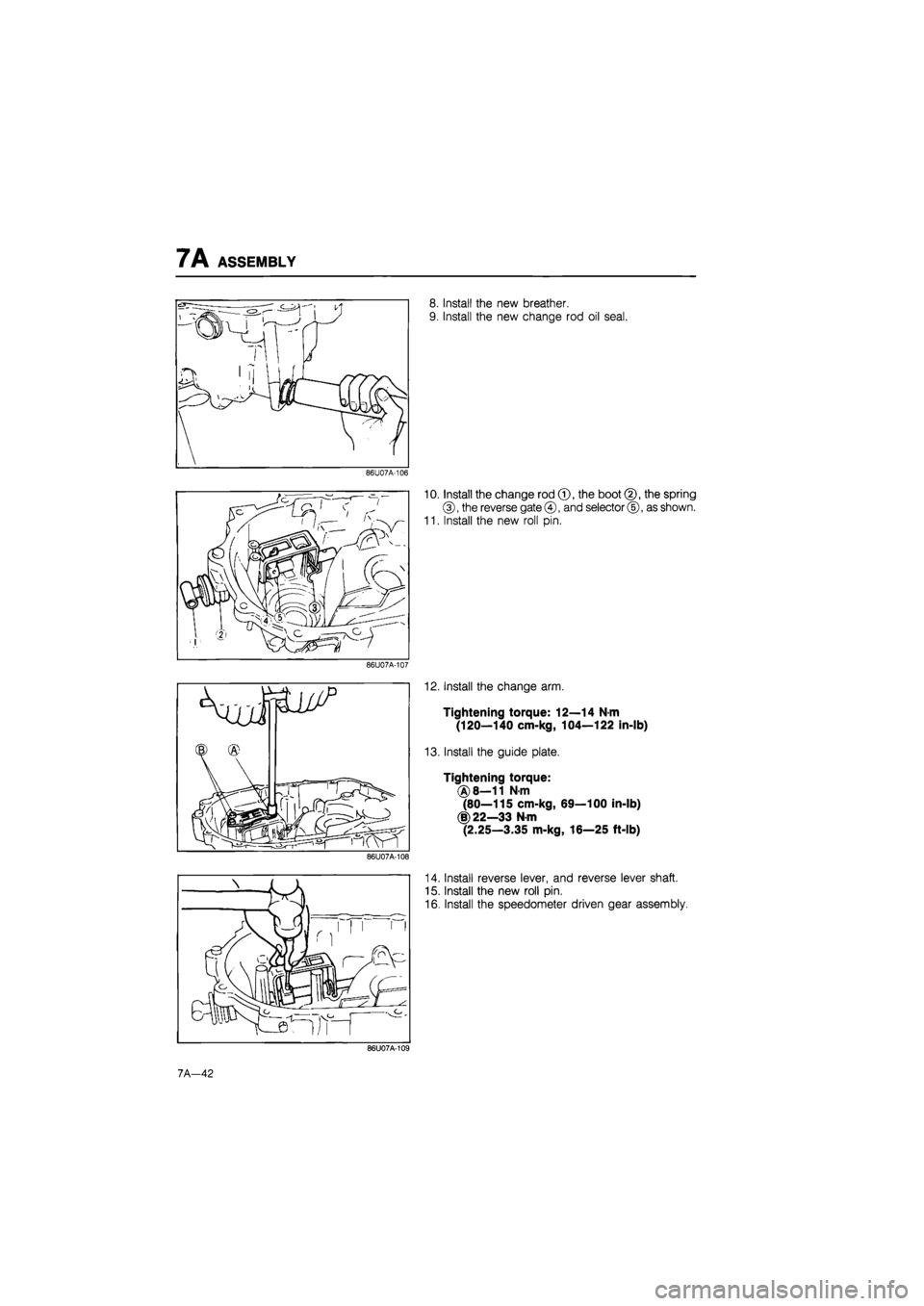
8. Install the new breather.
9. Install the new change rod oil seal.
10. Install the change rod ©, the boot the spring
(3),
the reverse gate @, and selector ©, as shown.
11. Install the new roll pin.
12. Install the change arm.
Tightening torque: 12—14 N-m
(120—140 cm-kg, 104—122 in-lb)
13. Install the guide plate.
Tightening torque:
©8—11 N-m
(80—115 cm-kg, 69—100 in-lb)
(1)22—33 N-m
(2.25—3.35 m-kg, 16—25 ft-lb)
14. Install reverse lever, and reverse lever shaft.
15. Install the new roll pin.
16. Install the speedometer driven gear assembly.
86U07A-109
7A-42
Page 880 of 1865

7B TROUBLESHOOTING (G4A-EL)
ON VEHICLE-
-f-
—OFF VEHICLE
\ Inspection point
and
\ reference page
Condition
•
Electronic control system Prelim-
inary
Hydraulic
control
system
Power train \ Inspection point
and
\ reference page
Condition
•
7B-66
m CO I m r--
7B-63
i
cn to I m
Section
4B
|
Section
4B
|
ID to i m
CO CO 1 CD
7B-68
|
en CO 1 IX)
to 1 00 r-.
cn CD 1 CO
7B-69
|
1 CD r--
cn s-1 m
Section
4B
r*-cn
S-1 CD h-
"=1-
rJ CO
7 CD r-
(XI o
1 m
cn CM 1 CD
7B-107
|
CD
7 CD 7 m
I
7B-113
I
CO CM
7 CO r-.
m cn
7 CO r-.
cn
7 DO r-
CM CM
7 CO
|
7B-126
CO
1*-r*-
7 m r-
\ Inspection point
and
\ reference page
Condition
•
Brake
light
switch
|
Inhibitor
switch
|
Mode
switch
|
1
CO. •o o X
Idle
switch
Throttle
sensor
|
Water
temp,
switch
|
0 tn c 0) cn
s
ffi
Q tn 01 o Hi >
Pulse
generator
|
"a o c 0) a to CM
TJ O CL ID s CO C\l 3-4
solenoid
|
Lock-up
solenoid
I
ATF
level
and
condition
|
Selector
lever
m Xj CO CJ 03
1 sz
Idle
speed
and
Ignition
timing
Control
valves
Accumulators
Oil
pump
Hydraulic
circuit
Torque
converter
Forward
clutch
Coasting
clutch
Reverse
clutch
JT O
u TT ro 2-4
brake
band
and
servo
$ 2
B cn cii > £ "O C CO
o
XI y
o >. CO S cb a O
One-way
clutch
2
s CI Cn tz JC 5 0-
Planetary
gear
Differential
assembly
Accelerating
Vehicle does
not
move
in
D,
S,
L,
or R
range
O O O O O O O O O O 0
Accelerating
Vehicle moves
in N
range -0 0 -—
Accelerating
Excessive creep
-0 O O -—
Accelerating
No creep
at all
O o o o
o
G 0 O O
Shifting
|
No shift
O O o
o
0 O 0 0
o
o O
Shifting
|
Abnormal shift sequence
0 o O O 0
o
o 0 O o o 0 O
Shifting
|
Frequent shifting 0 o 0 0 o 0 O O 0
Shifting
|
Excessively high
or
low
shift point 0 o 0 O 0 0 o 0 O 0 0
Shifting
|
No lock-up
0 o 0 0 o 0 O O o O
Shifting
|
No kick-down o o o o
Slipping
Engine
run
away
or
slip when
starting vehicle 0 o 0 O o O
Slipping
Engine
run
away
or
slip when
up-
or
down-shifting o o o 0 o O 0 0 O
8 n cn 4S SI V)
Excessive
N to D or N to R
shift shock o O o o o O
8 n cn 4S SI V)
Excessive shift shock when
up-
shifting
or
downshifting o o o o 0 0 0 8 n cn 4S SI V) Excessive shift shock when
changing range 0 0 o 0 o
j
Noise
Transaxle noisy
in N or P
range o o 0 O
j
Noise
Transaxle noisy
in D, S, L,
or
R range o 0 0 O
I
Others
j
No engine braking o O o 0 o o
I
Others
j
No mode change o 0 o o o o o o o
O
o
0
I
Others
j
Transaxle overheats
o o
0 o 0 o 0
I
Others
j
Vehicle moves
in
"P",
or
park-ing gear
not
disengaged when
"P"
is
dis-
engaged
0 O
I
Others
j
Hold indicator flashes o
0
o
0
o
O
o — — —
I
Others
j
Engine will
not
start
o
o
O — — —
76G07B-014
7B—14
Page 1661 of 1865

15 INTRODUCTION
ELECTRICAL SYMBOLS
Switches and Relays
There is an NC (normally closed) and NO (normally open) indication for switches and relays; this indi-
cates the condition when there has been no change of operating conditions.
Relay
NO type relay NC type relay
Switch
NO switch NC switch
Not
in
operation (No power supply)
—Jtfiifij —o o—
Flow Stop Flow
In operation (Power supply)
^
^aijuiy—'
Flow
l=3X
Stop
Flow
Stop
Other Electrical Symbols
Holder
Box —
© ©
Holder
Box —
Holder
Box —
BATTERY BODY GROUND FUSE FUSIBLE LINK
(£)
* 1 fc
MOTOR COIL, SOLENOID RESISTOR VARIABLE RESISTOR
1
ii
-L ©
THERMISTER DIODE CONDENSER LIGHT
1
TRANSISTOR SPEAKER CIGARETTE LIGHTER HEATER
69G15X-009
15—6
Page 1792 of 1865

OUTLINE 16
Discharging the Refrigeration System
1. Connect the manifold gauge set to the system.
2. Place the free end of the center hose on a shop
towel.
3. Slowly open the high pressure manual valve to ad-
just the refrigerant flow. Open the valve only slightly.
Caution
If refrigerant is allowed to escape too fast, the
compressor oil will be drawn out of the
system.
4. Check the shop towel to make sure no oil is being
discharged.
If oil is present, partially close the manual valve.
5. After the manifold gauge reading drops below 343
kPa (3.5 kg/cm2, 50 psi), slowly open the low
pressure manual valve.
6. As the system pressure drops, gradually open both
the high- and low-pressure manual valves until both
gauges read 0 kPa (0 kg/cm2, 0 psi).
76G16X-631
Evacuation of the Refrigeration System
Whenever the air-conditioning system has been ex-
posed to the atmosphere, it must be evacuated.
1. Connect the manifold gauge set.
2. Connect the center hose of the gauge set to the
vacuum pump inlet.
3. Operate the vacuum pump, then open both man-
ual valves.
4. When the low pressure gauge indicates approxi-
mately 710 mmHg (28 inHg), close both manual
valves and stop the vacuum pump.
5. Check to be sure that the degree of pressure does
not change after 10 minutes or more in this condi-
tion.
If
the pressure changes, check the system for
leaks, and repair if necessary.
6. If no leaks are found, once again operate the vacu-
um pump and open both manual valves to obtain
760 mmHg (30 inHg).
7. Close both manual valves, and stop the vacuum
pump.
Disconnect the hose from the vacuum pump.
69G16X-019
16-9
Page 1799 of 1865
16 COMPRESSOR
DISASSEMBLY OF COMPRESSOR
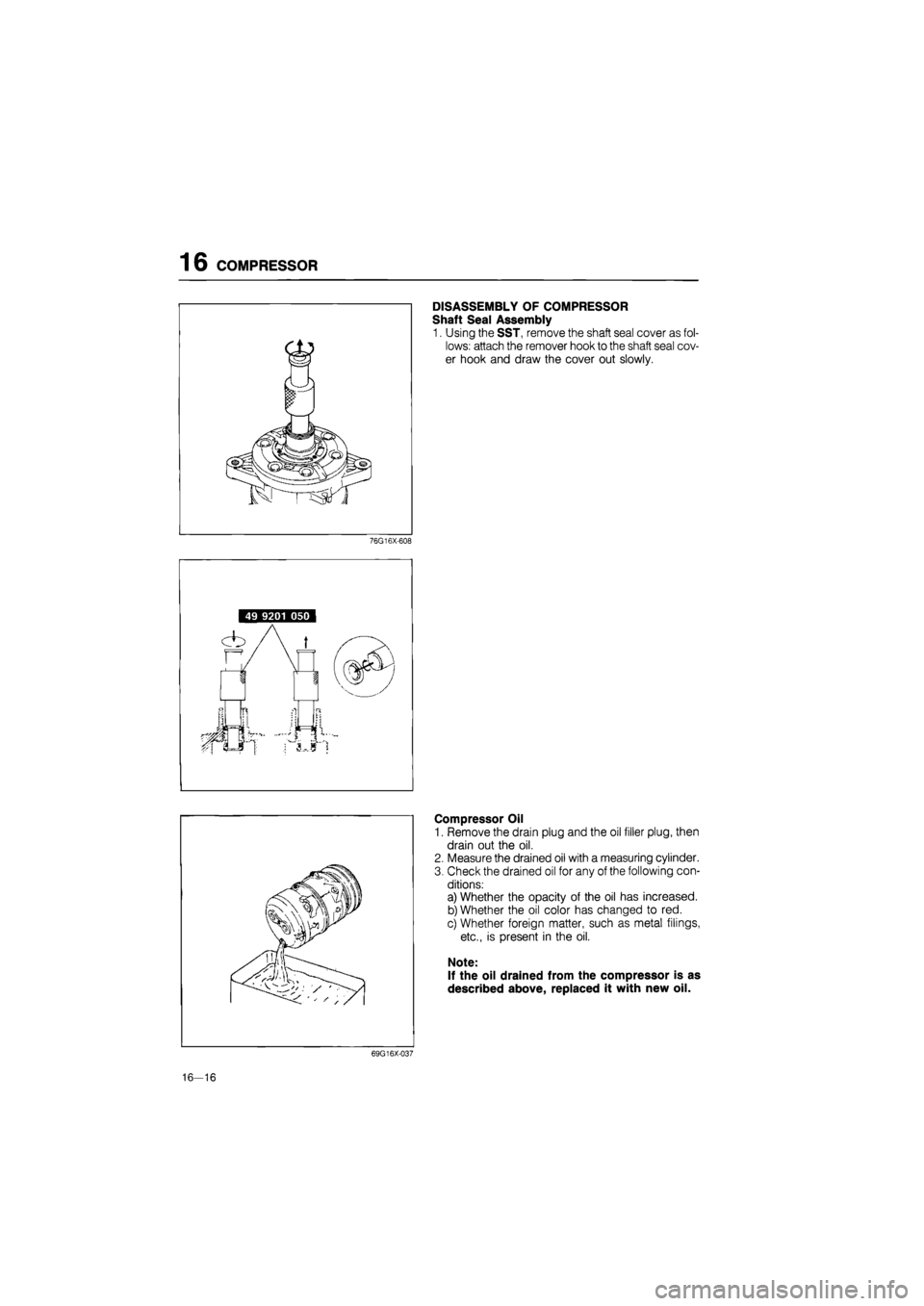
Shaft Seal Assembly
1. Using the SST, remove the shaft seal cover as fol-
lows: attach the remover hook to the shaft seal cov-
er hook and draw the cover out slowly.
76G16X-608
Compressor Oil
1. Remove the drain plug and the oil filler plug, then
drain out the oil.
2. Measure the drained oil with a measuring cylinder.
3. Check the drained oil for any of the following con-
ditions:
a) Whether the opacity of the oil has increased.
b) Whether the oil color has changed to red.
c) Whether foreign matter, such as metal filings,
etc., is present in the oil.
Note:
If the oil drained from the compressor is as
described above, replaced it with new oil.
69G16X-037
16—16