coolant temperature MAZDA 626 1987 Owner's Manual
[x] Cancel search | Manufacturer: MAZDA, Model Year: 1987, Model line: 626, Model: MAZDA 626 1987Pages: 1865, PDF Size: 94.35 MB
Page 515 of 1865
FUEL SYSTEM 4B
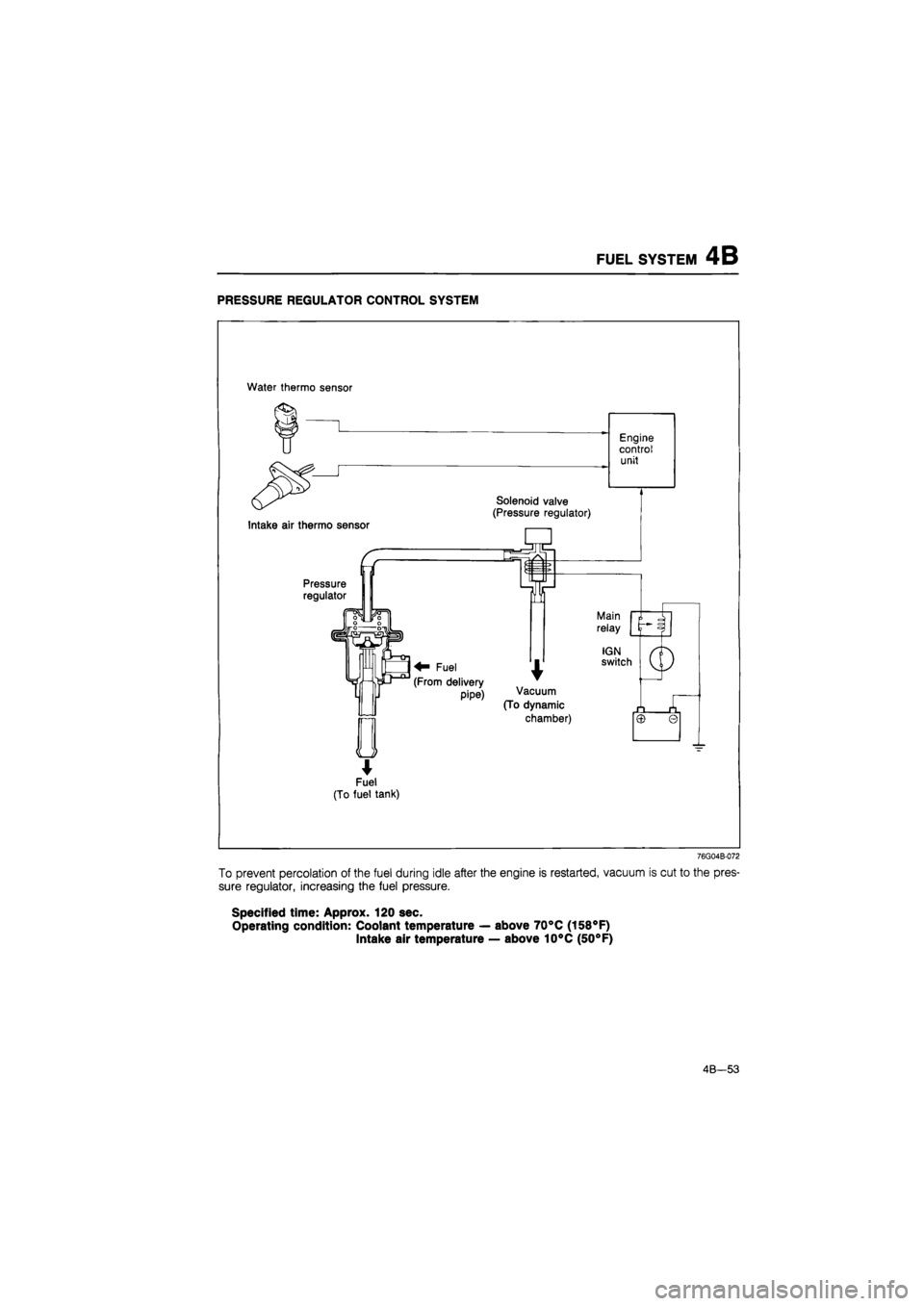
PRESSURE REGULATOR CONTROL SYSTEM
Water thermo sensor
*
Fuel
(To fuel tank)
76G04B-072
To prevent percolation of the fuel during idle after the engine is restarted, vacuum is cut to the pres-
sure regulator, increasing the fuel pressure.
Specified time: Approx. 120 sec.
Operating condition: Coolant temperature — above 70°C (158°F)
Intake air temperature — above 10°C (50°F)
4B—53
Page 516 of 1865
4B FUEL SYSTEM
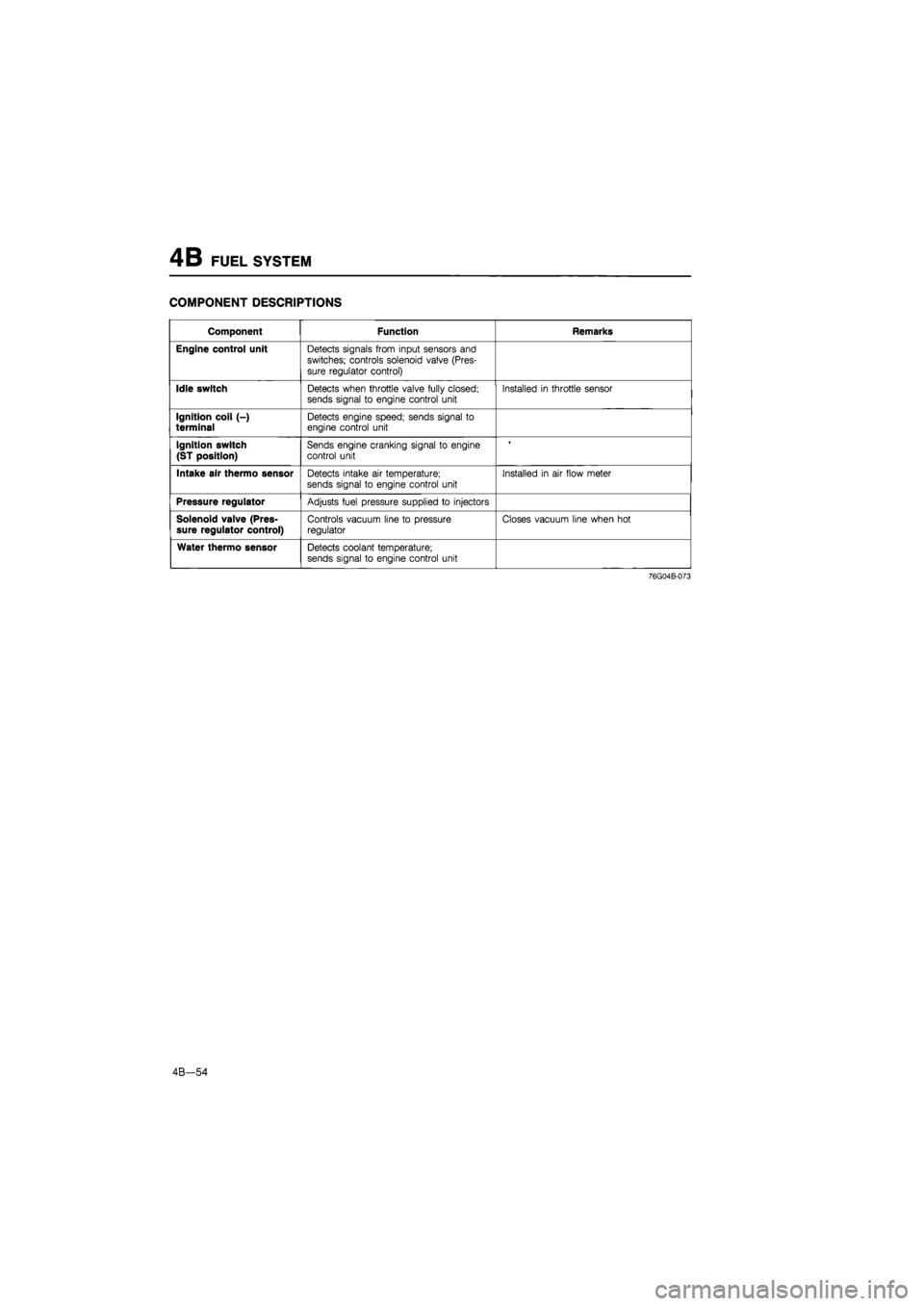
COMPONENT DESCRIPTIONS
Component Function Remarks
Engine control unit Detects signals from input sensors and
switches; controls solenoid valve (Pres-
sure regulator control)
Idle switch Detects when throttle valve fully closed; sends signal to engine control unit Installed in throttle sensor
Ignition coil (-) terminal Detects engine speed; sends signal to engine control unit
Ignition switch
(ST position)
Sends engine cranking signal to engine control unit
Intake air thermo sensor Detects intake air temperature; sends signal to engine control unit
Installed in air flow meter
Pressure regulator Adjusts fuel pressure supplied to injectors
Solenoid valve (Pres-sure regulator control) Controls vacuum line to pressure regulator Closes vacuum line when hot
Water thermo sensor Detects coolant temperature; sends signal to engine control unit
76G04B-073
4B—54
Page 526 of 1865

4B DECELERATION CONTROL SYSTEM
DECELERATION CONTROL SYSTEM
This system consists of the dashpot and fuel cut system. The dashpot is to prevent after-burn so that
the throttle valve gradually closes during deceleration.
The control unit detects engine deceleration judging from the engine speed and the idle switch, and
signals a fuel cut operation to match the engines need, based on the coolant temperature and the
driving condition.
4B—64
Page 527 of 1865

DECELERATION CONTROL SYSTEM 4B
COMPONENT DESCRIPTIONS
Component Function Remarks
Brake light switch Detects braking operation (deceleration);
sends signal to engine control unit
Clutch switch Detects in-gear condition;
sends signal to engine control unit Switch ON when clutch pedal released
Dashpot (MTX) Prevents sudden closing of throttle valve during deceleration or shifting Adjustment speed: 1,900—2,100 rpm
Engine control unit Detects signals from input sensors and switches; cuts fuel injection
Idle switch Detects when throttle valve fully closed; sends signal to engine control unit Installed in throttle sensor
Ignition coil (-) terminal Detects engine speed; sends signal to engine control unit
Neutral switch Detects in-gear condition; sends signal to engine control unit Switch ON when in-gear
Water thermo sensor Detects coolant temperature; sends signal to engine control unit
Water thermo switch Detects radiator coolant temperature; sends signal to engine control unit ON: above 17°C (63°F)
76G04B-089
4B—65
Page 533 of 1865

EGR SYSTEM 4B
EXHAUST GAS RECIRCULATION
(EGR)
SYSTEM
EGR modulator valve Solenoid valve (EGR)
86U04A-127
This system introduces exhaust gas into the intake manifold to reduce NOx in the exhaust gas. It oper-
ates depending on the engine load, engine speed (above 1,500 rpm), engine coolant temperature
(above 70°C, 158°F), and radiator coolant temperature (above 17°C, 63°F).
COMPONENT DESCRIPTIONS
Component Function Remarks
EGR control valve Recirculates portion of exhaust gas
EGR modulator valve Controls vacuum acting on EGR control
valve
Engine control unit Detects signals from input sensors and switches; controls solenoid valve (EGR)
Ignition coil (-) terminal Detects engine speed; sends signal to engine control unit
Solenoid valve (EGR) Controls vacuum line to EGR control
valve
Throttle sensor Detects throttle valve opening angle; sends signal to engine control unit Integrated idle switch
Water thermo sensor Detects coolant temperature; sends signal to engine control unit
Water thermo switch Detects radiator coolant temperature; sends signal to engine control unit
ON: above 17°C (63°F)
76G04B-102
4B-71
Page 536 of 1865
4B EEC SYSTEM
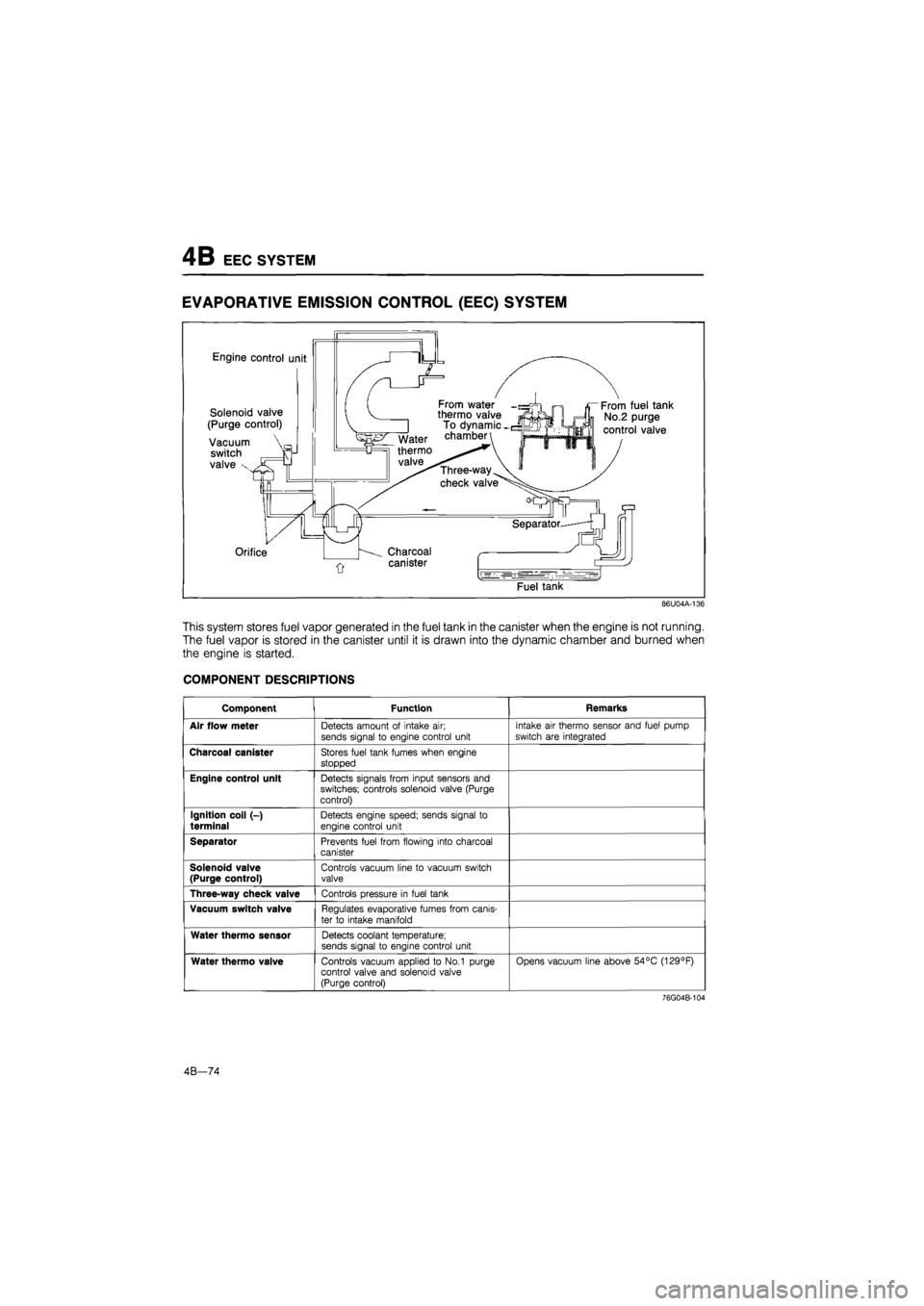
EVAPORATIVE EMISSION CONTROL
(EEC)
SYSTEM
Engine control unit
Solenoid valve
(Purge control)
Vacuum
switch
valve x
From water thermo valve To dynamic -chamber
Three-way
check valve
Orifice Charcoal
canister
From fuel tank
No.2 purge
control valve
Fuel tank
86U04A-136
This system stores fuel vapor generated in the fuel tank in the canister when the engine is not running.
The fuel vapor is stored in the canister until it is drawn into the dynamic chamber and burned when
the engine is started.
COMPONENT DESCRIPTIONS
Component Function Remarks
Air flow meter Detects amount of intake air; sends signal to engine control unit
Intake air thermo sensor and fuel pump
switch are integrated
Charcoal canister Stores fuel tank fumes when engine
stopped
Engine control unit Detects signals from input sensors and switches; controls solenoid valve (Purge control)
Ignition coil (-)
terminal Detects engine speed; sends signal to
engine control unit
Separator Prevents fuel from flowing into charcoal canister
Solenoid valve (Purge control) Controls vacuum line to vacuum switch valve
Three-way check valve Controls pressure in fuel tank
Vacuum switch valve Regulates evaporative fumes from canis-
ter to intake manifold
Water thermo sensor Detects coolant temperature; sends signal to engine control unit
Water thermo valve Controls vacuum applied to No.1 purge control valve and solenoid valve (Purge control)
Opens vacuum line above 54°C (129°F)
76G04B-104
4B—74
Page 605 of 1865

4C ISC SYSTEM
IDLE
SPEED CONTROL
(ISC)
SYSTEM
Air valve BAC valve (ISC valve + air valve)
ISC valve
Air passage
c=£> Coolant passage
Idle switch
Large
Bypass air
amount
Small
Characteristics of air valve
Low 50°C (122°F) High
Coolant temperature
76G04C-077
To improve idle smoothness, the ISC system controls the intake air amount by regulating the bypass
air amount that passes through the throttle body.
This system consists of the BAC valve and the control system.
The BAC valve consists of the air valve which functions only when the engine is cold (below 50°C
(122°F)) and the ISC valve which works throughout the entire engine speed range.
4C-44
Page 606 of 1865

ISC SYSTEM 4C
COMPONENT DESCRIPTION
Component Function Remark
A/C switch Detects air conditioner operation; sends
signal to engine control unit Switch ON when air conditioner
operating
Air valve When cold, supplies bypass air into dy-namic chamber • Engine speed increased to shorten warm-up period • Thermo wax type
• Installed in BAC valve
Clutch switch Detects in-gear condition; sends signal to engine control unit Switch ON when clutch pedal released
E/L control unit Detects that E/L is being applied; sends
signal to engine control unit
Engine control unit Detects signals from input sensors and switches; controls solenoid valve (Idle speed control)
Idle switch Detects when throttle valve fully closed;
sends signal to engine control unit
Installed on throttle body
Ne signal pick-up Detects crank angle at 180° intervals; sends signal to engine control unit Installed in distributor
Neutral switch Detects in-gear condition; sends signal to engine control unit
Switch ON when in gear
P/S pressure switch Detects P/S operation; sends signal to engine control unit Switch ON when steering wheel turned right or left
Solenoid valve (Idle speed control) Controls bypass air amount • Controlled by duty signal from engine control unit • Installed in BAC valve
• Operates idle-up
Test connector For initial idle speed adjustment • Gerrn, 1-pin
• Idle speed feedback control cancelled when connector grounded
Water thermo sensor Detects coolant temperature; sends
signal to engine control unit
76G04C-078
4C—45
Page 611 of 1865

4C FUEL SYSTEM
COMPONENT DESCRIPTION
Component Function Remark
Air flow sensor Detects amount of intake air;
sends signal to engine control unit
Clutch switch Detects in-gear condition; sends signal to engine control unit Switch ON when clutch pedal released
Engine control unit Detects signals from input sensors and switches; controls injector and fuel pump operations
Fuel filter Filters fuel
Fuel pump Provides fuel to injectors • Operates while engine running
• Installed in fuel tank
Fuel pump control unit (4WS) Monitors fuel level in left section; controls transfer pump operation
G signal pick-up Detects No.1 cylinder TDC; sends signal to engine control unit Installed in distributor
Idle switch Detects when throttle valve fully closed; sends signal to engine control unit Installed on throttle body
Ignition switch (ST position) Sends engine cranking signal to engine control unit
Injector Injects fuel into intake port • Controlled by signals from engine control unit • High-ohmic injector
Intake air thermo sensor Detects intake air temperature; send signal to engine control unit
Control relay Supplies electric current to injectors fuel pump and engine control unit
Ne signal pick-up Detects crank angle at 180° intervals; sends signal to engine control unit Installed in distributor
Neutral switch Detects in-gear condition; sends signal to engine control unit
Switch ON when in gear
Oxygen sensor (Unleaded fuel) Detects oxygen concentration; sends signal to engine control unit
• Zirconia ceramic and platinum coating • Integrated heater coil
Pressure regulator Adjusts fuel pressure supplied to injectors
Pulsation damper Absorbs fuel pulsation
Throttle sensor Detects throttle valve opening angle;
sends signal to engine control unit
Installed on throttle body
Transfer pump (4WS) Pumps fuel from the left to the right side Controlled by fuel pump control unit
Transfer pump switch (4WS) Detects fuel level in left section;
sends signal to control unit
Water thermo sensor Detects coolant temperature; sends signal to engine control unit
Water thermo switch (Unleaded fuel) Detects radiator coolant temperature; sends signal to engine control unit ON: above 17°C (63°F)
76G04C-088
4C-50
Page 629 of 1865

4C PRC SYSTEM
PRESSURE REGULATOR CONTROL
(PRC)
SYSTEM
Distributor (Ne signal)
I Fuel
(To fuel tank)
76G04C-128
To prevent percolation of the fuel during idle after the engine is restarted, vacuum is cut to the pres-
sure regulator, increasing the fuel pressure.
Specified time: Approx. 120 sec.
Operating condition: Coolant temperature — above 70°C (158°F)
Intake air temperature — above 30°C (86°F)....Unleaded fuel
above 50°C (122°F)....Leaded fuel
4C-68