fuel MAZDA 626 1987 Owner's Manual
[x] Cancel search | Manufacturer: MAZDA, Model Year: 1987, Model line: 626, Model: MAZDA 626 1987Pages: 1865, PDF Size: 94.35 MB
Page 130 of 1865
1A INSTALLATION
76G01A-147
86U01X-199
86U01X-200
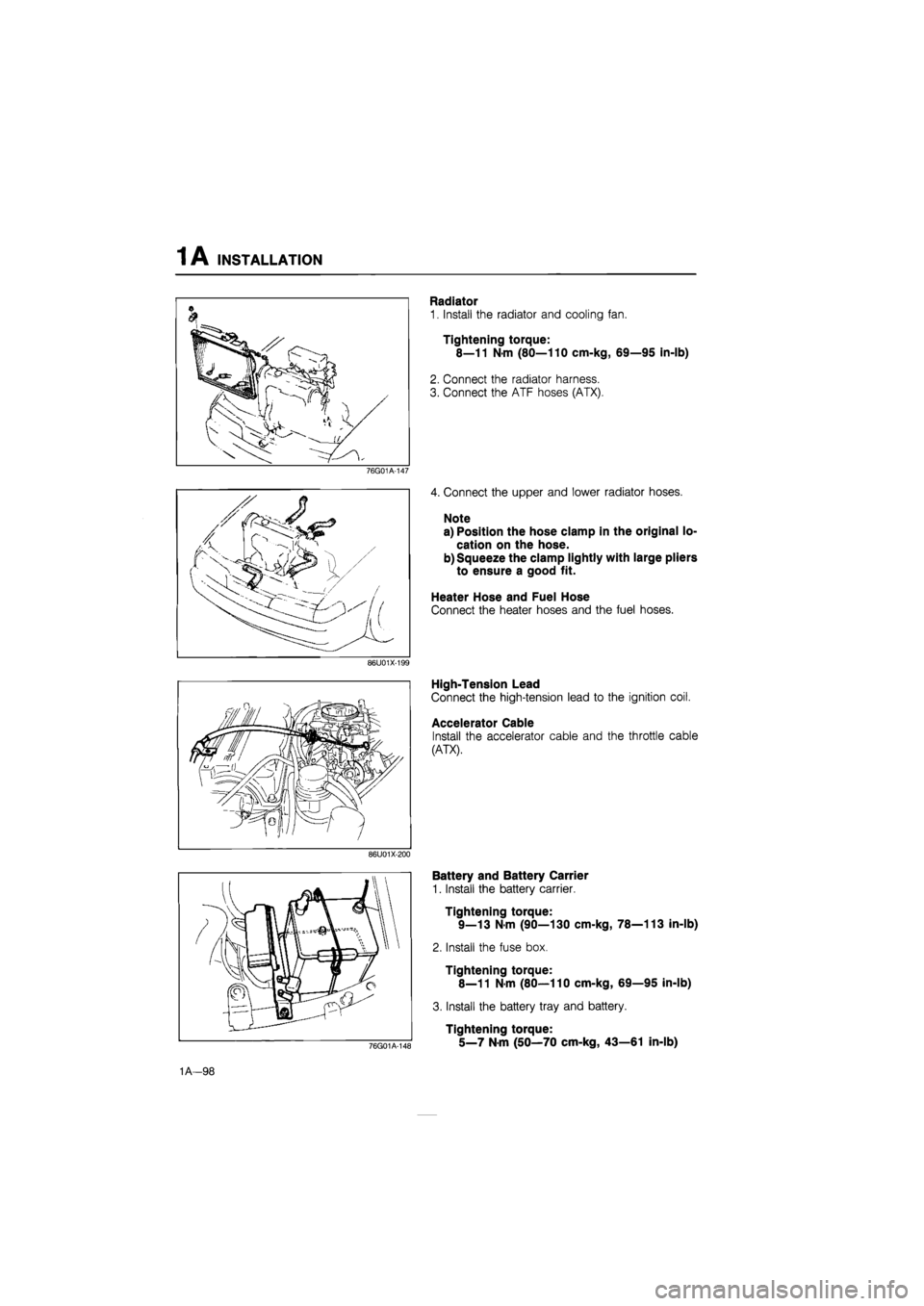
Radiator
1. Install the radiator and cooling fan.
Tightening torque:
8—11 N-m (80—110 cm-kg, 69—95 in-lb)
2. Connect the radiator harness.
3. Connect the ATF hoses (ATX).
4. Connect the upper and lower radiator hoses.
Note
a) Position the hose clamp in the original lo-
cation on the hose.
b) Squeeze the clamp lightly with large pliers
to ensure a good fit.
Heater Hose and Fuel Hose
Connect the heater hoses and the fuel hoses.
High-Tension Lead
Connect the high-tension lead to the ignition coil.
Accelerator Cable
Install the accelerator cable and the throttle cable
(ATX).
76G01A-148
Battery and Battery Carrier
1. Install the battery carrier.
Tightening torque:
9—13 N-m (90—130 cm-kg, 78—113 in-lb)
2. Install the fuse box.
Tightening torque:
8—11 N-m (80—110 cm-kg, 69—95 in-lb)
3. Install the battery tray and battery.
Tightening torque:
5_7 Nm (50—70 cm-kg, 43—61 in-lb)
1A—98
Page 134 of 1865

TROUBLESHOOTING GUIDE 1 B
SPECIFICATIONS
Engine model FE DOHC
Item Leaded fuel Unleaded fuel
Type Gasoline, 4 cycle
Cylinder arrangement and number In line, 4 cylinders
Combustion chamber Pentroof
Valve system OHC, belt driven
Displacement cc (cu in) 1,998 (121.9)
Bore and stroke mm (in) 86.0 x 86.0 (3.39 x 3.39)
Compression ratio 10.0 : 1 9.2 : 1
Compression pressure Standard 1,422 (14.5, 206)—290 1,373 (14.0, 199)—310
kPa (kg/cm2, psi)-rpm Minimum 996 (10.2, 144)—290 961 (9.8, 139)—310
IN Open BTDC 10° 10°
Valve timing
IN Close ABDC 60° 55° Valve timing
EX Open BBDC 60° 55° EX Close ATDC 10° 10°
Valve clearance mm (in) IN 0; Maintenance-free Valve clearance mm (in) EX 0; Maintenance-free
Idle speed rpm 750 ± 50
Ignition timing BTDC 12° ± 1°
Firing order 1—3--4-2
76G01B-002
TROUBLESHOOTING GUIDE
Problem Possible Cause Remedy Page
Difficult starting Malfunction of engine-related components
Burned valve
Worn piston, piston ring, or cylinder
Failed cylinder head gasket
Replace
Replace or repair Replace
1B—35 1B—43 1B—16
Malfunction of fuel system Refer to Section 4C
Malfunction of electrical system Refer to Section 5
Poor Idling Malfunction of engine-related components Malfunction of HLA
Poor valve to valve seat contact
Failed cylinder head gasket
Replace
Repair or replace
Replace
1B—60 1B—37 1B—16
Malfunction of fuel system Refer to Section 4C
Excessive oil
consumption Oil working up Worn piston ring groove or sticking piston ring Worn piston or cylinder
Replace
Replace or repair
1B-43 1B-43
Oil working down
Worn valve seal
Worn valve stem or guide
Replace
Replace 1B-35
Oil leakage Refer to Section 2A
76G01B-003
1B—3
Page 135 of 1865
TROUBLESHOOTING GUIDE 1 B
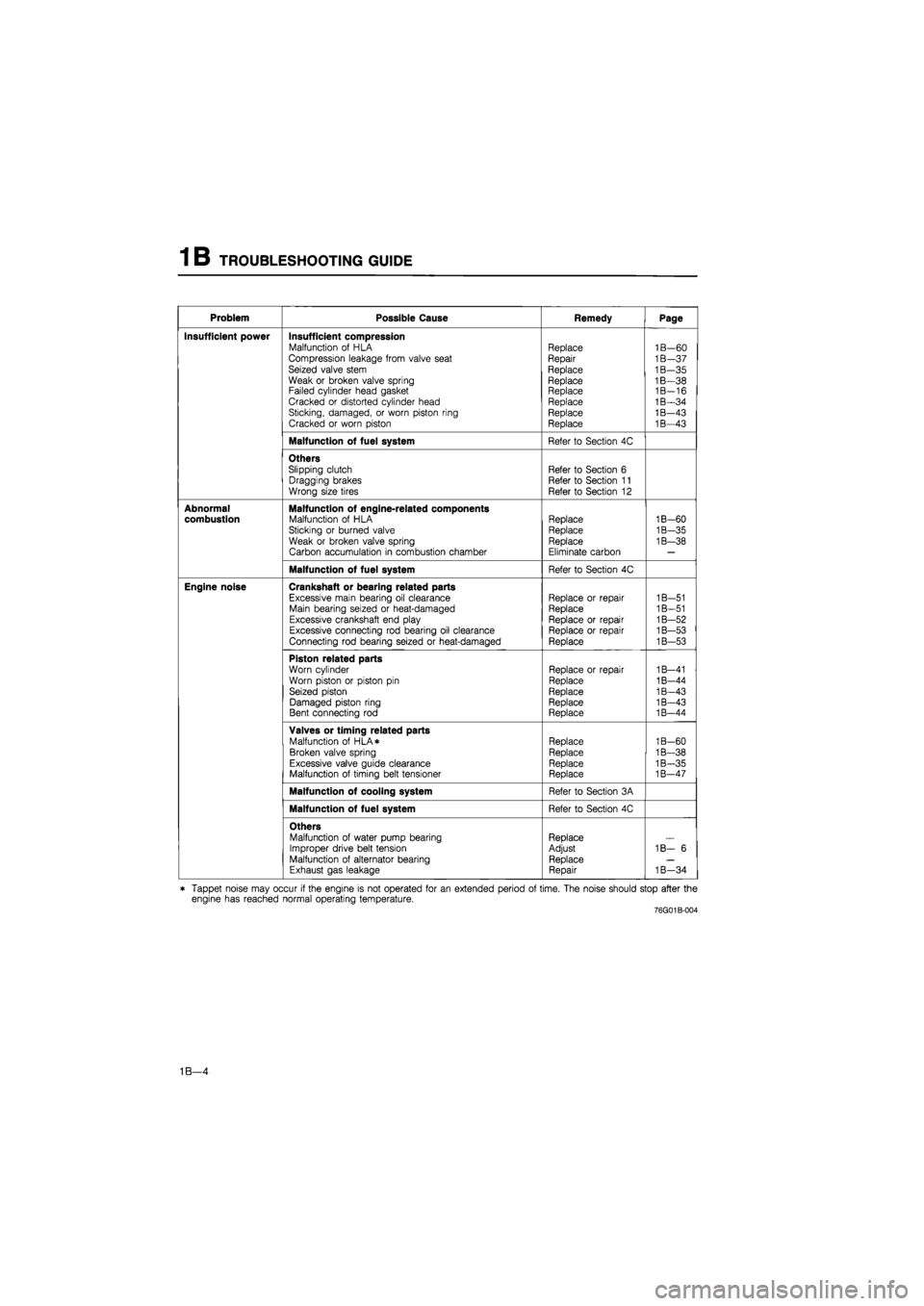
Problem Possible Cause Remedy Page
Insufficient power Insufficient compression Malfunction of HLA Compression leakage from valve seat Seized valve stem Weak or broken valve spring Failed cylinder head gasket Cracked or distorted cylinder head Sticking, damaged, or worn piston ring Cracked or worn piston
Replace Repair
Replace
Replace Replace Replace Replace Replace
1B—60 1B—37 1B—35 1B—38 1B-16 1B—34 1B—43 1B—43
Malfunction of fuel system Refer to Section 4C
Others Slipping clutch Dragging brakes Wrong size tires
Refer to Section 6 Refer to Section 11 Refer to Section 12
Abnormal combustion Malfunction of engine-related components Malfunction of HLA Sticking or burned valve
Weak or broken valve spring Carbon accumulation in combustion chamber
Replace Replace Replace
Eliminate carbon
1B-60
1B-35
1B—38
Malfunction of fuel system Refer to Section 4C
Engine noise Crankshaft or bearing related parts
Excessive main bearing oil clearance Main bearing seized or heat-damaged Excessive crankshaft end play Excessive connecting rod bearing oil clearance Connecting rod bearing seized or heat-damaged
Replace or repair Replace
Replace or repair Replace or repair Replace
1B-51 1B—51 1B—52 1B—53 1B—53
Piston related parts
Worn cylinder Worn piston or piston pin Seized piston Damaged piston ring Bent connecting rod
Replace or repair
Replace
Replace Replace Replace
1B—41 1B-44 1B—43 1B—43 1B-44
Valves or timing related parts Malfunction of HLA* Broken valve spring Excessive valve guide clearance Malfunction of timing belt tensioner
Replace Replace Replace Replace
1B-60 1B—38 1B—35 1B—47
Malfunction of cooling system Refer to Section 3A
Malfunction of fuel system Refer to Section 4C
Others Malfunction of water pump bearing Improper drive belt tension Malfunction of alternator bearing Exhaust gas leakage
Replace Adjust Replace Repair
1B— 6
1B—34
* Tappet noise may occur if the engine is not operated for an extended period of time. The noise should stop after the engine has reached normal operating temperature. 76G01B-004
1B—4
Page 141 of 1865
1 B ON-VEHICLE INSPECTION
76G01B-017
86U01X-020
76G01B-018
Possible Cause
ON-VEHICLE INSPECTION
If the engine exhibits low power, poor fuel economy,
or poor idle, check the following points.
1. Ignition system (Refer to Section 5)
2. Compression
3. Fuel system (Refer to Section 4C)
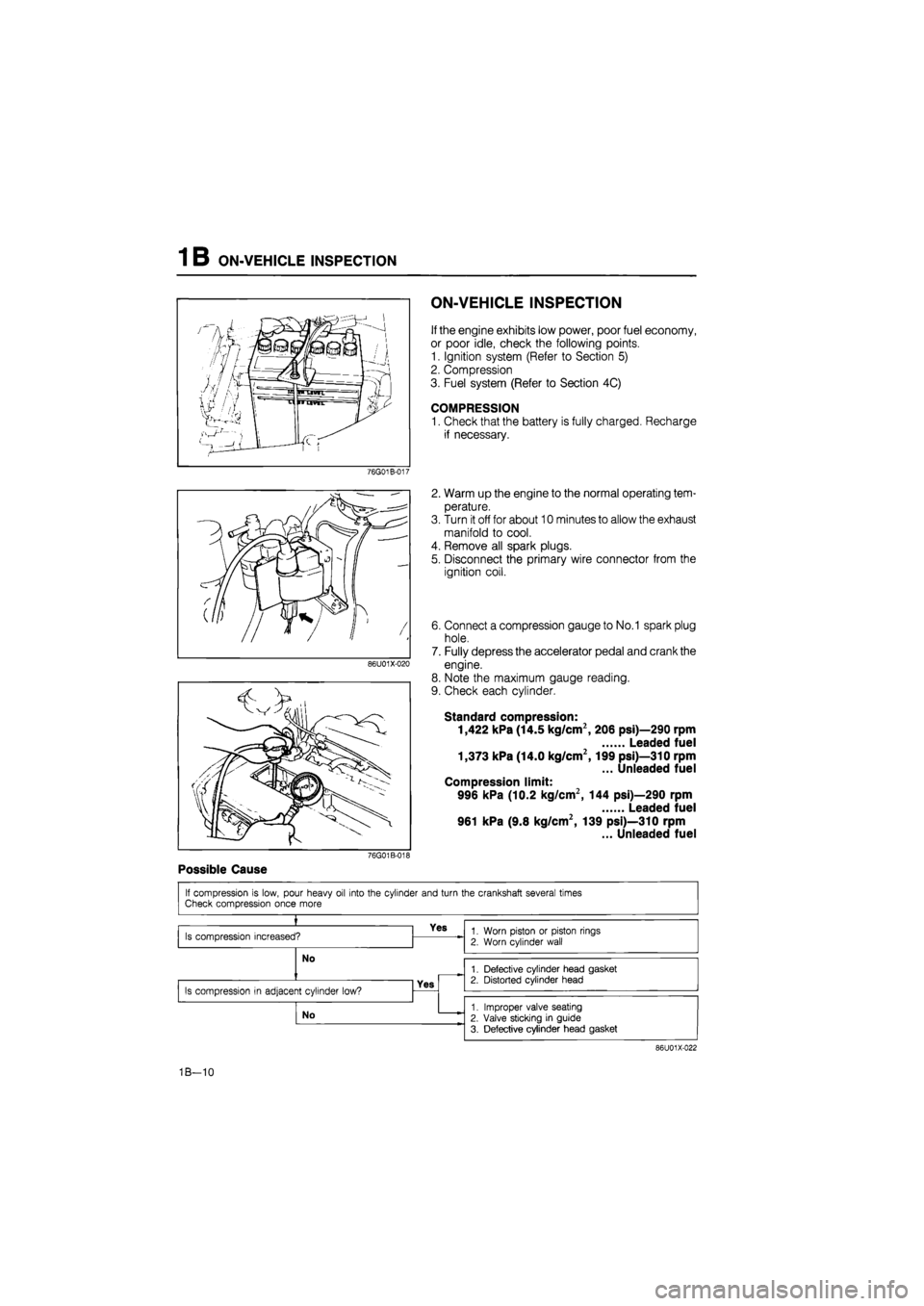
COMPRESSION
1. Check that the battery is fully charged. Recharge
if necessary.
2. Warm up the engine to the normal operating tem-
perature.
3. Turn it off for about 10 minutes to allow the exhaust
manifold to cool.
4. Remove all spark plugs.
5. Disconnect the primary wire connector from the
ignition coil.
6. Connect a compression gauge to No.1 spark plug
hole.
7. Fully depress the accelerator pedal and crank the
engine.
8. Note the maximum gauge reading.
9. Check each cylinder.
Standard compression:
1,422 kPa (14.5 kg/cm2, 206 psi)—290 rpm
Leaded fuel
1,373 kPa (14.0 kg/cm2,199 psi)—310 rpm
... Unleaded fuel
Compression limit:
996 kPa (10.2 kg/cm2, 144 psi)—290 rpm
Leaded fuel
961 kPa (9.8 kg/cm2, 139 psi)—310 rpm
... Unleaded fuel
If compression is low, pour heavy oil into the cylinder and turn the crankshaft several times Check compression once more
»
Is compression increased? Yes 1. Worn piston or piston rings
2. Worn cylinder wall
No
1. Worn piston or piston rings
2. Worn cylinder wall
No 1. Defective cylinder head gasket 2. Distorted cylinder head
Is compression in adjacent cylinder low? Yes
1. Defective cylinder head gasket 2. Distorted cylinder head
Is compression in adjacent cylinder low?
No 1. Improper valve seating
2. Valve sticking in guide
3. Defective cylinder head gasket
86U01X-022
1B—10
Page 147 of 1865

1 B ON-VEHICLE MAINTENANCE (CYLINDER HEAD)
CYLINDER HEAD
Removal
Warning: Release the fuel pressure. (Refer to Section 4C.)
1. Disconnect the negative battery cable.
2. Drain the engine coolant.
3. Remove in the sequence shown in the figure referring to the removal note for specially marked parts.
1B—16
76G01B-034
Page 148 of 1865

1 B ON-VEHICLE MAINTENANCE (CYLINDER HEAD)
1. Center cover
2. High-tension lead and spark plug
3. Accelerator cable
4. Air intake pipe assembly
5. Fuel hose
6. Upper radiator hose
7. Heater hose
8. Brake vacuum hose
9. Canister hose (Unleaded fuel)
10. Engine harness connector and ground
11. EGR pipe (Unleaded fuel)
12. A/C compressor and bracket
13. Exhaust manifold insulator
14. Exhaust pipe
15. Exhaust manifold
16. Intake manifold bracket
17. Intake manifold assembly
18. Distributor
19. Engine mount stay
20. Upper timing belt cover
21. Timing belt tensioner spring
22. Timing belt
23. Cylinder head cover
24. Cylinder head and gasket
76G01B-030
Removal note
Fuel hose
Warning
a) Cover the hose with a rag because fuel will
spray out when disconnecting.
b) Keep sparks and open flame away from the
fuel area.
Plug the disconnected hoses to avoid fuel leakage.
86U01X-032
Timing belt
1. Before removing the timing belt, turn the crankshaft
to align the mating marks of the camshaft pulleys
with the seal plate timing mark.
Note
For intake side camshaft pulley, align "I"
mark.
For exhaust side camshaft pulley, align "E"
mark.
76G01B-031
2. Loosen the timing belt tensioner lock bolt.
3. Shift the tensioner outward as far as possible, then
temporarily tighten it.
76G01B-034
1B—17
Page 153 of 1865

1B REMOVAL
REMOVAL
Warning: Release the fuel pressure. (Refer to Section 4C.)
1. Disconnect the negative battery cable.
2. Drain the engine oil and coolant.
3. Remove in the sequence shown in the figure referring to the removal note for specially marked parts.
76G01B-036
1B—22
Page 154 of 1865

REMOVAL 1B
1. Battery and battery carrier
2. Air cleaner assembly
3. High-tension lead
4. Accelerator cable
5. Fuel hose
6. Radiator hose
7. Radiator harness
8. Radiator and electric fan
9. EGI harness
10. Engine harness
11. Brake vacuum hose
12. Canister hose (Unleaded
fuel)
13. Heater hose
14. Transaxle harness
15. Speedometer cable
16. Clutch release cylinder
17. Drive belt
18. A/C compressor and
bracket
19. P/S oil pump
20. Engine side cover
21. Front wheel
22. Tie-rod end
23. Stabilizer control rod
24. Lower arm bushing
25. Driveshaft
26. Change rod
27. Extension bar
28. Exhaust pipe
29. Engine mount
30. Engine and transaxle
31. Transaxle
76G01B-037
Removal Note
Fuel hose
Warning
a) Cover the hose with a rag because fuel will
spray out when disconnecting.
b) Keep sparks and open flame away from the
fuel area.
Plug the disconnected hoses to avoid fuel leakage.
76G01A-11£
P/S pump, A/C compressor
Remove the P/S pump and A/C compressor with the
hoses still connected to them, secure the pump and
compressor as shown in the figure.
67U01X-029
Driveshaft
Remove the driveshafts. (Refer to Section 9.) Slide
the SST into the transaxle.
86U01X-060
1B—23
Page 156 of 1865
DISASSEMBLY (AUXILIARY PARTS) 1 B
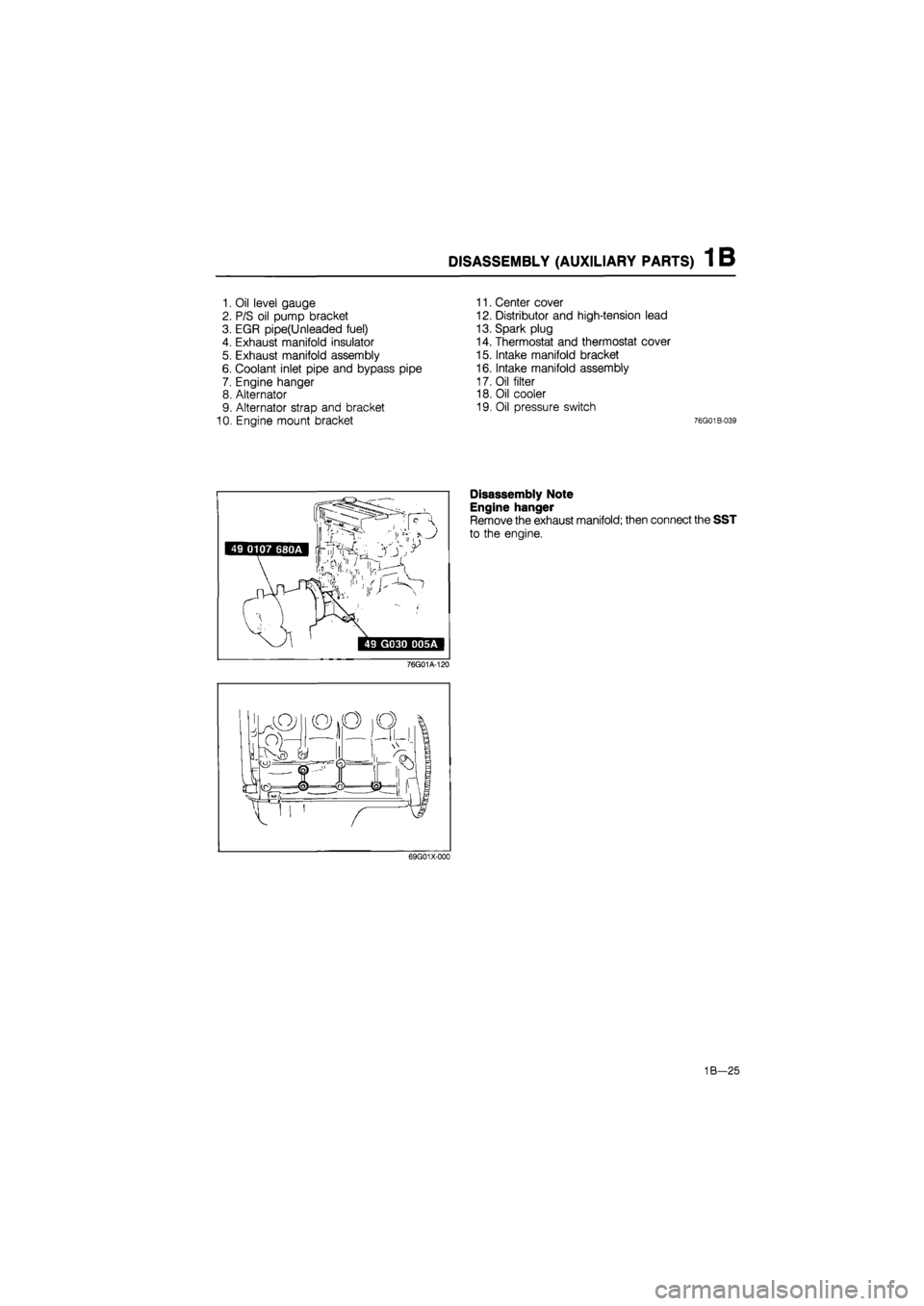
1. Oil level gauge
2. P/S oil pump bracket
3. EGR pipe(Unleaded fuel)
4. Exhaust manifold insulator
5. Exhaust manifold assembly
6. Coolant inlet pipe and bypass pipe
7. Engine hanger
8. Alternator
9. Alternator strap and bracket
10. Engine mount bracket
11. Center cover
12. Distributor and high-tension lead
13. Spark plug
14. Thermostat and thermostat cover
15. Intake manifold bracket
16. Intake manifold assembly
17. Oil filter
18. Oil cooler
19. Oil pressure switch
76G01B-039
49 0107 680A Irf^Ys'^
,v,, I
' ir
>
49 G030 D05A
76G01A-120
Disassembly Note
Engine hanger
Remove the exhaust manifold; then connect the SST
to the engine.
69G01X-000
1B—25
Page 170 of 1865
INSPECTION AND REPAIR 1 B
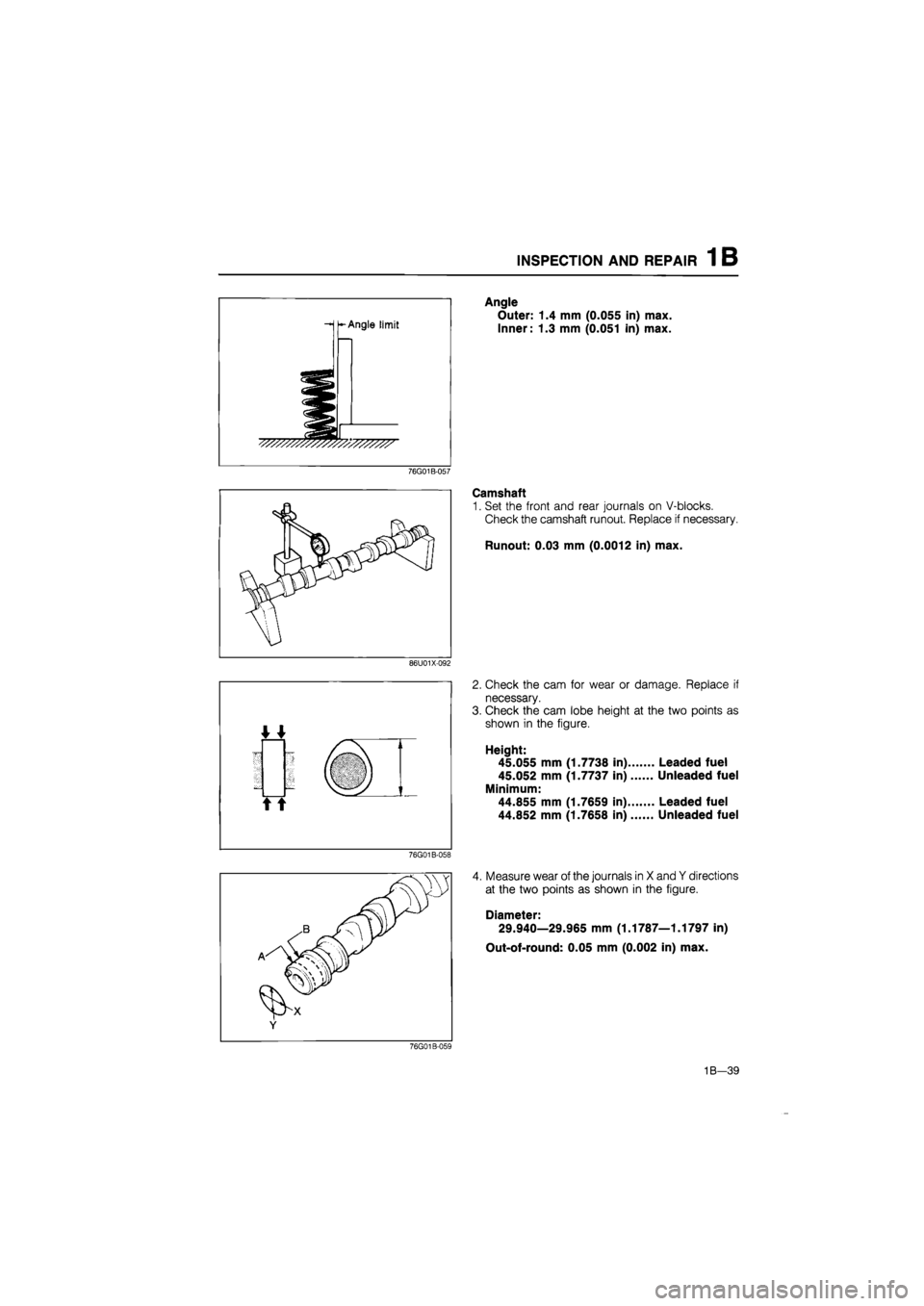
-Angle limit
76G01B-057
86U01X-092
76G01B-058
Angle
Outer: 1.4 mm (0.055 in) max.
Inner: 1.3 mm (0.051 in) max.
Camshaft
1. Set the front and rear journals on V-blocks.
Check the camshaft runout. Replace if necessary.
Runout: 0.03 mm (0.0012 in) max.
2. Check the cam for wear or damage. Replace if
necessary.
3. Check the cam lobe height at the two points as
shown in the figure.
Height:
45.055 mm (1.7738 in) Leaded fuel
45.052 mm (1.7737 in) Unleaded fuel
Minimum:
44.855 mm (1.7659 in) Leaded fuel
44.852 mm (1.7658 in) Unleaded fuel
4. Measure wear of the journals in X and Y directions
at the two points as shown in the figure.
Diameter:
29.940—29.965 mm (1.1787—1.1797 in)
Out-of-round: 0.05 mm (0.002 in) max.
76G01B-059
1B-39