wiring MAZDA 626 1987 Owner's Manual
[x] Cancel search | Manufacturer: MAZDA, Model Year: 1987, Model line: 626, Model: MAZDA 626 1987Pages: 1865, PDF Size: 94.35 MB
Page 517 of 1865
FUEL SYSTEM 4B
TROUBLESHOOTING
Check the condition of the wiring harness and connections before checking the sensors or switches
below.
Note
Make the system inspection first. If no problem is found, continue with the next system
inspection of the Troubleshooting Guide. (Refer to pages 4B—7 and 8.)
Possible \ cause
\ Page
Solenoid valve (Pres-sure regula-tor control)
Water thermo
sensor Intake air
thermo sensor
Engine con-trol unit terminal
2K
System inspection
Symptom 4B—56 4B—97 4B—94 4B—89 4B—55
Engine stalls or rough after hot starting 2 3
A
5 1
76G04B-074
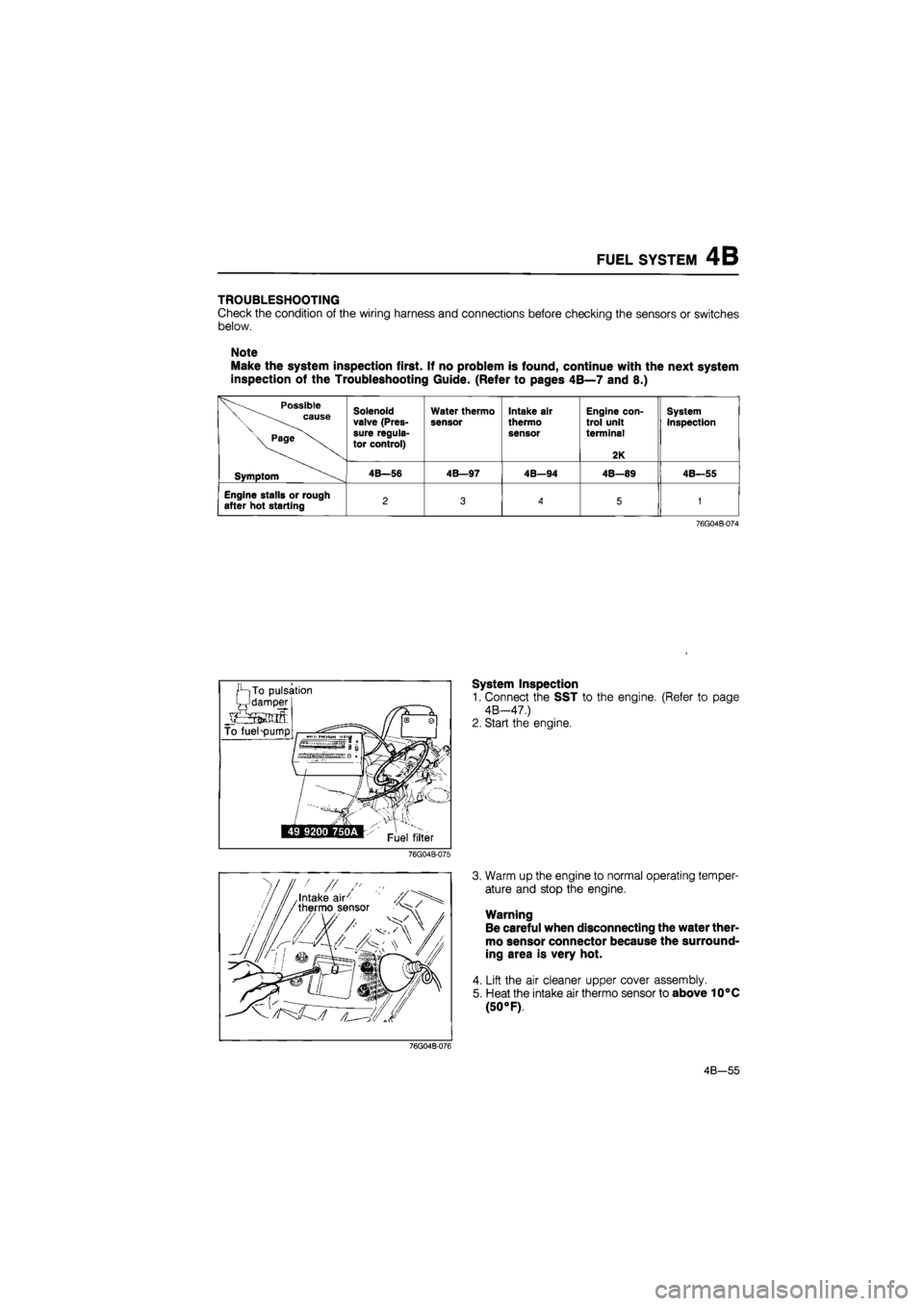
System Inspection
1. Connect the SST to the engine. (Refer to page
4B—47.)
2. Start the engine.
76G04B-075
3. Warm up the engine to normal operating temper-
ature and stop the engine.
Warning
Be careful when disconnecting the water ther-
mo sensor connector because the surround-
ing area is very hot.
4. Lift the air cleaner upper cover assembly.
5. Heat the intake air thermo sensor to above 10°C
(50 °F).
76G04B-076
4B—55
Page 528 of 1865
4B DECELERATION CONTROL SYSTEM
TROUBLESHOOTING
Check the condition of the wiring harness and connectors before checking the sensor or switches below.
Note
Make the system inspection first. If no problem is found, continue with the next system
inspection of the Troubleshooting Guide. (Refer to page 4B—7 and 8.)
Possible
^^ cause
Symptom
Dashpot Water thermo
sensor
Electrical signal
inspection
(Injector)
Possible
^^ cause
Symptom 4B—67 4B—97 4B-66
High idle speed after warming up 1
Runs rough on deceleration 1 3 2
Afterburn in exhaust system 1 3 2
Poor fuel consumption 1 3 2
Fails emission test 1 3 2
76G04B-090
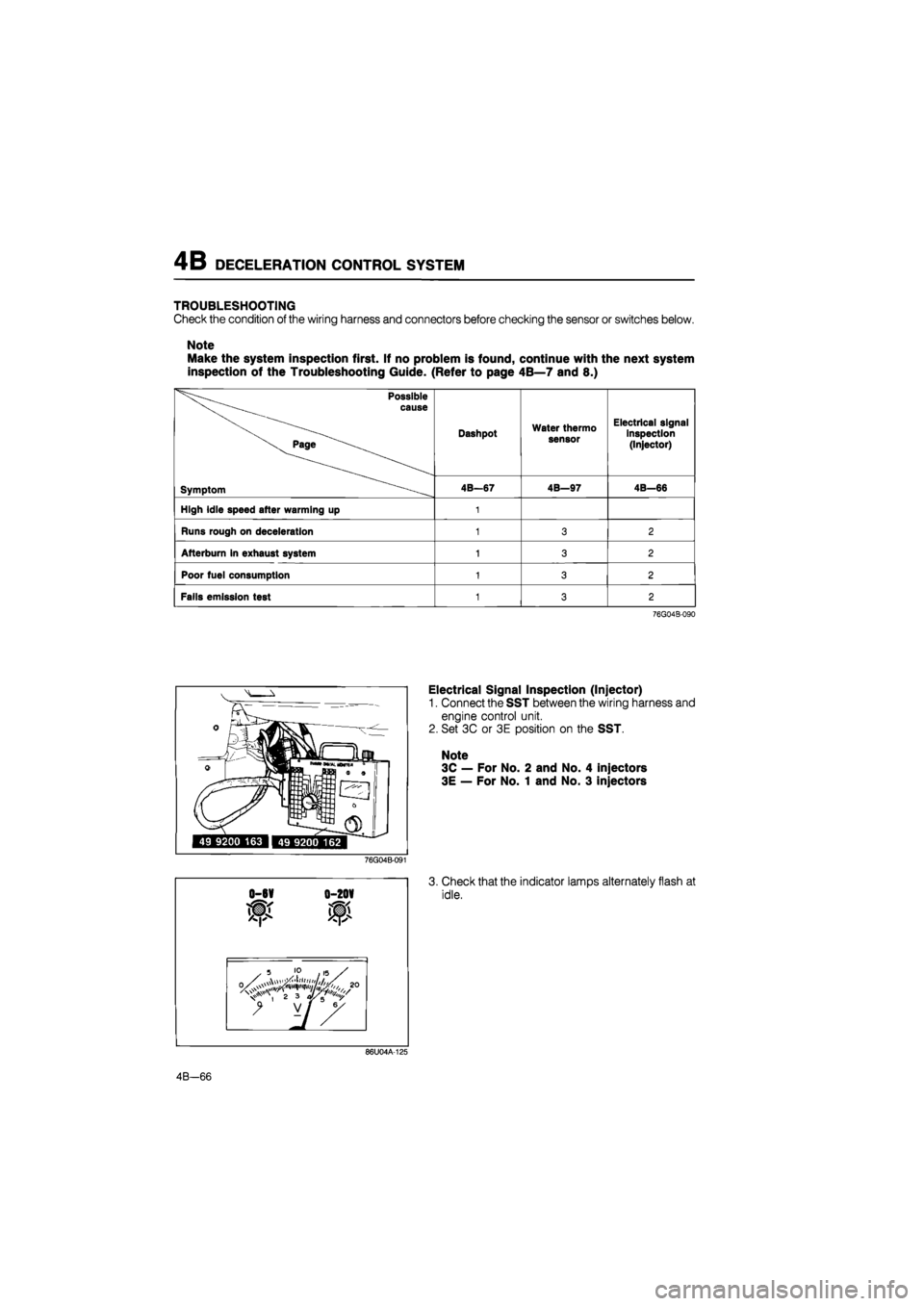
Electrical Signal Inspection (Injector)
1. Connect the SST between the wiring harness and
engine control unit.
2. Set 3C or 3E position on the SST.
Note
3C — For No. 2 and No. 4 injectors
3E — For No. 1 and No. 3 injectors
76G04B-091
0-6V 0-20V
3. Check that the indicator lamps alternately flash at
idle.
86U04A-125
4B—66
Page 531 of 1865
AIR INJECTION SYSTEM 4B
TROUBLESHOOTING
Check the condition of the wiring harness and connectors before checking the sensors or switch.
Note
Make the system inspection first. If no problem is found, continue with the next system
inspection of the Troubleshooting Guide. (Refer to pages 4B—7 and 8.)
Possible cause Air control valve Reed valve System inspection
Page 4B—69 4B—70 4B—69
Checking order 2 3 1
76G04B-097
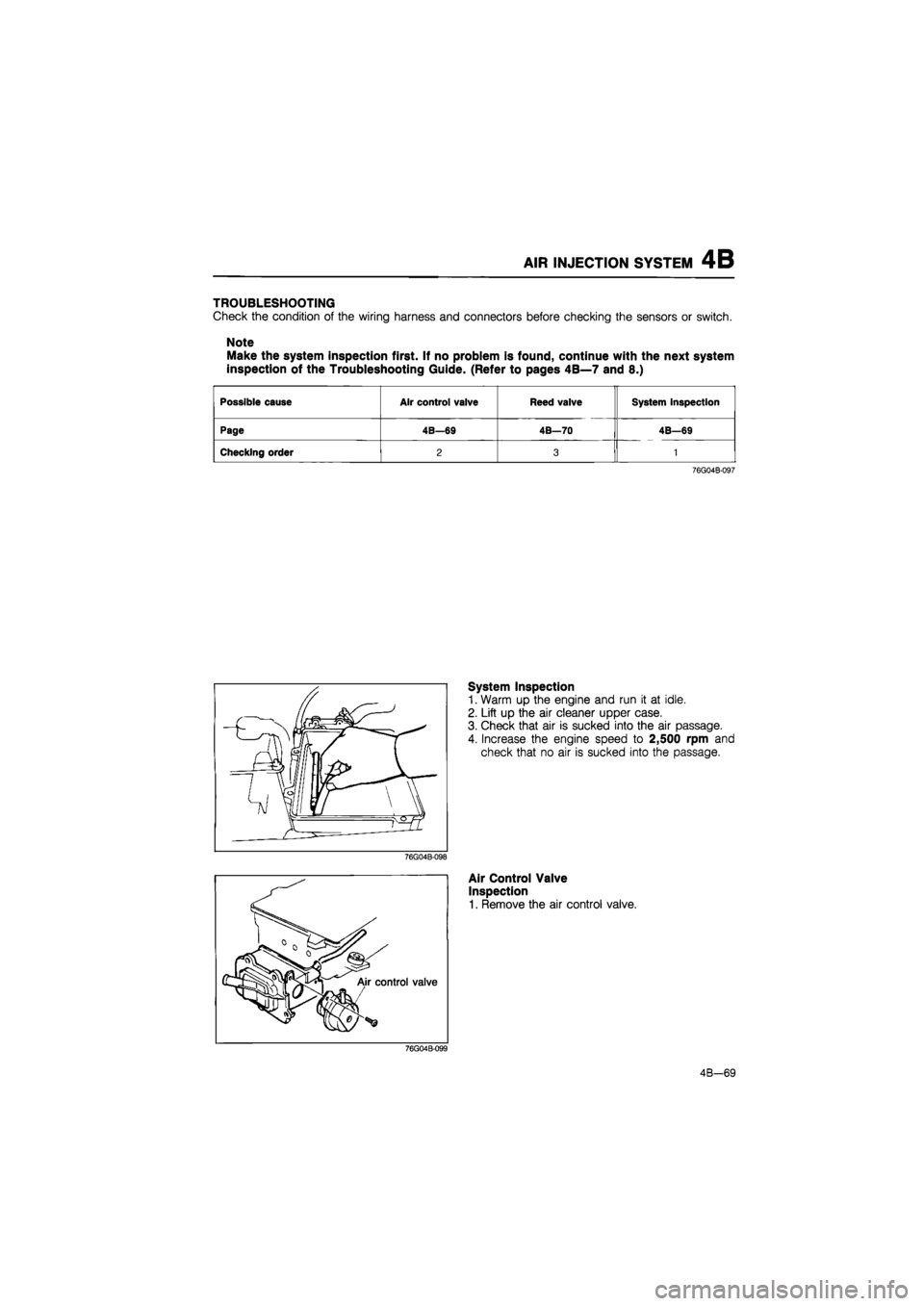
System Inspection
1. Warm up the engine and run it at idle.
2. Lift up the air cleaner upper case.
3. Check that air is sucked into the air passage.
4. Increase the engine speed to 2,500 rpm and
check that no air is sucked into the passage.
Air Control Valve
Inspection
1. Remove the air control valve.
4B-69
Page 534 of 1865
4B EGR SYSTEM
TROUBLESHOOTING
Check the condition of the wiring harness and connectors before checking the sensors or switches below.
Note
Make the system inspection first. If no problem is found, continue with the next system
inspection of the Troubleshooting Guide. (Refer to pages 4B—7 and 8.)
Possible cause
Solenoid
valve (EGR)
EGR modula-tor valve
EGR con-trol valve
Water
thermo sensor
Water
thermo switch
Engine control unit
terminal
System in-spection
2N
Page 4B—72 4B—73 4B—73 4B—97 4B—97 4B—90 4B—72
Checking order 3 2 4 6 5 7 1
76G04B-103
86U04A-130
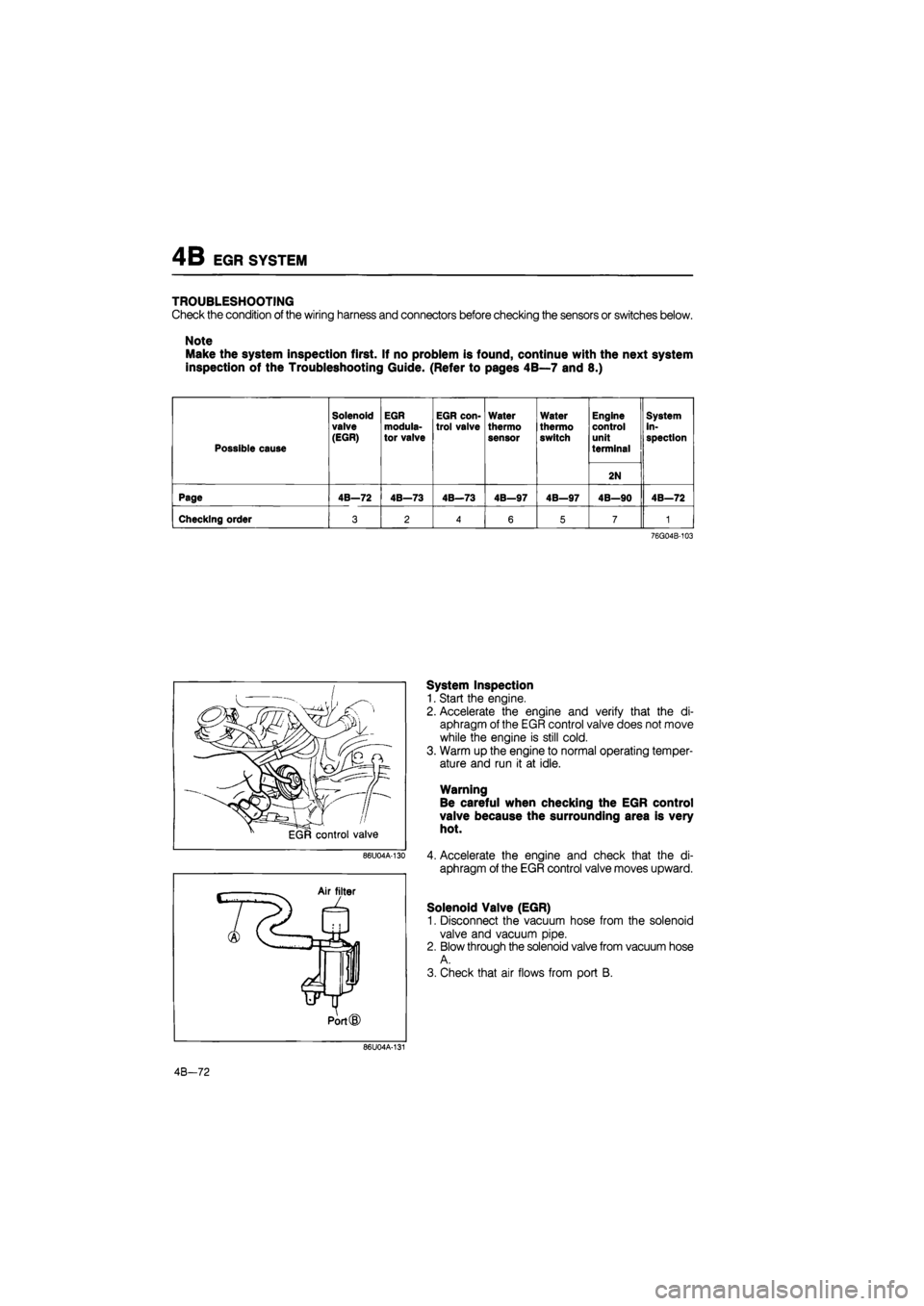
System Inspection
1. Start the engine.
2. Accelerate the engine and verify that the di-
aphragm of the EGR control valve does not move
while the engine is still cold.
3. Warm up the engine to normal operating temper-
ature and run it at idle.
Warning
Be careful when checking the EGR control
valve because the surrounding area is very
hot.
4. Accelerate the engine and check that the di-
aphragm of the EGR control valve moves upward.
Solenoid Valve (EGR)
1. Disconnect the vacuum hose from the solenoid
valve and vacuum pipe.
2. Blow through the solenoid valve from vacuum hose
A.
3. Check that air flows from port B.
86U04A-131
4B-72
Page 537 of 1865
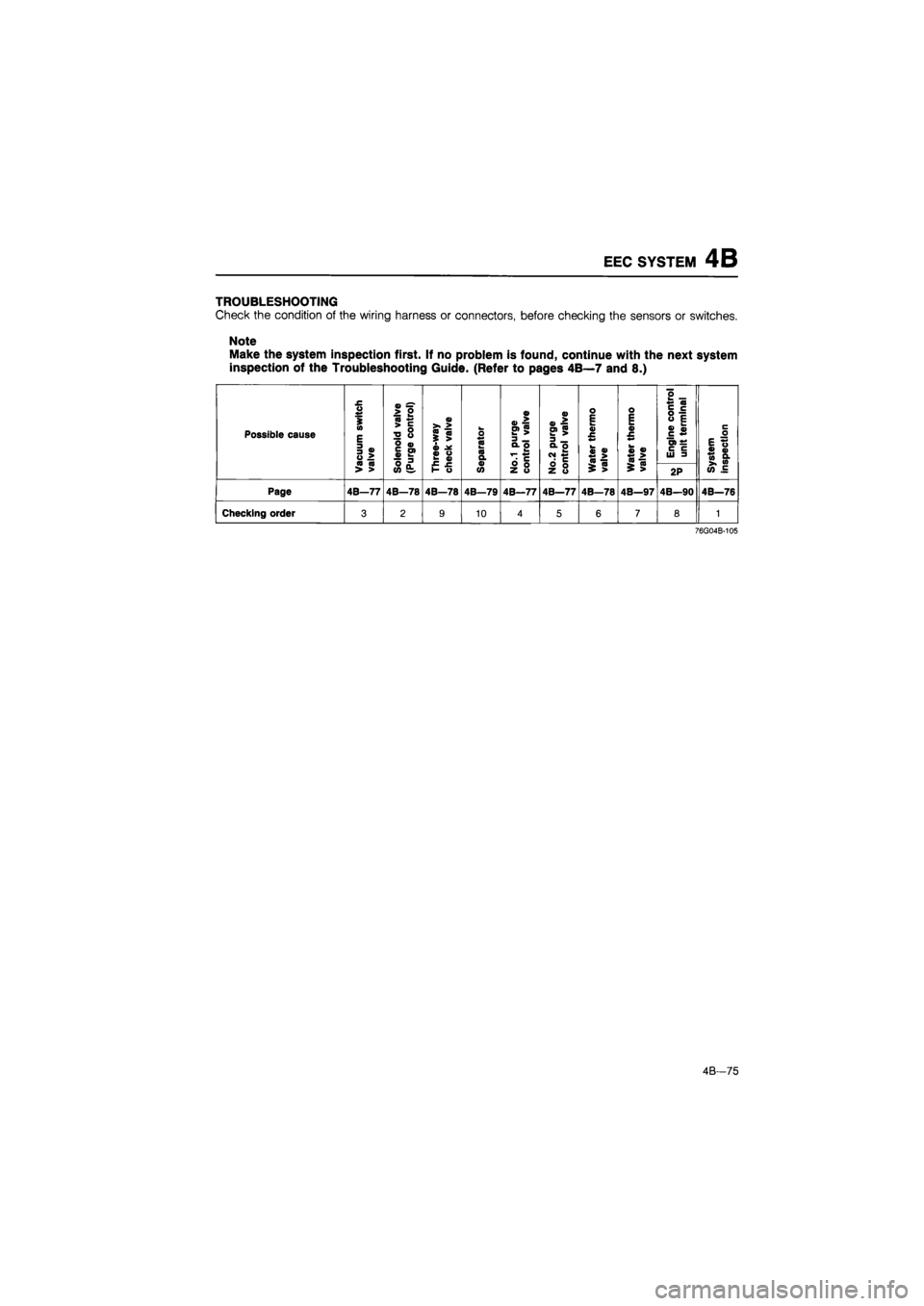
EEC SYSTEM
4B
TROUBLESHOOTING
Check
the
condition
of the
wiring harness
or
connectors, before checking
the
sensors
or
switches.
Note
Make the system inspection first.
If no
problem
is
found, continue with
the
next system
inspection
of the
Troubleshooting Guide. (Refer
to
pages 4B—7 and
8.)
Possible cause
Vacuum
switch
valve
Solenoid
valve
(Purge
control)
0)
<0
m
i
>
« «
o
•C
?
o ** «0 a a
No.1
purge
control
valve
No.2
purge
control
valve
Water
thermo
valve
o E tm 0) £
«>
0)
^
>
Engine
control
unit
terminal
System inspection Vacuum
switch
valve
Solenoid
valve
(Purge
control)
purge
control
valve
No.2
purge
control
valve
Water
thermo
valve
$
>
2P
System inspection
Page 4B—77 4B—78 4B—78 4B—79 4B—77 4B—77 4B—78 4B—97 4B—90 4B—76
Checking order 3 2 9 10 4 5 6 7 8 1
76G04B-105
4B—75
Page 549 of 1865

CONTROL SYSTEM 4B
ENGINE CONTROL UNIT
Engine Signal Monitor (49 9200 162) and Adapter (49 9200 163).
Adapter harness 49 9200 163
Engine wiring harnessN
Selector switch
Monitor switch
Engine control unit
terminal number
Terminals
(A and 8)
ENGINE SIGNAL MONITOR
86U04A-171
The Engine Signal Monitor (49 9200 162) was developed to check the control unit terminal voltages.
This monitor easily inspects the individual terminal voltages through selection of the monitor switch.
How to Use the Engine Signal Monitor
1. Connect the Engine Signal Monitor (49 9200 162) between the engine control unit and the en-
gine harness using the adapter (49 9200 163).
2. Turn the selector switch and monitor switch to select the terminal number.
3. Check the terminal voltage.
Caution
Never apply voltage to terminals A and B.
4B-87
Page 550 of 1865

4B CONTROL SYSTEM
Terminal Voltage
If the input and output devices and related wiring are normal, but the engine control unit terminal volt-
age is incorrect, replace the engine control unit.
Terminal Input Output Connection to Voltage (After warming-up) Remarks Terminal Input Output Connection to IGN: ON Idle Remarks
1A — — — — —
1B o Self-Diagnosis Checker (Code number)
For 3sec. after ignition switch OFF ->• ON: below 6.2V (Buzzer sounds) After 3sec.: Battery voltage (Buzzer does not sound)
• Using Self-Diagnosis Check-er and test con-nector grounded • Buzzer sounds: below 6.2V • Buzzer does not sound: Battery voltage
1C — — — — —
1D o Self-Diagnosis Checker (Monitor lamp)
Test connector grounded
For 3sec. after igni-tion switch OFF ON:
below 6.2V (light il-luminates) After 3sec.: Battery voltage (light does not illuminate)
(Test connector grounded) approx. 10V (Test connector not grounded) Monitor lamp ON: below 6.2V Monitor lamp OFF: Battery voltage
With Self-Diagnosis
Checker
1E O Idle switch Accelerator pedal released: below 1.5V
Accelerator pedal depressed: Battery voltage
1F o A/C relay A/C switch ON: below 2.5V A/C switch OFF: Battery voltage
Blower motor ON
1G — — — — —
1H o Water thermo switch Below 1,5V Radiator temp.:
above 17°C (63°F)
11 o Electrical load con-trol unit Electrical load ON: below 1.5V Electrical load OFF: Battery voltage Electrical load: Rear defroster Headlight Blower motor (3rd & 4th position) Electrical fan
1J o Brake light switch Brake pedal released: below 1.5V
Brake pedal depressed: battery voltage
1K — — — — — —
1L o A/C switch A/C switch ON: below 1.5V
A/C switch OFF: battery voltage
Blower motor: ON
1M o Ignition coil © terminal Battery voltage *1 Battery voltage *1 Engine Signal Monitor: green and red lights flash
1N — — — — —
10 — — — —
4B-88
Page 573 of 1865

4C TROUBLESHOOTING WITH SST
Check connector: (Green, 6 pin)
49 H018 9A1
86U04A-011
Test connector: (Green, 1 pin)'
INSPECTION PROCEDURE
1. Connect the SST to the check connector. (Green,
6-pin) and the negative battery terminal.
2. Set the select switch to position A.
Note
The check connector is located at the rear of
the left side wheel housing.
3. Ground the test connector (Green, 1-pin) with a
jumper wire.
Note
The test connector is located near the Self-
Diagnosis Checker check connector.
86U04A-012
OO
uu
SELF-DIAGNOSIS CHECKER
MONITOR LAMP SELECT SW «
o o o
o
76G04C-012
4. Turn the ignition switch ON.
5. Verify that 88 flashes on the digital display and that
the buzzer sounds for three seconds after turn-
ing the ignition switch ON.
6. If 88 does not flash, check the control relay (refer
to page 4C—96), power supply circuit, and check
connector wiring.
7. If 88 flashes and the buzzer sounds continuously
for more than 20 seconds check the check con-
nector wiring, then replace the engine control unit
and perform steps 3 and 4 again.
8. Note the code numbers and check for the causes
by referring to the check sequences shown on
pages 4C—16 to 4C—24. Repair as necessary.
Note
Cancel the code numbers by performing the
after-repair procedure after repairing.
AFTER-REPAIR PROCEDURE
1. Cancel the memory of malfunctions by disconnect-
ing the negative battery cable and depress the
brake pedal for at least five seconds.
76G04C-013
4C-12
Page 579 of 1865

4C TROUBLESHOOTING WITH SST
Is there continuity between air flow sensor and
engine control unit?
Air flow sensor Engine control unit
D (RB wire) 2E
E (RW wire) 2B
NO
YES
Is there 12V at terminal B of air flow sensor connector? (Refer to page 4C—103)
YES
Is there continuity between terminal F of air flow sensor and ground? (Refer to page 4C-103)
YES
NO
NO
PC: Open circuit in wiring harness
PC: Open or short circuit in wiring harness from terminal B to control relay
PC: Open circuit in wiring harness
PC: • Engine control unit malfunction • Short circuit in wiring from terminal D of air flow sensor to engine control unit
76G04C-022
Code No. 09 (Water thermo sensor)
Are there poor connections in water thermo sensor circuit?
NO
Is there continuity between water thermo sensor and engine control unit?
YES
Is resistance of the water thermo sensor OK? Resistance:
YES
Water thermo sensor Enaine control unit
A (YB wire) 21
B (LgY wire) 2C
NO
Coolant temp Resistance
-20°C ( —4°F) 14.5-17.8 kfl
20°C ( 68°F) 2.2- 2.7 kfi
40°C {104°F) 1.0- 1.3 kfi
60°C (140°F) 500-640 fi
80°C (176°F) 280-350 fi
NO
YES
Is same Code No. present after performing after-repair procedure? (Refer to page 4C—12)
YES
Are engine control unit 21 and 2C terminal voltages OK? (Refer to page 4C—98)
YES
NO
NO
PC: Possible Cause
Repair or replace connector
PC: Open circuit in wiring harness from water thermo sensor to engine control unit
Replace water thermo sensor
Water thermo sensor and circuit OK
PC: Short circuit in wiring harness
PC: Engine control unit malfunction
76G04C-023
4C—18
Page 580 of 1865

TROUBLESHOOTING WITH SST 4C
No. 11 Code (Intake air thermo sensor) PC: Possible Cause
NO
Is there continuity between intake air thermo sensor
(dynamic chamber) and engine control unit?
Intake air thermo sensor (dynamic chamber) Engine control unit
A (RC wire) 2J
B (LgY wire) 2C
YES
Is resistance of intake air thermo sensor (dynamic chamber) OK? Resistance:
NO PC: Open circuit in wiring harness
Temperature Resistance
20°C (68°F) 29.7-36.3 kQ
50°C (122°F) 8.4-10.2 kQ
85°C (185°F) 2.5-3.1 kQ
NO Replace intake air thermo sensor (dynamic chamber)
YES
76G04C-024
Code No. 12 (Throttle sensor) PC: Possible cause
Next step
4C-19