air filter MAZDA 626 1987 Owner's Guide
[x] Cancel search | Manufacturer: MAZDA, Model Year: 1987, Model line: 626, Model: MAZDA 626 1987Pages: 1865, PDF Size: 94.35 MB
Page 569 of 1865

4C OUTLINE
SPECIFICATIONS
Item Engine type Unleaded Fuel Leaded Fuel
Idle speed rpm 750 ± 50
Throttle body
Type Horizontal draft (2-barrel)
Throat diameter mm (in) No. 1 46 (1.8) Throat diameter mm (in) No. 2 40 (1.6)
Fuel pump
Type Impeller (in tank)
Output pressure kPa (kg/cm2, psi) Main pump: 441-588 (4.5—6.0, 64—85) Transfer pump: 20—25 (0.20—0.25, 2.8—3.6)
Feeding capacity cc (cu in)/10 sec. Main pump: More than 220 (13.4) Transfer pump: More than 190 (11.6)
Fuel filter
Type Low pressure side Nylon element Type High pressure side Paper element
Pressure regulator
Type Diaphragm
Regulating pressure kPa (kg/cm2, psi) 235-275 (2.4 -2.8, 34-40)
Injector
Type High-ohmic
Type of drive Voltage
Resistance G 12--16
Injection amount cc (cu in)/15 sec. 66-91 (4.03-5.55)
Idle speed control valve
Solenoid resistance a 6.3--9.9
Fuel tank
Capacity liters (US gal, Imp gal) 60 (15.9, 13.2), 57 (15.0, 12.5): 4-wheel steering vehicle
Air cleaner
Element type Dry
Fuel
Specification Unleaded (95 RON or more) Leaded or unleaded fuel
(95 RON or more)
76G04C-008
4C-8
Page 570 of 1865

TROUBLESHOOTING GUIDE 4C
TROUBLESHOOTING GUIDE
This troubleshooting guide shows the malfunction numbers and the symptoms of various failures.
Perform troubleshooting as described below.
Input sensors and switches
Possible cause
Page
Symptom and No. CO
T O
a c OI '35
O
I o Tt
o in
a> in
8 c
o
o (A C 0) in
S o
I o
c $
o E
00 T-I O
T o I-ij
o in c at at o E « £
2 a
o>
o
e o •C H
I O
o at e 0)
o CM I o
E a> «-» in >• in a o (0 A •o a> d>
CM I o
Output solenoid valve
o> > <0 >
2
—.
§8 £ c
O O
(0
O
CVI I o
c 0 u « 01 w 3 a
o z «
> 73 >
"O o c a> o (/)
CM CM
o
O o 0) o>
Q. CM
V >
CB >
•o o c 4) o CO
CM CM
O
oc (9 UJ, g
n >
•o o c a> o <0
CO CM
O
o o •o w « a in «
2
s
5 •o o c »
o CO
CO CM
o
n
£
o in c a* (A c a> o>
o
CM
O
w q) t « s > c w QJ O)
"8 g> IS n « £
a> >
a >
T3 O C ai o CO
TT CM
o
Fault Indicated by SST
Code No. 02 03 05 *i 08 09 11 12 *2 15 • 2 17 *2 25 26 *2 27 *2 28 • 2 34 36 • 2 41
Hard start or won't start
(Cranks OK)
Engine stalls
Rough
Idle
During warm up
After warm up
During warm up
After warm up
High idle speed after warm up
Poor acceleration, hesita-tion or lack of power
TROUBLESHOOTING PROCEDURE
Note
Code No. Is to quickly determine which system or unit may be at fault by use of the SST. (Self-Diagnosis Checker 49 H018 9A1 or Digital Code Checker 49 G018 9A0 with Adaptor harness 49 9200 180)
1st: Check input sensors and output solenoid valves with the SST. (Refer to
page
AC—11.)
2nd: Check other switches with the SST. (Refer to page AC—25.)
3rd: Check the following items:
Electrical system
1) Battery condition 2) Fuses
Runs rough on deceleration
Afterburn in exhaust
system
9
10
Poor fuel consumption
Engine stalls or runs
rough after hot starting
11
12
Knocking
Fuel system
1) Fuel level
2) Fuel leakage 3) Fuel filter 4) Idle speed (with test connec-tor grounded)
Engine
1) Compression 2) Overheating
Ignition system 1) Ignition spark
2) Ignition timing (with test connec-tor grounded)
Intake air system 1) Air cleaner element 2) Vacuum or air leakage 3) Vacuum hose routing 4) Accelerator cable
Others 1) Clutch slippage
2) Brake dragging
Fails emission test 4th: Check Fuel and Emission Control Systems. (Refer to page 4C—10.)
*1..
*2„
.Leaded fuel
.Unleaded fuel
76G04C-009
4C—9
Page 592 of 1865

INTAKE AIR SYSTEM 4C
INTAKE AIR SYSTEM
76G04C-052
This system controls the air required by the engine for operation. The system consists of the air duct,
resonance chamber, air cleaner, air flow sensor, throttle body, dynamic chamber, and intake manifold.
COMPONENT DESCRIPTION
Component Function Remark
Air cleaner Filters air entering throttle body Dry type
Air flow sensor Detects amount of intake air; sends signal to engine control unit Hot-wire type
Resonance chamber Minimizes intake air noise
Throttle body Controls intake air quantity Integrated throttle sensor and idle switch
4C—31
Page 603 of 1865
4C VIC SYSTEM
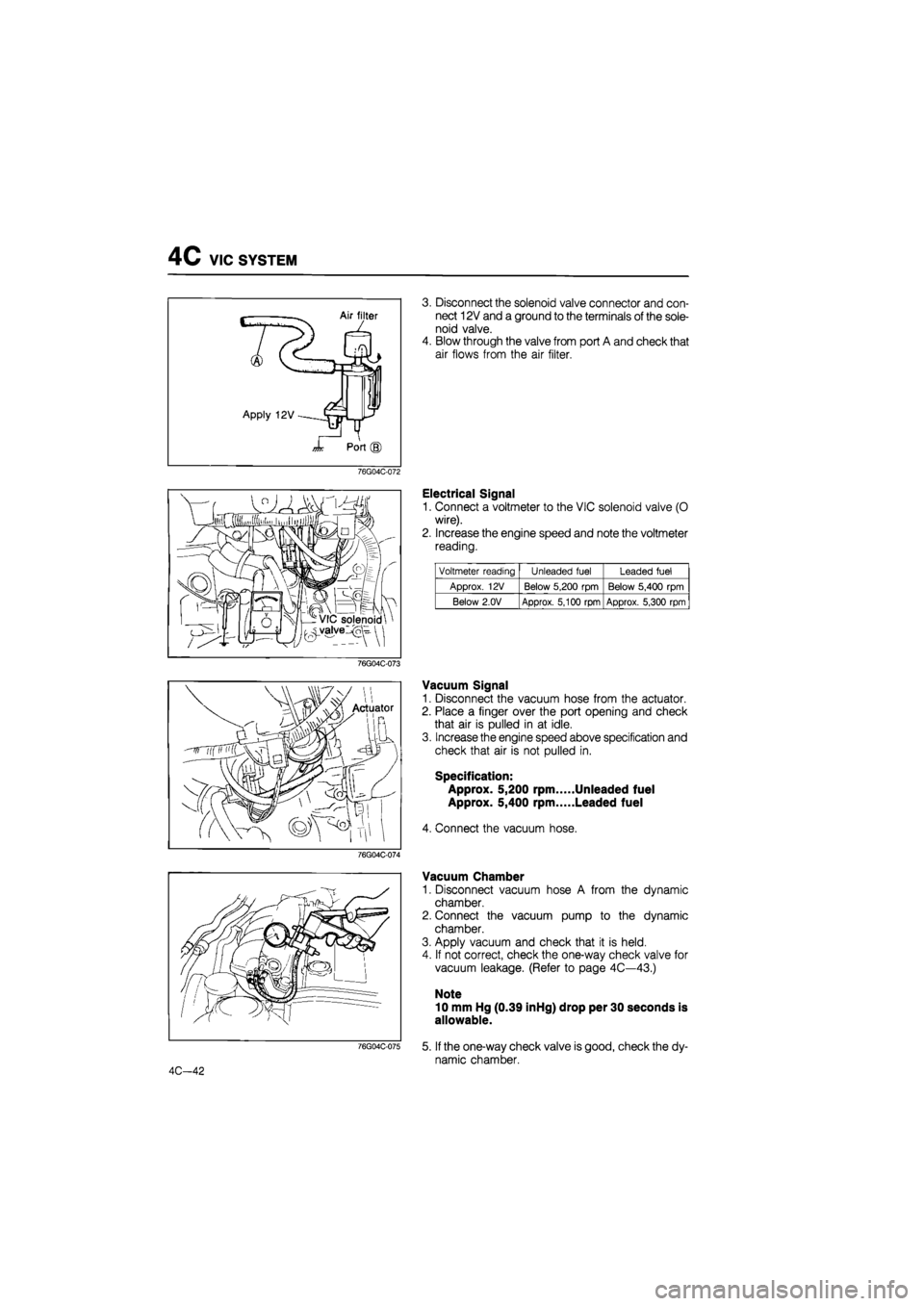
3. Disconnect the solenoid valve connector and con-
nect 12V and a ground to the terminals of the sole-
noid valve.
4. Blow through the valve from port A and check that
air flows from the air filter.
76G04C-072
Electrical Signal
1. Connect a voltmeter to the VIC solenoid valve (O
wire).
2. Increase the engine speed and note the voltmeter
reading.
Voltmeter reading Unleaded fuel Leaded fuel
Approx. 12V Below 5,200 rpm Below 5,400 rpm
Below 2.0V Approx. 5,100 rpm Approx. 5,300 rpm
76G04C-073
Vacuum Signal
1. Disconnect the vacuum hose from the actuator.
2. Place a finger over the port opening and check
that air is pulled in at idle.
3. Increase the engine speed above specification and
check that air is not pulled in.
Specification:
Approx. 5,200 rpm Unleaded fuel
Approx. 5,400 rpm Leaded fuel
4. Connect the vacuum hose.
76G04C-074
76G04C-075
4C-42
Vacuum Chamber
1. Disconnect vacuum hose A from the dynamic
chamber.
2. Connect the vacuum pump to the dynamic
chamber.
3. Apply vacuum and check that it is held.
4. If not correct, check the one-way check valve for
vacuum leakage. (Refer to page 4C—43.)
Note
10 mm Hg (0.39 inHg) drop per 30 seconds is
allowable.
5. If the one-way check valve is good, check the dy-
namic chamber.
Page 611 of 1865

4C FUEL SYSTEM
COMPONENT DESCRIPTION
Component Function Remark
Air flow sensor Detects amount of intake air;
sends signal to engine control unit
Clutch switch Detects in-gear condition; sends signal to engine control unit Switch ON when clutch pedal released
Engine control unit Detects signals from input sensors and switches; controls injector and fuel pump operations
Fuel filter Filters fuel
Fuel pump Provides fuel to injectors • Operates while engine running
• Installed in fuel tank
Fuel pump control unit (4WS) Monitors fuel level in left section; controls transfer pump operation
G signal pick-up Detects No.1 cylinder TDC; sends signal to engine control unit Installed in distributor
Idle switch Detects when throttle valve fully closed; sends signal to engine control unit Installed on throttle body
Ignition switch (ST position) Sends engine cranking signal to engine control unit
Injector Injects fuel into intake port • Controlled by signals from engine control unit • High-ohmic injector
Intake air thermo sensor Detects intake air temperature; send signal to engine control unit
Control relay Supplies electric current to injectors fuel pump and engine control unit
Ne signal pick-up Detects crank angle at 180° intervals; sends signal to engine control unit Installed in distributor
Neutral switch Detects in-gear condition; sends signal to engine control unit
Switch ON when in gear
Oxygen sensor (Unleaded fuel) Detects oxygen concentration; sends signal to engine control unit
• Zirconia ceramic and platinum coating • Integrated heater coil
Pressure regulator Adjusts fuel pressure supplied to injectors
Pulsation damper Absorbs fuel pulsation
Throttle sensor Detects throttle valve opening angle;
sends signal to engine control unit
Installed on throttle body
Transfer pump (4WS) Pumps fuel from the left to the right side Controlled by fuel pump control unit
Transfer pump switch (4WS) Detects fuel level in left section;
sends signal to control unit
Water thermo sensor Detects coolant temperature; sends signal to engine control unit
Water thermo switch (Unleaded fuel) Detects radiator coolant temperature; sends signal to engine control unit ON: above 17°C (63°F)
76G04C-088
4C-50
Page 621 of 1865
4C FUEL SYSTEM
BW B
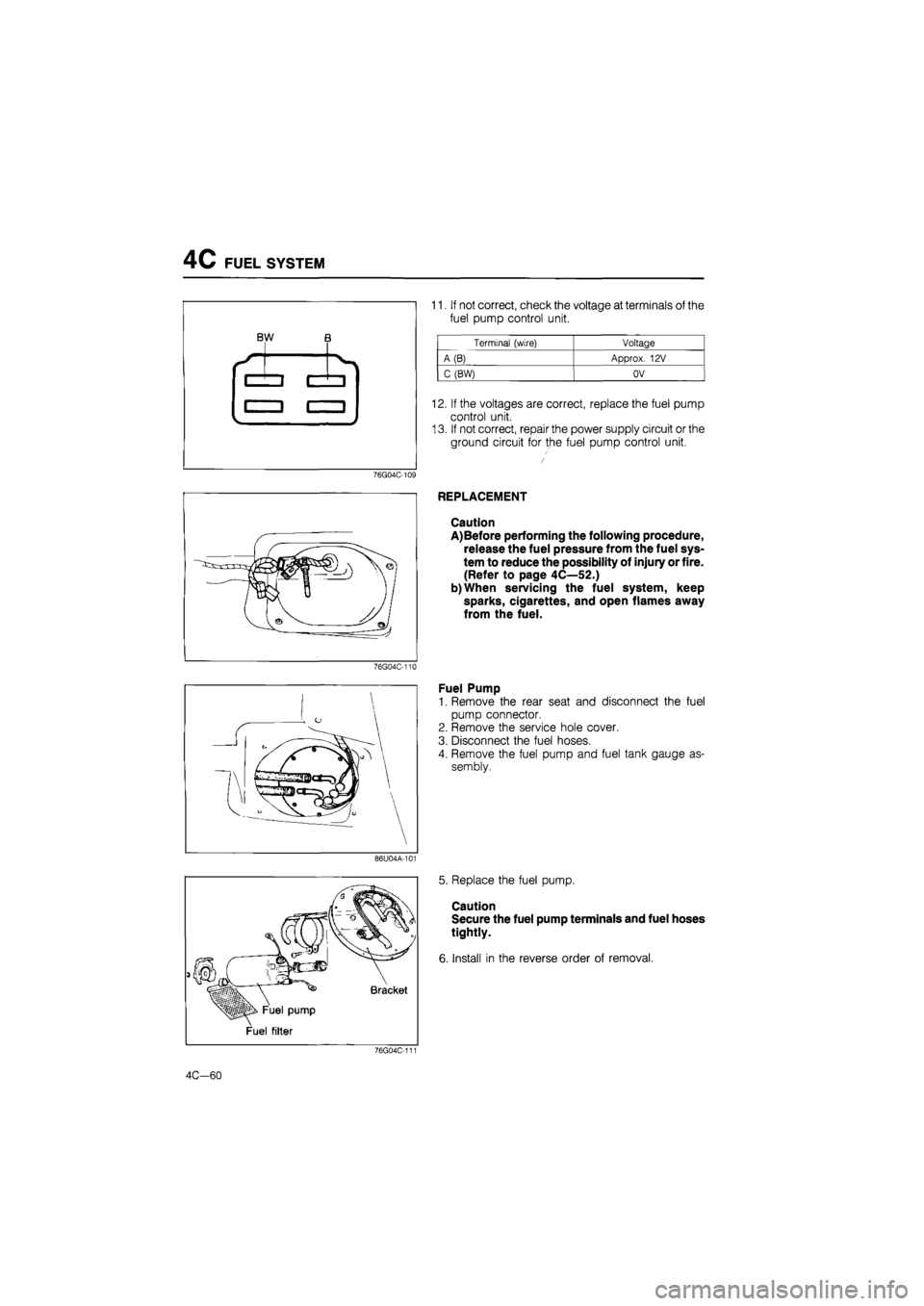
11. If not correct, check the voltage at terminals of the
fuel pump control unit.
76G04C-109
76G04C-110
86U04A-101
Fuel pump
Fuel filter
Bracket
76G04C-111
Terminal (wire) Voltage
A(B) Approx. 12V
C (BW) OV
12. If the voltages are correct, replace the fuel pump
control unit.
13. If not correct, repair the power supply circuit or the
ground circuit for the fuel pump control unit.
REPLACEMENT
Caution
A)Before performing the following procedure,
release the fuel pressure from the fuel sys-
tem to reduce the possibility of injury or fire.
(Refer to page 4C—52.)
b)When servicing the fuel system, keep
sparks, cigarettes, and open flames away
from the fuel.
Fuel Pump
1. Remove the rear seat and disconnect the fuel
pump connector.
2. Remove the service hole cover.
3. Disconnect the fuel hoses.
4. Remove the fuel pump and fuel tank gauge as-
sembly.
5. Replace the fuel pump.
Caution
Secure the fuel pump terminals and fuel hoses
tightly.
6. Install in the reverse order of removal.
4C—60
Page 632 of 1865

PRC SYSTEM 4C
Apply 12V
4. Disconnect the solenoid valve connector.
5. Connect 12V and a ground to the terminals of the
solenoid valve.
6. Blow through the solenoid valve from the vacuum
hose A.
7. Check that air flows from the valve air filter.
86U04A-099
4C-71
Page 640 of 1865
EGR SYSTEM (UNLEADED FUEL) 4C
Apply 12V
J* Port
76G04C-147
86U04A-133
76G04C-148
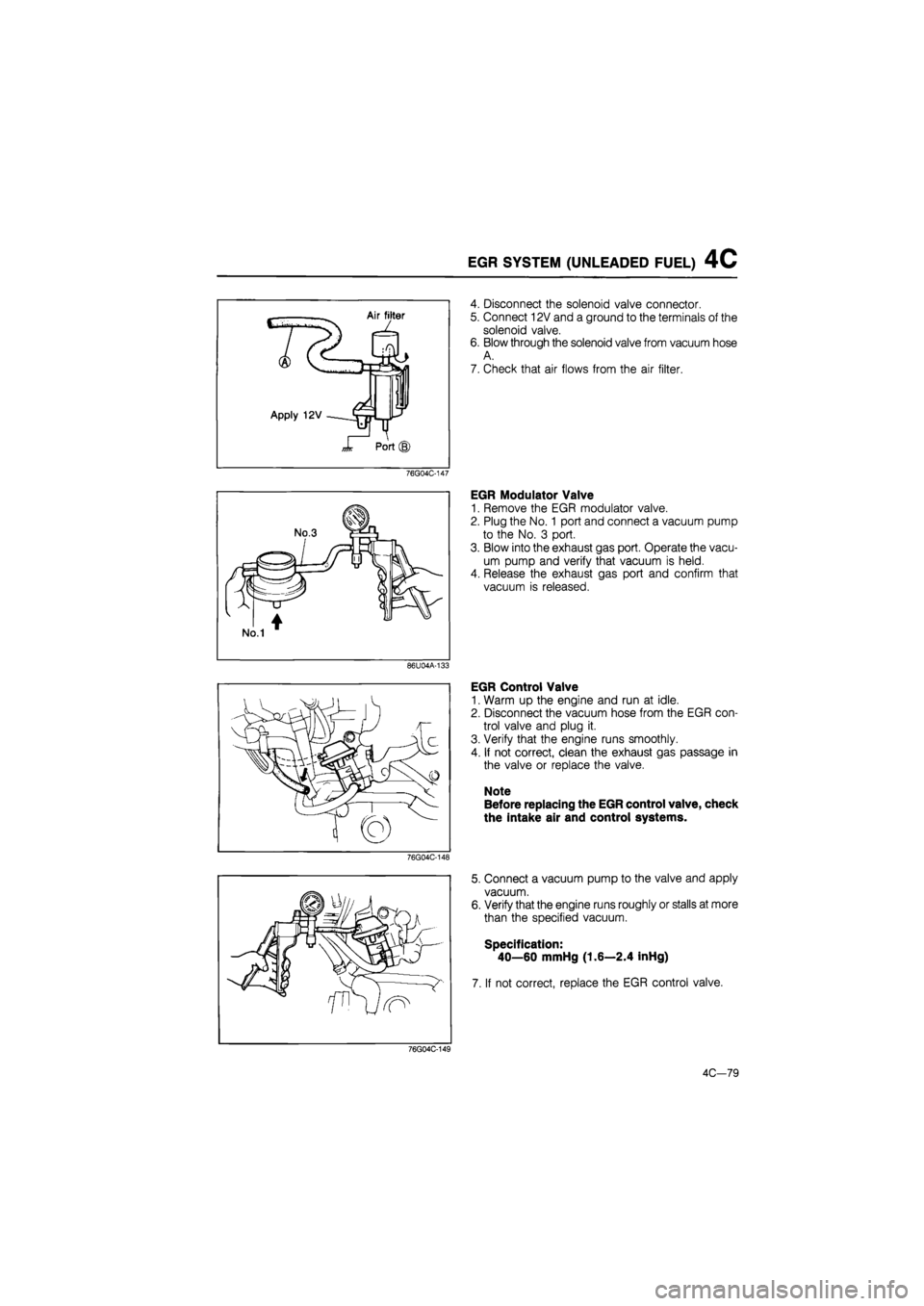
4. Disconnect the solenoid valve connector.
5. Connect 12V and a ground to the terminals of the
solenoid valve.
6. Blow through the solenoid valve from vacuum hose
A.
7. Check that air flows from the air filter.
EGR Modulator Valve
1. Remove the EGR modulator valve.
2. Plug the No. 1 port and connect a vacuum pump
to the No. 3 port.
3. Blow into the exhaust gas port. Operate the vacu-
um pump and verify that vacuum is held.
4. Release the exhaust gas port and confirm that
vacuum is released.
EGR Control Valve
1. Warm up the engine and run at idle.
2. Disconnect the vacuum hose from the EGR con-
trol valve and plug it.
3. Verify that the engine runs smoothly.
4. If not correct, clean the exhaust gas passage in
the valve or replace the valve.
Note
Before replacing the EGR control valve, check
the intake air and control systems.
5. Connect a vacuum pump to the valve and apply
vacuum.
6. Verify that the engine runs roughly or stalls at more
than the specified vacuum.
Specification:
40—60 mmHg (1.6—2.4 inHg)
7. If not correct, replace the EGR control valve.
76G04C-149
4C-79
Page 644 of 1865
EEC SYSTEM 4C
76G04C-157
76G04C-158
Three-way
check valve
86U04A-148
BO
To canister
Pressure valve
O A To tank
Vacuum valve
Air filter
86U04A-149
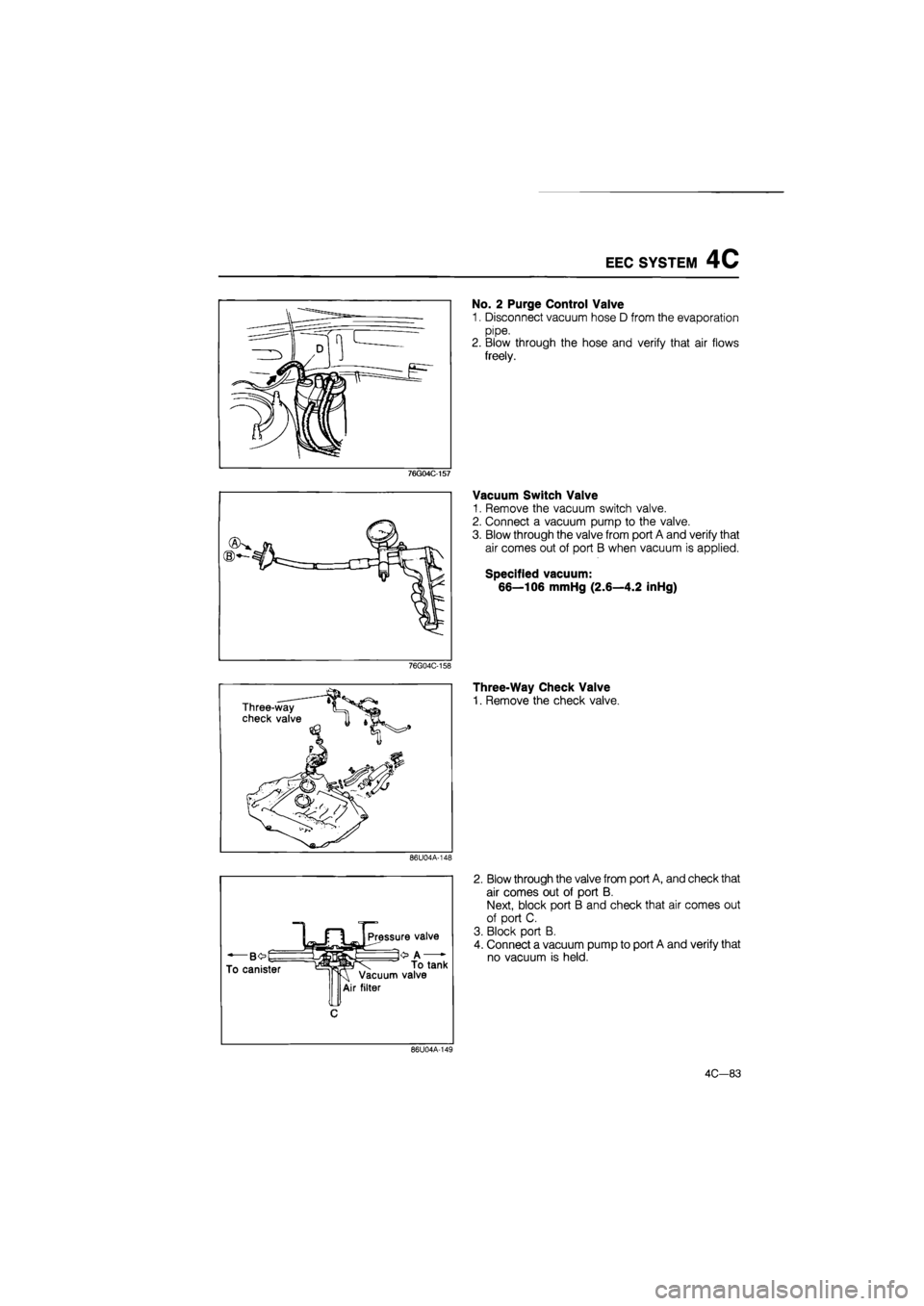
No. 2 Purge Control Valve
1. Disconnect vacuum hose D from the evaporation
pipe.
2. Blow through the hose and verify that air flows
freely.
Vacuum Switch Valve
1. Remove the vacuum switch valve.
2. Connect a vacuum pump to the valve.
3. Blow through the valve from port A and verify that
air comes out of port B when vacuum is applied.
Specified vacuum:
66—106 mmHg (2.6—4.2 inHg)
Three-Way Check Valve
1. Remove the check valve.
2. Blow through the valve from port A, and check that
air comes out of port B.
Next, block port B and check that air comes out
of port C.
3. Block port B.
4. Connect a vacuum pump to port A and verify that
no vacuum is held.
4C—83
Page 645 of 1865

4C EEC SYSTEM
Solenoid Valve
1. Remove the solenoid valve.
76G04C-159
2. Connect vacuum hoses to the valve as shown in
the figure.
3. Blow air through the valve from hose A and check
that air comes out of the valve air filter.
4. Apply 12V and ground the solenoid valve with jum-
per wires.
5. Blow air through the valve from hose A and check
that the air comes out of port B.
6. Replace, if necessary.
86U04A-151
Two-way check valve
Inspection
1. Remove the two-way check valve.
76G04C-160
4C-84
Connect a pressure gauge to the passage that nor-
mally is connected to the fuel tank.
Blow through the valve from port A. Verify that the
valve opens at 2.94 kPa (0.03 kg/cm2,0.43 psi).
Remove the pressure gauge and connect
it
to the
passage to atmosphere.
Blow through the valve from port B. Verify that the
valve opens at 0.98 kPa (0.01 kg/cm2,0.14 psi).