air condition MAZDA 626 1987 Repair Manual
[x] Cancel search | Manufacturer: MAZDA, Model Year: 1987, Model line: 626, Model: MAZDA 626 1987Pages: 1865, PDF Size: 94.35 MB
Page 639 of 1865
4C EGR SYSTEM (UNLEADED FUEL)
TROUBLESHOOTING
Check the condition of the wiring harness and connectors before checking the sensors or switches.
Note
Make the system inspection first. If no problem is found, continue with inspection of the
next system of the Troubleshooting Guide. (Refer to pages 4C—10 and 11.)
Possible cause
Throttle
sensor
Solenoid valve
(EGR)
EGR
modula-
tor valve
EGR con-trol valve
Water
thermo
sensor
Water
thermo switch
Engine control unit
terminal
System in-spection
2N
Page 4C—104 4C—78 4C—79 4C—79 4C—107 4C—106 4C—98 4C—78
Checking order 8 2 4 3 6 5 7 1
76G04C-144
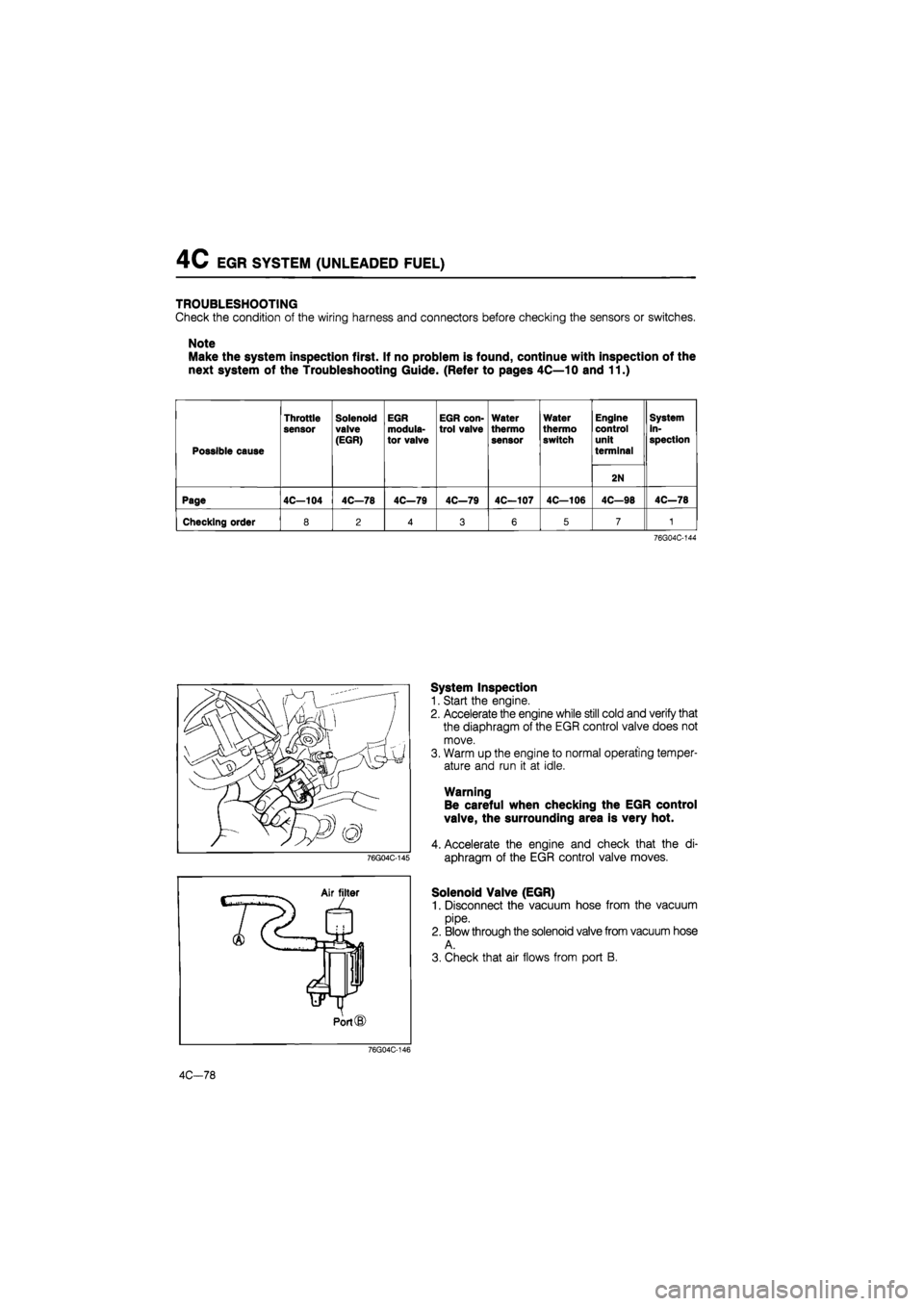
System Inspection
1. Start the engine.
2. Accelerate the engine while still cold and verify that
the diaphragm of the EGR control valve does not
move.
3. Warm up the engine to normal operating temper-
ature and run it at idle.
Warning
Be careful when checking the EGR control
valve, the surrounding area is very hot.
4. Accelerate the engine and check that the di-
aphragm of the EGR control valve moves.
Solenoid Valve (EGR)
1. Disconnect the vacuum hose from the vacuum
pipe.
2. Blow through the solenoid valve from vacuum hose
A.
3. Check that air flows from port B.
76G04C-146
4C-78
Page 642 of 1865
EEC SYSTEM
4C
TROUBLESHOOTING
Check
the
condition
of the
wiring harness
and
connectors before checking
the
sensors
or
switches.
Note
Make
the
system inspection first.
If no
problem
is
found, continue with inspection
of the
next system
of the
Troubleshooting Guide. (Refer
to
pages 4C—10
and 11.)
Possible cause
« > (0 >
£ O
S in
E 3 3
Solenoid
valve
(No.
1 purge
control)
Solenoid
valve
(No.
2 purge
control)
Two-way
check
valve
a>
>. >
i
S
i
^
3>
o
o CO k n
V
*
£
3
_
a
o
k. T-
a>
E»S 3
_
a
o
CM
£
£ O
S in o E tm a> £
w V
o ID C a> in o E k a> £ **
a>
Engine
control
unit
terminal
c o +s o a> a. w c
E a> O <0 >
Solenoid
valve
(No.
1 purge
control)
Solenoid
valve
(No.
2 purge
control)
Two-way
check
valve
>-
0)
£
£
1-
o
Q. d) o
fe
Z
o
ofe Z
O
(0 (0 $ 2P,20
in
(O
Page 4C—83 4C-84 4C-84 4C—84 4C-83 4C-85 4C-82 4C-83 4C-106 4C-107 4C—98 4C-81
Checking order (Unleaded fuel) 4 2 3 — 10 11 5 6 7 8 9 1
Checking order
(Leaded fuel) — — — 1 — 2
76G04C-152
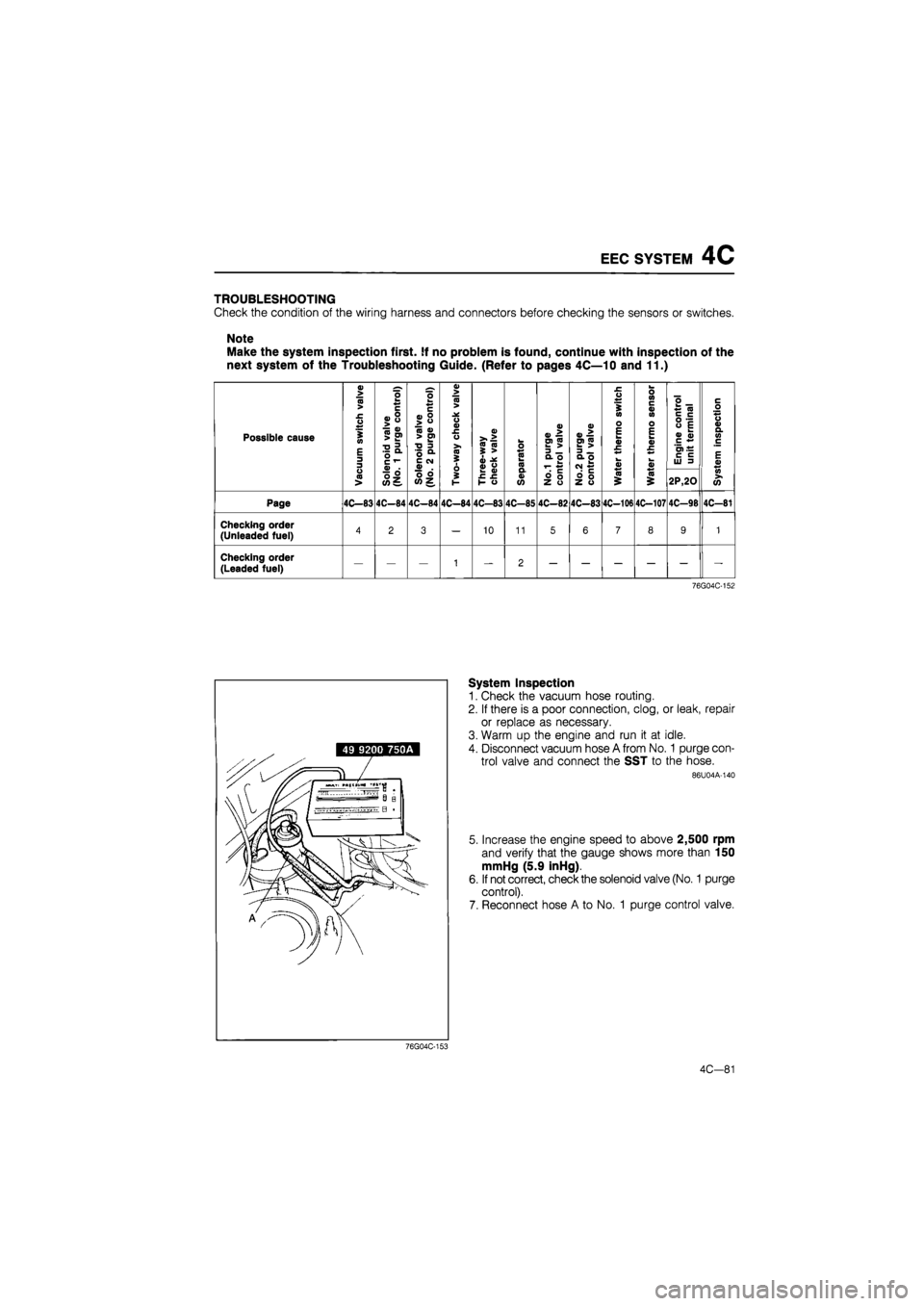
System Inspection
1. Check
the
vacuum hose routing.
2. If there
is a
poor connection, clog,
or
leak, repair
or replace
as
necessary.
3. Warm
up the
engine
and run it at
idle.
4. Disconnect vacuum hose
A
from
No. 1
purge con-
trol valve
and
connect
the SST to the
hose.
86U04A-140
5. Increase
the
engine speed
to
above 2,500
rpm
and verify that
the
gauge shows more than
150
mmHg
(5.9
inHg).
6. If not correct, check the solenoid valve (No.
1
purge
control).
7. Reconnect hose
A to No. 1
purge control valve.
4C-81
76G04C-153
Page 655 of 1865

4C CONTROL SYSTEM
Output Devices
and
Engine Conditions (Unleaded fuel)
REMARK
*
Above
7,000
rpm:
fuel
cut
'Coolant
temp.:
below
50°C
(122°F)
41 Coolant
temp:
below
70°C
(158°F)
*2 Engine
speed
above
1,700
rpm
*3 Engine
speed:
1,500—3,500
rpm
*
During
hot
start
only
*
Engine
speed:
above
5,200
rpm
'Engine
speed:
above
3,000
rpm
'Delays
0.5
second
IGN:
ON
(ENGINE
NOT RUNNING)
No
injection
No bypass OFF
(main
fuel
pump
not
operated)
OFF
OFF
z
1
IDLE
(THROTTLE
VALVE
FULLY CLOSED)
Rich
and
i
lean
Sequential
(once
per
two
revolutions)
OFF
o en C3 UJ
z
"After
start-
ing:
ON
(Vacuum
cut) OFF
o
DECELE-
RATION
'Fuel
cut
L
Small
amount
of
bypass
air
N (1st
stage
operate:
o
o Ho 3 O CO CD > CO >
>; CO
CO c o
c o o
HEAVY
LOAD
•ST c
Closed
Small
amount
of
bypass
air
-co-CD CO
N (1st
stage
operate:
In CD 2? 03 a. o CD o> CO to "O c
*3 OFF (EGR)
o Ho 3 O CO CD > CO >
03 k-o CO c 03 CO z o *
CD c O) c 03 c o
c o o a 3
ACCELE-
RATION
Rich
o •*—• 3 o > CD
O
Small
amount
of
bypass
air
03 Q. O Q. E 3
ON
O
In CD 2? 03 a. o CD o> CO to "O c
ON
(EGR cut)
:F (Vacuum
to
pressure
regulatt
03 3 -C CO o
c 03 CS3 > X o o
z o * CO •o c CD Q. CD T3
C CO CD o "O 3= O c: 3 CO
LL LL o
MEDIUM
LOAD
WARM
Rich
and lean
|
Q. CD O
CD D
C CO E
CVJ.
z o fS *
*3 OFF (EGR)
:F (Vacuum
to
pressure
regulatt
E 3 3
c 03 i t 3 G, LL LL
T3 CD O c CO > "O <
C CO CD o "O 3= O c: 3 CO
LL LL o
MEDIUM
LOAD
COLD
ro
c CD 3 cr
z O "a CD a? CD CL o
F (2nd
stage
not
operated)
:F (Vacuum
to
pressure
regulatt
z o * O «
WARMING
UP
(DURING
IDLE)
Rich
CD CO c CD Q-O
o
c 3 CO O CO E CO
o c
stage
not
operated)
tr O UJ
z o
O
LL z
Fixed
at
BTDC
12°
CRANKING
(COLD
ENGINE)
1
group
(twice
per
revolution)
CO
«
CD urn i CO
CO
LL LL O
LL O * « o o
LL LL o
Fixed
at
BTDC
6°
z o
SOLENOID
VALVE
(PRESSURE
REGU-
LATOR
CONTROL)
CC
o z o o iii z
o z 111
OUTPUT
DEVICE
FUEL
INJECTION
AMOUNT FUEL
INJECTION
TIMING
AIR
VALVE
'
ISC
VALVE
FUEL
PUMP
CONTROL
MAIN
POWER
CONTROL
SOLENOID
VALVE
(No.1
PURGE)
SOLENOID
VALVE
(NO.2
PURGE)
SOLENOID
VALVE
(EGR)
SOLENOID
VALVE
(PRESSURE
REGU-
LATOR
CONTROL)
SOLENOID
VALVE
(VARIABLE
INE
TIA
CONTROL)
> <
Ul oc oc o
£T u. O 1 z oc 3 m
oc o
OUTPUT
DEVICE
INJECTOR
BAC
VALVE
CONTROL
RELAY
SOLENOID
VALVE
(No.1
PURGE)
SOLENOID
VALVE
(NO.2
PURGE)
SOLENOID
VALVE
(EGR)
SOLENOID
VALVE
(PRESSURE
REGU-
LATOR
CONTROL)
SOLENOID
VALVE
(VARIABLE
INE
TIA
CONTROL)
tn z Ul (0 z Ul o >-X o
A/C
RELAY
IGNITER
z Ul (O
=5 o
IL oc <
76G04C-169
4C—94
Page 656 of 1865
CONTROL SYSTEM
4C
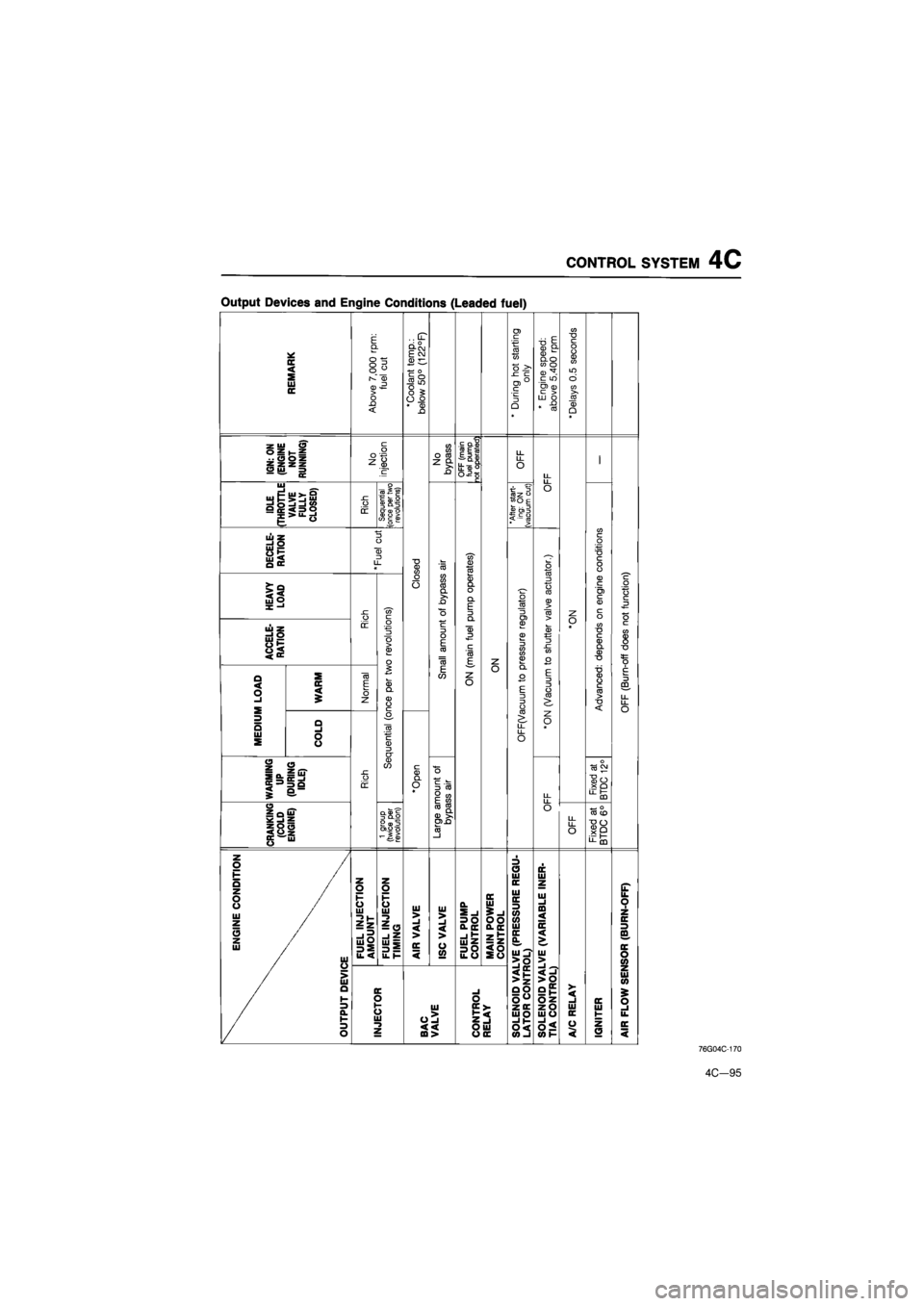
Output Devices
and
Engine Conditions (Leaded fuel)
REMARK
E Q
O O O r-»" CD > o n <
fuel
cut
'Coolant
temp.:
below
50°
(122°F)
*
During
hot
starting
only
*
Engine
speed:
above
5,400
rpm
'Delays
0.5
seconds
IGN:
ON
(ENGINE
I
NOT
RUNNING)
o
z
injection
No
bypass
OFF
(main
fuel
pump
not
operated)
OFF
LL
I
IDLE
(THROTTLE
VALVE
FULLY
CLOSED)
Rich
I
Sequential (once
per
two
revolutions)
"After
start-
ing:
ON
(vacuum
cut)
O
DECELE-
RATION
i
i
'Fuel
cut
•o CD CO "co" CD ts o to 3 o CO CD > CO
CO c o
c o o
HEAVY
LOAD
sz "co" c
O o CO CO CO Q. >. -O
O
CD Q. O CL E CL ® D
C CO F
o 08 3 u> £ CD 3 CO 0) CD
o to 3 o CO CD > CO
z
B
ACCELE-RATION
ir o 3 0 > CD 1 O
C
O E CO
"CO
CD Q. O CL E CL ® D
C CO F
z
o 08 3 u> £ CD 3 CO 0) CD
CD e 3 SZ CO o
O * CO
c CD CL CD T3
c CO 8 "D
'
MEDIUM
LOAD
WARM
Normal
CD Q. CD O
E CO
z
O
o o_ O
E
3 3
o CO ^ LL LL O
E 3 3 O CO
•o
c
3
m
LL LL o
'
MEDIUM
LOAD
COLD
.H C CD 3 CT
o_ O
E
3 3
o CO ^ LL LL O
z
o *
WARMING
UP
(DURING
IDLE)
Rich
CD CO
*Open
B
3
CO
O
CO
E
<®
LL
Fixed
at
BTDC
12°
CRANKING
(COLD
ENGINE)
1
group
(twice
per
revolution)
CO
«
0)
>,
u>n w-CO
o
OFF
Fixed
at
BTDC
6°
ENGINE
CONDITION
OUTPUT
DEVICE
FUEL
INJECTION
AMOUNT
'
FUEL
INJECTION
TIMING
AIR
VALVE
ISC
VALVE
FUEL
PUMP
CONTROL MAIN
POWER
CONTROL
SOLENOID
VALVE
(PRESSURE
REGU-
LATOR
CONTROL)
SOLENOID
VALVE
(VARIABLE
INER-
TIA
CONTROL)
(T ik 0 1 z DC 3
ffl
OC o tn
OUTPUT
DEVICE
INJECTOR
BAC
VALVE
CONTROL
RELAY
SOLENOID
VALVE
(PRESSURE
REGU-
LATOR
CONTROL)
SOLENOID
VALVE
(VARIABLE
INER-
TIA
CONTROL)
A/C
RELAY
IGNITER
Z Ul tn
£ o
ik DC <
76G04C-170
4C—95
Page 661 of 1865
4C CONTROL SYSTEM
Terminal Input Output Connection to Voltage (After warming-up) Remark Terminal Input Output Connection to Ign: ON Idle Remark
10 o Air flow sensor
(Burn-off control) Below 2.5V White burning off:
Approx. 8—12V
1P o
Control relay (Power supply circuit) Below 2.5V Ignition switch OFF:
Approx. 12V
1Q 0 Control relay (Fuel pump circuit) Approx. 12V Below 2.5V
1R
(L/F) O Knock sensor OV or 2—7V While knocking:
Approx. 0.001
1S — — — — —
1T o Ignition switch
(ON position) Approx. 12V
1U — — — — —
1V — — — — —
1W o Test connector Test connector grounded: OV Test connector not grounded: approx. 12V Green connector, 1-pin
1X o Igniter Approx. 12V *Approx.1V 'Engine Signal
Monitor: green and
red lights flash
2A (U/F) o V ref 4.5—5.5V
2B o Air flow sensor
(Ground) OV
2C — — Ground (E2) OV
2D (U/F) o Oxygen sensor OV 0-1.0V
• Cold engine: 0V at idle
• After warming-up: Increase engine speed: 0.7—1.0V Deceleration: 0—0.2V
2E o Air flow sensor
(Intake air mass) 1.0—1.6V 1.7—2.3V Increase engine speed: voltage increases
2F — — — .— —
2G (U/F) o Throttle sensor Accelerator pedal released: approx. 0.5V
Max. voltage (Throt-tle valve fully opened): approx. ,4.3V
2H (L/F) o Air flow sensor (Variable resister) 0-5V Depends on
adjustment
21 o Water thermo sensor Approx. 0.4V
Engine coolant
temp. 20°C (68°F):
approx. 2.5
2J o Intake air thermo sensor (Dynamic chamber)
Approx. 2.5V at 20°C (68°F)
2K o
Solenoid valve (Pressure regula-tor control)
For 120 sec. after ignition switch OFF - ON: below 2.5V
For 120. sec after starting: below 2.5V
During hot condi-tion: Coolant temp, above 70°C (158°F) Intake air temp, above 30°C (86°F) ...Unleaded fuel above 50°C (122°F) ...Leaded fuel
2K o
Solenoid valve (Pressure regula-tor control)
ADDrox. 12V Other conditions
2L — — — — —
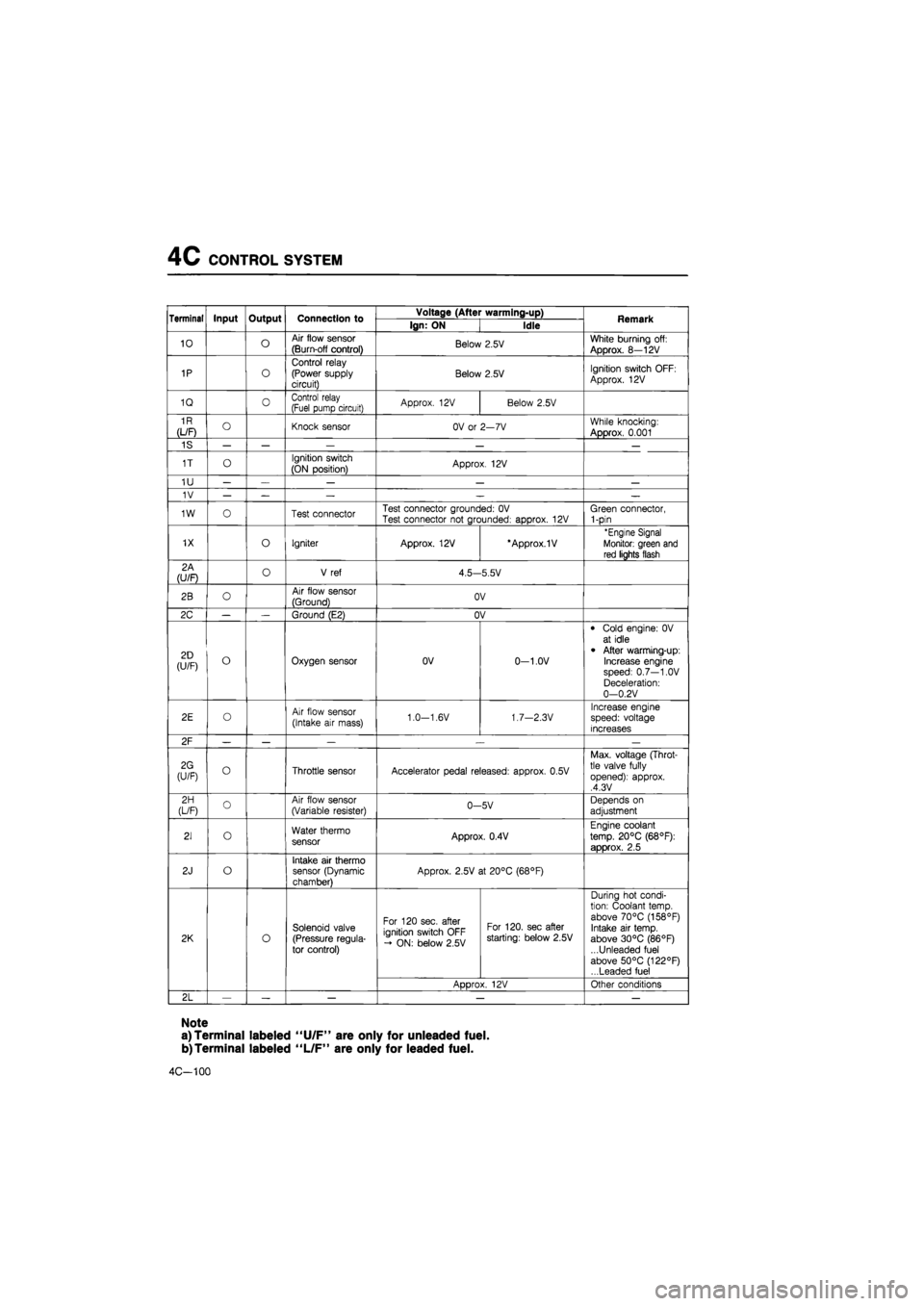
Note
a) Terminal labeled "U/F" are only for unleaded fuel.
b)Terminal labeled "L/F" are only for leaded fuel.
4C-100
Page 664 of 1865
CONTROL SYSTEM 4C
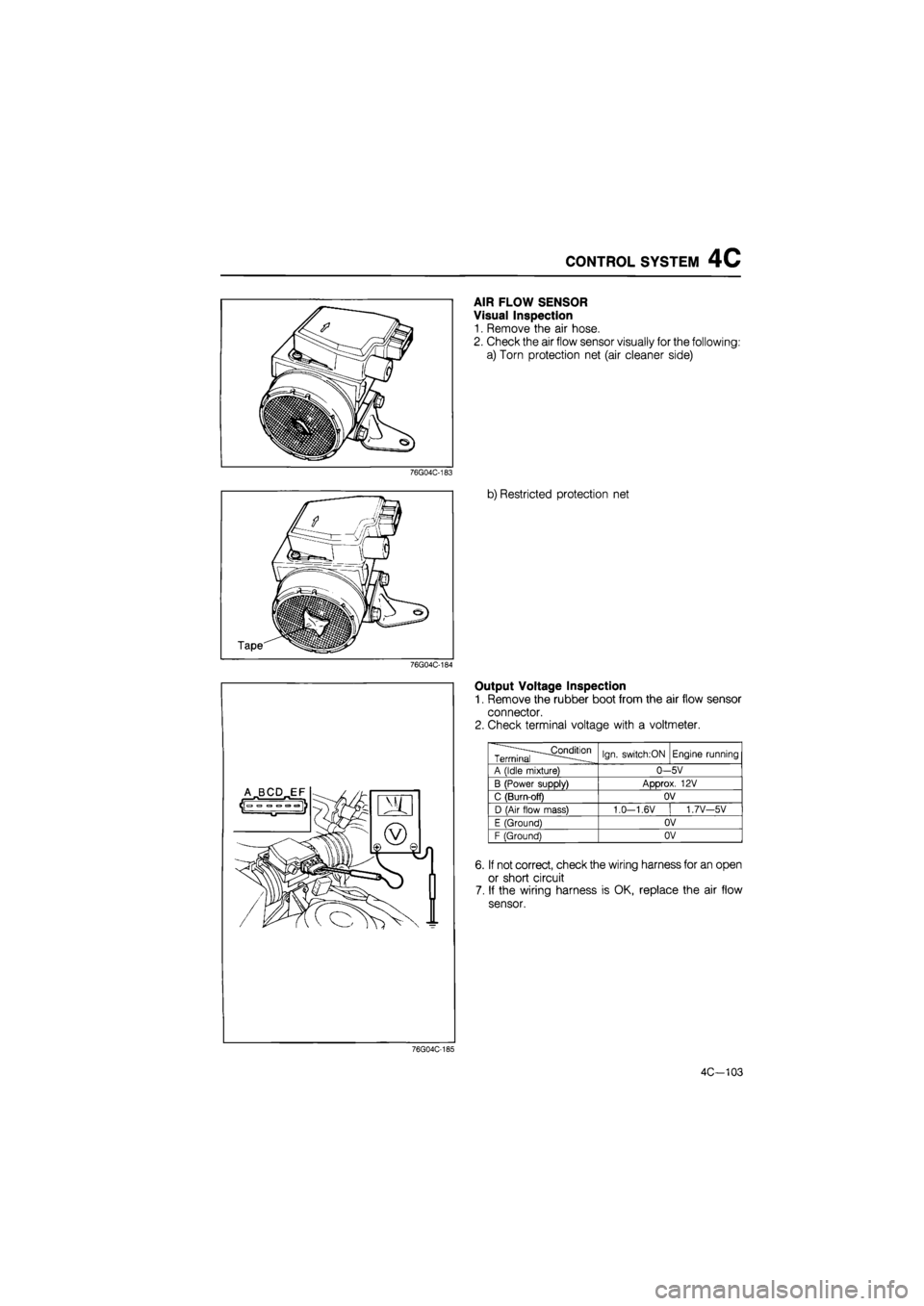
AIR FLOW SENSOR
Visual Inspection
1. Remove the air hose.
2. Check the air flow sensor visually for the following:
a) Torn protection net (air cleaner side)
76G04C-183
b) Restricted protection net
76G04C-184
Output Voltage Inspection
1. Remove the rubber boot from the air flow sensor
connector.
2. Check terminal voltage with a voltmeter.
——^.Condition Terminal — ... Ign. switch;ON Engine running
A (Idle mixture) 0—5V
B (Power supply) Approx. 12V
C (Burn-off) OV
D (Air flow mass) 1.0-1,6V I 1.7V-5V
E (Ground) OV
F (Ground) 0V
6. If not correct, check the wiring harness for an open
or short circuit
7. If the wiring harness is OK, replace the air flow
sensor.
76G04C-185
4C-103
Page 674 of 1865

TROUBLESHOOTING GUIDE 4D
TROUBLESHOOTING GUIDE
Condition Condition Cause Remedy
Hard starting Fuel filter
Clogged Replace
Water or air in filter Repair
Fuel injection pump Faulty fuel cut solenoid Replace Incorrect injection timing Adjust
Air in pump Bleed
Faulty pump Replace
Fuel injection nozzle Seized needle valve Replace
Fuel dripping from nozzle Replace Incorrect valve opening pressure Adjust
Faulty glow plug Replace
Faulty cold start device Adjust or replace
Faulty supercharging system Refer to page 4D—10
Rough idle Fuel filter (Refer to "Hard starting") Fuel injection pump (Refer to "Hard starting")
Fuel injection nozzle
Seized needle valve Replace
Incorrect valve opening pressure Adjust
Improper mounting to nozzle holder Repair
Leakage of nozzle holder copper washer Replace
Fuel injection pipe Cranks Replace
Leaking from joint Repair
Improper idle speed adjustment Adjust
Engine knocking Incorrect injection timing Adjust
Low quality fuel Replace
Incorrect injection nozzle opening pressure Ajust
Seized injection nozzle needle valve Replace
Fuel dripping from injection nozzle Replace
Faulty supercharging system Refer to page 4D—10
High fuel Fuel injection pump consumption Incorrect injection timing Adjust consumption High idle speed Adjust, Inspect the dashpot
Fuel injection nozzle Incorrect valve opening pressure Repair
Fuel dripping from nozzle Replace
Leakage of nozzle holder copper washer Replace
Fuel leaking from connection Repair
Clogged fuel filter Replace
Clogged air cleaner Replace
Poor acceleration Fuel injection nozzle (Refer to "Hard starting")
Fuel injection pump (Refer to "Hard starting")
Fuel injection pipe (Refer to "Rough idle") Fuel filter (Refer to "Hard starting") Clogged air cleaner Clean or replace
Faulty supercharging system Refer to page 4D—10
Excessive exhaust Clogged air cleaner Clean or replace
smoke Improper injection timig Adjust
Faulty nozzle or nozzle holder Adjust or replace
Faulty supercharging system Refer to page 4D—10
76G04D-003
4D-3
Page 715 of 1865

SPARK PLUG 5
Slow Charge
1. Stop the engine
2. Turn all the accessories off.
3. Remove the negative battery cable.
4. Perform a slow charge (3.5A to 4.5A).
5. Add distilled water if necessary while charging.
6. Charge once more if the specific gravity is under
fully charged gravity.
4BG05X-010
SPARK PLUG
REMOVAL AND INSTALLATION
Note the following points:
1. When the high-tension lead is to be pulled off, be
sure to pull the boot itself, and not the wire.
2. Tighten the spark plugs to the specified torque.
Tightening torque: 15—23 N-m
(1.5—2.3 m-kg, 10.8—16.6 ft-lb)
76G05X-054
Wear and adhesion or cabon
INSPECTION
Check the following points. If a problem is found, re-
place the spark plug.
1. Damaged insulation
2. Worn electrodes
3. Carbon deposits
If cleaning is necessary, use a plug cleaner or a
wire brush. Clean the upper insulator also.
4. Damaged gasket
5. Burnt condition of spark insulator
6. If it is black with carbon deposits, either misfiring
due to improper proportions of gas and air or over-
heating of the plug may have occurred.
Plug gap:
FE (12VALVE) and FE DOHC Leaded fuel
model:
0.70—0.80 mm (0.028—0.031 in)
FE (8VALVE) and FE DOHC Unleaded fuel
model:
1.0—1.10 mm (0.039—0.043 in)
Others:
0.75—0.85 mm (0.030—0.034 in)
76G05X-005
5-9
Page 1123 of 1865
TROUBLESHOOTING
7C
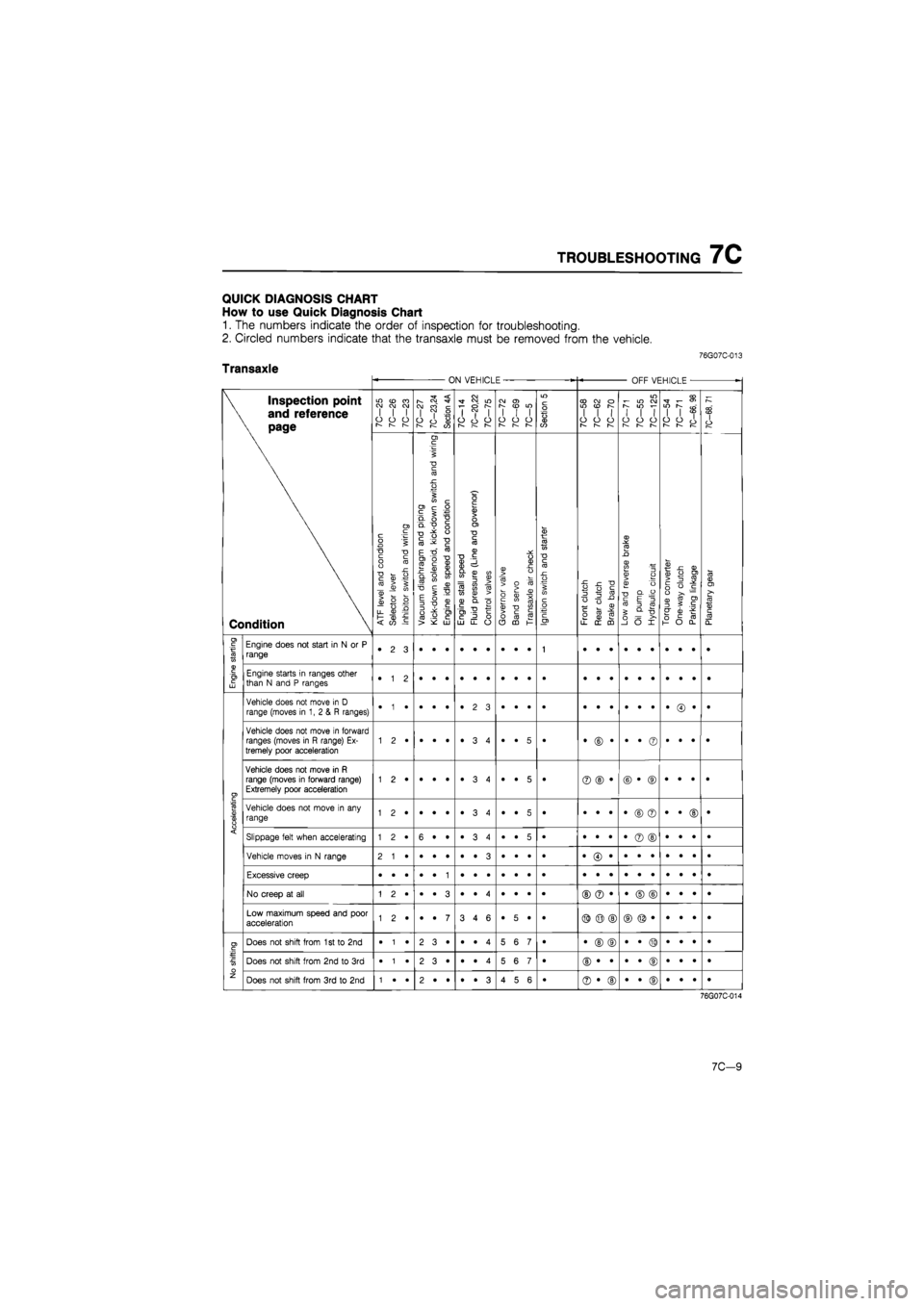
QUICK DIAGNOSIS CHART
How
to use
Quick Diagnosis Chart
1.
The
numbers indicate
the
order
of
inspection
for
troubleshooting.
2. Circled numbers indicate that
the
transaxle must
be
removed from
the
vehicle.
76G07C-013
Transaxle ON VEHICLE OFF VEHICLE
•
\ Inspection point
\
and
reference
\ page
Condition
7C-25
7C-26
7C-23
10—21
7C—23,24
Section
4A
7C-14
7C—20,22
10—lb
10-12 10—69
7C—5
Section
5
7C—58
7C-62
7C-70
7C-71
7C-55
7C-125
7C-54 7C-71
7C-66,
98
7C-68,
71
\ Inspection point
\
and
reference
\ page
Condition
ATF
level
and
condition
Selector
lever
Inhibitor
switch
and
wiring
^
Vacuum
diaphragm
and
piping
|
Kick-down
solenoid,
kick-down
switch
and
wiring
Engine
idle
speed
and
condition
Engine
stall
speed
Fluid
pressure
(Line
and
governor)
Control
valves
Governor
valve
Band
servo
Transaxle
air
check
Ignition
switch
and
starter
Front
clutch
Rear
clutch
Brake
band
Low
and
reverse
brake
Oil
pump Hydraulic
circuit
Torque
converter
One-way
clutch
Parking
linkage
Planetary
gear
I
Engine
starting
Engine does
not
start
in
N or P
range •
2 3
1
Engine
starting
Engine starts
in
ranges other than
N
and P
ranges •
1 2
Accelerating
Vehicle does
not
move
in
D
range (moves
in 1, 2 & R
ranges) •
• •
•
Accelerating
Vehicle does
not
move
in
forward ranges (moves
in R
range)
Ex-
tremely poor acceleration •
• 5
• •
© •
•
• ©
•
• •
•
Accelerating
Vehicle does
not
move
in R
range (moves
in
forward range) Extremely poor acceleration 1
2 •
•
• •
•
3 4
•
• 5
• ©
© •
©
• ©
•
• •
•
Accelerating
Vehicle does
not
move
in any
range 1
2 •
•
• •
•
3 4
•
• 5
• •
• •
•
© ©
•
• ©
•
Accelerating Slippage felt when accelerating 1
2 •
6
• •
•ST
CO
•
•
• 5
• •
• •
•
© ©
•
• •
• Accelerating
Vehicle moves
in
N
range
Accelerating
Excessive creep
Accelerating
No creep
at all
©
© •
•
© ©
•
• •
•
Accelerating
Low maximum speed
and
poor acceleration 1
2 •
•
• 7
3
4 6
•
5 •
• ©
© ©
No shifting
Does
not
shift from
1
st to 2nd
•
1 •
2
3 •
•
• 4
5
6 7
• •
© ©
•
• ©
•
• •
•
No shifting
Does
not
shift from
2nd to 3rd
•
1 •
2
3 •
•
• 4
5
6 7
•
No shifting
Does
not
shift from
3rd to 2nd
1
• •
2
• •
•
• 3
4
5 6
• ©
• ©
•
• ©
•
• •
•
76G07C-014
7C-9
Page 1124 of 1865
7C TROUBLESHOOTING
ON VEHICLE OFF VEHICLE
-
\ Inspection point
\ and reference
\ page
Condition
LO
(O
CO CJ OJ CM I
I I
O
O
CJ
r-~
r—
7C-27
7C—23,24
Section
4A
7C—14
7C—20,22
7C-75
CO
O)
I
I I
o
o o
r—
r—
Section
5
CO CO
o
WON I
I I
o
o o
1— 1—
m i-
in co
S
IO
i-
1
1 1
o
o o
—
I—
7C—54
7C-71
7C-66,
98
7C—68,
71
\ Inspection point
\ and reference
\ page
Condition
A.TF
level
and
condition
Selector
lever
Inhibitor
switch
and
wiring
Vacuum
diaphragm
and
piping
Kick-down
solenoid,
kick-down
switch
and
wiring
Engine
idle
speed
and
condition
Engine
stall
speed
Fluid
pressure
(Line
and
governor)
Control
valves
Governor
valve
Band
servo
Transaxle
air
check
Ignition
switch
and
starter
Front
clutch
Rear
clutch
Brake
band
Low
and
reverse
brake
Oil pump Hydraulic
circuit
Torque
converter
One-way
clutch
Parking
linkage
Planetary
gear
No
shifting
Does
not
shift from 2nd
to
1
st or from
3rd to
1
st 1
• •
2
• •
•
• 3
4
5 6
•
No
shifting
Does
not
kick-down when accelerator
is
depressed
in 3rd
within
the
kick-down range 1
• •
3
2*
•
• 4
5
• •
• •
• ©
•
• ©
•
• •
•
No
shifting
Excessive engine speed when accelerated
in 3rd
due
to
delayed kick-down 5
• 6
• ©
• •
•
• ©
•
• •
• No
shifting
Does
not
shift from
3rd to 2nd
on
D to
2
range shift 1
2 •
5
6 •
• ©
• ®
•
• ®
•
• •
•
No
shifting
Does
not
shift from
3rd to 2nd
on
D to 1
range shift 5
7 6
• ©
• ®
•
• ®
•
• •
•
Shift
shock
Excessive
N to
D
range shift shock •
• •
2
• 1
•
3 4
•
• •
• •
© •
•
• •
•
• •
•
Shift
shock
Excessive
1
st
to
2nd shift shock 1
• •
2
• •
3
• 4
•
5 6
• •
• ©
•
• •
•
• •
•
Shift
shock
Excissive 2nd
to 3rd
shift shock •
• •
1
• •
•
2 3
•
4 5
• ©
• ©
Shift
shock
Vehicle braked when shifted from
1
st
to 2nd
Shift
shock
Vehicle braked when shifted from 2nd
to 3rd
1
• •
•
• •
•
• 3
.
2 •
•
Shift
shock
Vehicle braked when shifted
to
R range 1
• •
•
• •
•
• •
•
3 2
• •
© ©
•
• •
•
• ©
•
Shift
shock
Shift shock felt when accelerator
is
released
and
deceleration occurs •
1 •
2
3*
•
4 5
6
• •
• •
• •
•
• ©
•
• *
•
Shift
shock
Excessively large 2nd
to 1st
shift shock
in 1
range 1
• •
2
• •
3
4 5
•
• •
•
Shift
point
Excessively high
1st to 2nd
and 2nd
to
3rd shift 1
• •
2
3 •
•
4 5
6
• •
•
Shift
point
Excessively high
3rd to 2nd
and
2nd to
1
st shift point •
1 •
2
3 •
•
4 5
6
• •
• •
• •
•
• ©
•
• •
•
Shift
point
Kick-down operates
or
engine overruns when depressing
ped-
al
in 3rd
beyond kick-down speed limit
1
2 •
3
• •
•
4 5
6
• 7
•
Shift
sequence
Shifts directly from 1st
to 3rd
1
• •
•
• •
•
• 2
3
• 4
• •
• ©
•
• ©
•
• •
•
Shift
sequence
Shifts from
2nd to 1st or
2nd
to
3rd
in
2
range •
1 •
•
• •
•
2 3
•
• •
•
7C-10