air condition MAZDA 626 1987 User Guide
[x] Cancel search | Manufacturer: MAZDA, Model Year: 1987, Model line: 626, Model: MAZDA 626 1987Pages: 1865, PDF Size: 94.35 MB
Page 217 of 1865
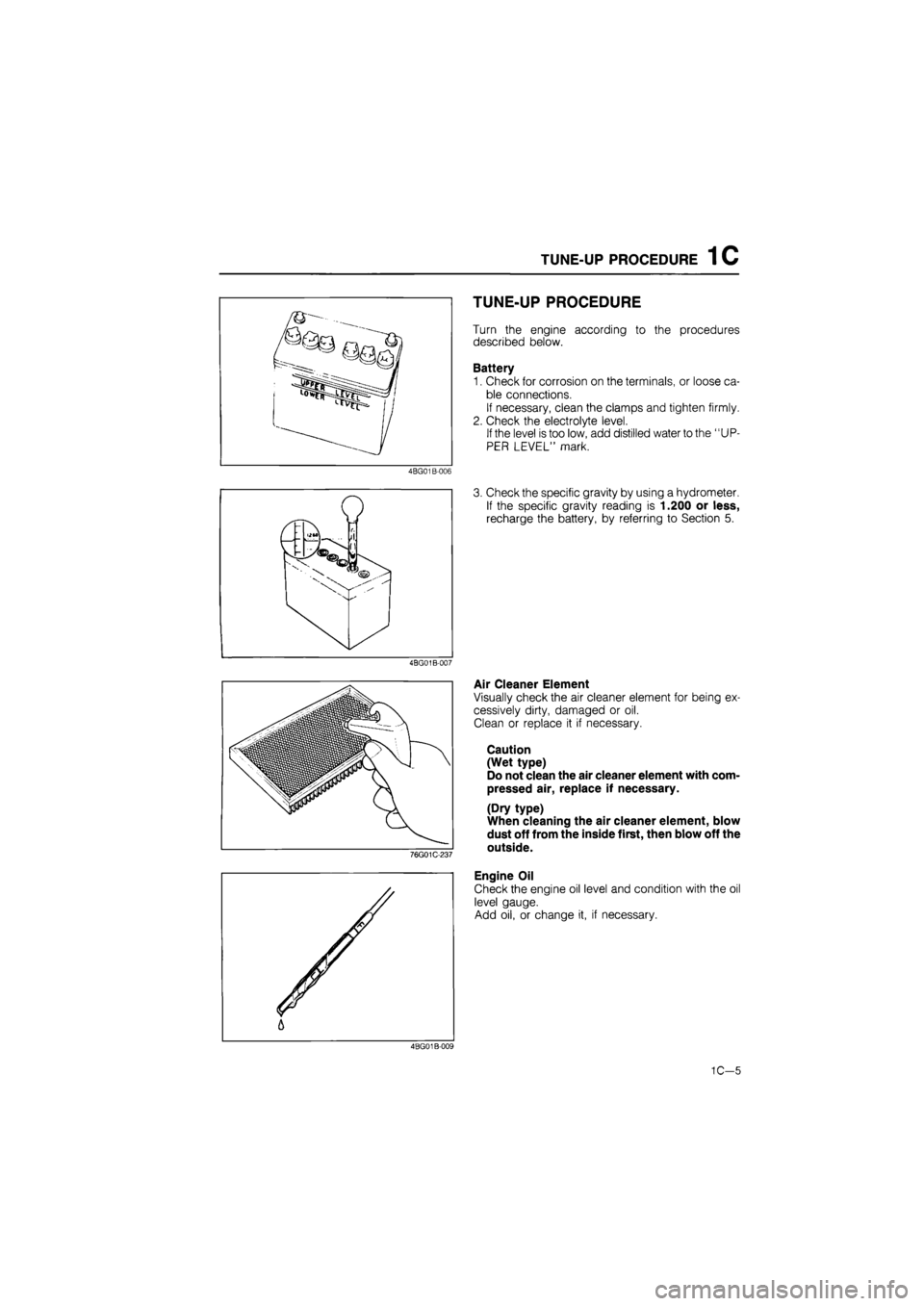
TUNE-UP PROCEDURE 1C
4BG01 B-006
4BG01B-007
76G01C-237
TUNE-UP PROCEDURE
Turn the engine according to the procedures
described below.
Battery
1. Check for corrosion on the terminals, or loose ca-
ble connections.
If necessary, clean the clamps and tighten firmly.
2. Check the electrolyte level.
If the level is too low, add distilled water to the "UP-
PER LEVEL" mark.
3. Check the specific gravity by using a hydrometer.
If the specific gravity reading is 1.200 or less,
recharge the battery, by referring to Section 5.
Air Cleaner Element
Visually check the air cleaner element for being ex-
cessively dirty, damaged or oil.
Clean or replace it if necessary.
Caution
(Wet type)
Do not clean the air cleaner element with com-
pressed air, replace if necessary.
(Dry type)
When cleaning the air cleaner element, blow
dust off from the inside first, then blow off the
outside.
Engine Oil
Check the engine oil level and condition with the oil
level gauge.
Add oil, or change it, if necessary.
4BG01B-009
1C—5
Page 316 of 1865

INSPECTION, ENGINE OIL 2A
86U02X-004
INSPECTION
ENGINE OIL
1. Be sure the vehicle is on level ground.
2. Warm up the engine to normal operating temper-
ature and stop it.
3. Wait for five minutes.
4. Remove the oil level gauge and check the oil lev-
el and condition.
5. Add or replace oil if necessary.
Note
The distance between the L and F marks on
the level gauge represents 1.0 liter (1.06 US
qt, 0.88 Imp qt).
OIL PRESSURE
1. Remove the oil pressure switch.
69G02A-006
76G02A-005
86U02X-006
2. Screw the SST into the pressure switch installa-
tion hole.
3. Warm up the engine to normal operating tem-
perature.
4. Run the engine at 3,000 rpm, and note the gauge
reading.
Oil pressure:
343—441 kPa
(3.5—4.5 kg/cm2, 50—64 psi)...DOHC 2g4 392 kPa
(3.0—4.0 kg/cm2, 43—57 psi)...SOHC
5. If the pressure is not as specified, check for the
cause, and repair if necessary.
(Refer to Troubleshooting Guide.)
ENGINE OIL
REPLACEMENT
1. Warm up the engine to the normal operating tem-
perature and stop it.
2. Remove the oil filler cap and the oil pan drain plug.
3. Drain the oil into a suitable container.
Warning
Be careful when draining, the oil is very hot.
2A-5
Page 329 of 1865

INSPECTION 2B
A
76G02B-006
INSPECTION
ENGINE OIL
1. Be sure the vehicle is on level ground.
2. Warm up the engine to normal operating temper-
ature and stop it.
3. Wait for five minutes.
4. Remove the oil level gauge and check the oil lev-
el and condition.
5. Add or replace oil if necessary.
Note
The distance between the L and F marks on
the level gauge represents 1.2 liters (1.26 US
qt, 1.05 Imp qt).
OIL PRESSURE
1. Disconnect the oil hose (vacuum pump—cylinder
block).
76G02B-007
2. Set the SST as shown.
3. Remove the vacuum pump drive belt to prevent
heat damage to bearing.
4. Warm up the engine to normal operating tem-
perature.
76G02B-008
5. Run the engine first at 1,000 rpm, then at 3,000
rpm and note the gauge reading.
Standard oil pressure kPa (kg/cm2, psi)
1,000 rpm 147-245 (1.5-2.5, 21-36)
3,000
rpm
343—441 (3.5-4.5, 50—64)
6. If the pressure is not as specified, check for the
cause, and repair if necessary.
(Refer to Troubleshooting Guide.)
76G02B-009
2B—5
Page 382 of 1865

TROUBLESHOOTING GUIDE
4A
TROUBLESHOOTING GUIDE
F6 (GENERAL)
The Troubleshooting Guide lists the systems most likely to cause
a
given symptom. After finding the
system(s)
to
check, refer
to
the pages shown
for
detailed guides
for
each system.
\\ POSSIBLE CAUSE
\ PAGE
SYMPTOM
Air
cleaner
(Air
cleaner
element)
intake
air
temperature
control
system
Idle
adjustment
Fuel
system
(Carburetor,
Fuel
pump)
idle-up
control
system
Exhaust
system
Positive
crankcase
ventilation
system
Auto-return
choke
system
\\ POSSIBLE CAUSE
\ PAGE
SYMPTOM 4A—23 4A—60 4A—38 4A—24 4A—68 4A—96 4A—67 4A—40
1 Hard start
or
won't start (Cranks
OK)
1 2
2 Engine stalls During warm
up
3 2 1 4
2 Engine stalls After warm
up
4 2 5 1 3
3 Rough Idle During warm
up
3 2 1 4
3 Rough Idle After warm
up
3 2 5 1 4
4 High idle speed after warm
up
1 3 2
5 Poor acceleration, hesitation, or lack
of
power
1 2 3
6 Runs rough
on
deceleration
1
7 Afterburn
in
exhaust system
1
8 Poor fuel consumption
2 1 4 3
9 Fails emission test
2 1 4 5 3
76G04A-015
The numbers of the list show the priorities
of
inspections from the most possible to that with the lowest
possibility.
These were determined
on
the following basis:
• Ease
of
inspection
•
Most possible system
•
Most Possible point
in
system
TROUBLESHOOTING PROCEDURE:
1st Check the following items:
Electrical system
1) Battery condition
2) Fuses
Ignition system
1) Spark plugs
2) Ignition timing
Fuel system
1) Fuel level
2) Fuel leakage
3) Fuel filter
4) Idle speed
Intake
air
system
1) Vacuum
or air
leakage
2) Vacuum hose routing
3) Accelerator cable
4) Choke cable
2nd Check Fuel and Emission Control Systems
Engine
1) Compression
2) Overheating
Others
1) Clutch slippage
2) Brake dragging
4 A-17
Page 383 of 1865

4A TROUBLESHOOTING GUIDE
F6 (SINGAPORE)
The Troubleshooting Guide lists the systems most likely
to
cause
a
given symptom. After finding
the
system(s)
to
check, refer
to the
pages shown
for
detailed guides
for
each system.
POSSIBLE CAUSE
\ PAGE
SYMPTOM
Air
cleaner
(Air
cleaner
element)
Intake
air
temperature
control
system
Idle
adjustment
Fuel
system
(Carburetor,
Fuel
pump)
Air
injection
system
Deceleration
control
system
Positive
crankcase
ventilation
system
Exhaust
system
Idle-up
control
system
POSSIBLE CAUSE
\ PAGE
SYMPTOM 4A-23 4A-60 4 A—38 4A—24 4A-58 4A-45 4A-67 4A-SW 4A—68
1 Hard start
or
won't start (Cranks
OK)
1 2
2 Engine stalls During warm
up
3 2 1 4
2 Engine stalls After warm
up
3 2 4 1
3 Rough idle During warm
up
3 2 1 4
3 Rough idle After warm
up
3 2 4 1
4 High idle speed after warm
up
1 4 3* 2
5 Poor acceleration, hesitation,
or
lack
of
power
1 2 3
6 Runs rouah
on
deceleration
2 1
7 Afterburn
in
exhaust svstem
2 1
8 Poor fuel consumption
2 1 4 3
9 Fails emission test
6 4 5 3 2 1
Only MTX
76G04A-016
The numbers
of
the list show the priorities
of
inspections from the most possible to that with the lowest
possibility.
These were determined
on the
following basis:
• Ease
of
inspection
•
Most possible system
•
Most possible point
in
system
TROUBLESHOOTING PROCEDURE:
1st Check
the
following items:
Electrical system
1) Battery condition
2) Fuses
Ignition system
1) Spark plugs
2) Ignition timing
Fuel system
1) Fuel level
2) Fuel leakage
3) Fuel filter
4) Idle speed
Intake
air
system
1) Vacuum
or air
leakage
2) Vacuum hose routing
3) Accelerator cable
Engine
1) Compression
2) Overheating
Others
1) Clutch slippage
2) Brake dragging
2nd Check
the
Fuel
and
Emission Control Systems
4A—18
Page 384 of 1865

TROUBLESHOOTING GUIDE
4A
FE
12
VALVE and
F8
(EXCEPT MIDDLE EAST and GENERAL)
The Troubleshooting Guide lists the systems most likely to cause
a
given symptom. After finding
the
system(s)
to
check, refer
to
the pages shown
for
detailed guides
for
each system.
POSSIBLE CAUSE
\ PAGE
SYMPTOM
Air
cleaner
(Air
cleaner
element)
Intake
air
temperature
control
system
Idle
adjustment
Fuel
system
(Carburetor,
Fuel
pump)
PTC
heater
system
Air
injection
system
Positive
crankcase
ventilation
system
Deceleration
control
system
Idle-up
control
system
Ignition
control
system
POSSIBLE CAUSE
\ PAGE
SYMPTOM
4A-23 4A-60 4A-38 4A-24 4A-42 4A-58 4A-67 4A—45 4A—68 4 A—80
1 Hard start
or
won't start
(Cranks
OK)
1 2
2 Engine stalls During warm
up
5 4 1 6 2 3
2 Engine stalls After warm
up
3 2 4 1
3 Rough idle During warm
up
5 4 1 6 2 3
3 Rough idle After warm
up
3 2 4 1
4 High idle speed after warm
up
1 4 3 2
5 Poor acceleration, hesitation, or lack
of
power
1 4 2 3
6 Runs rough
on
deceleration
2 1
7 Afterburn
in
exhaust system
2 1
8 Poor fuel consumption
3 1 4 2
4
9 Fails emission test
6 2 5 3 1 4
76G04A-017
The numbers of the list show the priorities
of
inspections from the most possible to that with the lowest
possibility.
These were determined
on the
following basis:
• Ease
of
inspection
•
Most possible system
•
Most possible point
in
system
TROUBLESHOOTING PROCEDURE:
1st Check the following items:
Electrical system
1) Battery condition
2) Fuses
Ignition system
1) Spark plugs
2) Ignition timing
Fuel system
1) Fuel level
2) Fuel leakage
3) Fuel filter
4) Idle speed
Intake
air
system
1) Vacuum
or air
leakage
2) Vacuum hose routing
3) Accelerator cable
Engine
1) Compression
2) Overheating
Others
1) Clutch slippage
2) Brake dragging
2nd Check the Fuel
and
Emission Control Systems
4A—19
Page 385 of 1865

4A TROUBLESHOOTING GUIDE
FE and F8 (GENERAL)
The Troubleshooting Guide lists the systems most likely to cause a given symptom. After finding the
system(s) to check, refer to the pages shown for detailed guides for each system.
POSSIBLE CAUSE
\ PAGE
SYMPTOM
Air
cleaner
(Air
cleaner
element)
Intake
air
temperature
control
system
Idle
adjustment
Fuel
system
(Carburetor,
Fuel
pump)
Idle-up
control
system
PTC
heater
system
Positive
crankcase
ventilation
system
Deceleration
control
system
POSSIBLE CAUSE
\ PAGE
SYMPTOM 4A-23 4A—60 4A—38 4A—24 4A—68 4A—42 4A—67 4A—45
1 Hard start or won't start (Cranks OK) 1 2
2 Engine stalls During warm up 5 4 1 6 2 3 2 Engine stalls After warm up 3 2 4 1
3 Rough idle During warm up 5 4 1 6 2 3 3 Rough idle After warm up 3 2 4 1
4 High idle speed after warm up 1 4 2 3
5 Poor acceleration, hesitation, or lack of power 1 4 3 2
6 Runs rough on deceleration 2 1
7 Afterburn in exhaust system 2 1
8 Poor fuel consumption 2 1 3
9 Fails emission test 3 2 4 1
76G04A-018
The numbers of the list show the priorities of inspections from the most possible to that with the lowest
possibility.
These were determined on the following basis:
Ease of inspection Most possible system Most possible point in system
TROUBLESHOOTING PROCEDURE:
1st Check the following items:
Electrical system
1) Battery condition
2) Fuses
Ignition system
1) Spark plugs
2) Ignition timing
Fuel system
1) Fuel level
2) Fuel leakage
3) Fuel filter
4) Idle speed
Intake air system
1) Vacuum or air leakage
2) Vacuum hose routing
3) Accelerator cable
Engine
1) Compression
2) Overheating
Others
1) Clutch slippage
2) Brake dragging
2nd Check the Fuel and Emission Control Systems
4A—20
Page 386 of 1865

TROUBLESHOOTING GUIDE 4A
FE (MIDDLE EAST)
The Troubleshooting Guide lists the systems most likely to cause a given symptom. After finding the
system(s) to check, refer to pages shown for detailed guides for each system.
V. POSSIBLE CAUSE
\ PAGE
SYMPTOM
I
Air
cleaner
(Air
cleaner
element)
Intake
air
temperature
control
system
Idle
adjustment
Fuel
system
(Carburetor,
Fuel
pump)
Idle-up
control
system
Dashpot
(Only
MTX)
Positive
crankcase
ventilation
system
Exhaust
system
Evaporative
emission
control
system
Auto-return
choke
system
V. POSSIBLE CAUSE
\ PAGE
SYMPTOM 4A—23 4A-60 4 A—38 4A-24 4A-68 4A-50 4A-67 4A-96 4A-78 4A-40
1 Hard start or won't start
(Cranks OK) 1 2 3
2 Engine stalls During warm up 3 2 1 4 2 Engine stalls After warm up 3 2 4 1
3 Rough idle During warm up 3 2 1 4 3 Rough idle After warm up 3 2 4 1
4 High idle speed after warm up 1 5 3 4 2
5 Poor acceleration, hesitation, or lack of power 1 2 3
6 Runs rough on deceleration 2 1
7 Afterburn in exhaust system 3 1 2
8 Poor fuel consumption 5 1 6 2 3 4
9 Falls emission test 5 4 6 3 1 2
76G04A-019
The numbers of the list show the priorities of inspections from the most possible to that with the lowest
possibility.
These were determined on the following basis:
• Ease of inspection • Most possible system • Most possible point in system
TROUBLESHOOTING PROCEDURE:
1st Check the following items:
Electrical system
1) Battery condition
2) Fuses
Ignition system
1) Spark plugs
2) Ignition timing
Fuel system
1) Fuel level
2) Fuel leakage
3) Fuel filter
4) Idle speed
Intake air system
1) Vacuum or air leakage
2) Vacuum hose routing
3) Accelerator cable
4) Choke cable
Engine
1) Compression
2) Overheating
Others
1) Clutch slippage
2) Brake dragging
2nd Check the Fuel and Emission Control Systems
4 A—21
Page 387 of 1865

4A TROUBLESHOOTING GUIDE
FE 8VALVE—UNLEADED FUEL
The Troubleshooting Guide lists the systems most likely to cause a given symptom. After finding the
system(s) to check, refer to the pages shown for detailed guides for each system.
V POSSIBLE CAUSE
\ PAGE
SYMPTOM
Air
cleaner
(Air
cleaner
element)
Idle
adjustment
Fuel
system
(Carburetor,
Fuel
pump)
PTC
heater
system
Air
injection
system
Positive
crankcase
ventilation
system
Deceleration
control
system
Exhaust
gas
recirculation
(EGR)
system
Exhaust
system
Intake
air
temperature
control
system
Idle-up
control
system
Purge
control
system
Auto-return
choke
system
V POSSIBLE CAUSE
\ PAGE
SYMPTOM 4A-23 4A-38 4A-24 4A—42 4A-58 4A—67 4A—45 4A-96 4A-97 4A—60 4A—68 4A--63 4A—40
1 Hard start or won't start
(Cranks OK) 1 2
2 Engine stalls During warm up 6 1 2 5 3 4 2 Engine stalls After warm up 4 2 3 1
3 Rough Idle During warm up 5 1 2 4 3 6 3 Rough Idle After warm up 4 2 3 1
4 High idle speed after warm up 1 5 4 3 2
5 Poor acceleration, hesitation, or lack of power 1 2 5 3 4
6 Runs rough on deceleratio 2 1
7 Afterburn in exhaust system 2 1
8 Poor fuel consumption 4 1 2 3 5
9 Fails emission test 5 1 6 4 3 2
76G04A-020
The numbers of the list show the priorities of inspections from the most possible to that with the lowest
possibility.
These were determined on the following basis:
• Ease of inspection • Most possible system • Most possible point in system
TROUBLESHOOTING PROCEDURE:
1st Check the following items:
Electrical system
1) Battery condition
2) Fuses
Intake air system
1) Vacuum or air leakage
2) Vacuum hose routing
3) Accelerator cable
4) Choke cable
2nd Check the Fuel and Emission Control Systems
Ignition system
1) Spark plugs
2) Ignition timing
Engine
1) Compression
2) Overheating
Fuel system
1) Fuel level
2) Fuel leakage
3) Fuel filter
4) Idle speed
Others
1) Clutch slippage
2) Brake dragging
4A-22
Page 403 of 1865
4A
IDLE
SPEED AND
IDLE
MIXTURE
76G04A-059
76G04A-060
76G04A-061
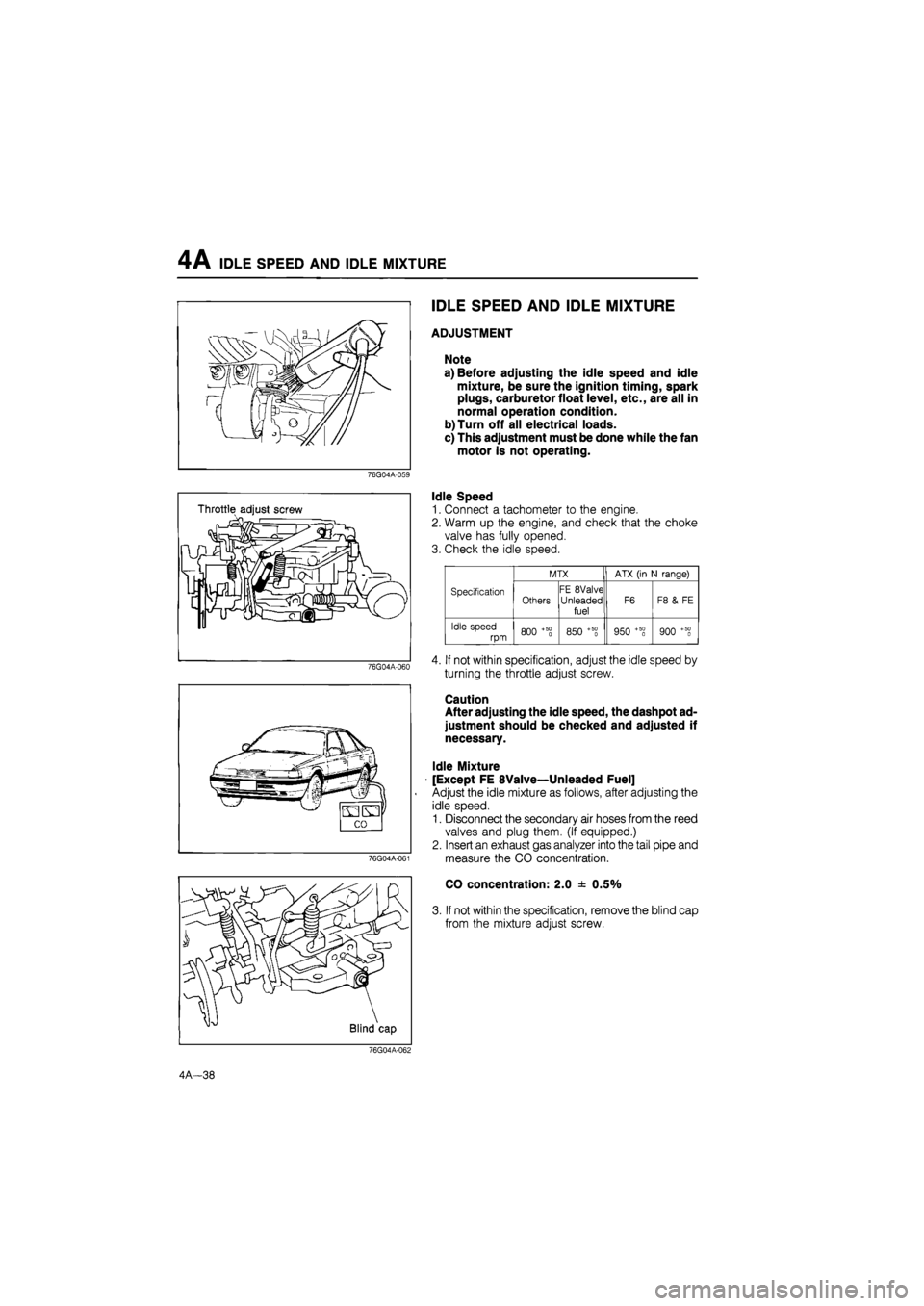
IDLE
SPEED AND IDLE MIXTURE
ADJUSTMENT
Note
a) Before adjusting the idle speed and idle
mixture, be sure the ignition timing, spark
plugs, carburetor float level, etc., are all in
normal operation condition.
b)Turn off all electrical loads.
c) This adjustment must be done while the fan
motor is not operating.
Idle Speed
1. Connect a tachometer to the engine.
2. Warm up the engine, and check that the choke
valve has fully opened.
3. Check the idle speed.
Specification
MTX ATX (in N range)
Specification Others
FE 8Valve Unleaded fuel F6 F8 & FE
Idle speed rpm 800 +6S 850 +5S 950 +5o° 900 +5§
4. If not within specification, adjust the idle speed by
turning the throttle adjust screw.
Caution
After adjusting the idle speed, the dashpot ad-
justment should be checked and adjusted if
necessary.
Idle Mixture
[Except FE 8Valve—Unleaded Fuel]
Adjust the idle mixture as follows, after adjusting the
idle speed.
1. Disconnect the secondary air hoses from the reed
valves and plug them. (If equipped.)
2. Insert an exhaust gas analyzer into the tail pipe and
measure the CO concentration.
CO concentration: 2.0 ± 0.5%
3. If not within the specification, remove the blind cap
from the mixture adjust screw.
76G04A-062
4A—38