fuel pressure MAZDA 626 1987 Manual PDF
[x] Cancel search | Manufacturer: MAZDA, Model Year: 1987, Model line: 626, Model: MAZDA 626 1987Pages: 1865, PDF Size: 94.35 MB
Page 656 of 1865
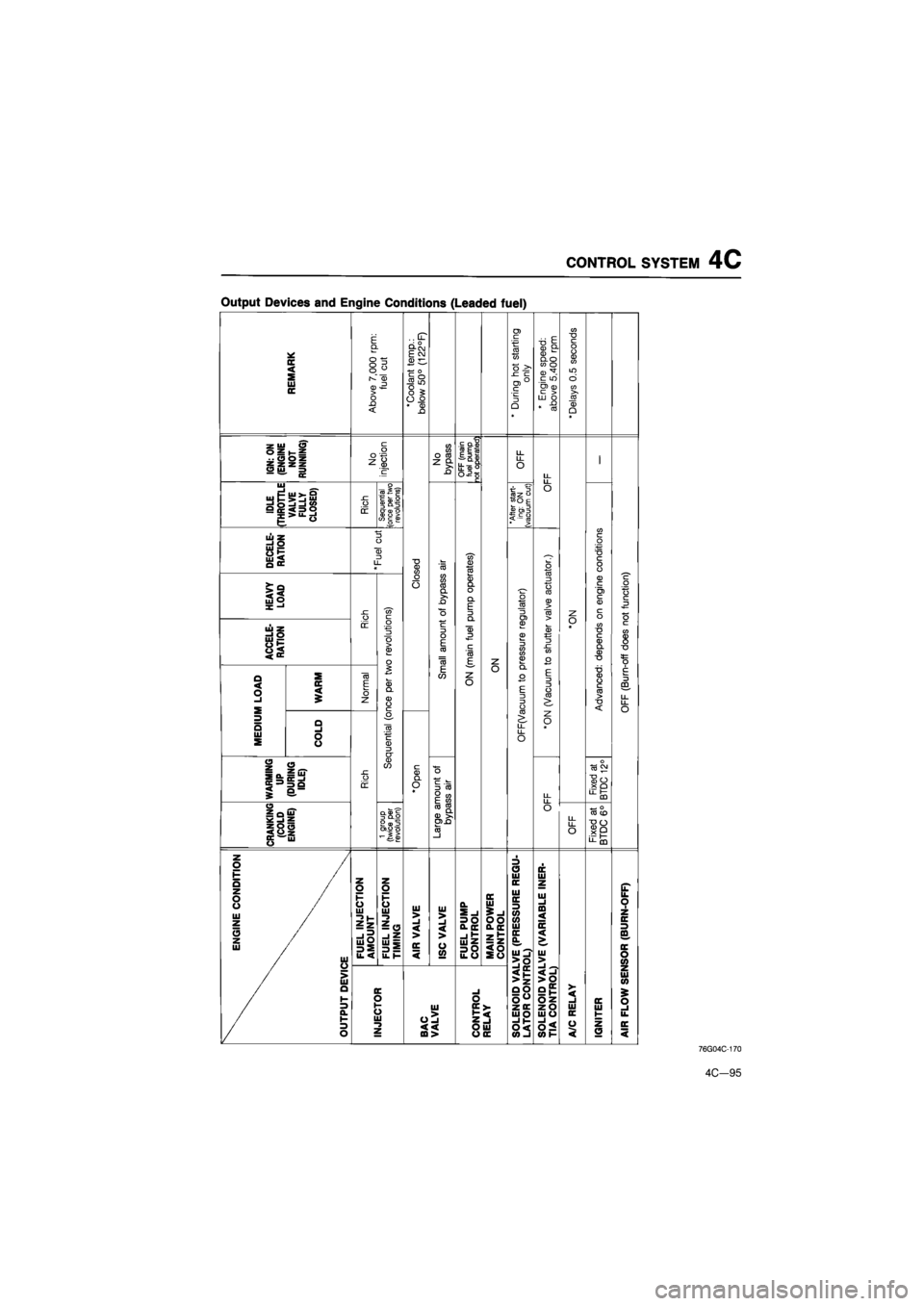
CONTROL SYSTEM
4C
Output Devices
and
Engine Conditions (Leaded fuel)
REMARK
E Q
O O O r-»" CD > o n <
fuel
cut
'Coolant
temp.:
below
50°
(122°F)
*
During
hot
starting
only
*
Engine
speed:
above
5,400
rpm
'Delays
0.5
seconds
IGN:
ON
(ENGINE
I
NOT
RUNNING)
o
z
injection
No
bypass
OFF
(main
fuel
pump
not
operated)
OFF
LL
I
IDLE
(THROTTLE
VALVE
FULLY
CLOSED)
Rich
I
Sequential (once
per
two
revolutions)
"After
start-
ing:
ON
(vacuum
cut)
O
DECELE-
RATION
i
i
'Fuel
cut
•o CD CO "co" CD ts o to 3 o CO CD > CO
CO c o
c o o
HEAVY
LOAD
sz "co" c
O o CO CO CO Q. >. -O
O
CD Q. O CL E CL ® D
C CO F
o 08 3 u> £ CD 3 CO 0) CD
o to 3 o CO CD > CO
z
B
ACCELE-RATION
ir o 3 0 > CD 1 O
C
O E CO
"CO
CD Q. O CL E CL ® D
C CO F
z
o 08 3 u> £ CD 3 CO 0) CD
CD e 3 SZ CO o
O * CO
c CD CL CD T3
c CO 8 "D
'
MEDIUM
LOAD
WARM
Normal
CD Q. CD O
E CO
z
O
o o_ O
E
3 3
o CO ^ LL LL O
E 3 3 O CO
•o
c
3
m
LL LL o
'
MEDIUM
LOAD
COLD
.H C CD 3 CT
o_ O
E
3 3
o CO ^ LL LL O
z
o *
WARMING
UP
(DURING
IDLE)
Rich
CD CO
*Open
B
3
CO
O
CO
E
<®
LL
Fixed
at
BTDC
12°
CRANKING
(COLD
ENGINE)
1
group
(twice
per
revolution)
CO
«
0)
>,
u>n w-CO
o
OFF
Fixed
at
BTDC
6°
ENGINE
CONDITION
OUTPUT
DEVICE
FUEL
INJECTION
AMOUNT
'
FUEL
INJECTION
TIMING
AIR
VALVE
ISC
VALVE
FUEL
PUMP
CONTROL MAIN
POWER
CONTROL
SOLENOID
VALVE
(PRESSURE
REGU-
LATOR
CONTROL)
SOLENOID
VALVE
(VARIABLE
INER-
TIA
CONTROL)
(T ik 0 1 z DC 3
ffl
OC o tn
OUTPUT
DEVICE
INJECTOR
BAC
VALVE
CONTROL
RELAY
SOLENOID
VALVE
(PRESSURE
REGU-
LATOR
CONTROL)
SOLENOID
VALVE
(VARIABLE
INER-
TIA
CONTROL)
A/C
RELAY
IGNITER
Z Ul tn
£ o
ik DC <
76G04C-170
4C—95
Page 660 of 1865

CONTROL SYSTEM 4C
Terminal Voltage
If the input and output devices wiring are normal, but the engine control unit terminal voltage is incor-
rect, replace the engine control unit.
Terminal Input Output Connection to Voltage (After warming-up) Remark Terminal Input Output Connection to Ign: ON Idle Remark
1A — — — — — —
1B o Self-Diagnosis Checker (Code No.)
For 3sec. after ignition switch OFF ->• ON: below 2.5V (Buzzer sounds) After 3sec.: approx. 12V (Buzzer does not sound)
• Using Self-Diagnosis Check-er and test con-nector grounded • Buzzer sounds: below 2.5V • Buzzer does not sound: approx. 12V
1C o
Solenoid valve (Variable inertia control) Approx. 12V
Above 5200 rpm (Unleaded fuel) or 5400 rpm (Leaded fuel): Below 2.5V
1D o Self-Diagnosis Checker (Monitor lamp)
For 3sec.after igni-tion switch OFF -» ON:
approx. 5V (light il-luminates)
After 3sec.: approx. 12V (light does not illuminate)
(Test connector grounded) approx. 5V (Test connector not grounded) Monitor lamp ON: approx. 5V Monitor lamp OFF: approx. 12V
With Self-Diagnosis
Checker
1E O Idle switch Accelerator pedal released: OV
Accelerator pedal depressed: approx. 12V
1F o A/C relay A/C switch ON: below 2.5V
A/C switch OFF: approx. 12V Blower motor ON
1G O Neutral or clutch switch
In-gear condition Clutch pedal depressed: approx. 12V Clutch pedal released: OV
MTX (Neutral: con-stant approx. 12V)
1H
(U/F) o Water thermo
switch
Approx. 12V Radiator temp.: be-low 17°C (63°R 1H
(U/F) o Water thermo
switch OV Radiator temp.:
above 17°C (63°F)
11 o Electrical load control unit E/L switch ON: below 2.5V
E/L switch OFF: approx. 10—12V
Electrical load: Rear defroster switch
Headlight switch Blower motor switch (3rd & 4th position) Electrical fan switch
1J — — — — —
1K o P/S pressure
switch
Constant approx.
12V
P/S ON: below 2.5V P/S OFF: approx. 12V
1L o A/C switch A/C switch ON: below 2.5V A/C switch OFF: aDDrox. 12V Blower motor: ON
1M o Distributor
(Ne signal) OV or 5V Approx. 2.0V
1N o Distributor (G signal) OV or 5V Approx. 1.2V
Note
Terminals labeled "U/F" are only for unleaded fuel.
4C-99
Page 661 of 1865
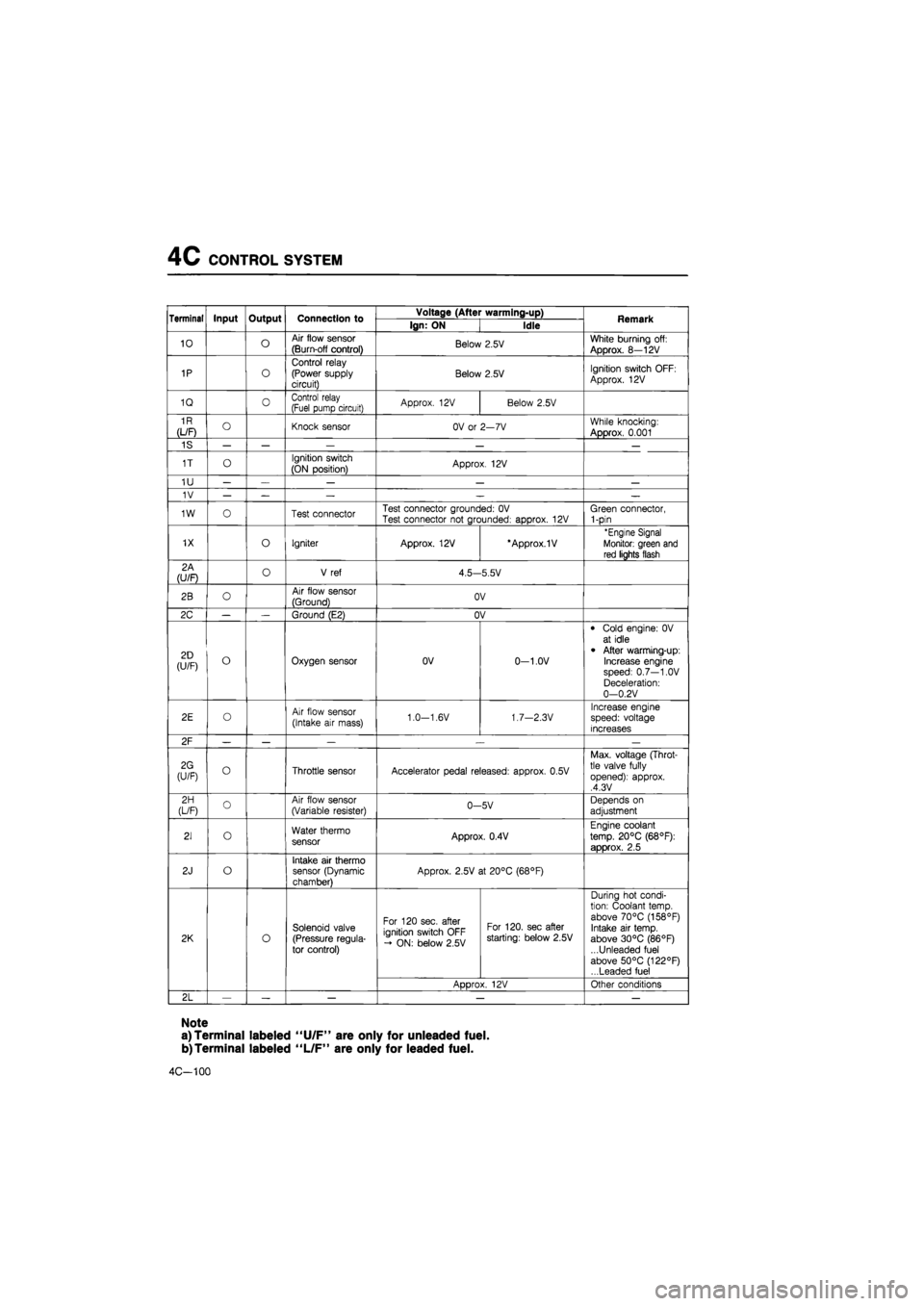
4C CONTROL SYSTEM
Terminal Input Output Connection to Voltage (After warming-up) Remark Terminal Input Output Connection to Ign: ON Idle Remark
10 o Air flow sensor
(Burn-off control) Below 2.5V White burning off:
Approx. 8—12V
1P o
Control relay (Power supply circuit) Below 2.5V Ignition switch OFF:
Approx. 12V
1Q 0 Control relay (Fuel pump circuit) Approx. 12V Below 2.5V
1R
(L/F) O Knock sensor OV or 2—7V While knocking:
Approx. 0.001
1S — — — — —
1T o Ignition switch
(ON position) Approx. 12V
1U — — — — —
1V — — — — —
1W o Test connector Test connector grounded: OV Test connector not grounded: approx. 12V Green connector, 1-pin
1X o Igniter Approx. 12V *Approx.1V 'Engine Signal
Monitor: green and
red lights flash
2A (U/F) o V ref 4.5—5.5V
2B o Air flow sensor
(Ground) OV
2C — — Ground (E2) OV
2D (U/F) o Oxygen sensor OV 0-1.0V
• Cold engine: 0V at idle
• After warming-up: Increase engine speed: 0.7—1.0V Deceleration: 0—0.2V
2E o Air flow sensor
(Intake air mass) 1.0—1.6V 1.7—2.3V Increase engine speed: voltage increases
2F — — — .— —
2G (U/F) o Throttle sensor Accelerator pedal released: approx. 0.5V
Max. voltage (Throt-tle valve fully opened): approx. ,4.3V
2H (L/F) o Air flow sensor (Variable resister) 0-5V Depends on
adjustment
21 o Water thermo sensor Approx. 0.4V
Engine coolant
temp. 20°C (68°F):
approx. 2.5
2J o Intake air thermo sensor (Dynamic chamber)
Approx. 2.5V at 20°C (68°F)
2K o
Solenoid valve (Pressure regula-tor control)
For 120 sec. after ignition switch OFF - ON: below 2.5V
For 120. sec after starting: below 2.5V
During hot condi-tion: Coolant temp, above 70°C (158°F) Intake air temp, above 30°C (86°F) ...Unleaded fuel above 50°C (122°F) ...Leaded fuel
2K o
Solenoid valve (Pressure regula-tor control)
ADDrox. 12V Other conditions
2L — — — — —
Note
a) Terminal labeled "U/F" are only for unleaded fuel.
b)Terminal labeled "L/F" are only for leaded fuel.
4C-100
Page 673 of 1865

4D OUTLINE
OUTLINE
The Mazda 626 offers two diesel engines; a Comprex supercharged RF-CX engine, and a normally
aspirated RF-N engine.
SPECIFICATIONS
—Engine model
Item ———
ECE UK, GENERAL —Engine model
Item ——— RF-CX RF-N
Fuel tank Capacity liters (US gal, Imp gal) 60 (15.9, 13.2)
Fuel filter Type Cartridge, paper element
Sedimenter Type With detector
Injection pump
Type Bosch VE distributor
Injection pump
Manufacturer Diesel Kiki Co,, Ltd.
Injection pump
Direction of rotation Clockwise Injection pump
Drive method Timing belt
Injection pump
Plunger diameter mm (in) 9.0 (0.35) 8.0 (0.31)
Injection pump
Cam lift mm (in) 2.2 (0.087)
Injection nozzle Type Throttle Injection nozzle
Injection pressure kPa (kg/cm2, psi) 13,240 (135 , 1,920)
Injection timing ATDC
1
° TDC 0°
Idle speed rpm 720 _+f0
Fast idle speed (A/C ON) rpm 700-750
Cold start device Engine speed rpm 1.100 Cold start device
Advance degree 6°
Air cleaner Type Cartridge, paper element Air cleaner Type
Wet Dry
PCV system Type Open Closed
76G04D-002
4D—2
Page 674 of 1865

TROUBLESHOOTING GUIDE 4D
TROUBLESHOOTING GUIDE
Condition Condition Cause Remedy
Hard starting Fuel filter
Clogged Replace
Water or air in filter Repair
Fuel injection pump Faulty fuel cut solenoid Replace Incorrect injection timing Adjust
Air in pump Bleed
Faulty pump Replace
Fuel injection nozzle Seized needle valve Replace
Fuel dripping from nozzle Replace Incorrect valve opening pressure Adjust
Faulty glow plug Replace
Faulty cold start device Adjust or replace
Faulty supercharging system Refer to page 4D—10
Rough idle Fuel filter (Refer to "Hard starting") Fuel injection pump (Refer to "Hard starting")
Fuel injection nozzle
Seized needle valve Replace
Incorrect valve opening pressure Adjust
Improper mounting to nozzle holder Repair
Leakage of nozzle holder copper washer Replace
Fuel injection pipe Cranks Replace
Leaking from joint Repair
Improper idle speed adjustment Adjust
Engine knocking Incorrect injection timing Adjust
Low quality fuel Replace
Incorrect injection nozzle opening pressure Ajust
Seized injection nozzle needle valve Replace
Fuel dripping from injection nozzle Replace
Faulty supercharging system Refer to page 4D—10
High fuel Fuel injection pump consumption Incorrect injection timing Adjust consumption High idle speed Adjust, Inspect the dashpot
Fuel injection nozzle Incorrect valve opening pressure Repair
Fuel dripping from nozzle Replace
Leakage of nozzle holder copper washer Replace
Fuel leaking from connection Repair
Clogged fuel filter Replace
Clogged air cleaner Replace
Poor acceleration Fuel injection nozzle (Refer to "Hard starting")
Fuel injection pump (Refer to "Hard starting")
Fuel injection pipe (Refer to "Rough idle") Fuel filter (Refer to "Hard starting") Clogged air cleaner Clean or replace
Faulty supercharging system Refer to page 4D—10
Excessive exhaust Clogged air cleaner Clean or replace
smoke Improper injection timig Adjust
Faulty nozzle or nozzle holder Adjust or replace
Faulty supercharging system Refer to page 4D—10
76G04D-003
4D-3
Page 682 of 1865

4D SUPERCHARGING SYSTEM (RF-CX)
ON-VEHICLE INSPECTION
Boost Pressure
1. Connect a pressure gauge to the hose from the
intake manifold.
2. (On chassis dynomometer, full load)
(1) Set the vehicle on a chassis dynomometer.
(2) Run the vehicle in gear at 3,000 rpm with the
acceleration pedal fully depressed.
(3) Measure the boost pressure.
Boost pressure:
82 kPa (0.87 kg/cm2, 8.1 psi)
Note
The above inspection should be done on a
chassis dynomometer. If a dynomometer is
not available follow the below procedure.
3. (Off chassis dynomometer, no load)
(1) Shift the transaxle out off gear.
(2) Run the engine in neutral at 3,000 rpm of the
engine no load.
Measure the boost pressure.
Boost pressure:
5 kPa (0.05 kg/cm2, 0.7 psi)
Note
The boost pressure is varied by engine speed
and engine load.
(3) Remove the starting valve bypass hose.
(4) Check that the bypass valve is closed at 3,000
rpm.
4.
If
the pressure is below specification, check the fol-
lowing. Replace the Comprex supercharger if
necessary.
(1) Intake air and exhaust passages leakage
(2) Intake air and exhaust passages clogged
(3) Wastegate (Refer to 4D—12.)
(4) Starting valve (Refer to 4D—15.)
(5) Fuel system (Injection nozzle... refer to page
4D—31, injection pump...refer to page 4D—24,
etc.)
5. If the pressure exceeds specification, check the
wastegate operation. (Refer to page 4D—12.)
4D—11
Page 700 of 1865
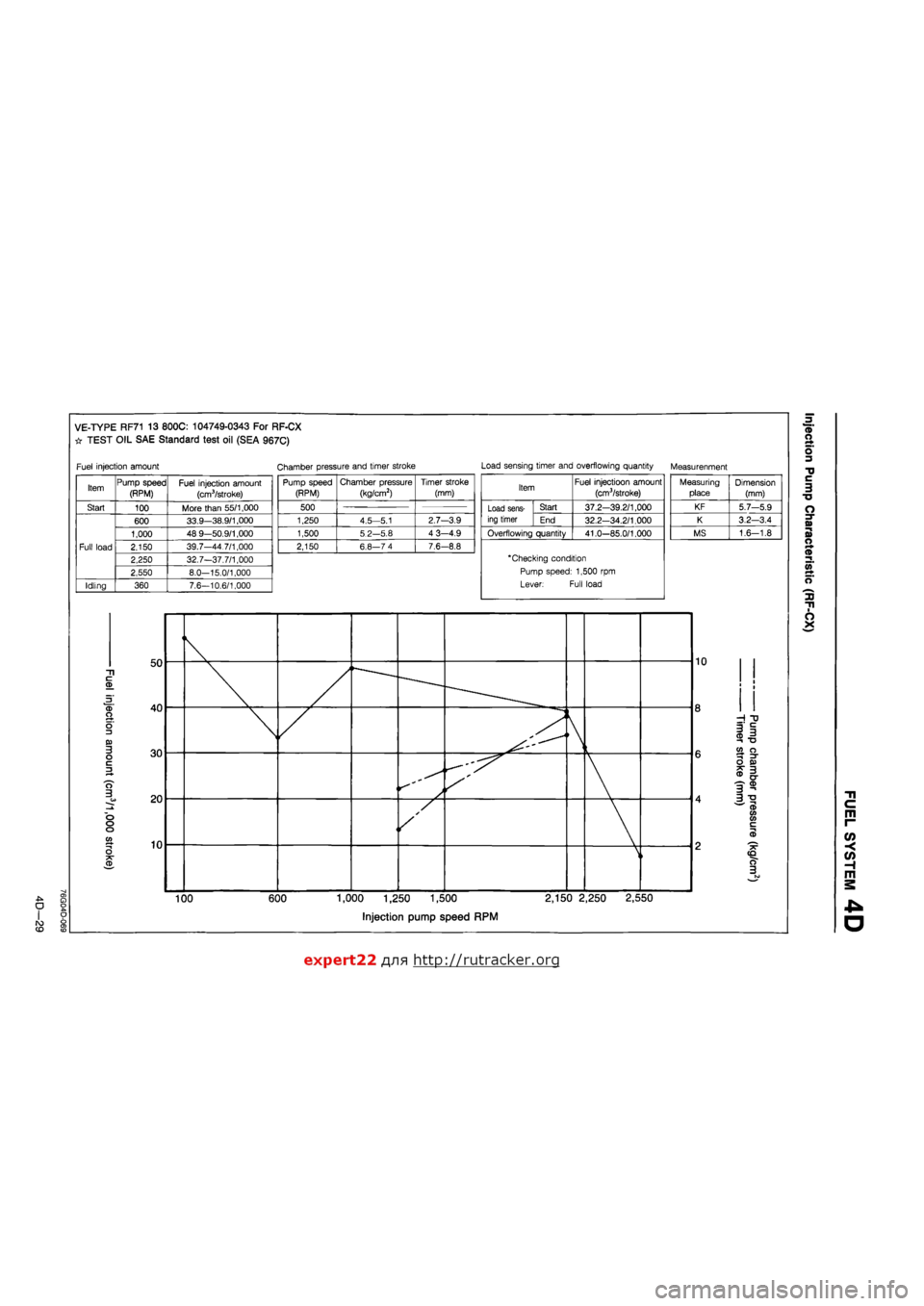
VE-TYPE RF71 13 800C: 104749-0343 For RF-CX
# TEST OIL SAE Standard test oil (SEA 967C)
Fuel injection amount Chamber pressure and timer stroke Load sensing timer and overflowing quantity Measurenment
Item Pump speed (RPM) Fuel injection amount
(cm3/stroke)
Start 100 More than 55/1,000
Full load
600 33.9—38.9/1,000
Full load
1,000 48 9—50.9/1,000
Full load 2,150 39.7—44 7/1,000 Full load
2,250 32.7-37.7/1,000
Full load
2,550 8.0—15.0/1,000
Idling 360 7.6—10.6/1,000
c CD
CD O
o 3 03 3 o c 3
O 3
o o o
o
CD
O
CD
50
40
30
20
10
Pump speed (RPM) Chamber pressure
(kg/cm2)
Timer stroke (mm)
500 500
1,250 4.5—5.1 2.7—3.9
1,500 5.2—5.8 4 3-4.9
2,150 6.8—7 4 7.6-8.8
Item Fuel injectioon amount
(cm3/stroke)
Load sens-ing timer
Start 37.2-39.2/1,000 Load sens-ing timer End 32.2-34.2/1.000
Overflowing quantity 41.0—85.0/1.000
"Checking condition
Pump speed: 1,500 rpm
Lever: Full load
Measuring place Dimension (mm)
KF 5.7—5.9
K 3.2—3.4
MS 1.6-1.8
/ J*
—
s
100 600 1,000 1,250 1,500
Injection pump speed RPM
10
2,150 2,250 2,550
CD
-I "0
i| T3 co o ^ =T O 03 3 cr
3? 3 ^ CD V) CO c CD
CD O r+ o 3
•D C 3 TJ
o
n> -i a> o r* ®
a> ^
o
3) n
O X
m r-
o> -<
(/> H m
D
expert22 ajia http://rutracker.org
Page 701 of 1865

o
GO o
VE-TYPE RF79 13 800A: 104748-0343 For RF-N ENGINE
£ TEST OIL SAE Standard test oil (SEA 967C)
Fuel injection amount Chamber pressure and timer stroke Load sensing timer and overflowing quantity Measurenment
Item Pump speed (RPM)
Fuel injection amount
(cm3/stroke)
Start 100 More than 42/1,000
Full load
600 29.0—33.0/1,000
Full load
1.375 34.9—36.9/1,000
Full load 2,325 30 2—34.2/1,000 Full load
2,600 9.8—15 8/1,000
Full load
2,700 Max. 6 0/1,000
Idling 360 8-12/1,000
Pump speed (RPM) Chamber pressure
(kg/cm2)
Timer stroke
(mm)
600 2 2—2.8
1,375 4 4—5,0 3 9—4.5
1,800 5 6—6.2 6.1-7.3
2.325 6.9—7.5 7.2—8.4
Item Fuel injectioon amount
(cm3/stroke)
Load sens- Start 26.7-29.7/1,000
ing timer End 14.6—17.6/1,000
Overflowing quantity 46.3—90.3/1.000
'Checking condition
Pump speed: 1,375 rpm
Lever: Full load
Measuring place Dimension (mm)
KF 5.8—5.9
K 3.2—3 4
MS 1.4—1.6
c
o'
3 03 3 o c 3
O 3
o o o
o
CD
50
40
30
20
10
r
10
100 600
o o
1,375 1,800
Injection pump speed RPM
2,325 2,600 2,700
H -D
u -1 T3 52. ° ? T1
CD (0 (A c ®
"3? CD o" 3
(D O r* o 3
u C 3 "O
O 3" 0) ^ 0> o CO
a o
3 •n
m i-
co •<
(/> H m
Page 703 of 1865

4D FUEL SYSTEM
Inspection
Injection starting pressure
1. Set the nozzle on the nozzle tester.
2. Bleed the air by pumping the nozzle tester handle
several times.
3. Slowly lower the nozzle tester handle and check
the pressure when injection starts.
Injection starting pressure:
13,200 kPa (135 kg/cm2, 1,920 lb/in2) at
20°C (36°F) of fuel temperature
76G04D-073
Adjusting shim
4. If the injection starting pressure is higher than
specification, increase the shim thickness. If the in-
jection starting pressure is lower than specification,
decrease the shim thickness.
Note
Adjusting shims are availabe in 0.05 mm
(0.0197 in) thicknesses, from 1.0 mm (0.039
in) to 1.95 mm (0.077 in). When 0.05 mm
(0.0197 in) is added, injection pressure in-
creases approx. 490 kPa (5.0 kg/cm2, 70 psi).
76G04D-074
Nozzle leakage
1. Apply 11,300 kPa (115 kg/cm2,1.640 psi) pres-
sure to the injection nozzle, and check for fuel leaks
from the injection hole.
2. If fuel leaks, overhaul or replace the' injection
nozzle.
76G04D-075
Atomization (spray pattern)
1. Set the injection nozzle on the nozzle tester.
2. Bleed the air by operating the nozzle tester han-
dle several times.
3. Lower the handle several times as quickly as pos-
sible so that a pulsating whistling sound is heard,
and check the atomization.
(1) Uniform and proper atomization
(2) Incorrect injection angle and direction
4. If necessary, overhaul or replace the injection
nozzle.
76G04D-076
4D—32
Page 704 of 1865

FUEL SYSTEM 4D
76G04D-077
76G04D-078
^^^
76G04D-079
Red paint
Injection Nozzle Disassembly
Disassemble the injection nozzle.
1. Nozzle holder
2. Adjusting shim
3. Pressure spring
4. Pressure pin
5. Distance piece
6. Nozzle
7. Retaining ring
Cleaning
Clean the parts in clean test oil.
Injection Nozzle Inspection
1. Check the needle valve, nozzle body, and other
parts for damage.
2. Hold the nozzle body upright and insert approxi-
mately two thirds of the needle valve, and check
that the needle valve drops to the valve seat by
its own weight.
Injection Nozzle Assembly
1. Assemble the injection nozzle.
Tightening torque of nozzle body:
29—49 N-m (3.0—5.0 m-kg, 22—36 ft-lb)
2. Check the injection starting pressure, and atomi-
zation. (Refer to page 4D—32.)
Injection Nozzle Installation
1. Install in the reverse order of removal, referring to
the installation note.
2. Check for fuel leakage.
Installation note
Nozzle gasket
Install a new gasket with the red face toward the
nozzle.
76G04D-080
4D-33