fuel pressure MAZDA 626 1987 Repair Manual
[x] Cancel search | Manufacturer: MAZDA, Model Year: 1987, Model line: 626, Model: MAZDA 626 1987Pages: 1865, PDF Size: 94.35 MB
Page 610 of 1865

FUEL SYSTEM 4C
FUEL SYSTEM
76G04C-087
This system supplies the necessary fuel for combustion at a constant pressure to the injectors. Fuel
is metered and injected into the intake manifold according to the injection control signals from the en-
gine control unit. It consists of the fuel pump, fuel filters, delivery pipe, pulsation damper, pressure
regulator, injectors, fuel pump control unit, and the control relay.
The fuel pump is mounted in the fuel tank to minimize the operating noise of the fuel pump. The injec-
tors directly supplied with battery voltage through the control relay. The connector of the injectors is
white to distinguish the injectors for FE DOHC from those of other engines.
Due to the installation of the steering angle transfer shaft for the 4-wheel steering (4WS) the fuel tank
of 4WS vehicles is designed with separate right and left sections. A transfer pump is used to pump
fuel from the left side to the right side.
4C—49
Page 611 of 1865

4C FUEL SYSTEM
COMPONENT DESCRIPTION
Component Function Remark
Air flow sensor Detects amount of intake air;
sends signal to engine control unit
Clutch switch Detects in-gear condition; sends signal to engine control unit Switch ON when clutch pedal released
Engine control unit Detects signals from input sensors and switches; controls injector and fuel pump operations
Fuel filter Filters fuel
Fuel pump Provides fuel to injectors • Operates while engine running
• Installed in fuel tank
Fuel pump control unit (4WS) Monitors fuel level in left section; controls transfer pump operation
G signal pick-up Detects No.1 cylinder TDC; sends signal to engine control unit Installed in distributor
Idle switch Detects when throttle valve fully closed; sends signal to engine control unit Installed on throttle body
Ignition switch (ST position) Sends engine cranking signal to engine control unit
Injector Injects fuel into intake port • Controlled by signals from engine control unit • High-ohmic injector
Intake air thermo sensor Detects intake air temperature; send signal to engine control unit
Control relay Supplies electric current to injectors fuel pump and engine control unit
Ne signal pick-up Detects crank angle at 180° intervals; sends signal to engine control unit Installed in distributor
Neutral switch Detects in-gear condition; sends signal to engine control unit
Switch ON when in gear
Oxygen sensor (Unleaded fuel) Detects oxygen concentration; sends signal to engine control unit
• Zirconia ceramic and platinum coating • Integrated heater coil
Pressure regulator Adjusts fuel pressure supplied to injectors
Pulsation damper Absorbs fuel pulsation
Throttle sensor Detects throttle valve opening angle;
sends signal to engine control unit
Installed on throttle body
Transfer pump (4WS) Pumps fuel from the left to the right side Controlled by fuel pump control unit
Transfer pump switch (4WS) Detects fuel level in left section;
sends signal to control unit
Water thermo sensor Detects coolant temperature; sends signal to engine control unit
Water thermo switch (Unleaded fuel) Detects radiator coolant temperature; sends signal to engine control unit ON: above 17°C (63°F)
76G04C-088
4C-50
Page 612 of 1865

FUEL SYSTEM
4C
TROUBLESHOOTING
Checking the condition of the wiring harness and connectors before checking the sensors or switches.
Note
If
no
problem
is
found, continue with inspection
of the
next system
of
Troubleshooting
Guide. (Refer
to
page 4C—10,
and 11)
Possible cause 0 CO £ O ** CO £ O "5
Page
o CO c 0> (A
S o c
w O M C
.fc <0 "o
^ o w c 0) <0 c « o>
Im O CO c w w
0>
!
41 10 o E k 0) £ **
d>
5 <0 O E ^ 0) £
w 0
Fuel
pump
Injector Fuel
pressure
Engine control
unit terminal
a. E 3 a
a> » c
Transfer
pump
sv
(4WS)
ha c o o
if Qj
«> S£
< g. X O £ 1-ID a 5
Fuel
pump
Injector Fuel
pressure
1Q 3C,3E 3F,3H 3B ID k_ H
Transfer
pump
sv
(4WS) 3
C
U.
3
Symptom *C—103 4C—110 4C—107 4C—104 4C—107 4C—106 4C-56 4C-57 4C-54 4C-98 40-59
Hard start
or
won't start (Cranks
OK)
— — —-— g — 1 7 — 2 8 6 3 4 5
Engine During warm
up
4 — — — 3 — — 2 1 — 5 — — — —
stalls After warm
up
1 — — — — — — 3 2 — 4 — — — —
Rough During warm
up
5 — — — 3 — — 2 1 — 4 — — — —
a> 3 Idle After warm
up
1 6 — — 4 — — 3 2 — 5 — — — —
•o a> •o (0 a> c -»
Poor acceleration, hesi-tation,
or
lack
of
power 1 — — 3 5 — — 4 2 — 6 — — — — •o a> •o (0 a> c -» Runs
rough on
deceleration 1 — — — — — — 2 — — 3 — — — —
Afterburn on deceleration 1 — — — — — — 2 — — 3 — — — —
Poor fuel consumption 6 — 5 — 4 — — 2 1 — 3 — — — —
Engine stalls
or
runs rough after hot starting 1 5 — — — — — 3 2 — 4 — — — —
Falls emission test — — 1 — — 2 — 3 — — 4 — — — —
Hard start
or
won't
start (Cranks
OK)
— — — — 9 — 1 7 — 2 8 6 3 4 5
Engine During warm
up
4 — — — 3 — — 2 1 — 5 — — — —
stalls After warm
up
1 — — — — — — 3 2 — 4 — — — —
Rough During warm
up
— — — 3 — — 2 1 — 4 — — — —
a> 3 Idle After warm
up
1 6 — — 4 — — 3 2 — 5 — — — —
•o a> •o a
Poor acceleration, hesi-tation,
or
lack
of
power 1 — — — 4 — — 3 2 — 5 — — — —
a> Runs rough on deceleration 1 — — — — — — 2 — — 3 — — — —
Afterburn on deceleration 1 — — — — — — 2 — — 3 — — — —
Poor fuel consumption 5 — — — 4 — — 2 1 — 3 — — — —
Engine stalls
or
runs rough after
hot
staring 1 5 — — — — — 3 2 — 4 — — — —
Falls emission test 1 ?
76G04C-089
4C—51
Page 613 of 1865

4C FUEL SYSTEM
FUEL PRESSURE RELEASE AND SERVICING
FUEL SYSTEM
Fuel in the fuel system remains under high pressure
even when the engine is not running.
a) Before disconnecting any fuel line, release the fuel
pressure from the fuel system to reduce the pos-
sibility of injury or fire.
1. Start the engine.
2. Disconnect the 4-pin connector from the con-
trol relay or the fuel pump connector (5-pin or
6-pin).
3. After the engine stalls, turn OFF the ignition
switch.
4. Reconnect the relay or fuel pump connector.
b) Use a rag as protection from fuel spray when dis-
connecting the hoses.
Plug the hoses after removal.
c) When inspecting the fuel system, use the SST.
4C—52
Page 614 of 1865

FUEL SYSTEM 4C
MULTI-PRESSURE TESTER (49 9200 750A)
filter
49 9200 750A
49 9200 750A
76G04C-091
The MULTI-PRESSURE TESTER (49 9200 750A) has been developed to check the fuel pressure
and the intake manifold vacuum.
4C—53
Page 615 of 1865
4C FUEL SYSTEM
f-|To pulsation
-'damper
76G04C-092
Pressure regulator
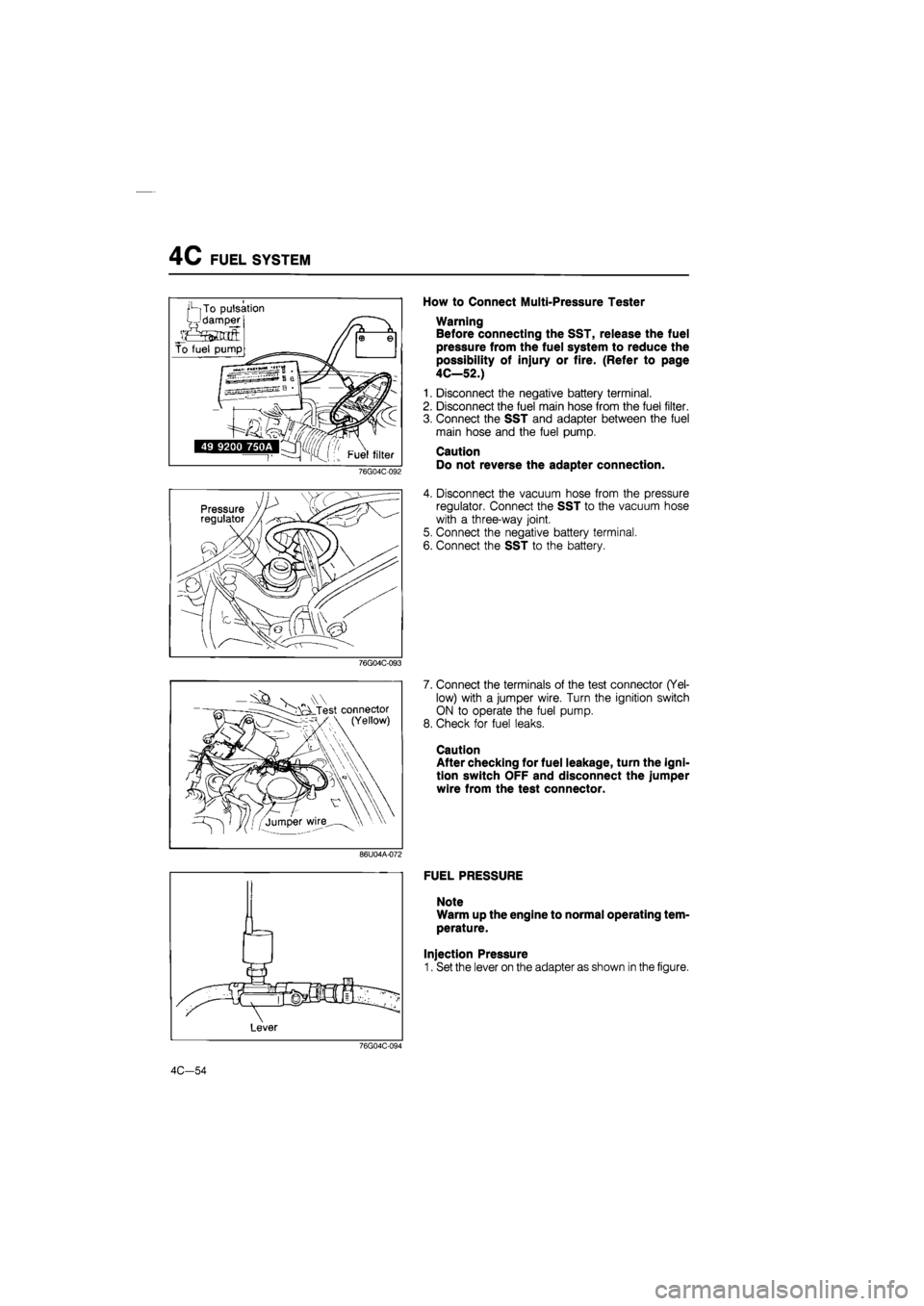
How to Connect Multi-Pressure Tester
Warning
Before connecting the SST, release the fuel
pressure from the fuel system to reduce the
possibility of injury or fire. (Refer to page
4C—52.)
1. Disconnect the negative battery terminal.
2. Disconnect the fuel main hose from the fuel filter.
3. Connect the SST and adapter between the fuel
main hose and the fuel pump.
Caution
Do not reverse the adapter connection.
4. Disconnect the vacuum hose from the pressure
regulator. Connect the SST to the vacuum hose
with a three-way joint.
5. Connect the negative battery terminal.
6. Connect the SST to the battery.
76G04C-093
V „ Test connector (Yellow)
7. Connect the terminals of the test connector (Yel-
low) with a jumper wire. Turn the ignition switch
ON to operate the fuel pump.
8. Check for fuel leaks.
Caution
After checking for fuel leakage, turn the igni-
tion switch OFF and disconnect the jumper
wire from the test connector.
86U04A-072
FUEL PRESSURE
Note
Warm up the engine to normal operating tem-
perature.
Injection Pressure
1. Set the lever on the adapter as shown in the figure.
76G04C-094
4C-54
Page 616 of 1865
FUEL SYSTEM 4C
i i 1 1 1 i i
r.:.:::r t t t t t izn —i—i—i—i—i—i—i—i—
2DD 350
86U04A-074
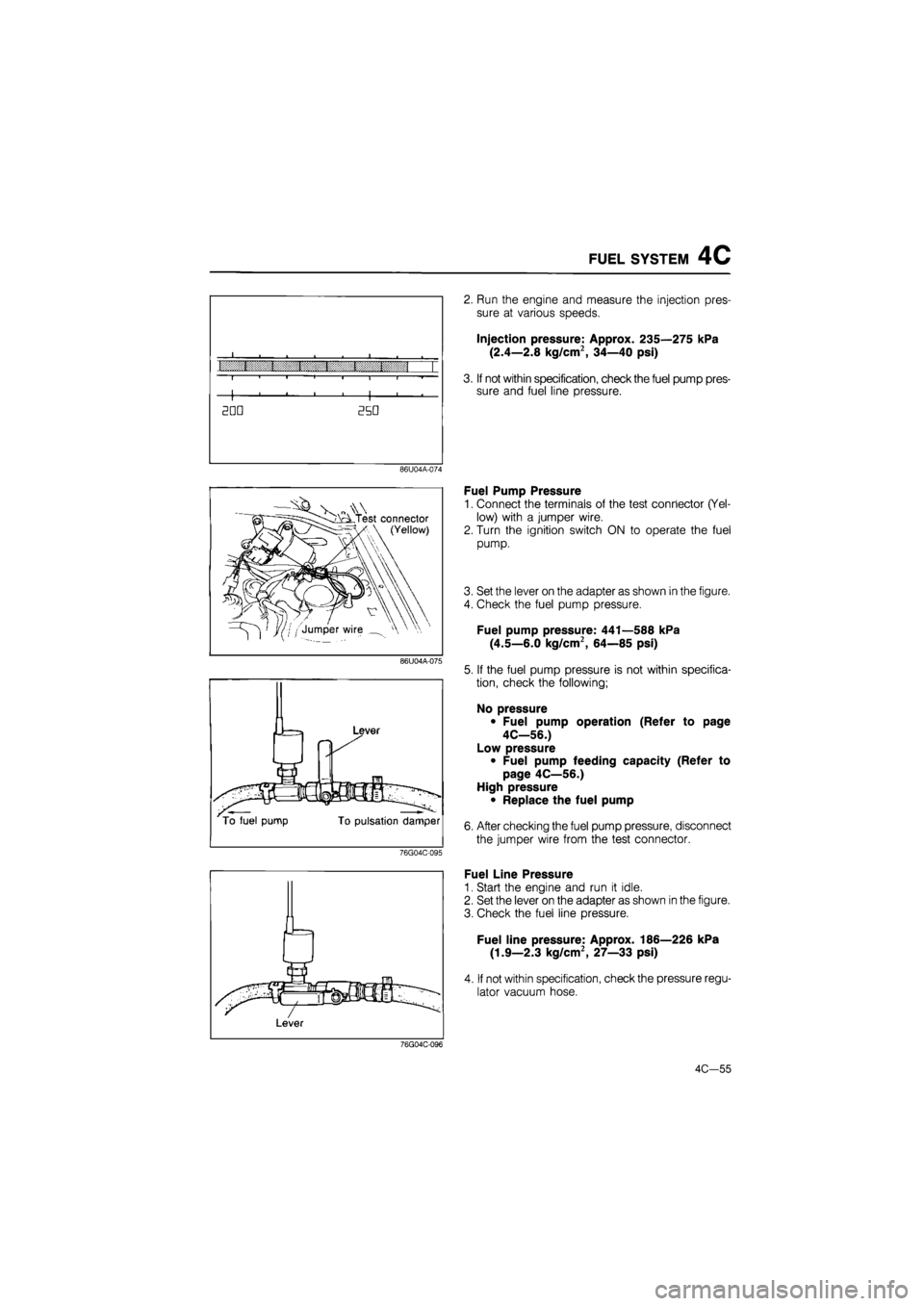
2. Run the engine and measure the injection pres-
sure at various speeds.
Injection pressure: Approx. 235—275 kPa
(2.4—2.8 kg/cm2, 34—40 psi)
3. If not within specification, check the fuel pump pres-
sure and fuel line pressure.
Fuel Pump Pressure
1. Connect the terminals of the test connector (Yel-
low) with a jumper wire.
2. Turn the ignition switch ON to operate the fuel
pump.
3. Set the lever on the adapter as shown in the figure.
4. Check the fuel pump pressure.
Fuel pump pressure: 441—588 kPa
(4.5—6.0 kg/cm2, 64—85 psi)
5. If the fuel pump pressure is not within specifica-
tion, check the following;
No pressure
• Fuel pump operation (Refer to page
4C—56.)
Low pressure
• Fuel pump feeding capacity (Refer to
page 4C—56.)
High pressure
• Replace the fuel pump
6. After checking the fuel pump pressure, disconnect
the jumper wire from the test connector.
Fuel Line Pressure
1. Start the engine and run it idle.
2. Set the lever on the adapter as shown in the figure.
3. Check the fuel line pressure.
Fuel line pressure: Approx. 186—226 kPa
(1.9—2.3 kg/cm2, 27—33 psi)
4. If not within specification, check the pressure regu-
lator vacuum hose.
4C-55
Page 617 of 1865

4C FUEL SYSTEM
86U04A-078
76G04C-097
76G04C-098
„\W cLTest connector (Yellow)
'-/jumper wire \\ \ •
5. Disconnect the vacuum hose from pressure regu-
lator, and place a finger over the end of the hose.
6. Check the fuel line pressure.
Fuel line pressure: 235—275 kPa
(2.4—2.8 kg/cm2, 34—40 psi)
7. If not within specification, replace the pressure
regulator.
8. Connect the vacuum hose to pressure regulator.
FUEL PUMP
Operation Test
1. Connect a jumper wire to the test connector
(Yellow).
2. Remove the fuel filler cap.
3. Disconnect transfer pump connector (8-pin).
4. Turn the ignition switch ON.
5. Listen for operational sound of the fuel pump at
the filler inlet.
6. Install the fuel filler cap.
7. If no sound was heard, check the voltage at the
fuel pump connector (WY wire and a ground).
Voltage: 12V
8. If the voltage is normal, replace the fuel pump.
9. If not correct, check the control relay and circuit
(Refer to page 4C—96.)
10. Disconnect the jumper wire.
Volume Test
Warning
Before performing the following procedures,
release the fuel pressure from the fuel system
to reduce the possibility of injury or fire.
(Refer to page 4C—52)
1. Connect a jumper wire to test connector (Yellow).
2. Disconnect the fuel return hose from fuel return
pipe.
76G04C-099
4C-56
Page 621 of 1865
4C FUEL SYSTEM
BW B
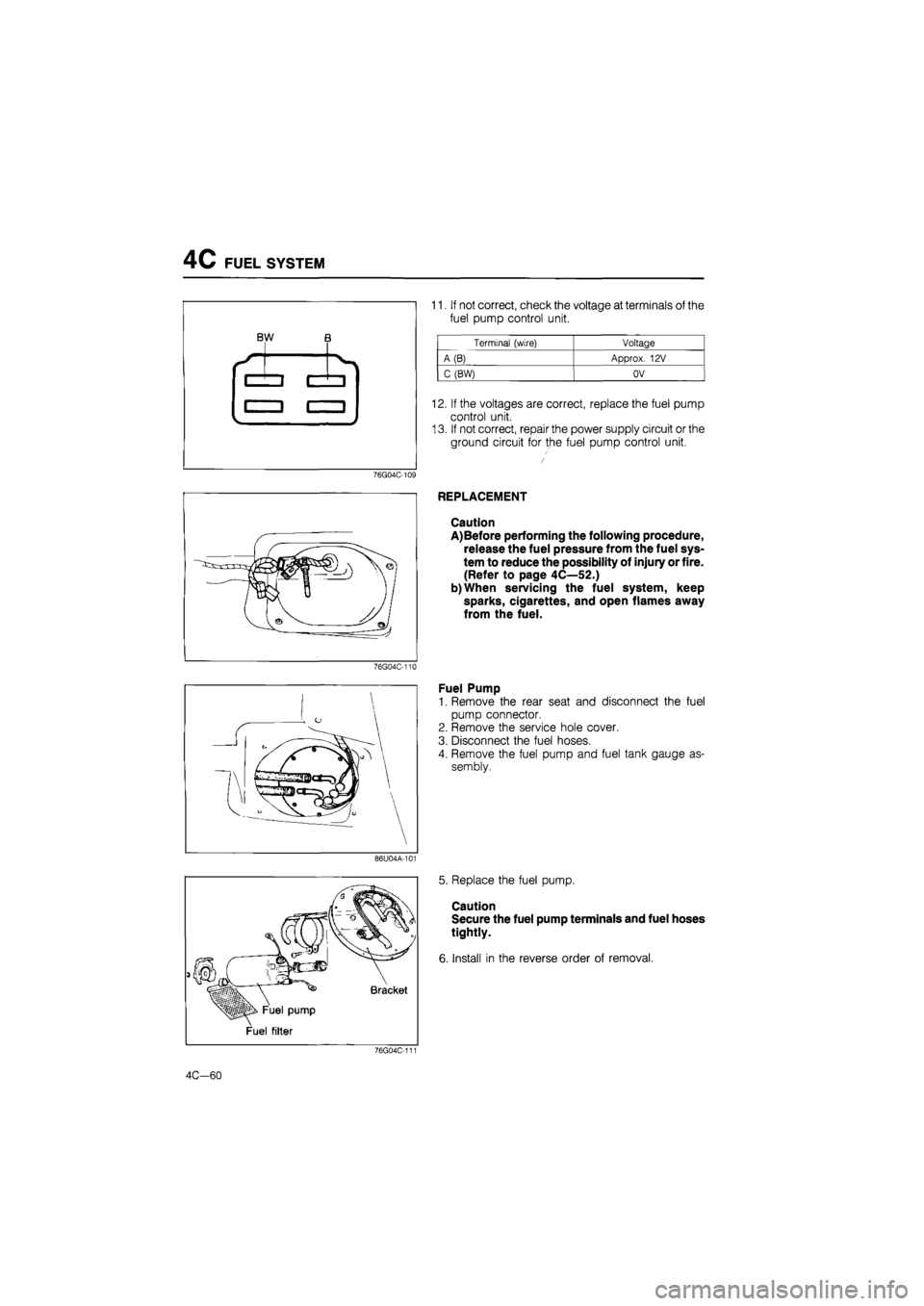
11. If not correct, check the voltage at terminals of the
fuel pump control unit.
76G04C-109
76G04C-110
86U04A-101
Fuel pump
Fuel filter
Bracket
76G04C-111
Terminal (wire) Voltage
A(B) Approx. 12V
C (BW) OV
12. If the voltages are correct, replace the fuel pump
control unit.
13. If not correct, repair the power supply circuit or the
ground circuit for the fuel pump control unit.
REPLACEMENT
Caution
A)Before performing the following procedure,
release the fuel pressure from the fuel sys-
tem to reduce the possibility of injury or fire.
(Refer to page 4C—52.)
b)When servicing the fuel system, keep
sparks, cigarettes, and open flames away
from the fuel.
Fuel Pump
1. Remove the rear seat and disconnect the fuel
pump connector.
2. Remove the service hole cover.
3. Disconnect the fuel hoses.
4. Remove the fuel pump and fuel tank gauge as-
sembly.
5. Replace the fuel pump.
Caution
Secure the fuel pump terminals and fuel hoses
tightly.
6. Install in the reverse order of removal.
4C—60
Page 625 of 1865
4C FUEL SYSTEM
^ Pulsation
damper
76G04C-121
Pulsation damper
—
Delivery pipe
76G04C-122
Fuel hose
,Fuel pump
-Intank filter
76G04C-123
Insulator
f f r—
/ 0 DM
•
II r
O - ring
Grommet
Manifold
Delivery pipe
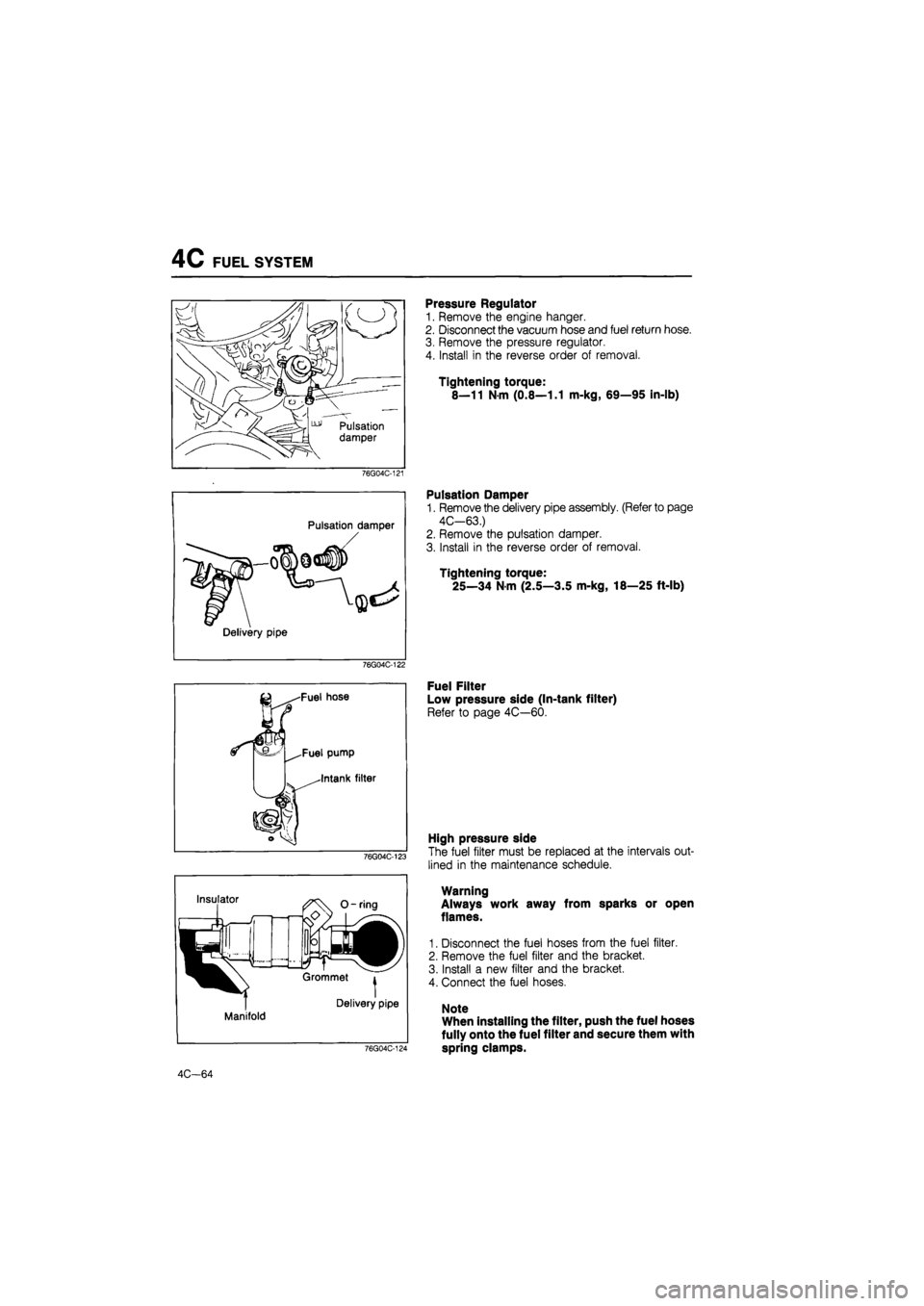
Pressure Regulator
1. Remove the engine hanger.
2. Disconnect the vacuum hose and fuel return hose.
3. Remove the pressure regulator.
4. Install in the reverse order of removal.
Tightening torque:
8—11 Nm (0.8—1.1 m-kg, 69—95 in-lb)
Pulsation Damper
1. Remove the delivery pipe assembly. (Refer to page
4C-63.)
2. Remove the pulsation damper.
3. Install in the reverse order of removal.
Tightening torque:
25—34 N m (2.5—3.5 m-kg, 18—25 ft-lb)
Fuel Filter
Low pressure side (In-tank filter)
Refer to page 4C—60.
76G04C-124
High pressure side
The fuel filter must be replaced at the intervals out-
lined in the maintenance schedule.
Warning
Always work away from sparks or open
flames.
1. Disconnect the fuel hoses from the fuel filter.
2. Remove the fuel filter and the bracket.
3. Install a new filter and the bracket.
4. Connect the fuel hoses.
Note
When installing the filter, push the fuel hoses
fully onto the fuel filter and secure them with
spring clamps.
4C-64