tire type MAZDA MODEL 3 4-DOOR 2017 Owners Manual
[x] Cancel search | Manufacturer: MAZDA, Model Year: 2017, Model line: MODEL 3 4-DOOR, Model: MAZDA MODEL 3 4-DOOR 2017Pages: 612
Page 123 of 612
3–47
Before Driving
Driving Tips
Hazardous Driving
WARNING
Be extremely careful if it is necessary to
downshift on slippery surfaces:Downshifting into lower gear
while driving on slippery surfaces is
dangerous. The sudden change in tire
speed could cause the tires to skid. This
could lead to loss of vehicle control
and an accident.
When driving on ice or in water, snow,
mud, sand, or similar hazards:
Be cautious and allow extra distance for
braking. Avoid sudden braking and sudden
maneuvering. Do not pump the brakes. Continue to
press down on the brake pedal.
Refer to Antilock Brake System (ABS)
on page 4-68. If you get stuck, select a lower gear and
accelerate slowly. Do not spin the front
wheels.
For more traction in starting on slippery
surfaces such as ice or packed snow,
use sand, rock salt, chains, carpeting, or
other nonslip material under the front
wheels.
NOTE
Use snow chains only on the front wheels.
Floor Mat
We recommend the use of Genuine
Mazda floor mats.
WARNING
Make sure the floor mats are secured
with the grommets or the retainers to
prevent them from bunching up under
the foot pedals (Driver's side): Using a floor mat that is not secured is
dangerous as it will interfere with the
accelerator and brake pedal operation
(driver's side), which could result in an
accident.
Only use a floor mat which conforms
to the shape of the floor on the driver's
side and make sure it is oriented
correctly.
Secure the floor mat using the
grommets or retainers.
There are various ways to secure floor
mats depending on the type used,
therefore secure the mat according to
the type.
After installing the floor mat, make
sure that it does not slide from side
to side or back and forth, and that
there is sufficient clearance with the
accelerator and brake pedals on the
driver's side.
After removing the floor mat for
cleaning or some other reason, always
securely reinstall it while paying
attention to the precautions just
mentioned.
Mazda3_8FL6-EA-16F_Edition2.indb 472016/08/10 17:35:38
Page 126 of 612
3–50
Before Driving
Driving Tips
Except Mexico (18–inch wheel vehicle)
The vehicle is originally equipped with
all season radials designed to be used all
year around. In some extreme climates you
may find it necessary to replace them with
snow tires during the winter months to
further improve traction on snow and ice
covered roads.
Mexico (18–inch wheel vehicle)
The vehicle is originally equipped with
summer tires designed for optimum
traction on wet and dry roads. If your
vehicle is to be used on snow and ice
covered roads, Mazda recommends that
you replace the tires originally equipped
on your vehicle with snow tires during the
winter months.
WARNING
Use only the same size and type tires
(snow, radial, or non-radial) on all four
wheels:Using tires different in size or type is
dangerous. Your vehicle's handling
could be greatly affected and result in
an accident.
CAUTION
Check local regulations before using
studded tires.
Tire Chains
Check local regulations before using tire
chains.
CAUTION
Chains may a ffect handling. Do not go faster than 50 km/h (30 mph)
or the chain manufacturer's
recommended limit, whichever is lower.
Drive carefully and avoid bumps, holes,
and sharp turns. Avoid locked-wheel braking. Do not use chains on a temporary spare
tire; it may result in damage to the
vehicle and to the tire.
Do not use chains on roads that are free
of snow or ice. The tires and chains could
be damaged.
Chains may scr atch or chip aluminum
wheels.
NOTE
The tire pressure monitoring system may
not function correctly when using tire
chains.
Install the chains on the front tires only.
Do not use chains on the rear tires.
Please consult an Authorized Mazda
Dealer.
Installing the chains
1. If your vehicle is equipped with wheel
covers remove them, otherwise the
chain bands will scratch them.
2. Secure the chains on the front tires as
tightly as possible.
Always follow the chain manufacturer's
instructions.
3. Retighten the chains after driving
1/2—1 km (1/4—1/2 mile).
Mazda3_8FL6-EA-16F_Edition2.indb 502016/08/10 17:35:39
Page 237 of 612
4–107
When Driving
i-ACTIVSENSE
*Some models.
Mazda Radar Cruise Control (MRCC)*
The Mazda Radar Cruise Control (MRCC) system is designed to maintain headway control*1
according to the vehicle speed using a radar sensor (front) to detect \
the distance to a vehicle
ahead, and by presetting the vehicle speed between 30 km/h (19 mph) an\
d 145 km/h (90 mph),
the driver is freed from having to constantly use the accelerator or bra\
ke pedals.
*1 Headway Control: Control of the distance between your vehicle and the ve\
hicle ahead
detected by the Mazda Radar Cruise Control (MRCC) system.
Additionally, if your vehicle starts closing in on the vehicle ahead because, for ex\
ample, the
vehicle ahead brakes suddenly, a warning sound and a warning indication in the display are
activated simultaneously to alert you to maintain a sufficient distance between the vehicles.
Use the Mazda Radar Cruise Control (MRCC) system on expressways and other highways
which do not require a lot of repeated acceleration and deceleration.
WARNING
Do not rely completely on the Mazda Radar Cruise Control (MRCC) system and always
drive carefully:
The Mazda Radar Cruise Control (MRCC) system is designed to reduce load on the driver,
and although it maintains a constant vehicle speed, or specifically, it maintains a constant
distance between your vehicle and the detected vehicle ahead according to the vehicle
speed, the system has detection limitations depending on the type of vehicle ahead and its
conditions, the weather conditions, and the road conditions. Additionally, the system may
be unable to decelerate sufficiently to avoid hitting the vehicle ahead if the vehicle ahead
applies the brakes suddenly or another vehicle cuts into the driving lane, which could result in
an accident. Always verify the safety of the surrounding area and depress the brake pedal or
accelerator pedal while keeping a safer distance from vehicles ahead or on-coming vehicles.
Do not use the Mazda Radar Cruise Control (MRCC) system in the following locations.
Otherwise, it could lead to an accident:
Roads with sharp cur ves and where vehicle traffic is heavy and there is insufficient
space between vehicles. Roads where frequent and repetitive acceleration and
deceleration occur (Driving under these conditions using the Mazda Radar Cruise
Control (MRCC) system is not possible).
When entering and exiting interchanges, service areas, and parking areas of highways
(If you exit a highway while headway control is in use, the vehicle ahead will no longer
be tracked and your vehicle may accelerate to the set speed).
Slippery roads such as ice or snow-bound roads (The tires could spin causing you to
lose vehicle control). Long descending slopes (to maintain distance between vehicles, the system automatically
and continuously applies the brakes which could result in the loss of brake power).
For the purposes of safety, switch the Mazda Radar Cruise Control (MRCC) system off
when it is not being used.
Mazda3_8FL6-EA-16F_Edition2.indb 1072016/08/10 17:36:46
Page 248 of 612
4–118
When Driving
i-ACTIVSENSE
WARNING
Do not rely completely on the Lane-keep Assist System (LAS) & Lane Departure
Warning System (LDWS):
The Lane-keep Assist System (LAS) & Lane Departure Warning System (LDWS) is not an
automatic driving system. In addition, the system is not designed to compensate for a
driver's lack of caution, and over-reliance on the system could lead to an accident.
The detection ability of the Lane-keep Assist System (LAS) & Lane Departure Warning
System (LDWS) is limited. Always stay on course using the steering wheel and drive
with care.
Do not use the Lane-keep Assist System (LAS) & Lane Departure Warning System
(LDWS) in the following cases: The system may not operate adequately according to the actual driving conditions,
resulting in an accident.
Driving on roads with tight curves. Driving under bad weather conditions (rain, fog, and snow). Slippery roads such as ice or snow-bound roads. Roads with heav y traffic and insufficient distance between vehicles. Roads with no whit e (yellow) lane lines. Narrow roads resulting from road construction or lane closures. The vehicle is driven on a temporary lane or section with a closed lane resulting from
road construction where there may be multiple white (yellow) lane lines or they are
interrupted.
The tire pressures are not adjusted to the specified pressure. Tires of a different specified size are used, such as an emergency spare tire.
CAUTION
Heed the following cautions so that the Lane-keep Assist System (LAS) & Lane Departure
Warning System (LDWS) can operate normally.
Do not modify the suspensions. Always use wheels of the specified type and size for the front and rear wheels. Consult
an Authorized Mazda Dealer for tire replacement.
NOTE
When the turn signal lever is operated for a lane change, the Lane-keep \
Assist System
(LAS) & Lane Departure Warning System (LDWS) is automatically disabled. The
Lane-keep Assist System (LAS) & Lane Departure Warning System (LDWS) becomes
operational again when the turn signal lever is returned and the system detects white
(yellow) lane lines while the vehicle is being driven normally within \
its vehicle lane.
Mazda3_8FL6-EA-16F_Edition2.indb 1182016/08/10 17:36:52
Page 283 of 612
4–153
When Driving
Tire Pressure Monitoring System
NOTE
Because this system detects slight changes in tire conditions, the timing of the warning may
be faster or slower in the following cases:
The size, manufacturer, or the type of tires is different from the specification. The size, manufacturer, or the type of a tire is different from the others, or the level of tire
wear is excessively different between them. A run-flat tire, studless tire, snow tire, or tire chains are used. An emergency tire is used (The tire pressure monitoring system warning light may flash
and then continue illuminating). A tire is repaired using the emergency flat tire repair kit. The tire pressure is excessively higher than the specified pressure, or the tire pressure is
suddenly lowered for some reason such as a tire burst during driving. The vehicle speed is lower than about 15 km/h (9.3 mph) (including wh\
en the vehicle is
stopped), or the drive period is shorter than 5 minutes. The vehicle is driven on an extr emely rough road or a slippery, icy road. Hard steering and rapid acceleration/deceleration are repeated such as during aggressive
driving on a winding road. Load on the vehicle is applied to a tir e such as by loading heavy luggage to one side of
the vehicle. System initialization has not been implemented with the specifie d tire pressure.
Mazda3_8FL6-EA-16F_Edition2.indb 1532016/08/10 17:37:04
Page 347 of 612
5–55
Interior Features
Audio System
*Some models.
Applications
NOTE
Depending on the grade and specification,
the screen display may differ.
Select the
icon on the home screen to
display the Applications screen. The
following information can be verified.
Top screenItemFunction
HD Radio™ Traffic
Map*— —
Fuel Economy
Monitor
Fuel
Consumption
Control
Status
(Vehicles
with
i-ELOOP)
SettingsRefer
to Fuel
Economy
Monitor
on page
4-75.
Vehicle
Status
Monitor
Maintenance Scheduled
Maintenance
Tire Rotation
Oil Change Refer to
Maintenance
Monitor
(Type B
audio) on
page
6-18.
Warning
Guidance
Warnings
currently
active can be
verified. Refer to If
a Warning
Light
Turns On
or Flashes
on page
7-25.
Audio Control Switch
Operation*
Adjusting the Volume
To increase the volume, press up the
volume switch (
).
To decrease the volume, press down the
volume switch (
).
Mazda3_8FL6-EA-16F_Edition2.indb 552016/08/10 17:37:47
Page 453 of 612
6–41
Maintenance and Care
Owner Maintenance
Tires
For reasons of proper performance, safety,
and better fuel economy, always maintain
recommended tire inflation pressures and
stay within the recommended load limits
and weight distribution.
WARNING
Using Different Tire Types:
Driving your vehicle with different
types of tires is dangerous. It could
cause poor handling and poor braking;
leading to loss of control.
Except for the limited use of the
temporary spare tire, use only the
same type tires (radial, bias-belted,
bias-type) on all four wheels.
Using Wrong-Sized Tires: Using any other tire size than what is
specified for the vehicle (page
9-10)
is dangerous. It could seriously affect
ride, handling, ground clearance,
tire clearance, and speedometer
calibration. This could cause you to
have an accident. Use only tires that
are the correct size specified for the
vehicle.
Tire Inflation Pressure
WARNING
Always inflate the tires to the correct
pressure: Overinflation or underinflation of tires
is dangerous. Adverse handling or
unexpected tire failure could result in a
serious accident.
Refer to Tires on page
9-10.
Use only a Mazda-genuine tire valve
cap: Use of a non-genuine part is
dangerous as the correct tire air
pressure cannot be maintained if the
tire valve becomes damaged. If the
vehicle is driven under this condition,
the tire air pressure will decrease which
could result in a serious accident. Do
not use any part for the tire valve cap
that is not a Mazda-genuine part.
Inspect all tire pressures monthly
(including the spare) when the tires are
cold. Maintain recommended pressures for
the best ride, handling, and minimum tire
wear.
Refer to the specification charts (page
9-10).
(With tire pressure monitoring system)
After adjusting the tire pressure,
initialization of the tire pressure
monitoring system is necessary to make
the system operate normally.
Refer to Tire Pressure Monitoring System
Initialization on page
4-154.
Mazda3_8FL6-EA-16F_Edition2.indb 412016/08/10 17:38:47
Page 456 of 612
6–44
Maintenance and Care
Owner Maintenance
*Some models.
CAUTION
Do not use your temporary spare tire
rim with a snow tire or a conventional
tire. Neither will properly fit and could
damage both tire and rim.
The temporary spare tire has a tread life
of less than 5,000 km (3,000 miles). The
tread life may be shorter depending on
driving conditions.
The temporary spare tire is for limited
use, however, if the tread wear solid-
band indicator appears, replace the tire
with the same type of temporary spare
(page
6-43).
NOTE
Tires degrade over time, even when
they are not being used on the road. It
is recommended that tires generally be
replaced when they are 6 years or older.
Heat caused by hot climates or frequent
high loading conditions can accelerate
the aging process. You should replace the
spare tire when you replace the other road
tires due to the aging of the spare tire. The
period in which the tire was manufactured
(both week and year) is indicated by a
4-digit number.
Refer to Tire Labeling on page
8-25.
Replacing a Wheel
WARNING
Always use wheels of the correct size on
your vehicle:Using a wrong-sized wheel is
dangerous. Braking and handling
could be affected, leading to loss of
control and an accident.
CAUTION
A wrong-sized wheel may adversely
affect:
Tire fit Wheel and bearing life Ground clearance Snow-chain clearance Speedometer calibration Headlight aim Bumper height Tire Pressure Monitoring System*
NOTE
When replacing a wheel, make sure
the new one is the same as the original
factory wheel in diameter, rim width,
and offset (inset/outset).
For details, contact an Authorized
Mazda Dealer.
Proper tire balancing provides the best
riding comfort and helps reduce tread
wear. Out-of-balance tires can cause
vibration and uneven wear, such as
cupping and flat spots.
Mazda3_8FL6-EA-16F_Edition2.indb 442016/08/10 17:38:49
Page 501 of 612
7–13
If Trouble Arises
Flat Tire
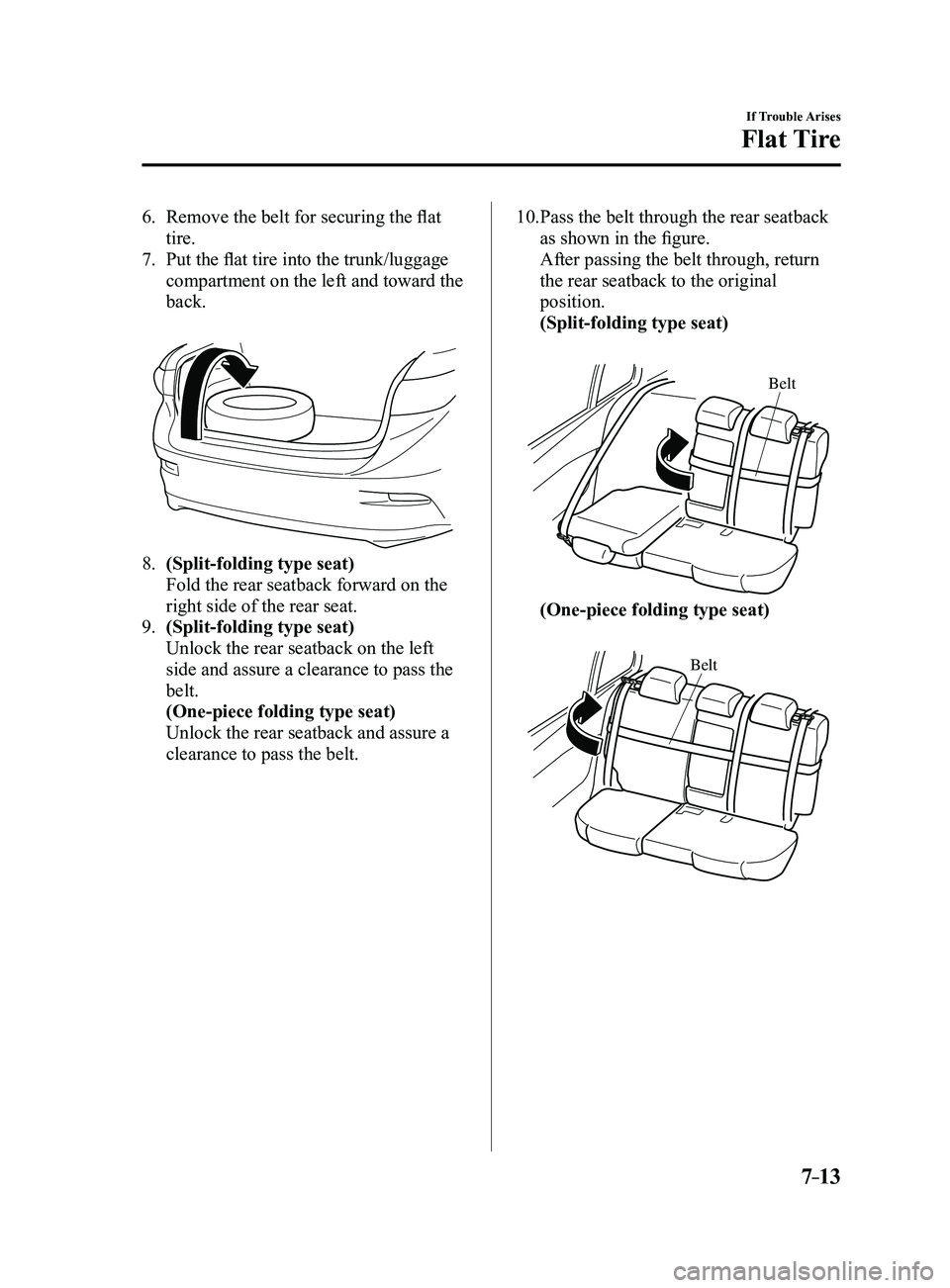
6. Remove the belt for securing the flat
tire.
7. Put the flat tire into the trunk/luggage
compartment on the left and toward the
back.
8. (Split-folding type seat)
Fold the rear seatback forward on the
right side of the rear seat.
9. (Split-folding type seat)
Unlock the rear seatback on the left
side and assure a clearance to pass the
belt.
(One-piece folding type seat)
Unlock the rear seatback and assure a
clearance to pass the belt.
10. Pass the belt through the rear seatback
as shown in the figure.
After passing the belt through, return
the rear seatback to the original
position.
(Split-folding type seat)
Belt
(One-piece folding type seat)
Belt
Mazda3_8FL6-EA-16F_Edition2.indb 132016/08/10 17:39:15
Page 503 of 612
7–15
If Trouble Arises
Flat Tire
13. (Split-folding type seat)
Return the rear seatback on the right
side of the rear seatback to its original
position.
14. Remove the tire blocks and store the
tools and jack.
15. Check the inflation pressure. Refer to
Tires on page 9-10.
16. Have the flat tire repaired or replaced
as soon as possible.
NOTE
Do not press the tire pressure monitoring
system set switch after installing the spare
tire. The switch is only to be pressed after
installing the repaired flat tire or installing
a replacement tire (page
4-23).
WARNING
Do not drive with any tires that have
incorrect air pressure:Driving on tires with incorrect air
pressure is dangerous. Tires with
incorrect pressure could affect
handling and result in an accident.
When you check the regular tires' air
pressure, check the spare tire, too.
NOTE
To prevent the jack and tool from rattling,
store them properly.
Mazda3_8FL6-EA-16F_Edition2.indb 152016/08/10 17:39:16