Insta MAZDA MODEL 3 HATCHBACK 2020 Owners Manual (in English)
[x] Cancel search | Manufacturer: MAZDA, Model Year: 2020, Model line: MODEL 3 HATCHBACK, Model: MAZDA MODEL 3 HATCHBACK 2020Pages: 598, PDF Size: 89.37 MB
Page 499 of 598
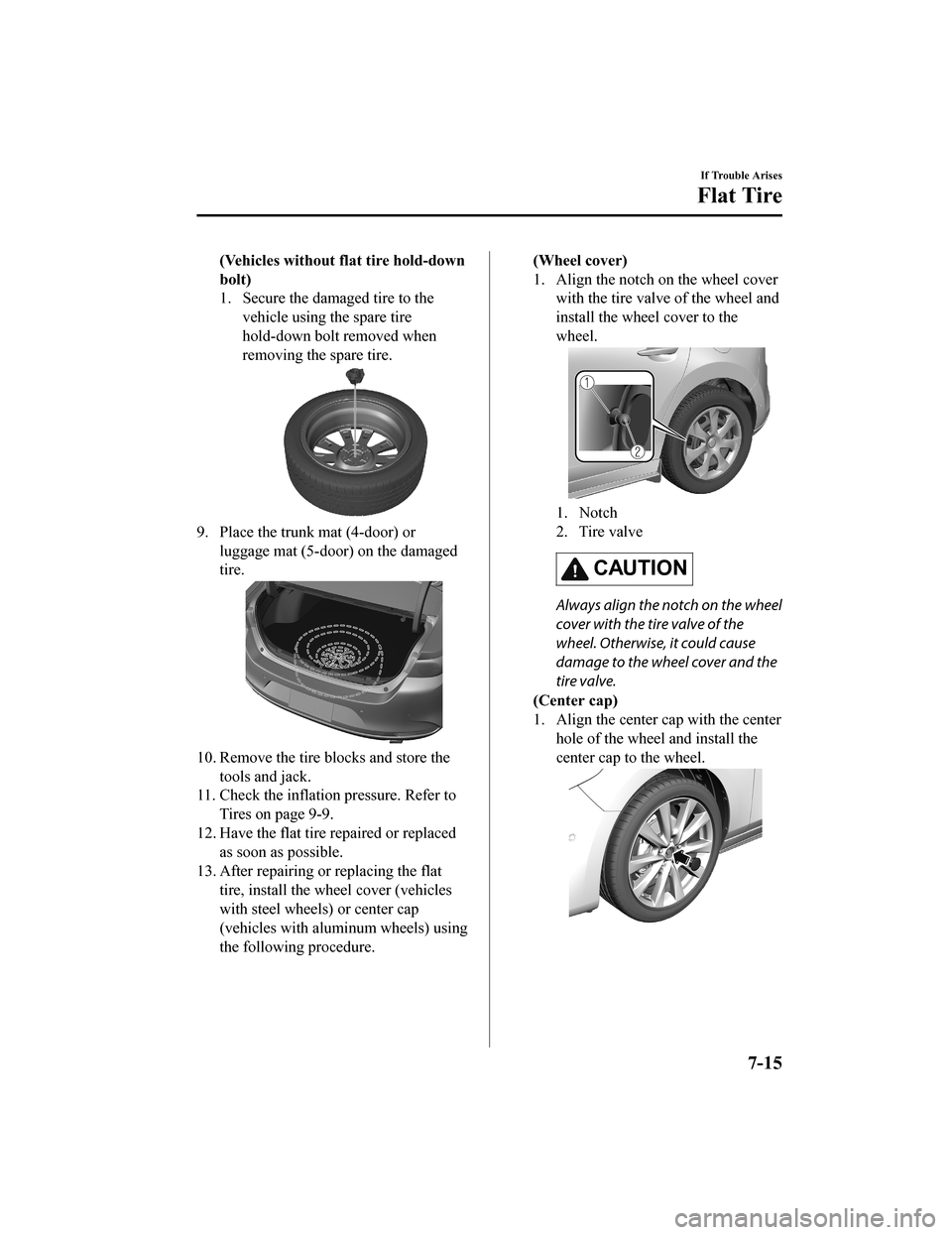
(Vehicles without flat tire hold-down
bolt)
1. Secure the damaged tire to thevehicle using the spare tire
hold-down bolt removed when
removing the spare tire.
9. Place the trunk mat (4-door) orluggage mat (5-door) on the damaged
tire.
10. Remove the tire blocks and store thetools and jack.
11. Check the inflation pressure. Refer to Tires on page 9-9.
12. Have the flat tire repaired or replaced
as soon as possible.
13. After repairing or replacing the flat
tire, install the wheel cover (vehicles
with steel wheels) or center cap
(vehicles with alumi num wheels) using
the following procedure.
(Wheel cover)
1. Align the notch on the wheel cover with the tire valve of the wheel and
install the whee l cover to the
wheel.
1. Notch
2. Tire valve
CAUTION
Always align the notch on the wheel
cover with the tire valve of the
wheel. Otherwise, it could cause
damage to the wheel cover and the
tire valve.
(Center cap)
1. Align the center cap with the center hole of the wheel and install the
center cap to the wheel.
If Trouble Arises
Flat Tire
7-15
Mazda3_8HZ1-EA-19G_Edition1_old 2019-5-17 13:49:03
Page 503 of 598

Location shown in the figure (do not connect to the negative (-) terminal of the
battery)
5. Start the booster vehicle's engine and rev the engine.
6. Start the engine of your vehicle. Run the engines for about 3 minutes to temporarily
charge the battery of your vehicle.
7. Disconnect the jumper cables in the reverse order of their co nnection.
8. Install the battery cover.
9. Have your vehicle inspected by an Authorized Mazda Dealer as soon as possible.
If Trouble Arises
Battery Runs Out
7-19
Mazda3_8HZ1-EA-19G_Edition1_old 2019-5-17 13:49:03
Page 509 of 598

(5–Door)
Rear
(4–Door)
(5–Door)
CAUTION
Do not use excessive force as it may
damage the cap or scratch the painted
bumper surface.
NOTE
Remove the cap completely and store it
so as not to lose it.
3. Securely install the tiedown eyelet using the lug wrench.
Front
(4–Door)
1. Lug wrench
2. Tiedown eyelet
(5–Door)
1. Lug wrench
2. Tiedown eyelet
If Trouble Arises
Emergency Towing
7-25
Mazda3_8HZ1-EA-19G_Edition1_old 2019-5-17 13:49:03
Page 519 of 598

Action to be taken
Add fuel. If the light is flashing, refuel as
soon as possible.
▼Check Fuel Cap Warning
Indication/Warning Light
If the check fuel cap warning light
illuminates while driving, the fuel-filler
cap may not be installed properly.
Action to be taken
Stop the engine and reinstall the fuel-filler
cap.
Refer to Refueli
ng on page 3-28.
▼Engine Oil Level Warning
Indication/Warning Light
This warning light indicates that the
engine oil level is around the MIN mark
(page 6-16).
CAUTION
Do not continue to drive the vehicle with
the engine oil level warning indication/
warning light displayed/turned on. If the
vehicle continues to be driven with an
insufficient amount of engine oil, it could
cause damage to the engine.
Action to be taken
Add 1 L (0.3 US gal, 0.2 Imp gal) of
engine oil (page 6-15).
▼Seat Belt Warning Indication/
Warning Light (Front seat)
The seat belt warning
light turns on if the
driver or front passenger's seat is occupied
and the seat belt is not fastened with the
ignition switched ON.
If the driver or front p assenger's seat belt
is unfastened (only when the front
passenger's seat is occupied) and the
vehicle is driven at a speed faster than
about 20 km/h (12 mph), the warning light
flashes. After a sho rt time, the warning
light stops flashing, but remains
illuminated.
NOTE
The warning light flashes for about 6
seconds if the driver's seat belt is not
fastened when the ignition is switched
ON. (Except Mexico, Puerto Rico)
Placing heavy items on the front
passenger's seat may cause the front
passenger's seat belt warning function
to operate depending on the weight of
the item.
To allow the front passenger occupant
classification sensor to function
properly, do not place and sit on an
additional seat cushion on the front
passenger's seat. The sensor may not
function properly because the additional
seat cushion could cause sensor
interference.
If a small child is seated on the front
passenger's seat, the warning light may
not operate.
If Trouble Arises
Warning/Indicator Lights and Warning Sounds
7-35
Mazda3_8HZ1-EA-19G_Edition1_old 2019-5-17 13:49:03
Page 551 of 598

Add-On Non-GenuineParts and Accessories
▼ Add-On Non-Genuine Parts and
Accessories
Non-genuine parts and accessories for
Mazda vehicles can be found in stores.
These may fit your vehicle, but they are
not approved by Mazda for use with
Mazda vehicles. When you install
non-genuine parts or accessories, they
could affect your vehicle's performance or
safety systems; the Mazda warranty
doesn't cover this. Before you install any
non-genuine parts or accessories, consult
an Authorized Mazda Dealer.
WA R N I N G
Always consult an Authorized Mazda
Dealer before you install non-genuine parts
or accessories:
Improperly designed parts or accessories
could seriously affect your vehicle's
performance or safety systems. This could
cause you to have an accident or increase
your chances of injuries in an accident.
Be very careful in choosing and installing
add-on electrical equipment, such as
mobile telephones, two-way radios, stereo
systems, and car alarm systems:
Incorrectly choosing or installing improper
add-on equipment or choosing an
improper installer is dangerous. Essential
systems could be damaged, causing engine
stalling, air-bag (SRS) activation,
ABS/TCS/DSC inactivation, or a fire in the
vehicle.
Mazda assumes no responsibility for
death, injury, or expenses that may result
from the installation of add-on
non-genuine parts or accessories.
Customer Information and Reporting Safety Defects
Wa r r an t y
8-17
Mazda3_8HZ1-EA-19G_Edition1_old
2019-5-17 13:49:03
Page 557 of 598
Tire Labeling
▼Tire Labeling
Federal law requires tire manufacturers to
place standardized information on the
sidewall of all tires. This information
identifies and describes the fundamental
characteristics of the tire and also provides
a tire identification number for safety
standard certification and in case of a
recall.
▼Information on Passenger Vehicle
Tires
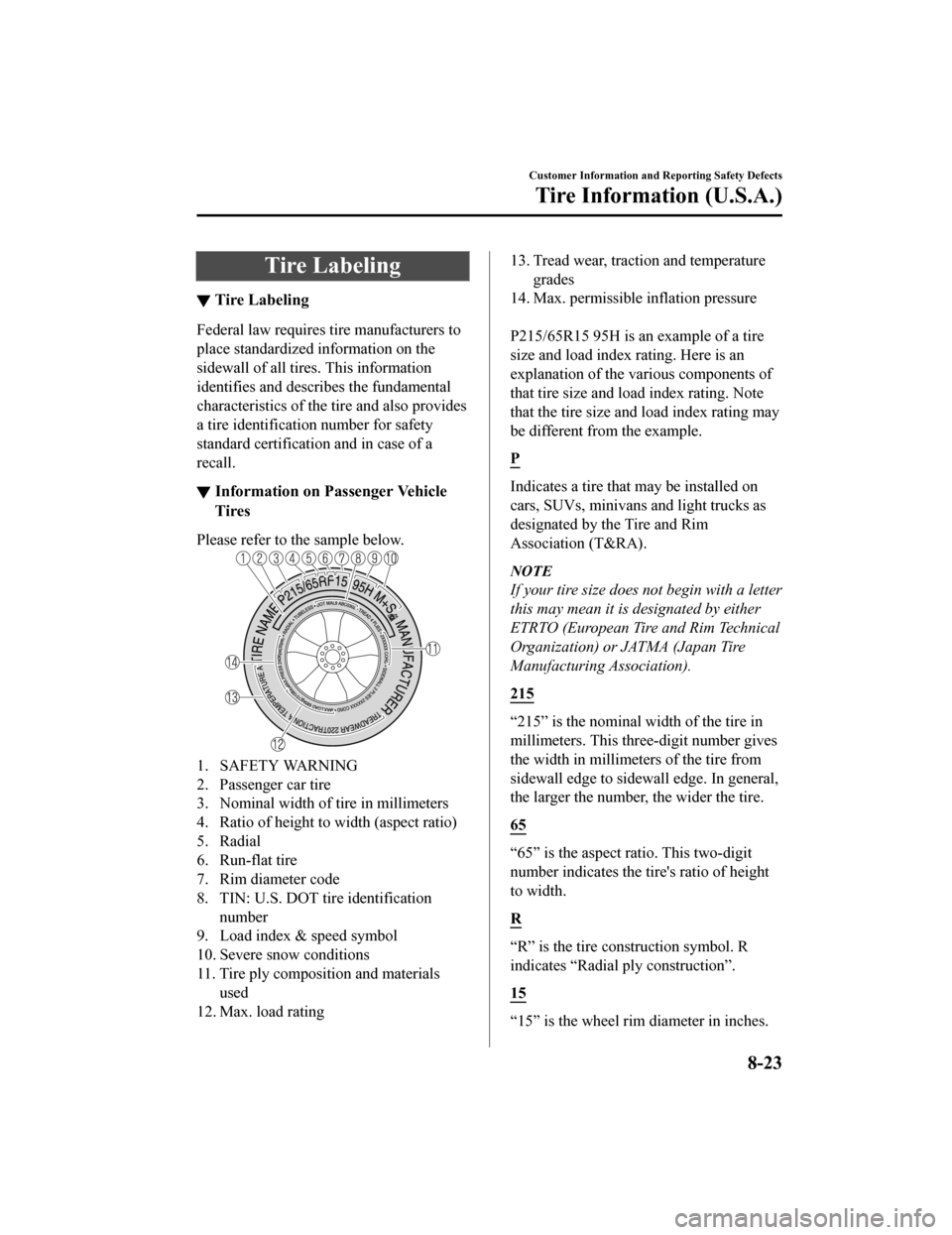
Please refer to the sample below.
1. SAFETY WARNING
2. Passenger car tire
3. Nominal width of tire in millimeters
4. Ratio of height to width (aspect ratio)
5. Radial
6. Run-flat tire
7. Rim diameter code
8. TIN: U.S. DOT tir
e identification
number
9. Load index & speed symbol
10. Severe snow conditions
11. Tire ply composition and materials used
12. Max. load rating
13. Tread wear, traction and temperature grades
14. Max. permissible inflation pressure
P215/65R15 95H is an example of a tire
size and load index rating. Here is an
explanation of the various components of
that tire size and load index rating. Note
that the tire size and load index rating may
be different from the example.
P
Indicates a tire that may be installed on
cars, SUVs, minivans and light trucks as
designated by the Tire and Rim
Association (T&RA).
NOTE
If your tire size does not begin with a letter
this may mean it is designated by either
ETRTO (European Tire and Rim Technical
Organization) or JATMA (Japan Tire
Manufacturing Association).
215
“215” is the nominal w idth of the tire in
millimeters. This three-digit number gives
the width in millimeters of the tire from
sidewall edge to sidewall edge. In general,
the larger the number, the wider the tire.
65
“65” is the aspect ratio. This two-digit
number indicates the tire's ratio of height
to width.
R
“R” is the tire construction symbol. R
indicates “Radial ply construction”.
15
“15” is the wheel rim diameter in inches.
Customer Information and Reporting Safety Defects
Tire Information (U.S.A.)
8-23
Mazda3_8HZ1-EA-19G_Edition1_old 2019-5-17 13:49:03
Page 560 of 598

T115/70D16 90M is an example of a tire
size and load index rating. Here is an
explanation of the various components of
that tire size and load index rating. Note
that the tire size and load index rating may
be different from the example.
T
Indicates a tire that may be installed on
cars, SUVs, minivans and light trucks as
designated by the Tire and Rim
Association (T&RA).
11 5
“115” is the nominal w idth of the tire in
millimeters. This three-digit number gives
the width in millimet ers of the tire from
sidewall edge to sidewall edge. In general,
the larger the number, the wider the tire.
70
“70” is the aspect ratio. This two-digit
number indicates the tire's ratio of height
to width.
D
“D” is the tire construction symbol. D
indicates “diagonal ply construction”.
16
“16” is the wheel rim diameter in inches.
90
“90” is the Load Index. This two-or
three-digit number indicates how much
weight each tire can support.
M
“M” is the speed rating. The speed rating
denotes the maximum speed for which the
use of the tire is rated.
Letter Rating Speed Rating M8 1 m ph
Customer Information and Reporting Safety Defects
Tire Information (U.S.A.)
8-26
Mazda3_8HZ1-EA-19G_Edition1_old 2019-5-17 13:49:03
Page 561 of 598

Location of the Tire Label(Placard)
▼Location of the Tire Label (Placard)
You will find the tire
label containing tire
inflation pressure by tire size and other
important info rmation on the driver's side
B-pillar or on the edge of the driver's door
frame.
SAMPLE
▼ Recommended Tire Inflation
Pressure
On the tire label you will find the
recommended tire inflation pressure in
both kPa and psi for the tires installed as
original equipment on
the vehicle. It is
very important that the inflation pressure
of the tires on your vehicle is maintained
at the recommended pressure. You should
check the tire pressure regularly to insure
that the proper inflation pressure is
maintained.
Refer to Tires on page 9-9.
NOTE
Tire pressures listed on the vehicle placard
or tire information label indicate the
recommended cold tire inflation pressure,
measured when the tires are cold, after the
vehicle has been parked for at least 3
hours. As you drive, the temperature in the
tire warms up, increasing the tire pressure.
WA R N I N G
Always check the tire inflation pressures on
a regular basis according to the
recommended tire inflation pressure on the
tire label and in conjunction with the
information in this owner's manual:
Driving your vehicle with under-inflated
tires is dangerous.
Under-inflation is the most common cause
of failures in any kind of tire and may result
in severe cracking, tread separation or
“blowout”, with unexpected loss of vehicle
control and increased risk of injury.
Under-inflation increases sidewall
flexing
and rolling resistance, resulting in heat
buildup and internal damage to the tire. It
results in unnecessary tire stress, irregular
wear, loss of control and accidents. A tire
can lose up to half of its air pressure and
not appear to be flat!
It is impossible to determine whether or not
tires are properly inflated just by looking at
them.
▼ Checking Tire Pressure
1. When you check the air pressure, make
sure the tires are cold ―meaning they
are not hot from driving even a mile.
2. Remove the cap from the valve on one
tire.
3. Firmly press a tire gauge onto the
valve.
4. Add air to achieve recommended air pressure.
5. If you overfill the tire, release air by
pushing on the metal stem in the center
of the valve. Then recheck the pressure
with your tire gauge.
6. Replace the valve cap.
Customer Information and Reporting Safety Defects
Tire Information (U.S.A.)
8-27
Mazda3_8HZ1-EA-19G_Edition1_old 2019-5-17 13:49:03
Page 562 of 598

7. Repeat with each tire, including thespare.
NOTE
Some spare tires require higher
inflation pressure.
8. Visually inspect the tires to make sure
there are no nails or other objects
embedded that could poke a hole in the
tire and cause an air leak.
9. Check the sidewalls to make sure there are no gouges, cuts, bulges, cracks or
other irregularities.
▼Glossary of Terms
Tire Placard:
A label indicating the OE
tire sizes, recommended inflation pressure,
and the maximum weight the vehicle can
carry.
Tire Identification Number (TIN): A
number on the sidewall of each tire
providing information about the tire brand
and manufacturing plant, tire size, and
date of manufacture.
Inflation Pressure: A measure of the
amount of air in a tire.
kPa: Kilopascal, the metric unit for air
pressure.
psi: Pounds per square inch, the English
unit for air pressure.
B-pillar: The structural member at the
side of the vehicle behind the front door.
Original Equipment (OE): Describes
components originally equipped on the
vehicle.
Vehicle Load Limit: The maximum value
of the combination weight of occupants
and cargo.
Bead Area of the Tire: Area of the tire
next to the rim.
Sidewall Area of the Tire: Area between
the bead area and the tread.
Tread Area of the Tire: Area on the
perimeter of the tire t hat contacts the road
when it's mounted on the vehicle.
Seating capacity means the total
allowable number of vehicle occupants.
Seating capacity is described on the tire
label.
Production options weight is the
combination weight of installed regular
production options weighing over 2.3
kilograms in excess of the standard items
which they replace, and not previously
considered in the curb weight or accessory
weight, including heavy duty brakes, ride
levelers, roof rack, heavy duty battery, and
special trim.
Rim is the metal support (wheel) for a tire
or a tire and tube assembly upon which the
tire beads are seated.
Customer Information and Reporting Safety Defects
Tire Information (U.S.A.)
8-28
Mazda3_8HZ1-EA-19G_Edition1_old 2019-5-17 13:49:03
Page 566 of 598

Payload is the combination weight of
cargo and passengers that the vehicle is
designed to carry. The maximum payload
for your vehicle can be found on the Tire
and Load Information l abel on the driver's
door frame or door pillar. Look for “THE
COMBINATION WEIGHT OF
OCCUPANTS AND CARGO SHOULD
NEVER EXCEED XXX kg or XXX lbs”
for your maximum payload. The payload
listed on the tire label is the maximum
payload for the vehicle as built by the
assembly plant. If any aftermarket or
dealer installed equipment has been
installed on the vehicle, the weight of the
equipment must be s ubtracted from the
payload listed on the tire label in order to
be accurate.
SAMPLE
CARGO
Cargo Weight includes all weight added
to the Base Curb Weight, including cargo
and optional equipment.
The cargo weight limit decreases
depending on the number of vehicle
occupants. The cargo weight limit can be
calculated by subtracting the total weight
of the vehicle occupants from the
“combination weight of occupants and
cargo should never exceed” value on the
tire label.
Examples: Based on a single occupant
weight of 68 kg (150 lbs), and a value of
385 kg (849 lbs) for the “combination
weight of occupants and cargo should
never exceed”:
The cargo weight limit with one occupant
is 385 kg (849 lbs) - 68 kg (150 lbs) =
317 kg (699 lbs)
The cargo weight limit with two occupants
is 385 kg (849 lbs) - (68 × 2) kg ( (150 ×
2) lbs) = 249 kg (549 lbs)
If the weight of the occupant increases, the
cargo weight limit decreases by that much.
GAW (Gross Axle Weight) is the total
weight placed on each axle (front and
rear) - including ve hicle curb weight and
all payload.
GAWR (Gross Axle Weight Rating) is
the maximum allowable weight that can be
carried by a single axle (front or rear).
These numbers are shown on the Safety
Compliance Certificat ion Label located
on the driver's door frame or door
pillar. The total lo ad on each axle must
never exceed its GAWR.
GVW
Customer Information and Reporting Safety Defects
Tire Information (U.S.A.)
8-32
Mazda3_8HZ1-EA-19G_Edition1_old 2019-5-17 13:49:03