Insta MAZDA MODEL 3 HATCHBACK 2020 (in English) Repair Manual
[x] Cancel search | Manufacturer: MAZDA, Model Year: 2020, Model line: MODEL 3 HATCHBACK, Model: MAZDA MODEL 3 HATCHBACK 2020Pages: 598, PDF Size: 89.37 MB
Page 304 of 598

Hanging curtains, gate poles such as
at toll gates and railroad crossing.
When traveling near objects such as
foliage, barriers, vehicles, walls, and
fences along a road.
When driving off-road in areas where
there is grass and forage.
When passing through low gates,
narrow gates, car washing machines,
and tunnels.
A trailer is connected.
A bright light source such as sunlight
hits the rear camera.
The surroundings are dark.
An exterior accessory such as a
bicycle carrier is installed around the
rear sonar.
(Manual transmission)
If the vehicle is stopped by the SBS-R
operation and the clutch pedal is not
depressed, the engine stops.
When the system operates, the user is
notified by the multi-information
display.
The collision warning beep sounds
intermittently while the SBS-R brake is
operating.
If the vehicle is stopped by the SBS-R
operation and the brake pedal is not
depressed, displaying in meter
“Emergency Braking Activated. Depress
Brake Pedal to Hold Stop”, after about
2 seconds and the SBS-R brake is
automatically released.
Turn off the SBS-R system while pulling
a trailer or while an accessory such as a
bicycle carrier is installed to the rear of
the vehicle.
▼ Collision Warning
If there is a possibili
ty of a collision, the
collision warning sound is activated
continuously and a warning is displayed
on the active driving display and the
multi-information display.
Multi-information display
1. “BRAKE!” message is displayed
Active drivin g display
1. “BRAKE!” message is displayed
▼Stopping the Smart Brake Support
[Rear] (SBS-R) System Operation
The SBS-R can be changed to inoperable.
Refer to the Settings section in the Mazda
Connect Owner's Manual.
When the SBS-R is canceled, the SBS
OFF indicator light turns on.
When Driving
i-ACTIVSENSE
4-160
Mazda3_8HZ1-EA-19G_Edition1_old
2019-5-17 13:49:03
Page 307 of 598

Do not apply a strong force to a rear radar
and rear camera:
When washing the vehicle, do not spray
highly pressurized water against a rear
radar and rear camera, or rub it strongly. In
addition, do not hit the rear bumper
forcefully when loading and unloading
cargo Otherwise, the sensors may not
detect obstructions correctly which could
cause the SBS-RC system to not operate
normally, or it could operate unnecessarily.
NOTE
The SBS-RC system will operate under
the following conditions.
The engine is running.
The shift lever (manual transmission
vehicle) or the selector lever
(automatic transmission vehicle) is in
the R (reverse) position.
i-ACTIVSENSE warning indication/
warning light is not displayed in the
multi-information display.
The vehicle speed is under about 10
km/h (6 mph).
The vehicle speed of an approaching
vehicle is about 3 km/h (2 mph) or
faster.
The SBS-R is not turned off.
The DSC is not malfunctioning.
In the following cases, the
i-ACTIVSENSE warning indication/
warning light turns on and operation of
the system is stopped. If the
i-ACTIVSENSE warning indication/
warning light remains illuminated, have
the vehicle inspected at an Authorized
Mazda Dealer as soon as possible.
Some problem with the system
including the SBS-RC system.
A large deviation in the installation
position of a rear side radar sensor on
the vehicle has occurred.
There is a large accumulation of snow
or ice on the rear bumper near a rear
side radar sensor.
Driving on snow-covered roads for
long periods.
The temperature near the radar
sensors becomes extremely hot due to
driving for long periods on slopes
during the summer.
The battery voltage has decreased.
Under the following conditions, the rear
side radar sensor cannot detect target
objects or it may be difficult to detect
them.
The rear side radar sensor detection
area is obstructed by a nearby wall or
parked vehicle. (Reverse the vehicle to
a position where the radar sensor
detection area is no longer
obstructed.)
1. Your vehicle
When Driving
i-ACTIVSENSE
4-163
Mazda3_8HZ1-EA-19G_Edition1_old 2019-5-17 13:49:03
Page 308 of 598

A vehicle is approaching directly from
the rear of your vehicle.
1. Your vehicle
The vehicle is parked on a slant.
1. Your vehicle
A vehicle is approaching from the
opposite direction on a steep gradient.
1. Your vehicle
Directly after the SBS-RC system
becomes operable using the
personalization feature.
Radio wave interference from a radar
sensor equipped on a nearby parked
vehicle.
Turn off the SBS-RC system while
pulling a trailer or while an accessory
such as a bicycle carrier is installed to
the rear of the vehicle. Otherwise, the
radio waves emitted by the radar will be
blocked causing the system to not
operate normally.
In the following cases, a rear radar and
rear camera may detect something as a
target obstruction which could cause the
SBS-RC system to operate.
Hanging curtains, gate poles such as
at toll gates and railroad crossing.
When traveling near objects such as
foliage, barriers, vehicles, walls, and
fences along a road.
When driving off-road in areas where
there is grass and forage.
When passing through low gates,
narrow gates, car washing machines,
and tunnels.
A trailer is connected.
A bright light source such as sunlight
hits the rear camera.
The surroundings are dark.
(Manual transmission)
If the vehicle is stopped by the SBS-RC
operation and the clutch pedal is not
depressed, the engine stops.
When the system operates, the user is
notified by the multi-information
display.
The collision warning beep sounds
intermittently while the SBS-RC brake is
operating.
When Driving
i-ACTIVSENSE
4-164
Mazda3_8HZ1-EA-19G_Edition1_old 2019-5-17 13:49:03
Page 311 of 598
Rear Cross Traffic Alert (RCTA)
If there is the possibility of a collision
with an approaching vehicle while the
rear view/rear wide view is displayed, a
warning is displayed on the center
display.
The Rear Cross Traffic Alert (RCTA)
uses rear side radar sensor to detect
vehicles approaching from the rear left
and right sides of the vehicle, and it
assists the driver in checking the rear of
the vehicle while reversing by flashing
the Blind Spot Monitoring (BSM)
warning lights and activating the
warning sound.
Refer to Rear Cross Traffic Alert
(RCTA) on page 4-114.
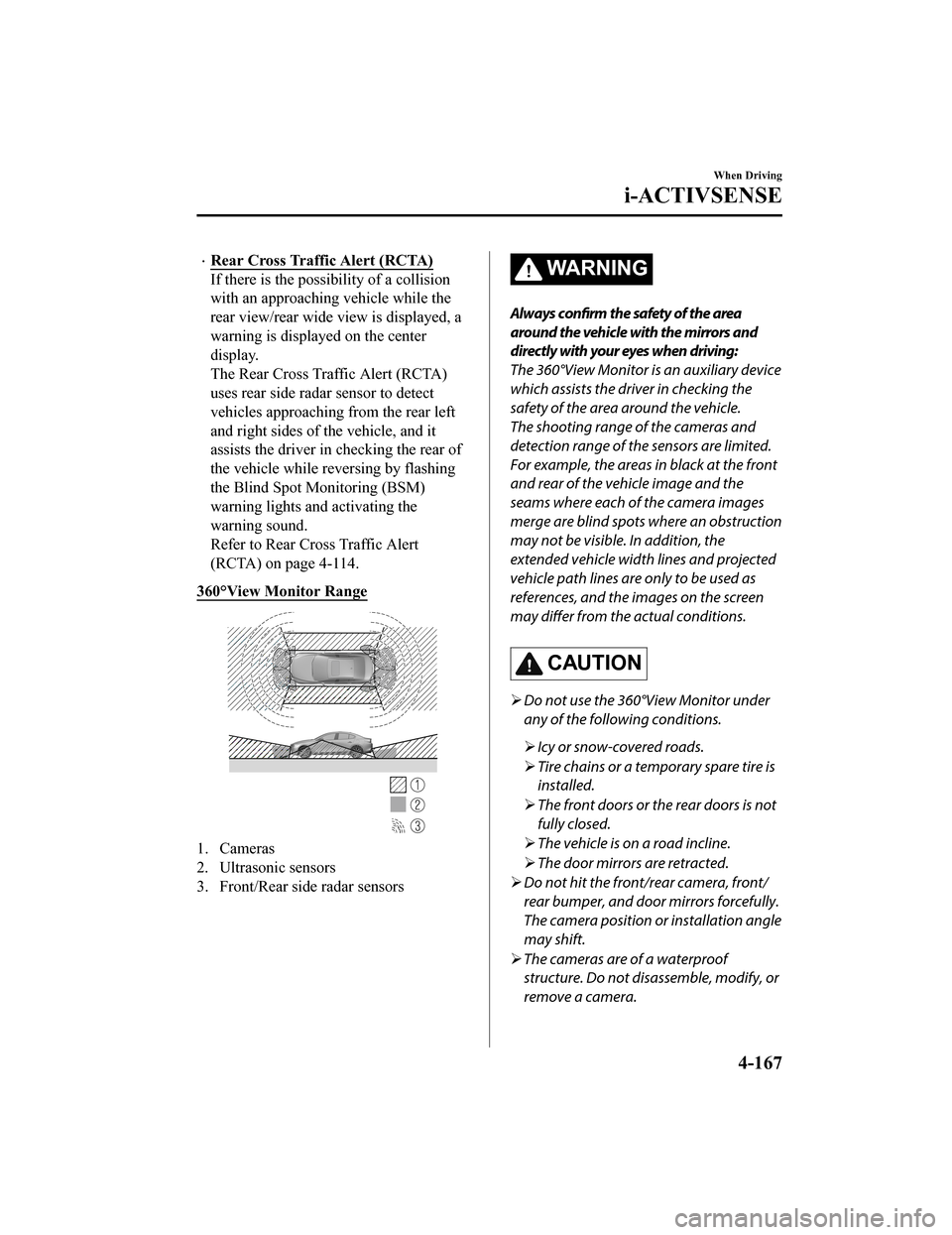
360°View Monitor Range
1. Cameras
2. Ultrasonic sensors
3. Front/Rear side radar sensors
WA R N I N G
Always confirm the safety of the area
around the vehicle with the mirrors and
directly with your eyes when driving:
The 360°View Monitor is an auxiliary device
which assists the driver in checking the
safety of the area around the vehicle.
The shooting range of the cameras and
detection range of the sensors are limited.
For example, the areas in black at the front
and rear of the vehicle image and the
seams where each of the camera images
merge are blind spots where an obstruction
may not be visible. In addition, the
extended vehicle width lines and projected
vehicle path lines are only to be used as
references, and the images on the screen
may differ from the actual conditions.
CAUTION
Do not use the 360°View Monitor under
any of the following conditions.
Icy or snow-covered roads.
Tire chains or a te mporary spare tire is
installed.
The front doors or the rear doors is not
fully closed.
The vehicle is on a road incline.
The door mirrors are retracted.
Do not hit the front/rear camera, front/
rear bumper, and door mirrors forcefully.
The camera position or installation angle
may shift.
The cameras are of a waterproof
structure. Do not disassemble, modify, or
remove a camera.
When Driving
i-ACTIVSENSE
4-167
Mazda3_8HZ1-EA-19G_Edition1_old 2019-5-17 13:49:03
Page 312 of 598
The camera cover is made of hard
plastic, therefore do not apply oil film
remover, organic solvents, wax, or
coating agents. If any such agent gets on
the camera cover, wipe it
off using a soft
cloth immediately.
Do not rub the camera lens forcefully, or
clean it with an abrasive or hard brush.
Otherwise, it could scratch the camera
lens and negatively affect the images.
Consult an Authorized Mazda Dealer for
repair, painting, or replacement of the
front/rear camera, front/rear bumper
and door mirrors.
Heed the following cautions to assure
that the 360°View Monitor operates
normally.
Do not modify the vehicle suspensions
or lower/raise the vehicle body, or
both.
Always use wheels of the
specified type
and size for the front and rear wheels.
Consult an Authorized Mazda Dealer
for tire replacement.
When the display is cold, images may
leave trails or the screen might be darker
than usual, making it
difficult to check
the vehicle surroundings. Always confirm
the safety at the front and around the
vehicle visually when driving.
The method for parking/stopping the
vehicle using the 360°View Monitor
differs depending on the road
circumstances/conditions and the
vehicle conditions. When and how much
you turn the steering wheel will differ
depending on the situation, , therefore
always check the vehicle surroundings
directly with your eyes while using the
system.Also, before using the system, always
make sure that the vehicle can be
parked/stopped in the parking/stopping
space.
NOTE
If there are water droplets, snow, or mud
on the camera lens, wipe it off using a
soft cloth. If the camera lens is
especially dirty, wash it off with mild
detergent.
If the camera lens is touched or there is
any dirt on it, it could affect the screen
image. Wipe the lens using a soft cloth.
If the area where the camera is
installed, such as the front/rear bumper
or door mirrors, has been damaged in a
vehicle accident, the camera (position,
installation angle) may have shifted.
Always consult an Authorized Mazda
Dealer to have the vehicle inspected.
If the camera is subjected to excessive
changes in temperature such as by
pouring hot water on the camera during
cold weather, the 360°View Monitor may
not operate normally.
If the battery voltage is low, the screen
might be temporarily difficult to view,
however, this does not indicate a
problem.
The 360°View Monitor has limitations.
Objects under the bumper or near both
ends of the bumper cannot be displayed.
Obstructions above the upper image
range of the camera are not displayed.
Under the following conditions, the
screen might be difficult to view,
however this does not indicate a
problem.
When Driving
i-ACTIVSENSE
4-168
Mazda3_8HZ1-EA-19G_Edition1_old 2019-5-17 13:49:03
Page 313 of 598

The temperature near the lens is high/
low.
Rainy conditions, water droplets on
the camera, or high humidity.
Mud or foreign matter near the
camera.
Extremely bright light such as sunlight
or headlights hitting the camera lens
directly.
The surroundings are illuminated by
vehicle lights, fluorescent lights, or
LED lights (Display may flicker).
Extremely small dark or white dots
appear on the screen (dots may
flicker).
Because the 360°View Monitor camera
uses a special lens, the distance
displayed on the screen differs from the
actual distance.
Obstructions displayed on the screen
may appear differently than in actuality.
(Obstructions may appear fallen, larger,
or longer than they actually are.)
Do not apply stickers to a camera or the
area around it. In addition, do not
install accessories or an illuminated
number/character license plate to the
area around a camera. Otherwise, the
camera may not correctly display the
surrounding conditions.
Free/open source software information
This product includes free/open sources.
Information about the licensing and
source code is available at the following
URL.
https://www.denso.com/global/en/
opensource/svss/mazda/
When Driving
i-ACTIVSENSE
4-169
Mazda3_8HZ1-EA-19G_Edition1_old2019-5-17 13:49:03
Page 345 of 598

Be careful not to scratch the Forward
Sensing Camera (FSC) lens or allow it
to get dirty.
Do not remove the Forward Sensing
Camera (FSC) cover.
Do not place objects on the dashboard
which
reflect light.
Always keep the windshield glass
around the camera clean by removing
dirt or fogging. Use the windshield
defroster to remove fogging on the
windshield.
Consult an Authorized Mazda Dealer
regarding cleaning the interior side of
the windshield around the Forward
Sensing Camera (FSC).
Consult an Authorized Mazda Dealer
before performing repairs around the
Forward Sensing Camera (FSC).
The Forward Sensing Camera (FSC) is
installed to the windshield. Consult an
Authorized Mazda Dealer for
windshield repair and replacement.
When cleaning the windshield, do not
allow glass cleaners or similar cleaning
fluids to get on the Forward Sensing
Camera (FSC) lens. In addition, do not
touch the Forward Sensing Camera
(FSC) lens.
When performing repairs around the
rearview mirror, consult an Authorized
Mazda Dealer.
Consult an Authorized Mazda Dealer
regarding cleaning of the camera lens.Do not hit or apply strong force to the
Forward Sensing Camera (FSC) or the
area around it. If the Forward Sensing
Camera (FSC) is severely hit or if there
are cracks or damage caused by
flying
gravel or debris in the area around it,
stop using the following systems and
consult an Authorized Mazda Dealer.
High Beam Control System (HBC)
Lane Departure Warning System
(LDWS)
Traffic Sign Recognition System
(TSR)
Distance & Speed Alert (DSA)
Driver Attention Alert (DAA)
Driver Monitoring (DM)
Mazda Radar Cruise Control (MRCC)
Mazda Radar Cruise Control with
Stop & Go function (MRCC with Stop
& Go function)
Lane-keep Assist System (LAS)
Traffic Jam Assist (TJA)
Smart Brake Support (SBS)
The direction in which the Forward
Sensing Camera (FSC) is pointed has
been finely adjusted. Do not change
the installation position of the Forward
Sensing Camera (FSC) or remove it.
Otherwise, it could result in damage or
malfunction.
Always use tires for all wheels that are of
the specified size, and the same
manufacturer, brand, and tread pattern.
In addition, do not use tires with
significantly different wear patterns on
the same vehicle as the system may not
operate normally.
When Driving
i-ACTIVSENSE
4-201
Mazda3_8HZ1-EA-19G_Edition1_old 2019-5-17 13:49:03
Page 346 of 598

The Forward Sensing Camera (FSC)
includes a function for detecting a soiled
windshield and informing the driver,
however, depending on the conditions, it
may not detect plastic shopping bags, ice
or snow on the windsh ield. In such cases,
the system cannot accurately determine
a vehicle ahead and may not be able to
operate normally. Always drive carefully
and pay attention to the road ahead.
NOTE
In the following cases, the Forward
Sensing Camera (FSC) cannot detect
target objects correctly, and each system
may be unable to operate normally.
The height of the vehicle ahead is low.
You drive your vehicle at the same
speed as the vehicle ahead.
Headlights are not turned on during
the night or when going through a
tunnel.
In the following cases, the Forward
Sensing Camera (FSC) may not be able
to detect target objects correctly.
Under bad weather condition, such as
rain, fog and snow.
The window washer is being used or
the windshield wipers are not used
when it's raining.
Ice, fog, snow, frost, rainfall, dirt, or
foreign matter such as a plastic bag is
stuck on the windshield.
Trucks with low lo ading platforms and
vehicles with an extremely low or high
profile.
When driving next to walls with no
patterning (including fences and
longitudinally striped walls).
The taillights of the vehicle ahead are
turned off.
A vehicle is outside the illumination
range of the headlights.
The vehicle is making a sharp turn, or
ascending or descending a steep
slope.
Entering or exiting a tunnel.
Heavy luggage is loaded causing the
vehicle to tilt.
Strong light is shone at the front of the
vehicle (back light or high-beam light
from on-coming vehicles).
There are many light emitters on the
vehicle ahead.
When the vehicle ahead is not
equipped with taillights or the
taillights are turned off at nighttime.
Elongated luggage or cargo is loaded
onto installed roof rails and covers
the Forward Sensing Camera (FSC).
Exhaust gas from the vehicle in front,
sand, snow, and water vapor rising
from manholes and grating, and water
splashed into the air.
When towing a malfunctioning
vehicle.
The vehicle is driven with tires having
significantly different wear.
The vehicle is driven on down slopes
or bumpy roads.
There are water puddles on the road.
The surroundings are dark such as
during the night, early evening, or
early morning, or in a tunnel or
indoor parking lot.
The illumination brightness of the
headlights is reduced or the headlight
illumination is weakened due to dirt
or a deviated optical axis.
When Driving
i-ACTIVSENSE
4-202
Mazda3_8HZ1-EA-19G_Edition1_old 2019-5-17 13:49:03
Page 347 of 598
The target object enters the blind spot
of the Forward Sensing Camera
(FSC).
A person or object bursts onto the
road from the shoulder or cuts right in
front of you.
You change lanes and approach a
vehicle ahead.
When driving extremely close to the
target object.
Tire chains or a temporary spare tire
is installed.
The vehicle ahead has a special
shape. For example, a vehicle towing
a trailer house or a boat, or a vehicle
carrier carrying a vehicle with its
front pointed rearward.
If the Forward Sensing Camera (FSC)
cannot operate normally due to rain,
backlight, or fog, the system functions
related to the Forward Sensing Camera
(FSC) are temporarily stopped and the
following warning lights turn on.
However, this does not indicate a
malfunction.
High Beam Control System (HBC)
warning indication/warning light
(amber)
i-ACTIVSENSE warning indication/
warning light
If the Forward Sensing Camera (FSC)
cannot operate normally due to high
temperatures, the system functions
related to the Forward Sensing Camera
(FSC) are temporarily stopped and the
following warning lights turn on.
However, this does not indicate a
malfunction. Cool down the area around
the Forward Sensing Camera (FSC)
such as by turning on the air
conditioner.
High Beam Control System (HBC)
warning indication/warning light
(amber)
i-ACTIVSENSE warning indication/
warning light
If the Forward Sensing Camera (FSC)
detects that the windshield is dirty or
foggy, the system functions related to the
Forward Sensing Camera (FSC) are
temporarily stopped and the following
warning lights turn on. However, this
does not indicate a problem. Remove the
dirt from the windshield or press the
defroster switch and defog the
windshield.
High Beam Control System (HBC)
warning indication/warning light
(amber)
i-ACTIVSENSE warning indication/
warning light
If there are recognizable cracks or
damage caused by flying gravel or
debris on the windshield, always have
the windshield replaced. Consult an
Authorized Mazda Dealer for
replacement.
The Forward Sensing Camera (FSC)
recognizes pedestrians when all of the
following conditions are met:
The height of a pedestrian is about 1
to 2 meters.
An outline such as the head, both
shoulders, or the legs can be
determined.
In the following cases, the Forward
Sensing Camera (FSC) may not be able
to detect target objects correctly:
Multiple pedestrians are walking, or
there are groups of people.
When Driving
i-ACTIVSENSE
4-203
Mazda3_8HZ1-EA-19G_Edition1_old 2019-5-17 13:49:03
Page 349 of 598
CAUTION
Heed the following precautions to assure
correct operation of each system.
Do not adhere stickers (including
transparent stickers) to the surface of the
radiator grille and front emblem in and
around the front radar sensor, and do
not replace the radiator grille and front
emblem with any product that is not a
genuine product designed for use with
the front radar sensor.
The front radar sensor includes a
function for detecting soiling of the radar
sensor's front surface and informing the
driver, however, depending on the
conditions, it may require time to detect
or it may not detect plastic shopping
bags, ice or snow. If this occurs, the
system may not operate correctly,
therefore always keep the front radar
sensor clean.
Do not install a grille guard.
If the front part of the vehicle has been
damaged in a vehicle accident, the
position of the front radar sensor may
have moved. Stop the system
immediately and always have the vehicle
inspected at an Authorized Mazda
Dealer.
Do not use the front bumper to push
other vehicles or obstructions such as
when pulling out of a parking space.
Otherwise, the front radar sensor could
be hit and its position deviated.
Do not remove, disa ssemble, or modify
the front radar sensor.
For repairs, replacement or paint work
around the front radar sensor, consult an
Authorized Mazda Dealer.
Do not modify the suspension. If the
suspension are modified, the vehicle's
posture could change and the front
radar sensor may not be able to correctly
detect a vehicle ahead or an obstruction.
NOTE
Under the following co nditions, the front
radar sensor may not be able to detect
vehicles ahead or obstructions correctly
and each system may not operate
normally.
The rear surface of a vehicle ahead
does not reflect radio waves
effectively, such as an unloaded
trailer or an automobile with a
loading platform covered by a soft
top, vehicles with a hard plastic
tailgate, and round-shaped vehicles.
Vehicles ahead with low vehicle height
and thus less area for reflecting radio
waves.
Visibility is reduced due to a vehicle
ahead casting off water, snow, or sand
from its tires and onto your
windshield.
The trunk/luggage compartment is
loaded with heavy objects or the rear
passenger seats are occupied.
Ice, snow, or soiling is on the front
surface of the front emblem.
During inclement weather such as
rain, snow, or sand storms.
When driving near facilities or objects
emitting strong radio waves.
Under the following co nditions, the front
radar sensor may not be able to detect
vehicles ahead or obstructions.
The beginning and end of a curve.
Roads with continuous curves.
When Driving
i-ACTIVSENSE
4-205
Mazda3_8HZ1-EA-19G_Edition1_old 2019-5-17 13:49:03