Insta MAZDA MODEL 3 HATCHBACK 2020 (in English) Workshop Manual
[x] Cancel search | Manufacturer: MAZDA, Model Year: 2020, Model line: MODEL 3 HATCHBACK, Model: MAZDA MODEL 3 HATCHBACK 2020Pages: 598, PDF Size: 89.37 MB
Page 225 of 598
i-ACTIV AWD Operation*
▼i-ACTIV AWD Operation
AWD provides excellent drivability on
snow-covered and ice-packed roads, sand
and mud, as well as on steep slopes and
other slippery surfaces.
A system malfunction or operation
conditions are indicated by a warning.
Refer to Contact a
n Authorized Mazda
Dealer and AWD Warning Indication/
Warning Light on page 7-31.
WA R N I N G
Never spin a wheel that is off the ground:
Spinning a wheel that is off the ground as a
result of the vehicle being stuck or in a
ditch is dangerous. The drive assembly
could be seriously damaged which could
lead to an accident or could even lead to
overheating, oil leakage, and a fire.
▼ AWD Driving
This vehicle has not been designed for the
purpose of off-road driving or rallies. Do
not attempt to drive over uneven or rocky
surfaces, or across rivers.
Although this vehicle is equipped with
AWD, acceleration, steering and braking
operations should be conducted in the
same manner as with a non-AWD vehicle,
with the emphasis placed on safe driving.
▼Tires and Tire Chains
The condition of the tires plays a large role
in the performance of the vehicle.
Moreover, to prevent adverse effects to the
drive assembly, please note the following:
Tires
When replacing tires, always replace all
front and rear tires at the same time.
All tires must be of the same size,
manufacture, brand and tread pattern.
Pay particular attention when equipping
snow or other types of winter tires.
Do not mix tread-worn tires with normal
tires.
Inspect tire inflation pressures at the
specified periods adjust to the specified
pressures.
NOTE
Check the tire inflation pressure label
attached to driver's door frame for the
correct tire inflation pressure.
Make sure to equip the vehicle with
genuine wheels of the specified size, on
all wheels. With AWD, the system is
calibrated for all 4 wheels being of the
same dimensions.
Tire chains
Install tire chains to the front tires.
Do not use tire chains on the rear
wheels.
Do not drive the vehicle faster than 30
km/h (19 mph) with the tire chains
installed.
Do not drive the vehicle with tire chains
on road conditions other than snow or
ice.
▼ To w i n g
If the vehicle requires towing, have it
towed with all 4 wheels completely off the
ground.
Refer to Towing Description on page
7-23.
When Driving
i-ACTIV AWD
*Some models.4-81
Mazda3_8HZ1-EA-19G_Edition1_old
2019-5-17 13:49:03
Page 228 of 598
▼Pre-Crash Safety Technology
Pre-crash safety technology is designed to
assist the driver in averting collisions or
reducing their severity in situations where
they cannot be avoided.
Collision damage reduction
Forward driving
Smart Brake Support (SBS)...... page 4-155
Reverse driving
Smart Brake Support [Rear]
(SBS-R).................................... page 4-157
Smart Brake Support [Rear Crossing]
(SBS-RC).................................. page 4-161
▼Camera and Sensors
Forward Sensing Camera (FSC)
The Forward Sensing Camera (FSC)
detects lane indications and recognizes
headlights, taillights and city lights during
nighttime driving. In addition, it also
detects the vehicle ahead, pedestrians, or
obstructions. The following systems use
the Forward Sens
ing Camera (FSC).
High Beam Control system (HBC)
Lane Departure Warning System
(LDWS)
Traffic Sign Recognition System (TSR)
Distance & Speed Alert (DSA)
Driver Attention Alert (DAA)
Driver Monitoring (DM)
Mazda Radar Cruise Control (MRCC)
Mazda Radar Cruise Control with Stop
& Go function (MRCC with Stop & Go
function)
Lane-keep Assist System (LAS)
Traffic Jam Assist (TJA)
Smart Brake Support (SBS)
The Forward Sensin g Camera (FSC) is
installed at the top of the windshield near
the rearview mirror.
Refer to Forward Sensing Camera (FSC)
on page 4-200.
Front radar sensor
The front radar sensor detects radio waves
reflected off a vehicle ahead sent from the
radar sensor. The following systems use
the front radar sensor.
Distance & Speed Alert (DSA)
Mazda Radar Cruise Control (MRCC)
Mazda Radar Cruise Control with Stop
& Go function (MRCC with Stop & Go
function)
Traffic Jam Assist (TJA)
Smart Brake Support (SBS)
The front radar sensor is mounted behind
the radiator grille.
Refer to Front Radar Sensor on page
4-204.
Front side radar sensor
The front side radar sensors detects radio
waves reflected off a vehicle ahead sent
from the radar sensor. The following
systems use the front side radar sensor.
Front Cross Traffic Alert (FCTA)
The front side radar sensors are installed
inside the front bumper, one on the left
side and one on the right side.
Refer to Front Side Radar Sensor on page
4-206.
When Driving
i-ACTIVSENSE
4-84
Mazda3_8HZ1-EA-19G_Edition1_old 2019-5-17 13:49:03
Page 229 of 598
Rear side radar sensor
The rear side radar sensors detects radio
waves reflected off a vehicle approaching
from the rear or an obstruction sent from
the radar sensors. The following systems
use the rear side radar sensor.
Blind Spot Monitoring (BSM)
Rear Cross Traffic Alert (RCTA)
Smart Brake Support [Rear Crossing]
(SBS-RC)
The rear side radar sensors are installed
inside the rear bumper, one on the left side
and one on the right side.
Refer to Rear Side Radar Sensor on page
4-208.
Rear/rear corner/rear side ultrasonic
sensor
The ultrasonic sensor detects ultrasonic
waves reflected off obstructions at the rear
sent from the ultr asonic sensors. The
following systems use the ultrasonic
sensor.
Smart Brake Support [Rear] (SBS-R)
Smart Brake Support [Rear Crossing]
(SBS-RC)
The ultrasonic sensors are mounted in the
rear bumper.
Refer to Rear/Rear corner/Rear Side
Ultrasonic Sensor on page 4-209.
Front camera/side cameras/rear camera
The front camera, side cameras, and rear
camera shoot images of the area
surrounding the vehicle. The 360°View
Monitor uses each camera.
Cameras are installed to the front bumper,
door mirrors, and rear bumper.
Refer to Front Camera/Side Cameras/Rear
Camera on page 4-210.
Driver monitoring camera
The driver monitoring camera detects
changes in the driver's facial features and
estimates the amount of accumulated
fatigue and sleepiness of the driver. The
following systems use the driver
monitoring camera.
Driver Monitoring (DM)
The driver monitoring camera is mounted
in the center display.
Refer to Driver Monitoring Camera on
page 4-211.
▼ i-ACTIVSENSE Status Symbol
(Warning/Risk Avoidance Support
System)
*
The system notifies t
he driver of any of
the following system status using the color
or OFF indication of the i-ACTIVSENSE
status symbol (Warning/risk avoidance
support system).
Lane Departure Warning System
(LDWS)
Blind Spot Monitoring (BSM)
Distance & Speed Alert (DSA)
Front Cross Traffic Alert (FCTA)
Rear Cross Traffic Alert (RCTA)
Lane-keep Assist System (LAS)
NOTE
The status of the system turned on using
the personalization feature is displayed.
When Driving
i-ACTIVSENSE
*Some models.4-85
Mazda3_8HZ1-EA-19G_Edition1_old 2019-5-17 13:49:03
Page 239 of 598
The vehicle speed is about 10 km/h
(6.3 mph) or faster.
The BSM will not operate under the
following circumstances.
The vehicle speed falls below about
10 km/h (6.3 mph) even though the
i-ACTIVSENSE warning indication/
warning light is turned off.
The shift lever (manual transmission)/
selector lever (automatic
transmission) is shifted to reverse (R)
and the vehicle is reversing.
The turning radius is small (making a
sharp turn, turning at intersections).
In the following cases, the
i-ACTIVSENSE warning indication/
warning light turns on and operation of
the system is stopped. If the
i-ACTIVSENSE warning indication/
warning light remains illuminated, have
the vehicle inspected at an Authorized
Mazda Dealer as soon as possible.
Some problem with the system
including the BSM warning indicator
lights is detected.
A large deviation in the installation
position of a rear side radar sensor on
the vehicle has occurred.
There is a large accumulation of snow
or ice on the rear bumper near a rear
side radar sensor. Remove any snow,
ice or mud on the rear bumper.
Driving on snow-covered roads for
long periods.
The temperature near the rear side
radar sensor becomes extremely hot
due to driving for long periods on
slopes during the summer.
The battery voltage has decreased.
Under the following conditions, the rear
side radar sensor cannot detect target
objects or it may be difficult to detect
them.
The rear bumper around the rear side
radar sensor is deformed.
Radio wave interference from a radar
sensor equipped on a nearby vehicle.
The approaching vehicle is any of the
following shapes.
a) The size of the vehicle body is extremely small.
b) The vehicle height is extremely low or high.
c) A special type of vehicle with a complex shape.
A vehicle is in the detection area at
the rear in an adjacent driving lane
but it does not approach. The BSM
determines the condition based on
radar detection data.
A vehicle is traveling alongside your
vehicle at nearly the same speed for
an extended period of time.
Vehicles approaching in the opposite
direction.
A vehicle in an adjacent driving lane
is attempting to pass your vehicle.
A vehicle is in an adjacent lane on a
road with extremely wide driving
lanes. The detection area of the rear
side radar sensor is set at the road
width of expressways.
In the following case, the flashing of the
BSM warning in dicator light, and the
activation of the warning sound and the
warning screen indicator display may
not occur or they may be delayed.
A vehicle makes a lane change from a
driving lane two lanes over to an
adjacent lane.
When Driving
i-ACTIVSENSE
4-95
Mazda3_8HZ1-EA-19G_Edition1_old 2019-5-17 13:49:03
Page 240 of 598
Driving on steep slopes.
Crossing the summit of a hill or
mountain pass.
When there is a difference in the
height between your driving lane and
the adjacent lane.
Directly after the BSM system
becomes operable by changing the
setting.
If the road width is extremely narrow,
vehicles two lanes over may be detected.
The detection area of the rear side radar
sensor is set according to the road width
of expressways.
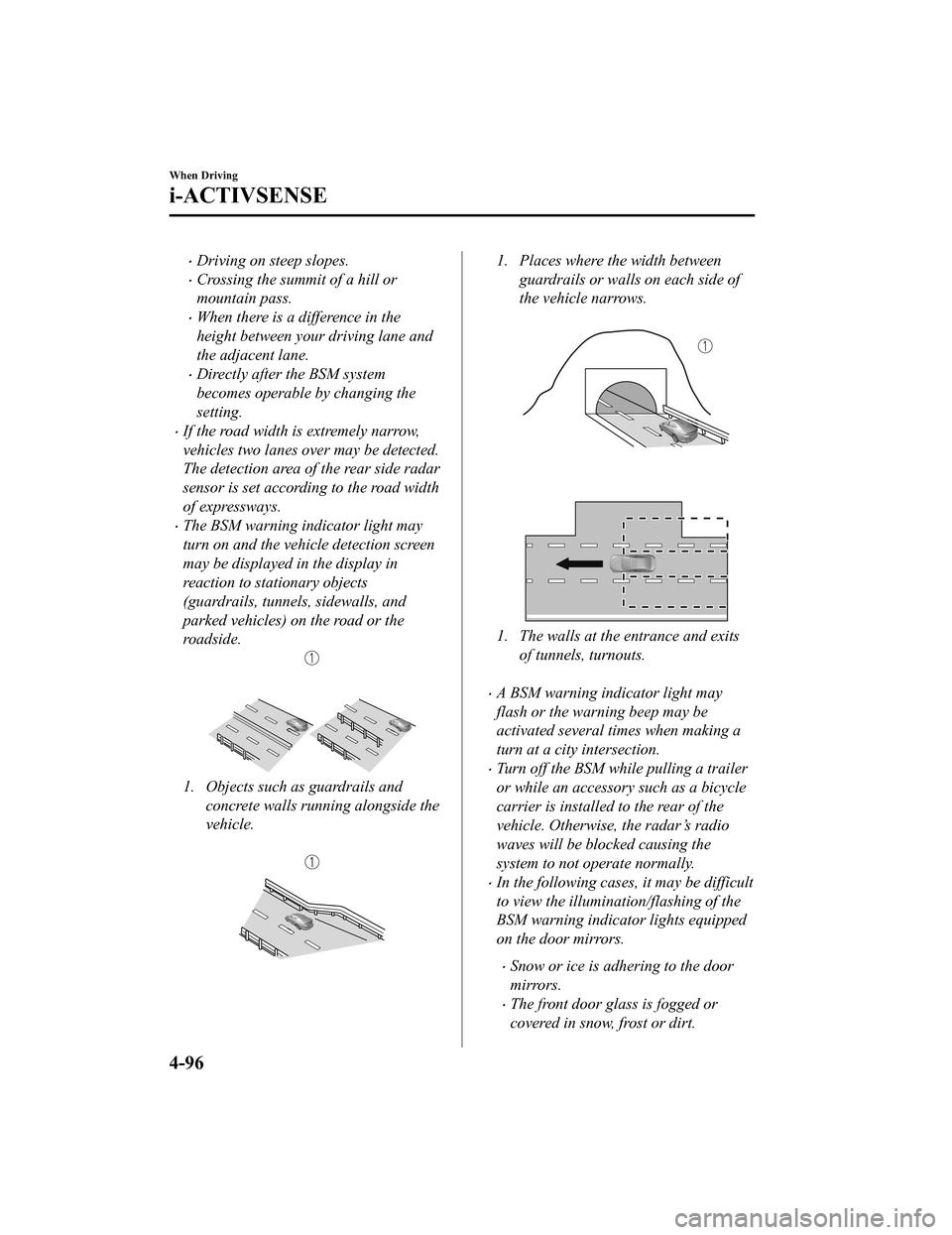
The BSM warning indicator light may
turn on and the vehicle detection screen
may be displayed in the display in
reaction to stationary objects
(guardrails, tunnels, sidewalls, and
parked vehicles) on the road or the
roadside.
1. Objects such as guardrails andconcrete walls running alongside the
vehicle.
1. Places where the width between guardrails or walls on each side of
the vehicle narrows.
1. The walls at the entrance and exits of tunnels, turnouts.
A BSM warning indicator light may
flash or the warning beep may be
activated several times when making a
turn at a city intersection.
Turn off the BSM while pulling a trailer
or while an accessory such as a bicycle
carrier is installed to the rear of the
vehicle. Otherwise, the radar’s radio
waves will be blocked causing the
system to not operate normally.
In the following cases, it may be difficult
to view the illumination/flashing of the
BSM warning indicator lights equipped
on the door mirrors.
Snow or ice is adhering to the door
mirrors.
The front door glass is fogged or
covered in snow, frost or dirt.
When Driving
i-ACTIVSENSE
4-96
Mazda3_8HZ1-EA-19G_Edition1_old 2019-5-17 13:49:03
Page 258 of 598
The front side radar sensor
installation position is greatly
deviated.
There is a large accumulation of snow
or ice on the front bumper near a front
side radar sensor.
The temperature near the radar
sensors becomes extremely hot due to
driving for a long time on slopes
during the summer.
The battery voltage has decreased.
The front side radar sensor of the
FCTA may be regulated under the
radio wave related laws of the country
where the vehicle is driven. If this
system is used abroad, it may be
necessary to turn off the system.
Refer to Front Side Radar Sensor on
page 4-206.
▼ Canceling Operation of Front Cross
Traffic Alert (FCTA)
The FCTA can be set to inoperable.
(If only the FCTA is turned off)
Refer to the Settings section in the
Mazda Connect Owner's Manual.
(If the FCTA is turned off by
operating the i-ACT
IVSENSE switch)
Refer to i-ACTIVSENSE Switch on
page 4-87.
NOTE
If the ignition is switched OFF while you
have canceled the system using the
i-ACTIVSENSE swit ch, the system is
automatically enabled the next time the
ignition is switched ON. However, if the
system is canceled using the
personalization features, the system is not
automatically enabled.
Rear Cross Traffic Alert
(RCTA)
*
▼Rear Cross Traffic Alert (RCTA)
The RCTA system is des
igned to assist the
driver in checking the area to the rear left
and right sides of your vehicle while your
vehicle is reversing by alerting the driver
to the presence of vehicles approaching
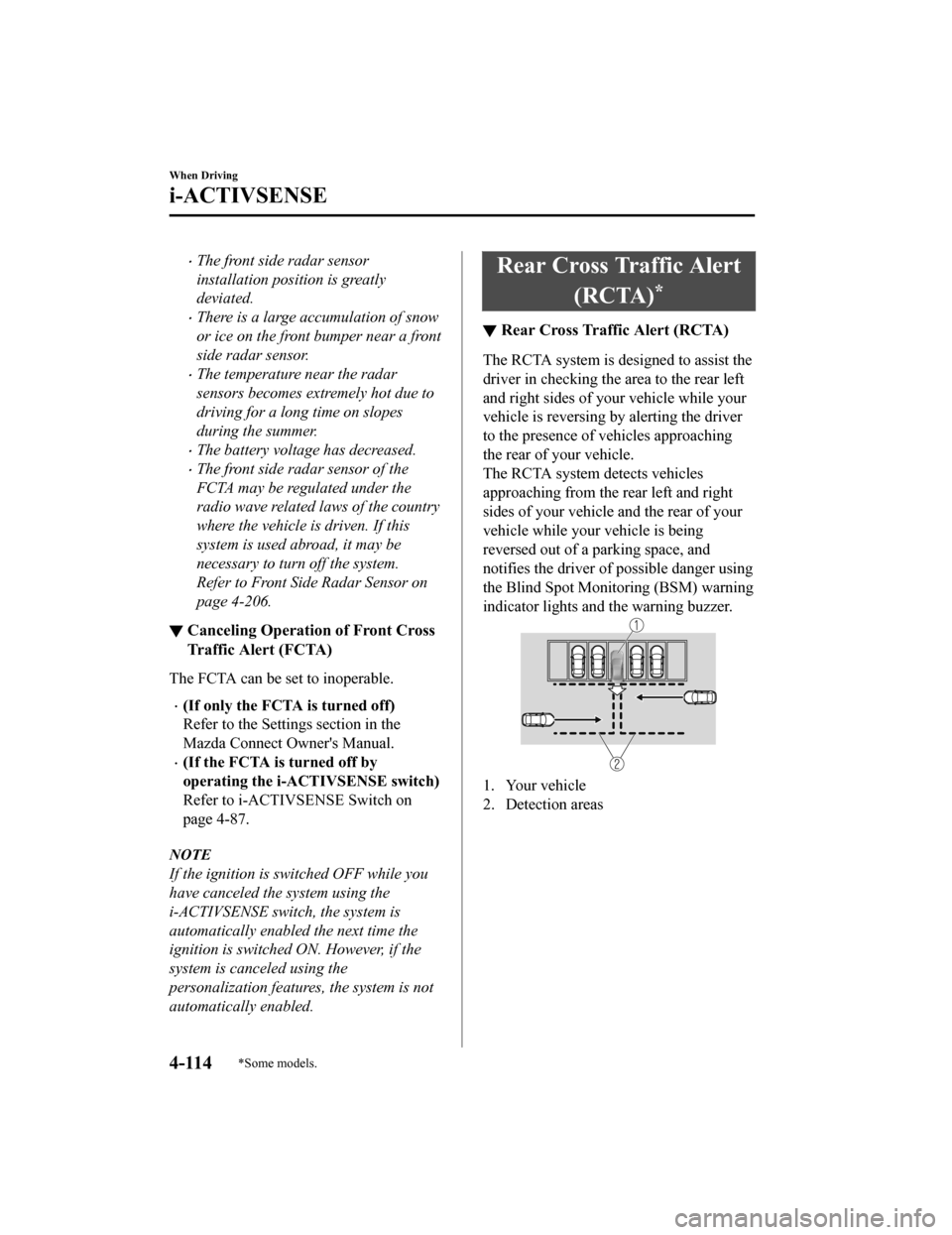
the rear of your vehicle.
The RCTA system detects vehicles
approaching from the rear left and right
sides of your vehicle and the rear of your
vehicle while your vehicle is being
reversed out of a parking space, and
notifies the driver of possible danger using
the Blind Spot Monitoring (BSM) warning
indicator lights and the warning buzzer.
1. Your vehicle
2. Detection areas
When Driving
i-ACTIVSENSE
4-114*Some models.
Mazda3_8HZ1-EA-19G_Edition1_old 2019-5-17 13:49:03
Page 260 of 598

A vehicle approaching from the rear
left and right side of your vehicle
slows down.
A vehicle approaching from the rear
left and right side of your vehicle
makes a right or left turn directly in
front of your vehicle.
A vehicle overtakes your vehicle while
it is stopped.
Your vehicle is in an area where
strong radio waves or electrical noise
may occur such as near a television
tower or power plant.
In the following cases, the
i-ACTIVSENSE warning indication/
warning light turns on and operation of
the system is stopped. If the
i-ACTIVSENSE warning indication/
warning light remains illuminated, have
the vehicle inspected at an Authorized
Mazda Dealer as soon as possible.
Some problem with the system
including the Blind Spot Monitoring
(BSM) warning indicator lights has
occurred.
A large deviation in the installation
position of a rear side radar sensor on
the vehicle has occurred.
There is a large accumulation of snow
or ice on the rear bumper near a rear
side radar sensor.
Driving on snow-covered roads for
long periods.
The temperature near the radar
sensors becomes extremely hot due to
driving for long periods on slopes
during the summer.
The battery voltage has decreased.
Under the following conditions, the rear
side radar sensor cannot detect
approaching vehicles or it might be
difficult to detect them, and the system
may not operate normally.
The vehicle speed when reversing is
about 15 km/h (9 mph) or faster.
The rear side radar sensor detection
area is obstructed by a nearby wall or
parked vehicle. (Reverse the vehicle to
a position where the radar sensor
detection area is no longer
obstructed.)
1. Your vehicle
A vehicle is approaching directly from
the rear of your vehicle.
1. Your vehicle
The vehicle is parked at an angle.
1. Your vehicle
When Driving
i-ACTIVSENSE
4-116
Mazda3_8HZ1-EA-19G_Edition1_old 2019-5-17 13:49:03
Page 261 of 598
Directly after the RCTA system
becomes operable using the
personalization feature.
Radio wave interference from a radar
sensor equipped on a nearby parked
vehicle.
In the following cases, it may be difficult
to view the illumination/flashing of the
Blind Spot Monitoring (BSM) warning
indicator lights equipped on the door
mirrors.
Snow or ice adheres to the door
mirrors.
The front door glass is fogged or
covered in snow, frost or dirt.
Turn off the RCTA system while pulling
a trailer or while an accessory such as a
bicycle carrier is installed to the rear of
the vehicle. Otherwise, the radio waves
emitted by the radar will be blocked
causing the system to not operate
normally.
The rear side radar sensor of the RCTA
may be regulated under the radio wave
related laws of the country where the
vehicle is driven. If this system is used
abroad, it may be necessary to turn off
the system.
Refer to Rear Side Radar Sensor on
page 4-208.
▼Canceling Operation of Rear Cross
Traffic Alert (RCTA)
The RCTA can be set to inoperable.
(If only the RCT
A is turned off)
Refer to the Settings section in the
Mazda Connect Owner's Manual.
(If the RCTA is turned off by
operating the i-ACTIVSENSE switch)
Refer to i-ACTIV SENSE Switch on
page 4-87.
NOTE
If the ignition is switched OFF while you
have canceled the system using the
i-ACTIVSENSE switch, the system is
automatically enabled the next time the
ignition is switched ON. However, if the
system is canceled using the
personalization features, the system is not
automatically enabled.
When Driving
i-ACTIVSENSE
4-117
Mazda3_8HZ1-EA-19G_Edition1_old 2019-5-17 13:49:03
Page 284 of 598
Back-light is reflected off the road
surface or the road surface is wet and
shiny after rain.
The shade of a guardrail parallel to a
white (yellow) lane line is cast on the
road.
The width of a lane is excessively
narrow or wide.
The road is excessively uneven.
The vehicle is shaken after hitting a
road bump.
There are various road markings or
division lines (lane markings) of
various shapes near an intersection.
The area in front of the camera is
soiled or an object that obstructs the
field of view is installed.
Exhaust gas from the vehicle in front,
sand, snow, and water vapor rising
from manholes and grating, and water
splashed into the air.
The surroundings are dark such as
during the early evening or early
morning.
A vehicle ahead with a certain
taillight shape.
A vehicle ahead veers off course from
your vehicle's line of travel.
A vehicle ahead is driving erratically.
The vehicle is driven on roads with
tight curves.
Headway control function
If a vehicle ahead is detected while
traveling at a constant speed, the
vehicle-ahead indication is displayed and
headway control is performed.
Steering assist function
When lane lines are detected, the function
assists the driver in keeping the vehicle
within the lane lines. If lane lines are not
detected, the function provides the driver
driving assistance in keeping the vehicle
along the motion path with the vehicle
ahead.
NOTE
Steering assist limit warning
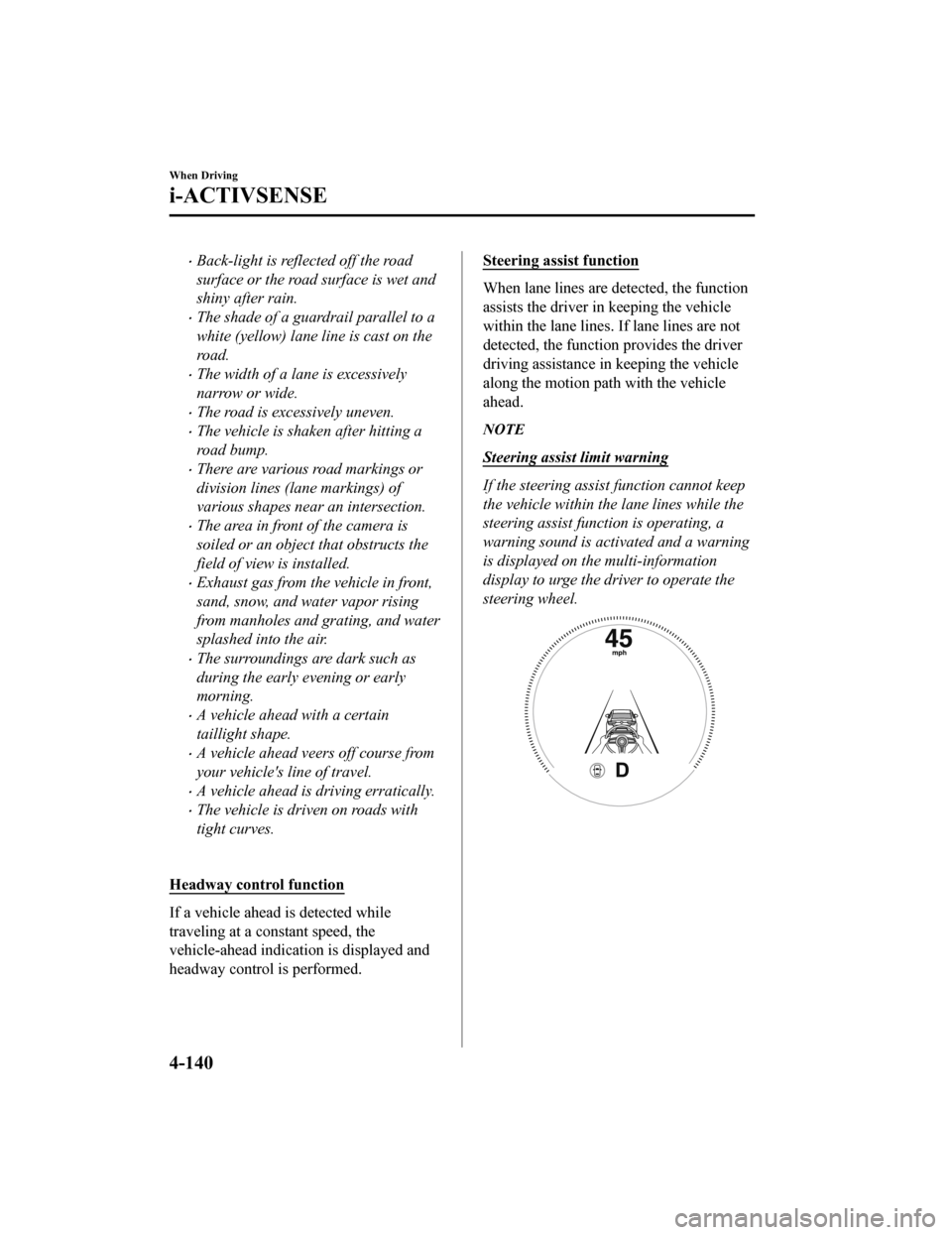
If the steering assist function cannot keep
the vehicle within the lane lines while the
steering assist function is operating, a
warning sound is activated and a warning
is displayed on the multi-information
display to urge the driver to operate the
steering wheel.
When Driving
i-ACTIVSENSE
4-140
Mazda3_8HZ1-EA-19G_Edition1_old 2019-5-17 13:49:03
Page 303 of 598
NOTE
The vehicle posture changes depending
on the accelerator pedal, brake pedal
and steering wheel operations, which
could make it difficult for the system to
recognize an obstruction, or it could
facilitate unnecessary detection. In such
cases, the SBS-R may or may not
operate.
The SBS-R system will operate under the
following conditions.
The engine is running.
The shift lever (manual transmission
vehicle) or the selector lever
(automatic transmission vehicle) is in
the R (reverse) position.
i-ACTIVSENSE warning indication/
warning light is not displayed in the
multi-information display.
The vehicle speed is between about 2
to 8 km/h (2 to 4 mph).
The SBS-R is not turned off.
The DSC is not malfunctioning.
In the following cases, the rear
ultrasonic sensor and rear camera
cannot detect obstructions and the
SBS-R may not operate.
The height of the obstruction is low
such as low walls or trucks with low
loading platforms.
The height of the obstruction is high
such as trucks with high loading
platforms.
The obstruction is small.
The obstruction is thin such as a
signpost.
The surface of the obstruction is not
pointed vertically relative to the
vehicle.
The obstruction is soft such as a
hanging curtain or snow stuck to a
vehicle.
The obstruction is shaped irregularly.
The obstruction is extremely close.
In the following cases, the rear
ultrasonic sensor and rear camera
cannot detect obstructions correctly and
the SBS-R may not operate.
Something is stuck on the bumper
near a rear ultrasonic sensor.
The brake or accelerator pedal is
operated.
There is another obstruction near one
obstruction.
During inclement weather such as
rain, fog and snow.
High or low humidity.
High or low temperatures
Strong winds.
The path of travel is not flat.
Heavy luggage is loaded in the
luggage compartment or on the rear
seat.
Objects such as a wireless antenna,
fog light, or illuminated license plate
is installed near a rear ultrasonic
sensor.
The orientation of a rear ultrasonic
sensor has deviated for reasons such
as a collision.
The vehicle is affected by other sound
waves such as the horn, engine noise,
ultrasonic sensor of another vehicle.
In the following cases, a rear ultrasonic
sensor and rear camera may detect
something as a target obstruction which
could cause the SBS-R system to
operate.
Driving on a steep slope.
Wheel blocks.
When Driving
i-ACTIVSENSE
4-159
Mazda3_8HZ1-EA-19G_Edition1_old 2019-5-17 13:49:03