warning MAZDA MODEL 6 2016 Owners Manual (in English)
[x] Cancel search | Manufacturer: MAZDA, Model Year: 2016, Model line: MODEL 6, Model: MAZDA MODEL 6 2016Pages: 614, PDF Size: 12.82 MB
Page 232 of 614
Black plate (232,1)
Function for cancelling illumination dimmer
When the headlight switch is in the
orposition, the brightness of the Blind Spot
Monitoring (BSM) warning lights is dimmed. If the Blind Spot Monitoring (BSM) warning
lights are difficult to see due to glare from surrounding brightness when traveling on snow-
covered roads or under foggy conditions, press the dimmer cancellation button to cancel
the dimmer and increase the brightness of Blind Spot Monitoring (BSM) warning lights
when they turn on.
Refer to Dashboard Illumination on page 4-14.
Blind Spot Monitoring (BSM) warning beep
The Blind Spot Monitoring (BSM) warning beep is activated simultaneously with the
flashing of a Blind Spot Monitoring (BSM) warning light.
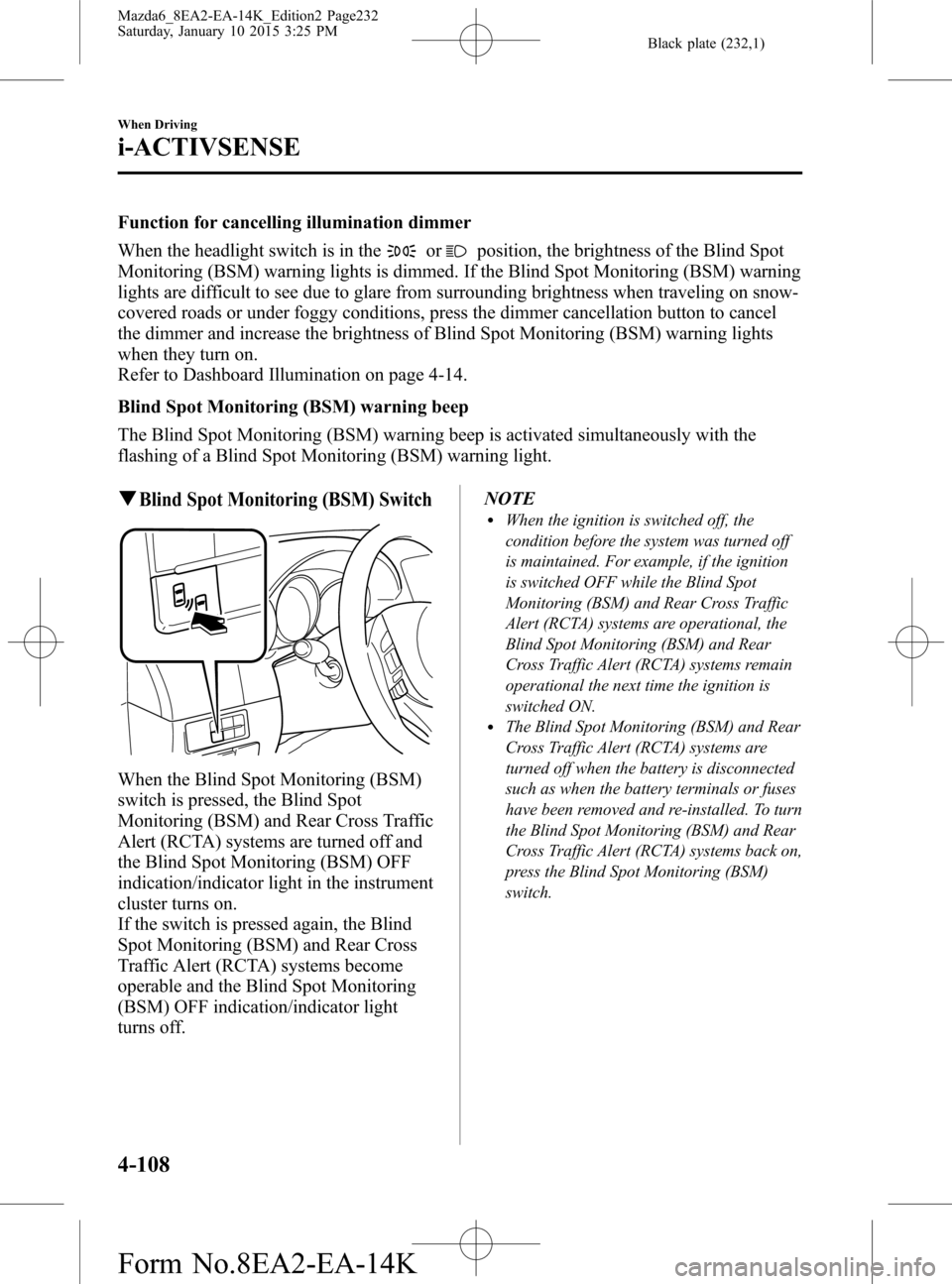
qBlind Spot Monitoring (BSM) Switch
When the Blind Spot Monitoring (BSM)
switch is pressed, the Blind Spot
Monitoring (BSM) and Rear Cross Traffic
Alert (RCTA) systems are turned off and
the Blind Spot Monitoring (BSM) OFF
indication/indicator light in the instrument
cluster turns on.
If the switch is pressed again, the Blind
Spot Monitoring (BSM) and Rear Cross
Traffic Alert (RCTA) systems become
operable and the Blind Spot Monitoring
(BSM) OFF indication/indicator light
turns off.NOTE
lWhen the ignition is switched off, the
condition before the system was turned off
is maintained. For example, if the ignition
is switched OFF while the Blind Spot
Monitoring (BSM) and Rear Cross Traffic
Alert (RCTA) systems are operational, the
Blind Spot Monitoring (BSM) and Rear
Cross Traffic Alert (RCTA) systems remain
operational the next time the ignition is
switched ON.
lThe Blind Spot Monitoring (BSM) and Rear
Cross Traffic Alert (RCTA) systems are
turned off when the battery is disconnected
such as when the battery terminals or fuses
have been removed and re-installed. To turn
the Blind Spot Monitoring (BSM) and Rear
Cross Traffic Alert (RCTA) systems back on,
press the Blind Spot Monitoring (BSM)
switch.
4-108
When Driving
i-ACTIVSENSE
Mazda6_8EA2-EA-14K_Edition2 Page232
Saturday, January 10 2015 3:25 PM
Form No.8EA2-EA-14K
Page 233 of 614

Black plate (233,1)
Distance Recognition
Support System (DRSS)
í
The Distance Recognition Support
System (DRSS) measures the distance
between your vehicle and a vehicle ahead
using a radar sensor (front) while the
vehicle speed is 30 km/h or faster (19
mph or faster), and indicates a
recommended distance to maintain
between the vehicles. Furthermore, if your
vehicle approaches a vehicle ahead more
closely than the appropriate distance to
maintain between the vehicles, the
vehicle-ahead indication in the multi-
information display or the active driving
display (with active driving display) is
flashed to advise the driver to keep a safer
distance from the vehicle ahead.
WARNING
Do not rely completely on the Distance
Recognition Support System (DRSS) and
always drive carefully:
The Distance Recognition Support
System (DRSS) provides advice for
safer driving and notifies the driver of
a recommended, safer distance to
maintain with a vehicle ahead. The
ability to detect a vehicle ahead is
limited depending on the type of
vehicle ahead, the weather
conditions, and the traffic conditions.
Therefore, if the accelerator and
brake pedals are not operated
correctly it could lead to an accident.
Always verify the safety of the
surrounding area and depress the
brake pedal or accelerator pedal
while keeping a safer distance from
vehicles ahead or on-coming vehicles.NOTE
lThe Distance Recognition Support System
(DRSS) operates when all of the following
conditions are met:
lThe ignition is switched ON.lThe Distance Recognition Support
System (DRSS) is on.
lThe selector lever is in a position other
than reverse (R).
lThe vehicle speed is 30 km/h or faster
(19 mph or faster).
lThe objects which activate the system are 4-
wheeled vehicles.
lThe Distance Recognition Support System
(DRSS) may also operate in the presence of
motorcycles and bicycles.
lThe Distance Recognition Support System
(DRSS) may not operate normally under the
following conditions:
lThe Dynamic Stability Control (DSC)
has a malfunction.
lThe vehicle ahead is traveling at an
extremely slow speed.
lThe system does not operate with the
following objects:
lVehicles approaching in the opposite
direction.
lStationary objects (stopped vehicles,
obstructions)
When Driving
i-ACTIVSENSE
4-109íSome models. Mazda6_8EA2-EA-14K_Edition2 Page233
Saturday, January 10 2015 3:25 PM
Form No.8EA2-EA-14K
Page 234 of 614

Black plate (234,1)
qIndication on Display
The Distance Recognition Support System (DRSS) operation status is displayed in the
multi-information display or the active driving display (with active driving display).
Problems are indicated in the center display (Type B audio). If there is a problem, take
appropriate action according to the displayed message.
Refer to Warning/Indicator Lights on page 4-22.
NOTE
lWhen the ignition is switched off, the operation status before the system was turned off is
maintained. For example, if the ignition is switched off with the Distance Recognition Support
System (DRSS) operable, the system will be operable when the ignition is switched ON the next
time.
lThe Distance Recognition Support System (DRSS) can be turned on/off and the system's sensitivity
can be changed.
Refer to Personalization Features on page 9-9.
Vehicle ahead
display
Distance between
vehicle display
4-110
When Driving
i-ACTIVSENSE
Mazda6_8EA2-EA-14K_Edition2 Page234
Saturday, January 10 2015 3:25 PM
Form No.8EA2-EA-14K
Page 236 of 614

Black plate (236,1)
Rear Cross Traffic Alert (RCTA)í
The Rear Cross Traffic Alert (RCTA) system is designed to assist the driver in checking the
area to the rear of the vehicle on both sides while the vehicle is reversing by alerting the
driver to the presence of vehicles approaching the rear of the vehicle.
The Rear Cross Traffic Alert (RCTA) system detects vehicles approaching from the left and
right sides of the vehicle while the vehicle is being reversed out of a parking space, and
notifies the driver of possible danger using the Blind Spot Monitoring (BSM) warning
lights and the warning buzzer.
Detection areas
Your vehicle
Rear Cross Traffic Alert (RCTA) operation
1. The Rear Cross Traffic Alert (RCTA) system operates when the shift lever (manual
transaxle) or the selector lever (automatic transaxle) is shifted to the reverse (R)
position.
4-112
When Driving
íSome models.
i-ACTIVSENSE
Mazda6_8EA2-EA-14K_Edition2 Page236
Saturday, January 10 2015 3:25 PM
Form No.8EA2-EA-14K
Page 237 of 614

Black plate (237,1)
2. If there is the possibility of a collision with an approaching vehicle, the Blind Spot
Monitoring (BSM) warning light flashes and the warning beep is activated
simultaneously.
(With rearview monitor)
The Rear Cross Traffic Alert (RCTA) warning indication in the rearview monitor also
synchronizes with the Blind Spot Monitoring (BSM) warning light on the door mirrors.
(With rearview monitor)
WARNING
Always check the surrounding area visually before actually putting the vehicle in
reverse:
The system is only designed to assist you in checking for vehicles at the rear when
putting the vehicle in reverse. Due to certain limitations with the operation of this
system, the Blind Spot Monitoring (BSM) warning light may not flash or it might be
delayed even though a vehicle is behind your vehicle. Always make it your
responsibility as a driver to check the rear.
When Driving
i-ACTIVSENSE
4-113
Mazda6_8EA2-EA-14K_Edition2 Page237
Saturday, January 10 2015 3:25 PM
Form No.8EA2-EA-14K
Page 238 of 614

Black plate (238,1)
NOTElIn the following cases, the Blind Spot Monitoring (BSM) OFF indication/indicator light turns on
and operation of the system is stopped. If the Blind Spot Monitoring (BSM) OFF indication/
indicator light remains illuminated, have the vehicle inspected at an Authorized Mazda Dealer as
soon as possible.
lSome problem with the system including the Blind Spot Monitoring (BSM) warning lights has
occurred.
lA large deviation in the installation position of a radar sensor (rear) on the vehicle has
occurred.
lThere is a large accumulation of snow or ice on the rear bumper near a radar sensor (rear).lDriving on snow-covered roads for long periods.lThe temperature near the radar sensors becomes extremely hot due to driving for long periods
on slopes during the summer.
lThe battery voltage has decreased.
4-114
When Driving
i-ACTIVSENSE
Mazda6_8EA2-EA-14K_Edition2 Page238
Saturday, January 10 2015 3:25 PM
Form No.8EA2-EA-14K
Page 239 of 614

Black plate (239,1)
lUnder the following conditions, the radar sensors (rear) cannot detect target objects or it may be
difficult to detect them.
lThe vehicle speed when reversing is about 12 km/h (7 mph) or faster.lThe radar sensor (rear) detection area is obstructed by a nearby wall or parked vehicle.
Reverse the vehicle to a position where the radar sensor detection area is no longer
obstructed.)
Your vehicle
lA vehicle is approaching directly from the rear of your vehicle.
Your vehicle
lThe vehicle is parked on a slant.
Your vehicle
lDirectly after pressing the Blind Spot Monitoring (BSM) switch and the system becomes
operable.
lIn the following cases, it may be difficult to view the illumination/flashing of the Blind Spot
Monitoring (BSM) warning lights equipped on the door mirrors.
lSnow or ice adheres to the door mirrors.lThe front door glass is fogged or covered in snow, frost or dirt.lTurn off the Rear Cross Traffic Alert (RCTA) system while pulling a trailer or while an accessory
such as a bicycle carrier is installed to the rear of the vehicle. Otherwise, the radio waves emitted
by the radar will be blocked causing the system to not operate normally.
When Driving
i-ACTIVSENSE
4-115
Mazda6_8EA2-EA-14K_Edition2 Page239
Saturday, January 10 2015 3:25 PM
Form No.8EA2-EA-14K
Page 241 of 614

Black plate (241,1)
Mazda Radar Cruise Control (MRCC)í
The Mazda Radar Cruise Control (MRCC) system is designed to maintain headway
control*1 according to the vehicle speed using a radar sensor to detect the distance to a
vehicle ahead, and by presetting the vehicle speed between 30 km/h (19 mph) and 145
km/h (90 mph), the driver is freed from having to constantly use the accelerator or brake
pedals.
*1 Headway Control: Control of the distance between your vehicle and the vehicle ahead
detected by the Mazda Radar Cruise Control (MRCC) system.
Additionally, if your vehicle starts closing in on the vehicle ahead because, for example,
the vehicle ahead brakes suddenly, a warning sound and a warning indication in the display
are activated simultaneously to alert you to maintain a sufficient distance between the
vehicles.
Use the Mazda Radar Cruise Control (MRCC) system on expressways and other highways
which do not require a lot of repeated acceleration and deceleration.
When Driving
i-ACTIVSENSE
4-117íSome models. Mazda6_8EA2-EA-14K_Edition2 Page241
Saturday, January 10 2015 3:25 PM
Form No.8EA2-EA-14K
Page 242 of 614

Black plate (242,1)
WARNING
Do not rely completely on the Mazda Radar Cruise Control (MRCC) system and
always drive carefully:
The Mazda Radar Cruise Control (MRCC) system is designed to reduce load on the
driver, and although it maintains a constant vehicle speed, or specifically, it
maintains a constant distance between your vehicle and the detected vehicle ahead
according to the vehicle speed, the system has detection limitations depending on the
type of vehicle ahead and its conditions, the weather conditions, and the road
conditions. Additionally, the system may be unable to decelerate sufficiently to avoid
hitting the vehicle ahead if the vehicle ahead applies the brakes suddenly or another
vehicle cuts into the driving lane, which could result in an accident. Always verify the
safety of the surrounding area and depress the brake pedal or accelerator pedal
while keeping a safer distance from vehicles ahead or on-coming vehicles.
Do not use the Mazda Radar Cruise Control (MRCC) system in the following locations.
Otherwise, it could lead to an accident:
ØRoads with sharp curves and where vehicle traffic is heavy and there is insufficient
space between vehicles. Roads where frequent and repetitive acceleration and
deceleration occur (Driving under these conditions using the Mazda Radar Cruise
Control (MRCC) system is not possible).
ØWhen entering and exiting interchanges, service areas, and parking areas of
highways (If you exit a highway while headway control is in use, the vehicle
ahead will no longer be tracked and your vehicle may accelerate to the set speed).
ØSlippery roads such as ice or snow-bound roads (The tires could spin causing you
to lose vehicle control).
ØLong descending slopes (to maintain distance between vehicles, the system
automatically and continuously applies the brakes which could result in the loss
of brake power).
For the purposes of safety, switch the Mazda Radar Cruise Control (MRCC) system off
when it is not being used.
CAUTION
If the vehicle is towed or you are towing something, switch the Mazda Radar Cruise
Control (MRCC) system off to prevent an incorrect operation.
4-118
When Driving
i-ACTIVSENSE
Mazda6_8EA2-EA-14K_Edition2 Page242
Saturday, January 10 2015 3:25 PM
Form No.8EA2-EA-14K
Page 243 of 614

Black plate (243,1)
NOTElThe Mazda Radar Cruise Control (MRCC) system operates when all of the following conditions
are met.
lThe vehicle speed is about 30 km/h (19 mph) to 145 km/h (90 mph).lThe Mazda Radar Cruise Control (MRCC) system is turned on.lThe parking brake is not applied.lThe Smart Brake Support (SBS) is not malfunctioning.lThe Dynamic Stability Control (DSC) is operating normally.lThe selector lever is in the drive (D) position or manual (M) position (manual mode).lIn the following cases, the warnings may not activate even if your vehicle starts closing in on the
vehicle ahead.
lYou are driving at the same speed as the vehicle ahead.lDirectly after the Mazda Radar Cruise Control (MRCC) system has been set.lWhen the accelerator pedal is depressed or directly after the accelerator pedal is released.lAnother vehicle cuts into the driving lane.lThe following are not detected as physical objects.lVehicles approaching in the opposite directionlPedestrianslStationary objects (stopped vehicles, obstructions)lIf a vehicle ahead is traveling at an extremely low speed, the system may not detect it correctly.lDuring headway control travel, do not set the system on two-wheeled vehicles such as motorcycles
and bicycles.
lDo not use the Mazda Radar Cruise Control (MRCC) system under conditions in which the close
proximity warnings are frequently activated.
lDuring headway control travel, the system accelerates and decelerates your vehicle in
conjunction with the speed of the vehicle ahead. However, if it is necessary to accelerate for a lane
change or if the vehicle ahead brakes suddenly causing you to close in on the vehicle rapidly,
accelerate using the accelerator pedal or decelerate using the brake pedal depending on the
conditions.
lWhile the Mazda Radar Cruise Control (MRCC) system is in use, it does not cancel even if the
selector lever is operated and any intended engine braking will not occur. If deceleration is
required, lower the vehicle speed setting or depress the brake pedal.
lThe brake lights are illuminated while the Mazda Radar Cruise Control (MRCC) automatic
braking is operating.
lThe Mazda Radar Cruise Control (MRCC) warning light (amber) turns on when the system has a
malfunction.
Refer to Warning/Indicator Lights on page 4-22.
lThe headway control operation can be canceled and the system can be switched to only cruise
control.
Refer to Cruise Control Function on page 4-124.
When Driving
i-ACTIVSENSE
4-119
Mazda6_8EA2-EA-14K_Edition2 Page243
Saturday, January 10 2015 3:25 PM
Form No.8EA2-EA-14K