trailer MAZDA MODEL B3000 TRUCK 2007 User Guide
[x] Cancel search | Manufacturer: MAZDA, Model Year: 2007, Model line: MODEL B3000 TRUCK, Model: MAZDA MODEL B3000 TRUCK 2007Pages: 280, PDF Size: 1.95 MB
Page 140 of 280
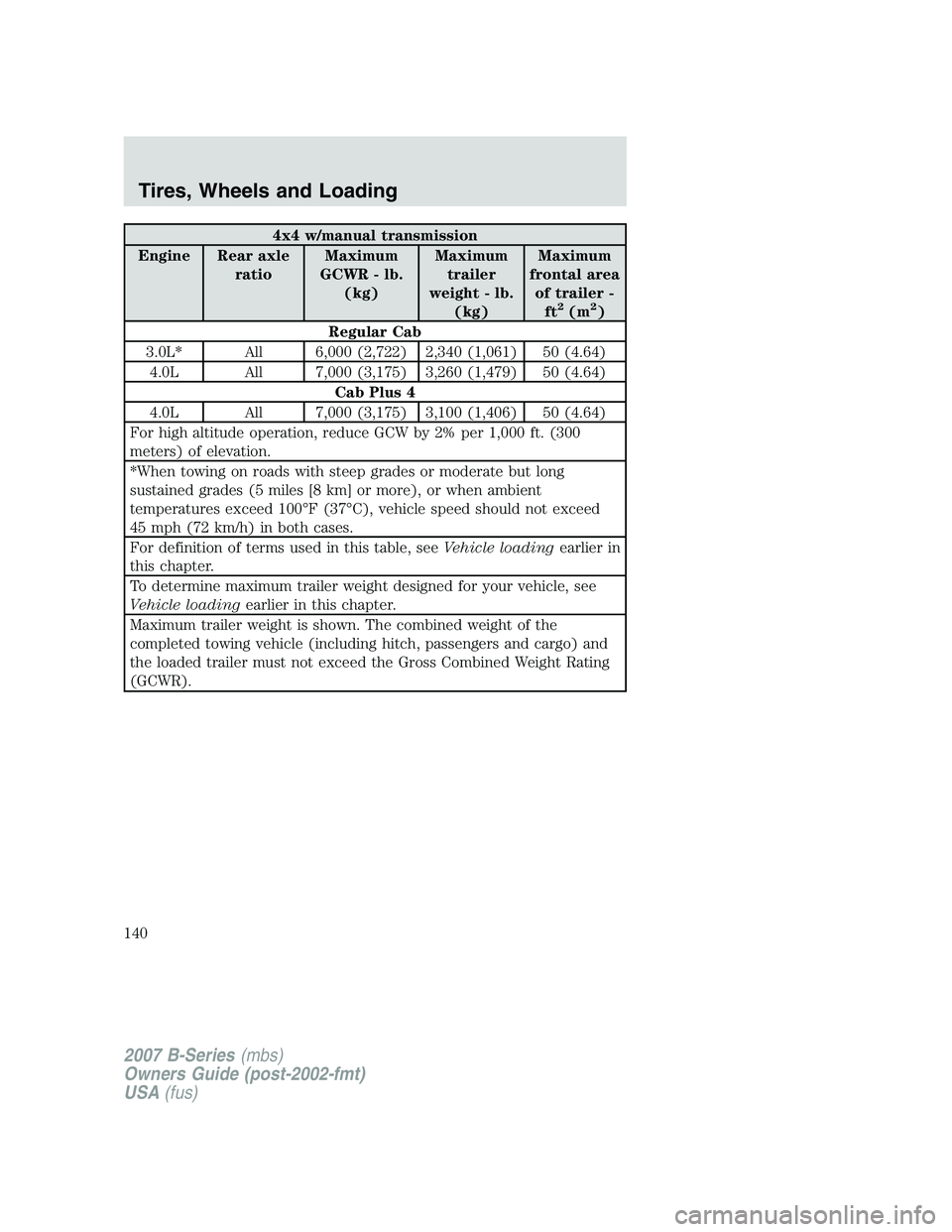
4x4 w/manual transmission
Engine Rear axle ratioMaximum
GCWR - lb. (kg) Maximum
trailer
weight - lb. (kg) Maximum
frontal area of trailer - ft
2(m2)
Regular Cab
3.0L* All 6,000 (2,722) 2,340 (1,061) 50 (4.64) 4.0L All 7,000 (3,175) 3,260 (1,479) 50 (4.64) Cab Plus 4
4.0L All 7,000 (3,175) 3,100 (1,406) 50 (4.64)
For high altitude operation, reduce GCW by 2% per 1,000 ft. (300
meters) of elevation.
*When towing on roads with steep grades or moderate but long
sustained grades (5 miles [8 km] or more), or when ambient
temperatures exceed 100°F (37°C), vehicle speed should not exceed
45 mph (72 km/h) in both cases.
For definition of terms used in this table, see Vehicle loadingearlier in
this chapter.
To determine maximum trailer weight designed for your vehicle, see
Vehicle loading earlier in this chapter.
Maximum trailer weight is shown. The combined weight of the
completed towing vehicle (including hitch, passengers and cargo) and
the loaded trailer must not exceed the Gross Combined Weight Rating
(GCWR).
2007 B-Series (mbs)
Owners Guide (post-2002-fmt)
USA (fus)
Tires, Wheels and Loading
140
Page 141 of 280
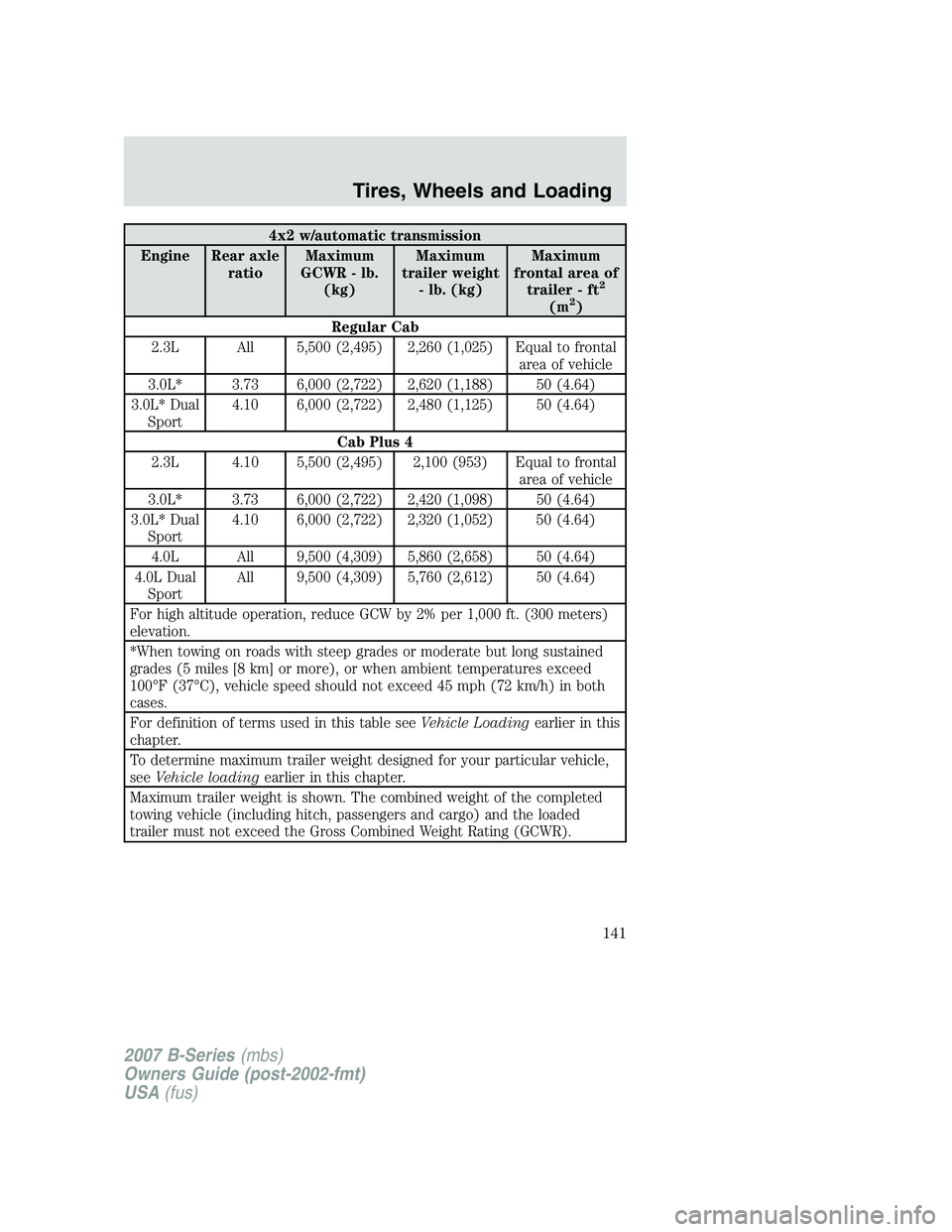
4x2 w/automatic transmission
Engine Rear axle ratioMaximum
GCWR - lb. (kg) Maximum
trailer weight - lb. (kg) Maximum
frontal area of trailer - ft
2
(m2)
Regular Cab
2.3L All 5,500 (2,495) 2,260 (1,025) Equal to frontal area of vehicle
3.0L* 3.73 6,000 (2,722) 2,620 (1,188) 50 (4.64)
3.0L* Dual Sport 4.10 6,000 (2,722) 2,480 (1,125) 50 (4.64)
Cab Plus 4
2.3L 4.10 5,500 (2,495) 2,100 (953) Equal to frontal area of vehicle
3.0L* 3.73 6,000 (2,722) 2,420 (1,098) 50 (4.64)
3.0L* Dual Sport 4.10 6,000 (2,722) 2,320 (1,052) 50 (4.64)
4.0L All 9,500 (4,309) 5,860 (2,658) 50 (4.64)
4.0L Dual Sport All 9,500 (4,309) 5,760 (2,612) 50 (4.64)
For high altitude operation, reduce GCW by 2% per 1,000 ft. (300 meters)
elevation.
*When towing on roads with steep grades or moderate but long sustained
grades (5 miles [8 km] or more), or when ambient temperatures exceed
100°F (37°C), vehicle speed should not exceed 45 mph (72 km/h) in both
cases.
For definition of terms used in this table see Vehicle Loadingearlier in this
chapter.
To determine maximum trailer weight designed for your particular vehicle,
see Vehicle loading earlier in this chapter.
Maximum trailer weight is shown. The combined weight of the completed
towing vehicle (including hitch, passengers and cargo) and the loaded
trailer must not exceed the Gross Combined Weight Rating (GCWR).
2007 B-Series (mbs)
Owners Guide (post-2002-fmt)
USA (fus)
Tires, Wheels and Loading
141
Page 142 of 280
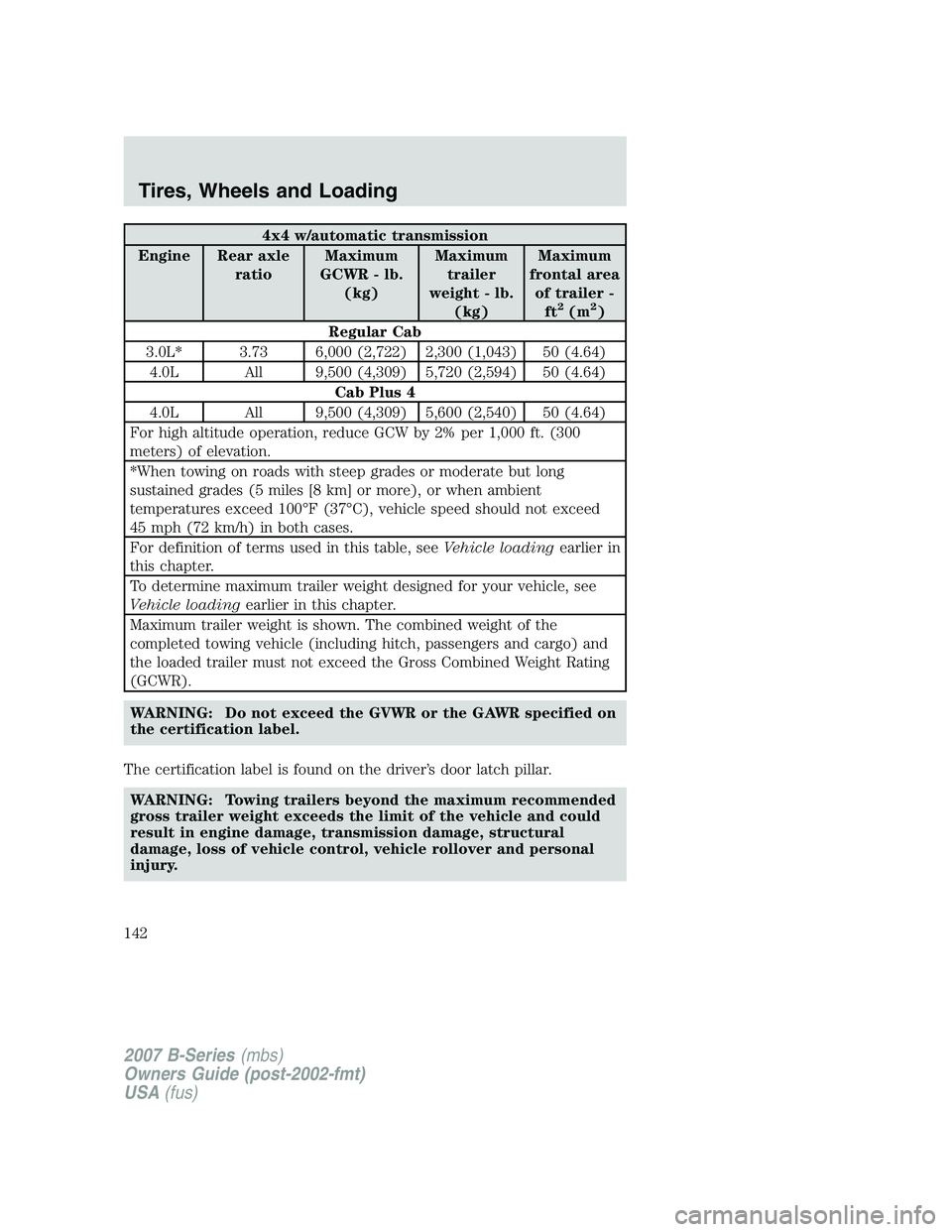
4x4 w/automatic transmission
Engine Rear axle ratioMaximum
GCWR - lb. (kg) Maximum
trailer
weight - lb. (kg) Maximum
frontal area of trailer - ft
2(m2)
Regular Cab
3.0L* 3.73 6,000 (2,722) 2,300 (1,043) 50 (4.64) 4.0L All 9,500 (4,309) 5,720 (2,594) 50 (4.64) Cab Plus 4
4.0L All 9,500 (4,309) 5,600 (2,540) 50 (4.64)
For high altitude operation, reduce GCW by 2% per 1,000 ft. (300
meters) of elevation.
*When towing on roads with steep grades or moderate but long
sustained grades (5 miles [8 km] or more), or when ambient
temperatures exceed 100°F (37°C), vehicle speed should not exceed
45 mph (72 km/h) in both cases.
For definition of terms used in this table, see Vehicle loadingearlier in
this chapter.
To determine maximum trailer weight designed for your vehicle, see
Vehicle loading earlier in this chapter.
Maximum trailer weight is shown. The combined weight of the
completed towing vehicle (including hitch, passengers and cargo) and
the loaded trailer must not exceed the Gross Combined Weight Rating
(GCWR).
WARNING: Do not exceed the GVWR or the GAWR specified on
the certification label.
The certification label is found on the driver’s door latch pillar. WARNING: Towing trailers beyond the maximum recommended
gross trailer weight exceeds the limit of the vehicle and could
result in engine damage, transmission damage, structural
damage, loss of vehicle control, vehicle rollover and personal
injury.
2007 B-Series (mbs)
Owners Guide (post-2002-fmt)
USA (fus)
Tires, Wheels and Loading
142
Page 143 of 280
Preparing to tow
Use the proper equipment for towing a trailer and make sure it is
properly attached to your vehicle. See your authorized dealer or a
reliable trailer dealer if you require assistance.
Hitches
For towing trailers up to 2,000 lb. (907 kg), use a weight carrying hitch
and ball which uniformly distributes the trailer tongue loads through the
underbody structure. Use a frame-mounted weight distributing hitch for
trailers over 2,000 lb. (907 kg).
Do not install a single or multi-clamp type bumper hitch, or a hitch
which attaches to the axle. Underbody mounted hitches are acceptable if
they are installed properly. Follow the towing instructions of a reputable
rental agency.
Whenever a trailer hitch and hardware are removed, make sure all
mounting holes in the underbody are properly sealed to prevent noxious
gases or water from entering.
Safety chains
Always connect the trailer’s safety chains to the frame or hook retainers
of the vehicle hitch. To connect the trailer’s safety chains, cross the
chains under the trailer tongue and allow slack for turning corners.
If you use a rental trailer, follow the instructions that the rental agency
gives to you.
Do not attach safety chains to the bumper.
Trailer brakes
Electric brakes and manual, automatic or surge-type trailer brakes are
safe if installed properly and adjusted to the manufacturer’s
specifications. The trailer brakes must meet local and Federal
regulations.WARNING: Do not connect a trailer’s hydraulic brake system
directly to your vehicle’s brake system. Your vehicle may not
have enough braking power and your chances of having a
collision greatly increase.
The braking system of the tow vehicle is rated for operation at the
GVWR not GCWR.
2007 B-Series (mbs)
Owners Guide (post-2002-fmt)
USA (fus)
Tires, Wheels and Loading
143
Page 144 of 280
Trailer lamps
Trailer lamps are required on most towed vehicles. Make sure all running
lights, brake lights, turn signals and hazard lights are working. See your
authorized dealer or trailer rental agency for proper instructions and
equipment for hooking up trailer lamps.
Using a step bumper
The optional step bumper is equipped with an integral hitch and requires
only a ball with a 3/4 inch (19 mm) shank diameter. The bumper has a
2,000 lb. (907 kg) trailer weight and 200 lb. (91 kg) tongue weight
capability.
The rated capacities (as shown in this guide) for trailer towing with the
factory bumper are only valid when the trailer hitch ball is installed
directly into the ball hole in the bumper. Addition of bracketry to either
lower the ball hitch position or extend the ball hitch rearward will
significantly increase the loads on the bumper and its attachments. This
can result in the failure of the bumper or the bumper attachments. Use
of any type of hitch extensions should be considered abuse.
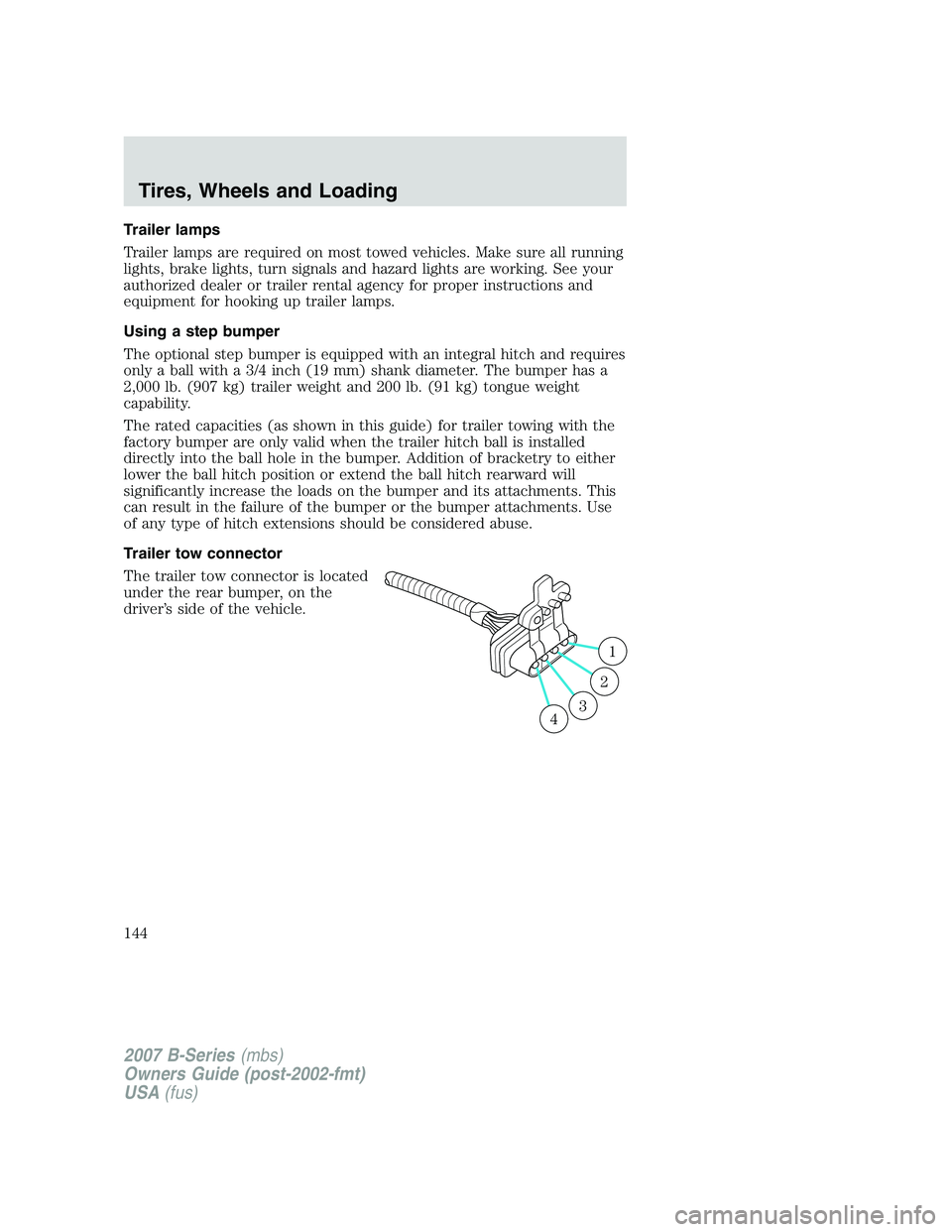
Trailer tow connector
The trailer tow connector is located
under the rear bumper, on the
driver’s side of the vehicle.
1
2
34
2007 B-Series(mbs)
Owners Guide (post-2002-fmt)
USA (fus)
Tires, Wheels and Loading
144
Page 145 of 280
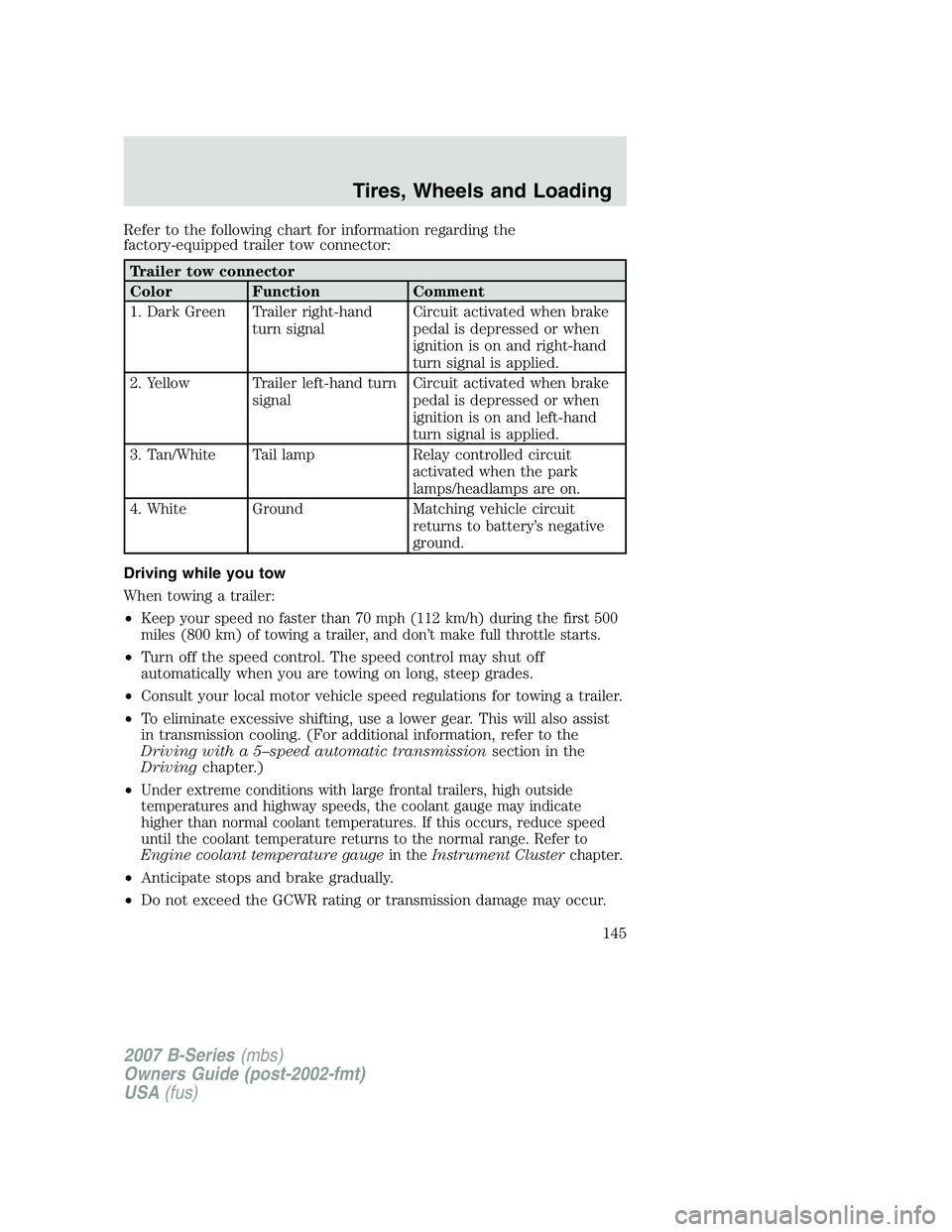
Refer to the following chart for information regarding the
factory-equipped trailer tow connector:
Trailer tow connector
ColorFunction Comment
1. Dark Green Trailer right-hand turn signal Circuit activated when brake
pedal is depressed or when
ignition is on and right-hand
turn signal is applied.
2. Yellow Trailer left-hand turn signal Circuit activated when brake
pedal is depressed or when
ignition is on and left-hand
turn signal is applied.
3. Tan/White Tail lamp Relay controlled circuit
activated when the park
lamps/headlamps are on.
4. White Ground Matching vehicle circuit
returns to battery’s negative
ground.
Driving while you tow
When towing a trailer:
•
Keep your speed no faster than 70 mph (112 km/h) during the first 500
miles (800 km) of towing a trailer, and don’t make full throttle starts.
• Turn off the speed control. The speed control may shut off
automatically when you are towing on long, steep grades.
• Consult your local motor vehicle speed regulations for towing a trailer.
• To eliminate excessive shifting, use a lower gear. This will also assist
in transmission cooling. (For additional information, refer to the
Driving with a 5–speed automatic transmission section in the
Driving chapter.)
•
Under extreme conditions with large frontal trailers, high outside
temperatures and highway speeds, the coolant gauge may indicate
higher than normal coolant temperatures. If this occurs, reduce speed
until the coolant temperature returns to the normal range. Refer to
Engine coolant temperature gauge in theInstrument Cluster chapter.
•Anticipate stops and brake gradually.
• Do not exceed the GCWR rating or transmission damage may occur.
2007 B-Series (mbs)
Owners Guide (post-2002-fmt)
USA (fus)
Tires, Wheels and Loading
145
Page 146 of 280
Servicing after towing
If you tow a trailer for long distances, your vehicle will require more
frequent service intervals. Refer to yourscheduled maintenance
information for more information.
Trailer towing tips
• Practice turning, stopping and backing up before starting on a trip to
get the feel of the vehicle trailer combination. When turning, make
wider turns so the trailer wheels will clear curbs and other obstacles.
• Allow more distance for stopping with a trailer attached.
• The trailer tongue weight should be 10–15% of the loaded trailer
weight.
• If you will be towing a trailer frequently in hot weather, hilly
conditions, at GCWR, or any combination of these factors, consider
refilling your rear axle with synthetic gear lube if not already so
equipped. Refer to the Maintenance and specifications chapter for
the lubricant specification. Remember that regardless of the rear axle
lube used, do not tow a trailer for the first 500 miles (800 km) of a
new vehicle, and that the first 500 miles (800 km) of towing be done
at no faster than 70 mph (112 km/h) with no full throttle starts.
• After you have traveled 50 miles (80 km), thoroughly check your
hitch, electrical connections and trailer wheel lug nuts.
• To aid in engine/transmission cooling and A/C efficiency during hot
weather while stopped in traffic, place the gearshift lever in P (Park)
(automatic transmission) or N (Neutral) (manual transmissions).
• Vehicles with trailers should not be parked on a grade. If you must
park on a grade, place wheel chocks under the trailer’s wheels.
Launching or retrieving a boat
Disconnect the wiring to the trailer before backing the trailer
into the water. Reconnect the wiring to the trailer after the
trailer is removed from the water.
When backing down a ramp during boat launching or retrieval:
• do not allow the static water level to rise above the bottom edge of
the rear bumper.
• do not allow waves to break higher than 6 inches (15 cm) above the
bottom edge of the rear bumper.
2007 B-Series (mbs)
Owners Guide (post-2002-fmt)
USA (fus)
Tires, Wheels and Loading
146
Page 160 of 280
R (Reverse)
With the gearshift lever in R (Reverse), the vehicle will move backward.
Always come to a complete stop before shifting into and out of R
(Reverse).
N (Neutral)
With the gearshift lever in N (Neutral), the vehicle can be started and is
free to roll. Hold the brake pedal down while in this position.
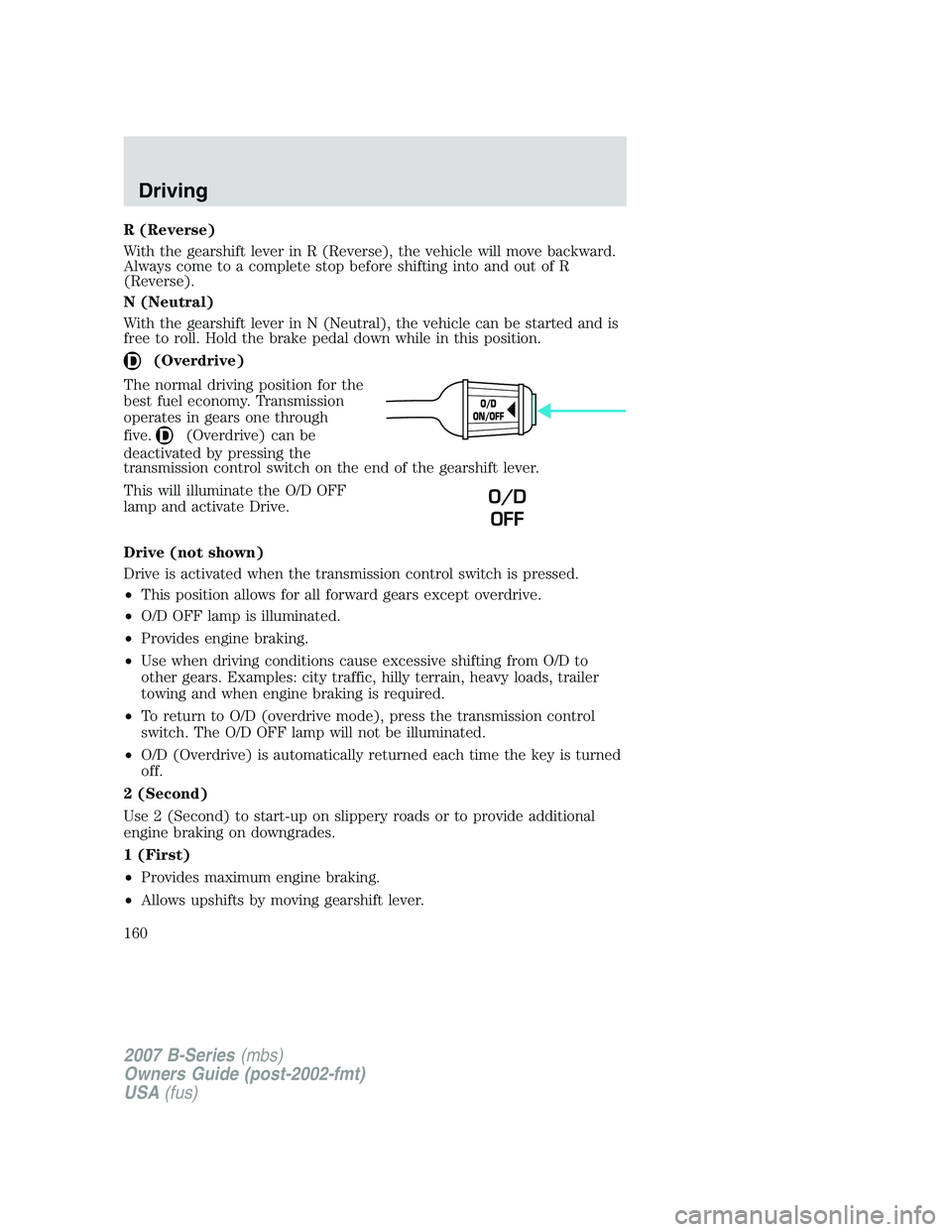
(Overdrive)
The normal driving position for the
best fuel economy. Transmission
operates in gears one through
five.
(Overdrive) can be
deactivated by pressing the
transmission control switch on the end of the gearshift lever.
This will illuminate the O/D OFF
lamp and activate Drive.
Drive (not shown)
Drive is activated when the transmission control switch is pressed.
• This position allows for all forward gears except overdrive.
• O/D OFF lamp is illuminated.
• Provides engine braking.
• Use when driving conditions cause excessive shifting from O/D to
other gears. Examples: city traffic, hilly terrain, heavy loads, trailer
towing and when engine braking is required.
• To return to O/D (overdrive mode), press the transmission control
switch. The O/D OFF lamp will not be illuminated.
• O/D (Overdrive) is automatically returned each time the key is turned
off.
2 (Second)
Use 2 (Second) to start-up on slippery roads or to provide additional
engine braking on downgrades.
1 (First)
• Provides maximum engine braking.
• Allows upshifts by moving gearshift lever.
O/D
ON/OFF
O/D OFF
2007 B-Series (mbs)
Owners Guide (post-2002-fmt)
USA (fus)
Driving
160
Page 173 of 280
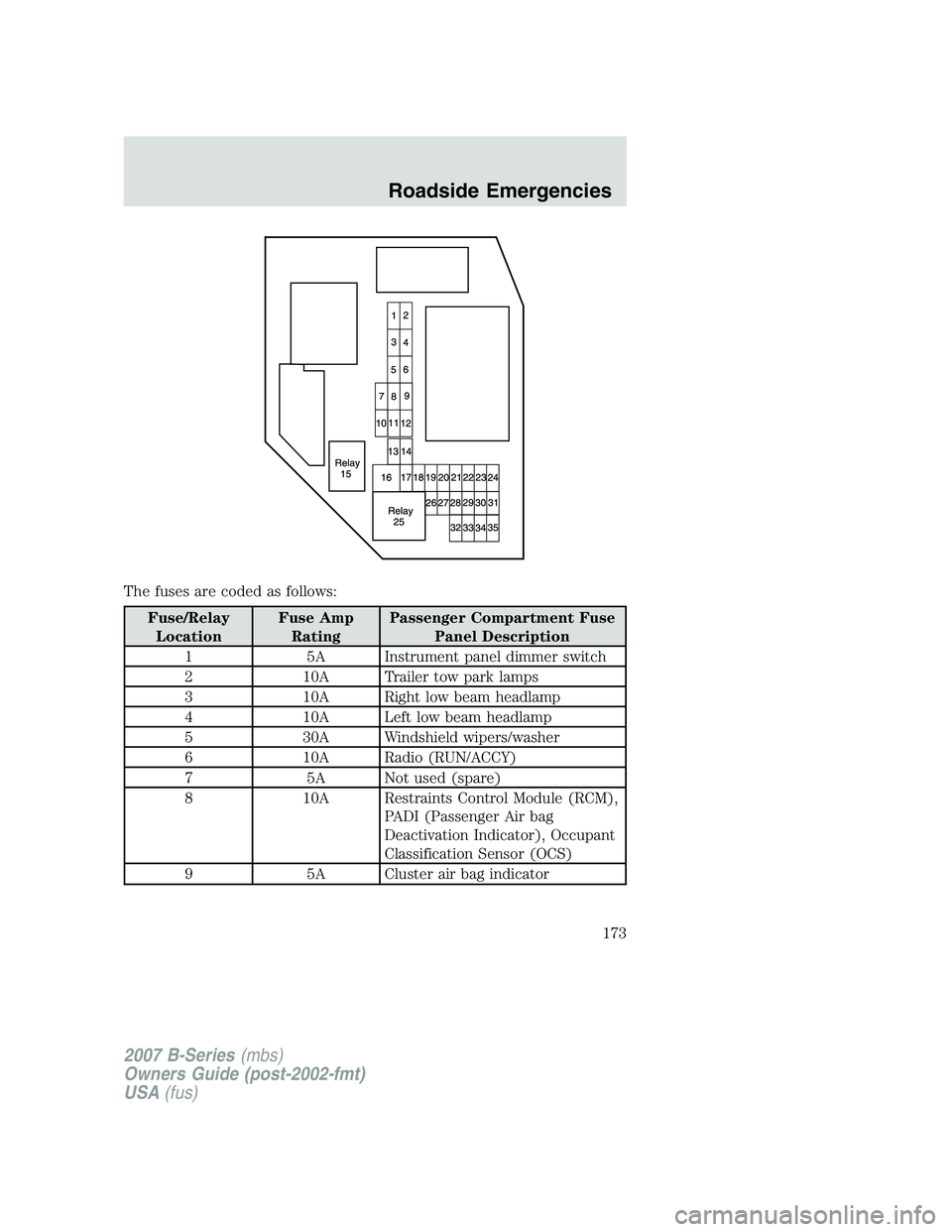
The fuses are coded as follows:
Fuse/RelayLocation Fuse Amp
Rating Passenger Compartment Fuse
Panel Description
1 5A Instrument panel dimmer switch
2 10A Trailer tow park lamps
3 10A Right low beam headlamp
4 10A Left low beam headlamp
5 30A Windshield wipers/washer
6 10A Radio (RUN/ACCY)
7 5A Not used (spare)
8 10A Restraints Control Module (RCM),
PADI (Passenger Air bag
Deactivation Indicator), Occupant
Classification Sensor (OCS)
9 5A Cluster air bag indicator
2007 B-Series(mbs)
Owners Guide (post-2002-fmt)
USA (fus)
Roadside Emergencies
173
Page 175 of 280
Fuse/RelayLocation Fuse Amp
Rating Passenger Compartment Fuse
Panel Description
30 5A Power mirrors
31 20A Front park lamps, Rear park
lamps, License plate lamps,
Dimmer switch, Trailer tow park
lamps
32 5A Brake switch (logic)
33 5A Instrument cluster battery feed
(B+)
34 20A Power point
35 15A Power locks
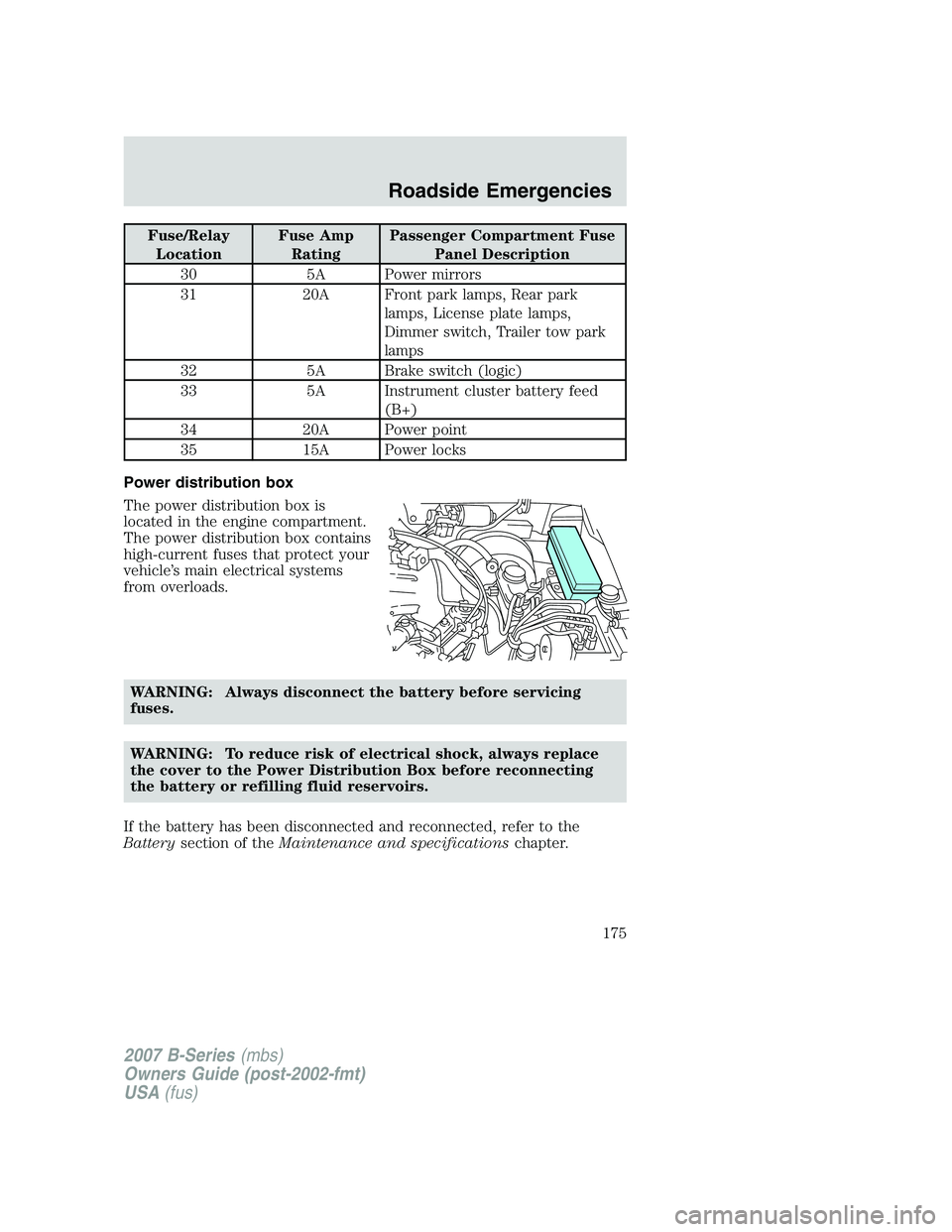
Power distribution box
The power distribution box is
located in the engine compartment.
The power distribution box contains
high-current fuses that protect your
vehicle’s main electrical systems
from overloads.
WARNING: Always disconnect the battery before servicing
fuses.
WARNING: To reduce risk of electrical shock, always replace
the cover to the Power Distribution Box before reconnecting
the battery or refilling fluid reservoirs.
If the battery has been disconnected and reconnected, refer to the
Battery section of the Maintenance and specifications chapter.
2007 B-Series(mbs)
Owners Guide (post-2002-fmt)
USA (fus)
Roadside Emergencies
175