height MAZDA MODEL CX-30 2020 Owner's Guide
[x] Cancel search | Manufacturer: MAZDA, Model Year: 2020, Model line: MODEL CX-30, Model: MAZDA MODEL CX-30 2020Pages: 562, PDF Size: 83 MB
Page 334 of 562

NOTE
The detection ability of the rear side
radar sensor has limitations. In the
following cases, the detection ability
may lower and the system may not
operate normally.
The rear bumper near the rear side
radar sensor has become
deformed.
Snow, ice or mud adheres to the
rear side radar sensor on the rear
bumper.
Under bad weather conditions
such as rain, snow and fog.
Under the following conditions, the
rear side radar sensor cannot detect
target objects or it may be difficult to
detect them.
Small motorcycles, bicycles,
pedestrians, animals, shopping
carts, and stationary objects on a
road or a road side.
Vehicle shapes which do not reflect radar waves well such as
empty trailers with a low vehicle
height and sports cars.
Vehicles are shipped with the
direction of the rear side radar
sensor adjusted for each vehicle to a
loaded vehicle condition so that the
rear side radar sensor detect
approaching vehicles correctly. If the
direction of the rear side radar
sensor has deviated for some reason,
have the vehicle inspected at an
Authorized Mazda Dealer.
For repairs or replacement of the rear
side radar sensor, or bumper repairs,
paintwork, and replacement near the
radar sensors, consult an Authorized
Mazda Dealer.
The radar sensors are regulated by
the relevant radio wave laws of the
country in which the vehicle is
driven. If the vehicle is driven
abroad, authorization from the
country in which the vehicle is driven
may be required.
When Driving
i-ACTIVSENSE
4-198
CX-30_8HG6-EA-19I_Edition1_new 2019-6-13 18:45:11
Page 423 of 562

support rod hole indicated by the
arrow to hold the hood open.
1. Pad
2. Support rod
▼Closing the Hood
1. Check under the hood area to
make certain all filler caps are in
place and all loose items (e.g.
tools, oil containers, etc.) have
been removed.
2. Lift the hood, grasp the padded area on the support rod, and secure
the support rod in the clip. Verify
that the support rod is secured in
the clip before closing the hood.
1. Clip
3. Lower the hood slowly to a height of about 20 cm (7.9 in) above its
closed position and then let it drop.
CAUTION
When closing the hood, do not push it
excessively such as by applying your
weight. Otherwise, the hood could be
deformed.
Maintenance and Care
Owner Maintenance
6-13
CX-30_8HG6-EA-19I_Edition1_new 2019-6-13 18:45:11
Page 441 of 562
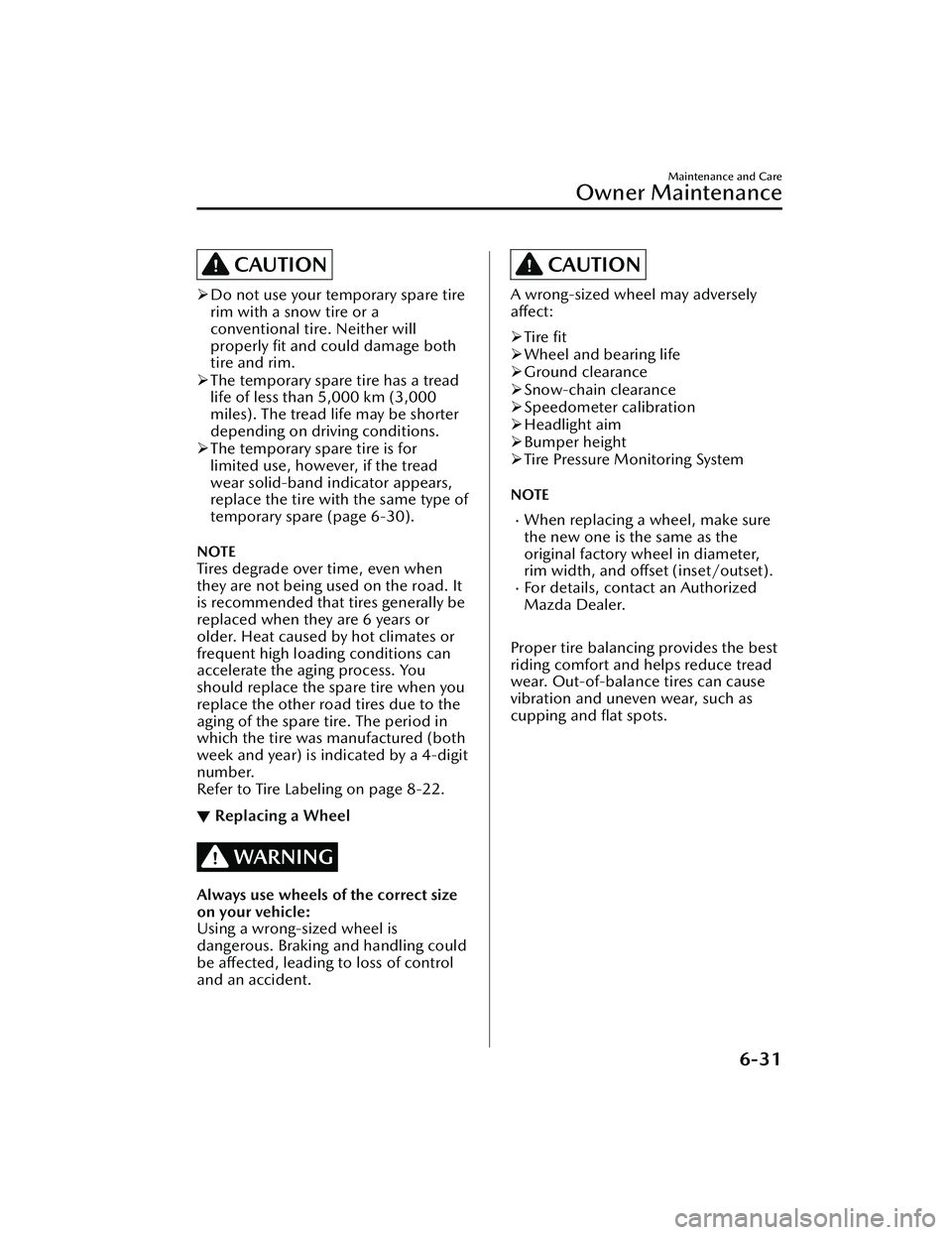
CAUTION
Do not use your temporary spare tire
rim with a snow tire or a
conventional tire. Neither will
properly
fit and could damage both
tire and rim.
The temporary spare tire has a tread
life of less than 5,000 km (3,000
miles). The tread life may be shorter
depending on driving conditions.
The temporary spare tire is for
limited use, however, if the tread
wear solid-band indicator appears,
replace the tire with the same type of
temporary spare (page 6-30).
NOTE
Tires degrade over time, even when
they are not being used on the road. It
is recommended that tires generally be
replaced when they are 6 years or
older. Heat caused by hot climates or
frequent high loading conditions can
accelerate the aging process. You
should replace the spare tire when you
replace the other road tires due to the
aging of the spare tire. The period in
which the tire was manufactured (both
week and year) is indicated by a 4-digit
number.
Refer to Tire Labeling on page 8-22.
▼ Replacing a Wheel
WARNING
Always use wheels of the correct size
on your vehicle:
Using a wrong-sized wheel is
dangerous. Braking and handling could
be
affected, leading to loss of control
and an accident.
CAUTION
A wrong-sized wheel may adversely
affect:
Tire
fit
Wheel and bearing life
Ground clearance
Snow-chain clearance
Speedometer calibration
Headlight aim
Bumper height
Tire Pressure Monitoring System
NOTE
When replacing a wheel, make sure
the new one is the same as the
original factory wheel in diameter,
rim width, and offset (inset/outset).
For details, contact an Authorized
Mazda Dealer.
Proper tire balancing provides the best
riding comfort and helps reduce tread
wear. Out-of-balance tires can cause
vibration and uneven wear, such as
cupping and flat spots.
Maintenance and Care
Owner Maintenance
6-31
CX-30_8HG6-EA-19I_Edition1_new
2019-6-13 18:45:11
Page 524 of 562
Tire Labeling
▼Tire Labeling
Federal law requires tire manufacturers
to place standardized information on
the sidewall of all tires. This
information identifies and describes
the fundamental characteristics of the
tire and also provides a tire
identification
number for safety
standard certification and in case of a
recall.
▼ Information on Passenger Vehicle
Tires
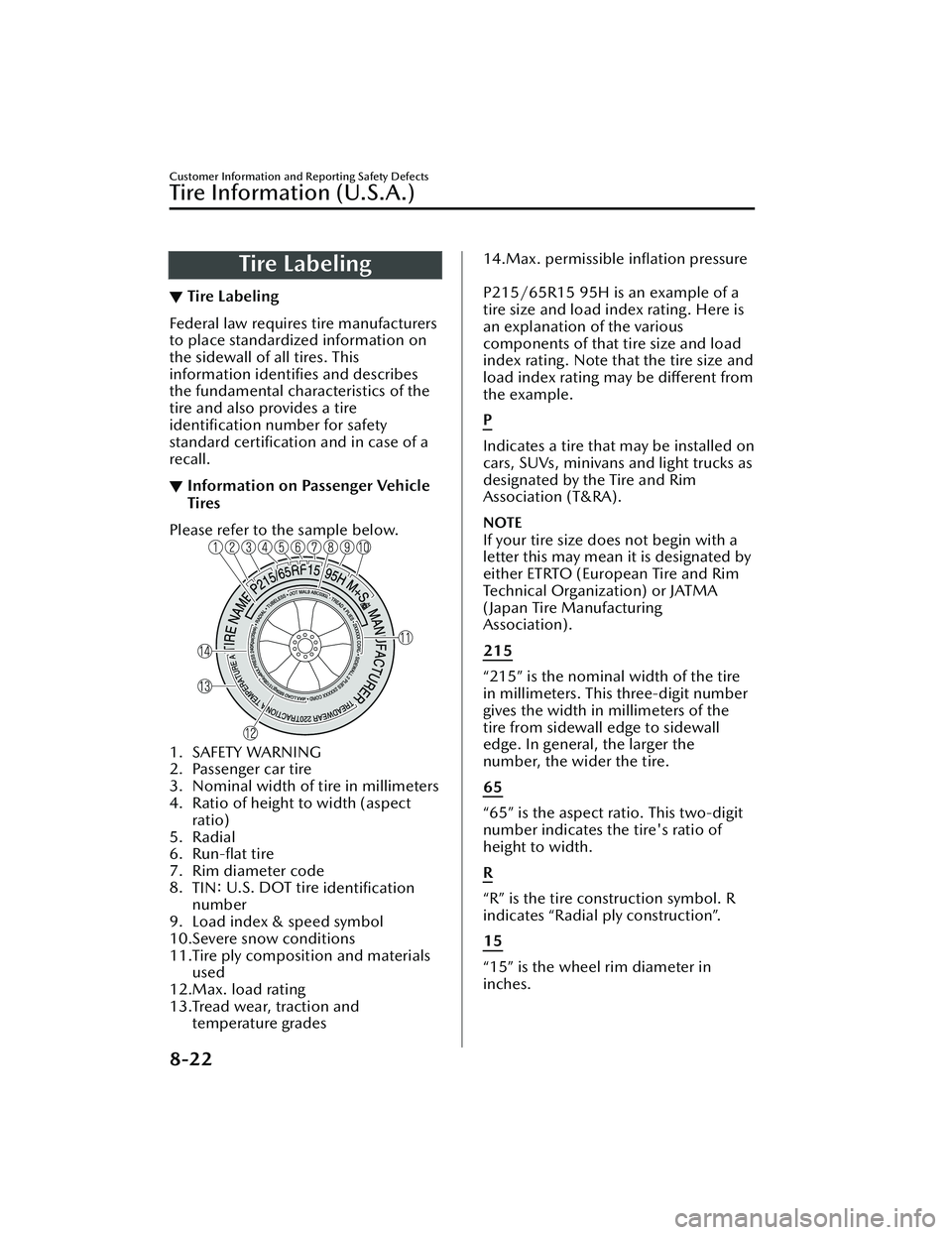
Please refer to the sample below.
1. SAFETY WARNING
2. Passenger car tire
3. Nominal width of tire in millimeters
4. Ratio of height to width (aspect
ratio)
5. Radial
6. Run-flat tire
7. Rim diameter code
8. TIN: U.S. DOT tire
identification
number
9. Load index & speed symbol
10.Severe snow conditions
11.Tire ply composition and materials used
12.Max. load rating
13.Tread wear, traction and temperature grades
14.Max. permissible inflation pressure
P215/65R15 95H is an example of a
tire size and load index rating. Here is
an explanation of the various
components of that tire size and load
index rating. Note that the tire size and
load index rating may be different from
the example.
P
Indicates a tire that may be installed on
cars, SUVs, minivans and light trucks as
designated by the Tire and Rim
Association (T&RA).
NOTE
If your tire size does not begin with a
letter this may mean it is designated by
either ETRTO (European Tire and Rim
Technical Organization) or JATMA
(Japan Tire Manufacturing
Association).
215
“215” is the nominal width of the tire
in millimeters. This three-digit number
gives the width in millimeters of the
tire from sidewall edge to sidewall
edge. In general, the larger the
number, the wider the tire.
65
“65” is the aspect ratio. This two-digit
number indicates the tire's ratio of
height to width.
R
“R” is the tire construction symbol. R
indicates “Radial ply construction”.
15
“15” is the wheel rim diameter in
inches.
Customer Information and Reporting Safety Defects
Tire Information (U.S.A.)
8-22
CX-30_8HG6-EA-19I_Edition1_new 2019-6-13 18:45:11
Page 526 of 562
The grades represent the tire's ability
to stop on wet pavement as measured
under controlled conditions on
specified government test surfaces of
asphalt and concrete. A tire marked C
may have poor traction performance.
Temperature: The temperature grades
are A (the highest), B and C,
representing the tire's resistance to the
generation of heat and its ability to
dissipate heat when tested under
controlled conditions on a specified
indoor laboratory test wheel.
Snow Tires
In some heavy snow areas, local
governments may require true snow
tires, those with very deeply cut tread.
These tires should only be used in pairs
or placed on all four wheels. Make
sure you purchase snow tires that are
the same size and construction type as
the other tires on your vehicle.
SAFETY WARNING
The following safety warning appears
on the tire's sidewall.
SERIOUS INJURY MAY RESULT FROM:
EXPLOSION OF TIRE/RIM ASSEMBLY
DUE TO IMPROPER
MOUNTING-MATCH TIRE
DIAMETER TO RIM DIAMETER;
NEVER EXCEED 40 psi (275 kPa) TO
SEAT BEADS-ONLY SPECIALLY
TRAINED PERSONS SHOULD
MOUNT TIRES.
TIRE FAILURE DUE TO UNDER-INFLATION/
OVERLOADING/DAMAGE-FOLLOW
OWNER'S MANUAL AND PLACARD
IN VEHICLE-FREQUENTLY CHECK
INFLATION PRESSURE AND INSPECT
FOR DAMAGE.
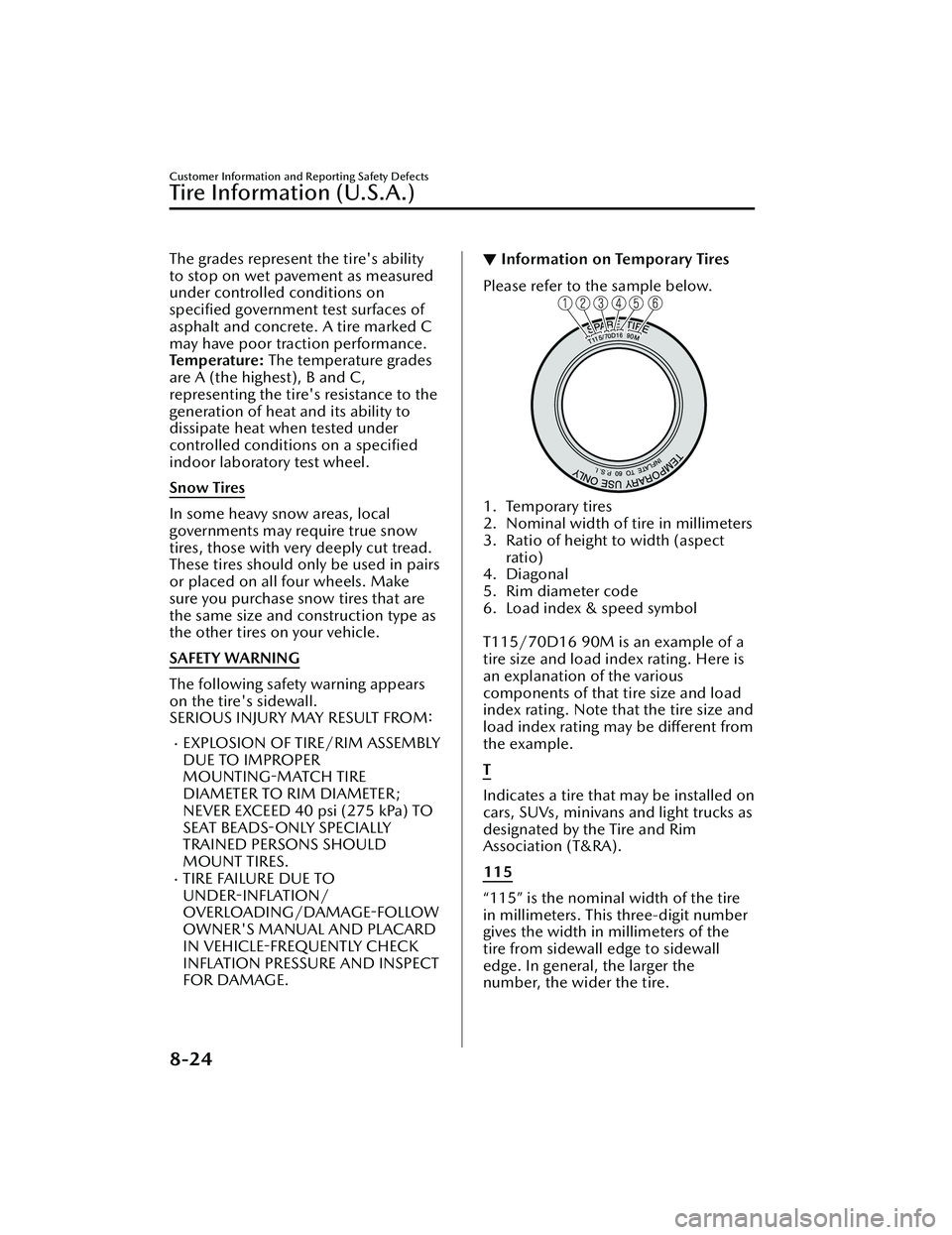
▼ Information on Temporary Tires
Please refer to the sample below.
1. Temporary tires
2. Nominal width of tire in millimeters
3. Ratio of height to width (aspect
ratio)
4. Diagonal
5. Rim diameter code
6. Load index & speed symbol
T115/70D16 90M is an example of a
tire size and load index rating. Here is
an explanation of the various
components of that tire size and load
index rating. Note that the tire size and
load index rating may be different from
the example.
T
Indicates a tire that may be installed on
cars, SUVs, minivans and light trucks as
designated by the Tire and Rim
Association (T&RA).
115
“115” is the nominal width of the tire
in millimeters. This three-digit number
gives the width in millimeters of the
tire from sidewall edge to sidewall
edge. In general, the larger the
number, the wider the tire.
Customer Information and Reporting Safety Defects
Tire Information (U.S.A.)
8-24
CX-30_8HG6-EA-19I_Edition1_new 2019-6-13 18:45:11
Page 527 of 562

70
“70” is the aspect ratio. This two-digit
number indicates the tire's ratio of
height to width.
D
“D” is the tire construction symbol. D
indicates “diagonal ply construction”.
16
“16” is the wheel rim diameter in
inches.
90
“90” is the Load Index. This two-or
three-digit number indicates how
much weight each tire can support.
M
“M” is the speed rating. The speed
rating denotes the maximum speed for
which the use of the tire is rated.
Letter Rating Speed Rating
M 81 mph
Location of the Tire Label (Placard)
▼Location of the Tire Label (Placard)
You will find the tire label containing
tire
inflation pressure by tire size and
other important information on the
driver's side B-pillar or on the edge of
the driver's door frame.
SAMPLE
▼ Recommended Tire Inflation
Pressure
On the tire label you will find the
recommended tire
inflation pressure in
both kPa and psi for the tires installed
as original equipment on the vehicle. It
is very important that the inflation
pressure of the tires on your vehicle is
maintained at the recommended
pressure. You should check the tire
pressure regularly to insure that the
proper inflation pressure is maintained.
Refer to Tires on page 9-7.
NOTE
Tire pressures listed on the vehicle
placard or tire information label
indicate the recommended cold tire
inflation pressure, measured when the
tires are cold, after the vehicle has
been parked for at least 3 hours. As
you drive, the temperature in the tire
warms up, increasing the tire pressure.
Customer Information and Reporting Safety Defects
Tire Information (U.S.A.)
8-25
CX-30_8HG6-EA-19I_Edition1_new 2019-6-13 18:45:11
Page 547 of 562
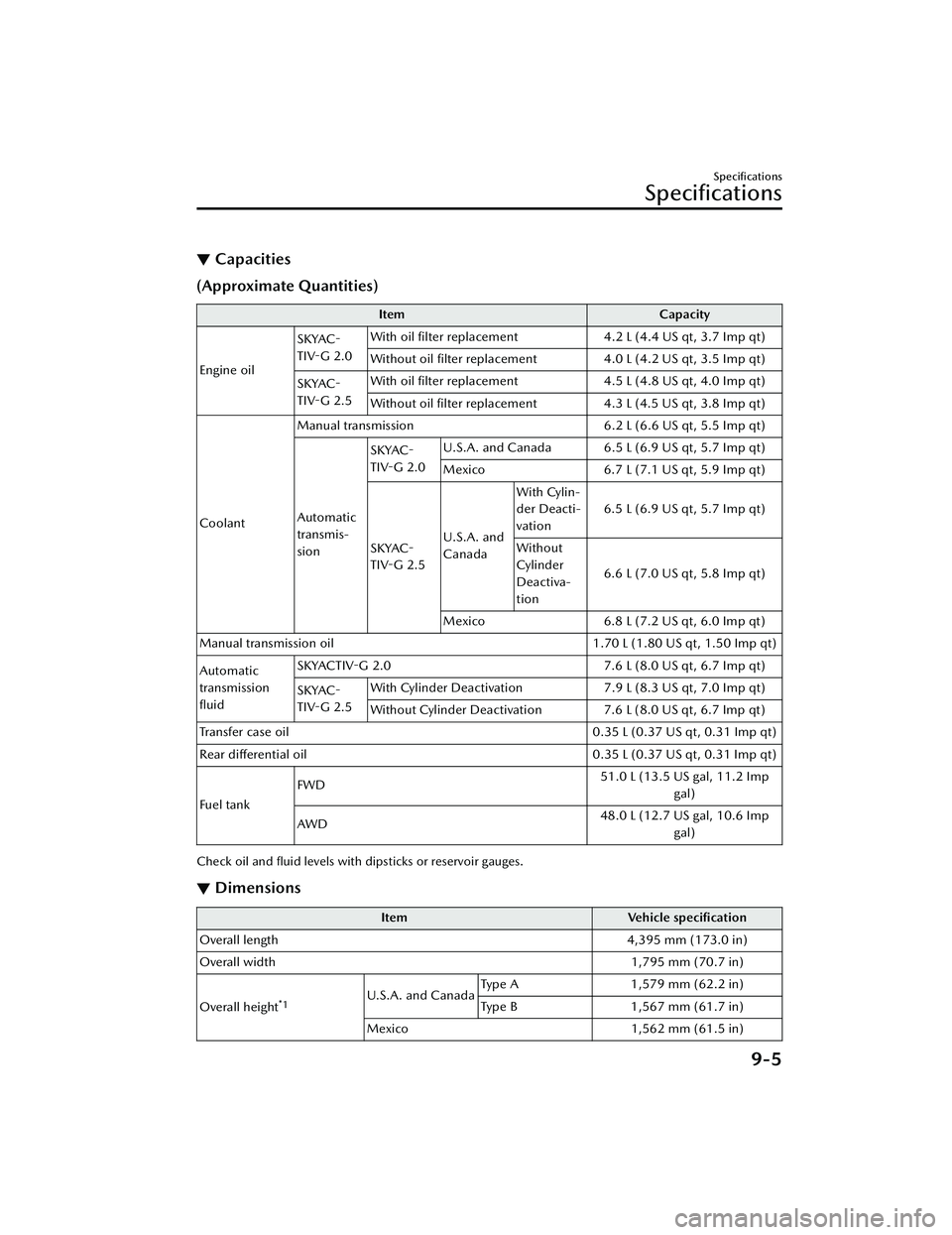
▼Capacities
(Approximate Quantities)
Item
Capacity
Engine oil SKYAC-
TIV-G 2.0
With oil filter replacement
4.2 L (4.4 US qt, 3.7 Imp qt)
Without oil filter replacement 4.0 L (4.2 US qt, 3.5 Imp qt)
SKYAC-
TIV-G 2.5 With oil filter replacement
4.5 L (4.8 US qt, 4.0 Imp qt)
Without oil filter replacement 4.3 L (4.5 US qt, 3.8 Imp qt)
Coolant Manual transmission
6.2 L (6.6 US qt, 5.5 Imp qt)
Automatic
transmis-
sion SKYAC-
TIV-G 2.0
U.S.A. and Canada 6.5 L (6.9 US qt, 5.7 Imp qt)
Mexico
6.7 L (7.1 US qt, 5.9 Imp qt)
SKYAC-
TIV-G 2.5 U.S.A. and
Canada With Cylin-
der Deacti-
vation
6.5 L (6.9 US qt, 5.7 Imp qt)
Without
Cylinder
Deactiva-
tion 6.6 L (7.0 US qt, 5.8 Imp qt)
Mexico 6.8 L (7.2 US qt, 6.0 Imp qt)
Manual transmission oil 1.70 L (1.80 US qt, 1.50 Imp qt)
Automatic
transmission
fluid SKYACTIV-G 2.0
7.6 L (8.0 US qt, 6.7 Imp qt)
SKYAC-
TIV-G 2.5 With Cylinder Deactivation
7.9 L (8.3 US qt, 7.0 Imp qt)
Without Cylinder Deactivation 7.6 L (8.0 US qt, 6.7 Imp qt)
Transfer case oil 0.35 L (0.37 US qt, 0.31 Imp qt)
Rear differential oil 0.35 L (0.37 US qt, 0.31 Imp qt)
Fuel tank FWD
51.0 L (13.5 US gal, 11.2 Imp
gal)
AWD 48.0 L (12.7 US gal, 10.6 Imp
gal)
Check oil and fluid levels with dipsticks or reservoir gauges.
▼Dimensions
Item
Vehicle specification
Overall length 4,395 mm (173.0 in)
Overall width 1,795 mm (70.7 in)
Overall height
*1U.S.A. and Canada Type A 1,579 mm (62.2 in)
Type B
1,567 mm (61.7 in)
Mexico 1,562 mm (61.5 in)
Specifications
Specifications
9-5
CX-30_8HG6-EA-19I_Edition1_new 2019-6-13 18:45:11
Page 548 of 562
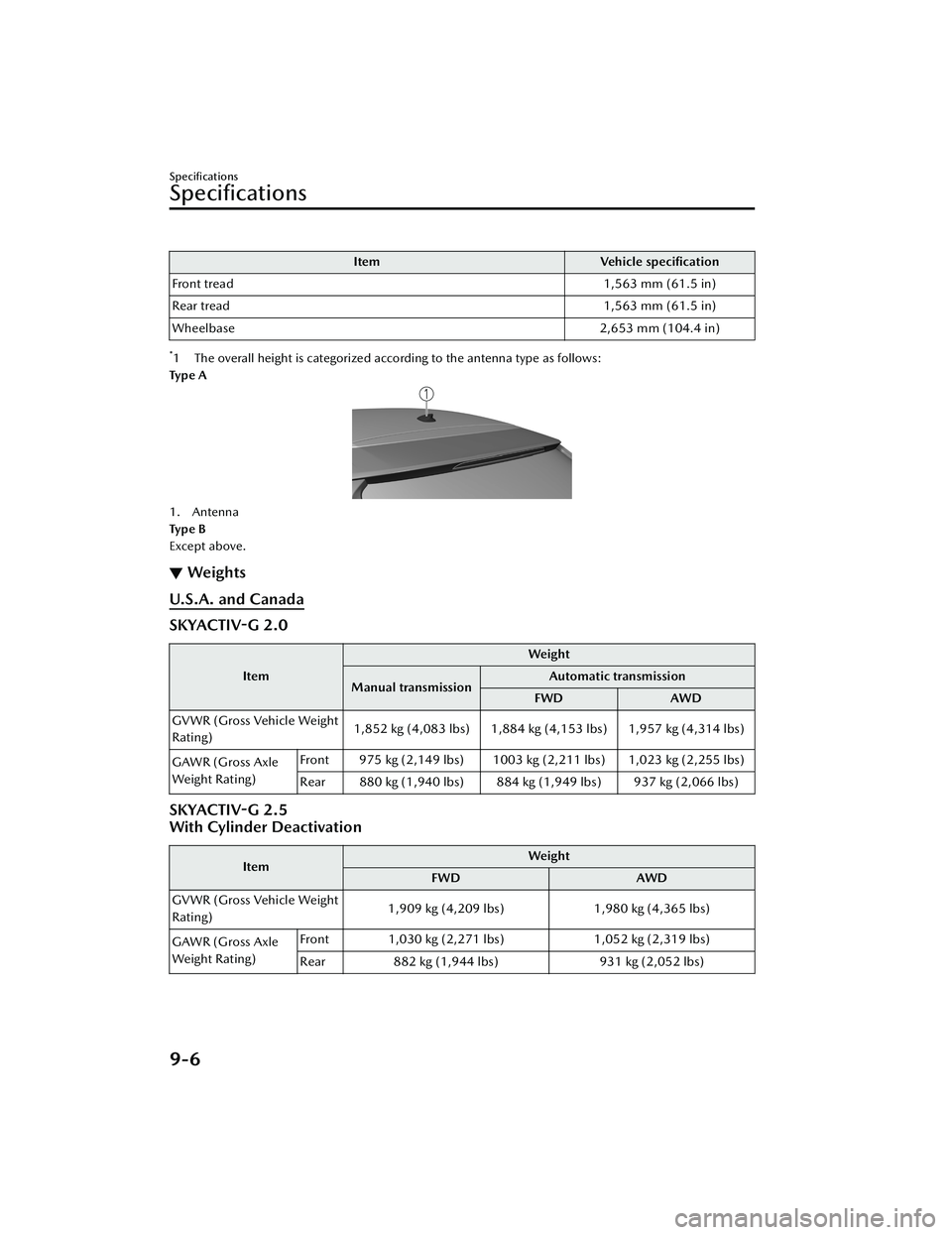
ItemVehicle specification
Front tread 1,563 mm (61.5 in)
Rear tread 1,563 mm (61.5 in)
Wheelbase 2,653 mm (104.4 in)
*1 The overall height is categorized according to the antenna type as follows:
Ty p e A
1. Antenna
Ty p e B
Except above.
▼ Weights
U.S.A. and Canada
SKYACTIV-G 2.0
Item Weight
Manual transmission Automatic transmission
FWD AWD
GVWR (Gross Vehicle Weight
Rating) 1,852 kg (4,083 lbs) 1,884 kg (4,153 lbs) 1,957 kg (4,314 lbs)
GAWR (Gross Axle
Weight Rating) Front 975 kg (2,149 lbs) 1003 kg (2,211 lbs) 1,023 kg (2,255 lbs)
Rear 880 kg (1,940 lbs) 884 kg (1,949 lbs) 937 kg (2,066 lbs)
SKYACTIV-G 2.5
With Cylinder Deactivation
Item
Weight
FWD AWD
GVWR (Gross Vehicle Weight
Rating) 1,909 kg (4,209 lbs)
1,980 kg (4,365 lbs)
GAWR (Gross Axle
Weight Rating) Front 1,030 kg (2,271 lbs)
1,052 kg (2,319 lbs)
Rear 882 kg (1,944 lbs) 931 kg (2,052 lbs)
Specifications
Specifications
9-6
CX-30_8HG6-EA-19I_Edition1_new 2019-6-13 18:45:11