height MAZDA MODEL MX-30 EV 2022 User Guide
[x] Cancel search | Manufacturer: MAZDA, Model Year: 2022, Model line: MODEL MX-30 EV, Model: MAZDA MODEL MX-30 EV 2022Pages: 547, PDF Size: 79.35 MB
Page 71 of 547

Sit in the center of the seat and wear
seat belts properly:
Sitting too close to the side air bag
modules or placing hands on them, or
sleeping up against the door or
hanging out the windows is extremely
dangerous. The side and curtain air
bags inflate with great force and speed
directly expanding along the door on
the side the car is hit. Serious injury
could occur if someone is sitting too
close to the door or leaning against a
window, or if rear seat occupants grab
the sides of the front seatbacks. Give
the side and curtain air bags room to
work by sitting in the center of the seat
while the vehicle is moving with seat
belts worn properly.
Do not attach objects on or around
the area where air bags deploy:
Attaching objects to the air bags or
placing something in the area where
the air bags deploy is dangerous. In an
accident, an object could interfere with
air bag in flation and injure the
occupants. Furthermore, the bag could
be damaged causing gases to release.
Always keep the deployment area of
the air bag modules free of any
obstructions.
For example, you should not do any of
the following as it may interfere with
air bag deployment.
Do not put a covering on or lean
anything against areas such as the
dashboard and lower portion of the
instrument panel that blocks the
passenger front air bag and knee air
bags.
Do not use seat covers on the front
seats and rear seats equipped with
in-seat side air bags.
Do not hang any backpacks, bags or
pouches that cover the sides of the
seats that block the side air bags.Do not place any objects on the
assist grips. Only hang clothes
directly on the coat hooks.
Do not touch the components of the
supplemental restraint system after
the air bags have in flated:
Touching the components of the
supplemental restraint system after the
air bags have in flated is dangerous.
Immediately after inflation, they are
very hot. You could get burned.
Never install any front-end equipment
to your vehicle:
Installation of front-end equipment,
such as frontal protection bar
(kangaroo bar, bull bar, push bar, or
other similar devices), snowplow, or
winches, is dangerous. The air bag
crash sensor system could be a ffected.
This could cause air bags to inflate
unexpectedly, or it could prevent the
air bags from inflating during an
accident. Front occupants could be
seriously injured.
Do not modify the suspension:
Modifying the vehicle suspension is
dangerous. If the vehicle's height or
the suspension is modi fied, the vehicle
will be unable to accurately detect a
collision or roll-over accident resulting
in incorrect or unexpected air bag
deployment and the possibility of
serious injuries.
To prevent false detection by the air
bag sensor system, heed the
following:
Do not use tires or wheels other than
those
specified for your Mazda:
Essential Safety Equipment
SRS Air Bags
2-54
MX
-30_8JD4-EA -21G_Edition2_new 2021-5-18 14:38:07
Page 222 of 547

When performing repairs around the
rearview mirror, consult an
Authorized Mazda Dealer.
Always use tires for all wheels that
are of the speci fied size, and the
same manufacturer, brand, and tread
pattern. In addition, do not use tires
with signi ficantly di fferent wear
patterns on the same vehicle as the
system may not operate normally.
NOTE
If the Forward Sensing Camera (FSC)
cannot operate normally due to rain,
backlight, or fog, the system
functions related to the Forward
Sensing Camera (FSC) are
temporarily stopped and the
following warning lights turn on.
However, this does not indicate a
malfunction.
HBC warning indication/warning
light (amber)
i-ACTIVSENSE warning indication/
warning light
If the Forward Sensing Camera (FSC)
cannot operate normally due to high
temperatures, the system functions
related to the Forward Sensing
Camera (FSC) are temporarily
stopped and the following warning
lights turn on. However, this does
not indicate a malfunction. Cool
down the area around the Forward
Sensing Camera (FSC) such as by
turning on the air conditioner.
HBC warning indication/warning
light (amber)
i-ACTIVSENSE warning indication/
warning light
If the Forward Sensing Camera (FSC)
detects that the windshield is dirty or
foggy, the system functions related to
the Forward Sensing Camera (FSC)
are temporarily stopped and the
following warning lights turn on.
However, this does not indicate a
problem. Remove the dirt from the
windshield or press the defroster
switch and defog the windshield.
HBC warning indication/warning
light (amber)
i-ACTIVSENSE warning indication/
warning light
Detection of pedestrians
The Forward Sensing Camera (FSC)
detects pedestrians when all of the
following conditions are met.
The height of a pedestrian is about 1
to 2 m (3 to 6.5 ft).
The outline of a pedestrian is
recognized such as the head, both
shoulders, or the feet.
The Forward Sensing Camera (FSC)
may not be able to detect pedestrians
when any of the following conditions is
met.
There are multiple pedestrians.A pedestrian is close to a separate
object.
A pedestrian is crouching, lying , or
slouching.
A pedestrian suddenly jumps into
the road.
A pedestrian is holding something
(such as an open umbrella or large
baggage).
A pedestrian blends into the
background (such as in a dark
location at night or by wearing
clothes matching the background
color).
When Driving
i-ACTIVSENSE
4-73
MX -30_8JD4-EA -21G_Edition2_new 2021-5-18 14:38:07
Page 223 of 547

Detection of objects
When any of the following conditions
is met, the Forward Sensing Camera
(FSC) may not be able to detect target
objects correctly, and each system may
not operate normally.
The height of the vehicle ahead is
low.
You are driving your vehicle at the
same speed as the vehicle ahead.
The headlights of your vehicle are not
turned on during the night or in a
tunnel.
When any of the fo llowing conditions
is met, the Forward Sensing Camera
(FSC) may not be able to detect target
objects, and each system may not
operate normally.
The target object enters the blind
spot of the Forward Sensing Camera
(FSC).
A person or object bursts onto the
road from the shoulder or cuts right
in front of you.
The distance between your vehicle
and the target object is extremely
close.
You change the course and approach
a target object.
A vehicle ahead has a special shape
(such as a vehicle carrier).
A vehicle ahead is a truck with a low
loading platform.
A vehicle ahead has an extremely
low or high pro file.
A vehicle ahead is outside the
illumination range of the headlights.
A vehicle ahead is not equipped with
taillights.
The taillights of a vehicle ahead are
dim or turned
off.
The headlights of an on-coming
vehicle are dim or turned
off.
Under bad weather conditions (rain,
fog , and snow).
Front visibility is reduced (due to a
vehicle ahead casting o ff water,
snow, or sand).
Strong light is directed at the front of
your vehicle (such as backlight and
high-beam headlights).
There is an object which emits a lot
of light.
The surrounding area is dark (such as
during the night, early evening, or
early morning , or in a tunnel or
indoor parking lot).
There are light sources in the
surrounding area (such as street
lamps, illuminated signboards, and tra ffic signals).
There are objects which re flect light
(such as re flective plates and signs)
in the surrounding area.
The surrounding brightness suddenly
changes (such as when entering or
exiting a tunnel).
The brightness of the headlights of
your vehicle is insu fficient (such as
the illumination is weakened due to
a dirty lens or the optical axis is
deviated).
Tires other than the speci fied size are
used on your vehicle (such as when
tire chains or temporary spare tires
are used).
The tires on your vehicle have signi ficantly di fferent wear.
Foreign matter is stuck to the
windshield (such as ice, fog , snow,
frost, raindrops, dirt, or a piece of
plastic).
The windshield is dirty or fogged.The Forward Sensing Camera (FSC) is
blocked by an obstruction, causing
poor forward visibility (such as when
roof rails are installed to the vehicle
and a long object is loaded).
The windshield washer is being used.The windshield wipers are not being
used when it is raining.
When Driving
i-ACTIVSENSE
4-74
MX -30_8JD4-EA -21G_Edition2_new 2021-5-18 14:38:07
Page 227 of 547

Vehicles are shipped with the
direction of the front side radar
sensor adjusted for each vehicle to a
loaded vehicle condition so that the
front side radar sensor detect
approaching vehicles correctly. If the
direction of the front side radar
sensor has deviated for some reason,
have the vehicle inspected at an
Authorized Mazda Dealer.
For repairs or replacement of the
front side radar sensor, or bumper
repairs, paintwork, and replacement
near the radar sensors, consult an
Authorized Mazda Dealer.
NOTE
The radar sensors are regulated by the
relevant radio wave laws of the country
in which the vehicle is driven. If the
vehicle is driven abroad, authorization
from the country in which the vehicle is
driven may be required.
When any of the fo llowing conditions
is met, the detection ability of the front
side radar sensors may decrease and
each system may not operate normally.
Under bad weather conditions (rain,
fog , and snow).
The front bumper around a front side
radar sensor is deformed.
Foreign matter (such as ice, snow,
and mud) is adhering to the front
bumper around a front side radar
sensor.
The front side radar sensors may not
detect the following target objects.
Small motorcyclesBicyclesPe de s tr ia n sAnimalsShopping cartsStationary objects on the road or
roadside
Vehicles with shapes that may not re flect radar waves (such as
unloaded trailers with low vehicle
heights and sports cars).
When Driving
i-ACTIVSENSE
4-78
MX -30_8JD4-EA -21G_Edition2_new 2021-5-18 14:38:07
Page 229 of 547

BicyclesPe de s tr ia n sAnimalsShopping cartsStationary objects on the road or
roadside
Vehicles with shapes that may notre flect radar waves (such as
unloaded trailers with low vehicle
heights and sports cars).
Rear Ultrasonic Sensor*
▼ Rear Ultrasonic Sensor
Your vehicle is equipped with rear
ultrasonic sensor.
1. Rear ultrasonic sensor
The following systems also use the rear
ultrasonic sensor.
Smart brake support (SBS) reverse
drive detection
The rear ultrasonic sensors function by
emitting ultrasonic waves which are
re flected o ff obstructions at the rear
and the returning ultrasonic waves are
picked up by the rear ultrasonic
sensors.
When Driving
i-ACTIVSENSE
4-80*Some models.
MX -30_8JD4-EA -21G_Edition2_new 2021-5-18 14:38:07
Page 238 of 547

The rear bumper around the rear
side radar sensor is deformed.
Radio wave interference from a
radar sensor equipped on a nearby
vehicle.
The approaching vehicle is any of
the following shapes.
a) The size of the vehicle body isextremely small.
b) The vehicle height is extremely low or high.
c) A special type of vehicle with a complex shape.
A vehicle is in the detection area at
the rear in an adjacent driving lane
but it does not approach. The BSM
determines the condition based on
radar detection data.
A vehicle is traveling alongside
your vehicle at nearly the same
speed for an exte nded period of
time.
Vehicles approaching in the
opposite direction.
A vehicle in an adjacent driving
lane is attempting to pass your
vehicle.
A vehicle is in an adjacent lane on
a road with extremely wide driving
lanes. The detection area of the
rear side radar sensor is set at the
road width of expressways.
In the following case, the flashing of
the BSM warning indicator light, and
the activation of the warning sound
and the warning screen indicator
display may not occur or they may be
delayed.
A vehicle makes a lane change
from a driving lane two lanes over
to an adjacent lane.
Driving on steep slopes.Crossing the summit of a hill or
mountain pass.
When there is a di fference in the
height between your driving lane
and the adjacent lane.
Directly after the BSM system
becomes operable by changing the
setting.
If the road width is extremely
narrow, vehicles two lanes over may
be detected. The detection area of
the rear side radar sensor is set
according to the road width of
expressways.
The BSM warning indicator light may
turn on and the vehicle detection
screen may be displayed in the
display in reaction to stationary
objects (guardrails, tunnels,
sidewalls, and parked vehicles) on
the road or the roadside.
When Driving
i-ACTIVSENSE
4-89
MX -30_8JD4-EA -21G_Edition2_new 2021-5-18 14:38:07
Page 255 of 547

A vehicle or pedestrian moves in
the parking lot or on the sidewalk
in the area surrounding your
vehicle.
After making a left or right turn, an
on-coming vehicle is present.
When passing an on-coming
vehicle.
A vehicle overtakes your vehicle
while it is stopped.
Your vehicle is in an area where
strong radio waves or electrical
noise may occur such as near a
television tower or power plant.
Under the following conditions, the
front side radar sensor cannot detect
approaching vehicles or it might bedi fficult to detect them, and the
system may not operate normally.
The front side radar sensor
detection area is obstructed by a
nearby wall or vehicle.
Directly after the system becomes
operable.
Radio wave interference from a
radar sensor equipped on a nearby
vehicle.
The approaching vehicle has any of
the following shapes.
a) The size of the vehicle body is extremely small.
b) The vehicle height is extremely low or high.
c) A special type of vehicle with a complex shape
A vehicle suddenly enters the
detection area from the front or
side of your vehicle.
A vehicle that has stopped
suddenly starts to move.
Multiple objects move at the same
time.
The vehicle is driven in bad
weather conditions such as heavy
rain, fog, snow, or sand storms.
The vehicle is driven on a sharp
curve or on bumpy roads.
An object that re flects the radio
waves of the radar such as a
parked vehicle, guardrail, or wall is
directly next to your vehicle.
A vehicle approaches while turning
(Such as roundabout)
The vehicle is driven at an
extremely slow speed.
In the following cases, the system
turns on the i-ACTIVSENSE warning
indication/warning light and
operation of the system is stopped. If
the i-ACTIVSENSE warning
indication/warning light remains on,
have the vehicle inspected by an
Authorized Mazda Dealer as soon as
possible.
Some problem with the system has
occurred.
The front side radar sensor
installation position is greatly
deviated.
There is a large accumulation of
snow or ice on the front bumper
near a front side radar sensor.
The temperature near the radar
sensors becomes extremely hot
due to driving for a long time on
slopes during the summer.
The lead-acid battery voltage has
decreased.
The front side radar sensor of the
FCTA may be regulated under the
radio wave related laws of the
country where the vehicle is driven.
If this system is used abroad, it may
be necessary to turn o ff the system.
Refer to Front Side Radar Sensor
on page 4-77.
▼ Canceling Operation of Front
Cross
Traffic Alert (FCTA)
The FCTA can be set to inoperable.
When Driving
i-ACTIVSENSE
4-106
MX
-30_8JD4-EA -21G_Edition2_new 2021-5-18 14:38:07
Page 280 of 547

The system detects white (yellow)
lane lines on both sides.
There is a vehicle on the rear sides.
NOTE
The Blind Spot Assist function may
not operate normally when any of
the following conditions is met.
A condition under which the
Forward Sensing Camera (FSC)
cannot detect a target object is
met.
Refer to Forward Sensing Camera
(FSC) on page 4-71.
The visibility of vehicles in adjacent
lanes is poor.
A vehicle in an adjacent lane
rapidly approaches at a high
speed.
Vehicles in adjacent lanes have any
of the following shapes.
The vehicle size is very small.The vehicle height is extremely
low or high.
A special type of vehicle with a
complex shape.
The visibility of white lines (yellow
lines) is poor (due to paint flaking
or dirt, or being hidden by vehicles
ahead).
There are multiple white lines
(yellow lines) or they are
interrupted.
A misleading line on the road is
picked up (such as temporary line
for construction, shadow, lingering
snow, or grooves filled with water).
The width of the vehicle lane is
narrow or wide.
The vehicle is shaken after hitting a
road bump.
The vehicle is driven on a section
with a closed lane or temporary
lane due to construction.
The vehicle is driven on a forked
road or junction.
When the ELK OFF indicator light is
on, the system is canceled according
to a Mazda Connect setting.
Refer to the Settings section in the
Mazda Connect Owner's Manual.
Temporary cancellation of the
function
The Blind Spot Assist function goes on
stand-by when any of the following
conditions is met. The Blind Spot Assist
function is automatically restored
when its operation conditions are met.
The vehicle speed is less than about
56 km/h (35 mph).
The system cannot detect white
(yellow) lane lines.
The accelerator pedal is depressed
abruptly.
The brake pedal is depressed.The steering wheel is operated
abruptly.
The TCS/DSC is operating.The TCS/DSC is turned o ff.Multiple vehicles are traveling in the
detecting area near your vehicle.
Cancellation of the function
The Blind Spot Assist function is
canceled when any of the following
conditions is met.
The temperature in the Forward
Sensing Camera (FSC) is high or low.
The windshield around the Forward
Sensing Camera (FSC) is foggy.
The windshield around the Forward
Sensing Camera (FSC) is blocked by
an obstruction, causing poor forward
visibility.
When Driving
i-ACTIVSENSE
4-131
MX -30_8JD4-EA -21G_Edition2_new 2021-5-18 14:38:07
Page 288 of 547

The vehicle is driven on rough
roads such as in areas where there
is grass and foliage or o ff-road.
Refer to Stopping the Smart Brake
Support (SBS) System Operation
on page 4-143.
Always use tires for all wheels that
are of the speci fied size, and the
same manufacture, brand, and tread
pattern. In addition, do not use tires
with signi ficantly di fferent wear
patterns on the same vehicle. If such
improper tires are used, the SBS may
not operate normally.
Rearward detection function
The rearward detection function is
designed to reduce damage in the
event of a collision with a target object
when reversing.
The rearward detection function
detects obstructions using the rear
ultrasonic sensors. In addition, if there
is the possibility of your vehicle
colliding with a target object at the rear
while you are driving in reverse, you
are notified of possible danger by a
warning sound and a warning
indication on the display.
Furthermore, if the possibility of a
collision increases, brake control is
performed to reduce damage in the
event of a collision.
WARNING
Always check the surrounding area
visually when reversing the vehicle:
The operation of the rearward
detection function has certain
limitations. Therefore, the function
might not operate or it might be
delayed even if there is a target object
at the rear of your vehicle. Always
make it your responsibility as a driver
to check the rear.
Operation conditions
The rearward detection function
operates when all of the following
conditions are met.
The EV system is operating.The SBS is on.The selector lever is in the R position.The vehicle speed is about 2 km/h
(2 mph) to 8 km/h (4 mph).
There is no problem with the DSC.The Electric Parking Brake (EPB) is
not operating.
NOTE
When any of the following
conditions is met, the rearward
detection function may not operate.
Directly after the EV system starts.The height of the obstruction is
low such as low walls or trucks
with low loading platforms.
The height of the obstruction is
high such as trucks with high
loading platforms.
The obstruction is not as large as a
vehicle or wall.
The obstruction is thin such as a
signpost.
The surface of the obstruction is
not pointed vertically relative to
your vehicle.
When Driving
i-ACTIVSENSE
4-139
MX -30_8JD4-EA -21G_Edition2_new 2021-5-18 14:38:07
Page 305 of 547
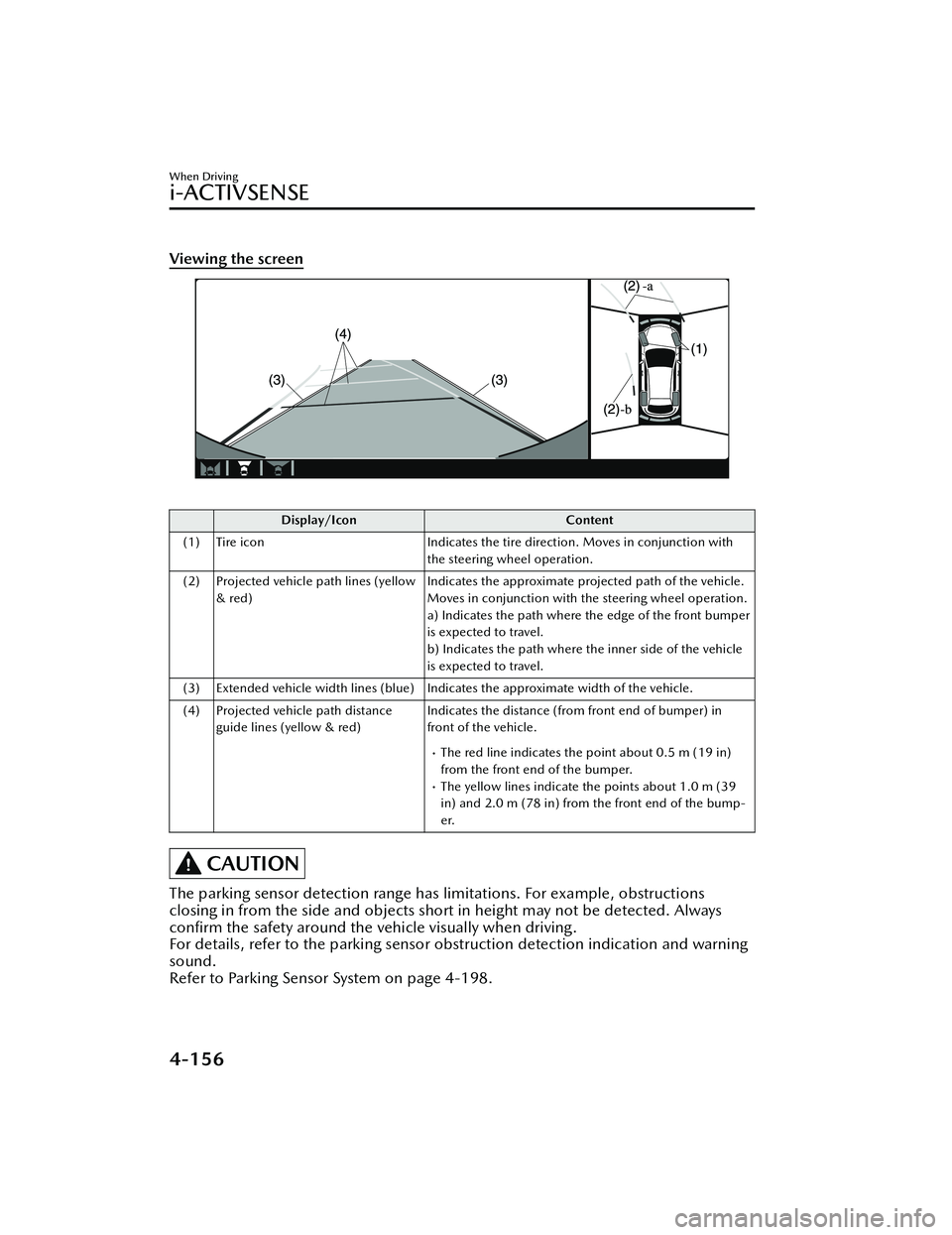
Viewing the screen
Display/IconContent
(1) Tire icon Indicates the tire direction. Moves in conjunction with
the steering wheel operation.
(2) Projected vehicle path lines (yellow & red) Indicates the approximate projected path of the vehicle.
Moves in conjunction with the steering wheel operation.
a) Indicates the path where the edge of the front bumper
is expected to travel.
b) Indicates the path where the inner side of the vehicle
is expected to travel.
(3) Extended vehicle width lines (blue) Indicates the approximate width of the vehicle.
(4) Projected vehicle path distance guide lines (yellow & red) Indicates the distance (from front end of bumper) in
front of the vehicle.
The red line indicates the point about 0.5 m (19 in)
from the front end of the bumper.
The yellow lines indicate the points about 1.0 m (39
in) and 2.0 m (78 in) from the front end of the bump-
er.
CAUTION
The parking sensor detection range has limitations. For example, obstructions
closing in from the side and objects shor
t in height may not be detected. Always
con firm the safety around the vehicle visually when driving.
For details, refer to the parking sensor obstruction detection indication and warning
sound.
Refer to Parking Sensor System on page 4-198.
When Driving
i-ACTIVSENSE
4-156
MX -30_8JD4-EA -21G_Edition2_new 2021-5-18 14:38:07