weight MAZDA MODEL MX-30 EV 2022 Owner's Manual
[x] Cancel search | Manufacturer: MAZDA, Model Year: 2022, Model line: MODEL MX-30 EV, Model: MAZDA MODEL MX-30 EV 2022Pages: 547, PDF Size: 79.35 MB
Page 344 of 547

When parking in a space with a division line on only one side of the parking space,
the division line and the vehicle width guide line appear aligned in the monitor,
but they may not actually be aligned on the ground.
▼Variance Between Actual Road Conditions and Displayed Image
Some variance occurs between the actual road and the displayed road. Such
variance in distance perspective could lead to an accident. Note the following
conditions that may cause a variance in distance perspective.
When the vehicle is tilted due to the weight of passengers and load
When the vehicle rear is lowered, the object displayed on the screen appears farther
than the actual distance.
1. Object
2. Variance
3. Object on screen
When there is a steep grade behind the vehicle
When there is a steep upgrade (downgrade) behind the vehicle, the object displayed
on the screen appears farther (downgrade: closer) than the actual distance.
1. Appears farther than actual distance
2. Appears closer than actual distance
3. Distance between the vehicle and object displayed on the screen.
When Driving
Rear View Monitor
4-195
MX
-30_8JD4-EA -21G_Edition2_new 2021-5-18 14:38:07
Page 410 of 547

3. Grasp the support rod in thepadded area and secure it in the
support rod hole indicated by the
arrow to hold the hood open.
1. Pad
2. Support rod
▼Closing the Hood
1. Check under the hood area to
make certain all filler caps are in
place and all loose items (e.g.
tools, oil containers, etc.) have
been removed.
2. Lift the hood, grasp the padded area on the support rod, and secure
the support rod in the clip. Verify
that the support rod is secured in
the clip before closing the hood.
1. Clip
3. Lower the hood slowly to a heightof about 20 cm (7.9 in) above its
closed position and then let it drop.
CAUTION
When closing the hood, do not push it
excessively such as by applying your
weight. Otherwise, the hood could be
deformed.
Maintenance and Care
Owner Maintenance
6-9
MX -30_8JD4-EA -21G_Edition2_new 2021-5-18 14:38:07
Page 424 of 547

Tires
▼Tires
For reasons of proper performance,
safety, and better energy
effi ciency,
always maintain recommended tire
in flation pressures and stay within the
recommended load limits and weight
distribution.
WARNING
Using Di fferent Tire Types:
Driving your vehicle with di fferent
types of tires is dangerous. It could
cause poor handling and poor braking;
leading to loss of control.
Except for the limited use of the
temporary spare tire, use only the
same type tires (radial, bias-belted,
bias-type) on all four wheels.
Using Wrong-Sized Tires:
Using any other tire size than what is
speci fied for the vehicle (page 9-5)
is dangerous. It could seriously a ffect
ride, handling, ground clearance, tire
clearance, and speedometer
calibration. This could cause you to
have an accident. Use only tires that
are the correct size speci fied for the
vehicle.
▼ Tire In
flation Pressure
WARNING
Always in flate the tires to the correct
pressure:
Overin flation or underinfl ation of tires
is dangerous. Adverse handling or
unexpected tire failure could result in a
serious accident.
Refer to Tires on page 9-5.
Use only a Mazda-genuine tire valve
cap:
Use of a non-genuine part is
dangerous as the correct tire air
pressure cannot be maintained if the
tire valve becomes damaged. If the
vehicle is driven under this condition,
the tire air pressure will decrease
which could result in a serious
accident. Do not use any part for the
tire valve cap that is not a
Mazda-genuine part.
Inspect all tire pressures monthly when
the tires are cold. Maintain
recommended pressures for the best
ride, handling , and minimum tire
wear.
Refer to the speci fication charts (page
9-5).
NOTE
Always check tire pressure when tires
are cold.
Warm tires normally exceed
recommended pressures. Do not
release air from warm tires to adjust
the pressure.
Underin flation can cause reduced
energy e fficiency, uneven and
accelerated tire wear, and poor
sealing of the tire bead, which will
deform the wheel and cause
separation of tire from rim.
Overin flation can produce a harsh
ride, uneven and accelerated tire
wear, and a greater possibility of
damage from road hazards.
Keep your tire pressure at the correct
levels. If one frequently needs in flating, have it inspected.
Maintenance and Care
Owner Maintenance
6-23
MX -30_8JD4-EA -21G_Edition2_new 2021-5-18 14:38:07
Page 474 of 547

▼i-ACTIVSENSE Warning
Indication/Warning Light*
The indication displays if the system
has a malfunction.
Check the reason for the indication
displaying on the center display or
multi-information display.
Refer to If a Warning Light Turns On or
Flashes on page 7-21.
▼Exterior Light Warning Indication/
Warning Light
This light illuminates if there is a
malfunction in the exterior lights
(except license plate lights). Have your
vehicle inspected by an Authorized
Mazda Dealer.
CAUTION
Do not drive the vehicle while an
exterior light has a malfunction. Poor
visibility, and not being able to signal
braking and turns may cause an
accident. In addition, if the vehicle is
driven with the lights not turned on, it
may con
flict with laws and regulations
due to poor maintenance.
▼ Seat Belt Warning Indication/
Warning Light (Front seat)
The seat belt warning light turns on if
the driver or front passenger's seat is
occupied and the seat belt is not
fastened with the power switch
switched ON.
If the driver or front passenger's seat
belt is unfastened (only when the front
passenger's seat is occupied) and if the
vehicle is driven at about 20 km/h (12
mph) or faster, or about 10 km/h (6
mph) or faster for a continuous 30
seconds, with the seat belt unfastened,
the warning light
flashes for a certain
period. After a short time, the warning
light stops flashing , but remains
illuminated.
NOTE
The warning light flashes for about 6
seconds if the driver or front
passenger's seat is not fastened
when the power switch is switched
ON.
Placing heavy items on the front
passenger's seat may cause the front
passenger's seat belt warning
function to operate depending on
the weight of the item.
To allow the front passenger
occupant classi fication sensor to
function properly, do not place and
sit on an additional seat cushion on
the front passenger's seat. The
sensor may not function properly
because the additional seat cushion
could cause sensor interference.
If a small child is seated on the front
passenger's seat, the warning light
may not operate.
Action to be taken
Fasten the seat belts.
If Trouble Arises
Warning/Indicator Lights and Warning Sounds
*Some models.7-29
MX -30_8JD4-EA -21G_Edition2_new 2021-5-18 14:38:07
Page 511 of 547

95
“95” is the Load Index. This two-or
three-digit number indicates how
much weight each tire can support.
H
“H” is the speed rating. The speed
rating denotes the maximum speed for
which the use of the tire is rated.
Letter Rating Speed RatingQ 99 mphR 106 mph
S 112 mph
T 118 mph
U 124 mph
H 130 mph
V 149 mph
W 168
* mph
Y 186
* mph
* For tires with a maximum speed capability over
149 mph, tire manufacturers sometimes use the
letters ZR. For tires with a maximum speed
capability over 186 mph, tire manufacturers
always use the letters ZR.
M+S or M/S: Mud and Snow
AT
: All Terrain.
AS : All Season. The “M+S” or “M/S”
indicates that the tire has some
functional use in mud and snow.
U.S. DOT Tire Identi fication Number
(TIN)
This begins with the letters “DOT”
which indicates the tire meets all
federal standards. The next two
numbers or letters are the plant code
where it was manufactured, and the
last four numbers represent the week
and year the tire was manufactured.
For example, the numbers 457 means
the 45st week of 1997. After 2000 the
numbers go to four digits. For
example, the number 2102 means the
21th week of 2002. The other
numbers are marketing codes used at
the manufacturer's discretion. This
information is used to contact
consumers if a tire defect requires a
recall.
Tire Ply Composition and Materials
Used
The number of plies indicates the
number of layers of rubber-coated
fabric in the tire. In general, the greater
the number of plies, the more weight a
tire can support. Tire manufacturers
also must indicate the tire materials,
which include steel, nylon, polyester,
and other.
Maximum Load Rating
This number indi cates the maximum
load in kilograms and pounds that can
be carried by the tire.
Maximum Permissible In flation
Pressure
This number is the greatest amount of
air pressure that should ever be put in
the tire under normal driving
conditions.
Tread Wear, Traction and Temperature
Grades
Trea d wea r : The tread wear grade is a
comparative rating based on the wear
rate of the tire when tested under
controlled conditions on a specified
government test course. For example,
a tire graded 150 would wear one and
one-half (1 1/2) times as well on the
government course as a tire graded
100.
Traction: The traction grades, from
highest to lowest are AA, A, B, and C.
Customer Information and Reporting Safety Defects
Tire Information (U.S.A.)
8-22
MX -30_8JD4-EA -21G_Edition2_new 2021-5-18 14:38:07
Page 513 of 547

70
“70” is the aspect ratio. This two-digit
number indicates the tire's ratio of
height to width.
D
“D” is the tire construction symbol. D
indicates “diagonal ply construction”.
16
“16” is the wheel rim diameter in
inches.
90
“90” is the Load Index. This two-or
three-digit number indicates how
much weight each tire can support.
M
“M” is the speed rating. The speed
rating denotes the maximum speed for
which the use of the tire is rated.
Letter Rating Speed Rating
M 81 mph
Location of the Tire Label (Placard)
▼Location of the Tire Label (Placard)
Yo u w i l l
find the tire label containing
tire inflation pressure by tire size and
other important information on the
driver's side B -pillar or on the edge of
the rear door on the driver's side.
SAMPLE
▼ Recommended Tire In
flation
Pressure
On the tire label you will find the
recommended tire inflation pressure in
both kPa and psi for the tires installed
as original equipment on the vehicle. It
is very important that the inflation
pressure of the tires on your vehicle is
maintained at the recommended
pressure. You should check the tire
pressure regularly to insure that the
proper in flation pressure is maintained.
Refer to Tires on page 9-5.
NOTE
Tire pressures listed on the vehicle
placard or tire information label
indicate the recommended cold tire
in flation pressure, measured when the
tires are cold, after the vehicle has
been parked for at least 3 hours. As
you drive, the temperature in the tire
warms up, increasing the tire pressure.
Customer Information and Reporting Safety Defects
Tire Information (U.S.A.)
8-24
MX -30_8JD4-EA -21G_Edition2_new 2021-5-18 14:38:07
Page 514 of 547

WARNING
Always check the tire inflation
pressures on a regular basis according
to the recommended tire inflation
pressure on the tire label and in
conjunction with the information in
this owner's manual:
Driving your vehicle with
under-in flated tires is dangerous.
Under-in flation is the most common
cause of failures in any kind of tire and
may result in severe cracking , tread
separation or “blowout”, with
unexpected loss of vehicle control and
increased risk of injury. Under-inflation
increases sidewall flexing and rolling
resistance, resulting in heat buildup
and internal damage to the tire. It
results in unnecessary tire stress,
irregular wear, loss of control and
accidents. A tire can lose up to half of
its air pressure and not appear to be
fl at!
It is impossible to determine whether
or not tires are properly inflated just by
looking at them.
▼ Checking Tire Pressure
1. When you check the air pressure,
make sure the tires are cold
―meaning they are not hot from
driving even a mile.
2. Remove the cap from the valve on
one tire.
3. Firmly press a tire gauge onto the valve.
4. Add air to achieve recommended air pressure.
5. If you over fill the tire, release air by
pushing on the metal stem in the
center of the valve. Then recheck
the pressure with your tire gauge.
6. Replace the valve cap.
7. Repeat with each tire, including the spare.
NOTE
Some spare tires require higher
inflation pressure.
8. Visually inspect the tires to make sure there are no nails or other
objects embedded that could poke
a hole in the tire and cause an air
leak.
9. Check the sidewalls to make sure there are no gouges, cuts, bulges,
cracks or other irregularities.
▼Glossary of Terms
Tire Placard:
A label indicating the OE
tire sizes, recommended in flation
pressure, and the maximum weight the
vehicle can carry.
Tire Identi fication Number (TIN): A
number on the sidewall of each tire
providing information about the tire
brand and manufacturing plant, tire
size, and date of manufacture.
In flation Pressure: A measure of the
amount of air in a tire.
kPa: Kilopascal, the metric unit for air
pressure.
psi: Pou nd s pe r s qu a re in ch , t h e
English unit for air pressure.
B -pillar: The structural member at the
side of the vehicle behind the front
door.
Original Equipment (OE): Describes
components originally equipped on
the vehicle.
Ve h i c l e L o a d L i m i t : The maximum
value of the combination weight of
occupants and cargo.
Bead Area of the Tire: Area of the tire
next to the rim.
Sidewall Area of the Tire: Area
between the bead area and the tread.
Tread Area of the Tire: Area on the
perimeter of the tire that contacts the
Customer Information and Reporting Safety Defects
Tire Information (U.S.A.)
8-25
MX -30_8JD4-EA -21G_Edition2_new 2021-5-18 14:38:07
Page 515 of 547

road when it's mounted on the
vehicle.
Seating capacity means the total
allowable number of vehicle
occupants. Seating capacity is
described on the tire label.
Production options weight is the
combination weight of installed regular
production options weighing over 2.3
kilograms in excess of the standard
items which they replace, and not
previously considered in the curb
weight or accessor y weight, including
heavy duty brakes, ride levelers, roof
rack, heavy duty battery, and special
trim.
Rim is the metal support (wheel) for a
tire or a tire and tube assembly upon
which the tire beads are seated.Tire Maintenance
▼ Tire Maintenance
Improper or inadequate vehicle
maintenance can cause tires to wear
abnormally. Here are some important
maintenance points:
▼Tire
Inflation Pressure
Inspect all tire pressure monthly
(including the spare) when the tires are
cold. Maintain recommended
pressures for the best ride, top
handling , and minimum tire wear. Use
the pressures speci
fied on the vehicle
tire information placard or tire label for
optimum service.
▼ Tire Rotation
To equalize tread wear, rotate the tires
every 16,000 km (10,000 miles) at the
latest or sooner if irregular wear
develops. Mazda recommends to
rotate every 8,000 km (5,000 miles) to
help increase tire life and distribute
wear more evenly.
1. Forward
Do not include (TEMPORARY USE
ONLY) spare tire in rotation.
Inspect the tires for uneven wear and
damage. Abnormal wear is usually
caused by one or a combination of the
following:
Incorrect tire pressure
Customer Information and Reporting Safety Defects
Tire Information (U.S.A.)
8-26
MX
-30_8JD4-EA -21G_Edition2_new 2021-5-18 14:38:07
Page 517 of 547

Ve h i c l e L o a d i n g
▼Ve h i c l e L o a d i n g
WARNING
Do not tow a trailer with this vehicle:
Towing a trailer with this vehicle is
dangerous because it has not been
designed to tow a trailer and doing so
will
aff ect the drive system which could
result in vehicle damage.
This section will guide you in the
proper loading of your vehicle, to keep
your loaded vehicle weight within its
design rating capability. Properly
loading your vehicle will provide
maximum return of vehicle design
performance. Before loading your
vehicle, familiarize yourself with the
following terms for determining your
vehicle's weight ratings, from the
vehicle's Safety Certi fication Label and
Tire and Load Information Label:
WARNING
Overloaded Vehicle:
Overloading a vehi cle is dangerous.
The results of overloading can have
serious consequences in terms of
passenger safety. Too much weight on
a vehicle's suspension system can
cause spring or shock absorber failure,
brake failure, handling or steering
problems, irregular tire wear, tire
failure or other damage.
Overloading makes a vehicle harder to
drive and control. It also increases the
distance required for stopping. In cases
of serious overloading , brakes can fail
completely, particularly on steep
grades. The load a tire will carry safely
is a combination of the size of the tire,
its load range, and corresponding
in flation pressure.
Never overload the vehicle and always
observe the vehicle's weight ratings
from the vehicle's Safety Certi fication
and Tire and Load Information labels.
Base Curb Weight is the weight of the
vehicle including all standard
equipment. It does not include
passengers, cargo, or optional
equipment.
Vehicle Curb Weight is the weight of
your new vehicle when you picked it
up from your dealer plus any
aftermarket equipment.
PAY LOA D
Pay l o a d is the combination weight of
cargo and passengers that the vehicle
is designed to carry. The maximum
payload for your vehicle can be found
on the Tire and Load Information label
on the rear door on the driver's side or
door pillar. Look for “THE
COMBINATION WEIGHT OF
OCCUPANTS AND CARGO SHOULD
NEVER EXCEED XXX kg or XXX lbs” for
your maximum payload. The payload
listed on the tire label is the maximum
payload for the vehicle as built by the
assembly plant. If any aftermarket or
dealer installed equipment has been
installed on the vehicle, the weight of
the equipment must be subtracted
Customer Information and Reporting Safety Defects
Tire Information (U.S.A.)
8-28
MX -30_8JD4-EA -21G_Edition2_new 2021-5-18 14:38:07
Page 518 of 547
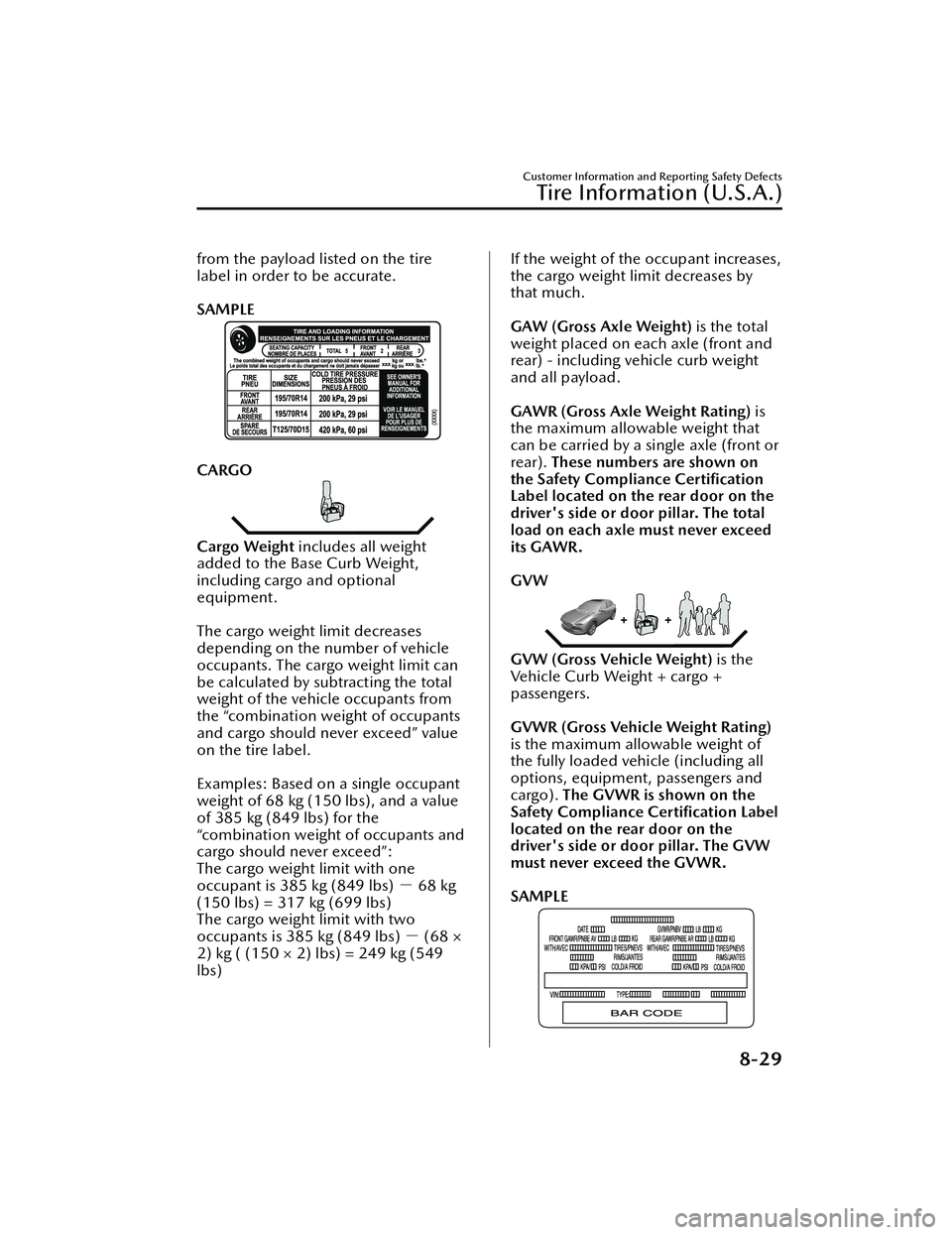
from the payload listed on the tire
label in order to be accurate.
SAMPLE
CARGO
Cargo Weight includes all weight
added to the Base Curb Weight,
including cargo and optional
equipment.
The cargo weight limit decreases
depending on the number of vehicle
occupants. The cargo weight limit can
be calculated by subtracting the total
weight of the vehicle occupants from
the “combination weight of occupants
and cargo should never exceed” value
on the tire label.
Examples: Based on a single occupant
weight of 68 kg (150 lbs), and a value
of 385 kg (849 lbs) for the
“combination weight of occupants and
cargo should never exceed”:
The cargo weight limit with one
occupant is 385 kg (849 lbs) - 68 kg
(150 lbs) = 317 kg (699 lbs)
The cargo weight limit with two
occupants is 385 kg (849 lbs) - (68 ×
2) kg ( (150 × 2) lbs) = 249 kg (549
lbs)
If the weight of the occupant increases,
the cargo weight limit decreases by
that much.
GAW (Gross Axle Weight) is the total
weight placed on each axle (front and
rear) - including vehicle curb weight
and all payload.
GAWR (Gross Axle Weight Rating) is
the maximum allowable weight that
can be carried by a single axle (front or
rear). These numbers are shown on
the Safety Compliance Certi fication
Label located on the rear door on the
driver's side or door pillar. The total
load on each axle must never exceed
its GAWR.
GVW
GVW (Gross Vehicle Weight) is the
Vehicle Curb Weight + cargo +
passengers.
GVWR (Gross Vehicle Weight Rating)
is the maximum allowable weight of
the fully loaded vehicle (including all
options, equipment, passengers and
cargo). The GVWR is shown on the
Safety Compliance Certification Label
located on the rear door on the
driver's side or door pillar. The GVW
must never exceed the GVWR.
SAMPLE
Customer Information and Reporting Safety Defects
Tire Information (U.S.A.)
8-29
MX -30_8JD4-EA -21G_Edition2_new 2021-5-18 14:38:07