engine oil MAZDA MODEL TRIBUTE 2002 (in English) User Guide
[x] Cancel search | Manufacturer: MAZDA, Model Year: 2002, Model line: MODEL TRIBUTE, Model: MAZDA MODEL TRIBUTE 2002Pages: 256, PDF Size: 2.66 MB
Page 207 of 256
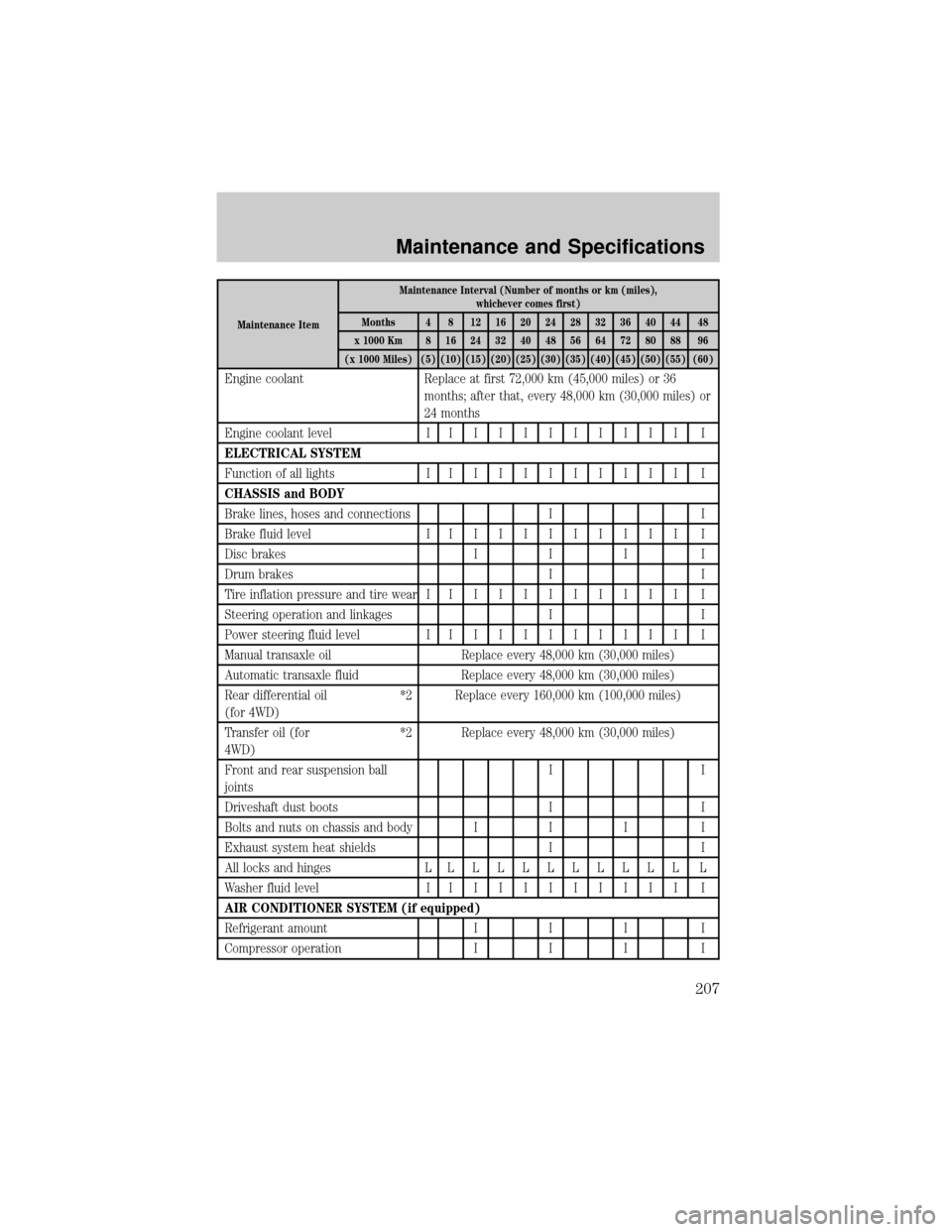
Maintenance ItemMaintenance Interval (Number of months or km (miles),
whichever comes first)
Months 4 8 12 16 20 24 28 32 36 40 44 48
x 1000 Km 8 16 24 32 40 48 56 64 72 80 88 96
(x 1000 Miles) (5) (10) (15) (20) (25) (30) (35) (40) (45) (50) (55) (60)
Engine coolant Replace at first 72,000 km (45,000 miles) or 36
months; after that, every 48,000 km (30,000 miles) or
24 months
Engine coolant level IIIIIIIIIII I
ELECTRICAL SYSTEM
Function of all lights IIIIIIIIIII I
CHASSIS and BODY
Brake lines, hoses and connections I I
Brake fluid level IIIIIIIIIII I
Disc brakes I I I I
Drum brakes I I
Tire inflation pressure and tire wear IIIIIIIIIII I
Steering operation and linkages I I
Power steering fluid level IIIIIIIIIII I
Manual transaxle oil Replace every 48,000 km (30,000 miles)
Automatic transaxle fluid Replace every 48,000 km (30,000 miles)
Rear differential oil
(for 4WD)*2 Replace every 160,000 km (100,000 miles)
Transfer oil (for
4WD)*2 Replace every 48,000 km (30,000 miles)
Front and rear suspension ball
jointsII
Driveshaft dust boots I I
Bolts and nuts on chassis and body I I I I
Exhaust system heat shields I I
All locks and hinges LLLLLLLLLLL L
Washer fluid level IIIIIIIIIII I
AIR CONDITIONER SYSTEM (if equipped)
Refrigerant amount I I I I
Compressor operation I I I I
Maintenance and Specifications
207
Page 208 of 256
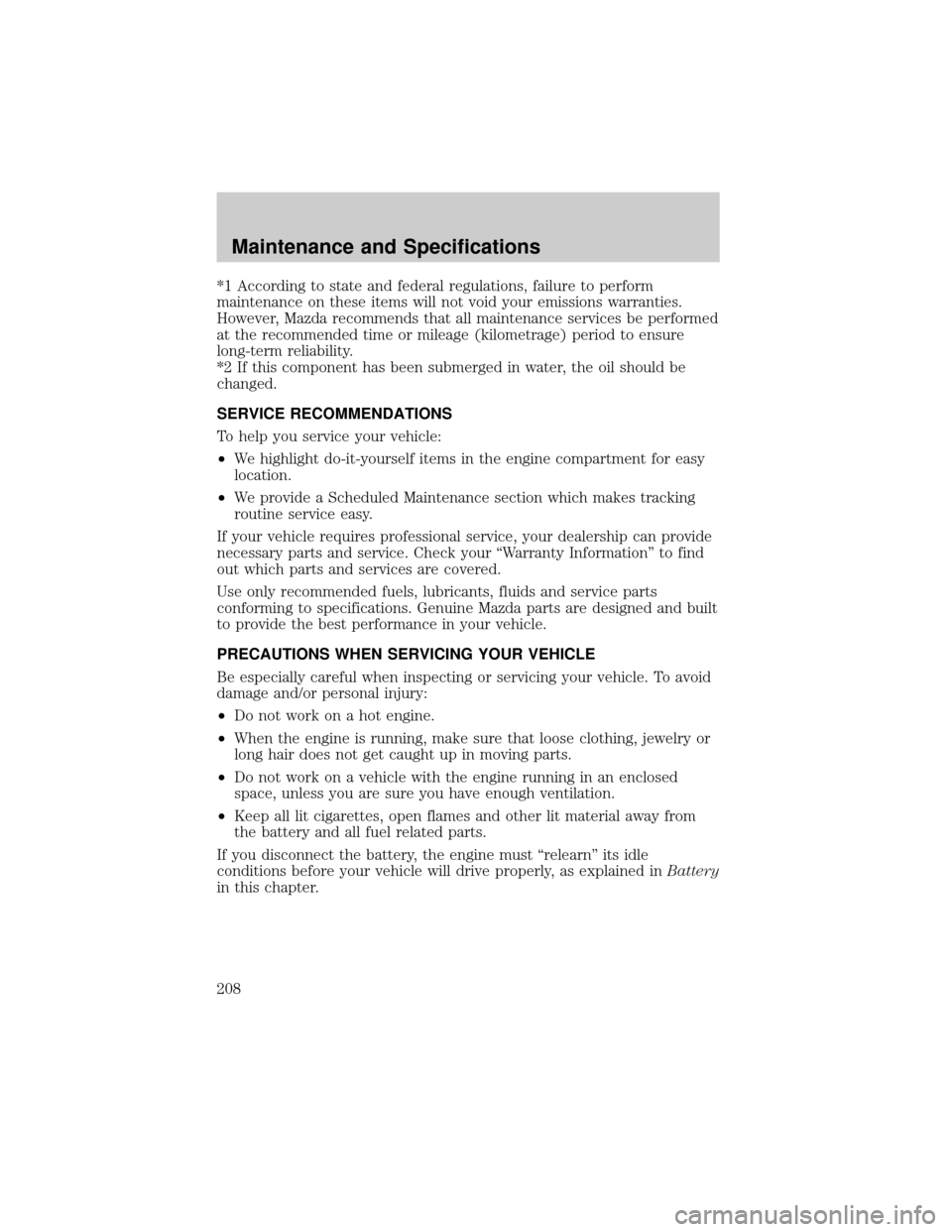
*1 According to state and federal regulations, failure to perform
maintenance on these items will not void your emissions warranties.
However, Mazda recommends that all maintenance services be performed
at the recommended time or mileage (kilometrage) period to ensure
long-term reliability.
*2 If this component has been submerged in water, the oil should be
changed.
SERVICE RECOMMENDATIONS
To help you service your vehicle:
²We highlight do-it-yourself items in the engine compartment for easy
location.
²We provide a Scheduled Maintenance section which makes tracking
routine service easy.
If your vehicle requires professional service, your dealership can provide
necessary parts and service. Check your ªWarranty Informationº to find
out which parts and services are covered.
Use only recommended fuels, lubricants, fluids and service parts
conforming to specifications. Genuine Mazda parts are designed and built
to provide the best performance in your vehicle.
PRECAUTIONS WHEN SERVICING YOUR VEHICLE
Be especially careful when inspecting or servicing your vehicle. To avoid
damage and/or personal injury:
²Do not work on a hot engine.
²When the engine is running, make sure that loose clothing, jewelry or
long hair does not get caught up in moving parts.
²Do not work on a vehicle with the engine running in an enclosed
space, unless you are sure you have enough ventilation.
²Keep all lit cigarettes, open flames and other lit material away from
the battery and all fuel related parts.
If you disconnect the battery, the engine must ªrelearnº its idle
conditions before your vehicle will drive properly, as explained inBattery
in this chapter.
Maintenance and Specifications
208
Page 211 of 256

IDENTIFYING COMPONENTS IN THE ENGINE COMPARTMENT
2.0L DOHC I4 Zetec engine
1. Power steering fluid reservoir
2. Engine coolant reservoir
3. Brake/Clutch fluid reservoir
4. Air filter assembly
5. Power distribution box
6. Battery
7. Engine oil filler cap
8. Engine oil dipstick
9. Windshield washer fluid reservoir
5678
1234
9
Maintenance and Specifications
211
Page 212 of 256

3.0L DOHC V6 Duratec engine
1. Power steering fluid reservoir
2. Engine coolant reservoir
3. Automatic transmission fluid dipstick
4. Brake fluid reservoir
5. Air filter assembly
6. Power distribution box
7. Battery
8. Engine oil dipstick
9. Engine oil filler cap
10. Windshield washer fluid reservoir
10987
123456
Maintenance and Specifications
212
Page 213 of 256
WINDSHIELD WASHER FLUID
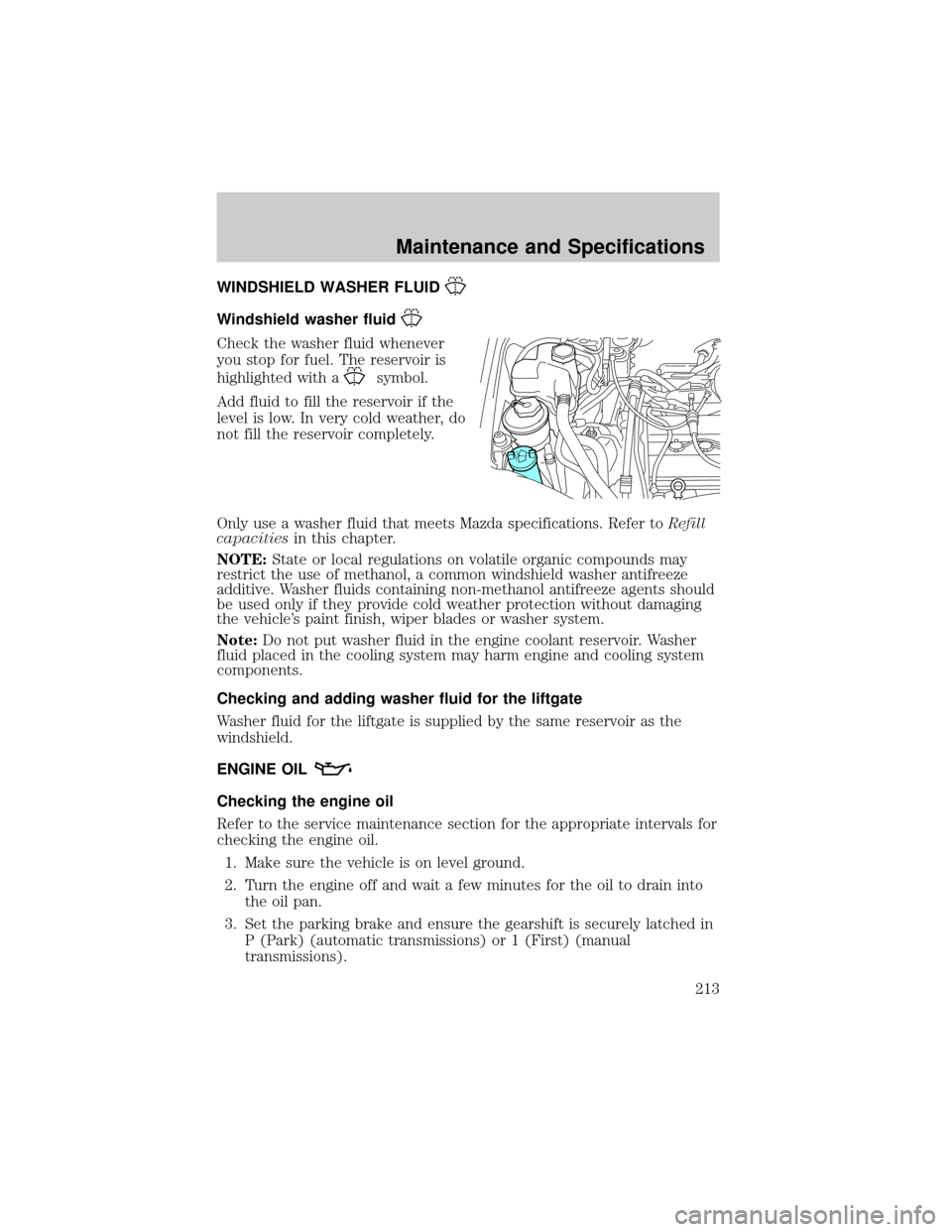
Windshield washer fluid
Check the washer fluid whenever
you stop for fuel. The reservoir is
highlighted with a
symbol.
Add fluid to fill the reservoir if the
level is low. In very cold weather, do
not fill the reservoir completely.
Only use a washer fluid that meets Mazda specifications. Refer toRefill
capacitiesin this chapter.
NOTE:State or local regulations on volatile organic compounds may
restrict the use of methanol, a common windshield washer antifreeze
additive. Washer fluids containing non-methanol antifreeze agents should
be used only if they provide cold weather protection without damaging
the vehicle's paint finish, wiper blades or washer system.
Note:Do not put washer fluid in the engine coolant reservoir. Washer
fluid placed in the cooling system may harm engine and cooling system
components.
Checking and adding washer fluid for the liftgate
Washer fluid for the liftgate is supplied by the same reservoir as the
windshield.
ENGINE OIL
Checking the engine oil
Refer to the service maintenance section for the appropriate intervals for
checking the engine oil.
1. Make sure the vehicle is on level ground.
2. Turn the engine off and wait a few minutes for the oil to drain into
the oil pan.
3. Set the parking brake and ensure the gearshift is securely latched in
P (Park) (automatic transmissions) or 1 (First) (manual
transmissions).
Maintenance and Specifications
213
Page 214 of 256

4. Open the hood. Protect yourself from engine heat.
5. Locate and carefully remove the engine oil level indicator (dipstick).
²2.0L DOHC I4 Zetec engine
²3.0L DOHC V6 Duratec engine
6. Wipe the indicator clean. Insert the indicator fully, then remove it
again.
²If the oil level isbetween the MIN-MAX or ADD-FULL marks,the
oil level is acceptable.DO NOT ADD OIL.
FULL ADD
MAX MIN
Maintenance and Specifications
214
Page 215 of 256

²If the oil level is below the MIN or ADD mark, add enough oil to raise
the level within the MIN±MAX or ADD-FULL range.
²2.0L DOHC I4 Zetec engine
²3.0L DOHC V6 Duratec engine
²Oil levels above the MAX or FULL mark may cause engine damage.
Some oil must be removed from the engine by a service technician.
7. Put the indicator back in and ensure it is fully seated.
Adding engine oil
1. Check the engine oil. For instructions, refer toChecking the engine
oilin this chapter.
2. If the engine oil level is not within the normal range, add only
certified engine oil of the recommended viscosity. Remove the engine
oil filler cap and use a funnel to pour the engine oil into the opening.
3. Recheck the engine oil level. Make sure the oil level is not above the
MAX or FULL mark on the engine oil level indicator (dipstick).
4. Install the indicator and ensure it is fully seated.
5. Fully install the engine oil filler cap by turning the filler cap
clockwise 1/4 of a turn until it is seated.
Maintenance and Specifications
215
Page 216 of 256

To avoid possible oil loss, DO NOT operate the vehicle with the
engine oil level indicator and/or the engine oil filler cap removed.
Engine oil and filter recommendations
SAE 5W-20 engine oil is recommended
Look for this certification
trademark.
Use SAE 5W-20 motor oil certified for gasoline engines by the American
Petroleum Institute (API).
Motor oil displaying the API certification trademark will meet all
requirements for your vehicle's engine.
Do not use supplemental engine oil additives, oil treatments or engine
treatments. They are unnecessary and could, under certain conditions,
lead to engine damage which is not covered by your warranty.
Change your engine oil and filter according to the appropriate schedule
listed in the service maintenance section.
Mazda production and replacement oil filters are designed for added
engine protection and long life. If a replacement oil filter is used that
does not meet Mazda material and design specifications, start-up engine
noises or knock may be experienced.
It is recommended you use the appropriate Genuine Mazda oil filter (or
another brand meeting Mazda specifications) for your engine application.
Maintenance and Specifications
216
Page 219 of 256

transmission may shift firmly. This operation is considered normal and
will not affect function or durability of the transmission. Over time the
adaptive learning process will fully update transmission operation to its
optimum shift feel.
If the battery has been disconnected or a new battery has been installed,
the clock and the preset radio stations must be reset once the battery is
reconnected.
²Always dispose of automotive
batteries in a responsible manner.
Follow your local authorized
standards for disposal. Call your
local authorized recycling center
to find out more about recycling
automotive batteries.
ENGINE COOLANT
Checking engine coolant
The concentration and level of engine coolant should be checked at the
mileage intervals listed in the service maintenance section. The coolant
concentration should be maintained at 50/50 coolant and water, which
equates to a freeze point of -36É C (-34É F). Coolant concentration
testing is possible with a hydrometer or antifreeze tester (such as the
Rotunda Battery and Antifreeze Tester, 014±R1060). The level of coolant
should be maintained at the ªcold fullº of ªcold fill rangeº level in the
coolant reservoir. If the level falls below, add coolant per the instructions
in theAdding Engine Coolantsection.
Your vehicle was factory-filled with a 50/50 engine coolant and water
concentration. If the concentration of coolant falls below 40% or above
60%, the engine parts could become damaged or not work properly.A
50±50 mixture of coolant and water provides the following:
²freeze protection down to -36É C (-34É F).
²boiling protection up to 129É C (265É F).
²protection against rust and other forms of corrosion.
²an accurate temperature readout from the engine coolant
gauge.
LEAD
RETURN
RECYCLE
Maintenance and Specifications
219
Page 231 of 256

²Warming up a vehicle on cold mornings is not required and may
reduce fuel economy.
²Resting your foot on the brake pedal while driving may reduce fuel
economy.
²Combine errands and minimize stop-and-go driving.
Maintenance
²Keep tires properly inflated and use only recommended size.
²Operating a vehicle with the wheels out of alignment will reduce fuel
economy.
²Use recommended engine oil. Refer toLubricant specificationsin
this chapter.
²Perform all regularly scheduled maintenance items. Follow the
recommended maintenance schedule and owner maintenance checks
found in your vehicle service maintenance section.
Conditions
²Heavily loading a vehicle or towing a trailer may reduce fuel economy
at any speed.
²Carrying unnecessary weight may reduce fuel economy (approximately
0.4 km/L [1 mpg] is lost for every 180 kg [400 lb] of weight carried).
²Adding certain accessories to your vehicle (for example bug
deflectors, rollbars/light bars, running boards, ski/luggage racks) may
reduce fuel economy.
²Using fuel blended with alcohol may lower fuel economy.
²Fuel economy may decrease with lower temperatures during the first
12±16 km (8±10 miles) of driving.
²Driving on flat terrain offers improved fuel economy as compared to
driving on hilly terrain.
²Transmissions give their best fuel economy when operated in the top
cruise gear and with steady pressure on the gas pedal.
²Close windows for high speed driving.
EPA window sticker
Every new vehicle should have the EPA window sticker. Contact your
dealer if the window sticker is not supplied with your vehicle. The EPA
window sticker should be your guide for the fuel economy comparisons
with other vehicles.
Maintenance and Specifications
231