light MAZDA MODEL TRIBUTE HEV 2008 Workshop Manual
[x] Cancel search | Manufacturer: MAZDA, Model Year: 2008, Model line: MODEL TRIBUTE HEV, Model: MAZDA MODEL TRIBUTE HEV 2008Pages: 312, PDF Size: 3.68 MB
Page 130 of 312

How does the side airbag system work?
The design and development of the
side airbag system included
recommended testing procedures
that were developed by a group of
automotive safety experts known as
the Side Airbag Technical Working
Group. These recommended testing
procedures help reduce the risk of
injuries related to the deployment of
side airbags.
The side airbag system consists of
the following:
•An inflatable nylon bag (airbag)
with a gas generator concealed
behind the outboard bolster of
the driver and front passenger
seatbacks.
• A special seat cover designed to allow airbag deployment.
• The same warning light, electronic control and diagnostic unit as used
for the front airbags.
• Two crash sensors located on the lower portion of the b-pillar (one on
each side of the vehicle).
Side airbags, in combination with seat belts, can help reduce the risk of
severe injuries in the event of a significant side impact collision.
The side airbags are fitted on the outboard side of the seatbacks of the
front seats. In certain lateral collisions, the airbag on the side affected by
the collision will be inflated. If the front passenger sensing system
detects an empty seat, the front passenger seat-mounted side airbag will
be deactivated. The airbag was designed to inflate between the door
panel and occupant to further enhance the protection provided
occupants in side impact collisions.
The airbag SRS is designed to activate when the vehicle sustains lateral
deceleration sufficient to cause the sensors to close an electrical circuit
that initiates airbag inflation.
The fact that the airbags did not inflate in a collision does not mean that
something is wrong with the system. Rather, it means the forces were
not of the type sufficient to cause activation. Side airbags are designed
2008 Tribute Hybrid (thv)
Owners Guide (post-2002-fmt)
USA (fus)
Seating and Safety Restraints
130
Page 131 of 312
to inflate in side-impact collisions, not roll-over, rear-impact, frontal or
near-frontal collisions, unless the collision causes sufficient lateral
deceleration.WARNING: Several airbag system components get hot after
inflation. Do not touch them after inflation.
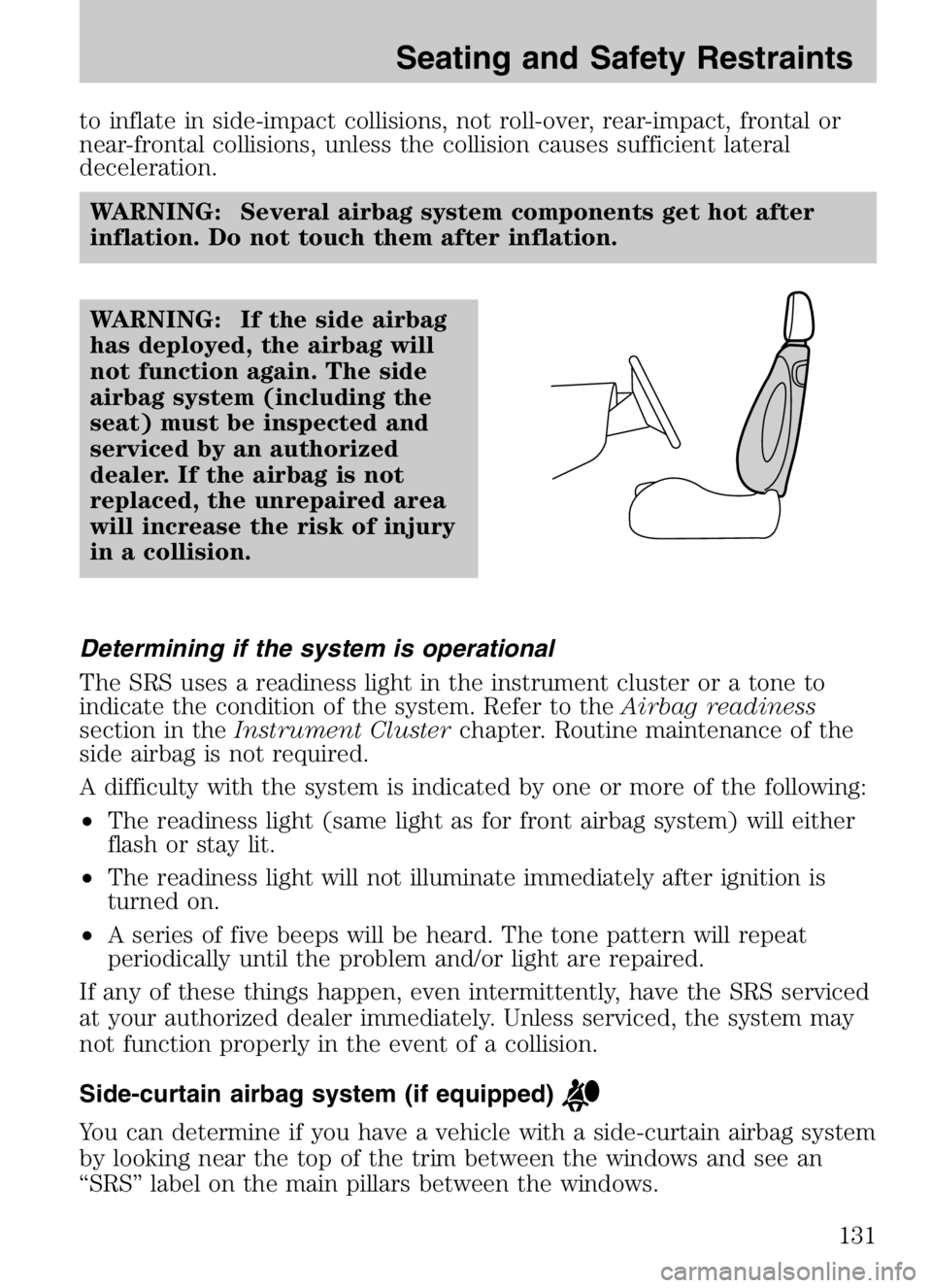
WARNING: If the side airbag
has deployed, the airbag will
not function again. The side
airbag system (including the
seat) must be inspected and
serviced by an authorized
dealer. If the airbag is not
replaced, the unrepaired area
will increase the risk of injury
in a collision.
Determining if the system is operational
The SRS uses a readiness light in the instrument cluster or a tone to
indicate the condition of the system. Refer to the Airbag readiness
section in the Instrument Cluster chapter. Routine maintenance of the
side airbag is not required.
A difficulty with the system is indicated by one or more of the following:
• The readiness light (same light as for front airbag system) will either
flash or stay lit.
• The readiness light will not illuminate immediately after ignition is
turned on.
• A series of five beeps will be heard. The tone pattern will repeat
periodically until the problem and/or light are repaired.
If any of these things happen, even intermittently, have the SRS serviced
at your authorized dealer immediately. Unless serviced, the system may
not function properly in the event of a collision.
Side-curtain airbag system (if equipped)
You can determine if you have a vehicle with a side-curtain airbag system
by looking near the top of the trim between the windows and see an
“SRS” label on the main pillars between the windows.
2008 Tribute Hybrid (thv)
Owners Guide (post-2002-fmt)
USA (fus)
Seating and Safety Restraints
131
Page 133 of 312

How do the side-curtain airbags (if equipped) work?
The design and development of the
side air curtain system included
recommended testing procedures
that were developed by a group of
automotive safety experts known as
the Side Airbag Technical Working
Group. These recommended testing
procedures help reduce the risk of
injuries related to the deployment of
side airbags (including side air
curtain systems).
The side-curtain airbags (if
equipped) consists of the following:
•An inflatable nylon curtain with a
gas generator concealed behind
the headliner and above the doors
(one on each side of vehicle).
• A headliner designed to flex open
above the side doors to allow side-curtain airbag deployment.
• The same warning light, electronic control and diagnostic unit as used
for the front airbags.
• Two crash sensors mounted at lower B-Pillar (one on each side).
• Two crash sensors located at the c-pillar behind the rear doors (one
on each side).
• Rollover sensor in the restraints control module (RCM).
The side-curtain airbags (if equipped), in combination with seat belts,
can help reduce the risk of severe injuries in the event of a significant
side impact collision or rollover event.
Children 12 years old and under should always be properly restrained in
the rear seats. The side-curtain airbags (if equipped) will not interfere
with children restrained using a properly installed child or booster seat
because it is designed to inflate downward from the headliner above the
doors along the side window opening.
The side-curtain airbags (if equipped) are designed to activate when the
vehicle sustains lateral deceleration sufficient to cause the RCM to
initiate side-curtain airbag (if equipped) inflation or when a certain
likelihood of a rollover event is detected by the rollover sensor.
2008 Tribute Hybrid (thv)
Owners Guide (post-2002-fmt)
USA (fus)
Seating and Safety Restraints
133
Page 134 of 312
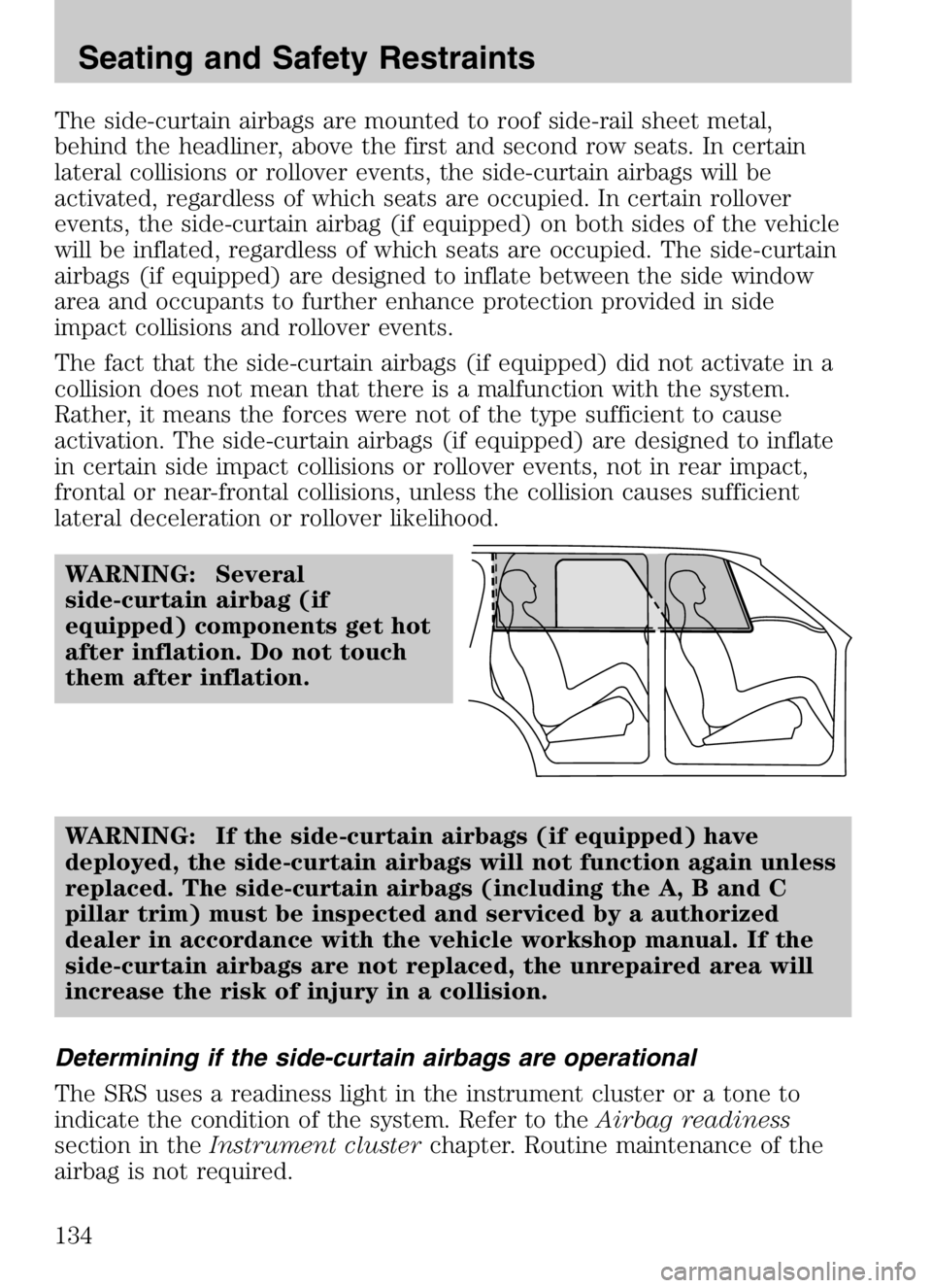
The side-curtain airbags are mounted to roof side-rail sheet metal,
behind the headliner, above the first and second row seats. In certain
lateral collisions or rollover events, the side-curtain airbags will be
activated, regardless of which seats are occupied. In certain rollover
events, the side-curtain airbag (if equipped) on both sides of the vehicle
will be inflated, regardless of which seats are occupied. The side-curtain
airbags (if equipped) are designed to inflate between the side window
area and occupants to further enhance protection provided in side
impact collisions and rollover events.
The fact that the side-curtain airbags (if equipped) did not activate in a
collision does not mean that there is a malfunction with the system.
Rather, it means the forces were not of the type sufficient to cause
activation. The side-curtain airbags (if equipped) are designed to inflate
in certain side impact collisions or rollover events, not in rear impact,
frontal or near-frontal collisions, unless the collision causes sufficient
lateral deceleration or rollover likelihood.WARNING: Several
side-curtain airbag (if
equipped) components get hot
after inflation. Do not touch
them after inflation.
WARNING: If the side-curtain airbags (if equipped) have
deployed, the side-curtain airbags will not function again unless
replaced. The side-curtain airbags (including the A, B and C
pillar trim) must be inspected and serviced by a authorized
dealer in accordance with the vehicle workshop manual. If the
side-curtain airbags are not replaced, the unrepaired area will
increase the risk of injury in a collision.
Determining if the side-curtain airbags are operational
The SRS uses a readiness light in the instrument cluster or a tone to
indicate the condition of the system. Refer to the Airbag readiness
section in the Instrument cluster chapter. Routine maintenance of the
airbag is not required.
2008 Tribute Hybrid (thv)
Owners Guide (post-2002-fmt)
USA (fus)
Seating and Safety Restraints
134
Page 135 of 312
A difficulty with the system is indicated by one or more of the following:
•The readiness light (same light as for front airbag system) will either
flash or stay lit.
• The readiness light will not illuminate immediately after ignition is
turned on.
• A series of five beep sounds will be heard. The tone pattern will
repeat periodically until the problem and light are repaired.
If any of these things happen, even intermittently, have the SRS serviced
at your authorized Mazda dealership immediately. Unless serviced, the
system may not function properly in the event of a collision.
Disposal of airbags and airbag equipped vehicles
(including pretensioners)
See your authorized dealer. Airbags MUST BE disposed of by qualified
personnel.
SAFETY RESTRAINTS FOR CHILDREN
See the following sections for directions on how to properly use safety
restraints for children. Also see Airbag supplemental restraint system
(SRS) in this chapter for special instructions about using airbags.
Important child restraint precautions
You are required by law to use safety restraints for children in the U.S.
and Canada. If small children (generally children who are four years old
or younger and who weigh 40 lb. [18 kg] or less) ride in your vehicle, you
must put them in safety seats made especially for children. Many states
require that children use approved booster seats until they are eight
years old. Check your local and state or provincial laws for specific
requirements regarding the safety of children in your vehicle. When
possible, always place children under age 12 in the rear seat of your
vehicle. Accident statistics suggest that children are safer when properly
restrained in the rear seating positions than in the front seating position. WARNING: Never let a passenger hold a child on his or her lap
while the vehicle is moving. The passenger cannot protect the
child from injury in a collision.
Always follow the instructions and warnings that come with any infant or
child restraint you might use.
2008 Tribute Hybrid (thv)
Owners Guide (post-2002-fmt)
USA (fus)
Seating and Safety Restraints
135
Page 151 of 312

Glossary of tire terminology
•Tire label: A label showing the OE (Original Equipment) tire sizes,
recommended inflation pressure and the maximum weight the vehicle
can carry.
• Tire Identification Number (TIN): A number on the sidewall of
each tire providing information about the tire brand and
manufacturing plant, tire size and date of manufacture. Also referred
to as DOT code.
• Inflation pressure: A measure of the amount of air in a tire.
• Standard load: A class of P-metric or Metric tires designed to carry a
maximum load at 35 psi [37 psi (2.5 bar) for Metric tires]. Increasing
the inflation pressure beyond this pressure will not increase the tire’s
load carrying capability.
• Extra load: A class of P-metric or Metric tires designed to carry a
heavier maximum load at 41 psi [43 psi (2.9 bar) for Metric tires].
Increasing the inflation pressure beyond this pressure will not increase
the tire’s load carrying capability.
• kPa: Kilopascal, a metric unit of air pressure.
• PSI: Pounds per square inch, a standard unit of air pressure.
• Cold inflation pressure: The tire pressure when the vehicle has
been stationary and out of direct sunlight for an hour or more and
prior to the vehicle being driven for 1 mile (1.6 km).
• Recommended inflation pressure: The cold inflation pressure found
on the Safety Compliance Certification Label or Tire Label located on
the B-Pillar or the edge of the driver’s door.
• B-pillar: The structural member at the side of the vehicle behind the
front door.
• Bead area of the tire: Area of the tire next to the rim.
• Sidewall of the tire: Area between the bead area and the tread.
• Tread area of the tire: Area of the perimeter of the tire that
contacts the road when mounted on the vehicle.
• Rim: The metal support (wheel) for a tire or a tire and tube assembly
upon which the tire beads are seated.
INFLATING YOUR TIRES
Safe operation of your vehicle requires that your tires are properly
inflated. Remember that a tire can lose up to half of its air pressure
without appearing flat.
2008 Tribute Hybrid (thv)
Owners Guide (post-2002-fmt)
USA (fus)
Tires, Wheels and Loading
151
Page 160 of 312
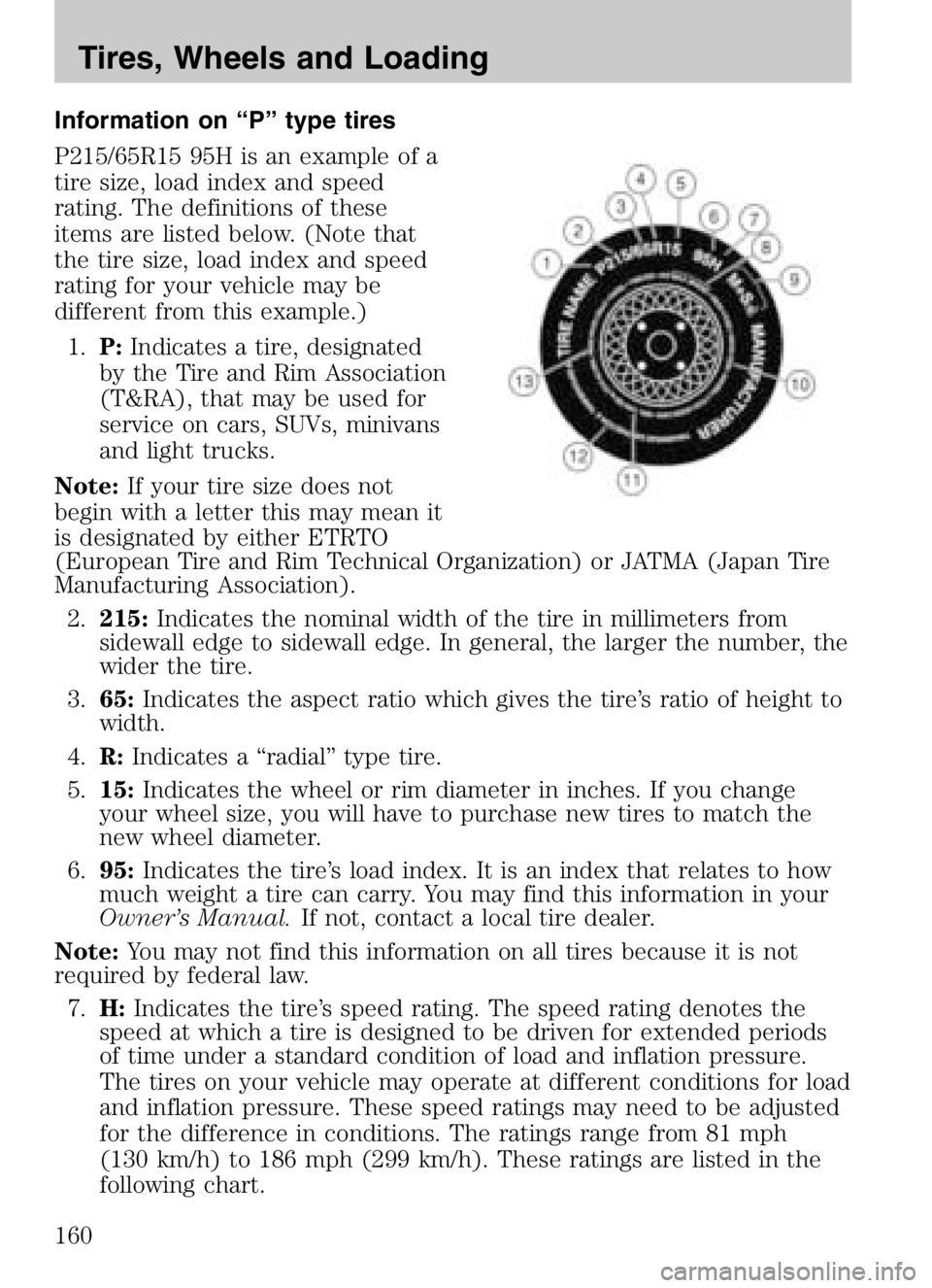
Information on “P” type tires
P215/65R15 95H is an example of a
tire size, load index and speed
rating. The definitions of these
items are listed below. (Note that
the tire size, load index and speed
rating for your vehicle may be
different from this example.)1. P:Indicates a tire, designated
by the Tire and Rim Association
(T&RA), that may be used for
service on cars, SUVs, minivans
and light trucks.
Note: If your tire size does not
begin with a letter this may mean it
is designated by either ETRTO
(European Tire and Rim Technical Organization) or JATMA (Japan Tire
Manufacturing Association).
2. 215: Indicates the nominal width of the tire in millimeters from
sidewall edge to sidewall edge. In general, the larger the number, the
wider the tire.
3. 65: Indicates the aspect ratio which gives the tire’s ratio of height to
width.
4. R: Indicates a “radial” type tire.
5. 15: Indicates the wheel or rim diameter in inches. If you change
your wheel size, you will have to purchase new tires to match the
new wheel diameter.
6. 95: Indicates the tire’s load index. It is an index that relates to how
much weight a tire can carry. You may find this information in your
Owner’s Manual. If not, contact a local tire dealer.
Note: You may not find this information on all tires because it is not
required by federal law.
7. H: Indicates the tire’s speed rating. The speed rating denotes the
speed at which a tire is designed to be driven for extended periods
of time under a standard condition of load and inflation pressure.
The tires on your vehicle may operate at different conditions for load
and inflation pressure. These speed ratings may need to be adjusted
for the difference in conditions. The ratings range from 81 mph
(130 km/h) to 186 mph (299 km/h). These ratings are listed in the
following chart.
2008 Tribute Hybrid (thv)
Owners Guide (post-2002-fmt)
USA (fus)
Tires, Wheels and Loading
160
Page 163 of 312
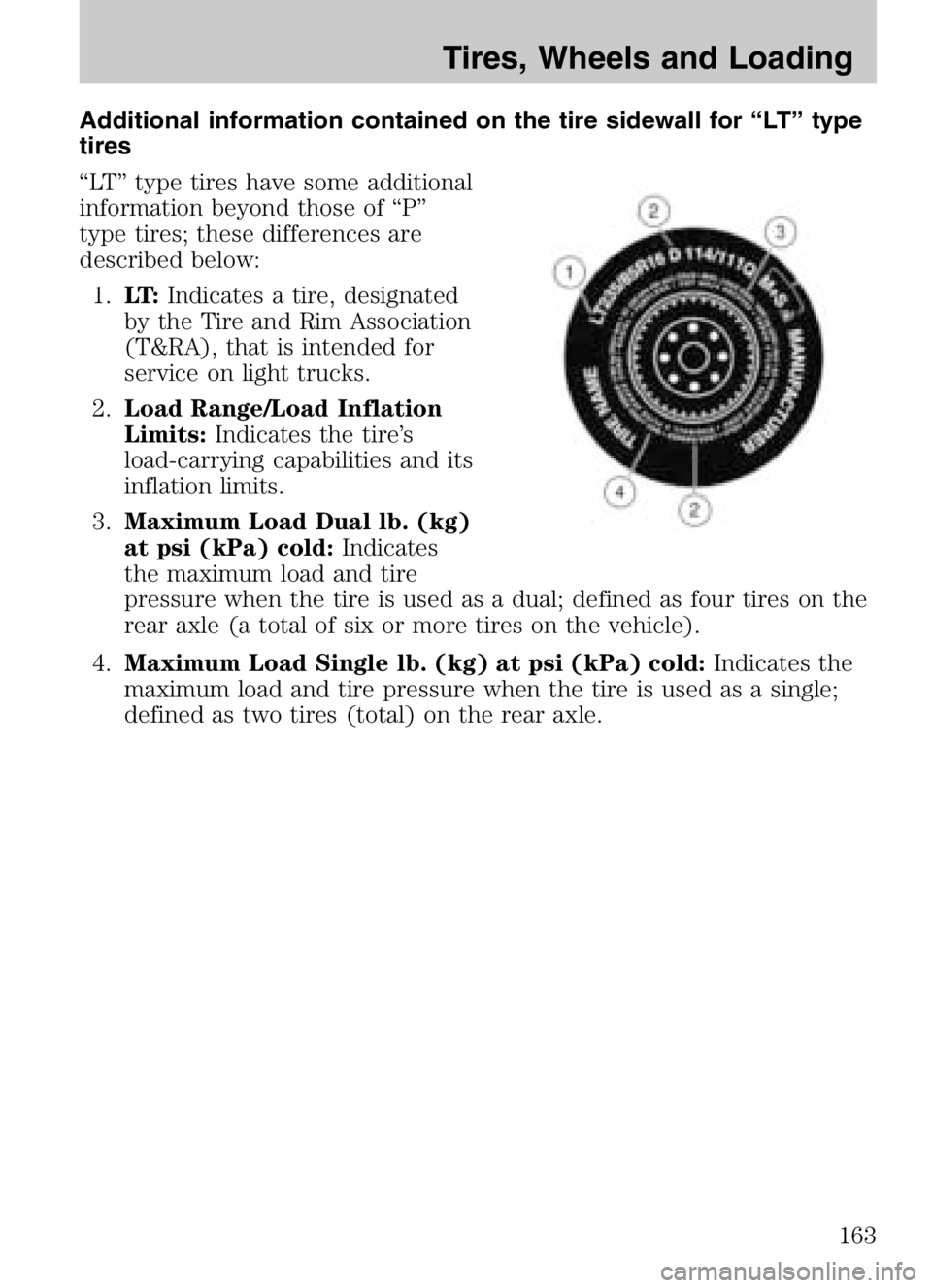
Additional information contained on the tire sidewall for “LT” type
tires
“LT” type tires have some additional
information beyond those of “P”
type tires; these differences are
described below:1. LT: Indicates a tire, designated
by the Tire and Rim Association
(T&RA), that is intended for
service on light trucks.
2. Load Range/Load Inflation
Limits: Indicates the tire’s
load-carrying capabilities and its
inflation limits.
3. Maximum Load Dual lb. (kg)
at psi (kPa) cold: Indicates
the maximum load and tire
pressure when the tire is used as a dual; defined as four tires on the
rear axle (a total of six or more tires on the vehicle).
4. Maximum Load Single lb. (kg) at psi (kPa) cold: Indicates the
maximum load and tire pressure when the tire is used as a single;
defined as two tires (total) on the rear axle.
2008 Tribute Hybrid (thv)
Owners Guide (post-2002-fmt)
USA (fus)
Tires, Wheels and Loading
163
Page 164 of 312

Information on “T” type tires
“T” type tires have some additional
information beyond those of “P”
type tires; these differences are
described below:
T145/80D16 is an example of a tire
size.
Note:The temporary tire size for
your vehicle may be different from
this example.
1. T:Indicates a type of tire,
designated by the Tire and Rim
Association (T&RA), that is
intended for temporary service
on cars, SUVs, minivans and
light trucks.
2. 145: Indicates the nominal
width of the tire in millimeters
from sidewall edge to sidewall edge. In general, the larger the
number, the wider the tire.
3. 80: Indicates the aspect ratio which gives the tire’s ratio of height to
width. Numbers of 70 or lower indicate a short sidewall.
4. D: Indicates a “diagonal” type tire.
R: Indicates a “radial” type tire.
5. 16: Indicates the wheel or rim diameter in inches. If you change
your wheel size, you will have to purchase new tires to match the
new wheel diameter.
Location of the tire label
You will find a Tire Label containing tire inflation pressure by tire size
and other important information located on the B-Pillar or the edge of
the driver’s door. Refer to the payload description and graphic in the
Vehicle loading — with and without a trailer section.
2008 Tribute Hybrid(thv)
Owners Guide (post-2002-fmt)
USA (fus)
Tires, Wheels and Loading
164
Page 166 of 312

following two conditions: (1) This device may not cause harmful
interference, and (2) This device must accept any interference received,
including interference that may cause undesired operation.WARNING: The Tire Pressure Monitoring System is NOT a
substitute for manually checking tire pressure. The tire
pressure should be checked periodically (at least monthly)
using a tire gauge, see Inflating your tiresin this chapter.
Failure to properly maintain your tire pressure could increase
the risk of tire failure, loss of control, vehicle rollover and
personal injury.
Changing tires with TPMS
Each road tire is equipped with
a tire pressure sensor fastened
to the inside rim of the wheel.
The pressure sensor is covered
by the tire and is not visible
unless the tire is removed. The
pressure sensor is located
opposite (180 degrees) from the
valve stem. Care must be taken
when changing the tire to avoid
damaging the sensor. It is
recommended that you always have
your tires serviced by an authorized
dealer.
The tire pressure should be checked
periodically (at least monthly) using
an accurate tire gauge, refer to
Inflating your tires in this chapter.
Understanding your Tire Pressure Monitoring System (TPMS)
The Tire Pressure Monitoring System measures pressure in your four
road tires and sends the tire pressure readings to your vehicle. The Low
Tire Pressure Warning Lamp will turn ON if the tire pressure is
significantly low. Once the light is illuminated, your tires are under
inflated and need to be inflated to the manufacturer’s recommended tire
pressure. Even if the light turns ON and a short time later turns OFF,
your tire pressure still needs to be checked.
2008 Tribute Hybrid (thv)
Owners Guide (post-2002-fmt)
USA (fus)
Tires, Wheels and Loading
166