seats MAZDA MX5 MIATA 2017 User Guide
[x] Cancel search | Manufacturer: MAZDA, Model Year: 2017, Model line: MX5 MIATA, Model: MAZDA MX5 MIATA 2017Pages: 568, PDF Size: 16.58 MB
Page 34 of 568
2 –20 Essential Safety Equipment
Child Restraint
Child-Restraint System
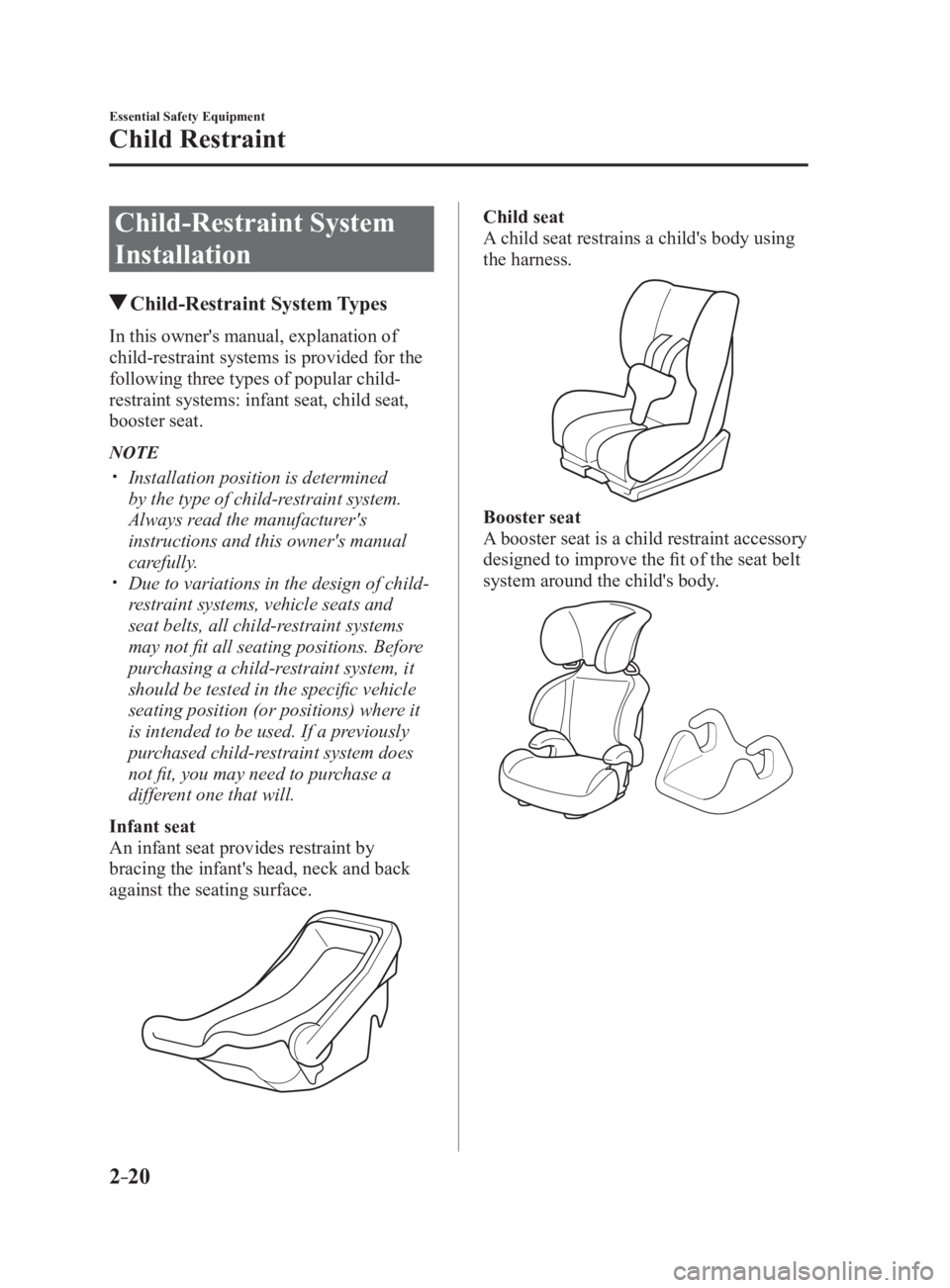
Installation Child-Restraint System TypesIn this owner's manual, explanation of
child-restraint systems is provided for the
following three types of popular child-
restraint systems: infant seat, child seat,
booster seat.
NOTE
Installation position is determined
by the type of child-restraint system.
Always read the manufacturer's
instructions and this owner's manual
carefully.
Due to variations in the design of child-
restraint systems, vehicle seats and
seat belts, all child-restraint systems
may not fit all seating positions. Before
purchasing a child-restraint system, it
should be tested in the specific vehicle
seating position (or positions) where it
is intended to be used. If a previously
purchased child-restraint system does
not fit, you may need to purchase a
different one that will.
Infant seat
An infant seat provides restraint by
bracing the infant's head, neck and back
against the seating surface. Child seat
A child seat restrains a child's body using
the harness.
Booster seat
A booster seat is a child restraint accessory
designed to improve the fit of the seat belt
system around the child's body.
MX-5_8FR4-EA-16J_Edition1.indb 20 2016/08/11 20:28:24
Page 35 of 568
2 –21 Essential Safety Equipment
Child Restraint
Installing Child-Restraint
Systems The passenger lap/shoulder belt can easily
be converted into the automatic locking
mode, which must be done to hold the
child-restraint system.
NOTE
To check if your seats have side air
bags:
Mazda vehicles equipped with side
air bag will have an embossed "SRS
AIRBAG" marking on the outboard
shoulder of the seats.
Follow the child-restraint system
manufacturer's instructions carefully.
Depending on the type of child-restraint
system, it may not employ seat belts
which are in automatic locking mode,
however if it uses an upper tether, it
may not be mounted properly in this
vehicle as there is no safe way to anchor
the tether. Confirm whether the child-
restraint system can be used with seat
belts by reading the child-restraint
system manufacturer's instructions. WARNING Do not allow a child or anyone to lean
over or against the side window of a
vehicle with side air bags:
It is dangerous to allow anyone to
lean over or against the side window,
the area of the passenger seat from
which the side air bags deploy, even
if a child-restraint system is used. The
impact of inflation from a side air bag
could cause serious injury or death to
an out of position child. Furthermore,
leaning over or against the door could
block the side air bags and eliminate
the advantages of supplemental
protection. Because the side air bag
deploys from the outboard shoulder of
the seat, do not allow the child to lean
over or against the side window, even
if the child is seated in a child-restraint
system.
CAUTION When moving the seats forward and
rearward, make sure you hold onto
the seatback with your hand while
operating. If the seatback is not held,
the seat will move suddenly and could
cause injury.
MX-5_8FR4-EA-16J_Edition1.indb 21 2016/08/11 20:28:24
Page 39 of 568

2 –25 Essential Safety Equipment
SRS Air BagsSmall children must be protected by a child-restraint system as stipulated by law in every
state and province. In certain states and provinces, larger children must use a child-restraint
system (page 2-15 ).
Carefully consider which child-restraint system is necessary for your child and follow
the installation directions in this Owner's Manual as well as the child-restraint system
manufacturer's instructions.
Do not use a child-restraint system which employs an upper tether because there is no
appropriate means to anchor the tether.
WARNING Seat belts must be worn in air bag equipped vehicles:
Depending only on the air bags for protection during an accident is dangerous. Alone, air
bags may not prevent serious injuries. The appropriate air bags can be expected to inflate
only in the first accident, such as frontal, near frontal or side collisions that are at least
moderate. Vehicle occupants should always wear seat belts.
Always make sure the passenger air bag deactivation indicator light is illuminated
when using a child-restraint system (With Passenger Occupant Classification System):
Seating a child in a child-restraint system that is installed on the passenger seat with the
passenger air bag deactivation indicator light not illuminated is extremely dangerous. In
an accident, an air bag could inflate and cause serious injuries or even death to the child
seated in the child-restraint system. Always make sure the passenger air bag deactivation
indicator light is illuminated.
Refer to Occupant Classification System on page 2-37 .
Do not sit too close to the driver and passenger air bags:
Sitting too close to the driver and passenger air bag modules or placing hands or feet on
them is extremely dangerous. The driver and passenger air bags inflate with great force
and speed. Serious injuries could occur if someone is too close. The driver should always
hold onto only the rim of the steering wheel. The passenger should keep both feet on
the floor. Seat occupants should adjust their seats as far back as possible and always sit
upright against the seatbacks with seat belts worn properly.
Do not sit too close to a door or lean against doors in vehicles with side air bags:
Sitting too close to the side air bag modules or placing hands on them is extremely
dangerous. A side air bag inflates with great force and speed directly out of the outboard
shoulder of the seat and expands along the door on the side the car is hit. Serious injury
could occur if someone is sitting too close to the door or leaning against a window in the
seats. Furthermore, sleeping up against the door or hanging out the driver-side window
while driving could block the side air bag and eliminate the advantages of supplemental
protection. Give the side air bags room to work by sitting in the center of the seat while
the vehicle is moving with seat belts worn properly.
MX-5_8FR4-EA-16J_Edition1.indb 25 2016/08/11 20:28:24
Page 40 of 568

2 –26 Essential Safety Equipment
SRS Air Bags Sit in the center of the seat and wear seat belts properly:
Sitting too close to the side air bag modules or placing hands on them, or sleeping up
against the door or hanging out the windows is extremely dangerous. The side air bags
inflate with great force and speed directly expanding along the door on the side the car is
hit. Serious injury could occur if someone is sitting too close to the door. Give the side air
bags room to work by sitting in the center of the seat while the vehicle is moving with seat
belts worn properly.
Do not attach objects on or around the area where driver and passenger air bags
deploy:
Attaching an object to the driver and passenger air bag modules or placing something in
front of them is dangerous. In an accident, an object could interfere with air bag inflation
and injure the occupants.
Do not attach objects on or around the area where a side air bag deploys:
Attaching objects to the seat in such a way as to cover the outboard side of the seat in any
way is dangerous. In an accident the object could interfere with the side air bag, which
inflates from the outboard side of the seats, impeding the added protection of the side air
bag system or redirecting the air bag in a way that is dangerous. Furthermore, the bag
could be cut open releasing the gas.
Do not hang net bags, map pouches or backpacks with side straps on the seats. Never use
seat covers on the seats. Always keep the side air bag modules in your seats free to deploy
in the event of a side collision.
Do not touch the components of the supplemental restraint system after the air bags
have inflated:
Touching the components of the supplemental restraint system after the air bags have
inflated is dangerous. Immediately after inflation, they are very hot. You could get burned.
Never install any front-end equipment to your vehicle:
Installation of front-end equipment, such as frontal protection bar (kangaroo bar, bull
bar, push bar, or other similar devices), snowplow, or winches, is dangerous. The air bag
crash sensor system could be affected. This could cause air bags to inflate unexpectedly,
or it could prevent the air bags from inflating during an accident. Occupants could be
seriously injured.
Do not modify the suspension:
Modifying the vehicle suspension is dangerous. If the vehicle's height or the suspension is
modified, the vehicle will be unable to accurately detect a collision resulting in incorrect
or unexpected air bag deployment and the possibility of serious injuries.
MX-5_8FR4-EA-16J_Edition1.indb 26 2016/08/11 20:28:25
Page 41 of 568

2 –27 Essential Safety Equipment
SRS Air BagsDo not modify a door or leave any damage unrepaired. Always have an Authorized
Mazda Dealer inspect a damaged door:
Modifying a door or leaving any damage unrepaired is dangerous. Each door has a side
crash sensor as a component of the supplemental restraint system. If holes are drilled in
a door, a door speaker is left removed, or a damaged door is left unrepaired, the sensor
could be adversely affected causing it to not detect the pressure of an impact correctly
during a side collision. If a sensor does not detect a side impact correctly, the side air bags
and the seat belt pretensioner may not operate normally which could result in serious
injury to occupants.
Do not modify the supplemental restraint system:
Modifying the components or wiring of the supplemental restraint system is dangerous.
You could accidentally activate it or make it inoperable. Do not make any modifications
to the supplemental restraint system. This includes installing trim, badges, or anything
else over the air bag modules. It also includes installing extra electrical equipment on or
near system components or wiring. An Authorized Mazda Dealer can provide the special
care needed in the removal and installation of seats. It is important to protect the air bag
wiring and connections to assure that the bags do not accidentally deploy, and that the
passenger occupant classification system and the seats retain an undamaged air bag
connection.
Do not place luggage or other objects under the seats:
Placing luggage or other objects under the seats is dangerous. The components essential
to the supplemental restraint system could be damaged, and in the event of a side
collision, the appropriate air bags may not deploy, which could result in death or serious
injury. To prevent damage to the components essential to the supplemental restraint
system, do not place luggage or other objects under the seats.
Do not operate a vehicle with damaged air bag/seat belt pretensioner system
components:
Expended or damaged air bag/seat belt pretensioner system components must be
replaced after any collision which caused them to deploy or damage them. Only a trained
Authorized Mazda Dealer can fully evaluate these systems to see that they will work in
any subsequent accident. Driving with an expended or damaged air bag or pretensioner
unit will not afford you the necessary protection in the event of any subsequent accident
which could result in serious injury or death.
Do not remove interior air bag parts:
Removing any components such as the seats, front dashboard, the steering wheel,
containing air bag parts or sensors is dangerous. These parts contain essential air bag
components. The air bag could accidentally activate and cause serious injuries. Always
have an Authorized Mazda Dealer remove these parts.
MX-5_8FR4-EA-16J_Edition1.indb 27 2016/08/11 20:28:25
Page 54 of 568

2 –40 Essential Safety Equipment
SRS Air Bags
Luggage or other items placed under the passenger seat or between the passenger
seat and driver seat that push up the passenger seat bottom.
An object, such as a seat cushion, is put on the passenger's seat or between the
passenger's back and the seatback.
A seat cover is put on the passenger's seat.
Luggage or other items are placed on the seat with the child in the child-restraint
system.
The seat is washed.
Liquids are spilled on the seat.
The passenger seat is moved backward, pushing into luggage or other items placed
behind it.
Luggage or other items are placed between the passenger seat and driver seat.
An electric device is put on the passenger's seat.
An additional electrical device, such as a seat warmer is installed to the surface of the
passenger seat.
The passenger front and side air bags and seat belt pretensioner systems will deactivate if
the passenger air bag deactivation indicator light turns on.
CAUTION
To assure proper deployment of the front air bag and to prevent damage to the sensor in
the seat cushion:
Do not place sharp objects on the seat cushion or leave heavy luggage on them.
Do not spill any liquids on the seats or under the seats.
To allow the sensors to function properly, always perform the following:
Adjust the seats as far back as possible and always sit upright against the seatbacks
with seat belts worn properly.
If you place your child on the passenger seat, secure the child-restraint system properly
and slide the passenger seat as far back as possible.
MX-5_8FR4-EA-16J_Edition1.indb 40 2016/08/11 20:28:27
Page 102 of 568
3 –46 Before Driving
Convertible Top (Retractable Fastback) NOTE
Do not open/close the roof with the engine
stopped. Otherwise the vehicle's battery
power could be depleted.
5. Slightly slide the seats back if they are
in the foremost position.
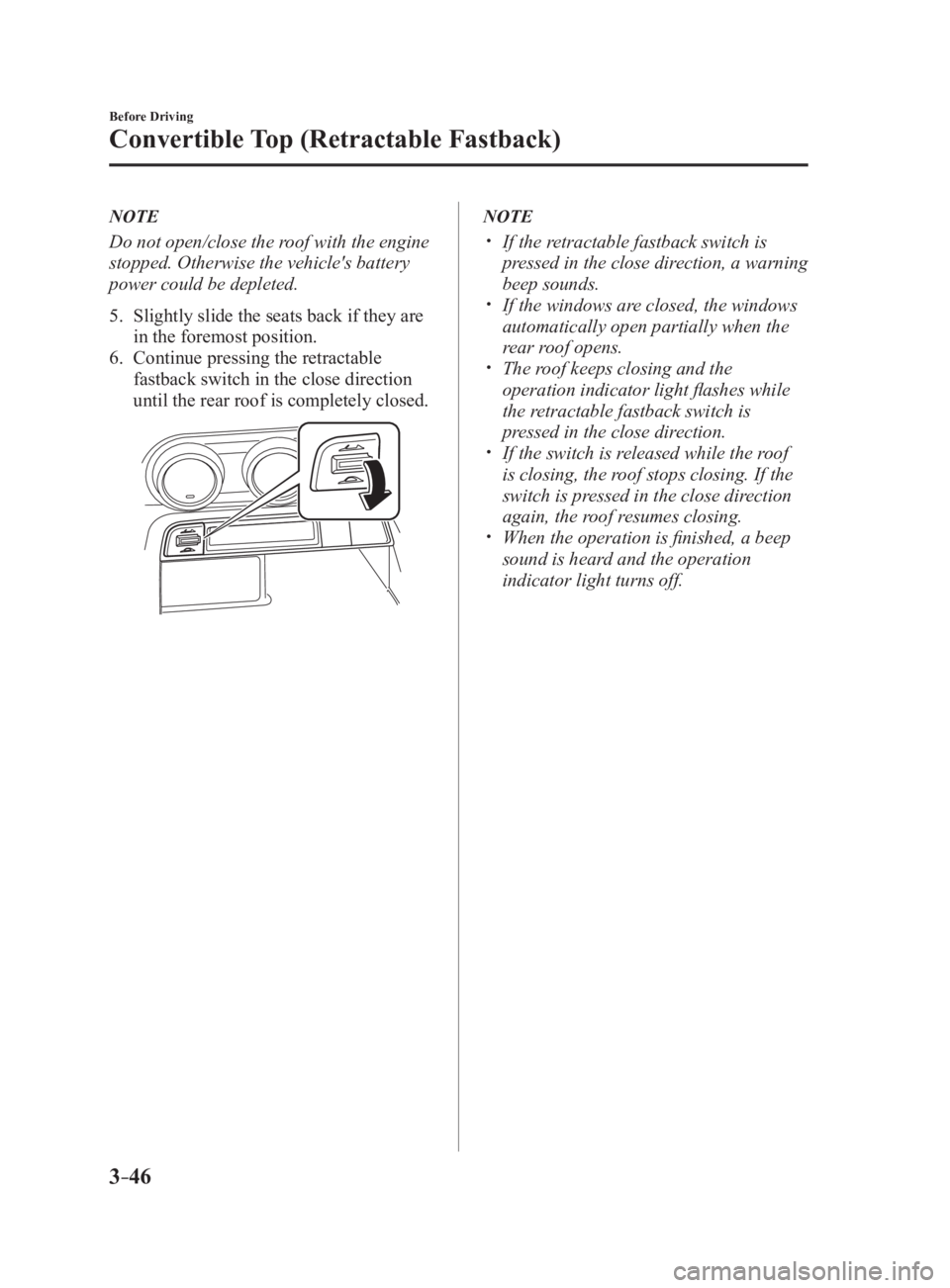
6. Continue pressing the retractable
fastback switch in the close direction
until the rear roof is completely closed. NOTE
If the retractable fastback switch is
pressed in the close direction, a warning
beep sounds.
If the windows are closed, the windows
automatically open partially when the
rear roof opens.
The roof keeps closing and the
operation indicator light flashes while
the retractable fastback switch is
pressed in the close direction.
If the switch is released while the roof
is closing, the roof stops closing. If the
switch is pressed in the close direction
again, the roof resumes closing.
When the operation is finished, a beep
sound is heard and the operation
indicator light turns off.
MX-5_8FR4-EA-16J_Edition1.indb 46 2016/08/11 20:28:37
Page 492 of 568

7 –58 If Trouble Arises
When the Roof Cannot be Closed NOTE
This procedure is for manually closing the roof as an emergency measure. After closing
the roof manually, electric operation is not possible until the system is restored by an
Authorized Mazda Dealer.
Using a flashlight will facilitate the procedure.
Manual closingBefore closing manually
WARNINGVerify that the ignition is switched off
before manually operating the roof:
Manually closing the roof with the
ignition not switched off is dangerous
as the motors could turn on suddenly
and cause injury resulting from
hands or fingers being pinched in the
mechanism.
1. Park on a hard, level surface off the
right-of-way and firmly set the parking
brake.
2. Put a vehicle with an
automatictransmission in Park (P), a
manual transmission in Neutral.
3. Switch the ignition off while depressing
the brake pedal.
4. Turn on the hazard warning flasher if it
is needed. Tool preparation
Take out the five tools stored in the seat
side box.
Refer to Seat Side Box on page 5-138 .Wire Gear
(tool kit) Rope
L-shaped
he xagonal wrench
(Small) L-shaped
hexagonal wrench
(Large)
Opening the rear roof
CAUTION
When turning the bolt, cover the front
roof using a cloth. The front roof may
be damaged if the L-shaped hexagonal
wrench contacts it.
Because the clearance with the stored
front roof is narrow, be careful not to let
the L-shape hexagonal wrench contact
the roof when turning the bolt.
NOTE
Moving the seats as far forward as
possible and folding the seatbacks forward
will facilitate the procedure.
Refer to Seat Operation on page 2-4 .
MX-5_8FR4-EA-16J_Edition1.indb 58 2016/08/11 20:30:09
Page 566 of 568

10 –6O Odometer and Trip Meter ........... 4-12, 4-20
Outside Mirrors
................................... 3-28
Outside Temperature Display
..... 4-15, 4-22
Overhead Light
................................. 5-132
Overheating
......................................... 7-27
Overloading
......................................... 3-55
Owner Maintenance
Closing the hood
........................... 6-25
Engine compartment overview
..... 6-26
Key battery replacement
............... 6-38
Opening the hood
.......................... 6-24
Owner maintenance precautions
... 6-22
P Parking Brake ...................................... 4-62
Personalization Features
....................... 9-9
Power Steering
.................................... 4-73
Power Steering Warning Buzzer
......... 7-50
Power Windows
.................................. 3-31
R Radar Sensors (Rear) .......................... 4-98
Rear Cross Traffic Alert (RCTA)
........ 4-92
Rear Window Defogger
...................... 4-55
Rearview Mirror
.................................. 3-29
Recommended Oil
.............................. 6-27
Recording of Vehicle Data
.................. 8-21
Recreational Towing
........................... 3-57
Registering Your Vehicle in A Foreign
Country
............................................... 8-17
Replacement
Fuse
............................................... 6-54
Key battery
.................................... 6-38
Light bulbs
.................................... 6-45
Tires
............................................... 6-43
Wheel
............................................ 6-43
Wiper
............................................. 6-33
Request Switch Inoperable Warning Beep
(With the advanced keyless function)
... 7-50 Retractable Fastback
When the roof cannot be closed
.... 7-57
Retractable fastback warning beep
..... 7-49
Rocking the Vehicle
............................ 3-53
S SRS Air Bags
How the SRS air bags work
.......... 2-31
Limitations to SRS air bag
............ 2-35
Monitoring ..................................... 2-42
Passenger occupant classification
system
............................................ 2-37
SRS air bag deployment criteria
... 2-34
Supplemental restraint system
components
................................... 2-29
Safety Defects, Reporting
................... 8-13
Satellite Radio
..................................... 5-46
Saving Fuel and Protection of the
Environment
........................................ 3-51
Scheduled Maintenance
........................ 6-4
Seat
........................................................ 2-4
Seat Belt System
................................. 2-10
3-point type
................................... 2-10
Automatic locking
........................... 2-9
Emergency locking
.......................... 2-9
Extender
........................................ 2-13
Pregnant women
.............................. 2-9
Seat belt precautions
....................... 2-7
Seat Belt Warning Beep
...................... 7-49
Seat Side Box
.................................... 5-138
Seats
Head restraint
.................................. 2-6
Seat warmer
..................................... 2-5
Security System
Immobilizer system
....................... 3-47
Theft-deterrent system
.................. 3-49
Specifications
........................................ 9-4
Speedometer
........................................ 4-12
Starting the Engine
................................ 4-5
Steering Wheel
.................................... 3-27
Horn ............................................... 4-56 Index
MX-5_8FR4-EA-16J_Edition1.indb 6 2016/08/11 20:30:24