fuel pump MAZDA PROTEGE 1992 User Guide
[x] Cancel search | Manufacturer: MAZDA, Model Year: 1992, Model line: PROTEGE, Model: MAZDA PROTEGE 1992Pages: 1164, PDF Size: 81.9 MB
Page 282 of 1164
F OUTLINE
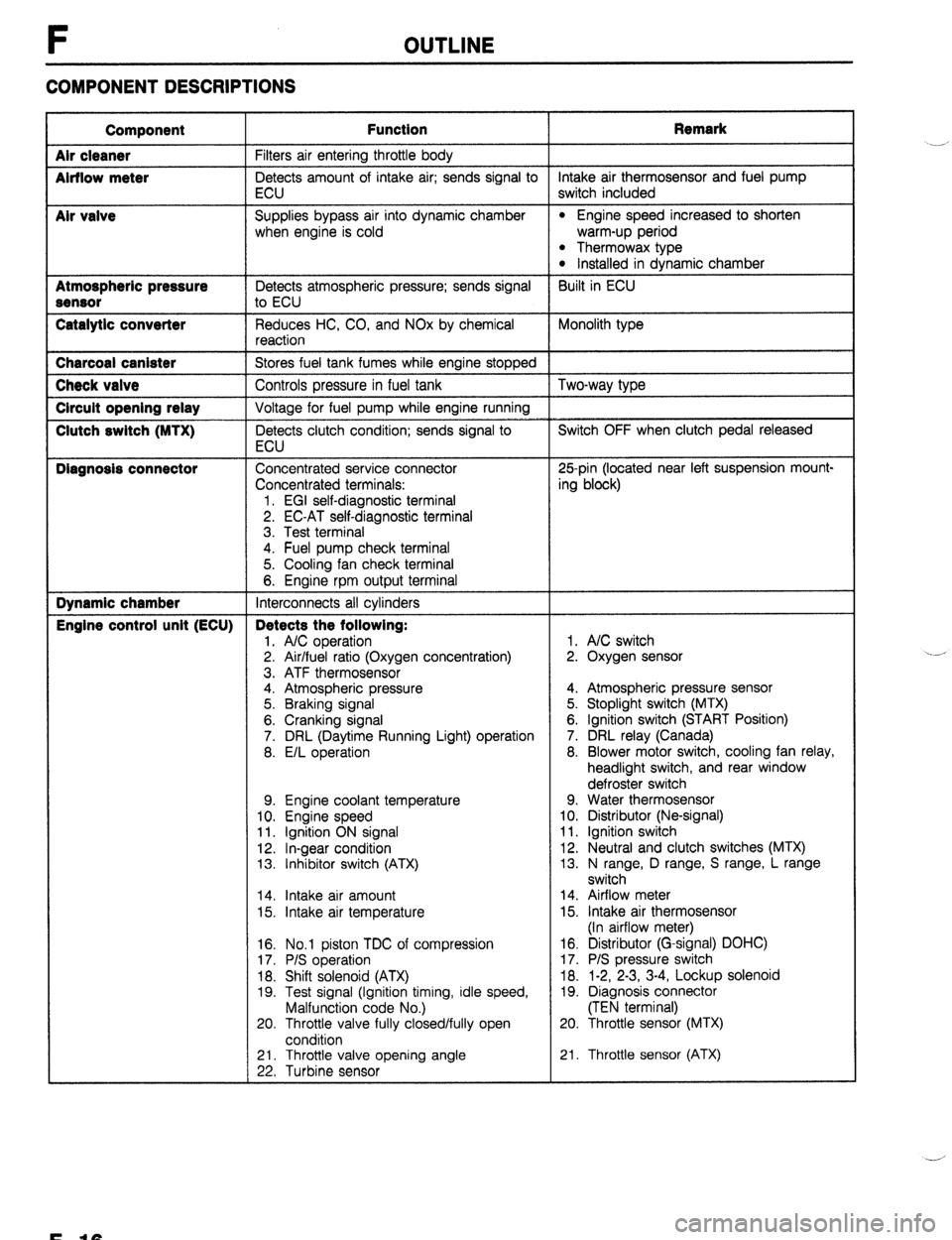
COMPONENT DESCRIPTIONS
Component
Air cleaner
Airflow meter
Mr valve
Atmospheric pressure
Sensor
Catalytic converter Function Remark
Filters air entering throttle body
Detects amount of intake air; sends signal to intake air thermosensor and fuel pump
ECU switch included
Supplies bypass air into dynamic chamber
l Engine speed increased to shorten
when engine is cold warm-up period
l Thermowax type l Installed in dynamic chamber
Detects atmospheric pressure; sends signal Built in ECU
to ECU
Reduces HC, CO, and NOx by chemical Monolith type
reaction Charcoal canister
Stores fuel tank fumes while engine stopped Check valve
Controls pressure in fuel tank Two-way type Circuit opening relay
Voltage for fuel pump while engine running Clutch switch (MTX)
Detects clutch condition; sends signal to Switch OFF when clutch pedal released
ECU Diagnosis connector
Concentrated service connector 25pin (located near left suspension mount-
Concentrated terminals: ing block)
1. EGI self-diagnostic terminal
2. EC-AT self-diagnostic terminal
3. Test terminal
4. Fuel pump check terminal
5. Cooling fan check terminal
6. Engine rpm output terminal Dynamic chamber
Interconnects all cylinders Engine control unit (ECU) Detects the following:
1. A/C operation 1. A/C switch
2. Air/fuel ratio (Oxygen concentration) 2. Oxygen sensor
3. ATF thermosensor
4. Atmospheric pressure 4. Atmospheric pressure sensor
5. Braking signal 5. Stoplight switch (MTX)
6. Cranking signal 6. Ignition switch (START Position)
7. DRL (Daytime Running Light) operation 7. DRL relay (Canada)
8. E/L operation 8. Blower motor switch, cooling fan relay,
headlight switch, and rear window
defroster switch
9. Engine coolant temperature 9. Water thermosensor
10. Engine speed 10. Distributor (Ne-signal)
11. Ignition ON signal 11. Ignition switch
12. In-gear condition 12. Neutral and clutch switches (MTX)
13. Inhibitor switch (ATX) 13. N range, D range, S range, L range
switch
14. Intake air amount 14. Airflow meter
15. Intake air temperature 15. Intake air thermosensor
(In airflow meter)
16. No.1 piston TDC of compression
17. P/S operation
18. Shift solenoid (ATX)
19. Test signal (Ignition timing, idle speed,
Malfunction code No.)
20. Throttle valve fully closed/fully open
condition 16. Distributor (G-signal) DOHC)
17. P/S pressure switch
18. 1-2, 2-3, 3-4, Lockup solenoid
19. Diagnosis connector
(TEN terminal)
20. Throttle sensor (MTX)
21. Throttle valve opening angle
22. Turbine sensor 21. Throttle sensor (ATX) .__r
F-10
Page 283 of 1164
OUTLINE
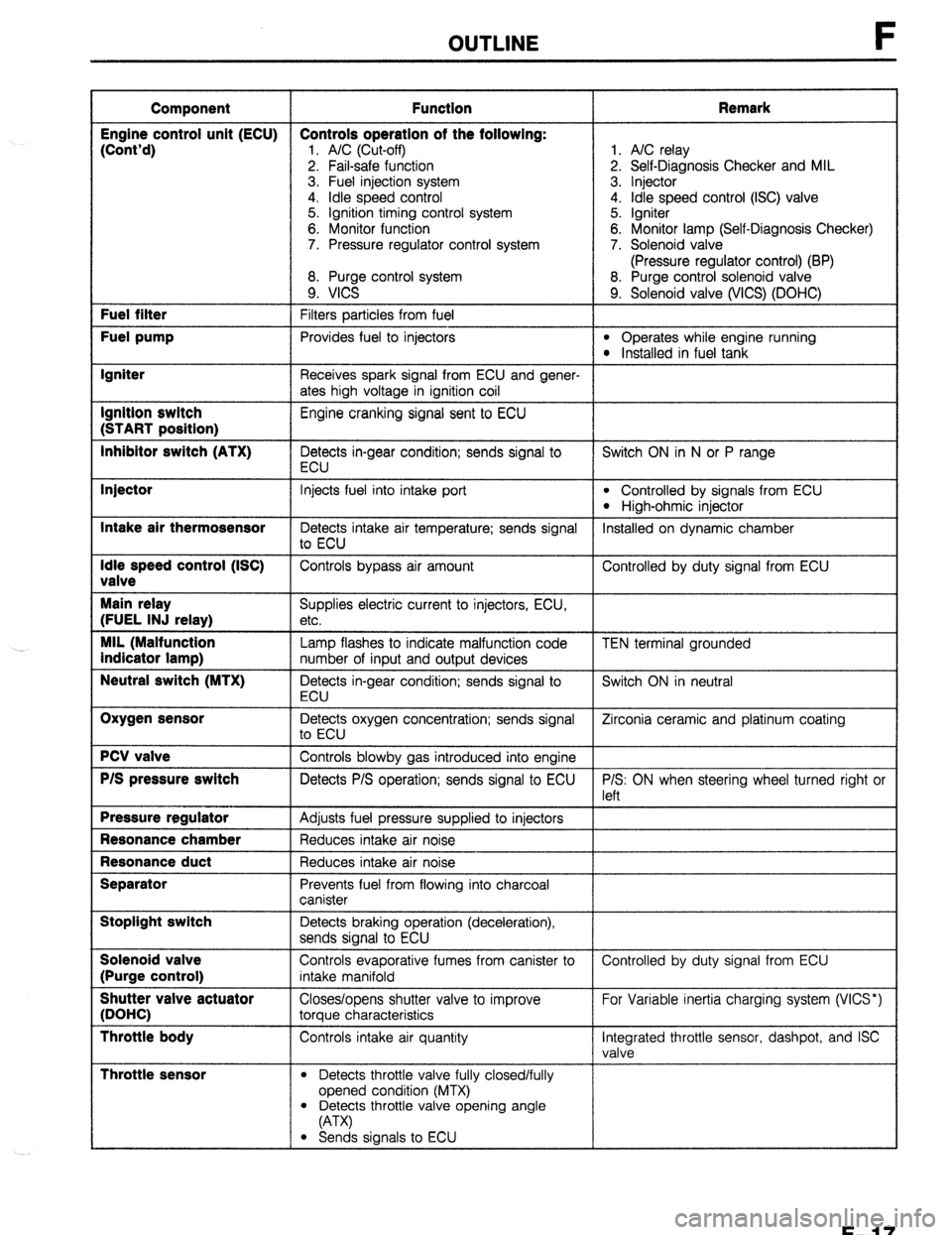
Component Function Remark
Engine control unit (ECU) Controls operation of the following:
(Cont’d)
1. A/C (Cut-off) 1. A/C relay
2. Fail-safe function 2. Self-Diagnosis Checker and MIL
3. Fuel injection system 3. Injector
4. idle speed control 4. Idle speed control (ISC) valve
5. Ignition timing control system 5. Igniter
6. Monitor function 6. Monitor lamp (Self-Diagnosis Checker)
7. Pressure regulator control system 7. Solenoid valve
(Pressure regulator control) (BP)
8. Purge control system 8. Purge control solenoid valve
9. VICS 9. Solenoid valve (WCS) (DOHC) Fuel filter
Filters particles from fuel Fuel pump
Provides fuel to injectors l Operates while engine running l Installed in fuel tank Igniter
Receives spark signal from ECU and gener-
ates high voltage in ignition coil Ignition switch
Engine cranking signal sent to ECU (START position)
Inhibitor switch (ATX)
Detects in-gear condition; sends signal to Switch ON in N or P range
ECU Injector
Intake air thermosensor
Idle speed control (ISC)
valve
Main relay
(FUEL INJ relay)
MIL (Malfunction
indicator lamp)
Neutral switch (MTX)
Oxygen sensor
PCV valve
P/S pressure switch
Pressure regulator
Resonance chamber
Resonance duct
Separator
Stoplight switch
Solenoid valve
(Purge control)
Shutter valve actuator
(DOHC)
Throttle body
Throttle sensor
Injects fuel into intake port l Controlled by signals from ECU
l High-ohmic injector
Detects intake air temperature; sends signal Installed on dynamic chamber
to ECU
Controls bypass air amount Controlled by duty signal from ECU
Supplies electric current to injectors, ECU,
etc.
Lamp flashes to indicate malfunction code
number of input and output devices
Detects in-gear condition; sends signal to
ECU
Detects oxygen concentration; sends signal
to ECU
Controls blowby gas introduced into engine
Detects P/S operation; sends signal to ECU
Adjusts fuel pressure supplied to injectors
Reduces intake air noise
Reduces intake air noise
Prevents fuel from flowing into charcoal
canister
Detects braking operation (deceleration),
sends signal to ECU
Controls evaporative fumes from canister to
intake manifold
Closes/opens shutter valve to improve
torque characteristics
Controls intake air quantity
l Detects throttle valve fully closed/fully
opened condition (MTX) TEN terminal grounded
Switch ON in neutral
Zirconia ceramic and platinum coating
P/S: ON when steering wheel turned right or
left
Controlled by duty signal from ECU
For Variable inertia charging system (VICS*)
Integrated throttle sensor, dashpot, and ISC
valve
l Detects throttle valve opening angle
(A-W
l Sends signals to ECU
F-l 7
Page 295 of 1164
TROUBLESHOOTING GUIDE F
REAR SEAT C
03UOFX-01
9MUOF2-1;
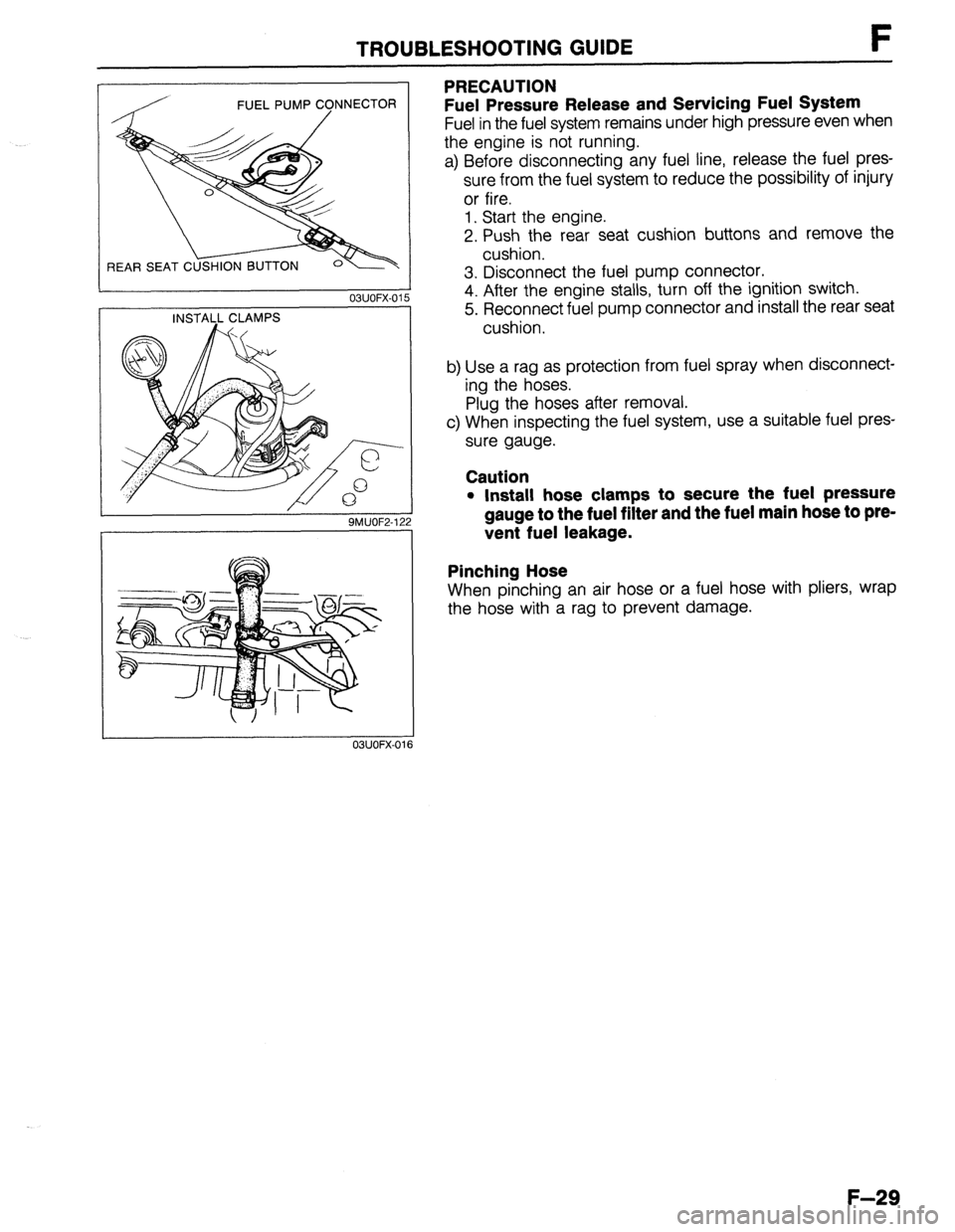
PRECAUTION
Fuel Pressure Release and Servicing Fuel System
Fuel in the fuel system remains under high pressure even when
the engine is not running.
a) Before disconnecting any fuel line, release the fuel pres-
sure from the fuel system to reduce the possibility of injury
or fire.
1. Start the engine.
2. Push the rear seat cushion buttons and remove the
cushion.
3. Disconnect the fuel pump connector.
4. After the engine stalls, turn off the ignition switch.
5. Reconnect fuel pump connector and install the rear seat
cushion.
b) Use a rag as protection from fuel spray when disconnect-
ing the hoses.
Plug the hoses after removal.
c) When inspecting the fuel system, use a suitable fuel pres-
sure gauge.
Caution
l Install hose clamps to secure the fuel pressure
gauge to the fuel filter and the fuel main hose to pre-
vent fuel leakage.
Pinching Hose
When pinching an air hose or a fuel hose with pliers, wrap
the hose with a rag to prevent damage.
03UOFX-016
F-29
Page 296 of 1164
F TROUBLESHOOTING GUIDE
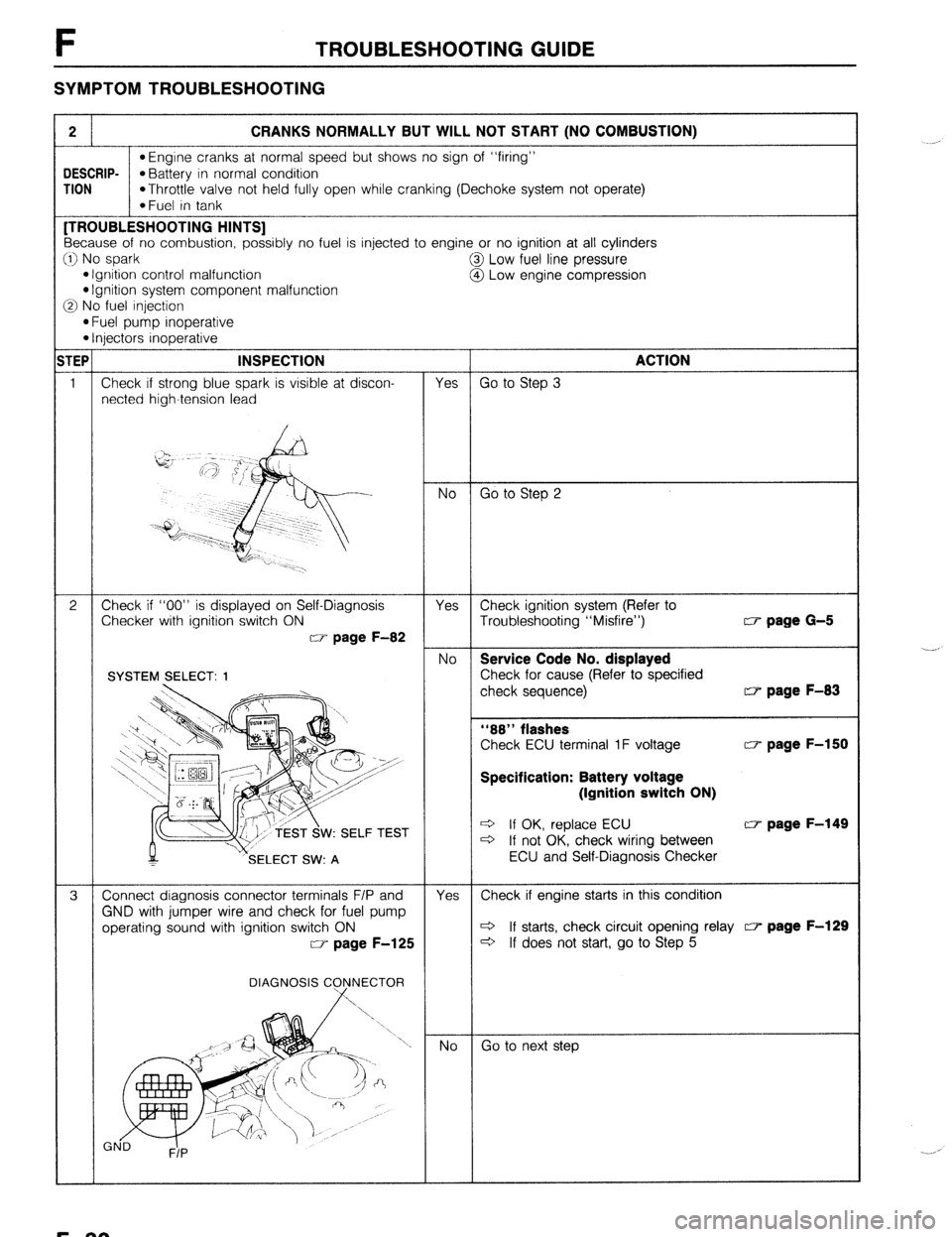
SYMPTOM TROUBLESHOOTING
2 CRANKS NORMALLY BUT WILL NOT START (NO COMBUSTION)
l Engine cranks at normal speed but shows no sign of “firing”
DESCRIP-
*Battery in normal condition
TION
*Throttle valve not held fully open while cranking (Dechoke system not operate)
*Fuel in tank [TROUBLESHOOTING HINTS]
Because of no combustion, possibly no fuel is injected to engine or no ignition at all cylinders
:I) No spark
@I Low fuel line pressure
l Ignition control malfunction
@ Low engine compression l Ignition system component malfunction
3 No fuel injection
l Fuel pump inoperative l Injectors inoperative
TEP INSPECTION
ACTION
1 Check if strong blue spark is visible at discon-
Yes Go to Step 3
netted high-tension lead
No Go to Step 2
2 Check if “00” is displayed on Self-Diagnosis
Yes Check ignition system (Refer to
Checker with ignition switch ON
Troubleshooting “Misfire”) w page G-5
w page F-82
No Service Code No. displayed
Check for cause (Refer to specified
check sequence) w page F-83
“88” flashes
Check ECU terminal 1F voltage w page F-150
Specification: Battery voltage
(Ignition switch ON)
W: SELF TEST e If OK, replace ECU w page F-149 c3 If not OK, check wiring between
SELECT SW: A ECU and Self-Diagnosis Checker
3 Connect diagnosis connector terminals F/P and
Yes Check if engine starts in this condition
GND with jumper wire and check for fuel pump
operating sound with ignition switch ON c3 If starts, check circuit opening relay c7 page F-129
w page F-125
c3 If does not start, go to Step 5
DIAGNOSIS C
Go to next step ._-,
._. ,
F-30
Page 298 of 1164

F TROUBLESHOOTING GUIDE
3 CRANKS NORMALLY BUT WILL NOT START (PARTIAL COMBUSTION) - WHEN ENGINE COLD
DESCRIP- *Engine cranks at normal speed but shows only partial combustion and will not continue to run
TION
l Battery in normal condition
*Fuel in tank
[TROUBLESHOOTING HINTS]
0 Air/Fuel mixture too rich
*Air cleaner element clogged
l Airflow meter stuck @ Low engine compression
@ Air/Fuel mixture too lean
l Fuel injection control malfunction
(Correction for coolant temperature)
*Low fuel line pressure
*Air leakage of intake air system
Checker with ignition switch ON
CT page F-83
w page F-150
Specification: Battery voltage
(Ignition switch ON)
W: SELF TEST w page F-149
Fuel line pressure:
285-314 kPa (2.7-3.2 kg/cm’, 38-48 psi) If fuel line pressure quickly in-
creases, check pressure regulator CF- page F-129
d If fuel line pressure gradually in-
creases check for clogging be-
I pump and pressure
Check if fuel return hose is clogged or
F-32
Page 302 of 1164
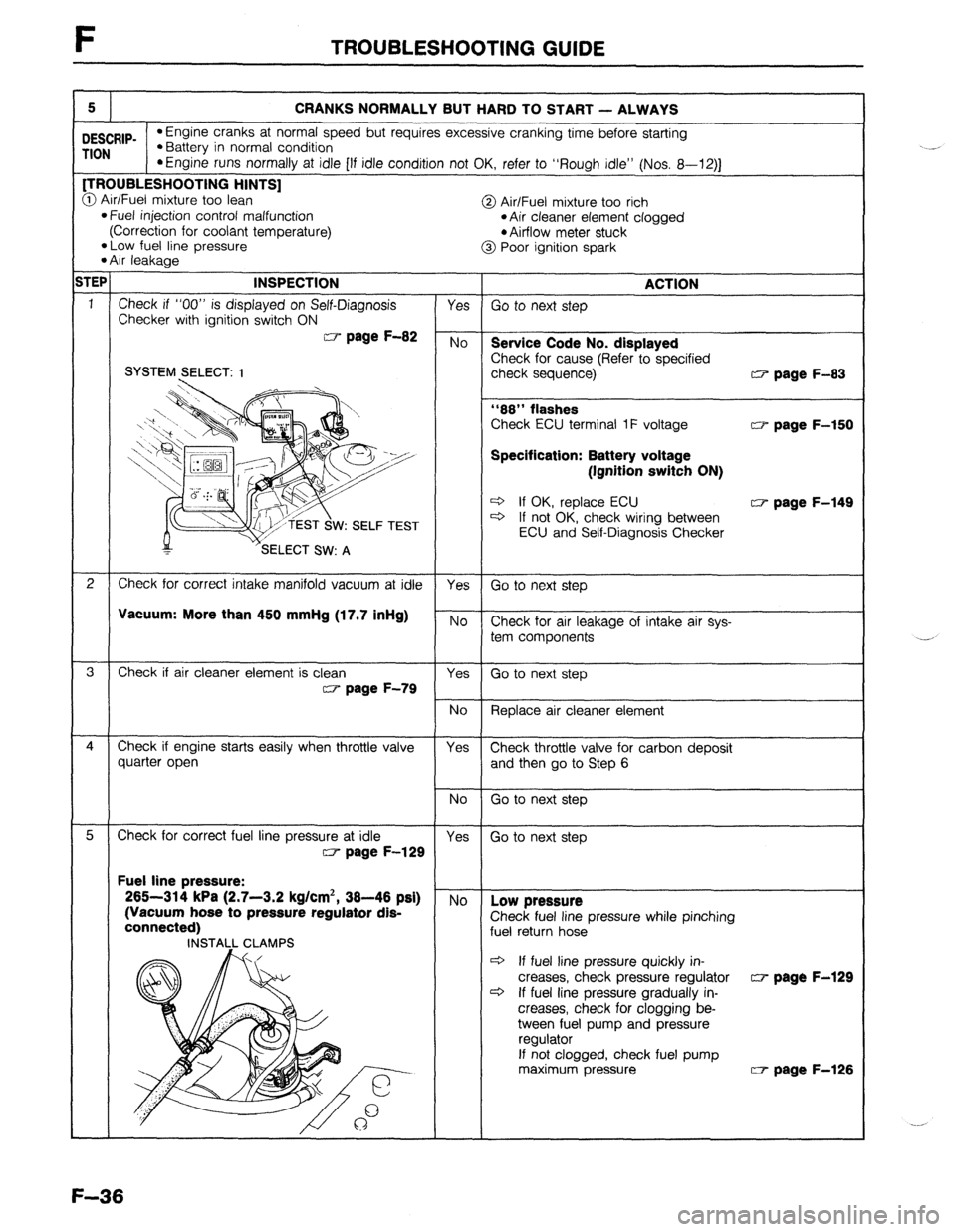
F TROUBLESHOOTING GUIDE
5
CRANKS NORMALLY BUT HARD TO START - ALWAYS
DESCRIP- l Engine cranks at normal speed but requires excessive cranking time before starting
TION l Battery in normal condition
*Engine runs normally at idle [If idle condition not OK, refer to “Rough idle” (Nos. 8-12)J [TROUBLESHOOTING HINTS]
@ Air/Fuel mixture too lean
@ Air/Fuel mixture too rich l Fuel injection control malfunction
(Correction for coolant temperature) *Air cleaner element clogged
l Airflow meter stuck
*Low fuel line pressure
l Air leakage @ Poor ignition spark
;TEP INSPECTION ACTION
1
Check if “00” is displayed on Self-Diagnosis Yes Go to next step
Checker with ignition switch ON W page F-82 No
Service Code No. displayed
Check for cause (Refer to specified SYSTEM SELECT: 1 check sequence) w page F-83
“88” flashes
Check ECU terminal 1F voltage w page F-150
Specification: Battery voltage
(Ignitlon switch ON)
* If OK, replace ECU w page F-149
W: SELF TEST c3 If not OK, check wiring between
ECU and Self-Diagnosis Checker
2 Check for correct intake manifold vacuum at idle
Yes Go to next step
VsCUUm: More than 450 mmHg (17.7 inHg) No Check for air leakage of intake air sys-
tem components
3 Check if air cleaner element is clean
Yes Go to next step w page F-79
No
Replace air cleaner element
4 Check if engine starts easily when throttle valve Yes Check throttle valve for carbon deposit
quarter open and then go to Step 6 Fuel line pressure:
265-314 kPa (2.7-3.2 kg/cm*, 38-46 psi)
(Vacuum hose to pressure regulator dis-
pressure while pinching
c3 If fuel line pressure quickly in-
creases, check pressure regulator w page F-129
c3 If fuel line pressure gradually in-
creases, check for clogging be-
tween fuel pump and pressure
If not clogged, check fuel pump
maximum pressure W- page F-126
F-36
Page 305 of 1164

TROUBLESHOOTING GUIDE F
1TEP INSPECTION
ACTION
7 Connect diagnosis connector terminals F/P and Yes
Go to next step
GND with jumper wire and check for correct fuel
line pressure with ignition switch ON w page F-122
No Low pressure
Check fuel line pressure while pinching Fuel line pressure:
265-314 kPa (2.7-3.2 kg/cm*, 38-46 psi) fuel return hose
c3 If fuel line pressure quickly in-
creases, check pressure regulator w page F-129
+ If fuel line pressure gradually in-
creases, check fuel line for clog-
ging between fuel pump and
pressure regulator
If not clogged, check fuel pump
maximum pressure High pressure w page F-126
Check if fuel return hose is clogged or
restricted
INSTALL CLAMPS c3 If OK, replace pressure regulator w page F-130 c3 If not OK, repair or replace hose
8
Try known good ECU and check if condition
Yes Replace ECU w page F-149
improves w page F-149 No
Change fuel to another brand
23UOFX-02
F-39
Page 306 of 1164
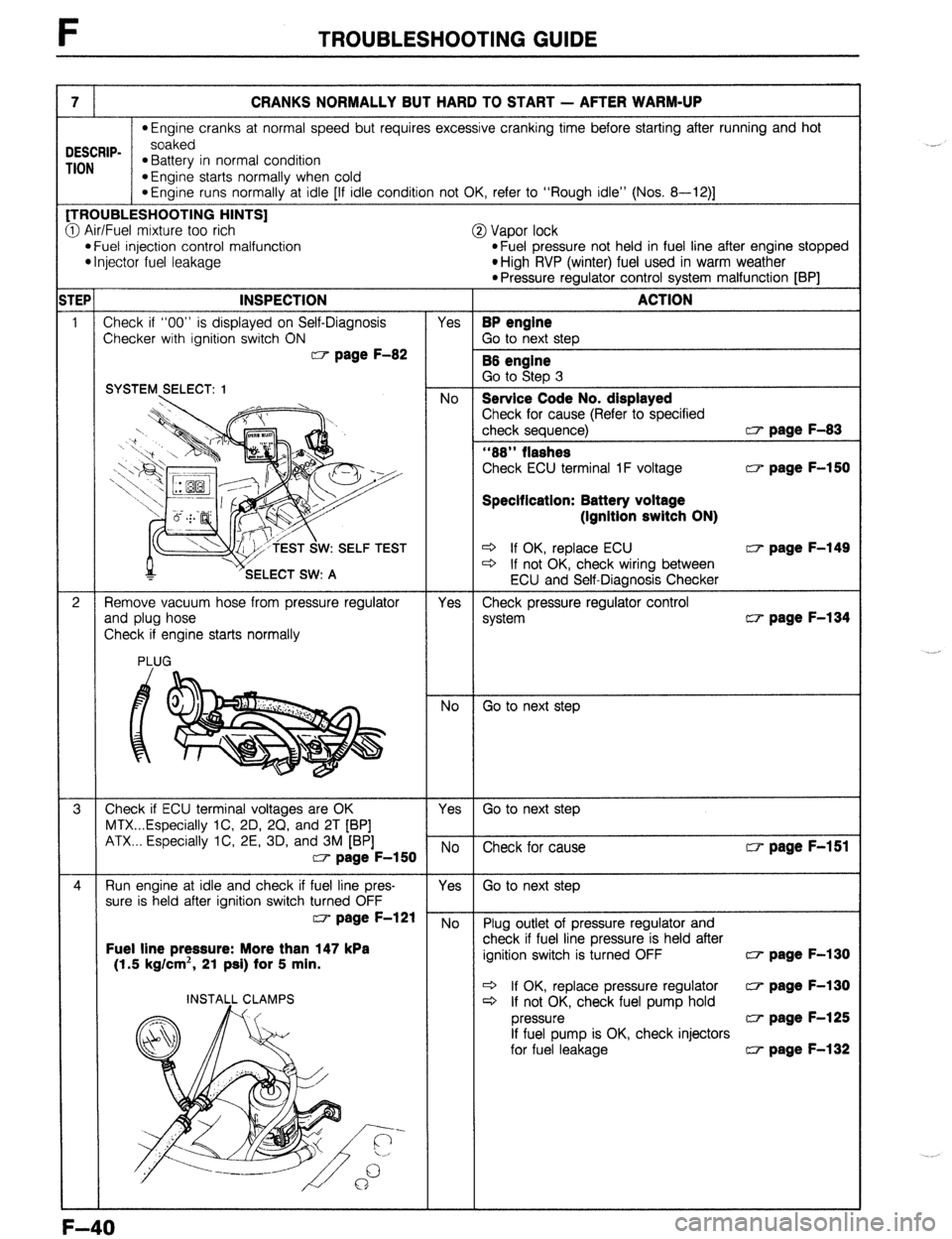
F TROUBLESHOOTING GUIDE
7 CRANKS NORMALLY BUT HARD TO START - AFTER WARM-UP
*Engine cranks at normal speed but requires excessive cranking time before starting after running and hot
DESCRIP- soaked
TION *Battery in normal condition
*Engine starts normally when cold
*Engine runs normally at idle [If idle condition not OK, refer to “Rough idle” (Nos. 8-12)] [TROUBLESHOOTING HINTS]
3 Air/Fuel mixture too rich
@ Vapor lock l Fuel injection control malfunction
*Fuel pressure not held in fuel line after engine stopped l Injector fuel leakage
*High RVP (winter) fuel used in warm weather
l Pressure regulator control system malfunction [BP] w page F-150
Specification: Battery voltage
(Ignition switch ON)
W: SELF TEST c3 If OK, replace ECU w page F-149 * If not OK, check wiring between CT- page F-134
Fuel line pressure: More than 147 kPa
(1.5 kg/cm*, 21 psi) for 5 min. w page F-130
+ If OK, replace pressure regulator CT- page F-130
c3 If not OK, check fuel pump hold w page F-125
If fuel pump is OK, check injectors
for fuel leakage (3 page F-132
F-40
Page 309 of 1164

TROUBLESHOOTING GUIDE F
WEAR AND CA
DAMAGE AND
DETERIORATION
r;f> If OK, replace injector
=D If not OK, check for cause w page F-131
u page Bl-10
82-l 0
Fuel line pressure:
265-314 kPa (2.7-3.2 kg/cm2, 38-48 psi) fuel line pressure while pinching
* If fuel line pressure quickly in-
creases, check pressure regulator L-Y page F-129
~3 If fuel line pressure gradually in-
creases, check for clogging be-
tween fuel pump and pressure
maximum pressure
CT page F-126
airflow meter moves smoot
_, .’
No Go to next step
I1
Check for correct engine compression
Yes Go to next step
CI page 81-10
82-l 0
Engine compression (Minimum):
l BP SOHC
834 kPa (8.5 kg/cm*, 121 psi)300 rpm
l BP DOHC
883 kPa (9.0 kg/cm*, 128 psi)-300 rpm
l B6 No Check for cause
CT page 81-10
82-l 0
932 kPa (9.5 kg/cm*, 135 psi)-300 rpm
I2 Connect System Selector to diagnosis connector
Yes Try known good ECU and check if con-
and set Test Switch to “SELF TEST” and check
dition improves
CT page F-149
for correct ignition timing at idle after warm-up
CT page F-79
Ignition timing (BTDC)
BP DOHC : Q”-ll”
BP SOHC : 4O-6O
B6
: 6”--8* No Adjust ignition timing
a- page F-79
23UOFX-Oi
F-43
Page 313 of 1164

TROUBLESHOOTING GUIDE F
Fuel line pressure:
265-314 kPa (2.7-3.2 kg/cm’, 36-46 psi)
(Vacuum hose to pressure regulator Ine pressure while pinching
d If fuel line pressure quickly in-
creases, check pressure regulator w page F-129
* If fuel line pressure gradually in-
If not clogged, check fuel pump
maximum pressure w page F-126
Ignition timing (BTDC)
l BP DOHC : go-1 1 o l BP SOHC : 4”-6O
Resistance: 12-l 60
eck wiring between ECU
Engine compression (Minimum):
l BP SOHC :
634 kPa (6.5 kg/cm2, 121 psi)900 rpm
check distributor cap and
23UOFX-02
F-47