fuel pump MAZDA PROTEGE 1992 Owner's Manual
[x] Cancel search | Manufacturer: MAZDA, Model Year: 1992, Model line: PROTEGE, Model: MAZDA PROTEGE 1992Pages: 1164, PDF Size: 81.9 MB
Page 324 of 1164

TROUBLESHOOTING GUIDE
TEP INSPECTION
ACTION
7 Check for correct fuel line pressure at idle Yes Check if fuel line pressure decreases w page F-129 when accelerating quickly Fuel line pressure:
c3 If decreases, check fuel line and fil- 265-314 kPa (2.7-3.2 kg/cm’, 38-46 psi) ter for clogging (Vacuum hose to pressure regulator dis- *
If no decrease, go to next step connected)
INSTALL CLAMPS No Low pressure
Check fuel line pressure while pinching
fuel return hose
+ If fuel line pressure quickly in-
creases, check pressure regulator w page F-129
+ If fuel line pressure gradually in-
creases, check for clogging be-
tween fuel pump and pressure
regulator
If not clogged, check fuel pump .*
maximum pressure w page F-126
8 Connect System Selector to diagnosis connector Yes Check if ignition timing advances when
and set Test Switch to “SELF TEST” and check accelerating
for correct ignition timing at idle after warm-up w page F-79
c3 If advances, go to next step
c3 If not advance, replace ECU w page F-149
Ignition timing (BTDC)
l BP DOHC : go-1 1 o l BP SOHC : 4’-8’
l B6 : 6O--8O No Adjust w page F-79
9
Check if air duct and air hoses are correctly Yes Go to next step
installed w page F-109
No
Repair
10 Check if exhaust system is restricted Yes Repair or replace w page F-136
No SOHC
Go to Step 12 DOHC
Go to next step
11 Check if variable inertia control system (VICS) is
Yes Go to next step
OK w page F-118
No
Repair or replace
12 Try known good ECU and check if condition
improves w page F-149
-’
F-58
Page 326 of 1164
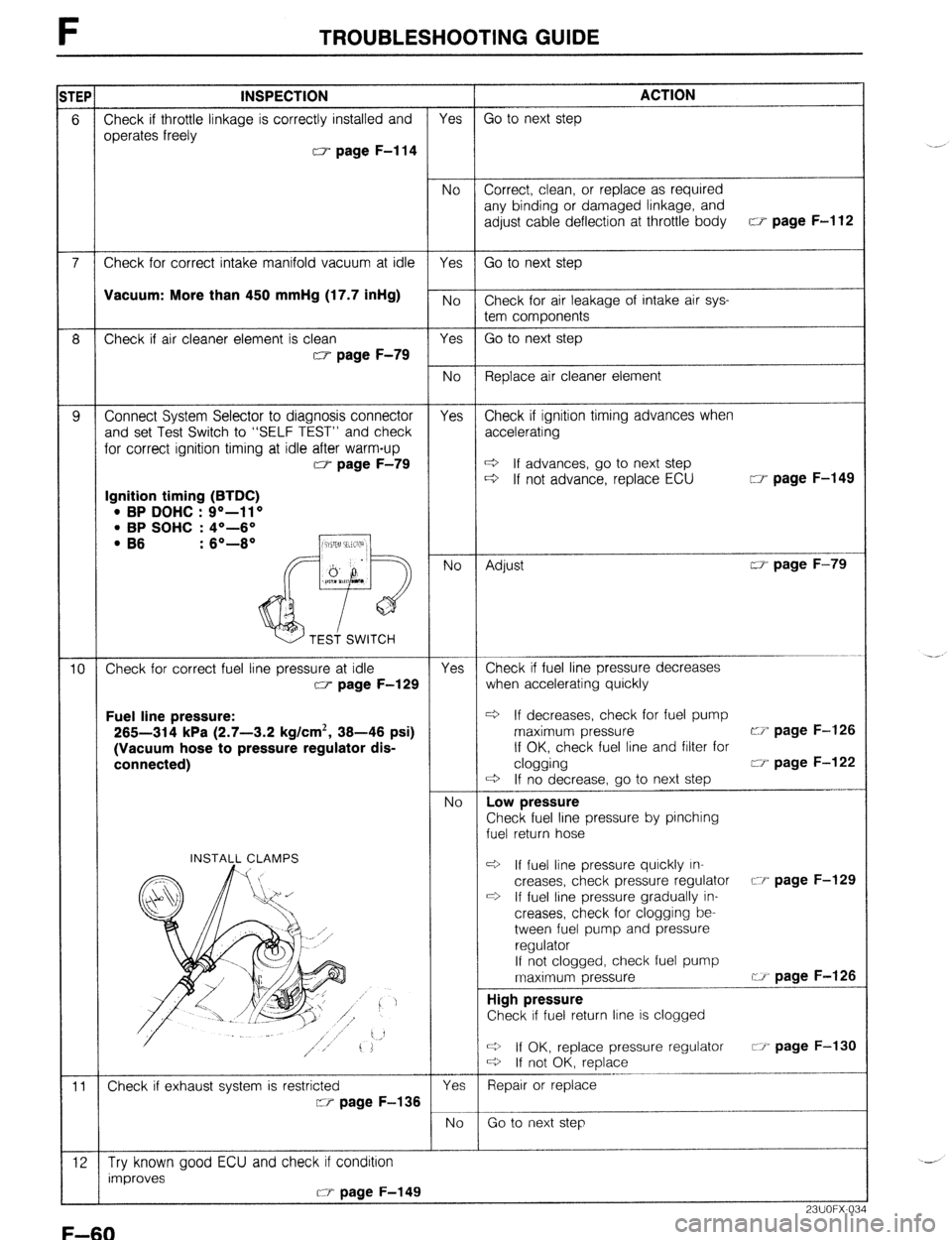
F TROUBLESHOOTING GUIDE
TEP INSPECTION ACTION
6 Check if throttle linkage is correctly installed and Yes Go to next step
operates freely
w page F-l 14
No Correct, clean, or replace as required
any binding or damaged linkage, and
adjust cable deflection at throttle body CT page F-l 12
7 Check for correct intake manifold vacuum at idle Yes Go to next step
Vacuum: More than 450 mmHg (17.7 intig) -
No
Check for air leakage of intake air sys-
tem components
8 Check if air cleaner element is clean Yes Go to next step
w page F-79
No Replace air cleaner element
9 Connect System Selector to diagnosis connector Yes Check if ignition timing advances when
and set Test Switch to “SELF TEST” and check accelerating
for correct ignition timing at idle after warm-up
w page F-79 c3 If advances, go to next step
c3 If not advance, replace ECU [II page F-149
Ignition timing (BTDC)
l BP DOHC : Q”-1 1 o l BP SOHC : 4O-6’
’ B6 : 6O-8O
No Adjust CT+ page F-79
10 Check for correct fuel line pressure at idle Yes Check if fuel line pressure decreases
w page F-129 when accelerating quickly
Fuel line pressure: c3 If decreases, check for fuel pump
265-314 kPa (2.7-3.2 kg/cm*, 38-46 psi) maximum pressure w page F-126
(Vacuum hose to pressure regulator dis- If OK, check fuel line and filter for
connected) clogging CI,’ page F-122
+ If no decrease, go to next step
-
No Low pressure
Check fuel line pressure by pinching
fuel return hose
cti If fuel line pressure quickly In-
creases, check pressure regulator CT page F-129
ti If fuel line pressure gradually in-
creases, check for clogging be-
tween fuel pump and pressure
regulator
If not clogged, check fuel pump
maximum pressure cr page F-126
-
High pressure
Check if fuel return line is clogged
Q If OK, replace pressure regulator C-Y- page F-130
+ If not OK, replace
--_I. 1”1-~~-~~
11 Check if exhaust system is restricted Yes Repair or replace
C-T- page F-136
No Go to next step
12 Try known good ECU and check if condition
improves
CT page F-149
23UOFX-034
F-60
Page 328 of 1164
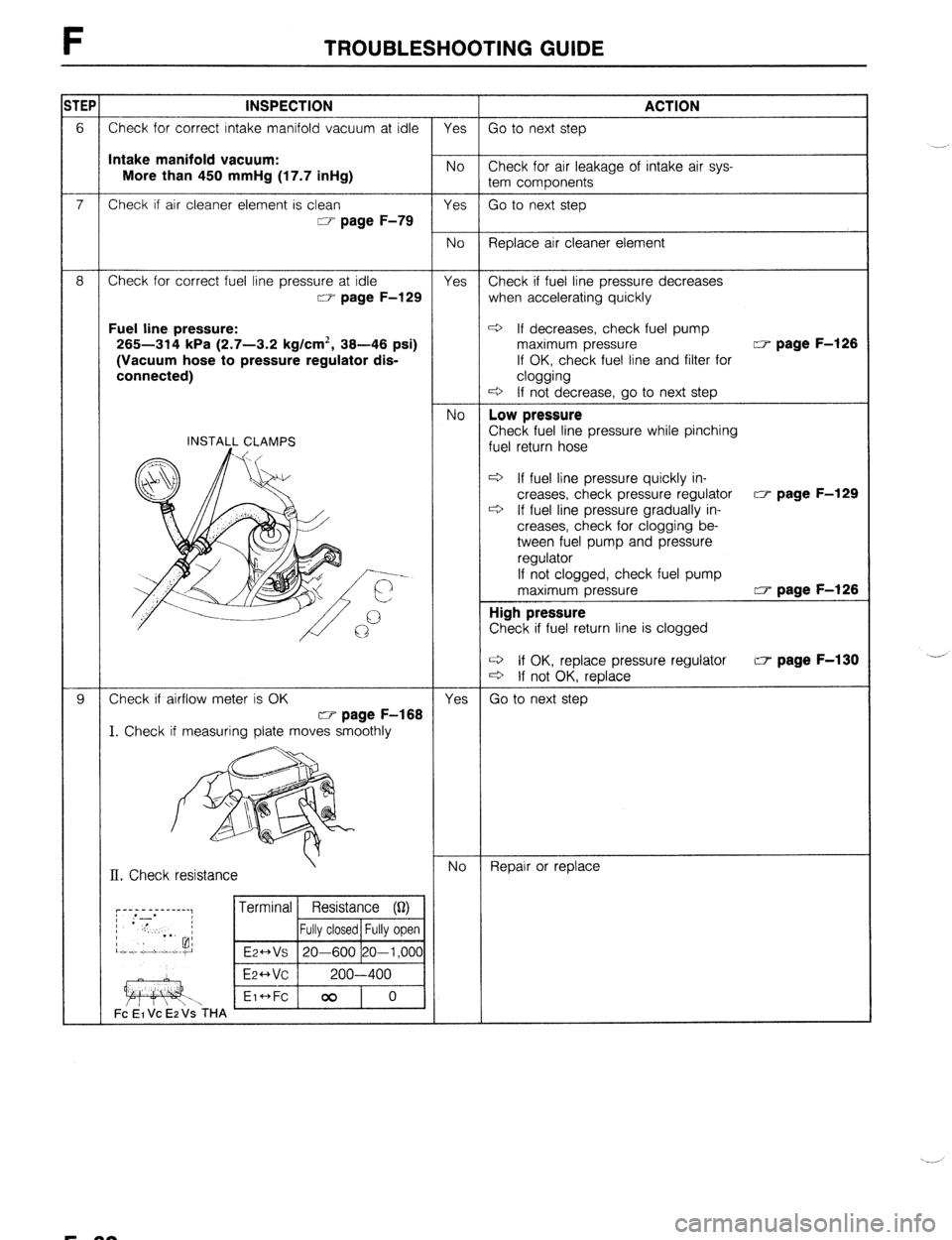
F TROUBLESHOOTING GUIDE
ITEP
INSPECTION ACTION
6 Check for correct intake manifold vacuum at idle Yes Go to next step
Intake manifold vacuum:
More than 450 mmHg (17.7 inHg) No Check for air leakage of intake air sys-
tem components
7 Check if air cleaner element is clean Yes Go to next step
w page F-79
No Replace air cleaner element
8 Check for correct fuel line pressure at idle Yes Check if fuel line pressure decreases
CT= page F-129 when accelerating quickly
Fuel line pressure: c3 If decreases, check fuel pump
265-314 kPa (2.7-3.2 kg/cm’, 38-46 psi) maximum pressure w page F-126
(Vacuum hose to pressure regulator dis- If OK, check fuel line and filter for
connected) clogging
ti If not decrease, go to next step
No Low pressure
INSTALL CLAMPS Check fuel line pressure while pinching
fuel return hose
9 If fuel line pressure quickly in-
creases, check pressure regulator w page F-129
c3 If fuel line pressure gradually in-
creases, check for clogging be-
tween fuel pump and pressure
regulator
If not clogged, check fuel pump
maximum pressure w page F-126
High pressure
Check if fuel return line is clogged
c3 If OK, replace pressure regulator CT page F-130
d If not OK, replace
9 Check if airflow meter is OK
Yes Go to next step
w page F-188
I. Check if measurin late moves smoothly
II. Check resistance No Repair or replace
F-62
Page 332 of 1164
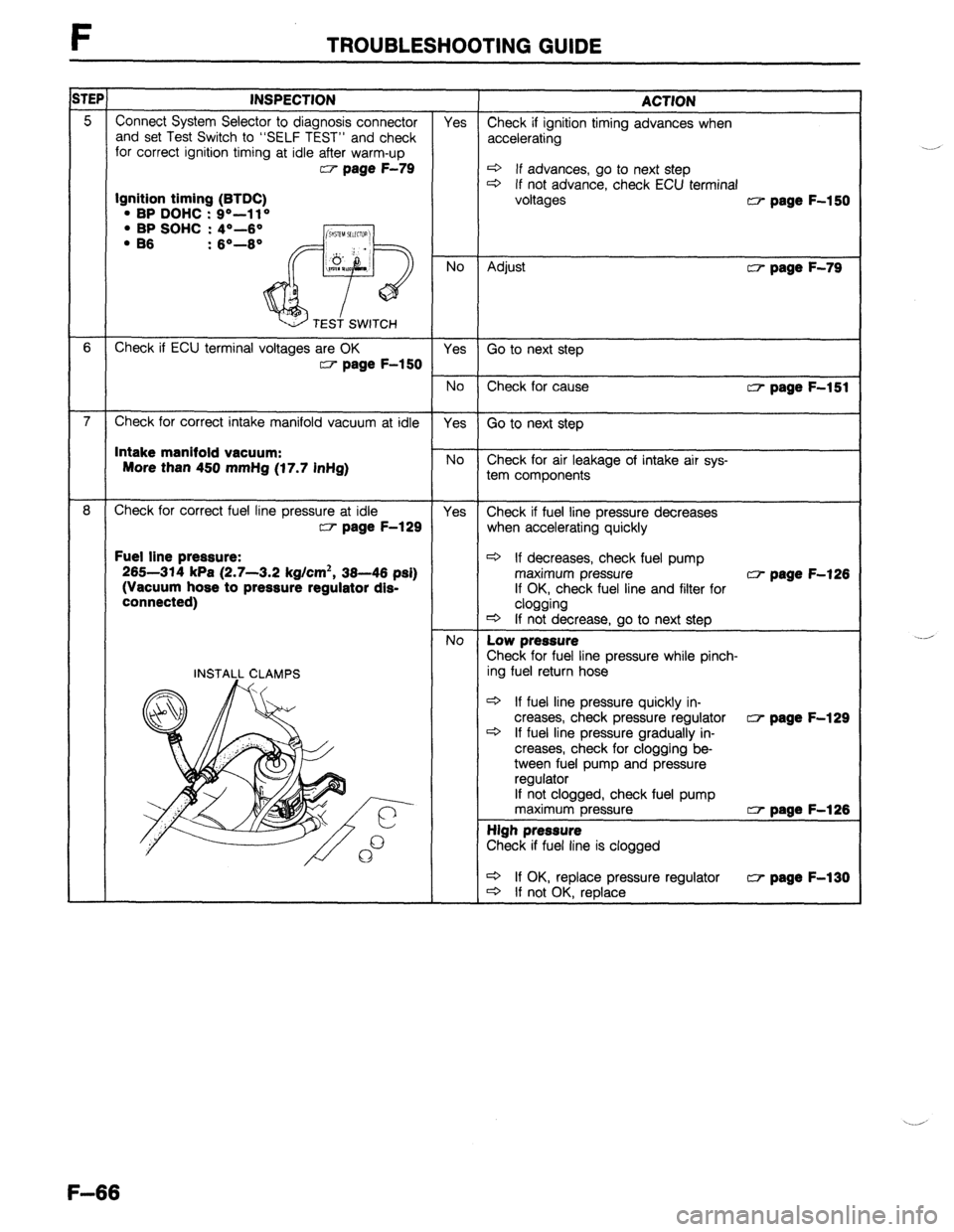
iTEP INSPECTION ACTION
5 Connect System Selector to diagnosis connector Yes
and set Test Switch to “SELF TEST” and check Check if ignition timing advances when
for correct ignition timing at idle after warm-up accelerating w page F-79
* If advances, go to next step
r3 If not advance, check ECU terminal Ignition timing (BTDC)
voltages l BP DOHC : go--ll” w page F-150 l BP SOHC : 4O-6O
. B6 : 6O-6O
No
Adjust w page F-79
6
Check if ECU terminal voltages are OK
Yes Go to next step w page F-150
No
Check for cause ~7 page F-151
7
Check for correct intake manifold vacuum at idle
Yes Go to next step Intake manifold vacuum:
More than 450 mmHg (17.7 inHg) No
Check for air leakage of intake air sys-
tem components
8 Check for correct fuel line pressure at idle
Yes Check if fuel line pressure decreases w page F-129
when accelerating quickly Fuel line pressure:
265-314 kPa (2.7-3.2 kg/cm’, 39-46 psi)
(Vacuum hose to pressure regulator dls-
connected)
d If decreases, check fuel pump
maximum pressure (3‘ page F-126
If OK, check fuel line and filter for
clogging
* If not decrease, go to next step
No Low pressure
Check for fuel line pressure while pinch-
ing fuel return hose
c3 If fuel line pressure quickly in-
creases, check pressure regulator w page F-129
+ If fuel line pressure gradually in-
creases, check for clogging be-
tween fuel pump and pressure
regulator
If not clogged, check fuel pump
maximum pressure w page F-126
High pressure
Check if fuel line is clogged
* If OK, replace pressure regulator w page F-130
c3 If not OK, replace
F-66
Page 338 of 1164

F TROUBLESHOOTING GUIDE
STEP INSPECTION ACTION
5 Check for correct fuel line pressure at idle Yes Check if fuel line pressure decreases
w page F-129 when accelerating quickly
Fuel line pressure: + If it decreases, check for clogging
265-314 kPa (2.7-3.2 kg/cm’, 36-46 psi) between fuel pump and pressure
(Vacuum hose to pressure regulator dis- regulator
connected) * If not decrease, go to next step
INSTALL CLAMPS No Low pressure
Check fuel line pressure while pinching
fuel return hose
c3 If fuel line pressure quickly in-
creases, check pressure regulator w page F-129
c3 If fuel line pressure gradually in-
creases, check for clogging be-
tween fuel pump and pressure
regulator
If not clogged, check fuel pump
maximum pressure w page F-126
6 Check if cooling system is OK Yes Go to next step
w page E-13
No Repair or replace
l Thermostat w page E-9
l Electric cooling fan w page E-16 l Radiator w page E-6
7 Try known good ECU and check if condition Yes Replace ECU CT page F-149
improves
CT= page F-149 No
Change fuel to another brand or use
higher octane fuel
23lJOFX.0: .-._ ,
F-72
Page 367 of 1164

SELF-DIAGNOSIS FUNCTION F
TEP
6
7
8
9
IO
11 INSPECTION
Check for correct fuel line pressure at idle
IV page F-122
Fuel line pressure:
265-314 kPa (2.7-3.2 kg/cm’, 38-46 psi)
(Vacuum hose to pressure regulator
disconnected)
Check intake air system components for air
leakage
Check for misfire of dead cylinder from Step 5
inspection
Check for injector operating sound at idle of
dead cylinder from Step 5 inspection -
Replace injector at dead cylinder from Step 5 in-
spection
CI page F-131
Check if same Code No. is present following
performing after-repair procedure
CT page F-104
Try known good ECU and check if condition
Improves
CT page F-149 Yes
No
Yes If not clogged, check fuel pump
maximum pressure
Go to Step 11
No Replace
--
Yes Repair or replace ignition system
No
Yes
No
Yes
No
T L ACTION
Go to next step
Low pressure
Check fuel line pressure while pinching
fuel return hose
~3 If fuel line pressure quickly in-
creases, check pressure regulator
v page F-129
c3 If fuel line pressure gradually in-
creases, check for clogging be-
tween fuel pump and pressure
regulator
CT page F-126
Go to next step
Go to next step
Check for battery voltage at injector
connector terminal-wire (W/R)
L3 If Yes, replace injector c7 page F-131
+ If No, check wire harness for short
or open
Go to next step
Removed injector at fault
Circuit Diagram
ATX
OXYGENSENSOR
R/L
ECU
-------------- ---
BILG
23UOFX-07
F-10'
Page 386 of 1164
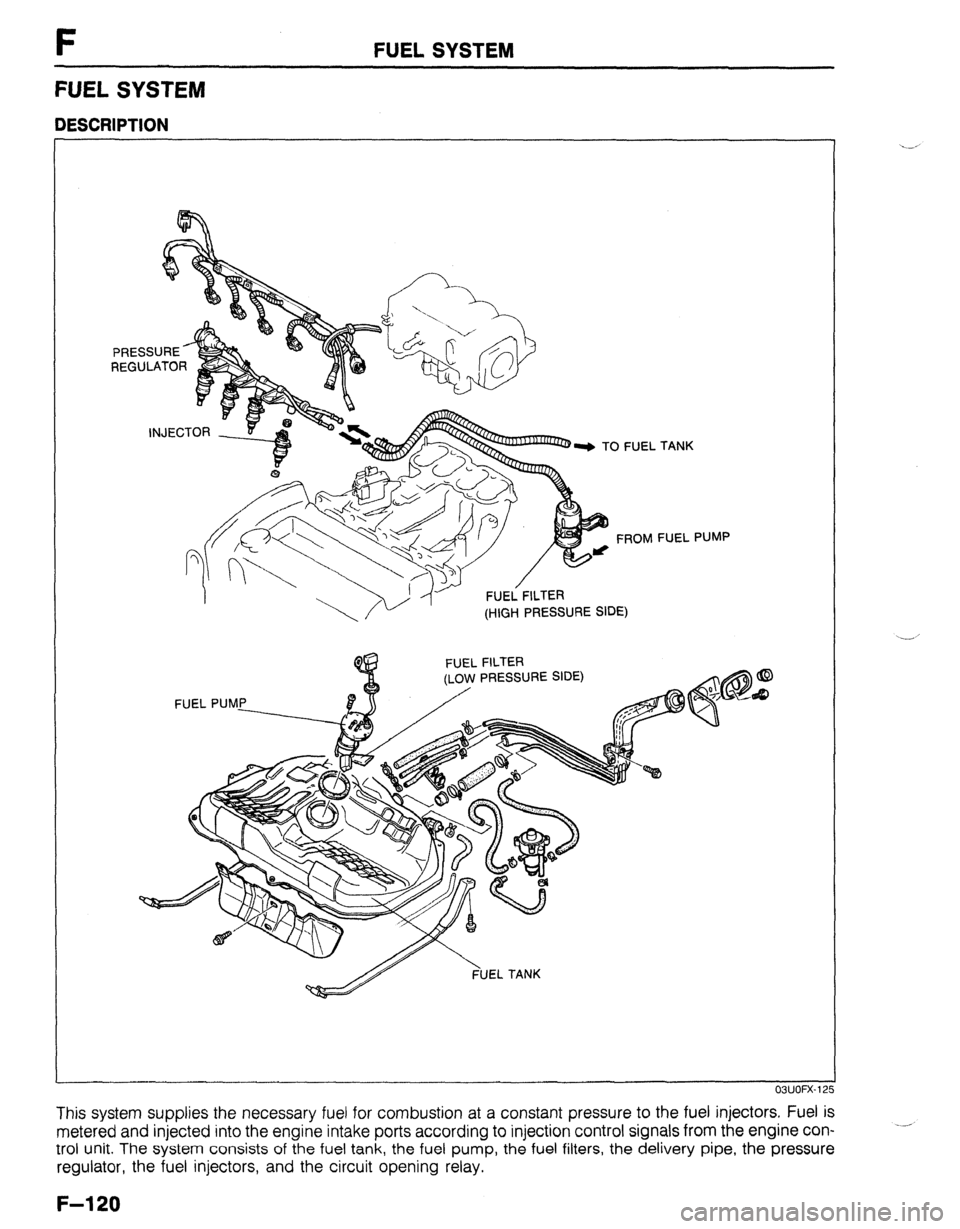
F FUEL SYSTEM
FUEL SYSTEM
DESCRIPTION
FUEL FILTER
(HIGH PRESSURE SIDE) . TANK
FUEL PUMP
PRESSURE SIDE)
OWOFX-12
This system supplies the necessary fuel for combustion at a constant pressure to the fuel injectors. Fuel is
metered and injected into the engine intake ports according to injection control signals from the engine con-
trol unit. The system consists of the fuel tank, the fuel pump, the fuel filters, the delivery pipe, the pressure
regulator, the fuel injectors, and the circuit opening relay. ._*
F-l 20
Page 387 of 1164
FUEL PUMP CONNECTOR
/
REAR SEAT C
FUEL SYSTEM F
PRECAUTION
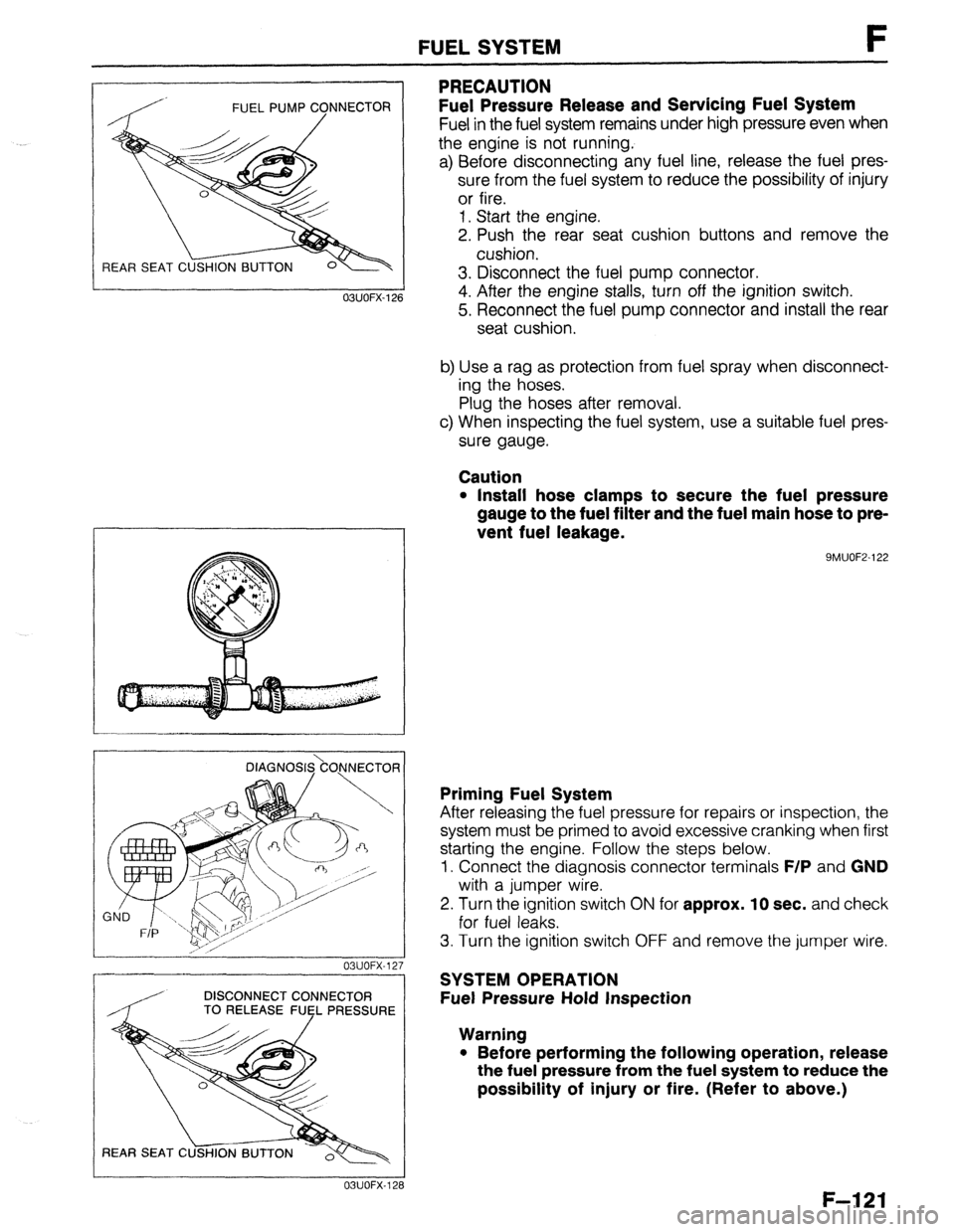
Fuel Pressure Release and Servicing Fuel System
Fuel in the fuel system remains under high pressure even when
the engine is not running.
a) Before disconnecting any fuel line, release the fuel pres-
sure from the fuel system to reduce the possibility of injury
or fire.
1. Start the engine.
2. Push the rear seat cushion buttons and remove the
cushion.
3. Disconnect the fuel pump connector.
4. After the engine stalls, turn off the ignition switch.
5. Reconnect the fuel pump connector and install the rear
seat cushion.
b) Use a rag as protection from fuel spray when disconnect-
ing the hoses.
Plug the hoses after removal.
c) When inspecting the fuel system, use a suitable fuel pres-
sure gauge.
Caution
l Install hose clamps to secure the fuel pressure
gauge to the fuel filter and the fuel main hose to pre-
vent fuel leakage.
9MUOF2-122 OBUOFX-126
DlAGNOS&O,NNECTOR
03UOFX-12.
-
DISCONNECT CONNECTOR
/ TO RELEASE FUEL PRESSURE
03UOFX-12;
Priming Fuel System
After releasing the fuel pressure for repairs or inspection, the
system must be primed to avoid excessive cranking when first
starting the engine. Follow the steps below.
1. Connect the diagnosis connector terminals
F/P and GND
with a jumper wire.
2. Turn the ignition switch
ON for approx. 10 sec. and check
for fuel leaks.
3. Turn the ignition switch OFF and remove the jumper wire.
SYSTEM OPERATION
Fuel Pressure Hold Inspection
Warning
l Before performing the following operation, release
the fuel pressure from the fuel system to reduce the
possibility of injury or fire. (Refer to above.)
F-121
Page 388 of 1164
F FUEL SYSTEM
OSUOFX-129
DIAGNOSIS.\CO.NNECTOR j
/, I 23UOFX-104
DISCONNECT CONNECTOR
TO RELEASE FlJsL PRESSURE
L 23UOFX-105
INSTALL CLAMPS
DIAGNOSI$kO)lNECTOfl
I
23UOFX-ll
F-l 22
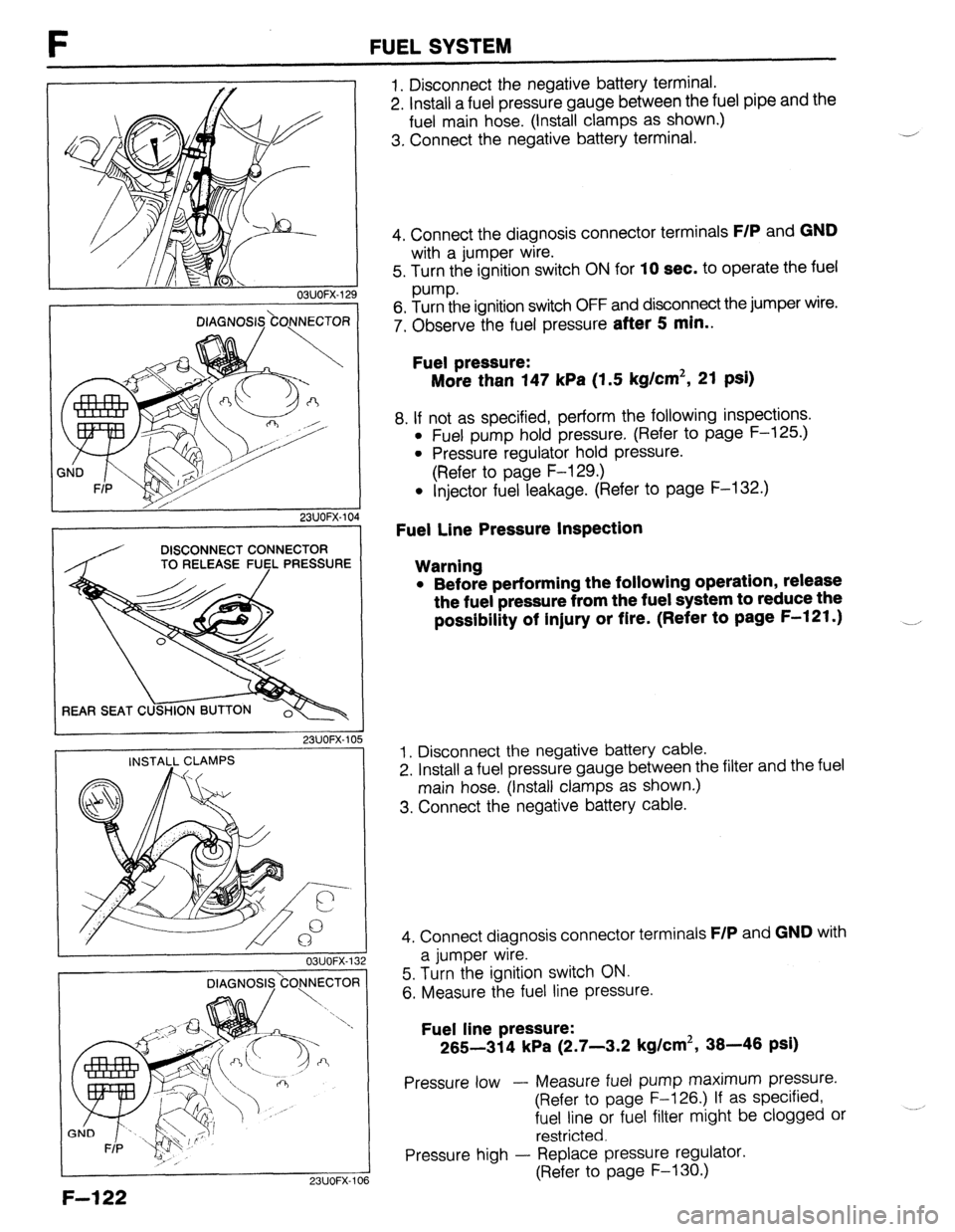
1. Disconnect the negative battery terminal.
2. Install a fuel pressure gauge between the fuel pipe and the
fuel main hose. (Install clamps as shown.)
3. Connect the negative battery terminal. J
4. Connect the diagnosis connector terminals
F/P and GND
with a jumper wire.
5. Turn the ignition switch ON for
10 sec. to operate the fuel
pump.
6. Turn the ignition switch OFF and disconnect the jumper wire.
7. Observe the fuel pressure
after 5 min..
Fuel pressure:
More than 147 kPa (1.5 kg/cm2, 21 psi)
8. If not as specified, perform the following inspections.
l Fuel pump hold pressure. (Refer to page F-125.)
l Pressure regulator hold pressure.
(Refer to page F-129.)
l Injector fuel leakage. (Refer to page F-132.)
Fuel Line Pressure Inspection
Warning
l Before performing the following operation, release
the fuel pressure from the fuel system to reduce the
possibility of injury or fire. (Refer to page F-121.) __,
1. Disconnect the negative battery cable.
2. Install a fuel pressure gauge between the filter and the fuel
main hose. (Install clamps as shown.)
3. Connect the negative battery cable.
4. Connect diagnosis connector terminals
F/P and GND with
a jumper wire.
5. Turn the ignition switch ON.
6. Measure the fuel line pressure.
Fuel line pressure:
265-314 kPa (2.7-3.2 kg/cm2, 38-46 psi)
Pressure low - Measure fuel pump maximum pressure.
(Refer to page F-126.) If as specified,
fuel line or fuel filter might be clogged or
restricted.
Pressure high - Replace pressure regulator.
(Refer to page F-130.)
Page 389 of 1164
FUEL SYSTEM F
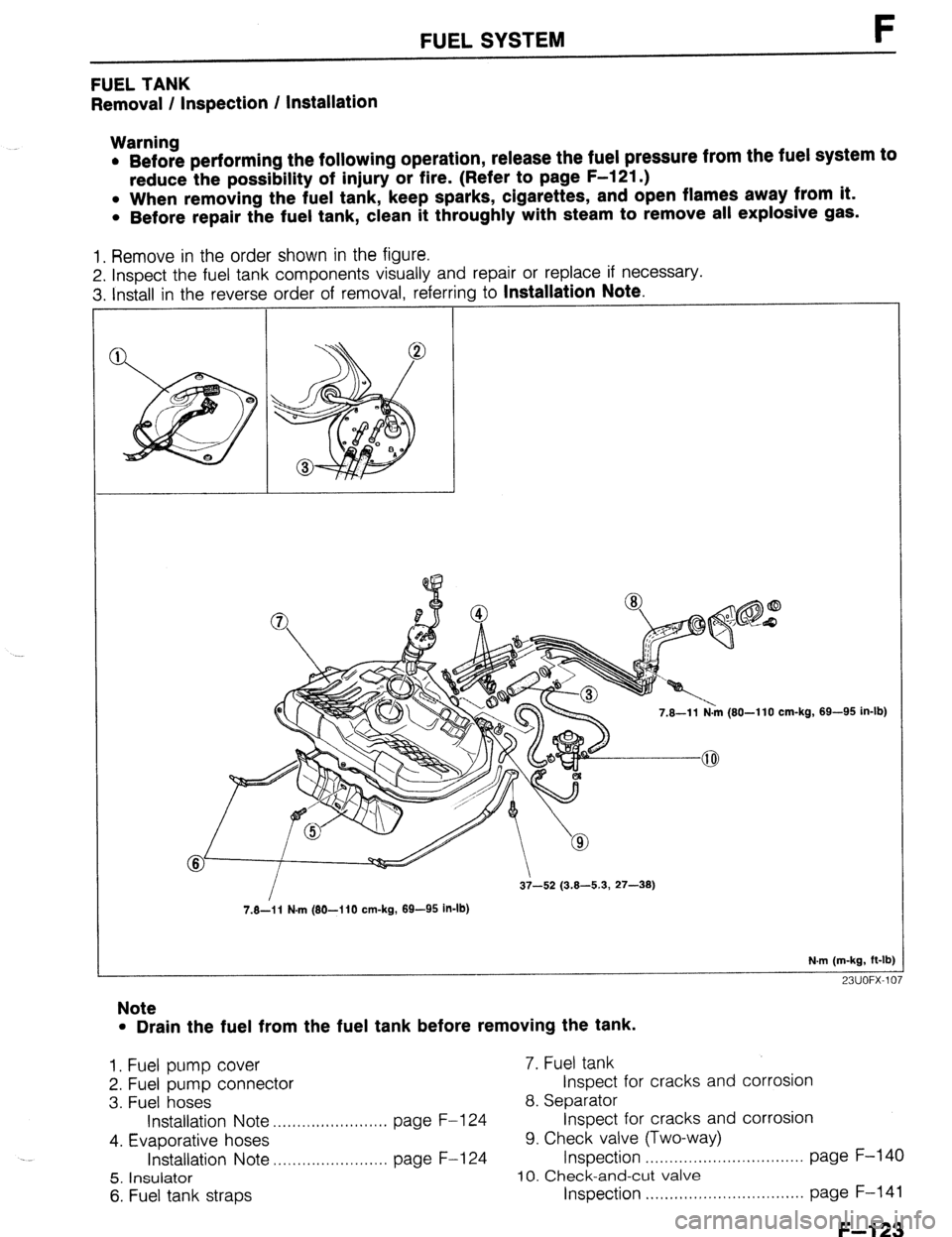
FUEL TANK
Removal / Inspection / Installation
Warning
l Before performing the following operation, release the fuel pressure from the fuel system to
reduce the possibility of injury or fire. (Refer to page F-121 .)
l When removing the fuel tank, keep sparks, cigarettes, and open flames away from it.
l Before repair the fuel tank, clean it throughly with steam to remove all explosive gas.
1. Remove in the order shown in the figure.
2. Inspect the fuel tank components visually and repair or replace if necessary.
3. Install in the reverse order of removal, referring to
Installation Note.
7.8-l 1 N.m (80-l 10 cm-kg,
7.8-i 1 N-m (80-I 10 cm-kg, 89-95 in-lb) 69-95 in-lb)
N.m (m-kg, ft-lb]
23UOFX-107
Note
l Drain the fuel from the fuel tank before removing the tank.
1. Fuel pump cover 7. Fuel tank
2. Fuel pump connector Inspect for cracks and corrosion
3. Fuel hoses 8. Separator
Installation Note . ..., I .I,,,,I,I,.,.I.,,. page F-l 24 Inspect for cracks and corrosion
4. Evaporative hoses 9. Check valve (Two-way)
Installation Note ,..,..,................. page F-l 24 Inspection . . . . . . . . . . . . . . . . . . . . . . . . . . . . . . . . . page F-140
5. Insulator 10. Check-and-cut valve
6. Fuel tank straps Inspection . . . . . . . . . . . . . . . . . . . . . . . . . . . page F-141
F--l 23