steering wheel MERCEDES-BENZ A-CLASS HATCHBACK 2008 Owner's Guide
[x] Cancel search | Manufacturer: MERCEDES-BENZ, Model Year: 2008, Model line: A-CLASS HATCHBACK, Model: MERCEDES-BENZ A-CLASS HATCHBACK 2008Pages: 305, PDF Size: 5.43 MB
Page 214 of 305
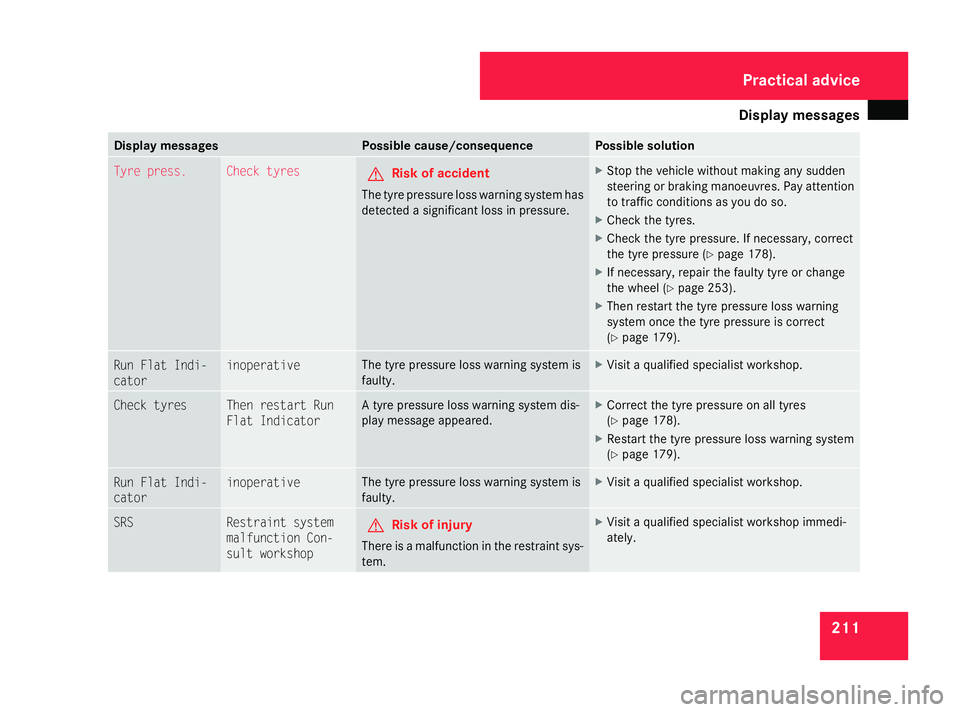
Display
messages 211Display messages Possible cause/consequence Possible solution
Tyre press. Check tyres
G
Risk of accident
The tyre pressure loss warning system has
detected a significant loss in pressure. X
Stop the vehicle witho ut making any sudden
steering or braking manoeuvres. Pay attention
to traffic conditions as you do so.
X Check the tyres.
X Check the tyre pressure. If necessary, correct
the tyre pressure (Y page 178).
X If necessary, repair the faulty tyre or change
the wheel ( Ypage 253).
X Then restart the tyre pressure loss warning
system once the tyre pressure is correct
(Y page 179). Run Flat Indi-
cator inoperative The tyre pressure loss warning system is
faulty. X
Visit a qualified specialist workshop. Check tyres Then restart Run
Flat Indicator A tyre pressure loss warning system dis-
play message appeared. X
Correct the tyre pressure on all tyres
(Y page 178).
X Restart the tyre pressure loss warning system
(Y page 179). Run Flat Indi-
cator inoperative The tyre pressure loss warning system is
faulty. X
Visit a qualified specialist workshop. SRS Restraint system
malfunction Con-
sult workshop G
Risk of injury
There is a malfunction in the restraint sys-
tem. X
Visit a qualified specialist workshop immedi-
ately. Practical advice
169_AKB; 2; 4, en-GB
wdomann
,V ersion: 2.10.6
2008-07-16T08:52:06+02:00 - Seite 211 ZDateiname: 6515_0315_02_buchblock.pdf; preflight
Page 227 of 305
Troubleshooting
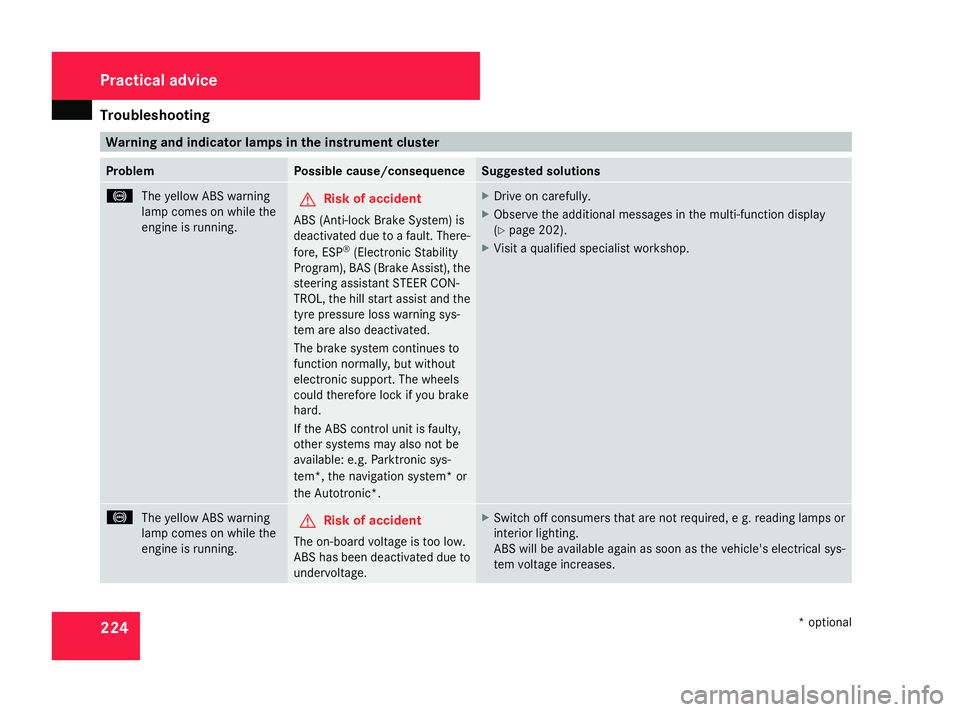
224 Warning and indicator lamps in the instrument cluster
Problem Possible cause/consequence Suggested solutions
-
Theyellow ABS warning
lamp comes on while the
engine is running. G
Risk of accident
ABS (Anti-lock Brake System) is
deactivated due to a fault. There-
fore, ESP ®
(Electronic Stability
Program), BAS (Brake Assist), the
steering assistant STEER CON-
TROL, the hill start assist and the
tyre pressure loss warning sys-
tem are also deactivated.
The brake system continues to
function normally, but without
electronic support. The wheels
could therefore lock if you brake
hard.
If the ABS control unit is faulty,
other systems may also not be
available: e.g. Parktronic sys-
tem*, the navigation system* or
the Autotronic*. X
Drive on carefully.
X Observe the additional messages in the multi-function display
(Y page 202).
X Visit a qualified specialist workshop. -
The yellow ABS warning
lamp comes on while the
engine is running. G
Risk of accident
The on-board voltage is too low.
ABS has been deactivated due to
undervoltage. X
Switch off consumers that are not required, e g. reading lamps or
interior lighting.
ABS will be available again as soon as the vehicle's electrical sys-
tem voltage increases. Practical advice
* optional
169_AKB; 2; 4, en-GB
wdomann
,V ersion: 2.10.6
2008-07-16T08:52:06+02:00 - Seite 224 Dateiname: 6515_0315_02_buchblock.pdf; preflight
Page 228 of 305
Troubleshooting
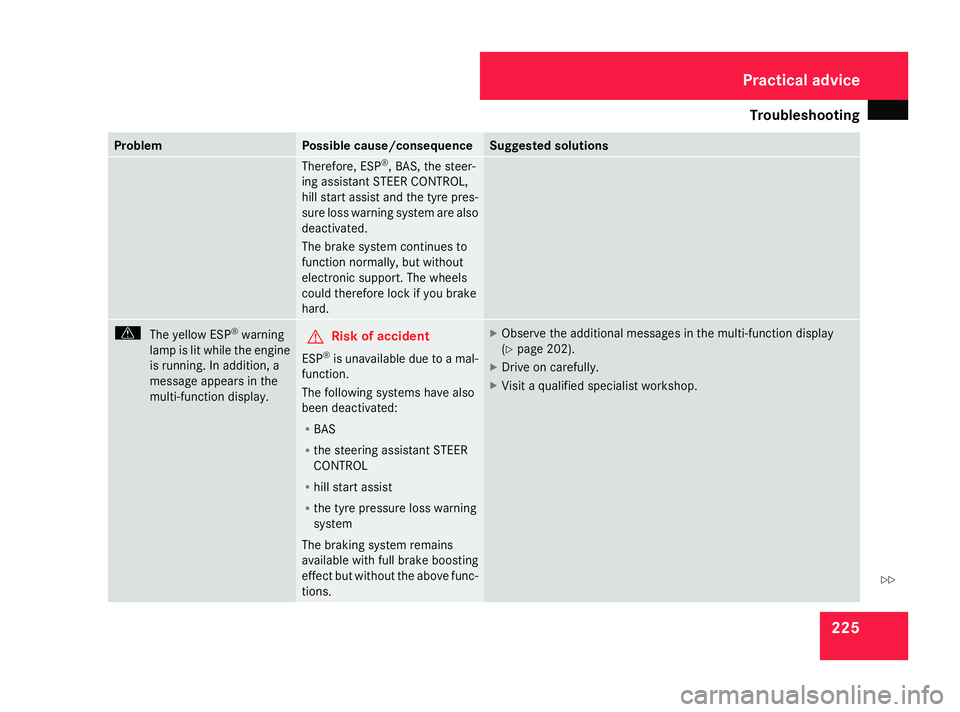
225Problem Possible cause/consequence Suggested solutions
Therefore, ESP
®
, BAS, the steer-
ing assistant STEER CONTROL,
hill start assist and the tyre pres-
sure loss warning system are also
deactivated.
The brake system continues to
function normall y, but without
electronic support. The wheels
could therefore lock if you brake
hard. v
The yellow ESP ®
warning
lamp is lit while the engine
is running. In addition, a
message appears in the
multi-function display. G
Risk of accident
ESP ®
is unavailable due to a mal-
function.
The following systems have also
been deactivated:
R BAS
R the steering assistant STEER
CONTROL
R hill start assist
R the tyre pressure loss warning
system
The braking system remains
available with full brake boosting
effect but without the above func-
tions. X
Observe the additional messages in the multi-function display
(Y page 202).
X Drive on carefully.
X Visit a qualified specialist workshop. Practical advice
169_AKB; 2; 4, en-GB
wdomann
,V ersion: 2.10.6
2008-07-16T08:52:06+02:00 - Seite 225 ZDateiname: 6515_0315_02_buchblock.pdf; preflight
Page 242 of 305
Troubleshooting
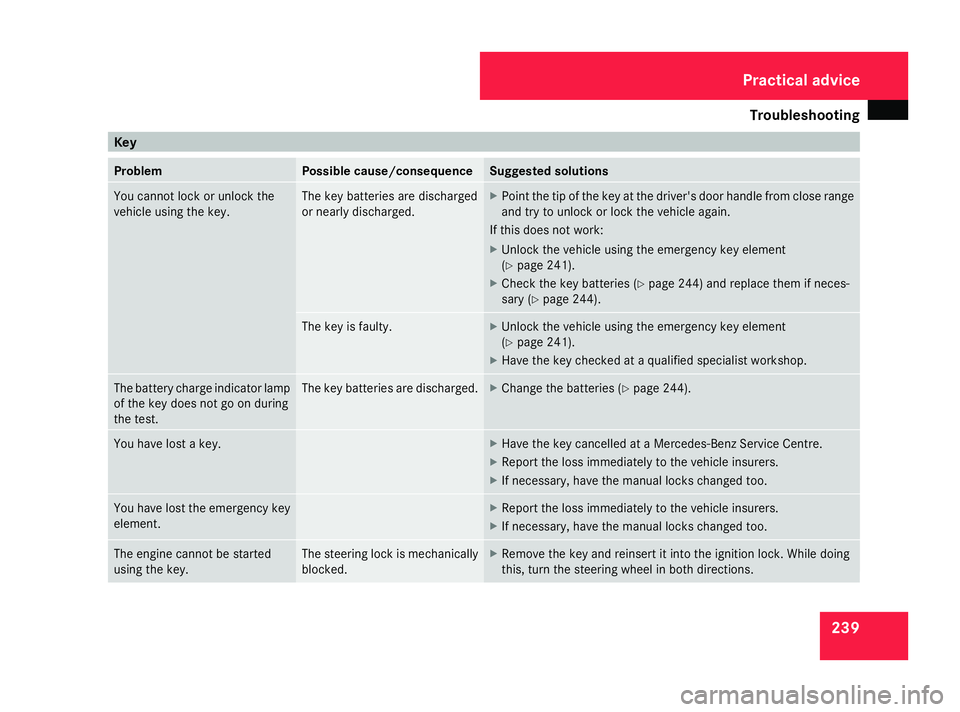
239Key
Problem Possible cause/consequence Suggested solutions
You cannot lock or unlock the
vehicle using the key. The key batteries are discharged
or nearl
y discharged. X
Point the tip of the key at the driver's door handle from close range
and try to unlock or lock the vehicle again.
If this does not work:
X Unlock the vehicle using the emergency key element
(Y page 241).
X Check the key batteries (Y page 244) and replace them if neces-
sary ( Ypage 244). The key is faulty. X
Unlock the vehicle using the emergency key element
(Y page 241).
X Have the key checked at a qualified specialist workshop. The battery charge indicator lamp
of the key does not go on during
the test. The key batteries are discharged. X
Change the batteries ( Ypage 244). You have lost a key. X
Have the key cancelled at a Mercedes-Benz Service Centre.
X Report the loss immediately to the vehicle insurers.
X If necessary, have the manual locks changed too. You have lost the emergency key
element. X
Report the loss immediately to the vehicle insurers.
X If necessary, have the manual locks changed too. The engine cannot be started
using the key. The steering lock is mechanically
blocked. X
Remove the key and reinsert it into the ignition lock. While doing
this, turn the steering wheel in both directions. Practical advice
169_AKB; 2; 4, en-GB
wdomann
,V ersion: 2.10.6
2008-07-16T08:52:06+02:00 - Seite 239 ZDateiname: 6515_0315_02_buchblock.pdf; preflight
Page 273 of 305
Towing and tow-starting
270
Vehicles with AUTOTRONIC* X
Turn the key to position 2in the ignition
lock.
X Move the selector lever to N.Tow-starting (emergency engine
starting)
Please note:
R Vehicles with AUTOTRONIC* must not be
tow-started.
R The battery must be connected.
R The engine and catalytic converter must be
cold.
R Avoid repeated and lengthy starting
attempts.
Vehicles with manual transmission X
Turn the key to position 2(Y page 62) in
the ignition lock.
X Fully depress the clutch pedal.
X Shift to neutral. X
Tow the vehicle or let it roll.
X Shift to a suitable gear and bring the clutch
pedal up slowly. Do not depress the accel-
erator pedal.
The engine is started. Removing the towing eye
X Take the wheel wrench from the vehicle
tool kit ( Ypage 200).
X Insert the wheel wrench handle into the
towing eye and turn it anti-clockwise.
X Unscrew the towing eye.
X Replace the cover and press it until it
engages.
X Return the towing eye and the wheel
wrench to the vehicle tool kit. Transporting the vehicle
The towing eyes or trailer coupling *can be
used to pull the vehicle onto a trailer or trans-
porter if you wish to transport it.
! Only lash the vehicle down by the wheels
or wheel rims, not by parts of the vehicle
such as axle or steering components. The
vehicle could otherwise be damaged.
Vehicles with manual transmission X
Shift to neutral.
Vehicles with AUTOTRONIC* X
Turn the key to position 2(Y page 62) in
the ignition lock.
X Move the selector lever to N.Practical advice
* optional
169_AKB; 2; 4, en-GB
wdomann,
Version: 2.10.6
2008-07-16T08:52:06+02:00 - Seite 270 Dateiname: 6515_0315_02_buchblock.pdf; preflight