ESP MERCEDES-BENZ B-CLASS 2012 Owner's Guide
[x] Cancel search | Manufacturer: MERCEDES-BENZ, Model Year: 2012, Model line: B-CLASS, Model: MERCEDES-BENZ B-CLASS 2012Pages: 340, PDF Size: 3.09 MB
Page 111 of 340
Changing the rear bulbs
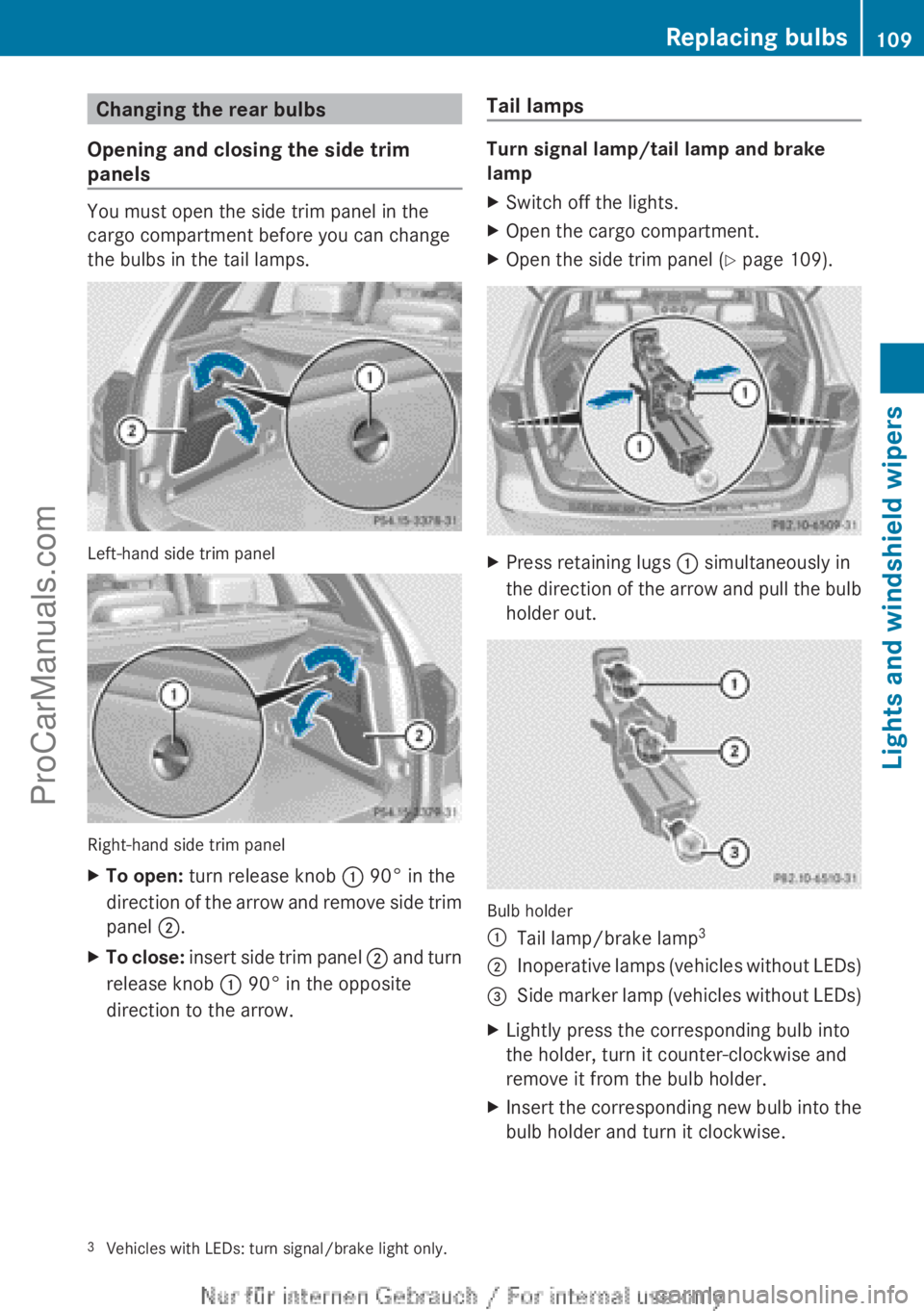
Opening and closing the side trim
panels You must open the side trim panel in the
cargo compartment before you can change
the bulbs in the tail lamps.
Left-hand side trim panel
Right-hand side trim panel
X
To open: turn release knob : 90° in the
direction of the
arrow and remove side trim
panel ;.
X To close: insert side trim panel
;
and turn
release knob : 90° in the opposite
direction to the arrow. Tail lamps Turn signal lamp/tail lamp and brake
lamp
X
Switch off the lights.
X Open the cargo compartment.
X Open the side trim panel ( Y page 109). X
Press retaining lugs : simultaneously in
the direction of
the arrow and pull the bulb
holder out. Bulb holder
:
Tail lamp/brake lamp 3
; Inoperative lamps (vehicles without LEDs)
= Side marker lamp (vehicles without LEDs)
X Lightly press the corresponding bulb into
the holder, turn it counter-clockwise and
remove it from the bulb holder.
X Insert the corresponding new bulb into the
bulb holder and turn it clockwise.
3 Vehicles with LEDs: turn signal/brake light only. Replacing bulbs
109
Lights and windshield wipers Z
ProCarManuals.com
Page 113 of 340
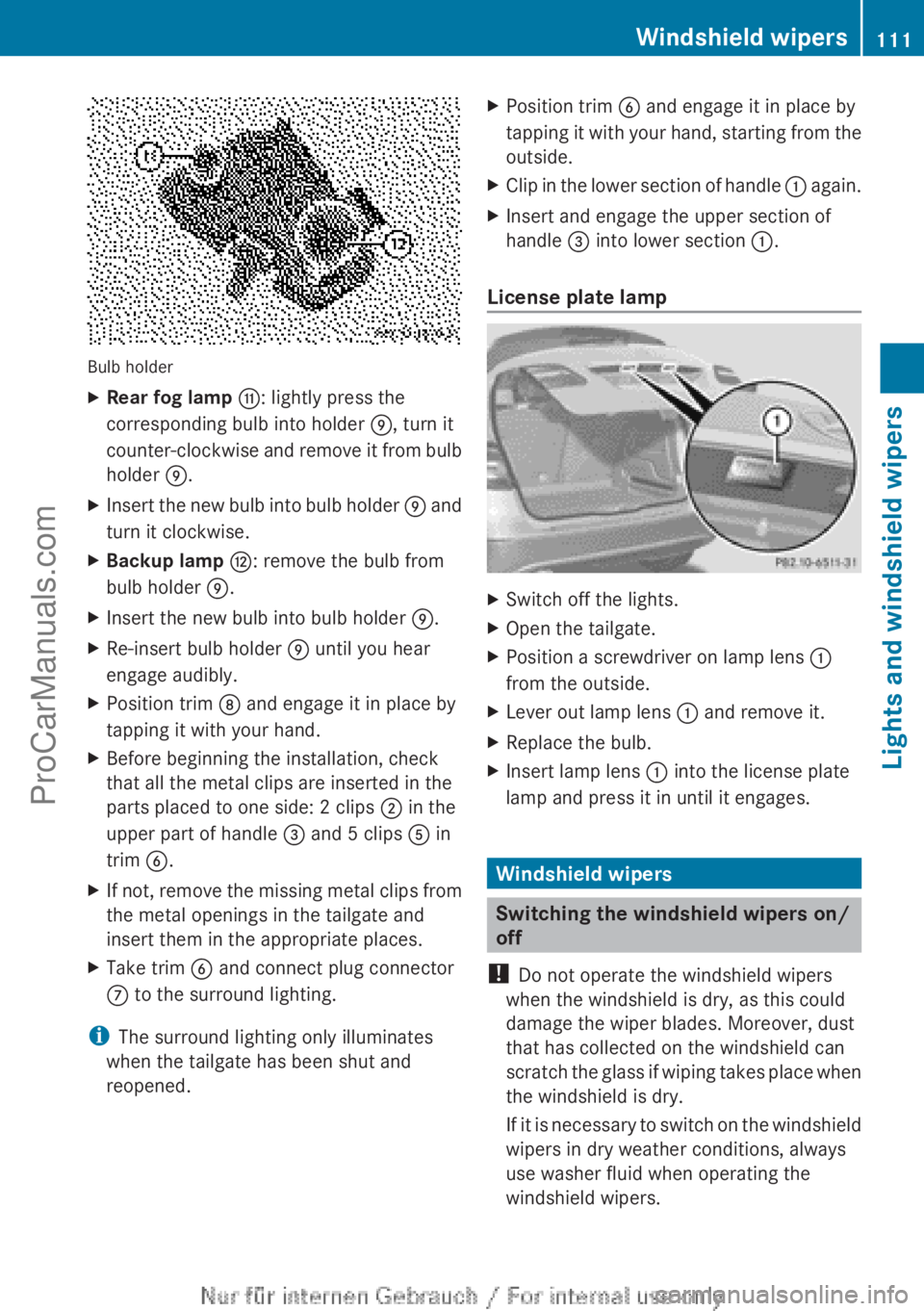
Bulb holder
X
Rear fog lamp G: lightly press the
corresponding bulb into holder E, turn it
counter-clockwise and
remove
it from bulb
holder E.
X Insert the new bulb into bulb holder E and
turn it clockwise.
X Backup lamp H: remove the bulb from
bulb holder E
.
X Insert the new bulb into bulb holder E.
X Re-insert bulb holder E until you hear
engage audibly.
X Position trim D and engage it in place by
tapping it with your hand.
X Before beginning the installation, check
that all the metal clips are inserted in the
parts placed to one side: 2 clips ; in the
upper part of handle = and 5 clips A in
trim B.
X If not, remove the missing metal clips from
the metal openings in the tailgate and
insert them in the appropriate places.
X Take trim B and connect plug connector
C to the surround lighting.
i The surround lighting only illuminates
when the tailgate has been shut and
reopened. X
Position trim B and engage it in place by
tapping it
with
your hand, starting from the
outside.
X Clip in the lower section of handle : again.
X Insert and engage the upper section of
handle = into lower section
:.
License plate lamp X
Switch off the lights.
X Open the tailgate.
X Position a screwdriver on lamp lens :
from the outside.
X Lever out lamp lens : and remove it.
X Replace the bulb.
X Insert lamp lens : into the license plate
lamp and press it in until it engages. Windshield wipers
Switching the windshield wipers on/
off
! Do not operate the windshield wipers
when the windshield is dry, as this could
damage the wiper blades. Moreover, dust
that has collected on the windshield can
scratch the glass
if wiping takes place when
the windshield is dry.
If it is necessary to switch on the windshield
wipers in dry weather conditions, always
use washer fluid when operating the
windshield wipers. Windshield wipers
111
Lights and windshield wipers Z
ProCarManuals.com
Page 114 of 340
!
If the windshield wipers leave smears on
the windshield after the vehicle has been
washed in an automatic car wash, wax or
other residues may be the reason for this.
Clean the windshield using washer fluid
after washing the vehicle in an automatic
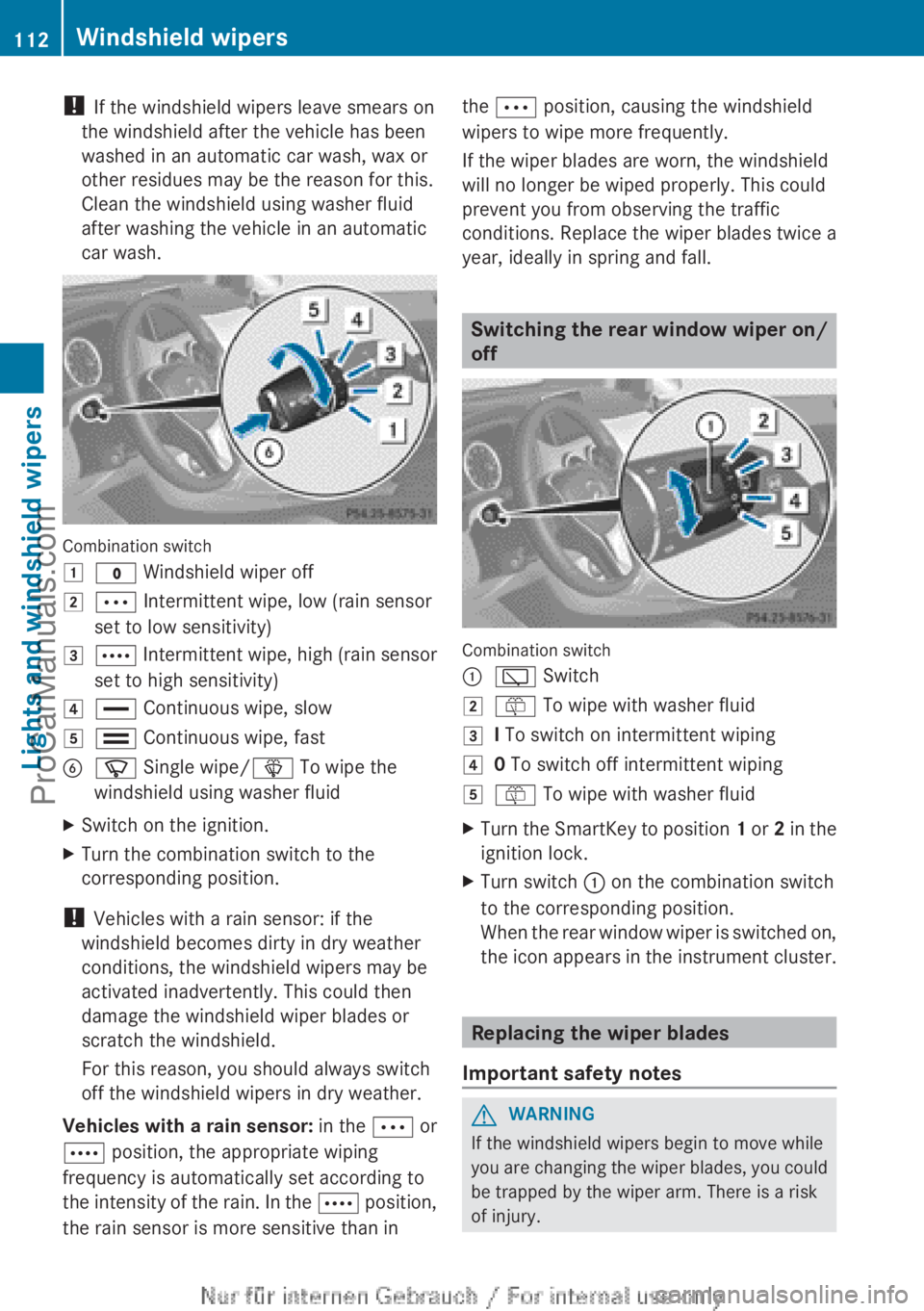
car wash. Combination switch
1
$ Windshield wiper off
2 Ä Intermittent wipe, low (rain sensor
set to low sensitivity)
3 Å Intermittent wipe, high (rain sensor
set to high sensitivity)
4 ° Continuous wipe, slow
5 ¯
Continuous wipe, fast
B í Single wipe/ î To wipe the
windshield using washer fluid
X Switch on the ignition.
X Turn the combination switch to the
corresponding position.
! Vehicles with a rain sensor: if the
windshield becomes dirty in dry weather
conditions, the windshield wipers may be
activated inadvertently. This could then
damage the windshield wiper blades or
scratch the windshield.
For this reason, you should always switch
off the windshield wipers in dry weather.
Vehicles with
a
rain sensor: in the Ä or
Å position, the appropriate wiping
frequency is automatically set according to
the intensity of the rain. In the Å position,
the rain sensor is more sensitive than in the Ä position, causing the windshield
wipers to wipe more frequently.
If the wiper blades are worn, the windshield
will no longer be wiped properly. This could
prevent you from observing the traffic
conditions. Replace the wiper blades twice a
year, ideally in spring and fall.
Switching the rear window wiper on/
off
Combination switch
:
è Switch
2 ô To wipe with washer fluid
3 I To switch on intermittent wiping
4 0 To switch off intermittent wiping
5 ô To wipe with washer fluid
X Turn the SmartKey to position 1 or
2
in the
ignition lock.
X Turn switch : on the combination switch
to the corresponding position.
When the rear
window wiper is switched on,
the icon appears in the instrument cluster. Replacing the wiper blades
Important safety notes G
WARNING
If the windshield wipers begin to move while
you are changing
the wiper blades, you could
be trapped by the wiper arm. There is a risk
of injury. 112
Windshield wipers
Lights and windshield wipers
ProCarManuals.com
Page 128 of 340
setting in small increments. Start at 72 ‡
(22 †).
Setting the air distribution
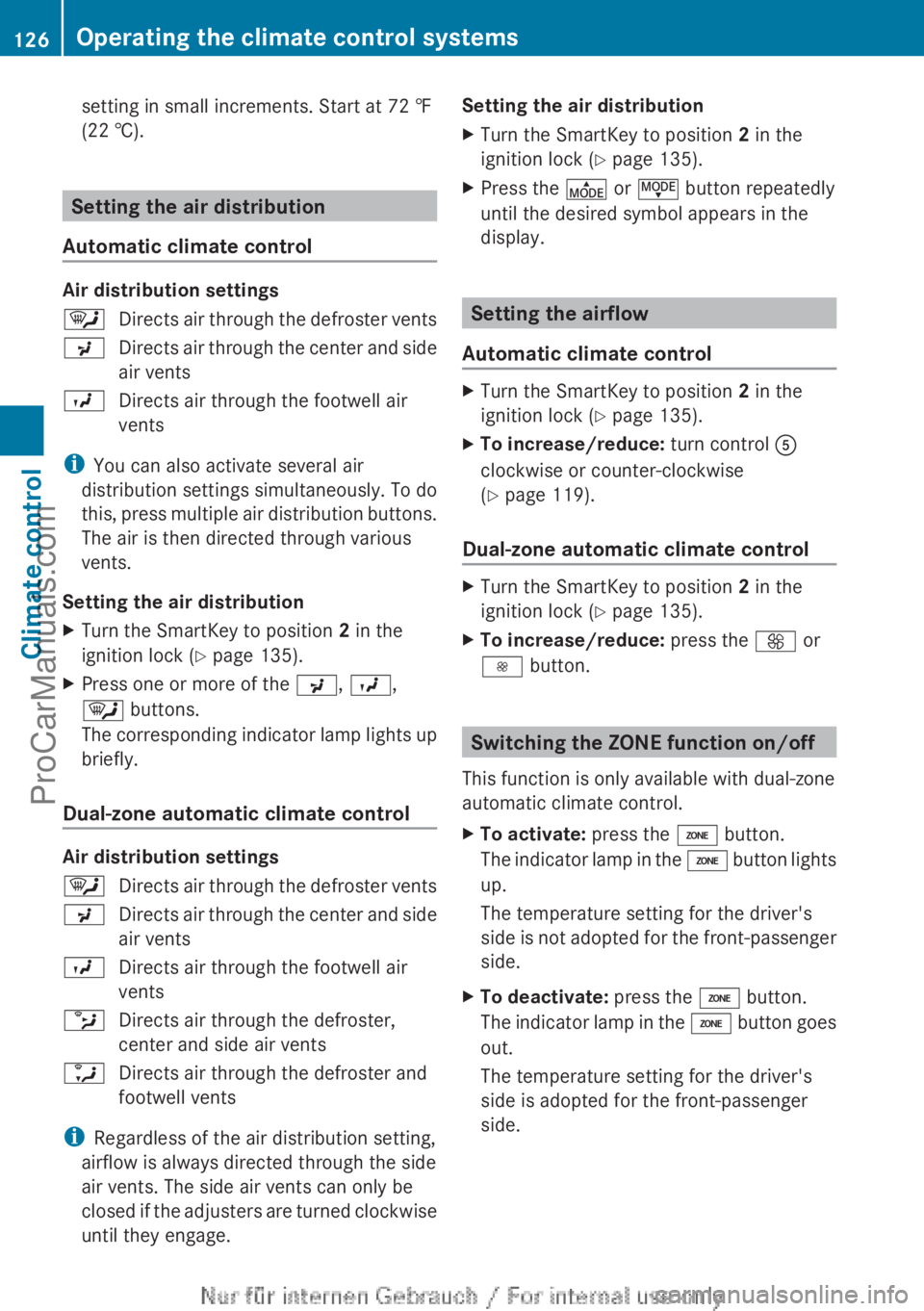
Automatic climate control Air distribution settings
¯
Directs air through the defroster vents
P Directs air through the center and side
air vents
O Directs air through the footwell air
vents
i You can also activate several air
distribution settings simultaneously. To do
this, press multiple
air distribution buttons.
The air is then directed through various
vents.
Setting the air distribution
X Turn the SmartKey to position 2 in the
ignition lock (Y page 135).
X Press one or more of the P, O,
¯ buttons.
The corresponding indicator
lamp lights up
briefly.
Dual-zone automatic climate control Air distribution settings
¯
Directs air through the defroster vents
P Directs air through the center and side
air vents
O Directs air through the footwell air
vents
b Directs air through the defroster,
center and side air vents
a Directs air through the defroster and
footwell vents
i Regardless of the air distribution setting,
airflow is always directed through the side
air vents. The side air vents can only be
closed if the
adjusters are turned clockwise
until they engage. Setting the air distribution
X
Turn the SmartKey to position 2 in the
ignition lock (Y page 135).
X Press the É or Ë button repeatedly
until the desired symbol appears in the
display. Setting the airflow
Automatic climate control X
Turn the SmartKey to position 2 in the
ignition lock (Y page 135).
X To increase/reduce: turn control A
clockwise or counter-clockwise
(Y page 119).
Dual-zone automatic climate control X
Turn the SmartKey to position 2 in the
ignition lock (Y page 135).
X To increase/reduce: press the K or
I button. Switching the ZONE function on/off
This function is only available with dual-zone
automatic climate control.
X To activate: press the á button.
The indicator lamp
in the á button lights
up.
The temperature setting for the driver's
side is not adopted for the front-passenger
side.
X To deactivate: press the á button.
The indicator lamp
in the á button goes
out.
The temperature setting for the driver's
side is adopted for the front-passenger
side. 126
Operating the climate control systems
Climate control
ProCarManuals.com
Page 136 of 340
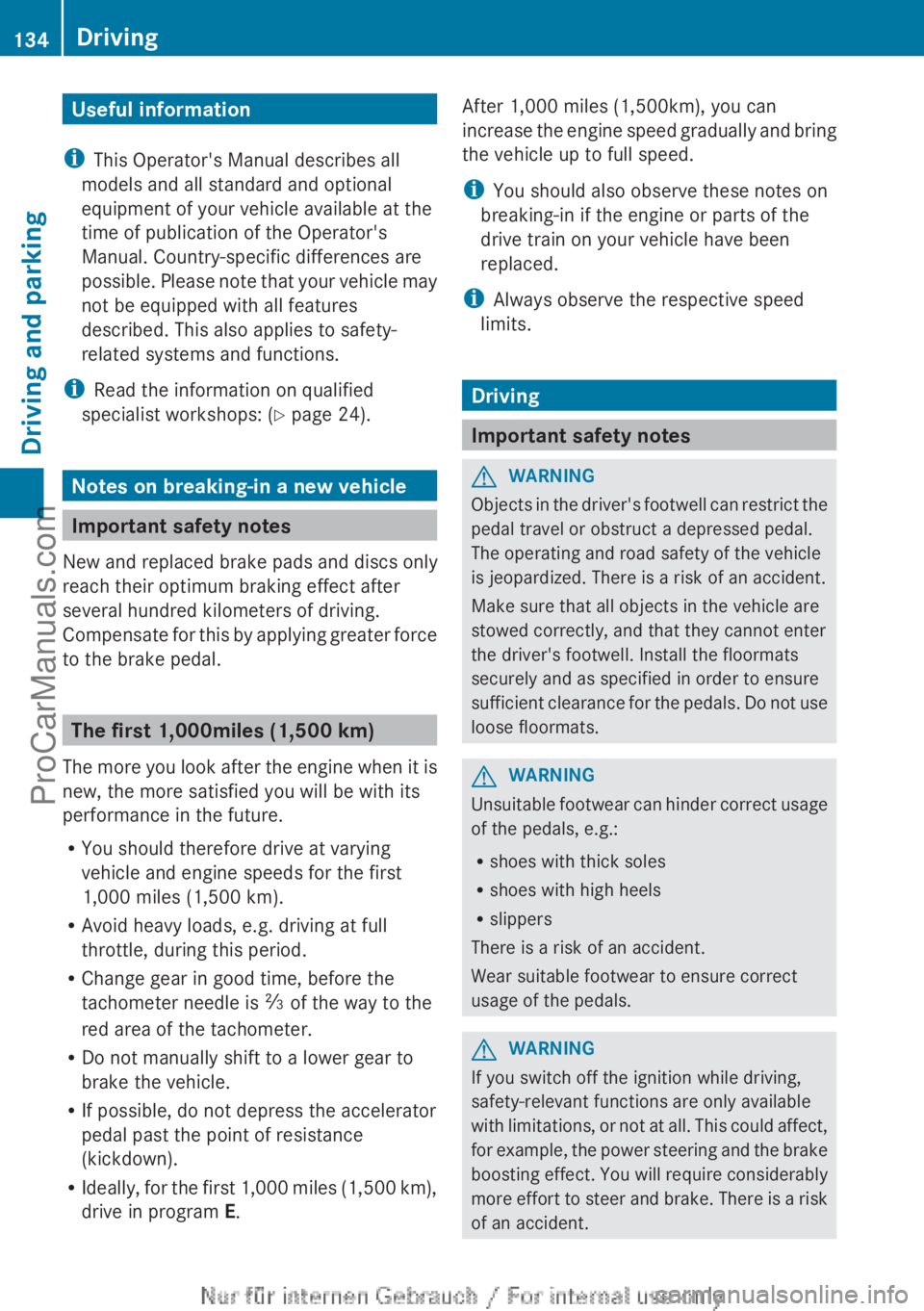
Useful information
i This Operator's Manual describes all
models and all standard and optional
equipment of your vehicle available at the
time of publication of the Operator's
Manual. Country-specific differences are
possible. Please note
that your vehicle may
not be equipped with all features
described. This also applies to safety-
related systems and functions.
i Read the information on qualified
specialist workshops: ( Y page 24).Notes on breaking-in a new vehicle
Important safety notes
New and replaced brake pads and discs only
reach their optimum braking effect after
several hundred kilometers of driving.
Compensate for this
by applying greater force
to the brake pedal. The first 1,000miles (1,500 km)
The more you
look after the engine when it is
new, the more satisfied you will be with its
performance in the future.
R You should therefore drive at varying
vehicle and engine speeds for the first
1,000 miles (1,500 km).
R Avoid heavy loads, e.g. driving at full
throttle, during this period.
R Change gear in good time, before the
tachometer needle is Ô of the way to the
red area of the tachometer.
R Do not manually shift to a lower gear to
brake the vehicle.
R If possible, do not depress the accelerator
pedal past the point of resistance
(kickdown).
R Ideally, for the first 1,000 miles (1,500 km),
drive in program E. After 1,000 miles (1,500km), you can
increase the
engine
speed gradually and bring
the vehicle up to full speed.
i You should also observe these notes on
breaking-in if the engine or parts of the
drive train on your vehicle have been
replaced.
i Always observe the respective speed
limits. Driving
Important safety notes
G
WARNING
Objects in the driver's footwell can restrict the
pedal travel or obstruct a depressed pedal.
The operating and road safety of the vehicle
is jeopardized. There is a risk of an accident.
Make sure that all objects in the vehicle are
stowed correctly, and that they cannot enter
the driver's footwell. Install the floormats
securely and as specified in order to ensure
sufficient clearance for
the pedals. Do not use
loose floormats. G
WARNING
Unsuitable footwear can hinder correct usage
of the pedals, e.g.:
R shoes with thick soles
R shoes with high heels
R slippers
There is a risk of an accident.
Wear suitable footwear to ensure correct
usage of the pedals. G
WARNING
If you switch off the ignition while driving,
safety-relevant functions are only available
with limitations, or
not at all. This could affect,
for example, the power steering and the brake
boosting effect. You will require considerably
more effort to steer and brake. There is a risk
of an accident. 134
Driving
Driving and parking
ProCarManuals.com
Page 138 of 340
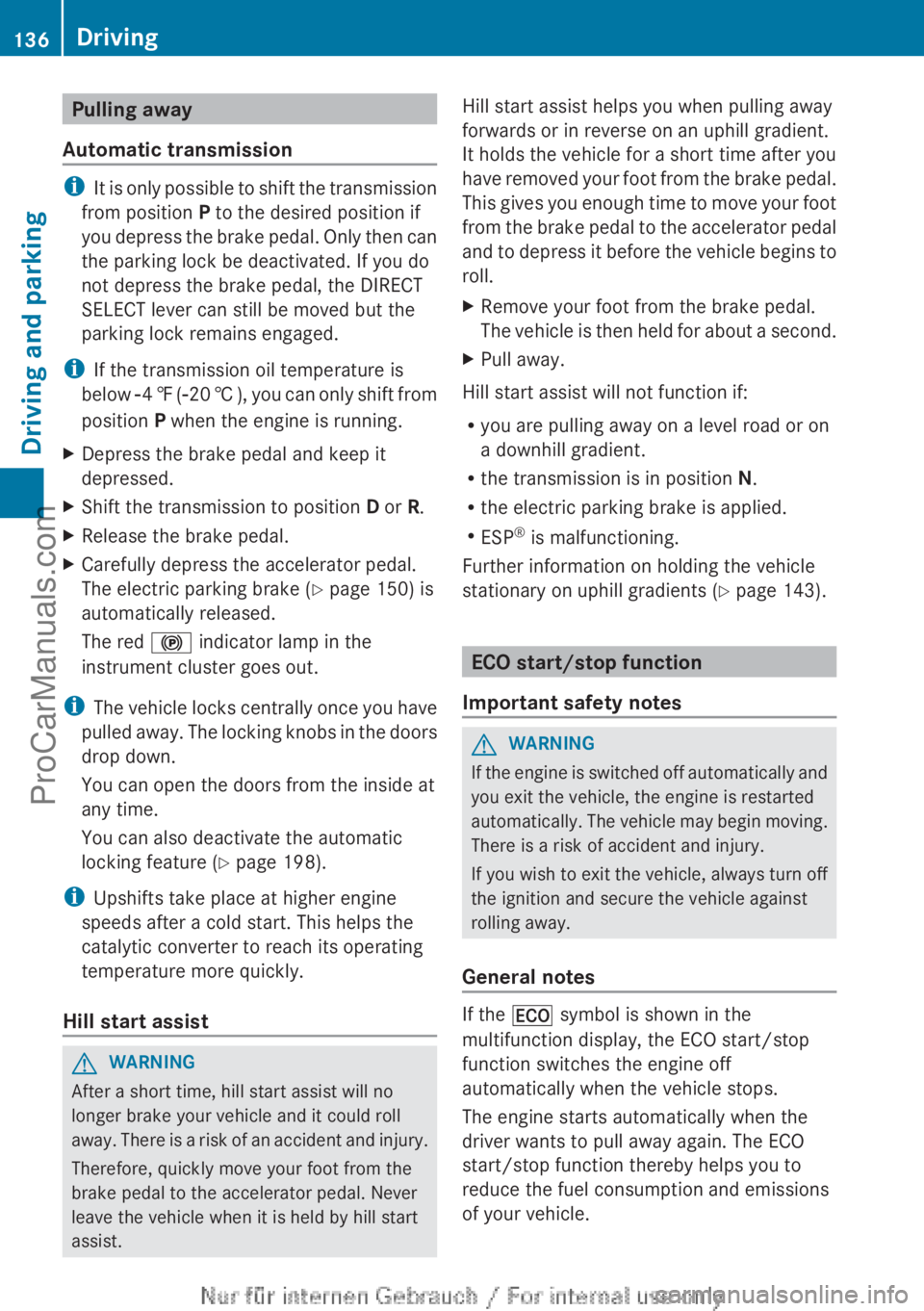
Pulling away
Automatic transmission i
It is only
possible to shift the transmission
from position P to the desired position if
you depress the brake pedal. Only then can
the parking lock be deactivated. If you do
not depress the brake pedal, the DIRECT
SELECT lever can still be moved but the
parking lock remains engaged.
i If the transmission oil temperature is
below Ò4 ‡ (Ò20 † ), you can only shift from
position P when the engine is running.
X Depress the brake pedal and keep it
depressed.
X Shift the transmission to position D or R.
X Release the brake pedal.
X Carefully depress the accelerator pedal.
The electric parking brake (Y page 150) is
automatically released.
The red ! indicator lamp in the
instrument cluster goes out.
i The vehicle locks
centrally once you have
pulled away. The locking knobs in the doors
drop down.
You can open the doors from the inside at
any time.
You can also deactivate the automatic
locking feature (Y page 198).
i Upshifts take place at higher engine
speeds after a cold start. This helps the
catalytic converter to reach its operating
temperature more quickly.
Hill start assist G
WARNING
After a short time, hill start assist will no
longer brake your vehicle and it could roll
away. There is
a risk of an accident and injury.
Therefore, quickly move your foot from the
brake pedal to the accelerator pedal. Never
leave the vehicle when it is held by hill start
assist. Hill start assist helps you when pulling away
forwards or in reverse on an uphill gradient.
It holds the vehicle for a short time after you
have removed
your
foot from the brake pedal.
This gives you enough time to move your foot
from the brake pedal to the accelerator pedal
and to depress it before the vehicle begins to
roll.
X Remove your foot from the brake pedal.
The vehicle is
then held for about a second.
X Pull away.
Hill start assist will not function if:
R you are pulling away on a level road or on
a downhill gradient.
R the transmission is in position N.
R the electric parking brake is applied.
R ESP ®
is malfunctioning.
Further information on holding the vehicle
stationary on uphill gradients ( Y page 143). ECO start/stop function
Important safety notes G
WARNING
If the engine is switched off automatically and
you exit the vehicle, the engine is restarted
automatically. The vehicle
may begin moving.
There is a risk of accident and injury.
If you wish to exit the vehicle, always turn off
the ignition and secure the vehicle against
rolling away.
General notes If the
¤ symbol is shown in the
multifunction display, the ECO start/stop
function switches the engine off
automatically when the vehicle stops.
The engine starts automatically when the
driver wants to pull away again. The ECO
start/stop function thereby helps you to
reduce the fuel consumption and emissions
of your vehicle. 136
Driving
Driving and parking
ProCarManuals.com
Page 141 of 340
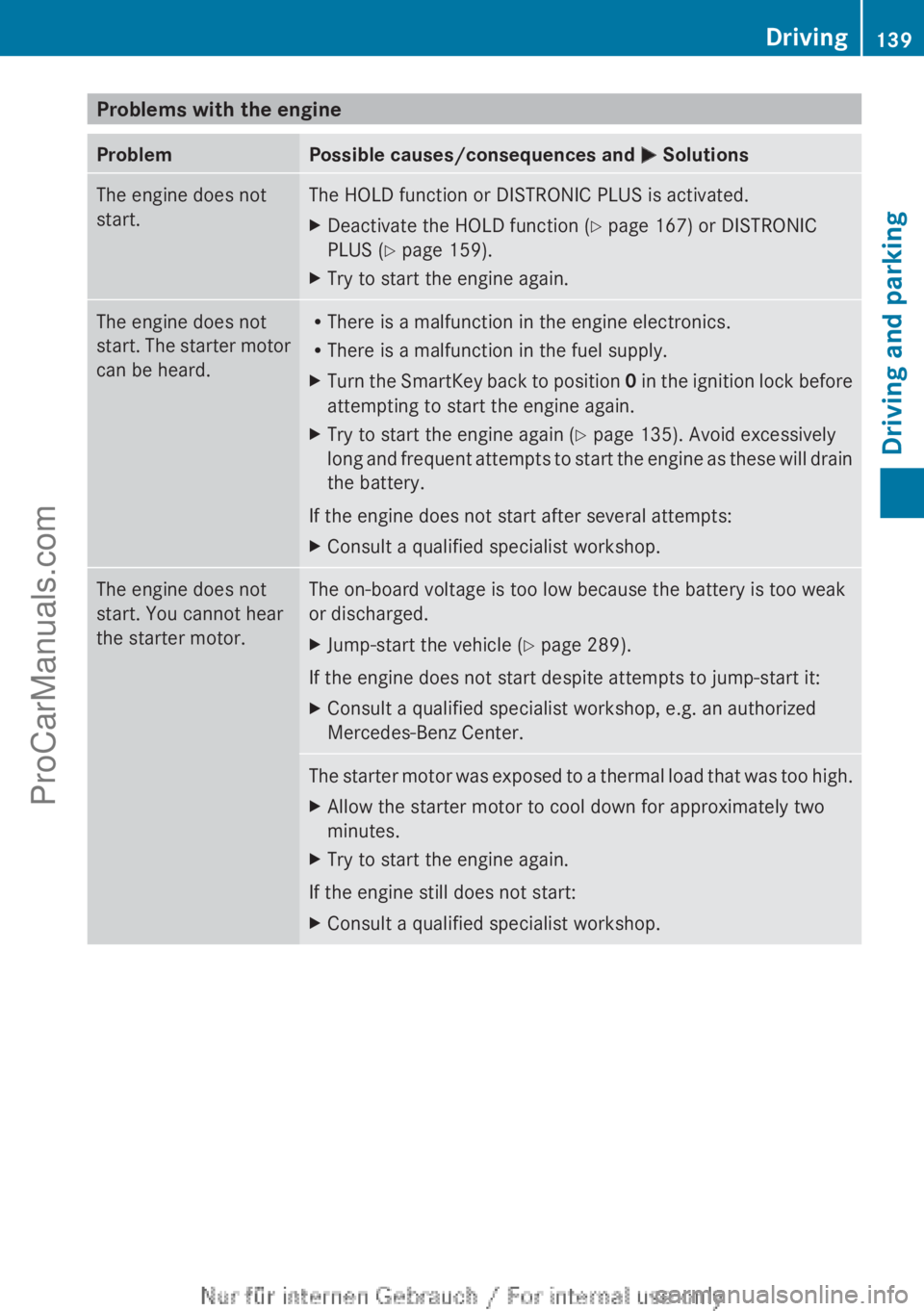
Problems with the engine
Problem Possible causes/consequences and
M SolutionsThe engine does not
start. The HOLD function or DISTRONIC PLUS is activated.
X
Deactivate the HOLD function (Y page 167) or DISTRONIC
PLUS (Y page 159).
X Try to start the engine again. The engine does not
start.
The starter
motor
can be heard. R
There is a malfunction in the engine electronics.
R There is a malfunction in the fuel supply.
X Turn the SmartKey back to position 0
in the
ignition lock before
attempting to start the engine again.
X Try to start the engine again (Y page 135). Avoid excessively
long and frequent
attempts to start the engine as these will drain
the battery.
If the engine does not start after several attempts:
X Consult a qualified specialist workshop. The engine does not
start. You cannot hear
the starter motor. The on-board voltage is too low because the battery is too weak
or discharged.
X
Jump-start the vehicle (Y page 289).
If the engine does not start despite attempts to jump-start it:
X Consult a qualified specialist workshop, e.g. an authorized
Mercedes-Benz Center. The starter motor was exposed to a thermal load that was too high.
X
Allow the starter motor to cool down for approximately two
minutes.
X Try to start the engine again.
If the engine still does not start:
X Consult a qualified specialist workshop. Driving
139Driving and parking Z
ProCarManuals.com
Page 144 of 340
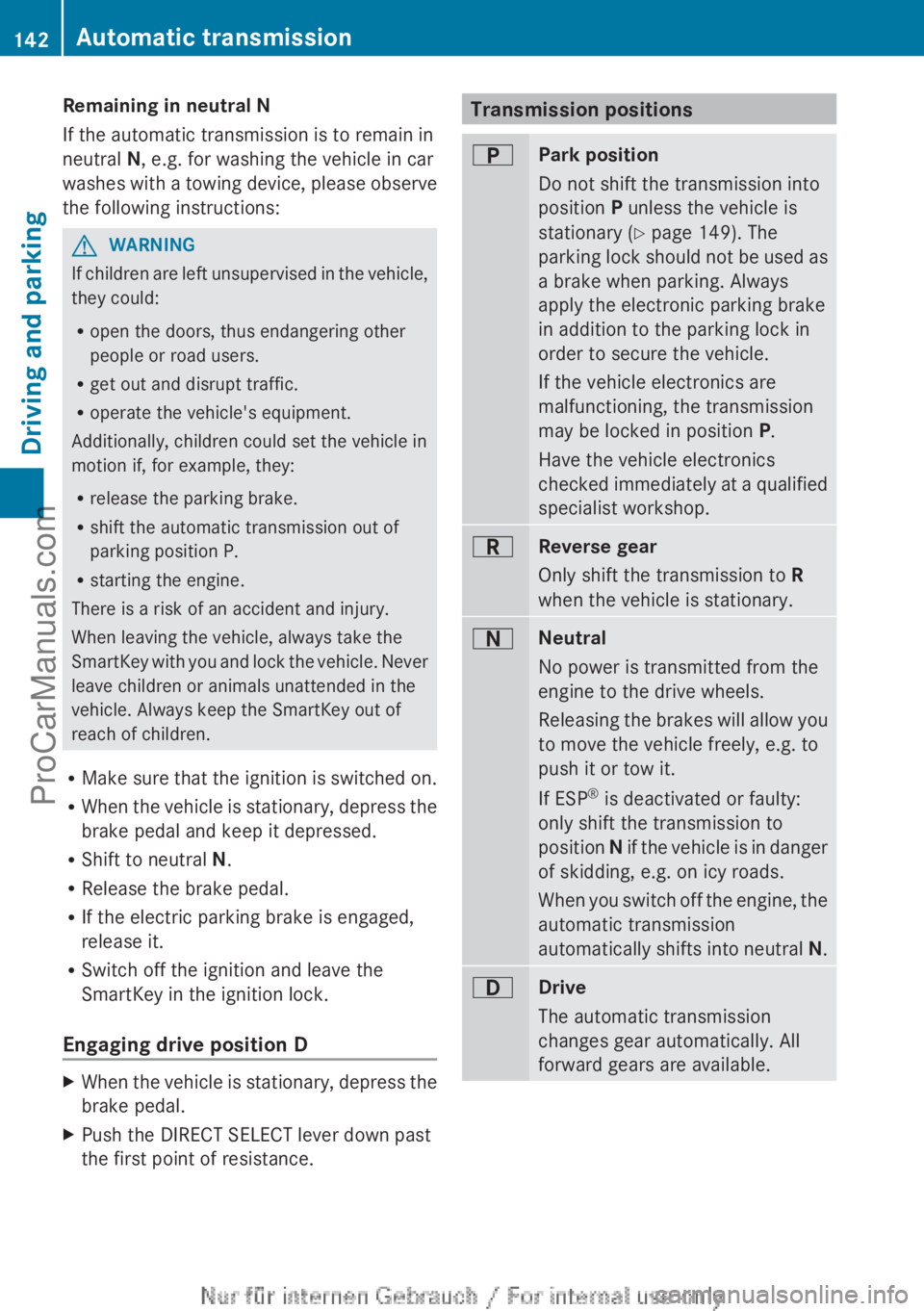
Remaining in neutral N
If the automatic transmission is to remain in
neutral N, e.g. for washing the vehicle in car
washes with
a
towing device, please observe
the following instructions: G
WARNING
If children are left unsupervised in the vehicle,
they could:
R open the doors, thus endangering other
people or road users.
R get out and disrupt traffic.
R operate the vehicle's equipment.
Additionally, children could set the vehicle in
motion if, for example, they:
R release the parking brake.
R shift the automatic transmission out of
parking position P.
R starting the engine.
There is a risk of an accident and injury.
When leaving the vehicle, always take the
SmartKey with you
and lock the vehicle. Never
leave children or animals unattended in the
vehicle. Always keep the SmartKey out of
reach of children.
R Make sure that the ignition is switched on.
R When the vehicle is stationary, depress the
brake pedal and keep it depressed.
R Shift to neutral N.
R Release the brake pedal.
R If the electric parking brake is engaged,
release it.
R Switch off the ignition and leave the
SmartKey in the ignition lock.
Engaging drive position D X
When the vehicle is stationary, depress the
brake pedal.
X Push the DIRECT SELECT lever down past
the first point of resistance. Transmission positions
B
Park position
Do not shift the transmission into
position P unless the vehicle is
stationary (
Y page 149). The
parking lock should
not be used as
a brake when parking. Always
apply the electronic parking brake
in addition to the parking lock in
order to secure the vehicle.
If the vehicle electronics are
malfunctioning, the transmission
may be locked in position P.
Have the vehicle electronics
checked immediately at a qualified
specialist workshop. C
Reverse gear
Only shift the transmission to
R
when the vehicle is stationary. A
Neutral
No power is transmitted from the
engine to the drive wheels.
Releasing the
brakes
will allow you
to move the vehicle freely, e.g. to
push it or tow it.
If ESP ®
is deactivated or faulty:
only shift the transmission to
position N if the vehicle is in danger
of skidding, e.g. on icy roads.
When you switch off the engine, the
automatic transmission
automatically shifts into neutral N. 7
Drive
The automatic transmission
changes gear automatically. All
forward gears are available.142
Automatic transmission
Driving and parking
ProCarManuals.com
Page 147 of 340
selected and engaged is shown in the
multifunction display.
Manual drive program
M differs from drive
programs E and S
with regard to spontaneity,
responsiveness and smoothness of gear
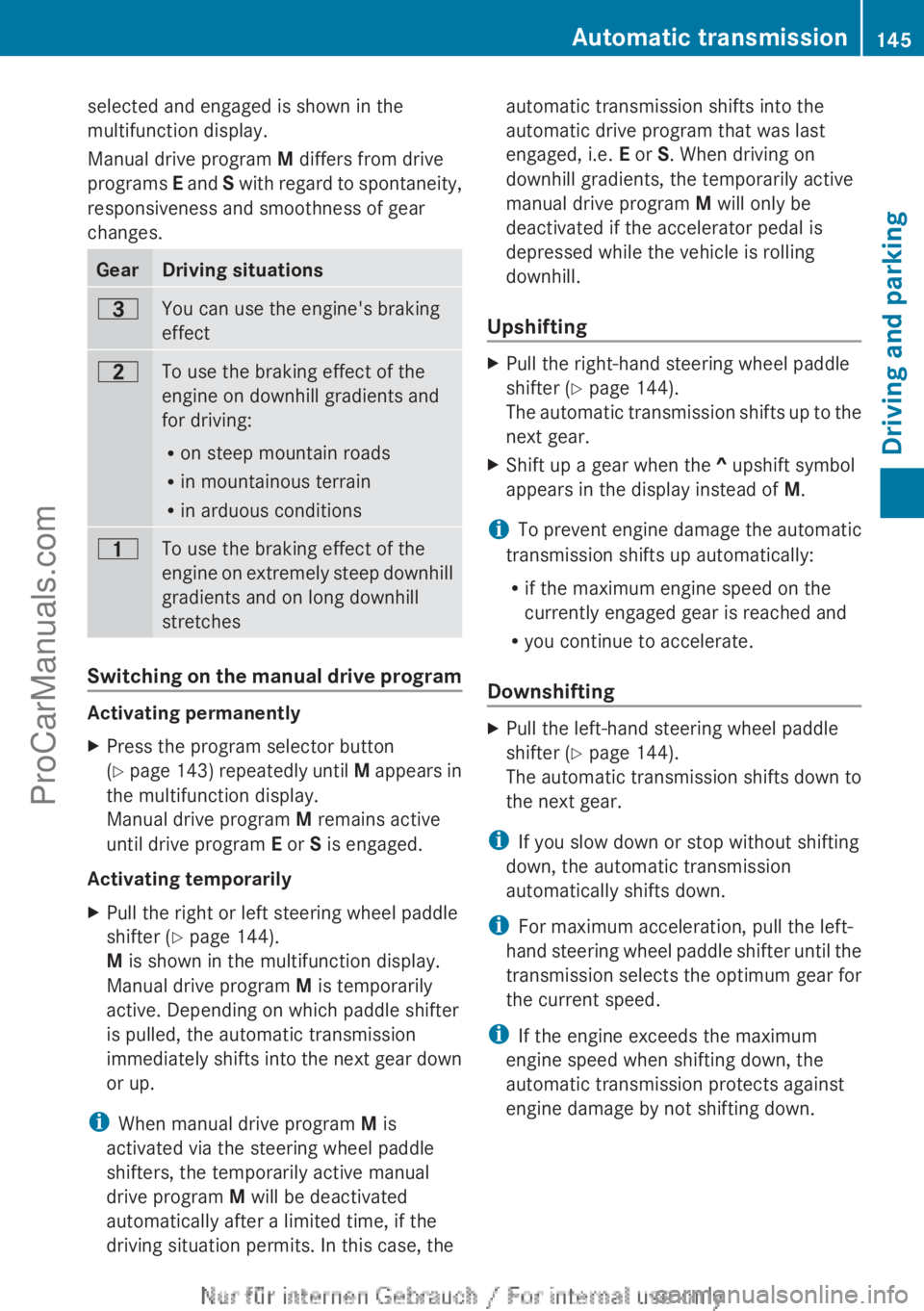
changes. Gear Driving situations
=
You can use the engine's braking
effect
5
To use the braking effect of the
engine on downhill gradients and
for driving:
R
on steep mountain roads
R in mountainous terrain
R in arduous conditions 4
To use the braking effect of the
engine on
extremely
steep downhill
gradients and on long downhill
stretches Switching on the manual drive program
Activating permanently
X
Press the program selector button
(Y page 143)
repeatedly until M appears in
the multifunction display.
Manual drive program M remains active
until drive program E or S is engaged.
Activating temporarily
X Pull the right or left steering wheel paddle
shifter (Y page 144).
M is shown in the multifunction display.
Manual drive program M is temporarily
active. Depending on which paddle shifter
is pulled, the automatic transmission
immediately shifts into
the next gear down
or up.
i When manual drive program M is
activated via the steering wheel paddle
shifters, the temporarily active manual
drive program M will be deactivated
automatically after a limited time, if the
driving situation permits. In this case, the automatic transmission shifts into the
automatic drive program that was last
engaged, i.e.
E or S. When driving on
downhill gradients, the temporarily active
manual drive program M will only be
deactivated if the accelerator pedal is
depressed while the vehicle is rolling
downhill.
Upshifting X
Pull the right-hand steering wheel paddle
shifter (Y page 144).
The automatic transmission
shifts up to the
next gear.
X Shift up a gear when the ^ upshift symbol
appears in the display instead of M.
i To prevent engine damage the automatic
transmission shifts up automatically:
R if the maximum engine speed on the
currently engaged gear is reached and
R you continue to accelerate.
Downshifting X
Pull the left-hand steering wheel paddle
shifter (Y page 144).
The automatic transmission
shifts down to
the next gear.
i If you slow down or stop without shifting
down, the automatic transmission
automatically shifts down.
i For maximum acceleration, pull the left-
hand steering wheel
paddle shifter until the
transmission selects the optimum gear for
the current speed.
i If the engine exceeds the maximum
engine speed when shifting down, the
automatic transmission protects against
engine damage by not shifting down. Automatic transmission
145
Driving and parking Z
ProCarManuals.com
Page 155 of 340
is a risk of fatal injury. Therefore never leave
the engine running in enclosed spaces
without sufficient ventilation.
Certain engine systems
are designed to keep
the level of poisonous components in exhaust
fumes within legal limits.
These systems only work at peak efficiency if
they are serviced exactly in accordance with
the manufacturer's specifications. For this
reason, only have work on the engine carried
out by qualified and authorized Mercedes-
Benz technicians.
The engine settings must not be changed
under any circumstances. Furthermore, all
specific service work must be carried out at
regular intervals and in accordance with the
Mercedes-Benz service requirements. Details
can be found in the Maintenance Booklet. ECO display
The ECO display
gives you information on how
economical your driving style is. The ECO
display assists you in achieving the optimum
driving style in terms of consumption, taking
the actual and selected conditions into
consideration. Your driving style can
significantly influence the vehicle's
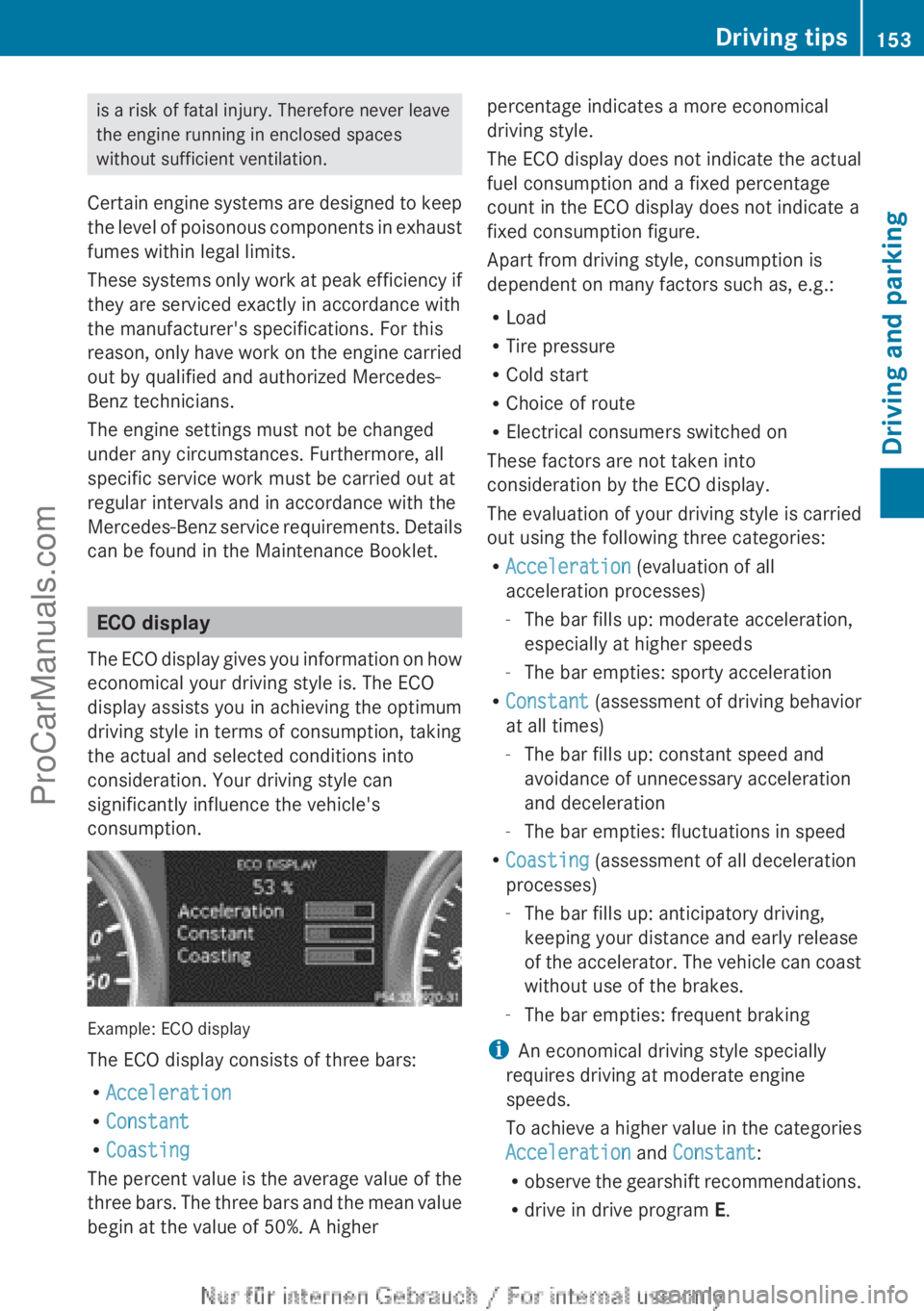
consumption. Example: ECO display
The ECO display consists of three bars:
R
Acceleration
R Constant
R Coasting
The percent value
is the average value of the
three bars. The three bars and the mean value
begin at the value of 50%. A higher percentage indicates a more economical
driving style.
The ECO display
does not indicate the actual
fuel consumption and a fixed percentage
count in the ECO display does not indicate a
fixed consumption figure.
Apart from driving style, consumption is
dependent on many factors such as, e.g.:
R Load
R Tire pressure
R Cold start
R Choice of route
R Electrical consumers switched on
These factors are not taken into
consideration by the ECO display.
The evaluation of your driving style is carried
out using the following three categories:
R Acceleration (evaluation of all
acceleration processes)
-The bar fills up: moderate acceleration,
especially at higher speeds
- The bar empties: sporty acceleration
R Constant (assessment of driving behavior
at all times)
-The bar fills up: constant speed and
avoidance of unnecessary acceleration
and deceleration
- The bar empties: fluctuations in speed
R Coasting (assessment of all deceleration
processes)
-The bar fills up: anticipatory driving,
keeping your distance and early release
of the accelerator. The vehicle can coast
without use of the brakes.
- The bar empties: frequent braking
i An economical driving style specially
requires driving at moderate engine
speeds.
To achieve a higher value in the categories
Acceleration and Constant:
R observe the gearshift recommendations.
R drive in drive program E. Driving tips
153
Driving and parking Z
ProCarManuals.com