warning MERCEDES-BENZ C-CLASS COUPE 2015 Owners Manual
[x] Cancel search | Manufacturer: MERCEDES-BENZ, Model Year: 2015, Model line: C-CLASS COUPE, Model: MERCEDES-BENZ C-CLASS COUPE 2015Pages: 385, PDF Size: 13.12 MB
Page 172 of 385
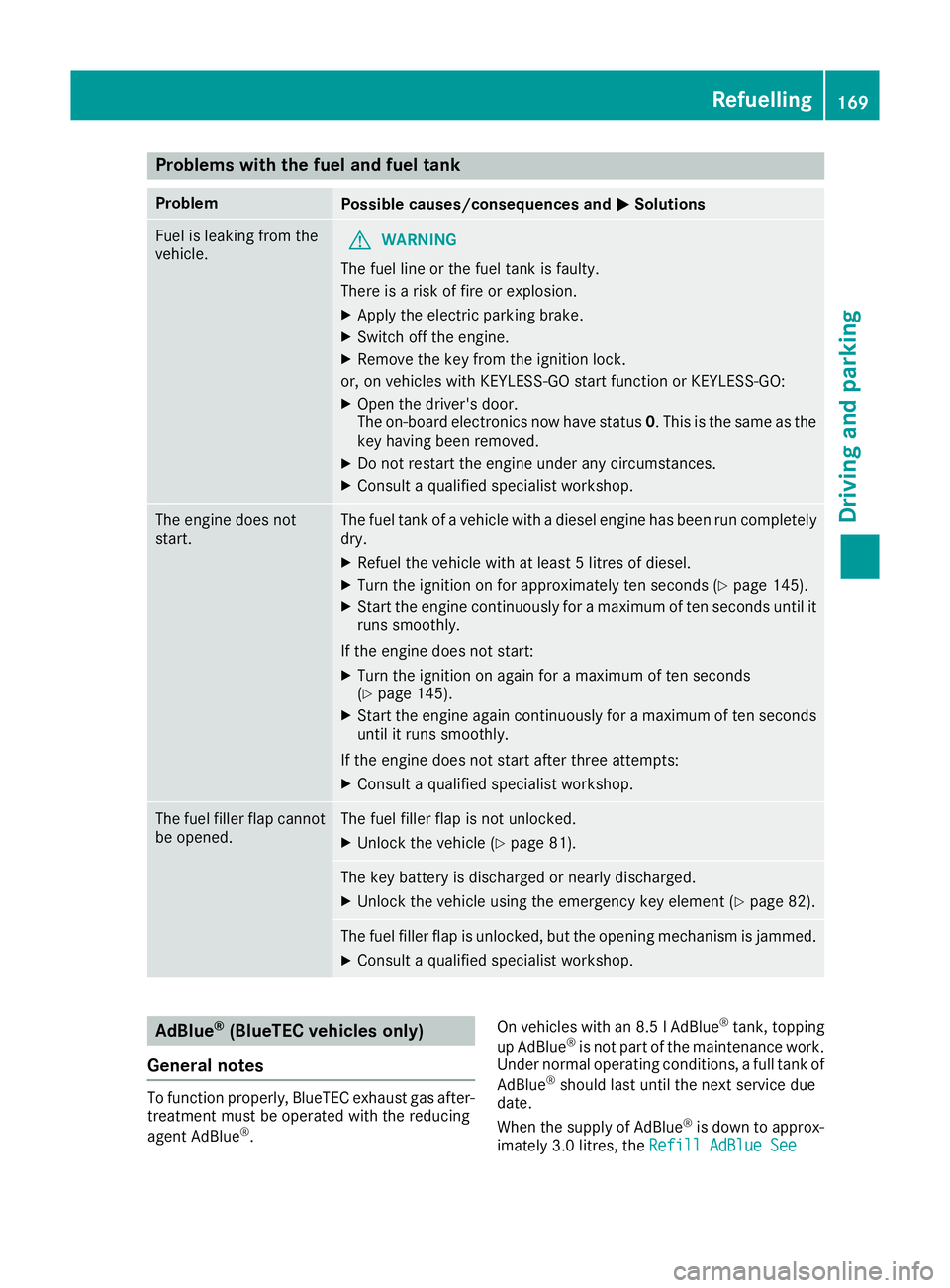
Problems with the fuel and fuel tank
Problem
Possible causes/consequences and
M
MSolutions Fuel is leaking from the
vehicle.
G
WARNING
The fuel line or the fuel tank is faulty.
There is arisk of fire or explosion.
X Apply the electric parking brake.
X Switch off the engine.
X Remove the key from the ignition lock.
or, on vehicles with KEYLESS-GO start function or KEYLESS ‑GO:
X Open the driver's door.
The on-board electronics now have status 0.This is the same as the
key having been removed.
X Do not restart the engine under any circumstances.
X Consult aqualified specialist workshop. The engine does not
start. The fuel tank of
avehicle with adiesel engine has been run completely
dry.
X Refuel the vehicle with at least 5litres of diesel.
X Turn the ignition on for approximately ten seconds (Y page 145).
X Start the engine continuously for amaximum of ten seconds until it
runs smoothly.
If the engine does not start: X Turn the ignition on again for amaximum of ten seconds
(Y page 145).
X Start the engine again continuously for amaximum of ten seconds
until it runs smoothly.
If the engine does not start after three attempts:
X Consult aqualified specialist workshop. The fuel filler flap cannot
be opened. The fuel filler flap is not unlocked.
X Unlock the vehicle (Y page 81). The key battery is discharged or nearly discharged.
X Unlock the vehicle using the emergency key element (Y page 82).The fuel filler flap is unlocked, but the opening mechanism is jammed.
X Consult aqualified specialist workshop. AdBlue
®
(BlueTEC vehicleso nly)
General notes To function properly, BlueTEC exhaust gas after-
treatmen tmust be operated with the reducing
agent AdBlue ®
. On vehicles with an 8.5
lAdBlue ®
tank ,topping
up AdBlue ®
is not part of the maintenanc ework.
Under normal operatin gconditions, afull tank of
AdBlue ®
should last until the nex tservic edue
date.
When the supply of AdBlue ®
is down to approx-
imately 3.0 litres, the Refill AdBlue See Refill AdBlue See Refuelling
169Driving and parking Z
Page 175 of 385
X
Turn disposable hose :on the opening of
AdBlue ®
refill canister ;anti-clockwise and
remove it.
X Reseal AdBlue ®
refill canister ;with the cap.
AdBlue ®
refill canisters are availabl eatmany
filling station sorataMercedes-Benz Service
Centre. AdBlue ®
refill canisters are often sold
with afiller hose. Afiller hose that does not
exactly fit the vehicle's AdBlue ®
tank offers no
protection against overfilling. AdBlue ®
may leak
out as aresult of overfilling. Mercedes-Benz
offers aspecial disposable hose with overfill
protection. You can obtain this from any
Mercedes-Benz Servic eCentre. AdBlue ®
is
availabl einavariety of containers and recepta-
cles. Only use the disposable hose with the
Mercedes-Benz AdBlue ®
refill canisters.
AdBlue ®
refill bottle !
Only screw on the AdBlue ®
refill bottle so
that it is hand-tight. Otherwise, the thread of
the AdBlue ®
refill bottle could be damaged
and AdBlue ®
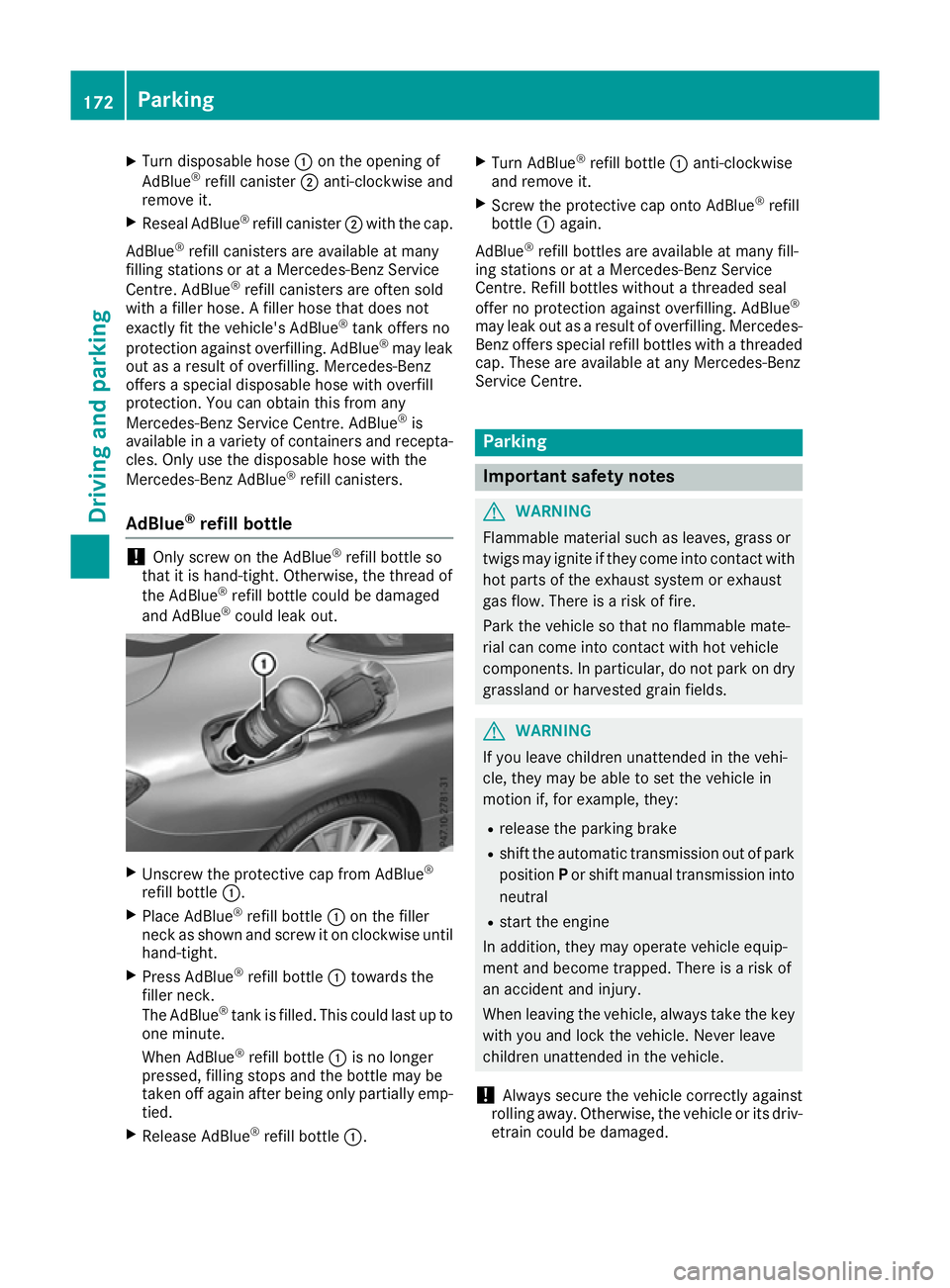
could leak out. X
Unscrew the protective cap from AdBlue ®
refill bottle :.
X Place AdBlue ®
refill bottle :on the filler
neck as shown and screw it on clockwise until hand-tight.
X Press AdBlue ®
refill bottle :towards the
filler neck.
The AdBlue ®
tank is filled. This could last up to
one minute.
When AdBlue ®
refill bottle :is no longer
pressed, filling stops and the bottle may be
taken off again after being only partially emp- tied.
X Release AdBlue ®
refill bottle :. X
Turn AdBlue ®
refill bottle :anti-clockwise
and remove it.
X Screw the protective cap ontoA dBlue®
refill
bottle :again.
AdBlue ®
refill bottles are available at many fill-
ing station sorataM ercedes-Benz Service
Centre. Refill bottles without athreaded seal
offer no protection against overfilling. AdBlue ®
may leak out as aresult of overfilling. Mercedes-
Benz offers special refill bottles with athreaded
cap. These are availabl eatany Mercedes-Benz
Servic eCentre. Parking
Important safety notes
G
WARNING
Flammable material such as leaves, grass or
twigs may ignite if they come into contact with hot parts of the exhaust system or exhaust
gas flow. There is arisk of fire.
Park the vehicle so that no flammable mate-
rial can come into contact with hot vehicle
components.Inp articular, do not park on dry
grassland or harvested grain fields. G
WARNING
If you leave children unattended in the vehi-
cle, they may be able to set the vehicle in
motion if, for example, they:
R release the parking brake
R shift the automatic transmission out of park
position Por shift manual transmission into
neutral
R start the engine
In addition, they may operate vehicle equip-
ment and become trapped. There is arisk of
an accident and injury.
When leaving the vehicle, alway stake the key
with you and lock the vehicle. Never leave
children unattended in the vehicle.
! Always secure the vehicle correctly against
rolling away.O therwise, the vehicle or its driv-
etrain could be damaged. 172
ParkingDriving and parking
Page 176 of 385
To ensure that the vehicle is safeguarded
against rolling away unintentionally:
R the electric parking brake must be applied
R on vehicles with manual transmission, engage
1st gear or reverse gear
R on vehicles with automatic transmission, the
transmission must be in position Pand the
key must be removed from the ignition lock
R the front wheels must be turned towards the
kerb on steep uphill or downhill gradients
R the empty vehicle must be secured at the
front axle with awheel chock or similar
object ,for example, on uphill or downhill gra-
dients
R al aden vehicle must also be secured at the
rear axle with awheel chock or similar object,
for example, on uphill or downhill gradients Switching off the engine
Important safety notes G
WARNING
The automatic transmission switches to neu-
tral position Nwhen you switch off the engine.
The vehicle may roll away.T here isarisk of an
accident.
After switching off the engine, alway sswitch
to parking position P.Prevent the parked vehi-
cle from rolling away by applying the parking
brake.
Vehicles with manual transmission X
Shift to either 1st gear or reverse gear R.
X Turn the key to position 0in the ignition lock
and remove it.
The immobiliser is activated.
X Apply the electric parking brake.
Vehicles with automatic transmission X
Apply the electric parking brake.
X Shift the transmission to position P.X
With the key: turn the key to position 0in the
ignition lock and remove it.
The immobiliser is activated.
X With the Start/Stop button: press the
Start/Stop button (Y page 145).
The engine stops and all the indicator lamps in the instrument cluster go out.
When the driver's door is closed, this corre-
sponds to key position 1.When the driver's
door is open, this corresponds to key position
0:" key removed".
If you switch the engine off with the transmis-
sion in position Ror D,t he automatic transmis-
sion shifts to Nautomatically.
With the key: if you then open the driver's door
or the front-passenger door or remove the key
from the ignition, the automatic transmission
shifts to Pautomatically.
With the Start/Stop button: if you then open
the driver's door or the front-passenger door,
the automatic transmission shifts to Pautomat-
ically.
If you want the automatic transmission to
remain in neutral N,e.g. when having the vehicle
cleaned in an automatic car wash with atowing
system:
X Vehicles with the Start-Stop button:
remove the Start-Stop button from the igni-
tion lock.
X Insert the key into the ignition lock.
X All vehicles: switch the ignition on.
X Depress the brake pedal and keep it
depressed.
X Shift to neutral N.
X Release the brake pedal.
X Release the electric parking brake.
X Switch off the ignition and leave the key in the
ignition lock.
The engine can be switched off while the vehicle is in motion by pressing and holding the Start/
Stop button for about three seconds. This func- tion operates independently of the ECO start/
stop automatic engine switch-off function. Parking
173Driving and parking Z
Page 177 of 385
Electric parking brake
General notes G
WARNING
If you leave childre nunattende dinthevehi-
cle ,the ym ay be able to set th evehicle in
motion if, for example, they:
R release th eparking brake
R shif tthe automatic transmission out of park
position Por shif tmanual transmission into
neutral
R start th eengine
In addition ,the ym ay operate vehicle equip-
men tand become trapped. Ther eisarisk of
an acciden tand injury.
When leavin gthe vehicle ,always tak ethe key
with you and loc kthe vehicle .Never leave
childre nunattende dinthevehicle.
The function of th eelectric parking brak eis
dependen tontheon-board voltage. If th eon-
boar dvoltage is low or if there is amalfunction
in th esystem, it may no tbepossible to apply the
released parking brake.
X If this is th ecase, only park th evehicle on
leve lground and secure it to prevent it from
rolling away.
X Vehicles with automatic transmission:
shif tthe automatic transmission to position
P .
X Vehicles with manua
ltra nsmission:
engage first gear.
It may no tbepossible to release an applied
parking brak eiftheon-board voltage is low or if
there is amalfunctio ninthesystem. Contac ta
qualified specialist workshop.
The electric parking brak ecarries out afunction
check at regular intervals when th eengine is
switched off .Noises that occur are normal. Applying or releasin
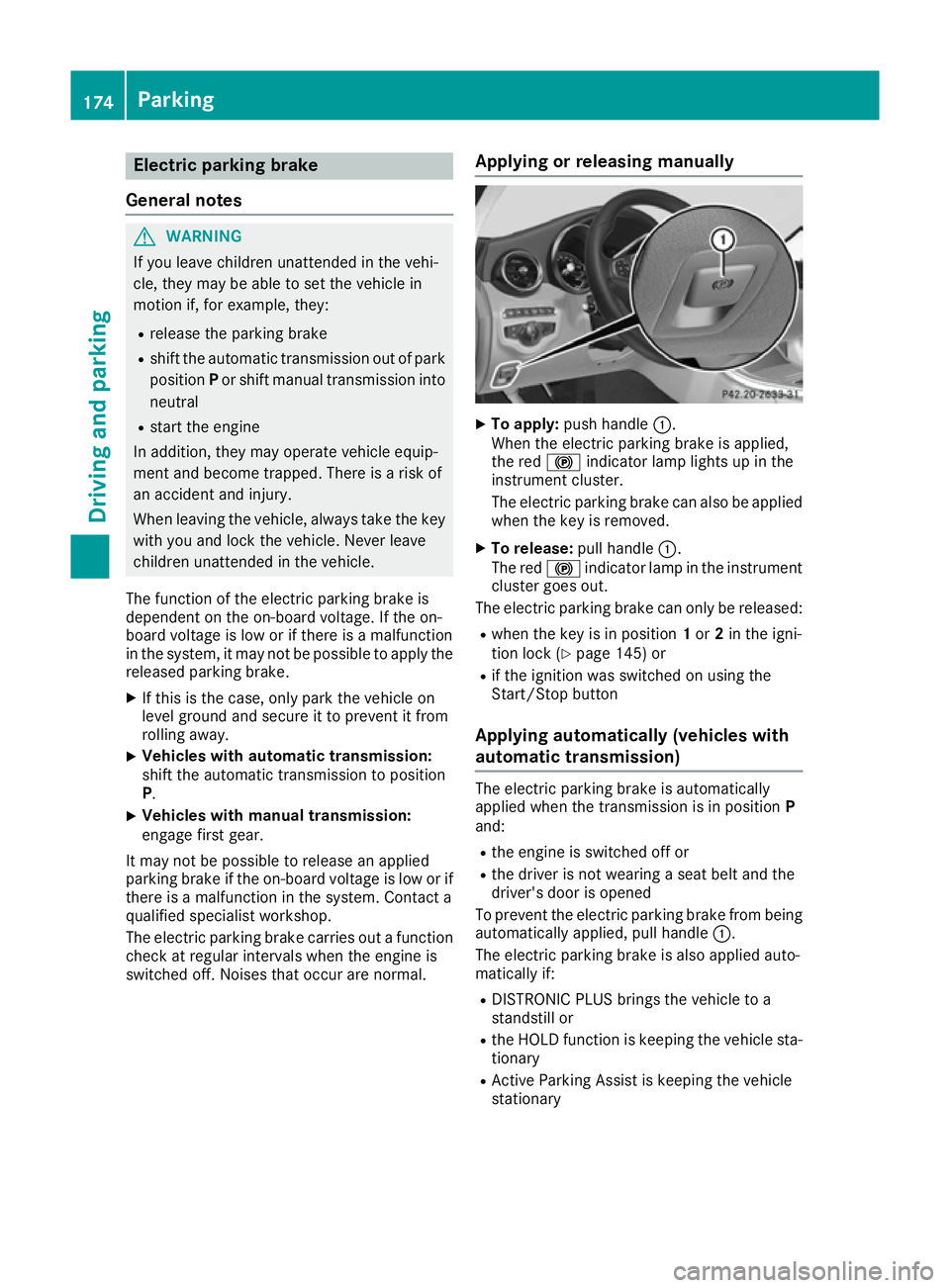
gmanually X
To apply: push handle :.
When th eelectric parking brak eisapplied,
th er ed ! indicator lamp light supinthe
instrumen tcluster.
The electric parking brak ecan also be applied
when th ekeyis removed.
X To release: pull handle:.
The red !indicator lamp in th einstrument
cluste rgoes out.
The electric parking brak ecan only be released:
R when th ekeyis in position 1or 2in th eigni-
tio nlock( Ypage 145) or
R if th eignition was switched on usin gthe
Start/Sto pbutton
Applying automatically (vehicles with
automatic transmission) The electric parking brak
eisautomatically
applied when th etransmission is in position P
and:
R thee ngine is switched off or
R thed river is no twearin gaseat belt and the
driver' sdoor is opened
To prevent th eelectric parking brak efromb eing
automaticall yapplied ,pull handle :.
The electric parking brak eisalso applied auto-
maticall yif:
R DISTRONIC PLU Sbrings th evehicle to a
standstil lor
R theH OLDf unction is keepin gthe vehicle sta-
tionary
R Activ eParking Assist is keepin gthe vehicle
stationary 174
ParkingDriving and parking
Page 179 of 385
Parking up the vehicle
If you leave the vehicle parked up for longer than
four weeks, the battery may be damaged by
exhaustive discharging.
If you leave the vehicle parked up for longer than six weeks, it may suffer from lack of use.
X Contact aqualified specialist workshop and
seek advice.
i You can obtain information about trickle
chargers from aqualified specialist work-
shop. Driving tips
General driving tips
Important safety notes G
WARNING
If you switch off the ignition while driving,
safety-relevant functions are only available
with limitations, or not at all. This could affect, for example, the power steering and the brake
boosting effect.Y ou will require considerably
more effort to steer and brake. There is arisk
of an accident.
Do not switch off the ignition while driving.
Drive sensibly–s ave fuelObserve the following tips to save fuel:
X The tyres should always be inflated to the rec-
ommended tyre pressure.
X Remove unnecessary loads.
X Remove roof racks when they are not needed.
X Warm up the engine at low engine speeds.
X Avoid frequent acceleration or braking.
X Have all maintenance work carried out as
indicated by the service intervals in the Ser-
vice Booklet or by the service interval display.
Fuel consumption also increases when driving in
cold weather, in stop-start traffic, on short jour- neys and in hilly terrain. ECO display
The ECO display shows you how economical
your driving style is. The ECO display assists you
in achieving the most economical driving style
for the selected settings and prevailing condi-
tions. Consumption can be significantly influ-
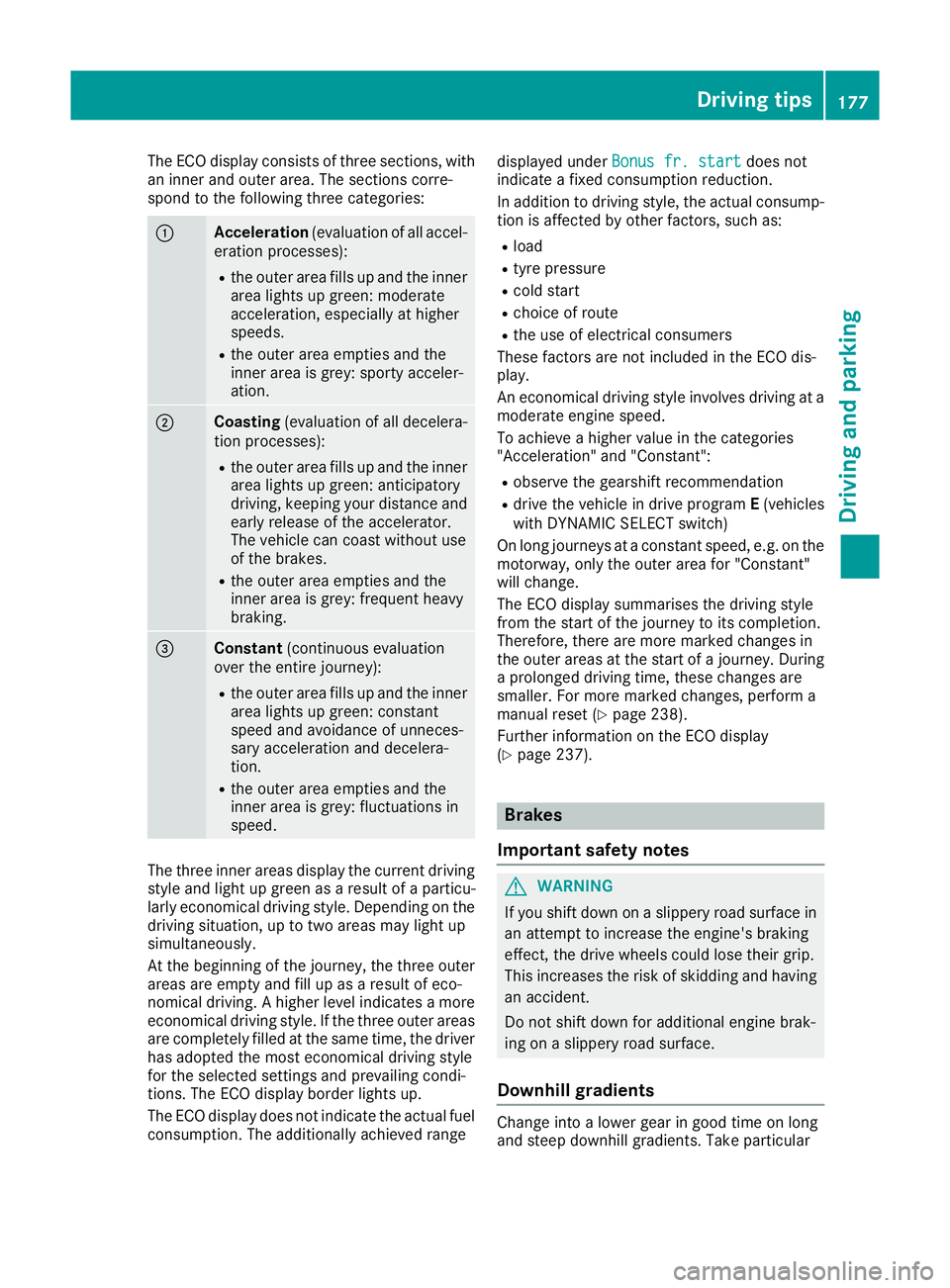
enced by your driving style. :
Acceleration
; Coasting
= Constant
? Additional range achieved
Range ?is shown under Bonus Bonusfr. fr.start
start and
represents the additional range achieved since
the beginning of the journey as aresult of an
adapted driving style.
If the fuel level has dropped into the reserve
range, the Reserve fuel Reserve fuel display message is
shown instead of range ?in the multifunction
display.Ina ddition, the 8warning lamp in
the instrumen tcluster lights up (Y page 290).176
Driving tipsDriving and parking
Page 180 of 385
The ECO display consist
softhree sections, with
an inner and outer area. The section scorre-
spond to the following three categories: :
Acceleration
(evaluation of all accel-
eration processes):
R the outer area fills up and the inner
area lights up green: moderate
acceleration ,especially at higher
speeds.
R the outer area empties and the
inner area is grey: sporty acceler-
ation. ;
Coasting
(evaluation of all decelera-
tion processes):
R the outer area fills up and the inner
area lights up green: anticipatory
driving, keeping your distance and
early release of the accelerator.
The vehicle can coast without use
of the brakes.
R the outer area empties and the
inner area is grey: frequent heavy
braking. =
Constant
(continuous evaluation
over the entir ejourney):
R the outer area fills up and the inner
area lights up green: constant
speed and avoidance of unneces-
sary acceleration and decelera-
tion.
R the outer area empties and the
inner area is grey: fluctuations in
speed. The three inner areas display the current driving
style and light up green as aresult of aparticu-
larly economical driving style. Dependin gonthe
driving situation, up to two areas may light up
simultaneously.
At the beginning of the journey, the three outer
areas are empty and fill up as aresult of eco-
nomical driving. Ahigher level indicates amore
economical driving style. If the three outer areas
are completely filled at the same time, the driver
has adopted the most economical driving style
for the selected settings and prevailing condi-
tions. The ECO display border lights up.
The ECO display does not indicate the actual fuel consumption. The additionally achieved range displayed under
Bonus fr. start Bonus fr. start does not
indicate afixed consumption reduction.
In addition to driving style, the actual consump- tion is affected by other factors, such as:
R load
R tyre pressure
R cold start
R choice of route
R the use of electrical consumers
These factor sare not included in the ECO dis-
play.
An economical driving style involves driving at a
moderate engine speed.
To achieve ahigher value in the categories
"Acceleration" and "Constant":
R observe the gearshift recommendation
R drive the vehicle in drive program E(vehicles
with DYNAMIC SELECT switch)
On long journeys at aconstant speed, e.g. on the
motorway, only the outer area for "Constant"
will change.
The ECO display summarises the driving style
from the start of the journey to its completion.
Therefore, there are more marked changes in
the outer areas at the start of ajourney. During
ap rolonged driving time, these changes are
smaller. For more marked changes, perform a
manual reset (Y page 238).
Further information on the ECO display
(Y page 237). Brakes
Important safety notes G
WARNING
If you shift down on aslippery road surface in
an attempt to increase the engine's braking
effect ,the drive wheels could lose their grip.
This increases the risk of skidding and having
an accident.
Do not shift down for additional engine brak-
ing on aslippery road surface.
Downhill gradients Change into
alower gear in good time on long
and steep downhill gradients. Take particular Driving tips
177Driving and parking Z
Page 181 of 385
note of thi
swhend riving aladen vehicl eand
when towing atrailer.
Thi salsoa pplies if cruis econtrol, DISTRONIC
PLU SorS PEEDTRONIC is activated.
Thi sw illu se the braking effect of the engine, so
less braking will be required to maintain vehicle
speed .Thisr elieves the load on the brake sys-
tem and prevents the brakes from overheating
and wearing too quickly.
Heavy and light loads G
WARNING
The braking system can overheat if yo ulea ve
your foo tonthe brake peda lwhile driving.
Thi sincreases the braking distance and could
eve ncause the braking system to fail. There is
ar iskofana ccident.
Never us ethe brake peda lasafootrest. Do
not simultaneousl ydepress both the brake
peda land the accelerato rpedal whiledriving.
! Depressing the brake peda
lconstantly
results in excessive and premature wear to
the brake pads.
If heavy demands are made on the brakes, do
not park the vehicl eimmediately. Driv eonfor a
short while. Thi sallow sthe airflow to cool the
brakes more quickly.
If the brakes have been used onl ymoderately,
yo us houl doccasionall ytest thei reffectiveness.
To do this, brake more firmly from ahigher
speed whil epayin gattentio ntothe traffic con-
ditions. Thi simprove sthe gri pofthe brakes.
Wet road surfaces If yo
uhaved riven for alon gt ime in heavy rain
withou tbraking ,ther em aybe adelayed reac-
tio nfrom the brakes when braking for the first
time .Thism ayalso occu rafte rac ar wash or
afte rdriving throug hdeepw ater.
Yo uw illh avetod epress the brake peda lmore
firmly .Maintain agreate rdistance to the vehicle
in front.
After driving on awetroa dorh aving the vehicle
washed, brake firmly whil epayin gattentio nto
the traffic conditions. Thi swillw armupt he
brake discs, thereb ydrying them more quickly
and protecting them against corrosion. Limite
dbraking performanc eonsalt-
treate droads If yo
udrive on salt-treate droads, alayer of salt
ma yform on the brake discs and pads. Thi scan
increas ethe braking distance considerably.
R In order to prevent any salt build-up, appl ythe
brakes occasionall ywhile paying attentio nto
the traffic conditions.
R Carefull ydepress the brake peda latthe end
of the journey and when starting the next
journey.
R Maintain amuchg reate rdistance to the vehi-
cle in front.
New brake discs and brake pads/
linings Brake pads/lining
sand discs tha tare either new
or have been replaced achieve optimu mbraking
effect onl yaftersevera lhun dre dkilometres of
driving .Com pensate for the reduce dbraking
effect by applying greate rforce to the brake
pedal.
For safety reasons ,Mercedes-Benz recom-
mend sonlyf itting the following brake discs and
brake pads/linings:
R brake discs tha thaveb eena pproved by
Mercedes-Benz
R brake pads/lining sthath aveb eena pproved
by Mercedes-Benz or tha tare of an equivalent
standard of quality
Othe rbrake discs or brake pads/lining scan
compromise the safety of your vehicle.
Alway sreplace al lbrake discs and brake pads/
lining sonana xleatt he same time .Alway sfit
new brake pads/lining swhenr eplacing brake
discs.
The vehicl eisequippe dwithl ightweight brake
discs to which the whee lassembl ywithr im and
threaded connectio nism atched.
The us eofbrake discs othe rtha nt hose
approved by Mercedes-Benz ma yalter track
width and is subject to approval ,ifapplicable.
Shock-typ eloads when handling the brake
discs, such as when changing wheels ,can lead
to areduction in comfort when driving with light-
weight brake discs. Avoi dshock-typ eloads on
the lightweight brake discs, particularly on the
brake plate. 178
Driving tipsDriving an
dparking
Page 182 of 385
High-performance and ceramic brakes
(Mercedes-AMG vehicles) The AMG brake systems are designed for heavy
loads. This may lea dtonoise when braking. This
is dependent on:
R speed
R braking force
R environmental conditions, such as tempera-
ture and humidity
The wea rofindividua lbrake system compo-
nents such as the brake pads/linings or brake
discs depends on individuald riving style and
operating conditions.
For this reason, it is impossible to state amile-
age (service life )that wil lbevalidu nder all cir-
cumstances. An aggressive driving style will
lea dtoh igh wear. You can obtai nmore infor-
mation on this from aqualified specialist work-
shop.
Brake pads/linings and discs that are either new or have been replaced only achieve optimum
braking effect after severa lhundre dkilometres
of driving. Compensate for the reduced braking
effect by applying greater force to the brake
pedal. Always be aware of this and adapt your
driving and braking accordingly during the run-
ning-in period.
Excessive heavy braking results in correspond-
ingly high brake wear. Observe the brake wear
warning lamp in the instrument cluste rand note
any brake status messages in the multifunction
display .Ifyou regularl ydrive at high speeds, it is
particularly important to have the brake system
checked and maintained regularly. Driving on wetr
oads
Aquaplaning If wate
rhas accumulated to acertain depth on
the road surface, there is adange rofa quaplan-
ing occurring, even if:
R you are driving at low speeds
R the tyres have adequate tread depth
For this reason, drive in the following manner in
the event of heavy rain or in conditions in which aquaplaning can occur:
R lower you rspeed
R avoi dtyre ruts R
avoi dsudden steering movements
R brake carefully
Driving on flooded roads !
Bear in mind that vehicles travelling in front
or in the opposite direction create waves. This may caus ethe maximu mpermissible water
depth to be exceeded.
These notes must be observed under all cir-
cumstances. You coul dotherwise damage
the engine, the electronics or the transmis-
sion.
If you must drive on stretches of road on which
wate rhas collected, please bea rinmind that:
R in the case of standing water, the wate rlevel
must be no higher than the lower edge of the vehicl ebody
R you should drive no faster than walking pace Winter driving
G
WARNING
If you shift downonas lippery road surface in
an attempt to increas ethe engine's braking
effect, the drive wheels coul dlose their grip.
This increases the risk of skidding and having
an accident.
Do not shift dow nfor additiona lengine brak-
ing on aslippery road surface. G
DANGER
If the exhaust pipeisb locked or adequate
ventilation is not possible,p oisonous gases
such as carbon monoxide (CO )may enter the
vehicle. This is the case, e.g. if the vehicle
become strappe dinsnow. There is arisk of
fatal injury.
If you leave the engine or the auxiliary heating
running, make sure the exhaust pipea nd area
around the vehicl eare clea rofsnow. To
ensure an adequate supply of fresh air, open a windo wont he side of the vehicl ethat is not
facing into the wind.
Have you rvehicl ewinterproofed at aqualified
specialist worksho patthe onset of winter. Driving tips
179Driving and parking Z
Page 184 of 385
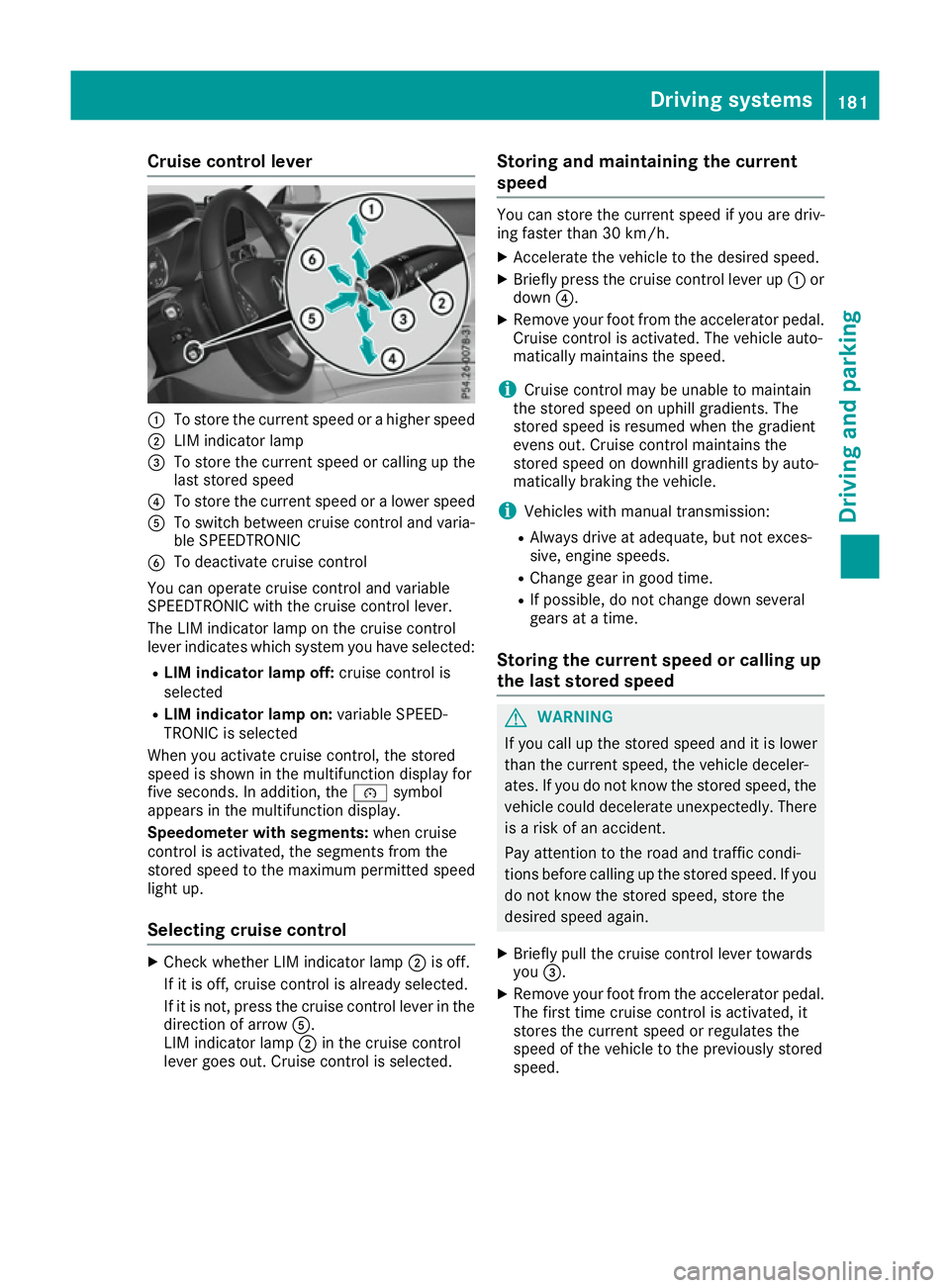
Cruise control lever
:
To store th ecurren tspee dorah igher speed
; LIM indicator lamp
= To store th ecurren tspee dorc alling up the
last store dspeed
? To store th ecurren tspee doral ower speed
A To switch between cruise control and varia-
ble SPEEDTRONIC
B To deactivate cruise control
You can operate cruise control and variable
SPEEDTRONIC wit hthe cruise control lever.
The LIM indicator lamp on th ecruise control
leve rindicates whic hsystem you have selected:
R LIM indicator lam poff:cruise control is
selected
R LIM indicator lam pon:variable SPEED-
TRONIC is selected
When you activat ecruise control, th estored
spee diss hown in th emultifunction display for
fiv es econds. In addition ,the é symbol
appear sinthemultifunction display.
Speedometer with segments: when cruise
control is activated, th esegments from the
store dspee dtot hemaximum permitted speed
light up.
Selecting cruise control X
Chec kwhether LIM indicator lamp ;is off.
If it is off ,cruise control is alread yselected.
If it is not, pres sthe cruise control leve rinthe
direction of arrow A.
LIM indicator lamp ;in th ecruise control
leve rgoes out .Cruis econtrol is selected. Storing and maintaining th
ecurrent
speed You can store th
ecurren tspee dify ou are driv-
ing faster than 30 km/h.
X Accelerat ethe vehicle to th edesired speed.
X Briefl ypres sthe cruise control leve rup:or
down ?.
X Remove your foo tfro mt heaccelerato rpedal.
Cruis econtrol is activated. The vehicle auto-
maticall ymaintain sthe speed.
i Cruis
econtrol may be unable to maintain
th es toreds pee donu phill gradients .The
store dspee disr esumed when th egradient
evens out .Cruis econtrol maintain sthe
store dspee dond ownhill gradients by auto-
maticall ybraking th evehicle.
i Vehicle swithm anual transmission:
R Always driv eatadequate, but no texces-
sive, engin espeeds.
R Change gear in good time.
R If possible, do no tchang ed own several
gear satat ime.
Storing th ecurren tspeed or callin gup
th el ast stored speed G
WARNING
If you call up th estoreds pee dand it is lower
than th ecurren tspeed, th evehicle deceler-
ates. If you do no tkno wt he store dspeed, the
vehicle coul ddecelerate unexpectedly. There
is ar iskofana ccident.
Pay attentio ntotheroad and traffic condi-
tions before calling up th estoreds peed. If you
do no tknowt he store dspeed, store the
desired spee dagain.
X Briefl ypull th ecruise control leve rtow ards
you =.
X Remove your foo tfro mt heaccelerato rpedal.
The first tim ecruise control is activated, it
store sthe curren tspee dorr egulate sthe
spee doft hevehicle to th epreviously stored
speed. Driving systems
181Driving and parking Z
Page 185 of 385
Setting
aspeed Bear in mind that it may take
abrief moment
until the vehicle has accelerated or braked to
the set speed.
X Press the cruise control lever up :for a
higher speed or down ?for alower speed.
X Keep the cruise control lever pressed until the
desired speed is reached.
X Release the cruise control lever.
The new speed is stored.
X To adjust the set speed in
1km/h incre-
ments: briefly press the cruise control lever
up : or down ?to the pressure point.
The last stored speed increases or decreases
in 1k m/h increments.
X To adjust the set speed in 10 km/h incre-
ments: briefly press the cruise control lever
up : or down ?beyond the pressure point.
The last stored speed increases or decreases in 10 km/h increments.
i Cruise control is not deactivated if you
depress the accelerator pedal. If you acceler-
ate to overtake, cruise control adjusts the
vehicle's speed to the last speed stored after
you have finished overtaking.
Deactivating cruise control There are several ways to deactivate cruise con-
trol:
X Briefly press the cruise control lever forwards
B.
or
X Brake.
or
X Briefly move the cruise control lever in the
direction of arrow A.
Variable SPEEDTRONIC is selected. LIM indi-
cator lamp ;in the cruise control lever is on.
Cruise control is automatically deactivated if: R you apply the electric parking brake
R you are driving at less than 30 km/h
R ESP ®
intervenes or you deactivate ESP ®
R while driving avehicle with manual transmis-
sion, you shift into neutral or depress the
clutch pedal for longer than six seconds R
on vehicles with manual transmission, you
shift to agear that is too high, and as aresult
the engine speed is too low
R on vehicles with automatic transmission, you
shift to position Nwhile driving
If cruise control is deactivated, you will hear a
warning tone. You will see the Cruise con‐
Cruise con‐
trol off trol off message in the multifunction display
for approximately five seconds.
i The last speed stored is cleared when you
switch off the engine. SPEEDTRONIC
General notes SPEEDTRONIC brakes automatically so that you
do not exceed the set speed. Change into a
lower gear in good time on long and steep down-
hill gradients. Take particular note of this when
driving aladen vehicle. By doing so, you will
make use of the braking effect of the engine.
This relieves the load on the brake system and
preventst he brakes from overheating and wear-
ing too quickly.
Important safety notes If you fail to adapt your driving style, SPEED-
TRONIC can neither reduce the risk of an acci-
dent nor override the laws of physics. SPEED-
TRONIC cannot take into account road, weather or traffic conditions. SPEEDTRONIC is only an
aid. You are responsible for the distance to the
vehicle in front,f or vehicle speed, for braking in
good time, and for staying in lane.
If there is achange of drivers, advise the new
driver of the speed stored.
You can set avariable or permanent limit speed:
R variable for speed limits, e.g. in built-up areas
R permanent for long-term speed restrictions,
e.g. when driving with winter tyres fitted
(Y page 184)
i The speed indicated in the speedometer
may differ slightly from the limit speed stored. 182
Driving systemsDriving and parking