warning MERCEDES-BENZ C-CLASS COUPE 2015 Owners Manual
[x] Cancel search | Manufacturer: MERCEDES-BENZ, Model Year: 2015, Model line: C-CLASS COUPE, Model: MERCEDES-BENZ C-CLASS COUPE 2015Pages: 385, PDF Size: 13.12 MB
Page 147 of 385
Running-i
nnotes Important safety notes
In certain driving and driving safety systems ,the
sensors adjust automaticall ywhile acertain dis-
tance is being driven afte rthe vehicl ehasbeen
delivered or afte rrepairs. Ful lsystem effective-
ness is not reached unti lthe end of this teach-in
process.
Brake pads/linings and discs that are either new or have bee nreplaced only achieve optimum
braking effect afte rsevera lhun dre dkilometres
of driving .Com pensate for the reduce dbraking
effect by applying greate rforce to the brake
pedal. The firs
t1,50 0km
If yo utrea tthe engine with sufficient care from
the very start, yo uwillber ewarded with excel-
lent performance for the remainder of the
engine's life.
R Drive at varying roa dspeeds and engine
speeds for the firs t1,500 km.
R Avoi doverstraining the vehicl eduring this
period, e.g. driving at ful lthrottle.
R Whe nchanging gears manually ,change up in
goo dtime ,before the rev counter needle rea-
ches Ôof the wa ytothe red are aofthe rev
counter.
R Do not shift dow nagearm anually in order to
brake.
R Vehicles with automatic transmission: try to
avoid depressing the accelerato rpedal
beyond the point of resistance (kickdown).
Additiona lnotes on running in Mercedes-AMG
vehicles:
R For the firs t1,500 km do not drive at speeds
above 140 km/h.
R Only allo wthe engine to reach amaximum
engine speed of 4,500 rpm briefly.
R Drive the vehicl emainly in drive program Cfor
the firs t1,500 km.
After 1,500 km ,you may gradually accelerate
the vehicl etofullr oa da nd engine speeds.
Yo us houl dalsoo bserve thes enotes on running-
in if the engine or parts of the drive trai nonyour
vehicl ehaveb eenr eplaced.
Alway sobserve the maximum permissible
speed. Self-lockin
grear axl edifferential
(Mercedes-AM Gvehicles)
Your vehicl eisequipped with aself-locking dif-
ferentia lonthe rea raxle.
Chang ethe oi ltoimprove protectio nofthe rear
axl ed ifferential:
R afte rar unning-in perio dof3,000 km
R every 50,00 0kmo r3y ears
These oi lchanges prolong the service life of the
differential. Have the oi lchange carrie doutat a
qualified specialist workshop. Driving
Important safety notes
G
WARNING
Objects in the driver' sfootwell may restrict
the clearance around the pedal sorblock a
depressed pedal .Thisj eopardise sthe oper-
ating and roa dsafety of the vehicle. There is a
ris kofana ccident.
Stow al lobjects securel yinthe vehicl esothat
they do not get into the driver' sfootwell.
Alway sfit the floormats securel yand as pre-
scribed in order to ensure that there is always sufficient roo mfor the pedals. Do not use
loose floormats and do not place severa lfloor-
mats on top of one another. G
WARNING
Unsuitabl efootwear can hinder correct usage
of the pedals, e.g.:
R shoes with thick soles
R shoes with hig hheels
R slippers
There is ariskofana ccident.
Wea rsuitabl efootwear to ensure correct
usag eoft he pedals. G
WARNING
If yo uswitch off the ignition whil edriving,
safety-relevant functions are only available
with limitations ,ornot at all. Thi scould affect,
for example, the power steering and the brake 144
DrivingDriving and parking
Page 148 of 385
boostin
geffect. You will require considerably
more effor ttosteer and brake. There is arisk
of an accident.
Do not switch off the ignition while driving. G
WARNING
If the parkin gbrake has not been fully
released when driving ,the parkin gbrake can:
R overheat and cause afire
R lose its hold function.
There is arisk of fire and an accident. Release
the parkin gbrake fully before driving off.
! Do not warm up the engin
ewhen the vehicle
is stationary. Driv eoff immediately. Avoid
high engin espeeds and driving at full throttle
until the engin ehas reached its operating
temperature.
Only shift the automatic transmission to the
desired drive position when the vehicle is sta-
tionary.
Where possible, avoid spinning the drive
wheels when pulling away on slippery roads.
You could otherwise damage the drive train.
! Mercedes-AMG vehicles:
at low engineoil
temperatures (below +20 †), the maximum
engin espeed is restricted in order to protect
the engine. To protect the engin eand main-
tain smoot hengin eoperation ,avoid driving at
full throttle when the engin eiscold. Key positions
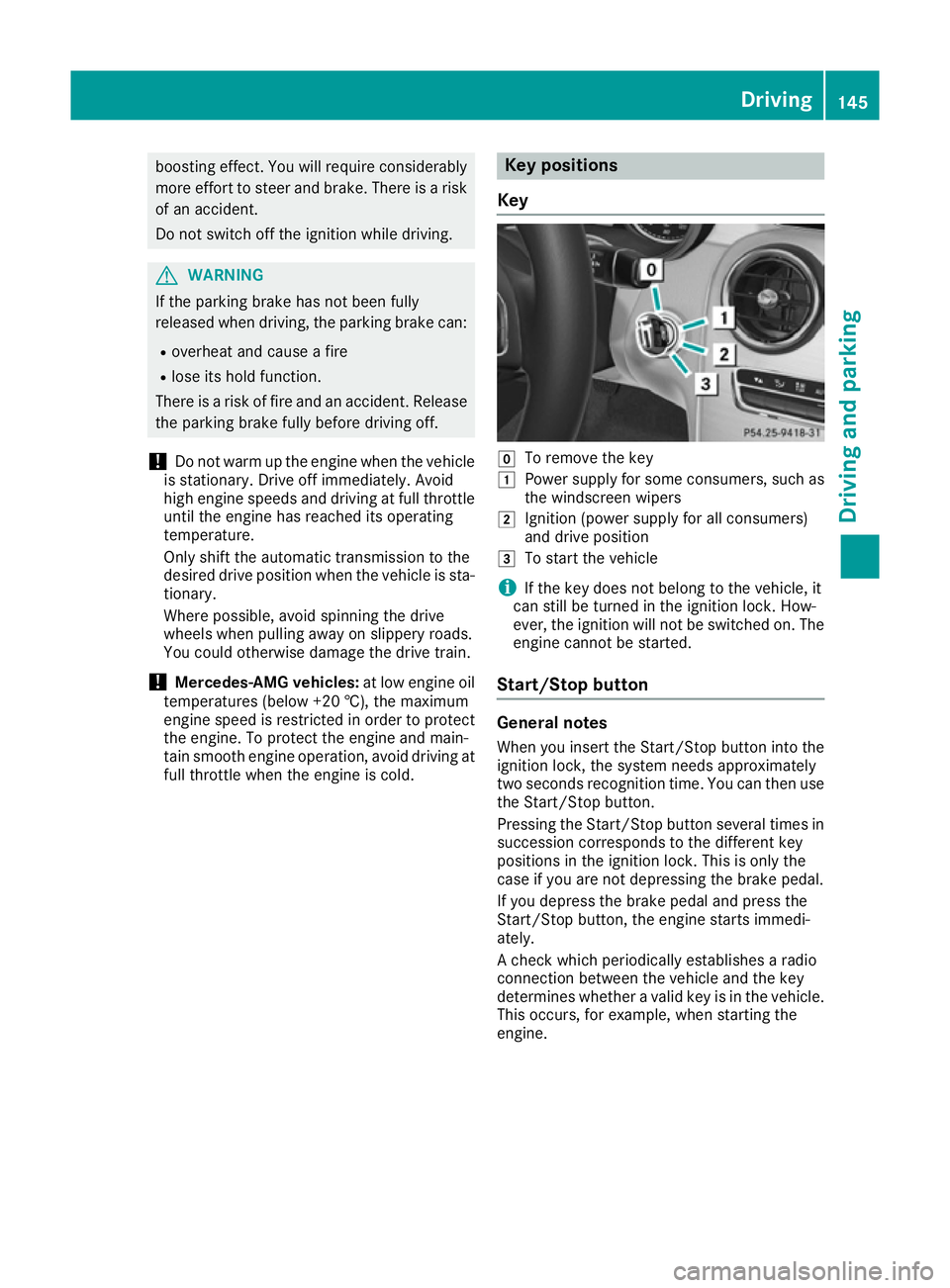
Key g
To remov ethe key
1 Power supply for some consumers, such as
the windscreen wipers
2 Ignition (power supply for all consumers)
and drive position
3 To start the vehicle
i If the key does not belong to the vehicle, it
can still be turned in the ignition lock .How-
ever, the ignition will not be switched on. The
engin ecannot be started.
Start/Stop button General notes
When you insert the Start/Stop butto nintot he
ignition lock ,the system needs approximately
two seconds recognition time. You can then use
the Start/Stop button.
Pressin gthe Start/Stop butto nseveral times in
succession corresponds to the differen tkey
position sinthe ignition lock .This is only the
case if you are not depressin gthe brake pedal.
If you depress the brake pedal and press the
Start/Stop button, the engin estart simmedi-
ately.
Ac hec kwhich periodically establishes aradio
connection between the vehicle and the key
determines whether avalid key is in the vehicle.
This occurs, for example, when starting the
engine. Driving
145Driving and parking Z
Page 150 of 385
Starting the vehicle
Important safety notes G
WARNING
If children are left unsupervised in the vehicle, they could:
R open doors, thereby endangering other per-
sons or road users
R get out and be struck by oncomingt raffic
R operate vehicle equipment and become
trapped, for example
In addition, the children could also set the
vehicle in motion, for example, if they:
R release the parking brake
R shift the automatic transmission out of park
position Porshift manual transmission into
neutral
R start the engine
There is arisk of an accident and injury.
When leaving the vehicle, always take the key with you and lock the vehicle. Never leave
children and animals unattended in the vehi-
cle. Keep the keys out of the reach of children. G
WARNING
Combustion engines emit poisonous exhaust
gases such as carbon monoxide. Inhaling
these exhaust gases leads to poisoning. There is ar isk of fatal injury. Therefore never leave
the engine running in enclosed spaces with-
out sufficient ventilation. G
WARNING
Flammable materials introduced through
environmental influence or by animals can
ignite if in contact with the exhaust system or parts of the engine that heat up. There is arisk
of fire.
Carry out regular checkstom ake sure that
there are no flammable foreign materials in
the engine compartmen torinthe exhaust
system. General notes Vehicles with
apetrol engine: the catalytic
converter is preheated for up to 30 seconds
after acold start. The sound of the engine may
change during this time.
Manual transmission X
Depress the brake pedal and keep it
depressed.
X Fully depress the clutch pedal.
X Shift to neutral N.
Automatic transmission X
Shift the transmission to position P
(Y page 158).
The transmission position indicator in the
multifunction display shows P(Y page 159).
i You can start the engine in transmission
position Pand N.
Starting procedurew ith the key To start the engine using the key instead of the
Start/Stop button, pull the Start/Stop button
out of the ignition lock.
X To startad iesel engine:t urn the key to
position 2in the ignition lock (Y page 145).
The % preglow indicator lamp in the instru-
ment cluster lights up.
X Turn the key to position 3in the ignition lock
and release it as soon as the engine is running
(Y page 145).
i Vehicles with
adiesel engine: you can
start the engine without preglow if the engine
is warm.
If the engine will not start:
X Remove the key from the ignition lock.
X Reinsert the key into the ignition lock after
waiting for ashort period.
X Turn the key to position 2in the ignition lock
(Y page 145).
The indicator lamps in the instrumen tcluster
light up (Y page 285).
X Turn the key to position 3(Y page 145) in the
ignition lock and release it as soon as the
engine is running. Driving
147Driving and parking Z
Page 151 of 385
Starting procedureu
sing the Start/
Stop button The Start/Stop button is only available on vehi-
cles with KEYLESS-GO or the KEYLESS-GO start
function.
The Start/Stop button can be used to start the
vehicle manually without insertin gthe key into
the ignition lock. The key must be in the vehicle and the Start/Stop button must be inserted in
the ignition lock. This mode for startingt he
engine operates independently of the ECO
start/stop automatic engine start function.
You can start the engine if avalid key is in the
vehicle. Switch off the engine and always take
the key with you when leaving the vehicle, even
if you only leave it for ashort time. Pay attention
to the important safety notes.
X Depress the brake pedal and keep it
depressed.
X Press the Start/Stop button once
(Y page 145).
Vehicles with apetrol engine: the engine
starts.
Vehicles with adiesel engine: preglow is
activated and the engine starts. Pulling away
General notes G
WARNING
Vehicles with automatic transmission:
If the engine speed is above the engine idling speed and you then engage transmission
position Dor R,t he vehicle may accelerate
suddenly. There is arisk of an accident.
When engaging transmission position Dor R,
always keep the brake pedal firmly depressed
and do not depress the accelerator pedal at
the same time.
! Vehicles with manualt
ransmission:
change gear in good time and avoid spinning
the wheels. You could otherwise damage the
vehicle.
Depress the accelerator carefully when pulling
away.
The vehicle locks centrally once you have pulled
away.T he locking knobs in the doors drop down. You can open the doors from the inside at any
time.
You can also deactivate the automatic locking
feature; see the Digital Owner's Manual.
Vehicles with automatic transmission: it is
only possible to shift the transmission from posi- tion Pto the desired position if you depress the
brake pedal. If you do not depress the brake
pedal, the DIRECT SELECT lever can still be
moved but the parking lock remains engaged.
i Vehicles with automatic transmission:
upshifts take place at higher engine speeds
after acold start. This helps the catalytic con-
verter to reach its operating temperature
more quickly.
Information on automatically releasing the elec- trical parking brake (Y page 175).
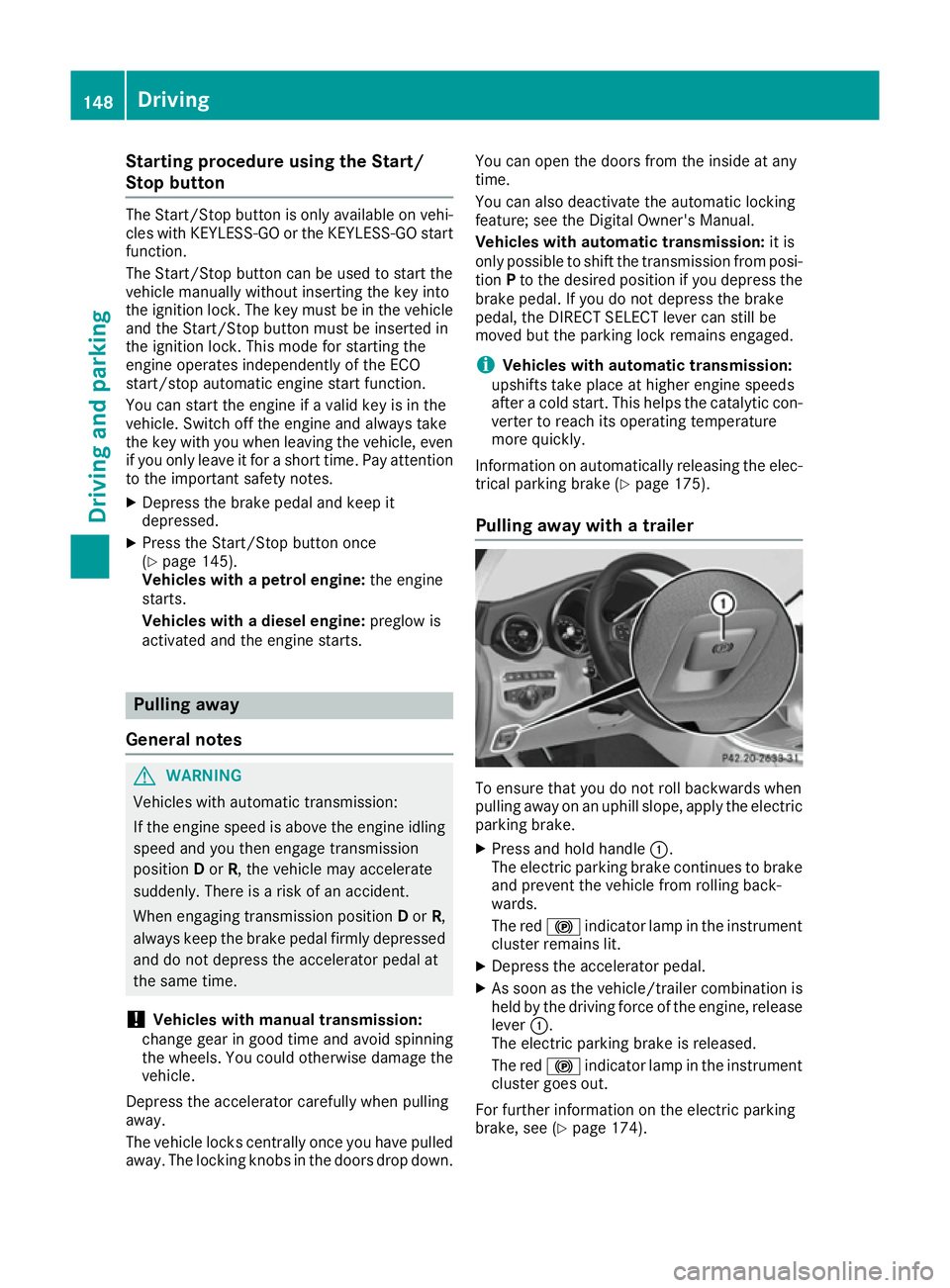
Pulling away with atrailer To ensure that you do not roll backwards when
pulling away on an uphill slope, apply the electric
parking brake.
X Press and hold handle :.
The electric parking brake continues to brake
and prevent the vehicle from rolling back-
wards.
The red !indicator lamp in the instrument
cluster remains lit.
X Depress the accelerator pedal.
X As soon as the vehicle/trailer combination is
held by the driving force of the engine, release lever :.
The electric parking brake is released.
The red !indicator lamp in the instrument
cluster goes out.
For further information on the electric parking
brake, see (Y page 174).148
DrivingDriving and parking
Page 152 of 385
Hill start assist
Hill start assist help
syou when pulling awa yfor-
wards or in reverse on an uphill gradient. It holds
the vehicl efor as hort time after you have
removed you rfoot from the brake pedal. This
gives you enoug htime to move yourf oot from
the brake peda ltothe accelerator peda land
depress it before the vehicl ebegins to roll. G
WARNING
After awhile, hills tart assist no longer holds
the vehicl eand it may roll away. There is arisk
of an accident and injury.
Therefore, quickly move yourf oot from the
brake peda ltothe accelerator pedal. Never
leave the vehicl ewhen it is held by hills tart
assist.
Hill start assist is not active if:
R you are pulling awayonal evelroad or a
downhill gradient
R on vehicles with automatic transmission, the
transmission is in position N
R the electric parking brake is applied
R ESP ®
is malfunctioning ECOs
tart/stop function
Introduction The ECO start/stop function switches the
engine off automatically if the vehicl eisstopped
under certain conditions.
When pulling awa yagain, the engine starts auto-
matically .The ECO start/stop function thereby
help syou to reduce the fuel consumption and
emissions of you rvehicle.
Important safety notes G
WARNING
If the engine is switched off automatically and you exit the vehicle, the engine is restarted
automatically.T he vehiclemay begi nmoving.
There is arisk of accident and injury.
If you wis htoexit the vehicle, alwayst urn off
the ignitio nand secure the vehicl eagainst
rolling away. General notes
:
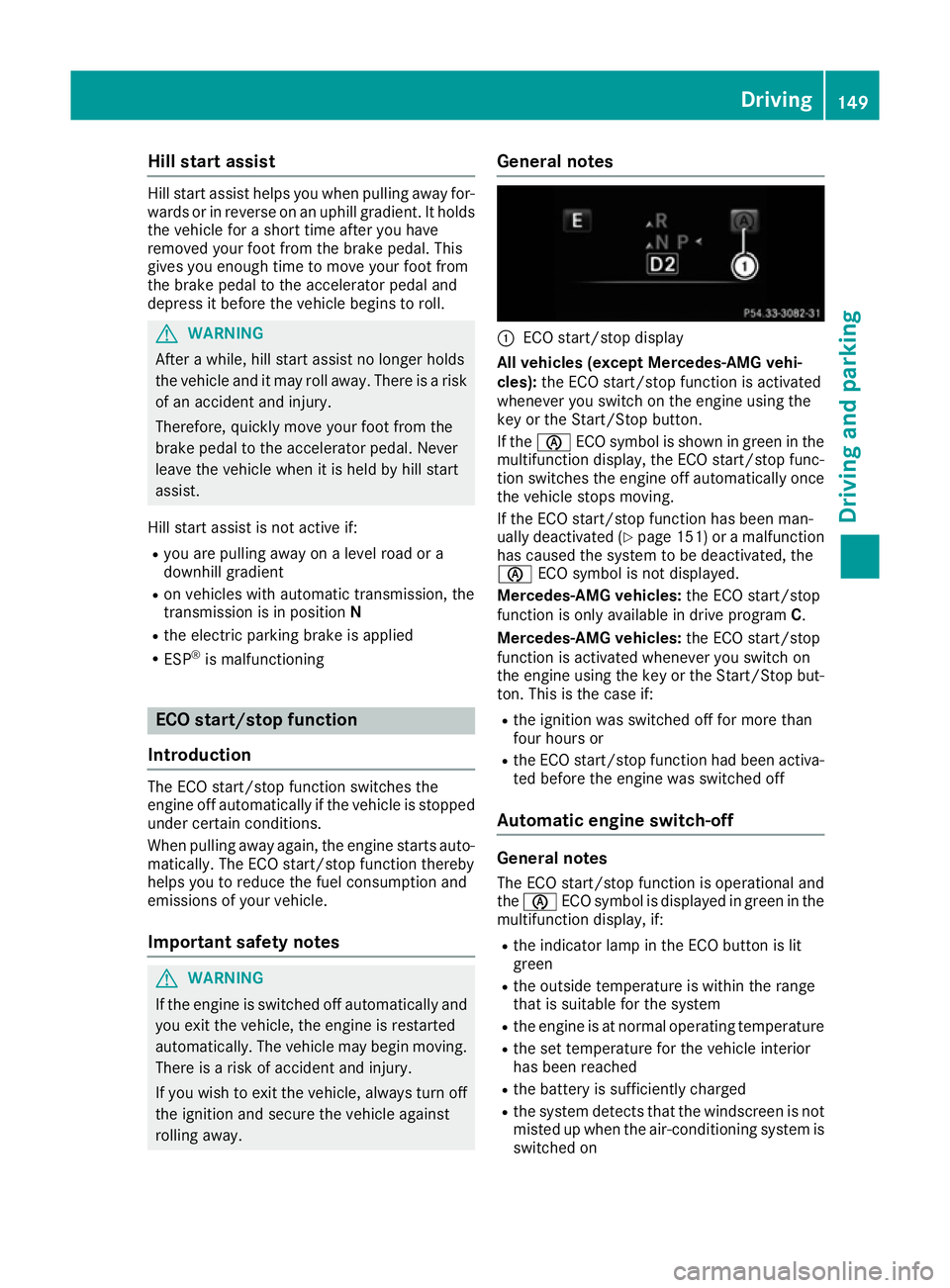
ECO start/stop display
All vehicle s(except Mercedes-AMG vehi-
cles): the ECO start/stop function is activated
whenever you switch on the engine using the
key or the Start/Stop button.
If the è ECO symbol is show ningreen in the
multifunction display ,the ECO start/stop func-
tion switches the engine off automatically once the vehicl estops moving.
If the ECO start/stop function has been man-
ually deactivated (Y page151) or amalfunction
has caused the system to be deactivated, the
è ECO symbol is not displayed.
Mercedes-AMG vehicles: the ECO start/stop
function is only available in drive program C.
Mercedes-AMG vehicles: the ECO start/stop
function is activated whenever you switch on
the engine using the key or the Start/Stop but- ton. This is the case if:
R the ignitio nwas switched off for more than
four hour sor
R the ECO start/stop function had been activa-
ted before the engine was switched off
Automatic engine switch-off General notes
The ECO start/stop function is operational and
the è ECO symbol is displayed in green in the
multifunction display ,if:
R the indicator lamp in the ECO button is lit
green
R the outside temperature is withi nthe range
that is suitable for the system
R the engine is at normal operating temperature
R the set temperature for the vehicl einterior
has been reached
R the battery is sufficiently charged
R the system detects that the windscreen is not
misted up when the air-conditioning system isswitched on Driving
149Driving and parking Z
Page 156 of 385
Problems with the engine
Problem
Possible causes/consequences and
M
MSolutions The engine does not
start. The HOLD function or DISTRONIC PLUS is activated.
X Deactivat ethe HOLD function (Y page 192) or DISTRONIC PLUS
(Y page 184).
X Try to start the engine again (Y page 147).The engine does not
start. The starter motor
can be heard. R
There is amalfunction in the engine electronics.
R There is amalfunction in the fuel supply.
Before attempting to start the engine again:
X Turn the key back to position 0in the ignition lock.
or X Press the Start/Stop button repeatedly until all indicator lamps in
the instrumen tcluster go out.
X Try to start the engine again (Y page 147). Avoid excessively long
and frequent attemptstos tart the engine, as this will drain the
battery.
If the engine does not start after several attempts:
X Consult aqualified specialist workshop. The engine does not
start. The starter motor
can be heard. The
reserve fuel warning
lamp is lit and the fuel
gauge display is at the
reserve level. The fuel tank is empty.
X Refuel the vehicle. The engine does not
start. You cannot hear
the starter motor. The on-board voltage is too low because the battery is too weak or
discharged.
X Jump-start the vehicle (Y page 345).
If the engine does not start despite attemptstoj ump-start it:
X Consult aqualified specialist workshop. The starter motor was exposed to
athermal load that was too high.
X Try to start the engine again (Y page 147).
If the engine still does not start:
X Consult aqualified specialist workshop. Vehicles with
apetrol
engine:
The engine is not running
smoothly and is misfir-
ing. There is
amalfunction in the engine electronics or in amechanical
componen tofthe engine management system.
X Only depress the accelerator pedal slightly.
Otherwise, non-combusted fuel may get into the catalytic converter
and damage it.
X Have the cause rectified immediately at aqualified specialist work-
shop. Driving
153Driving and parking Z
Page 157 of 385
Problem
Possible causes/consequences and
M
MSolutions The coolant temperature
display is showing more
than 120 †. Adisplay
message may also
appear in the multifunc-
tion display and awarn-
ing tone may sound. The coolant level is too low. The coolant is too hot and the engine is no
longer being cooled sufficiently.
X Stop as soon as possible and allow the engine and the coolant to
cool down.
X Check the coolant level (Y page 324). Observe the warning notes
as you do so and top up the coolant if necessary. If the coolant level is correct,t
he engine radiator fan may be faulty. The
coolant is too hot and the engine is no longer being cooled sufficiently.
X If the coolant temperature is below 120 †, you can continue driving
to the nearest qualified specialist workshop.
X Avoid heavy loads on the engine as you do so, e.g. driving in moun-
tainous terrain and stop-start traffic. DYNAMIC SELECTs
witchAll vehicles(
except Mercedes-AMG
vehicles)
Use the DYNAMIC SELECT switch to change the
drive program. Depending on the drive program
selected, the following vehicle characteristics
will change:
R the drive (engine and transmission manage-
ment)
R the suspension
R the steering
R the availability of the ECO start/stop function
R the climate control
- the climate control settings
- the rear window heating operation period
- the performance of the seat heating
If the ignition is switched off for less than four
hours, the previously selected drive program is
activated when the engine is next started. If the ignition is switched off for more than four hours,
drive program Cis activated when the engine is
next started. :
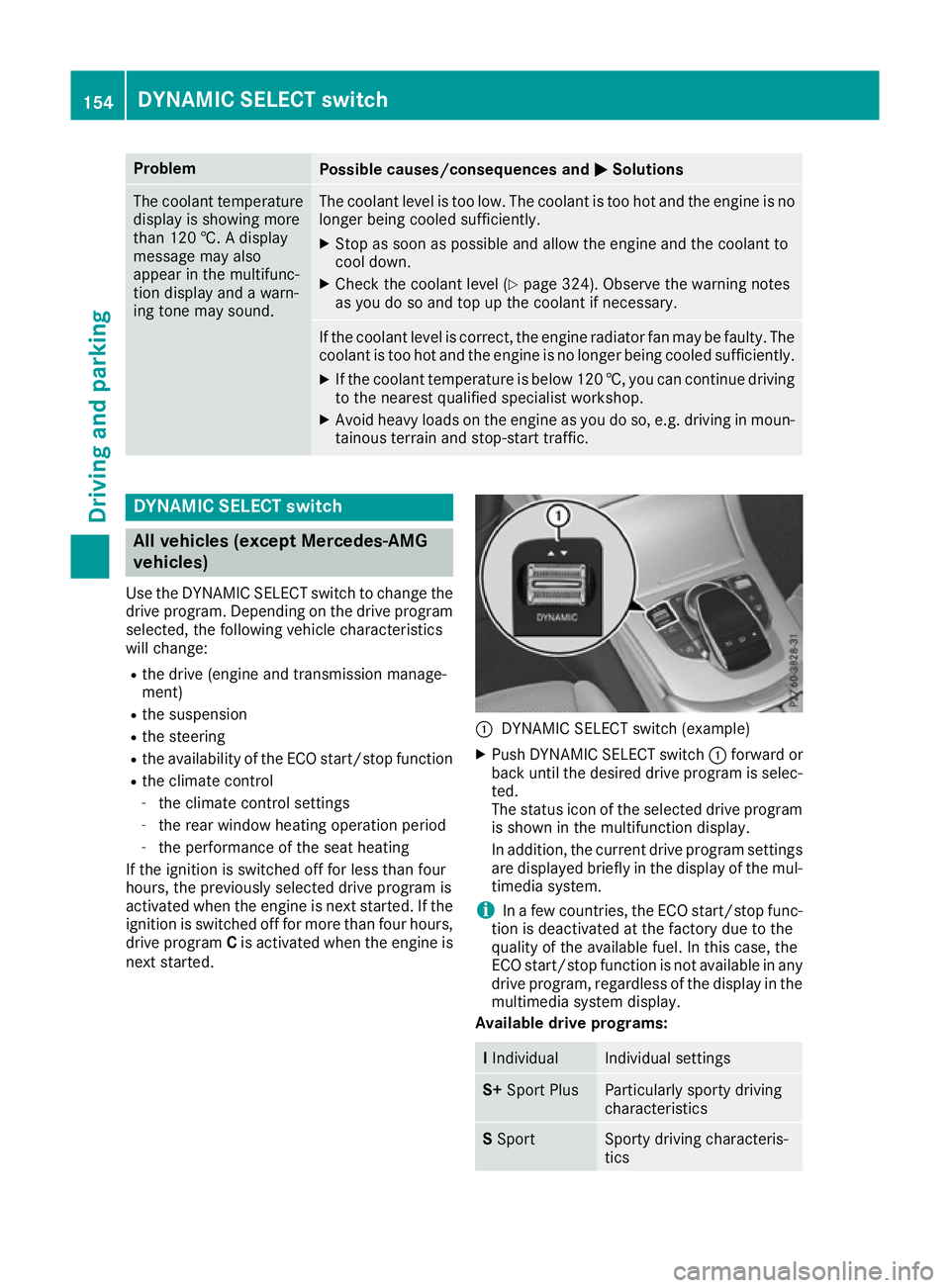
DYNAMIC SELECT switch (example)
X Push DYNAMIC SELECT switch :forward or
back until the desired drive program is selec- ted.
The status icon of the selected drive program
is shown in the multifunction display.
In addition, the current drive program settings are displayed briefly in the display of the mul-
timedia system.
i In
af ew countries, the ECO start/stop func-
tion is deactivated at the factory due to the
quality of the available fuel. In this case, the
ECO start/stop function is not available in any
drive program, regardless of the display in the
multimedia system display.
Available drive programs: I
Individual Individual settings
S+
Sport Plus Particularly sporty driving
characteristics S
Sport Sporty driving characteris-
tics154
DYNAMIC SELECT switchDriving and parking
Page 160 of 385
Gearshift recommendation
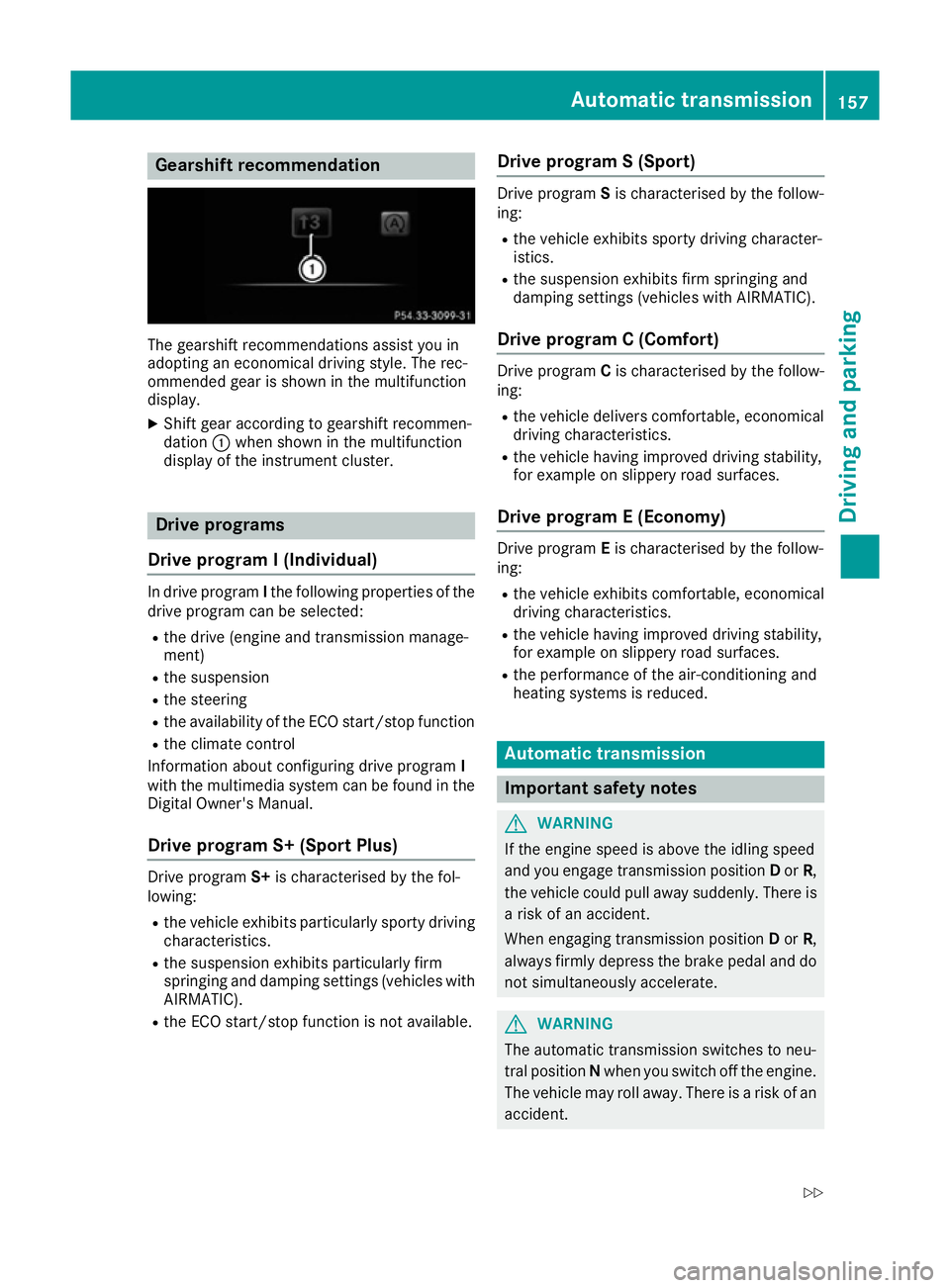
The gearshift recommendations assist you in
adopting an economical driving style .The rec-
ommended gear is shown in the multifunction
display.
X Shift gear according to gearshift recommen-
dation :when shown in the multifunction
display of the instrument cluster. Drive programs
Drive program I(Individual) In drive program
Ithe following properties of the
drive progra mcan be selected:
R the drive (engine and transmission manage-
ment)
R the suspension
R the steering
R the availability of the ECO start/stop function
R the climate control
Information abou tconfiguring drive program I
with the multimedia system can be found in the
Digital Owner's Manual.
Drive program S+ (Sport Plus) Drive program
S+is characterised by the fol-
lowing:
R the vehicle exhibits particularlys porty driving
characteristics.
R the suspension exhibits particularlyf irm
springing and damping settings (vehicles with
AIRMATIC).
R the ECO start/stop function is not available. Drive program
S(Sport) Drive program
Sis characterised by the follow-
ing:
R the vehicle exhibits sporty driving character-
istics.
R the suspension exhibits firm springing and
damping settings (vehicles with AIRMATIC).
Drive program C(Comfort) Drive program
Cis characterised by the follow-
ing:
R the vehicle delivers comfortable ,economical
driving characteristics.
R the vehicle having improve ddriving stability,
for exampl eonslippery road surfaces.
Drive program E(Economy) Drive program
Eis characterised by the follow-
ing:
R the vehicle exhibits comfortable ,economical
driving characteristics.
R the vehicle having improve ddriving stability,
for exampl eonslippery road surfaces.
R the performance of the air-conditioning and
heating systems is reduced. Automatic transmission
Important safety notes
G
WARNING
If the engine speed is above the idling speed
and you engage transmission position Dor R,
the vehicle could pulla waysuddenly. There is
ar isk of an accident.
When engaging transmission position Dor R,
alwaysf irmly depress the brake pedala nd do
not simultaneously accelerate. G
WARNING
The automatic transmission switches to neu-
tral position Nwhen you switch off the engine.
The vehicle may roll away. There is arisk of an
accident. Automatic transmission
157Driving and parking
Z
Page 161 of 385
After switching off the engine
,alway sswitch
to parking position P.Prevent the parked vehi-
cle from rolling away by applying the parking
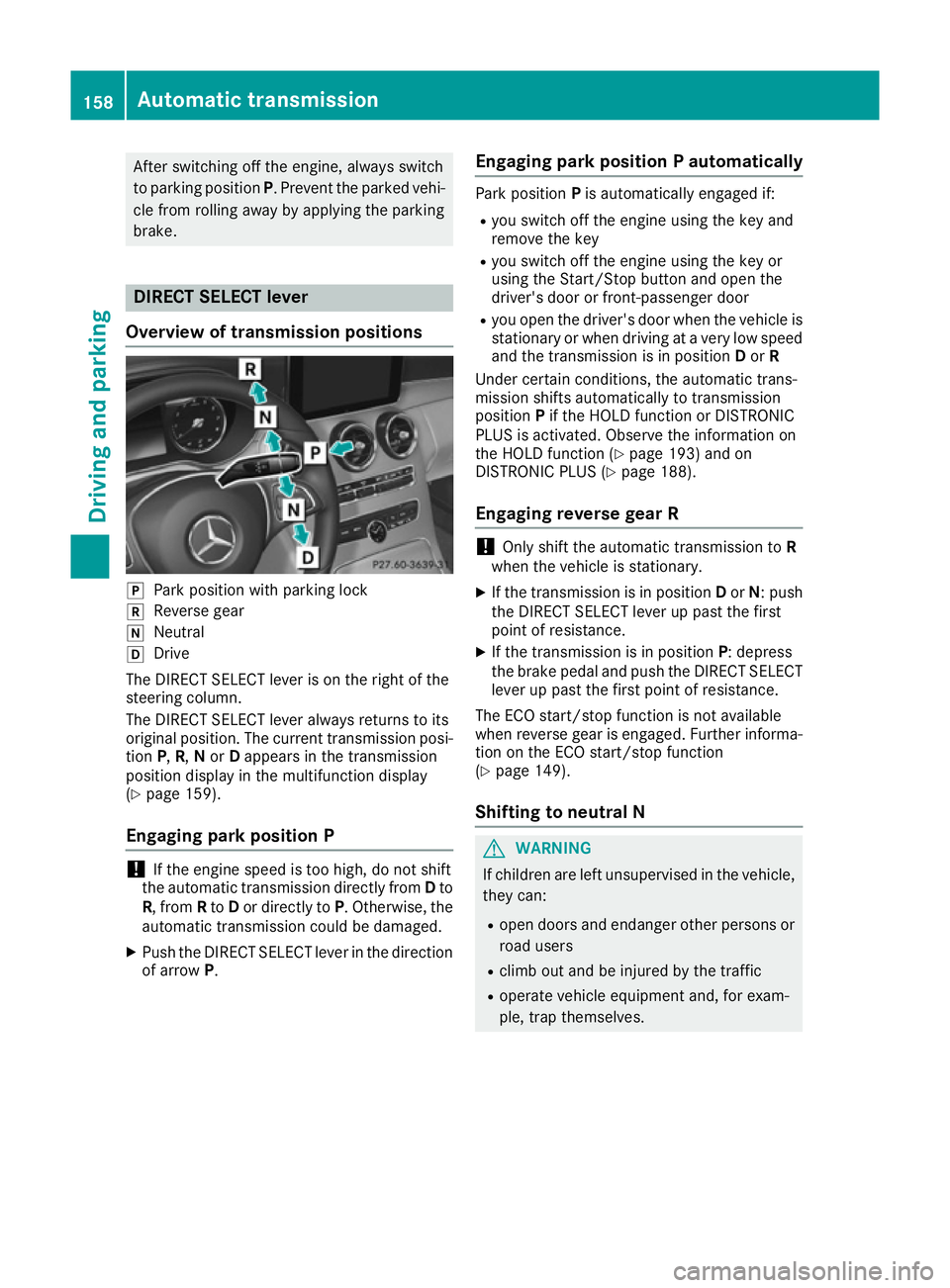
brake. DIREC
TSELECT lever
Overvie woftransmission positions j
Park positio nwithp arking lock
k Reverse gear
i Neutral
h Drive
The DIRECT SELEC Tlever is on the right of the
steering column.
The DIRECT SELEC Tlever always returns to its
original position. The current transmission posi- tion P,R, Nor Dappear sinthe transmission
positio ndisplay in the multifunctio ndisplay
(Y page 159).
Engagin gpark position P !
If the engine speed is too high, do not shift
the automatic transmission directl yfrom Dto
R,f rom Rto Dor directl ytoP.Otherwise, the
automatic transmission could be damaged.
X Push the DIRECT SELEC Tlev er in the direction
of arrow P. Engagin
gpark position Pautomatically Park position
Pis automaticall yengaged if:
R yous witch off the engine using the key and
remove the key
R yous witch off the engine using the key or
using the Start/Stop button and open the
driver's door or front-passenger door
R youo pent he driver's door when the vehicl eis
stationar yorwhend riving at averyl ow speed
and the transmission is in position Dor R
Unde rcertain conditions, the automatic trans-
mission shifts automaticall ytotransmission
position Pif the HOLD functio norDISTRONIC
PLU Sisa ctivated .Observ ethe informatio non
the HOLD functio n(Ypage 193 )and on
DISTRONI CPLUS(Ypage 188).
Engagin grevers egearR !
Onl
yshift the automatic transmission to R
when the vehicl eisstationary.
X If the transmission is in position Dor N:p ush
the DIRECT SELEC Tlever up past the first
point of resistance.
X If the transmission is in position P:depress
the brake peda land push the DIRECT SELECT
lever up past the first point of resistance.
The ECO start/sto pfunctio nisn ot available
when revers egearise ngaged .Further informa-
tio nont he ECO start/sto pfunction
(Y page 149).
Shiftin gtoneutral N G
WARNING
If children ar eleftu nsupervised in the vehicle,
they can:
R open doors and endanger othe rpersons or
roa dusers
R climb ou tand be injured by the traffic
R operate vehicl eequipment and,for exam-
ple, trap themselves. 158
Automati
ctransmissionDriving an dparking
Page 169 of 385
Problems with the transmission
Problem
Possible causes/consequences and
M
MSolutions The transmission has
problems shifting gear. The transmission is losing oil.
X Have the transmission checked at aqualified specialist workshop
immediately. The acceleration ability
is deteriorating.
The transmission no lon-
ger changes gear. The transmission is in emergency mode.
It is only possible to shift into
secondgear and reverse gear.
X Stop.
X Shift the transmission to position P.
X Switch off the engine.
X Wait at least ten seconds before restarting the engine.
X Shift the transmission to position Dor R.
If D is selected, the transmission shifts into secondgear; ifRis
selected, the transmission shifts into reverse gear.
X Have the transmission checked at aqualified specialist workshop
immediately. Refuelling
Important safety notes
G
WARNING
Fuel is highly flammable. If you handle fuel
incorrectly, there is arisk of fire and explo-
sion.
You must avoid fire, naked flames, creating
sparks and smoking. Switch off the engine
and, if applicable, the auxiliary heating before refuelling. G
WARNING
Fuels are poisonous and hazardous to health. There is adanger of injury.
Do not swallow fuel or let it come into contact
with skin, eyes or clothing. Do not inhale fuel
vapours. Keep fuels out of the reach of chil-
dren. If you or others come into contact with fuel,
observe the following:
R Wash the fuel off any affected areas of skin
with water and soap immediately.
R If you get fuel in your eyes, rinse them thor-
oughly with clean water immediately. Seek
immediate medical attention.
R If fuel is swallowed, seek immediate medi-
cal attention. Do not induce vomiting.
R Change any clothing that has come into
contact with fuel immediately. G
WARNING
Electrostatic charge can cause sparks and
thereby ignite fuel vapours. There is arisk of
fire and explosion.
Always touch the vehicle body before opening the fuel filler flap or touching the fuel pump
nozzle. This discharges any electrostatic
charge that may have built up.
Do not get into the vehicle again during the refu-
elling process. Otherwise, electrostatic charge
could build up again. G
WARNING
Vehicles with adiesel engine: 166
RefuellingDriving and parking