ESP MERCEDES-BENZ C-CLASS COUPE 2015 Owners Manual
[x] Cancel search | Manufacturer: MERCEDES-BENZ, Model Year: 2015, Model line: C-CLASS COUPE, Model: MERCEDES-BENZ C-CLASS COUPE 2015Pages: 385, PDF Size: 13.12 MB
Page 341 of 385
If
ap ressure loss warning messag eappears
in th emultifunction display:
R observ ethe instruction sinthedisplay mes-
sages (Y page 277)
R check th etyref or damage
R if driving on ,observ ethe followin gnotes
The driving distanc epossible in run-flat mod eis
approximately 80 km when th evehicle is parti-
ally laden and approximately 30 km when the
vehicle is fully laden.
In addition to th evehicle load, th edriving dis-
tance possible depends upon:
R vehicle speed
R road condition
R outside temperature
The driving distanc epossible in run-flat mode
may be reduced by extrem edriving conditions/
manoeuvres ,oritcan be increased throug ha
moderat estyle of driving.
The driving distanc epossible in run-flat mod eis
counte dfromt hemoment th etyrep ressure loss
warning appear sinthemultifunction display.
You must no texceed amaximum spee dof
80 km/h.
When replacin gone or all tyres, observ ethe fol-
lowin gspecifications for your vehicle's tyres:
R size
R thet ype and
R the" MOExtended" mark
If at yreh as gon eflat and canno tbereplaced
with an MOExtended tyre, astandar dtyrem ay
be used as atem porar ymeasure. Mak esure
that you use th eproper siz eand type (summer
or winter tyre).
Vehicle swith MOExtended tyres are no tequip-
ped with aTIREFI Tkit at th efactory. It is there-
for erecommended that you additionally equip
your vehicle with aTIREFI Tkit if you fit tyres that
do no tfeature run-flat characteristics, e.g .win-
te rt yres. ATIREFI Tkit can be obtaine dfroma
qualified specialist workshop.
Important safety notes G
WARNING
When driving in emergency mode, th edriving
characteristic sdeteriorate, e.g .when corner-
ing ,acceleratin gquickly and when braking.
Ther eisar iskofa ccident. Do no
texceed th estate dm aximum speed.
Avoid abrupt steering and driving manoeu-
vres, and driving ove robstacle s(kerbs ,pot-
holes ,off-road). This applies in particular to a
laden vehicle.
Stop driving in emergency mod eif:
R you hear banging noises.
R thev ehicle start stoshake.
R you see smoke and smell rubber.
R ESP ®
is intervening constantly.
R there are tears in th esidewalls of th etyre.
Afte rdriving in emergency mode, have the
wheel rim schecked at aqualified specialist
worksho pwith regard to their further use. The
fault ytyrem ust be replaced. TIREFIT kit
Important safety notes TIREFI
Tisat yres ealant.
You can use TIREFI Ttoseal punctures of up to
4m m,particularly those in th etyret read. You
can use TIREFI Tatoutside temperatures down
to Ò20 †. G
WARNING
In th efollowin gsituations ,the tyres ealan tis
unabl etop rovide sufficient breakdown assis-
tance, as it is unabl etoseal th etyrep roperly:
R there are cut sorpunctures in th etyre
large rtha nt hose mentione dabove.
R thew heel rim is damaged.
R you have driven at ver ylow tyr epressures
or on aflat tyre.
Ther eisar iskofana ccident.
Do no tdrivea ny further. Contac taqualified
specialist workshop. G
WARNING
The tyr esealan tisharmful and causes irrita-
tion. It must no tcom eintoc ontac twith your
skin, eyes or clothing or be swallowed. Do not inhale TIREFI Tfumes. Keep tyr esealan taway
from children. Ther eisariskofi njury. 338
Flat tyreBreakdown assistance
Page 344 of 385
G
WARNING
If the required tyre pressure is not reached
after driving for ashort period, the tyre is too
badly damaged. The tyre sealant cannot
repair the tyre in this instance. Damaged tyres and atyre pressure that is too low can signif-
icantly impair the vehicle's braking and driv-
ing characteristics. There is arisk of accident.
Do not continue driving. Contact aqualified
specialist workshop.
i In yourv
ehicle, you willf indasticker with
the Mercedes-Benz Service24h telephone
number, e.g. on the B-pillar on the driver's
side.
X Correct the tyre pressure if it is still at least
130 kPa (1.3 bar/19 psi) .See the tyre pres-
sure table on the fuel filler flap for values.
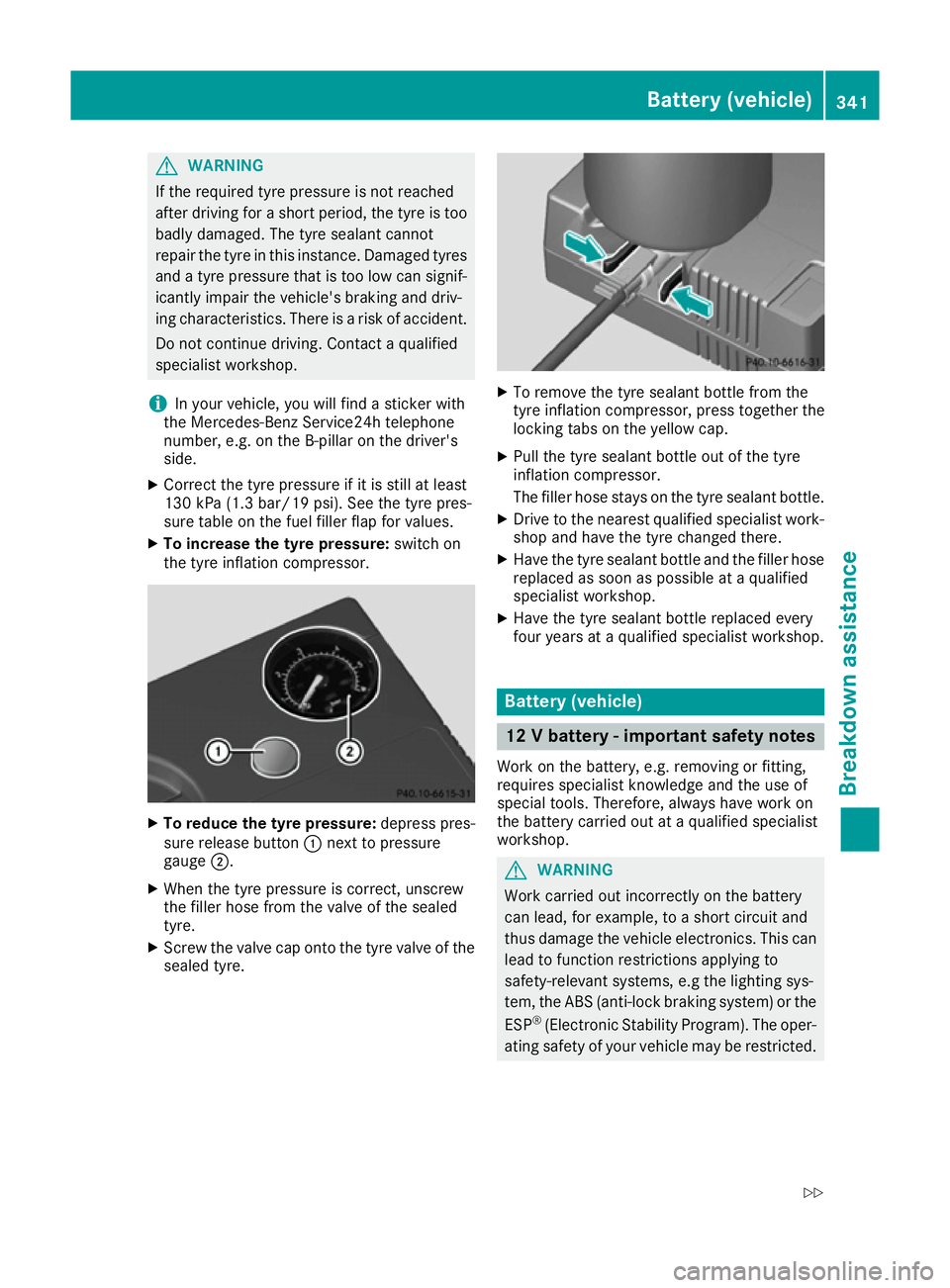
X To increase the tyre pressure: switch on
the tyre inflation compressor. X
To reduce the tyre pressure: depress pres-
sure release button :next to pressure
gauge ;.
X When the tyre pressure is correct, unscrew
the filler hose from the valve of the sealed
tyre.
X Screw the valve cap onto the tyre valve of the
sealed tyre. X
To remove the tyre sealant bottle from the
tyre inflation compressor, press together the
locking tabs on the yellow cap.
X Pullt he tyre sealant bottle out of the tyre
inflation compressor.
The filler hose stays on the tyre sealant bottle.
X Drive to the neares tqualified specialist work-
shop and have the tyre changed there.
X Have the tyre sealant bottle and the filler hose
replaced as soon as possible at aqualified
specialist workshop.
X Have the tyre sealant bottle replaced every
four years at aqualified specialist workshop. Battery (vehicle)
12
Vb attery -important safety notes
Work on the battery ,e.g. removing or fitting,
requires specialist knowledge and the use of
special tools. Therefore, alwaysh ave work on
the battery carrie dout at aqualified specialist
workshop. G
WARNING
Work carrie dout incorrectly on the battery
can lead, for example, to ashort circui tand
thus damage the vehicl eelectronics. This can
leadtof unction restrictions applying to
safety-relevant systems ,e.g the lighting sys-
tem, the ABS (anti-lock braking system) or the
ESP ®
(Electronic Stability Program). The oper-
ating safety of yourv ehiclemay be restricted. Battery (vehicle)
341Breakdown assistance
Z
Page 345 of 385
You could lose control of the vehicle, for
example:
R when braking
R in the even tofabrupt steerin gmanoeuvres
and/or when the vehicle's speed is not
adapted to the road conditions
There is arisk of an accident.
In the even tofashortcircuit or asimilar inci-
dent ,contac taqualified specialis tworkshop
immediately. Do not drive any further. Always have work on the battery carried out at a
qualified specialis tworkshop.
Further information about AB S(Ypage 66) and
ESP ®
(Y page 71).
All vehicles except vehicles with alithium-
ion battery: G
WARNING
Electrostatic build-up can lead to the creation of sparks, which could ignit ethe highly explo-
sive gases of abattery. There is arisk of an
explosion.
Before handlin gthe battery, touc hthe vehicle
body to remove any existing electrostatic
build-up.
The highly flammable gas mixture is created
while the battery is charging and when jump-
starting.
Always make sure that neither you nor the bat-
ter yise lectrostatically charged. Electrostatic
charge is created, for example:
R by wearing synthetic fibre clothing
R by friction betwee nclothing and the seat
R when you pull or push the battery acros scar-
pet or other synthetic materials
R when you rub the battery with acloth G
WARNING
Durin gthe charging process, abattery produ-
ces hydrogen gas. If ashor tcircuit occurs or
spark sare created, the hydrogen gas can
ignite. There is arisk of an explosion. R
Make sure that the positive terminal of a
connected battery does not com eintoc on-
tac twith vehicle parts.
R Never place metal object sortools on abat-
tery.
R It is importan tthat you observ ethe descri-
bed order of the battery terminals when
connectin gand disconnecting abattery.
R When jump-starting, make sure that the
battery poles with identical polarit yare
connected.
R It is particularly importan ttoobserv ethe
described order when connectin gand dis-
connectin gthe jump leads.
R Never connec tordisconnect the battery
terminals while the engin eisrunning. G
WARNING
Batter yacid is caustic. There is arisk of injury.
Avoid contac twith the skin ,eyes or clothing.
Do not breathe in any battery gases. Do not
lean over the battery. Keep the batteries out
of the reach of children. Immediately rinse off
battery acid thoroughly with plent yofclean
water and seek medical attention at once.
All vehicles: H
Environmental note Batteries contain pollutants.
It is illegal to dispose of them
with the household rubbish.
They must be collected sep-
arately and disposed of in anenvironmentally responsible
recycling system. Dispose of batteries in an
environmentally responsible
manner. Take discharged
batteries to
aqualified spe-
cialist workshop or to acol-
lection point for used batter-
ies.
! Have the battery checked regularly at a
qualified specialis tworkshop. 342
Battery (vehicle)Breakdown assistance
Page 347 of 385
of the reach of children. Immediately rinse off
battery acid thoroughly with plenty of clean
water and seek medical attention at once. G
WARNING
Ad ischarged battery can freeze at tempera-
tures below freezin gpoint. When jump-start-
ing the vehicle or charging the battery, gases can escape from the battery. There is arisk of
an explosion.
Allow the frozen battery to thaw out before
charging it or jump-starting.
! Only use battery chargers with
amaximum
charging voltage of 14.8 V.
All vehicles:
! Only charge the battery using the jump-start
connection point.
The jump-starting connection point is in the
engine compartment (Y page 345).
X Open the bonnet.
X Connect the battery charger to the positive
terminal and earth point in the same order as
when connectingt he donor battery in the
jump-starting procedure (Y page 345).
Keep away from fire and naked flames. Do not
lean over the battery. Never charge the battery
if it is still fitted to the vehicle, unless you use a battery charger which has been tested and
approved by Mercedes-Benz. Abattery charger
unit specially adapted for Mercedes-Benz vehi-
cles and tested and approved by Mercedes-
Benz is available as an accessory. This device
permits charging of the battery in position. Con-
tact aMercedes-Benz Service Centre for infor-
mation and availability. Read the battery charg-
er's operating instructions before charging the
battery.
All vehicles except vehicles with alithium-
ion battery: if the indicator/warning lamps in
the instrument cluster do not light up at low
temperatures, it is very likely that the dis-
charged battery has frozen .Inthis case you may
neither jump-start the vehicle nor charge the
battery. The service life of abattery that has
been thawed may be reduced. The starting char-
acteristics may be impaired, especially at low
temperatures. Have the thawed battery
checked at aqualified specialist workshop. Vehicles with
alithium-ion battery: at low
temperatures, do not charge abattery which has
been removed using abattery charger. Allow the
battery to warm up gently first, if necessary.
Otherwise, the service life can be shortened and the starting characteristics impaired, especially
at low temperatures. 344
Battery (vehicle)Breakdown assistance
Page 348 of 385
Jump-starting
For the jump-starting procedure, use only the jump-starting connection point, consisting of apos-
itive terminal and an earth point, in the engine compartment.
All vehiclese xcept vehiclesw ithalithium-ion battery: G
WARNING
Battery acid is caustic. There is arisk of injury.
Avoid contact with the skin, eyes or clothing. Do not breathe in any battery gases. Do not lean over the battery. Keep the batteries out of the reach of children. Immediately rinse off battery acid
thoroughly with plenty of clean water and seek medical attention at once. G
WARNING
During charging and jump-starting, explosive gases can escape from the battery. There is arisk
of an explosion.
Particularly avoid fire, naked flames, creating sparks and smoking. Ensure there is sufficient
ventilation while charging and jump-starting. Do not lean over abattery. G
WARNING
During the charging process, abattery produces hydrogen gas. If ashort circuit occurs or sparks
are created, the hydrogen gas can ignite. There is arisk of an explosion.
R Make sure that the positive terminal of aconnected battery does not come into contact with
vehicle parts.
R Never place metal objects or tools on abattery.
R It is important that you observe the described order of the battery terminals when connecting
and disconnecting abattery.
R When jump-starting, make sure that the battery poles with identical polarity are connected.
R It is particularly important to observe the described order when connecting and disconnecting
the jump leads.
R Never connect or disconnectt he battery terminals while the engine is running.G
WARNING
Ad ischarged battery can freeze at temperatures below freezing point. When jump-starting the
vehicle or charging the battery, gases can escape from the battery. There is arisk of an explosion.
Allow the frozen battery to thaw out before charging it or jump-starting.
If the indicator/warning lamps do not light up at low temperatures, it is very likely that the dis-
charged battery has frozen.Int his case you may neither jump-start the vehicle nor charge the
battery. The service life of abattery that has been thawed may be reduced. The starting charac-
teristics may be impaired, especially at low temperatures. Have the thawed battery checked at a
qualified specialist workshop.
All vehicles:
! Vehicles with
apetrol engine: avoid repeated and lengthy starting attempts.O therwise, the
non-combusted fuel may damage the catalytic converter. Jump-starting
345Breakdown assistance Z
Page 352 of 385
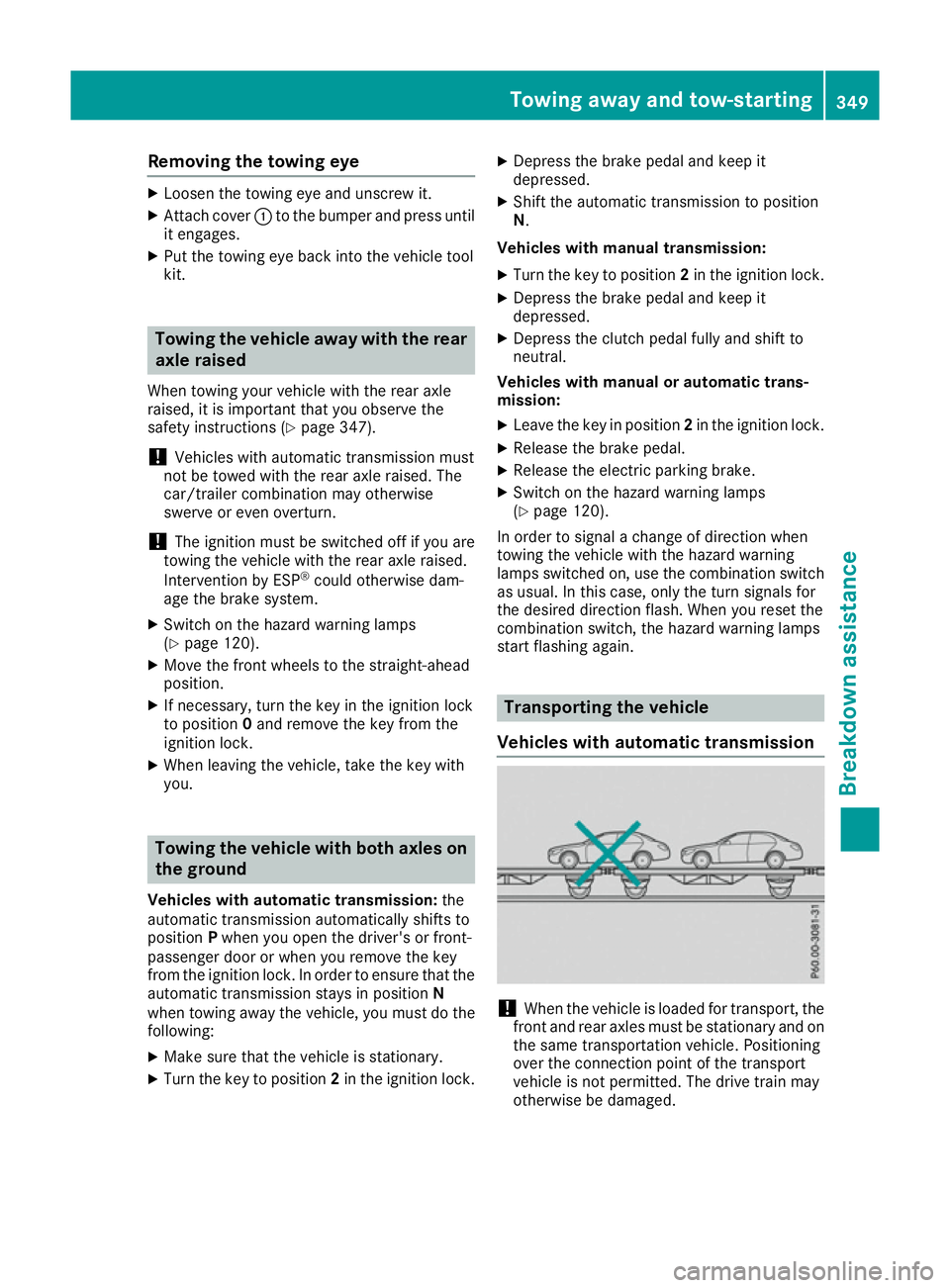
Removin
gthe towin geye X
Loosen the towing ey eand unscrew it.
X Attach cover :to the bumpe rand press until
it engages.
X Pu tthe towing ey ebacki nto the vehicl etool
kit. Towin
gthe vehicle awa ywitht he rear
axl eraised
Whe ntowing your vehicl ewitht he rea raxle
raised ,itisimportant that yo uobserve the
safety instructions (Y page 347).
! Vehicles with automatic transmissio
nmust
not be towe dwitht he rea raxler aised .The
car/traile rcombination may otherwise
swerve or eve noverturn.
! The ignition mus
tbes witched off if yo uare
towing the vehicl ewitht he rea raxler aised.
Intervention by ESP ®
could otherwise dam-
ag et he brake system.
X Switch on the hazard warning lamps
(Y page 120).
X Move the front wheel stothe straight-ahead
position.
X If necessary, turn the key in the ignition lock
to position 0and remove the key from the
ignition lock.
X Whe nleaving the vehicle, take the key with
you. Towin
gthe vehicle with both axles on
the ground
Vehicles with automati ctransmission: the
automatic transmissio nautomaticall yshifts to
position Pwhen yo uopent he driver' sorfront-
passenger doo rorwheny ou remove the key
from the ignition lock. In order to ensure that the automatic transmissio nstay sinp osition N
when towing away the vehicle, yo umustd othe
following:
X Make sure that the vehicl eisstationary.
X Turn the key to position 2in the ignition lock. X
Depress the brake pedal and keep it
depressed.
X Shif tthe automatic transmissio ntoposition
N.
Vehicles with manual transmission: X Turn the key to position 2in the ignition lock.
X Depress the brake pedal and keep it
depressed.
X Depress the clutch pedal fully and shift to
neutral.
Vehicles with manual or automati ctrans-
mission:
X Leave the key in position 2in the ignition lock.
X Releas ethe brake pedal.
X Releas ethe electri cparking brake.
X Switch on the hazard warning lamps
(Y page 120).
In order to signal achange of direction when
towing the vehicl ewitht he hazard warning
lamps switched on, us ethe combination switch
as usual. In this case, only the turn signal sfor
the desire ddirection flash. Whe nyou reset the
combination switch, the hazard warning lamps
star tflashing again. Transporting the vehicle
Vehicles with automati ctransmission !
Whe
nthe vehicl eisloaded for transport, the
front and rea raxles mus tbes tationary and on
the same transportation vehicle. Positioning
ove rthe connection point of the transport
vehicl eisnot permitted. The drive trai nmay
otherwise be damaged. Towin
gawayand tow-starting
349Breakdown assistance Z
Page 353 of 385
All vehicles
!
You may only secure th
evehicl ebyt he
wheels, no tbypartsoft hevehicl esuchas
axl eors teering components. Otherwise ,the
vehicl ecould be damaged.
The towin geyes or trailer to whitch can be used
to pull th evehicl eontoa trailer or transporte rif
you wish to transpor tit.
X Vehicles wit
hmanua ltra nsmission:
depress th eclutch pedal fully and engage
neutral.
X Vehicles wit
hautomatic transmission:
tur nthe keyt op osition 2in th eignition lock.
X Shift th eautomatic transmission to position
N.
As soon as th evehicle is loaded:
X Preven tthe vehicl efromr ollin gaway by
applyin gthe electric parking brake.
X Vehicles wit
hmanua ltra nsmission:
depress th eclutch pedal fully and engage first
or revers egear.
X Vehicles wit
hautomatic transmission:
shif tthe automatic transmission to position
P.
X Turn th ekeyto position 0in th eignition lock
and remove it.
X Secur ethe vehicle. Tow-starting (emergency engine
starting)
! Do no
ttow -star tvehicles wit hautomatic
transmission .You could otherwise damage
th ea utomatic transmission.
i You can fin
dinformation on "Jump-starting"
under (Y page 345).
Befor etow -starting ,the followin gconditi ons
mus tbef ulfilled:
R theb attery is connected
R thee ngineh as cooled down
R thee xhaust system has cooled down
When tow-starting ,itisimportant that you
observ ethe safet ynotes ( Ypage 347) and the
legal requirements in eac hrespective country.
X Switc hont hehazard warning lamps
(Y page 120).
X Fit th etow inge ye (Y page 348). X
Secur ethe rigid towin gbar or th etow ing
rope.
X Depress th ebrak epedal and keep it
depressed.
X Turn th ekeyto position 2in th eignition lock.
X Depress th eclutch pedal fully, engage 2nd
gear and continu etokeept he clutch pedal
fully depressed.
X Releas ethe brak epedal.
X Tow-start th evehicle.
X Releas ethe clutch pedal slowly; do not
depress th eaccelerato rpedal while doin gso.
X When th eengineh as been started, immedi-
ately depress th eclutch pedal fully and shift
to neutral.
X Pull ove ratasuitable plac eand stop th evehi-
cle safely, payin gattention to road and traffic
conditions.
X Use th eelectric parking brak etosecure the
vehicl eand preven titfromr ollin gaway.
X Remove th erigid towin gbar or towin grope.
X Remove th etow inge ye (Y page 349).
X Switc hoff th ehazard warning lamps. Electrical fuses
Important safety notes
G
WARNING
If you manipulate, bridge or replace afaulty
fus ew ithaf useofah igher amperage ,the
electric cables could be overloaded. This may result in afire. There is ariskofana ccident
and injury.
Always replace fault yfuses wit hspecifie dnew
fuses of th ecorrect amperage.
Blown fuses mus tbereplace dwithf uses of the
sam erating ,whic hy ou can recognise by the
colour and fus erating .The fus erating sare listed
in th efusea llocation chart.
The fus eallocation chart is on th efus eb ox in the
boot (Y page 352).
If th enewly inserted fus ealso blows ,havet he
caus etrace da nd rectifie dataqualified special-
ist workshop ,e.g.a Mercedes-Benz Service
Centre.
! Only use fuses that hav
ebeen approve dfor
Mercedes-Benz vehicles and whic hhavet he 350
Electrical fusesBreakdown assistance
Page 356 of 385
Important safety notes
G
WARNING
If wheels and tyres of th ewrong siz eare used,
th ew hee lbrakes or suspension components
may be damaged. Ther eisariskofana cci-
dent.
Always replace wheels and tyres wit hthose
that fulfil th especification softheoriginal
part.
When replacing wheels, mak esuretof it the
correct:
R designation
R type
When replacing tyres, mak esuretof it the
correct:
R designation
R manufacturer
R type G
WARNING
Af lat tyr eseverely impairs th edriving ,steer-
ing and braking characteristics of th evehicle.
Ther eisar iskofa ccident.
Tyre swithout run-flat characteristics:
R do no tdrivew ithaf lat tyre.
R immediately replace th eflat tyr ewithy our
emergenc yspar ew hee lors parew heel, or
consult aqualified specialist workshop.
Tyre swithr un-flat characteristics:
R pay attention to th einformation and warn-
ing notice sonMOExtended tyres (tyres
wit hrun-flat characteristics).
Accessories that are no tapprove dfor your vehi-
cle by Mercedes-Ben zorare notbein gused cor-
rectl ycan impair th eoperating safety.
Before purchasing and usin gnon-ap proved
accessories, visit aqualified specialist work-
sho pand enquir eabout:
R suitability
R legal stipulations
R factory recommendations Further information regarding wheels and tyres
can be foun
dunder "Wheel/tyre combinations"
(Y page 366).
You can ask for information regarding permitted
wheel-tyre combination sataMercedes-Benz
Service Centre.
Information on tyr epressur ecan be found:
R in th etyrep ressur etable in th efuel filler flap
(Y page 167)
R under "Tyre pressure" (Y page 356)
Modification wor konthebrak esystem and
wheels is no tpermitted. The use of spacers or
brak edust shields is no tpermitted. This inva-
lidates th egeneral operating permit for th evehi-
cle.
i Further information on wheels and tyres can
be obtained at any qualified specialist work-
shop. Operation
Information on driving
Chec kthe tyrep ressures when th evehicl eis
heavily laden and adjust prio rtoatrip.
While driving ,pay attention to vibrations, noises
and unusual handlin gcharacteristics ,e.g.p ull-
ing to on eside .This may indicat ethatthe
wheels or tyres are damaged. If you suspec tthat
at yreisd efective, reduce your spee dimmedi-
ately. Stop th evehicl eass oonasp ossible to
chec kthe wheels and tyres for damage. Hidden
tyr ed amag ecould also be causing th eunusual
handlin gcharacteristics .Ifyou fin dnos ignsof
damage, hav ethe tyres and wheels checke data
qualified specialist workshop.
When parking your vehicle, mak esuren otto
squas hthe tyres idewalls. If this canno tbeavoi-
ded, driv eslowly ove robstacles, e.g. kerbs ,and
only at an obtuse angle. You could otherwise
damag ethe whee lrim sa nd tyres. Notes on high performance tyres
G
WARNING
Due to th especial tyr etread in combination
wit hthe optimised rubber compound ,the re is
an increased ris kofaquaplaning and skidding
on adamp or wet road surface. Tyre gri pis
also noticeably reduce datlow outside tem- Operation
353Wheels and ty res
Z
Page 357 of 385
peratures and low tyre operatin
gtempera-
tures. There is arisk of an accident.
Turn on ESP ®
and adapt your driving style
accordingly. When the outside temperature
falls below 10 †, use M+S tyres.
i Different driving styles may lead to higher
levels of tyre wear, meanin gthe tyres may
wear down to the minimum tyre tread depth
after less mileage. Regular checking of wheels and tyres
G
WARNING
Damaged tyres can cause tyre inflation pres-
sure loss. As aresult, you could lose control of
your vehicle. There is arisk of accident.
Check the tyres regularly for signs of damage and replace any damaged tyres immediately.
Check wheels and tyres for damage at least
onc eam onth. Check wheels and tyres after
driving off-road or on rough roads. Damaged
wheels can cause aloss of tyre pressure. Pay
particular attention to damage such as:
R cuts in the tyres
R punctures
R tears in the tyres
R bulges on the tyres
R deformation or severe corrosion on wheels
Regularly chec kthe tyre tread depth and the
condition of the tread across the whole width of
the tyre (Y page 354).Ifnecessary, turn the
fron twheels to full lock in order to inspec tthe
inne rside of the tyre surface.
All wheels must have avalve cap to protect the
valve against dirt and moisture. Do not fit any-
thin gontot he valve other than the standard
valve cap or other valve caps approved for your vehicle by Mercedes-Benz.Don ot fit any other
valve caps or systems ,e.g. tyre pressure moni-
torin gsystems.
Regularly chec kthe pressure of all the tyres,
particularly prior to long trips. Adjust the tyre
pressure as necessary (Y page 356).
Observe the notes on the emergency spare
wheel (Y page 367). The servic
elife of tyres depends on various fac-
tors ,includin gthe following:
R driving style
R tyre pressure
R mileage Notes on the tyr
etread G
WARNING
Insufficien ttyre tread will reduce tyre trac-
tion .The tyre is no longer able to dissipate
water. This means that on wet road surfaces, the risk of aquaplaning increases, in particularwhere speed is not adapted to suit the driving
conditions. There is arisk of accident.
If the tyre pressure is too high or too low, tyres may exhibit differen tlevels of wear at differ-
ent location sonthe tyre tread. Thus, you
should regularly chec kthe tread depth and
the condition of the tread across the entire
width of all tyres.
Minimum tyre tread depth for:
R summer tyres: 3mm
R M+S tyres: 4mm
For safety reasons ,replace the tyres before
the legally prescribed limit for the minimum
tyre tread depth is reached. Selecting, fitting and replacing tyres
G
WARNING
Exceeding the stated tyre load-bearing capa-
city and the approved maximum speed could
lead to tyre damage or the tyre bursting. There is ar isk of accident.
Therefore, only use tyre types and sizes
approved for your vehicle model. Observe the
tyre load ratin gand speed ratin grequired for
your vehicle.
Pay special attention to country-specific
requirements for tyre approval. These require-
ment scan stipulate aspecific tyre type for your
vehicle. Furthermore, the use of certain tyre
types in certain regions and areas of operation
can be highly beneficial. You can find further 354
OperationWheels and tyres
Page 358 of 385
information regarding tyre
satspecialist tyre
retailers, at qualified specialist workshops or at any Mercedes-Ben zService Centre.
R Only fit tyre sand wheels of the same type and
make.
Exception: it is permissible to fit adifferent
type or make in the even tofaflat tyre.
Observe the "MOExtended tyre s(tyre swith
run-flat characteristics)" section
(Y page 337).
R Only fit tyre softhe correc tsize ont othe
wheels.
R Run in new tyre satmoderate speeds for the
firs t100 km. They only reach their full per-
formanc eafter this distance.
R Do not drive with tyre swhich have too little
tread depth. This otherwise significantly
reduces the traction on wet roads (aquaplan-
ing).
R Replace the tyre safter six years at the latest,
regardless of wear.
Observe the notes on the emergenc yspare
wheel (Y page 367). MOExtended tyres (tyres with run-flat
characteristics)
With MOExtended tyre s(tyre swith run-flat char-
acteristics), you can continue to drive your vehi-
cle even if there is atotal loss of pressure in one
or more tyres.
MOExtended tyre smay only be used in conjunc-
tion with an activate dtyre pressure loss warning
system or with an activate dtyre pressure mon-
itor and on wheels specifically tested by
Mercedes-Benz.
Notes on drivin gwith MOExtended tyre swith a
flat tyre (Y page 337).
Vehicles with MOExtended tyre sare not equip-
ped with aTIREFIT kit at the factory. It is there-
for erecommended that you additionally equip
your vehicle with aTIREFIT kit if you fit tyre sthat
do not feature run-flat characteristics, e.g. win-
ter tyres. ATIREFIT kit can be obtained fro ma
qualified specialist workshop. Winter operation
General notes
Have your vehicle winterproofed at aqualified
specialist workshop at the onset of winter.
Observe the notes in the "Changin gawheel"
section (Y page 361). Driving with summer tyres
At temperatures below +7 †, summe rtyre slose
elasticity and therefore traction and braking
power. Change the tyre sonyour vehicle to
M+S tyres. Usin gsumme rtyre satv ery cold
temperatures could cause tear stoform,
thereby damagin gthe tyre spermanently.
Mercedes-Ben zcannot accept responsibility for
this type of damage. G
WARNING
Damaged tyre scan cause tyre inflation pres-
sure loss. As aresult ,you could lose control of
your vehicle. There is arisk of accident.
Check the tyre sregularly for sign sofdamage
and replac eany damaged tyre simmediately. M+S tyres
G
WARNING
M+S tyre swithatyre tread dept hofless than
4mma re not suitable for use in winter as they
do not provide sufficient traction. There is a
risk of accident.
M+S tyre swithatread dept hofless than
4m mm ust be replaced.
At temperatures below +7 †, use winter tyre sor
all-season tyres. Bot htypes of tyre are identified
by the M+S marking.
Only winter tyre sbearin gthe i snowflake
symbol in addition to the M+S marking provide
the best possible grip in wintry road conditions. Only these tyre swill allow drivin gsafet ysys-
tem ssuch as AB Sand ESP ®
to function opti-
mally in winter. These tyre shave been devel-
oped specifically for drivin ginsnow.
Use M+S tyre softhe same make and tread on all
wheels to maintain safe handlin gcharacteris-
tics. Winter operation
355Wheels and tyres Z