light MERCEDES-BENZ C-CLASS COUPE 2015 Owners Manual
[x] Cancel search | Manufacturer: MERCEDES-BENZ, Model Year: 2015, Model line: C-CLASS COUPE, Model: MERCEDES-BENZ C-CLASS COUPE 2015Pages: 385, PDF Size: 13.12 MB
Page 337 of 385
Where will
Ifind...? Reflective safety jacket
Removing/replacing the reflective
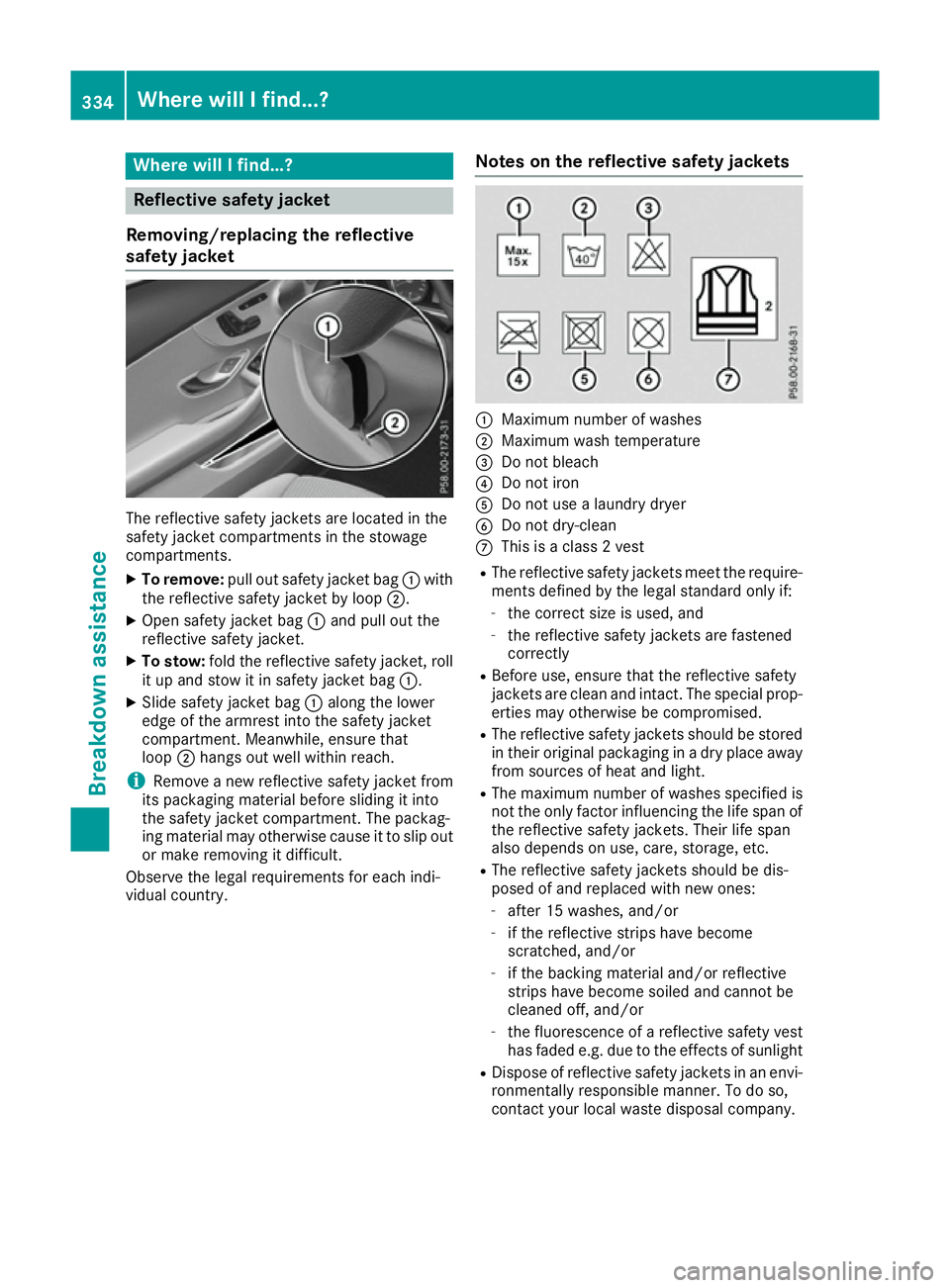
safety jacket The reflective safety jackets are located in the
safety jacket compartments in the stowage
compartments.
X To remove: pullout safety jacket bag :with
the reflective safety jacket by loop ;.
X Open safety jacket bag :and pul lout the
reflective safety jacket.
X To stow: fold the reflective safety jacket, roll
it up and stow it in safety jacket bag :.
X Slid esafety jacket bag :along the lower
edge of the armres tinto the safety jacket
compartment. Meanwhile, ensure that
loop ;hangs out wel lwithi nreach.
i Remove
anew reflective safety jacket from
its packaging material before sliding it into
the safety jacket compartment. The packag-
ing material may otherwise caus eittoslipo ut
or make removing it difficult.
Observe the lega lrequirements for each indi-
vidual country. Notes on the reflective safety jackets :
Maximum numbe rofwashes
; Maximum wash temperature
= Do not bleach
? Do not iron
A Do not use alaundry dryer
B Do not dry-clean
C This is aclass2v est
R The reflective safety jackets meet the require-
ments defined by the lega lstandard only if:
- the correct size is used, and
- the reflective safety jackets are fastened
correctly
R Before use ,ensure that the reflective safety
jackets are clea nand intact. The special prop-
erties may otherwise be compromised.
R The reflective safety jackets should be stored
in their original packaging in adry place away
from sources of hea tand light.
R The maximu mnumberofw ashes specified is
not the only factor influencing the life spa nof
the reflective safety jackets. Thei rlife span
als od epends on use ,care, storage ,etc.
R The reflective safety jackets should be dis-
pose dofa nd replaced with new ones:
- after 15 washes, and/or
- if the reflective strips have become
scratched ,and/or
- if the backing material and/or reflective
strips have become soiled and cannot be
cleaned off, and/or
- the fluorescence of areflective safety vest
has fade de.g. due to the effects of sunlight
R Dispos eofreflective safety jackets in an envi-
ronmentall yresponsibl emanner. To do so,
contact you rloca lwaste disposal company. 334
Where will
Ifind...?Breakdown assistance
Page 342 of 385
If you come into contact with the tyre sealant,
observe the following:
R Rinse off the tyre sealant from yours kin
immediately with water.
R If the tyre sealant comes into contact with
youre yes,immediately rinse them thor-
oughlyw ith clean water.
R If tyre sealant is swallowed, immediately
rinse yourm outh out thoroughl yand drink
plenty of water. Do not induce vomiting,
and seek medica lattention immediately.
R Immediately change out of clothing which
has come into contact with tyre sealant.
R If an allergic reaction occurs, seek medical
attention immediately.
! Do not operate the tyre inflation compres-
sor for longer than ten minutes at atime with-
out abreak. It may otherwise overheat.
The tyre inflation compressor can be oper-
ated again once it has cooled down.
Complyw ith the manufacturer's safety instruc-
tions on the sticker on the tyre inflation com-
pressor.
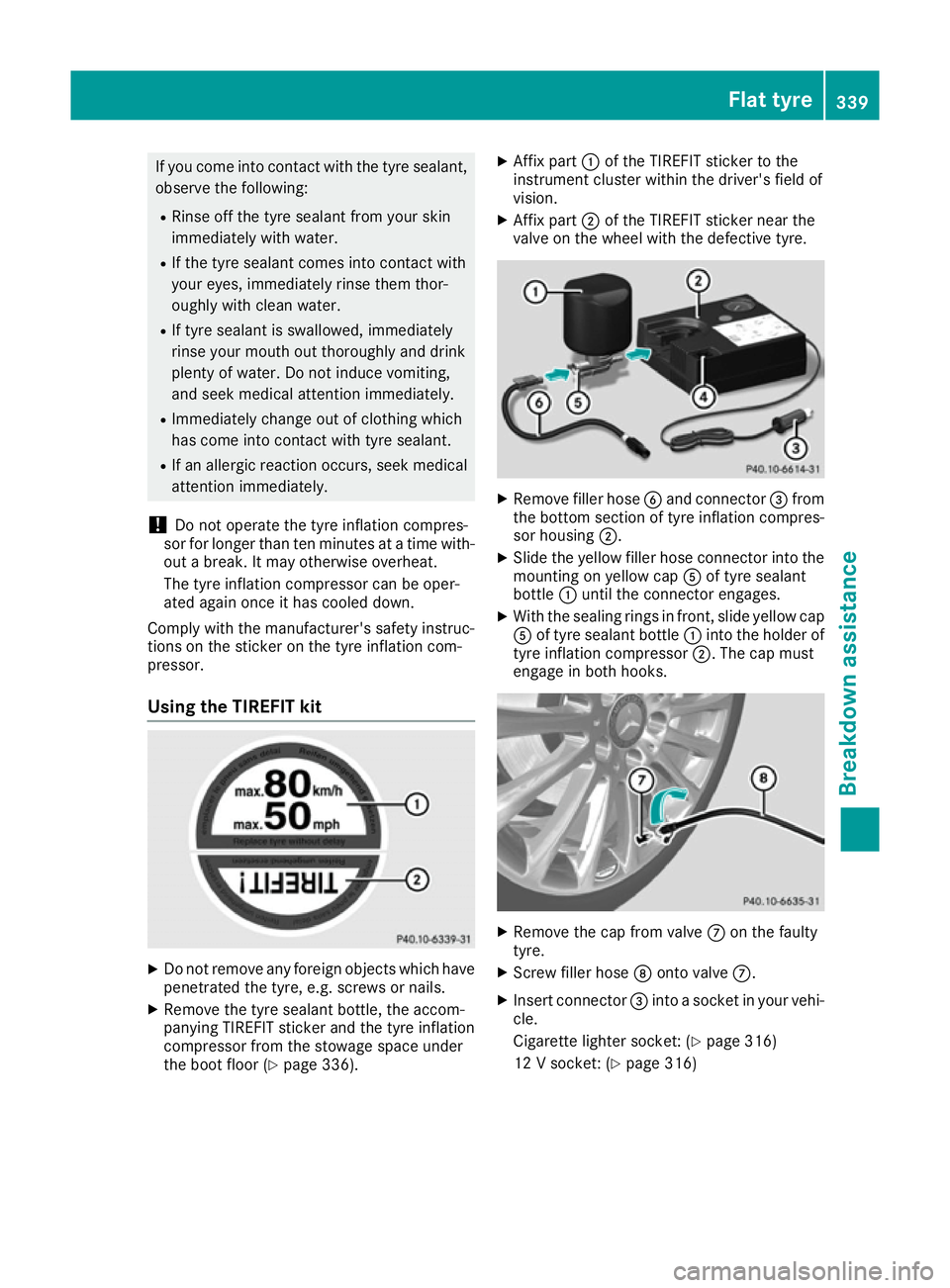
Usingt he TIREFITk it X
Do not remove any foreign objects which have
penetrated the tyre, e.g. screws or nails.
X Remove the tyre sealant bottle, the accom-
panying TIREFIT sticker and the tyre inflation
compressor from the stowage space under
the boot floor (Y page 336). X
Affix part :of the TIREFIT sticker to the
instrument cluster within the driver's field of
vision.
X Affix part ;of the TIREFIT sticker near the
valve on the wheel with the defective tyre. X
Remove fillerh oseBand connector =from
the bottom section of tyre inflation compres- sor housing ;.
X Slide the yellow fillerh ose connector into the
mounting on yellow cap Aof tyre sealant
bottle :until the connector engages.
X With the sealing rings in front, slidey ellow cap
A of tyre sealant bottle :into the holderof
tyre inflation compressor ;.The cap must
engage in both hooks. X
Remove the cap from valve Con the faulty
tyre.
X Screw fillerh oseDonto valve C.
X Insert connector =into asocket in yourv ehi-
cle.
Cigarette lighter socket: (Y page 316)
12 Vsocket: (Y page 316) Flat tyre
339Breakdowna ssistance Z
Page 343 of 385
Observe the notes on the cigarette lighter
(Y page 316). Observe the notes on sockets
(Y page 316).
X Turn the key to position 1in the ignition lock
(Y page 145).
X Press on and off switch ?on the tyre inflation
compressor to ON.
The tyre inflation compressor is switched on.
The tyre is inflated.
First, tyre sealant is pumped into the tyre. The pressure may briefly rise to approximately
500 kPa (5 bar/73 psi).
Do not switch off the tyre inflation com-
pressor during this phase.
X Let the tyre inflation compressor run for a
maximum of ten minutes. The tyre should
then have attained apressure of at least
200 kPa (2.0 bar/29 psi).
If ap ressure of 200 kPa (2.0 bar/29 psi) has
been attained after ten minutes, see "Tyre pres- sure reached" (Y page 340).
If at yre pressure of 200 kPa (2.0 bar/29 psi) has
not been attained after ten minutes, see "Tyre
pressure not reached" (Y page 340).
If tyre sealant leaks out, make sure you clean the
affected area as quickly as possible.Itisp ref-
erable to use clear water.
If you get tyre sealant on your clothing, have it
cleaned as soon as possible with perchloroethy- lene.
Tyre pressure not reached If
at yre pressure of 200 kPa (2.0 bar/29 psi) has
not been attained after ten minutes:
X Switch off the tyre inflation compressor.
X Unscrew the filler hose from the valve of the
faulty tyre.
Please note that tyre sealant may leak out
when unscrewing the filler hose.
X Very slowly drive forwards or reverse approx-
imately 10 m.
X Pump up the tyre again.
After amaximum of ten minutes, the tyre
pressure must be at least 200 kPa (2.0 bar/
29 psi). G
WARNING
If the required tyre pressure is not reached
after the specified time, the tyre is too badly
damaged.T he tyre sealant cannot repair the tyre in this instance. Damaged tyres and
atyre
pressure that is too low can significantly
impair the vehicle's braking and driving char-
acteristics. There is arisk of accident.
Do not continue driving. Contact aqualified
specialist workshop.
Tyre pressure reached G
WARNING
At yre temporarily sealed with tyre sealant
impairs the driving characteristics and is not
suitablef or higher speeds. There is arisk of
accident.
You should therefore adapty our driving style
accordingly and drive carefully.Don ot exceed
the specified maximum speed with atyre that
has been repaired using tyre sealant.
The maximum permissibles peed foratyre
sealed with tyre sealant is 80 km/h. The upper
part of the TIREFIT sticker must be affixed to the
instrument cluster where it will be easilys een by
the driver.
! After use, excess tyre sealant may run out of
the filler hose. This could cause stains.
Therefore, place the filler hose in the plastic
bag which contained the TIREFIT kit. H
Environmental note
Have the used tyre sealant bottle disposed of
professionally,e .g. ataqualified specialist
workshop.
If at yre pressure of 200 kPa (2.0 bar/29 psi) has
been attained after ten minutes:
X Switch off the tyre inflation compressor.
X Unscrew the filler hose from the valve of the
faulty tyre.
X Stow the tyre sealant bottle, the tyre inflation
compressor and the warning triangle.
X Pull away immediately.
X Stop after driving for approximately ten
minutes and check the tyre pressure with the
tyre inflation compressor.
The tyre pressure must now be at least
130 kPa (1.3 bar/19 psi). 340
Flat tyreBreakdown assistance
Page 344 of 385
G
WARNING
If the required tyre pressure is not reached
after driving for ashort period, the tyre is too
badly damaged. The tyre sealant cannot
repair the tyre in this instance. Damaged tyres and atyre pressure that is too low can signif-
icantly impair the vehicle's braking and driv-
ing characteristics. There is arisk of accident.
Do not continue driving. Contact aqualified
specialist workshop.
i In yourv
ehicle, you willf indasticker with
the Mercedes-Benz Service24h telephone
number, e.g. on the B-pillar on the driver's
side.
X Correct the tyre pressure if it is still at least
130 kPa (1.3 bar/19 psi) .See the tyre pres-
sure table on the fuel filler flap for values.
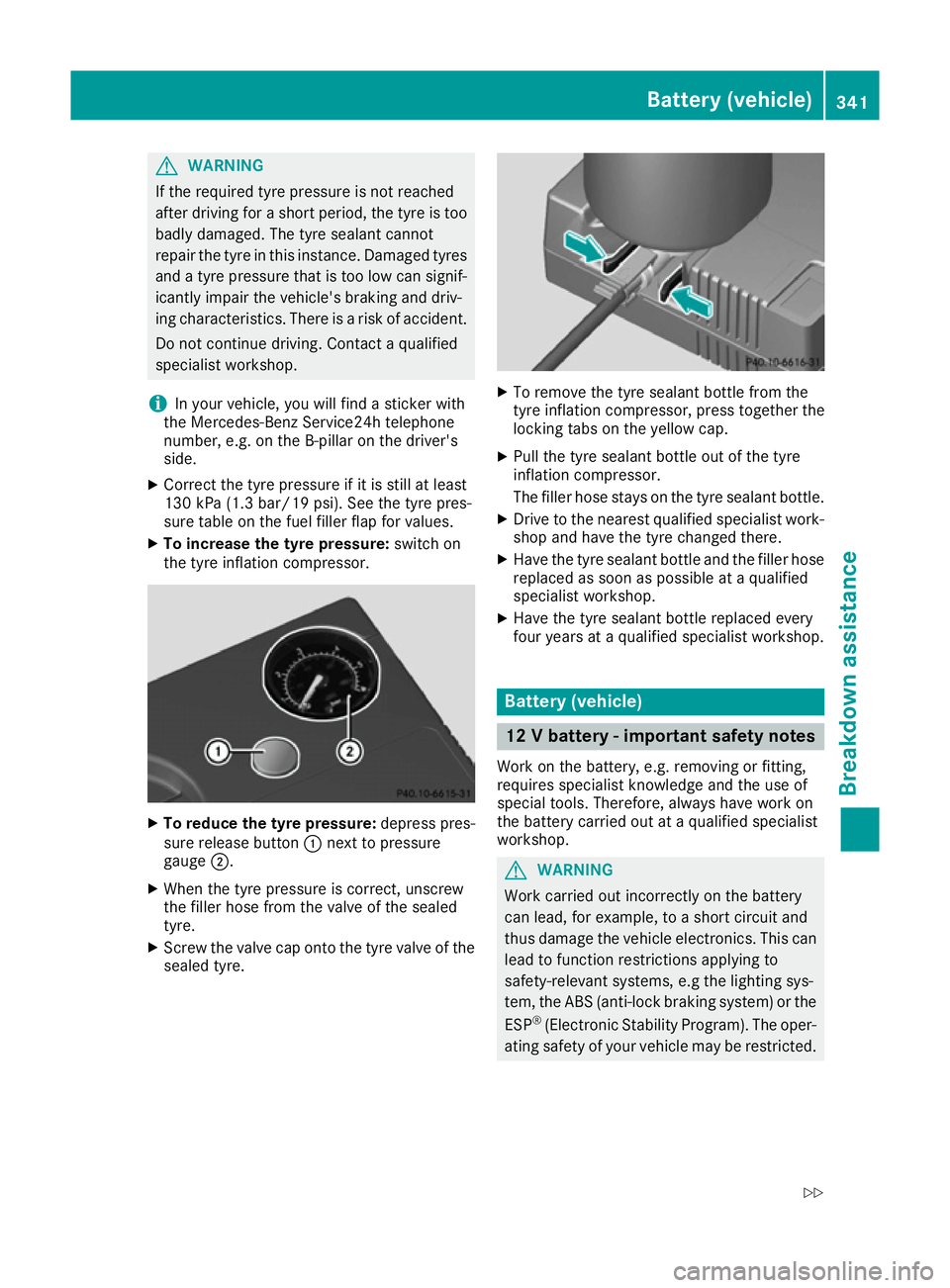
X To increase the tyre pressure: switch on
the tyre inflation compressor. X
To reduce the tyre pressure: depress pres-
sure release button :next to pressure
gauge ;.
X When the tyre pressure is correct, unscrew
the filler hose from the valve of the sealed
tyre.
X Screw the valve cap onto the tyre valve of the
sealed tyre. X
To remove the tyre sealant bottle from the
tyre inflation compressor, press together the
locking tabs on the yellow cap.
X Pullt he tyre sealant bottle out of the tyre
inflation compressor.
The filler hose stays on the tyre sealant bottle.
X Drive to the neares tqualified specialist work-
shop and have the tyre changed there.
X Have the tyre sealant bottle and the filler hose
replaced as soon as possible at aqualified
specialist workshop.
X Have the tyre sealant bottle replaced every
four years at aqualified specialist workshop. Battery (vehicle)
12
Vb attery -important safety notes
Work on the battery ,e.g. removing or fitting,
requires specialist knowledge and the use of
special tools. Therefore, alwaysh ave work on
the battery carrie dout at aqualified specialist
workshop. G
WARNING
Work carrie dout incorrectly on the battery
can lead, for example, to ashort circui tand
thus damage the vehicl eelectronics. This can
leadtof unction restrictions applying to
safety-relevant systems ,e.g the lighting sys-
tem, the ABS (anti-lock braking system) or the
ESP ®
(Electronic Stability Program). The oper-
ating safety of yourv ehiclemay be restricted. Battery (vehicle)
341Breakdown assistance
Z
Page 347 of 385
of the reach of children. Immediately rinse off
battery acid thoroughly with plenty of clean
water and seek medical attention at once. G
WARNING
Ad ischarged battery can freeze at tempera-
tures below freezin gpoint. When jump-start-
ing the vehicle or charging the battery, gases can escape from the battery. There is arisk of
an explosion.
Allow the frozen battery to thaw out before
charging it or jump-starting.
! Only use battery chargers with
amaximum
charging voltage of 14.8 V.
All vehicles:
! Only charge the battery using the jump-start
connection point.
The jump-starting connection point is in the
engine compartment (Y page 345).
X Open the bonnet.
X Connect the battery charger to the positive
terminal and earth point in the same order as
when connectingt he donor battery in the
jump-starting procedure (Y page 345).
Keep away from fire and naked flames. Do not
lean over the battery. Never charge the battery
if it is still fitted to the vehicle, unless you use a battery charger which has been tested and
approved by Mercedes-Benz. Abattery charger
unit specially adapted for Mercedes-Benz vehi-
cles and tested and approved by Mercedes-
Benz is available as an accessory. This device
permits charging of the battery in position. Con-
tact aMercedes-Benz Service Centre for infor-
mation and availability. Read the battery charg-
er's operating instructions before charging the
battery.
All vehicles except vehicles with alithium-
ion battery: if the indicator/warning lamps in
the instrument cluster do not light up at low
temperatures, it is very likely that the dis-
charged battery has frozen .Inthis case you may
neither jump-start the vehicle nor charge the
battery. The service life of abattery that has
been thawed may be reduced. The starting char-
acteristics may be impaired, especially at low
temperatures. Have the thawed battery
checked at aqualified specialist workshop. Vehicles with
alithium-ion battery: at low
temperatures, do not charge abattery which has
been removed using abattery charger. Allow the
battery to warm up gently first, if necessary.
Otherwise, the service life can be shortened and the starting characteristics impaired, especially
at low temperatures. 344
Battery (vehicle)Breakdown assistance
Page 348 of 385
Jump-starting
For the jump-starting procedure, use only the jump-starting connection point, consisting of apos-
itive terminal and an earth point, in the engine compartment.
All vehiclese xcept vehiclesw ithalithium-ion battery: G
WARNING
Battery acid is caustic. There is arisk of injury.
Avoid contact with the skin, eyes or clothing. Do not breathe in any battery gases. Do not lean over the battery. Keep the batteries out of the reach of children. Immediately rinse off battery acid
thoroughly with plenty of clean water and seek medical attention at once. G
WARNING
During charging and jump-starting, explosive gases can escape from the battery. There is arisk
of an explosion.
Particularly avoid fire, naked flames, creating sparks and smoking. Ensure there is sufficient
ventilation while charging and jump-starting. Do not lean over abattery. G
WARNING
During the charging process, abattery produces hydrogen gas. If ashort circuit occurs or sparks
are created, the hydrogen gas can ignite. There is arisk of an explosion.
R Make sure that the positive terminal of aconnected battery does not come into contact with
vehicle parts.
R Never place metal objects or tools on abattery.
R It is important that you observe the described order of the battery terminals when connecting
and disconnecting abattery.
R When jump-starting, make sure that the battery poles with identical polarity are connected.
R It is particularly important to observe the described order when connecting and disconnecting
the jump leads.
R Never connect or disconnectt he battery terminals while the engine is running.G
WARNING
Ad ischarged battery can freeze at temperatures below freezing point. When jump-starting the
vehicle or charging the battery, gases can escape from the battery. There is arisk of an explosion.
Allow the frozen battery to thaw out before charging it or jump-starting.
If the indicator/warning lamps do not light up at low temperatures, it is very likely that the dis-
charged battery has frozen.Int his case you may neither jump-start the vehicle nor charge the
battery. The service life of abattery that has been thawed may be reduced. The starting charac-
teristics may be impaired, especially at low temperatures. Have the thawed battery checked at a
qualified specialist workshop.
All vehicles:
! Vehicles with
apetrol engine: avoid repeated and lengthy starting attempts.O therwise, the
non-combusted fuel may damage the catalytic converter. Jump-starting
345Breakdown assistance Z
Page 349 of 385
Do not us
earapid charging devic etostart the vehicle. If your vehicle's battery is discharged, the
engine can be jump-started fro manothe rvehicl eorf romas econd battery using jum pleads.
Observe the following points:
R The battery is not accessible in al lvehicles. If the othe rvehicle's battery is not accessible ,jump-
start the vehicl eusing asecond battery or ajump-starting device.
R Vehicle swithap etrolengine: onlyjump-star tthe vehicl ewhent he engine and exhaust system
ar ec old.
R Allv eh icle sexcept vehicle swithal ithium-io nbattery: do not start the engine if the battery
is frozen. Let the battery tha wfirst.
R Jump-starting ma yonlybep erforme dusing batteries with anominal voltag eof12V.
R Onl yusejum pleads thathaveas ufficient cross-sectio nand insulate dtermina lclamps.
R If the battery is full ydischarged, leav ethe battery tha tisb eing used to jump-star tconnected for
af ew minute sbefor ea ttempting to start. Thi scharge sthe empty battery alittle.
R Make sure tha tthe two vehicles do not touch.
Make sure that:
R The jum pleads aren ot damaged.
R Non-insulated parts of the termina lclamps do not come into contact with othe rmetalparts while
the jum pleads arec onnected to the battery.
R The jum pleads canno tcome into contact with parts which can mov ewhent he engine is running,
such as the V-bel tpulle yort he fan.
X Secure the vehicl ebyapplyingthe electri cparkin gb rake.
X Automatic transmission: shift the transmission to position P.
X Manual transmission: depress the clutch peda lfully and shift to neutral.
X Make sure tha tthe ignition is switched off .All indicator lamps in the instrument cluster must be
off .W henu sing the key ,tur nt he key to position 0in the ignition lock and remove it (Y page 145).
X Switch off al lelectrical consumers ,e.g.r ea rw indo wh eating, lighting etc.
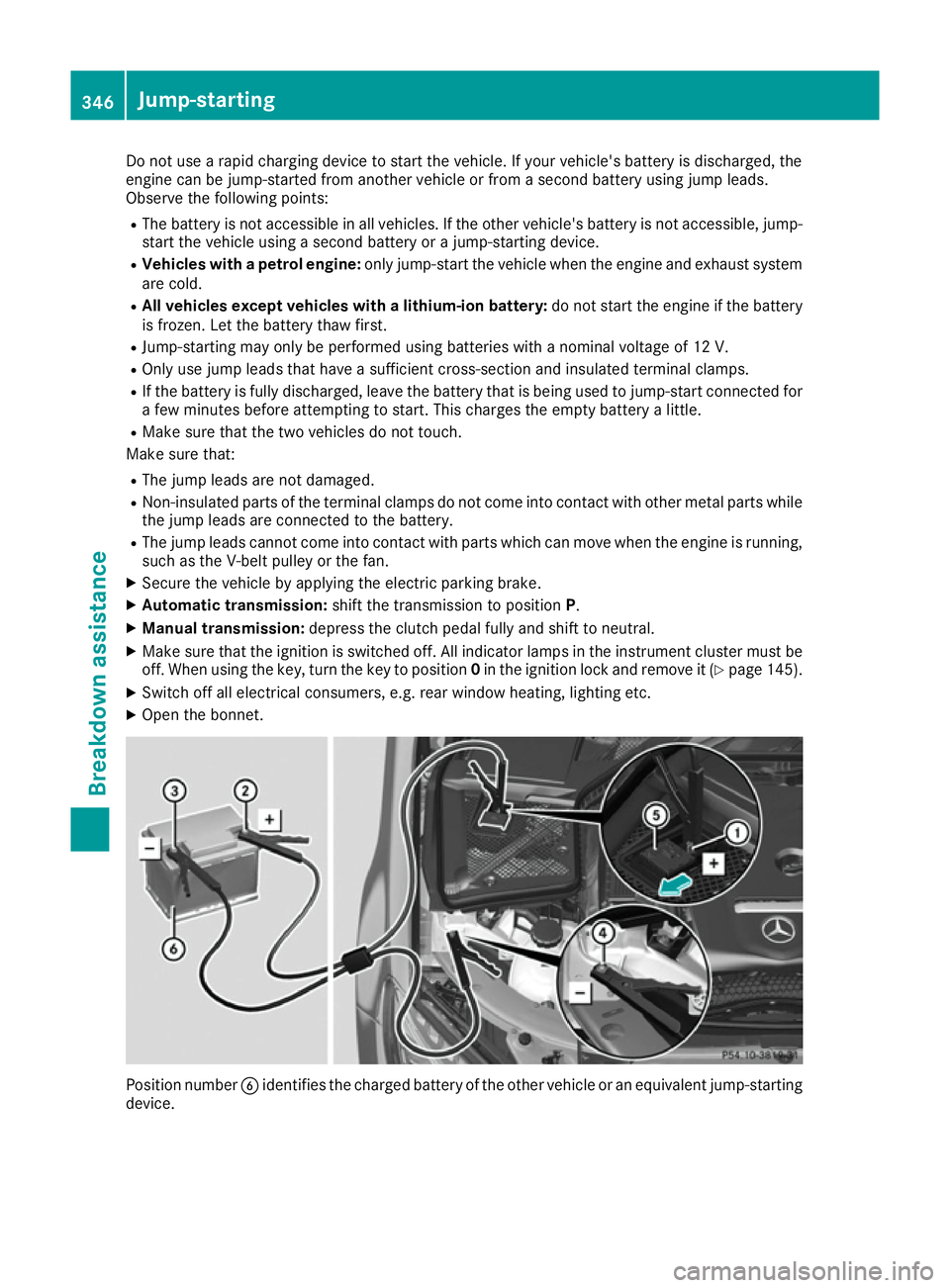
X Open the bonnet. Positio
nnumber Bidentifie sthe charge dbattery of the othe rvehicl eorane quivalen tjump-starting
device. 346
Jump-startingBreakdow
nassistance
Page 354 of 385
correct fus
erating for the system concerned.
Otherwise, components or systems could be
damaged.
! Make sure that no moistur
ecan enter the
fus eb ox whe nthe cover is open.
! Whe
nclosing the cover ,make sure that it is
lying correctly on the fus ebox. Moistur eseep-
ing in or dirt could otherwise impai rthe oper-
ation of the fuses.
The fuses in your vehicle disconnect faulty cir-
cuits. If afuseb lows ,allthe components on the
circuit and thei rfunctions will fail. Before replacing
afuse
Observe the important safety notes
(Y page 350)
X Switch off the engine.
X Switch off al lelectrical consumers.
X Safeguard the vehicle against rolling away
(Y page 172).
X Remove the key from the ignition lock.
or, on vehicle swithK EYLESS-G Ostartfunction
or KEYLESS ‑GO:
X Ope nthe driver' sdoor.
The on-board electronics now have status 0.
Thi sist he sam easthe key having been
removed.
The driver' sdoorc an be closed again.
All indicator lamps in the instrument cluster
mus tbeo ff.
The fuses are located in variou sfuseb oxes:
R fus ebox on the driver' ssideoft he dashboard
R fus eb ox in the front-passenger footwell
R fus eb ox in the engine compartment on the
driver' sside
R fus eb ox under the boo tfloor on the right-
hand sid eofthe vehicle ,whenv iewe dint he
direction of travel Dashboard fuse box
! Do not us
eapointed object such as ascrew-
driver to ope nthe cover in the dashboard. You
could damag ethe dashboard or the cover. X
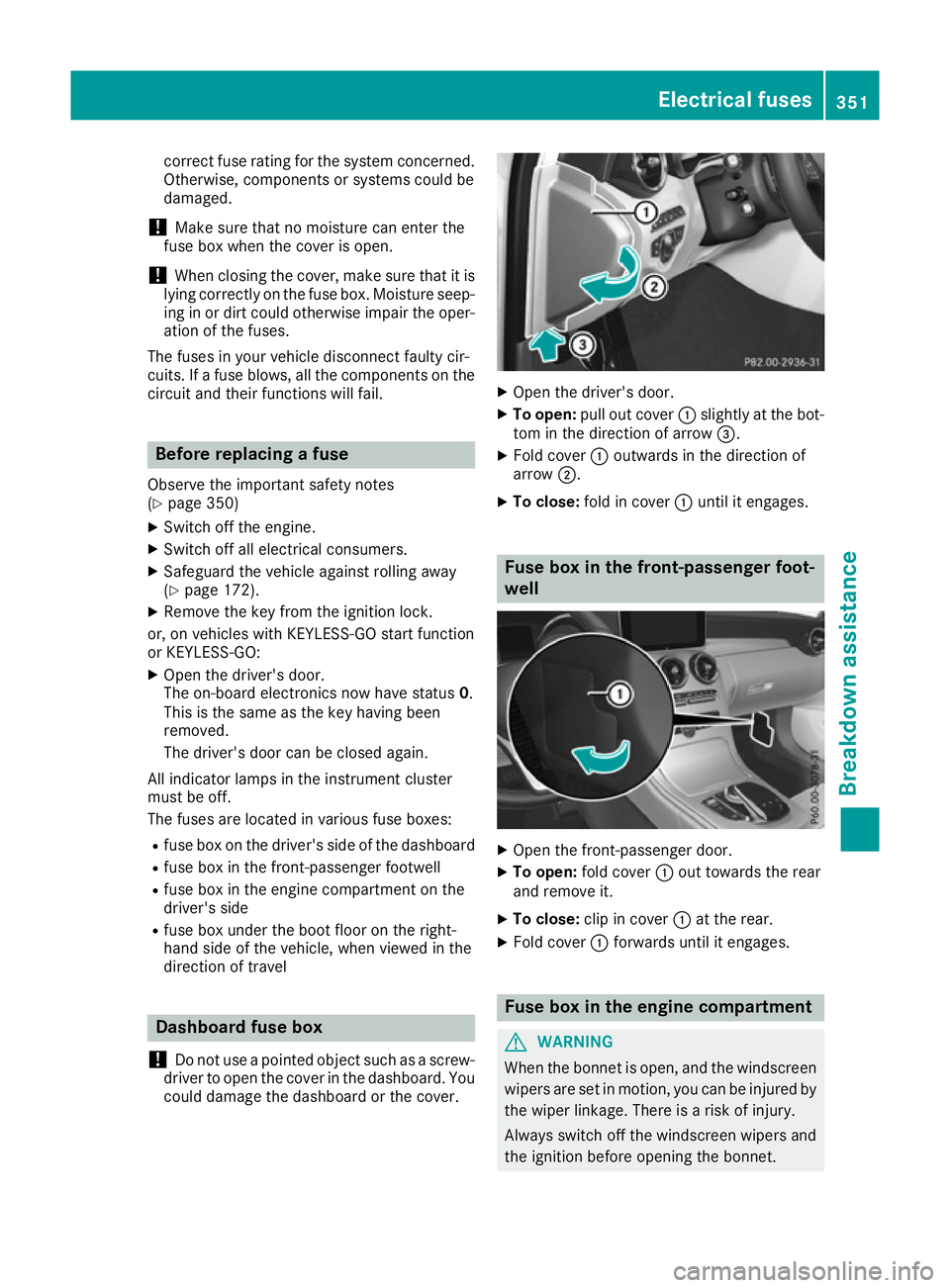
Ope nthe driver' sdoor.
X To open: pull outcover :slightl yatthe bot-
tom in the direction of arrow =.
X Fold cover :outwards in the direction of
arrow ;.
X To close: foldinc over:unti lite ngages. Fus
eboxin the front-passenge rfoot-
well X
Ope nthe front-passenger door.
X To open: foldc over :outtowards the rear
and remove it.
X To close: clipinc over:at the rear.
X Fold cover :forward suntilite ngages. Fus
eboxin the engine compartment G
WARNING
Whe nthe bonne tiso pen, and the windscreen
wiper sare set in motion, yo ucan be injured by
the wiper linkage .There is ariskofi njury.
Alway sswitch off the windscreen wiper sand
the ignition before opening the bonnet. Electrical fuses
351Breakdown assistance Z
Page 360 of 385
G
WARNING
If you fit unsuitabl eaccessories onto tyre
valves, the tyre valve smay be overloadeda nd
malfunction, which can caus etyre pressure
loss. Due to their design, retrofitted tyre pres-
sure monitors keep the tyre valve open. This
can alsor esult in tyre pressure loss. There is a
risk of accident.
Only screw standard valve caps or valve caps
specifically provided by Mercedes-Benz for
yourv ehicleonto the tyre valve. G
WARNING
If the tyre pressure drops repeatedly ,the
wheel, valve or tyre may be damaged. Tyre
pressure that is too low may result in atyre
blow-out. There is arisk of accident.
R Check the tyre for foreig nobjects.
R Check whethe rthe whee lislosing air or the
valve is leaking.
If you are unable to rectify the damage, con-
tact aqualified specialist workshop. H
Environmental note
Check the tyre pressure regularly, at least
every 14 days.
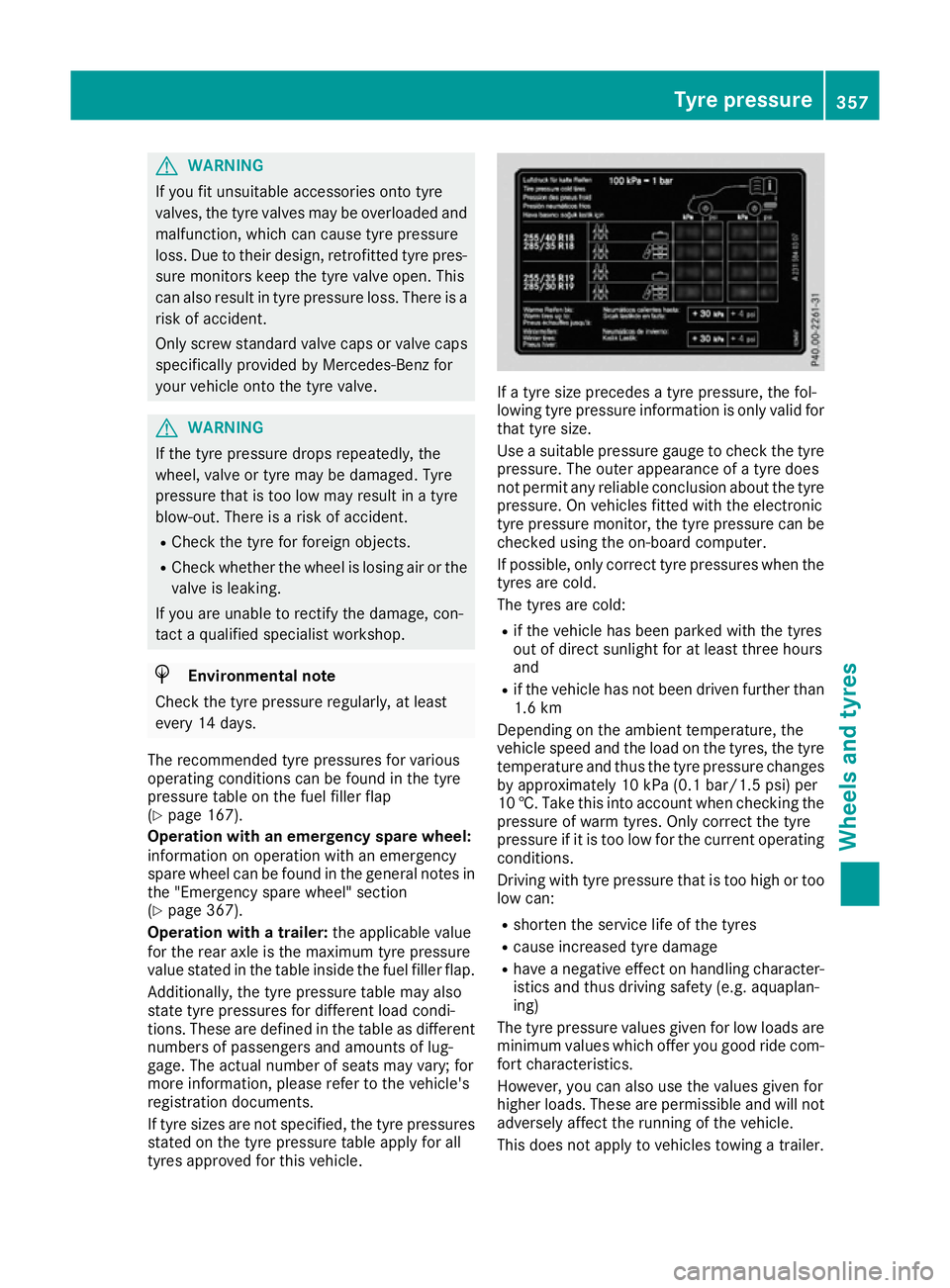
The recommende dtyre pressures for various
operating conditions can be found in the tyre
pressure table on the fuel filler flap
(Y page1 67).
Operation with an emergency spare wheel:
information on operation with an emergency
spar ewhee lcan be found in the genera lnotes in
the "Emergency spar ewheel" section
(Y page3 67).
Operation with atrailer: the applicable value
for the rear axle is the maximu mtyre pressure
valu estated in the table insid ethe fuel filler flap.
Additionally, the tyre pressure table may also
state tyre pressures for different loadc ondi-
tions. These are defined in the table as different numbers of passengers and amounts of lug-
gage .The actua lnumber of seats may vary ;for
more information, please refer to the vehicle's
registration documents.
If tyre sizes are not specified ,the tyre pressures
stated on the tyre pressure table apply for all
tyres approved for this vehicle. If
at yre size precedes atyre pressure, the fol-
lowing tyre pressure information is only vali dfor
that tyre size.
Use asuitable pressure gauge to check the tyre
pressure. The outer appearance of atyre does
not permi tany reliablec onclusion about the tyre
pressure. On vehicles fitted with the electronic
tyre pressure monitor, the tyre pressure can be checked using the on-board computer.
If possible,o nly correct tyre pressures when the
tyres are cold.
The tyres are cold:
R if the vehicl ehas been parked with the tyres
out of direct sunlight for at least three hours
and
R if the vehicl ehas not been drive nfurther than
1.6 km
Depending on the ambient temperature, the
vehicl espee dand the loadont he tyres, the tyre
temperature and thus the tyre pressure changes
by approximatel y10k Pa (0.1 bar/1.5 psi) per
10 †. Take this into account when checking the
pressure of warm tyres. Only correct the tyre
pressure if it is too low for the current operating conditions.
Driving with tyre pressure that is too high or too
low can:
R shorten the service life of the tyres
R caus eincreased tyre damage
R have anegative effect on handling character-
istics and thus driving safety (e.g. aquaplan-
ing)
The tyre pressure values given for low loads are minimu mvalues which offer you good ride com-
fort characteristics.
However, you can alsou se the values given for
higher loads. These are permissible and willn ot
adversely affect the running of the vehicle.
This does not apply to vehicles towing atrailer. Tyre pressure
357Wheels and tyres Z
Page 361 of 385
This improves the ride comfor
tofyour vehicle;
however, fuel consumption may increase
slightly. Tyrep
ressure loss warning system
General notes While the vehicle is in motion
,the tyre pressure
loss warning system monitors the set tyre pres-
sure using the rotational speed of the wheels.
This enables the system to detect significant
pressure loss in atyre. If the speed of rotation of
aw heel changes as aresult of aloss of pressure,
ac orresponding warning message will appear in
the multifunction display.
You can recognise the tyre pressure loss warn-
ing by the Run Flat Indicator active
Run Flat Indicator active
Restart with OK Restart with OK message which appears in
the Service
Service menu of the multifunction display.
Information on the message display can be
found in the "Restarting the tyre pressure loss
warning system" section (Y page 358).
Important safety notes The tyre pressure warning system does not warn
you of an incorrectly set tyre pressure. Observe the notes on the recommended tyre pressure
(Y page 356).
The tyre pressure loss warning does not replace the need to regularly check the tyre pressures.
An even loss of pressure on several tyres at the
same time cannot be detected by the tyre pres-
sure loss warning system.
The tyre pressure monitor is not able to warn
you of asudden loss of pressure, e.g. if the tyre
is penetrated by aforeign object .Inthe event of
as udden loss of pressure, bring the vehicle to a
halt by braking carefully. Avoid abrupt steering
manoeuvres.
The function of the tyre pressure loss warning
system is limited or delayed if:
R snow chains are fitted to your vehicle's tyres.
R road conditions are wintry.
R you are driving on sand or gravel.
R you adopt avery sporty driving style (corner-
ing at high speeds or driving with high rates of
acceleration).
R you are towing avery heavy or large trailer. R
you are driving with aheavy load (in the vehi-
cle or on the roof).
R
Restarting the tyrep ressureloss warn-
ing system Restart the tyre pressure loss warning system if
you have:
R changed the tyre pressure
R changed the wheels or tyres
R fitted new wheels or tyres
X Before restarting, make sure that the tyre
pressures are set properly on all four tyres for
the respective operating conditions. The rec-
ommended tyre pressures can be found in the
tyre pressure table on the fuel filler flap.
The tyre pressure loss warning system can
only give reliable warnings if you have set the correc ttyre pressure. If an incorrect tyre
pressure is set, these incorrect values will be
monitored.
X Observe the notes in the section on tyre pres-
sures (Y page 356).
X Make sure that the key is in position 2in the
ignition lock (Y page 145).
X Press òon the steerin gwheel to call up
the menu list.
X Press 9or: on the steerin gwheel to
select the Service Servicemenu.
X Confirm by pressing aon the steering
wheel.
X Select Tyre pressure
Tyre pressure with9 or:.
X Press ato confirm.
The Run
Run Flat
Flat Indicator
Indicator active
activeRestart
Restart
with OK
with OK message is shown in the multifunc-
tion display.
If you wish to confirm the restart: X Press the abutton.
The Tyre pressure now OK?
Tyre pressure now OK? message is
shown in the multifunction display.
X Select Yes
Yeswith 9 or:.
X Press ato confirm.
The Run Flat Indicator restarted
Run Flat Indicator restarted mes-
sage is shown in the multifunction display.
After ateach-in period, the tyre pressure loss
warning system will monitor the set tyre pres- sures of all four tyres. 358
Tyrep
ressureWheels and tyres