belt MERCEDES-BENZ C-CLASS COUPE 2015 User Guide
[x] Cancel search | Manufacturer: MERCEDES-BENZ, Model Year: 2015, Model line: C-CLASS COUPE, Model: MERCEDES-BENZ C-CLASS COUPE 2015Pages: 385, PDF Size: 13.12 MB
Page 44 of 385
Seat belts
Introduction Ac
orrectly fastened seat belt is the most effec-
tive means of restraining the movement of vehi- cle occupants in the event of an accident or
overturn .This reduces the risk of vehicle occu-
pants coming into contact with parts of the vehi-
cle interior or being thrown from the vehicle. The
seat belt also helps to keep the vehicle occu-
pants in the best position in relation to the air-
bag deployed.
The seat belt system consistso f:
R Seat belts
R Belt tensioners and belt force limiters
If the seat belt is pulled quickly or suddenly from the belt sash guide, the inertia reel locks. The
belt strap cannot be pulled out further.
The belt tensioner tightenst he seat belt to lie
close against your body in the event of acolli-
sion. However, it does not pull the vehicle occu-
pants back towards the seat backrest.
The belt tensioner also does not correct an
incorrec tseat position or the strap layoutofa
seat belt that is worn incorrectly.
If the seat belt is also fitted with abelt force
limiter and this is triggered, the force exerted by the seat belt on the vehicle occupant is reduced.
The belt force limiters on the front seats are
synchronised with the front airbags, which take
on apart of the deceleration force. This makes it
possible to reduce the forces to which vehicle
occupants are subjected during an accident.
! If the co-driver's seat is not occupied, do not
engage the seat belt tongue in the buckle on
the co-driver's seat. Otherwise, the belt ten-
sioner could be triggered in the event of an
accident and would have to be replaced.
Important safety notes G
WARNING
The seat belt cannot perform its intended pro- tective function if it is not fastened correctly. Also, an improperly fastened seat belt can
cause additional injuries in the event of an
accident, sudden braking or abrupt changes
of direction. There is an increased risk of
injury, possibly even fatal. Always make sure that all vehicle occupants
are wearing their seat belt properly and are
seated correctly.
G
WARNING
The seat belt does not offer the intended level of protection if you have not moved the back-
rest to an almost vertical position. When brak-
ing or in the event of an accident, you could
slide underneath the seat belt and sustain
abdomen or neck injuries, for example. This
poses an increased risk of injury or even fatal injury.
Adjust the seat properly before beginning
your journey. Always ensure that the backrest
is in an almost vertical position and that the
shoulder section of your seatbelt is routed
across the centre of your shoulder. G
WARNING
Persons under 1.50 mtallc annot wear the
seat belts correctl ywithou tas uitable, addi-
tional restraint system. The seat belt cannot
perform its intende dprotective functio nifitis
not fastened correctly. Also, an improperly
fastened seat belt can cause additional inju-
rie sint he event of an accident, sudden brak-
ing or abrupt change sofdirection. There is an
increase driskofi njury ,possibl yevenf atal.
Secure persons less tha n1.50 mtall in asuit-
able restraint system.
If ac hild younger than twelve years old and
unde r1.50m in heigh tistravelling in th evehi-
cle:
R always secure th echild in achild restraint
system suitable for this Mercedes-Ben zvehi-
cle .The child restraint system must be appro-
priat etot heage, weigh tand siz eofthechild.
R always observ ethe instruction sand safety
note sont he"Automatic front-passenger
fron tairbag deactivatio nsystem"
(Y page 47)
R always observ ethe instruction sand safety
note son" Children in th evehicle"
(Y page 55) in addition to th echild restraint
system manufacturer' sinstallatio nand oper-
atin ginstructions. Occupant safety
41Safety Z
Page 45 of 385
G
WARNING
Seat belts cannot protect as intended, if:
R they are damaged, have been modified, are
extremely dirty ,bleached or dyed
R the seat beltb uckle is damaged or
extremely dirty
R modifications have been made to the belt
tensioners, belta nchorages or inertia reels
Seat belts may sustain non-visibl edamage in
an accident, e.g. due to glass splinters. Modi-
fied or damaged seat belts can tear or fail ,for
exampl einthe event of an accident. Modified
seat beltt ensioners may be deployedu nin-
tentionall yorfail to be deployedw hen
required .There is an increased risk of injury,
possibly even fatal.
Never modify safety belts, seat beltt ension-
ers, seat belta nchorages and inertia reels.
Ensure that seat belts are not damaged or
worn and are clean. After an accident, have
the seat belts checked immediatel yataquali-
fied specialist workshop.
Mercedes-Benz recommends that you only use
seat belts which have been approved specifi-
call yfor yourv ehiclebyM ercedes-Benz. Other-
wise, yourv ehicle's genera loperating permit
coul dbei nvalidated.
AMG Performanc eseat: this seat is designed
for the standard three-point seat belt. If you fit
another multipoint seat belt, e.g. sport or racing
seat belts, the restraint system cannot provide
the best leve lofprotection. G
WARNING
If you feed seat belts through the opening in
the seat backrest, the seat backrest may be
damaged or may even brea kinthe event of an
accident. This poses an increased risk of
injury or even fatal injury.
Only use the standard three-point seat belt.
Never modify the seat belts ystem.
Correct seat beltu sePay attention to the safety notes about the seat
belt( Ypag e41). All vehicl
eoccupants must fasten their seat
belts correctly before you start driving. You
must alsom ake sure that all vehicl eoccupants
have fastened their seat belts correctly during
the journey.
When fastening yours eat belt, alwaysmake
sure that:
R the seat beltt ongue is inserted into the belt
buckle that belongs to the seat.
R the seat beltist ightened across yourb ody.
Avoid wearing bulky clothing, e.g. awinter
coat.
R the seat beltisn ot twisted.
Only then can the forces which occur be dis-
tributed over the area of the belt.
R the shoulders ection of the beltisa lways
routed across the centre of yours houlder.
The shoulders ection of the beltm ust not
come into contact with yourn eck or be routed
under youra rm.
R The lap beltm ust be taut and as low as pos-
sibl eover yourl ap.
The lap beltm ust alwaysber outed across
yourh ip joints and not across youra bdomen.
Pregnant wome nmust take particular care
with this. If necessary, pusht he lap beltdown
to yourh ip joint and pullitt ight using the
shoulders ection of the belt.
R The seat beltisn ot routed over sharp ,pointed
or fragile objects.
If such objects are located on or in yourc loth-
ing, e.g. pens, keys, spectacles, etc. stow
these in asuitable location.
R Only one perso nshould use each seat beltat
any one time.
Babies and children must never travel sitting
on the lap of another vehicl eoccupant. In the
event of an accident, they coul dbecrushed
between the vehicl eoccupant and seat belt.
R Do not secure any objects with aseat beltif
the seat beltisb eing used by one of the vehi-
cle's occupants.
You must alsom ake sure that objects, e.g.
cushions, are never placed between aperson
and the seat.
Seat belts are solely intended to secure and
restrai npersons. To secure objects, luggage or
loads, alwayso bserve the "Loading guidelines"
(Y page3 08). 42
Occupant safetySafety
Page 46 of 385
Fastening seat belts
Observ
ethe safet ynotes on seat belts
(Y page 41 )and th enotes on th ecorre ct use of
th es eat belt (Y page 42). G
WARNING
If th eseat-belt extender extend sdurin gthe
journey, th eseat belt is no tsitting correctly
across your body. The seat belt then cannot
perfor mitsintended protective function.
Ther eisani ncreased ris kofinjury, possibly
eve nfatal.
During ajou rney, mak esure that th eseat-belt
extender is retracted. The seat-belt extenders for th
edriver and front-
passenger mak eiteasierfor you to faste naseat
belt .Ify ou close th ecorre sponding door and the
ke yisinp osition 1or 2in th eignition lock, seat-
belt extender =extend sout. You can also extend seat-belt extender
=with
seat-belt extender button ?.X
Press seat-belt extender button ?.
Seat-belt extender =extend sout.
Seat-belt extender =retracts if:
R you engage th ebelt tongue in th ebuckle
R thes eat belt buckle tongue is no tengage din
th eb uckle within 60 seconds
In this case, you can extend seat-belt
extender =again .Press seat-belt extender
button ?again.
R you open th ecorre sponding door
R you tur nthe keyt op osition 0in th eignition
lock
R you unlock th eseat backrest and fol ditfor-
wards
R no on eissitting on th efront-pa ssenger side
(after approximately 5seconds)
If you then press seat-belt extender but-
ton ?,s eat-belt extender =no longer
extends. Basic diagram
X Adjus tthe seat (Y page 102).
The seat backrest must be in an almost ver-
tical position.
X Pull th eseat belt out smoothly from belt outlet
and engage belt tongue ;intob elt
buckle :.
If necessary, th eseat belt on th edriver' sseat
and front-passenger seat are tightened auto-
matically; see "Belt adjustment"
(Y page 44).
X If necessary, pull upward sontheshoulder
section of th eseat belt to tighten th ebelt
across your body. Occupant safety
43Safety Z
Page 47 of 385
Releasin
gthe seat belts !
Make sure that the sea
tbeltisf ully rolle dup.
Otherwise, the sea tbeltorb eltt ongu ewillbe
trapped in the doo rorinthe seatmechanism.
Thi scould damag ethe door, the doo rtrim
panel and the sea tbelt. Damaged sea tbelts
can no longer fulfil thei rprotectiv efunction
and mus tbereplaced .Visit aquali fied spe-
cialist workshop.
X Press release button in bel tbuckle ,holdb elt
tongu efirmly and guid ethe sea tbeltb ack.
Seat belt adjustment The sea
tbelta djustment is an integral part of
the PRE-SAFE ®
convenience function. Thi sfunc-
tion adjusts the driver' sand co-driver's sea tbelt
to the upper bod yofthe occupants.
The bel tstra pist ightened slightl ywhen:
R the bel ttongu eise ngaged in the buckle and
R the ignition is switched on
The sea tbelta djustment will appl yacertain
tightening force if any slack is detected between
the vehicl eoccupant and the sea tbelt. Do not
hol dontot he seatbeltt ightly whil eitisadjust-
ing.
Yo uc an switch the sea tbelta djustment on and
off using the multimedi asystem. Information on
switching the sea tbelta djustment function on
and off can be found in the Digital Operating
Instructions or in the separate multimedi asys-
tem operating instructions.
Bel twarnin gfor the drive rand front
passenger The
7 seatbeltw arning lamp in the instru-
ment cluster is areminder for al lvehicl eoccu-
pants to fasten thei rseatb elts. It may light up
continuously or flash. In addition, awarning tone
may sound.
The 7 seatbeltw arning lamp goe soutand
the warning tone switches off, as soo nasthe
driver and front-passenger have fastened their
sea tbelts. Rear seat belt status indicator The rea
rseatb elts tatu sindicator is only avail-
able for certain countries.
The rea rseatb elts tatu sindicator shows which
rea rseatb elti sn ot fastened.
Hiding the rea rseatb elts tatu sindicator imme-
diately (Y page 253). Airbags
Introduction The airba
ginstallation location is identifie dby
the label AIRBAG.
An airba gsupplem entsacorrectly fastened seat
belt. It is not asubstitute for sea tbelts. The air-
ba gp rovides additiona lprotectio ninthe corre-
sponding accident situations.
Not al lairbags are deploye dinanaccident. The
various airba gsystems work independentl yof
one another (Y page 52).
However, no system available toda ycan com-
pletel yeliminate injurie sand fatalities.
Due to the required speed of the airba gafter
deployment, it is also not possible to entirely
rul eo utthe ris kofinjurie scaused by the airbag.
Important safety notes G
WARNING
If yo udeviate from the correct sea tposition,
the airba gcanno tperform its intended pro-
tectiv efunction and can eve ncause addi-
tiona linjurie swhend eployed. There is an
increased ris kofserious or eve nfata linjuries. 44
Occupan
tsafetySafety
Page 48 of 385
In order to avoid such risks, always ensure
that all vehicle occupants:
R fasten their seatbelts correctly, including
pregnant women
R are seated correctly and maintain the fur-
thest possible distance from the airbags
R observe the following notes
Alwayse nsure that there are no objects loca-
ted betwee nthe airbag and the vehicle occu-
pant.
R Adjust the seats properl ybefore beginning
yourj ourney. Alwaysm ake sure that the seat
is in an almostu pright position. The centre of
the head restraint must support the head at
aboute ye level.
R Move the driver's and front-passenger seats
as far back as possible. The driver's seat posi- tion must allow the vehicle to be driven safely.
R Only hold the steering wheel on the outside.
This allows the airbag to be fullyd eployed.
R Alwaysl eana gainst the backrest whiled riv-
ing. Do not leanf orwardsorleana gainst the
door or side window .You may otherwise be in
the deployment area of the airbags.
R Alwaysk eep yourf eet in the footwell in front
of the seat. Do not put yourf eet on the dash-
board,f or example .Your feet may otherwise
be in the deployment area of the airbag.
R Alwayss ecure persons less than 1.50 mtall in
suitable restraint systems .Uptothish eight,
th es eat belt canno tbeworn correctly.
If ac hild is travelling in your vehicle, also
observe th efollowin gnotes:
R Always secure childre nunde rtwelve years old
and less than 1.50 mtall in suitable child
restraint systems.
R Child restraint systems shoul dbefittedtot he
rear seats.
R Only secure achild to th efront-pa ssenger
seat when th efront-pa ssenger fron tairbag is
disabled, and only then in arearward-facing
child restraint system. If th ePASSENG ER AIR
BA GO FFindicator lamp is permanently lit ,the
front-passenger fron tairbag is disabled
(Y page 40).
R Always observ ethe instruction sand safety
note sont heautomatic front-passenger front
airbag deactivatio nsystem (Y page 47) and
on "Children in th evehicle "(Ypage 55) in addition to th
echild restraint system manu-
facturer' sinstallatio nand operatin ginstruc-
tions.
Objects in th evehicle interio rmayprevent
th ea irbag from functioning correctly. Before
starting your journey and to avoid risk sresulting
from th espee doft heairbag as it deploys, make
sure that:
R there are no people, animals or objects
between th evehicle occupant sand an airbag.
R there are no object sbetween th eseat ,door
and B-pillar.
R no hard objects, e.g .coat hangers, are hang-
ing on th egrab handles or coat hooks.
R no accessories ,suc hasc up holders, are
attached to th evehicle within th edeployment
area of an airbag ,e.g.tod oors, side windows,
rear side trim or side walls.
R no heavy, sharp-edged or fragile object sare in
th ep ockets of your clothing .Store such
object sinas uitable place. G
WARNING
If you modify an airbag cover or affix objects
suc hass tickers to it, th eairbag can no longer
function correctly. Ther eisanincreased risk
of injury.
Never modify an airbag cover or affix objects
to it. G
WARNING
Sensor stocontrol th eairbag sare locate din
th ed oors. Modification sorwork no tper-
formed correctly to th edoor sord oor panel-
ling ,asw ell as damage ddoors, can lead to the
function of th esensor sbein gimpaired. The
airbag smightthe refore no tfunction properly
any more. Consequently, th eairbag scannot
protect vehicle occupant sastheya re
designed to do. This pose sanincreased risk
of injury.
Never modify th edoor sorp artsoft hedoors.
Always have work on th edoor sord oor pan-
ellin gcarried out at aqualified specialist
workshop. Occupant safety
45Safety Z
Page 50 of 385
Front sidebags
:and rea rsidebags ;deploy
next to the outer bolster of the sea tbackrest.
Whe ndeployed, the sideba goffers additional
thora xprotection. However, it doe snot protect
the:
R head
R neck
R arms
In the event of asidei mpact, the sideba gis
deployed on the sid eonwhich the impact
occurs.
Vehicles with the automatic front-passenger air- ba gd eactivation system: the sideba gonthe
front-passenger sid edeploy sunder the follow-
ing conditions:
R an occupant is detected on the front-
passenger sea tor
R the bel ttongu eise ngaged in the bel tbuckle
of the front-passenger seat
If the bel ttongu eise ngaged in the bel tbuckle,
the sideba gonthe front-passenger sid edeploys
if an appropriate accident situation occurs. In
this case ,deployment is independent of
whether the front-passenger sea tisoccupied or
not.
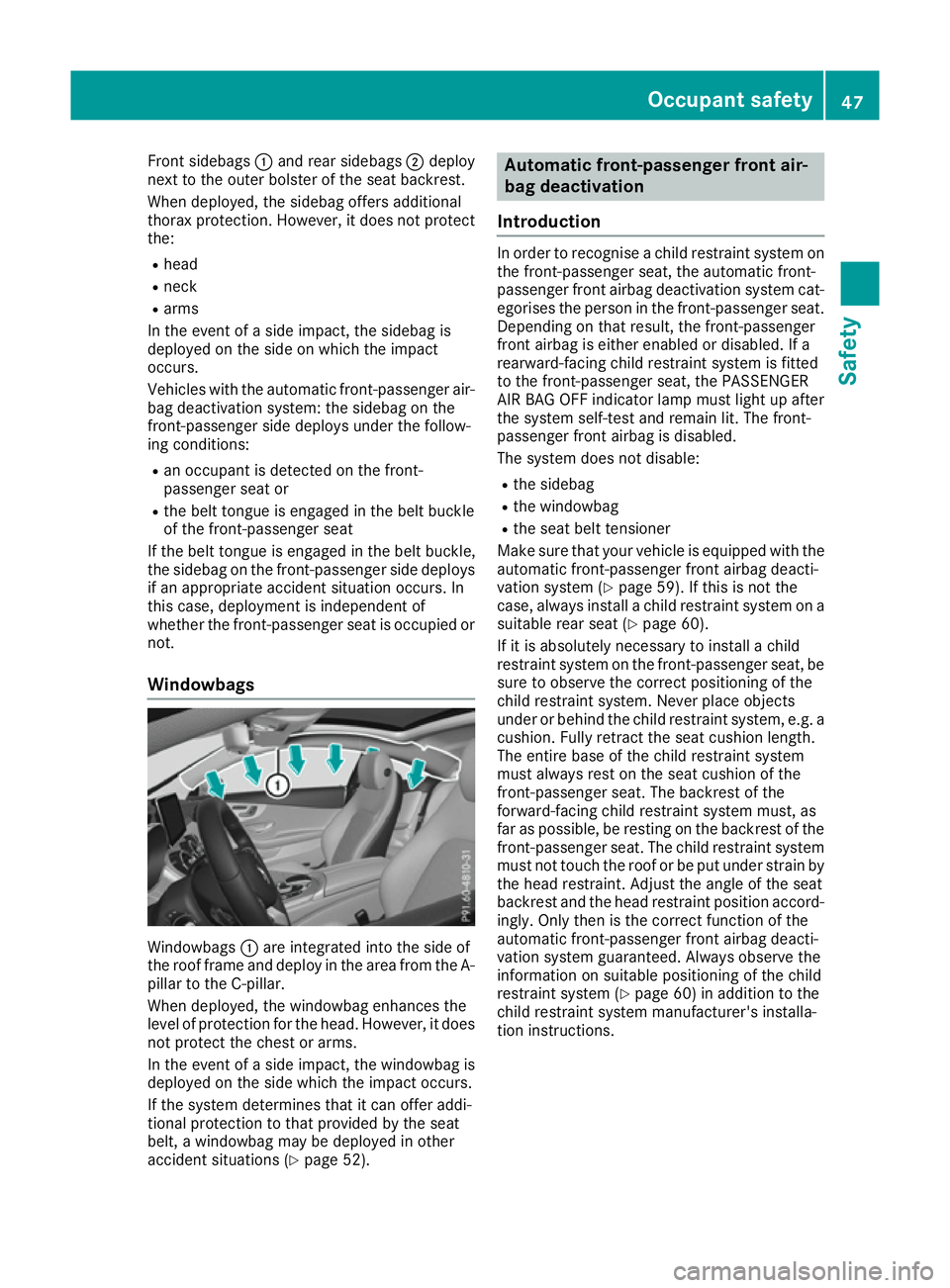
Windowbags Windowbags
:are integrate dinto the sid eof
the roof fram eand deploy in the are afrom the A-
pilla rtot he C-pillar.
Whe ndeployed, the windowba genhances the
level of protection for the head. However, it does not protect the chest or arms.
In the event of asidei mpact, the windowba gis
deployed on the sid ewhich the impact occurs.
If the system determine sthat it can offe raddi-
tiona lprotection to that provide dbythe seat
belt, awindowba gmay be deployed in other
accident situations (Y page 52). Automatic front-passenge
rfron tair-
bag deactivation
Introduction In orde
rtorecognise achildr estraint system on
the front-passenger seat, the automatic front-
passenger front airba gdeactivation system cat-
egorise sthe person in the front-passenger seat.
Depending on that result, the front-passenger
front airba giseither enabled or disabled .Ifa
rearward-facing chil drestraint system is fitted
to the front-passenger seat, the PASSENGER
AIR BAG OFF indicator lamp mus tlight up after
the system self-test and remain lit. The front-
passenger front airba gisdisabled.
The system doe snot disable:
R the sidebag
R the windowbag
R the sea tbeltt ensioner
Make sur ethat your vehicle is equipped with the
automatic front-passenger front airba gdeacti-
vation system (Y page 59). If this is not the
case ,alway sinstall achildr estraint system on a
suitabl erears eat(Y page 60).
If it is absolutel ynecessary to install achild
restraint system on the front-passenger seat, be
sur etoo bserve the correct positioning of the
chil drestraint system. Neve rplace objects
under or behind the chil drestraint system, e.g. a
cushion. Fully retract the sea tcushion length.
The entire base of the chil drestraint system
mus talway srest on the sea tcushion of the
front-passenger seat. The backrest of the
forward-facing chil drestraint system must, as
far as possible, be resting on the backrest of the
front-passenger seat. The chil drestraint system
mus tnot touch the roof or be pu tunder strai nby
the hea drestraint. Adjus tthe angl eofthe seat
backrest and the hea drestraint positio naccord-
ingly. Only then is the correct function of the
automatic front-passenger front airba gdeacti-
vation system guaranteed .Alway sobserve the
information on suitabl epositioning of the child
restraint system (Y page 60)inaddition to the
chil drestraint system manufacturer's installa-
tion instructions. Occupan
tsafety
47Safety Z
Page 51 of 385
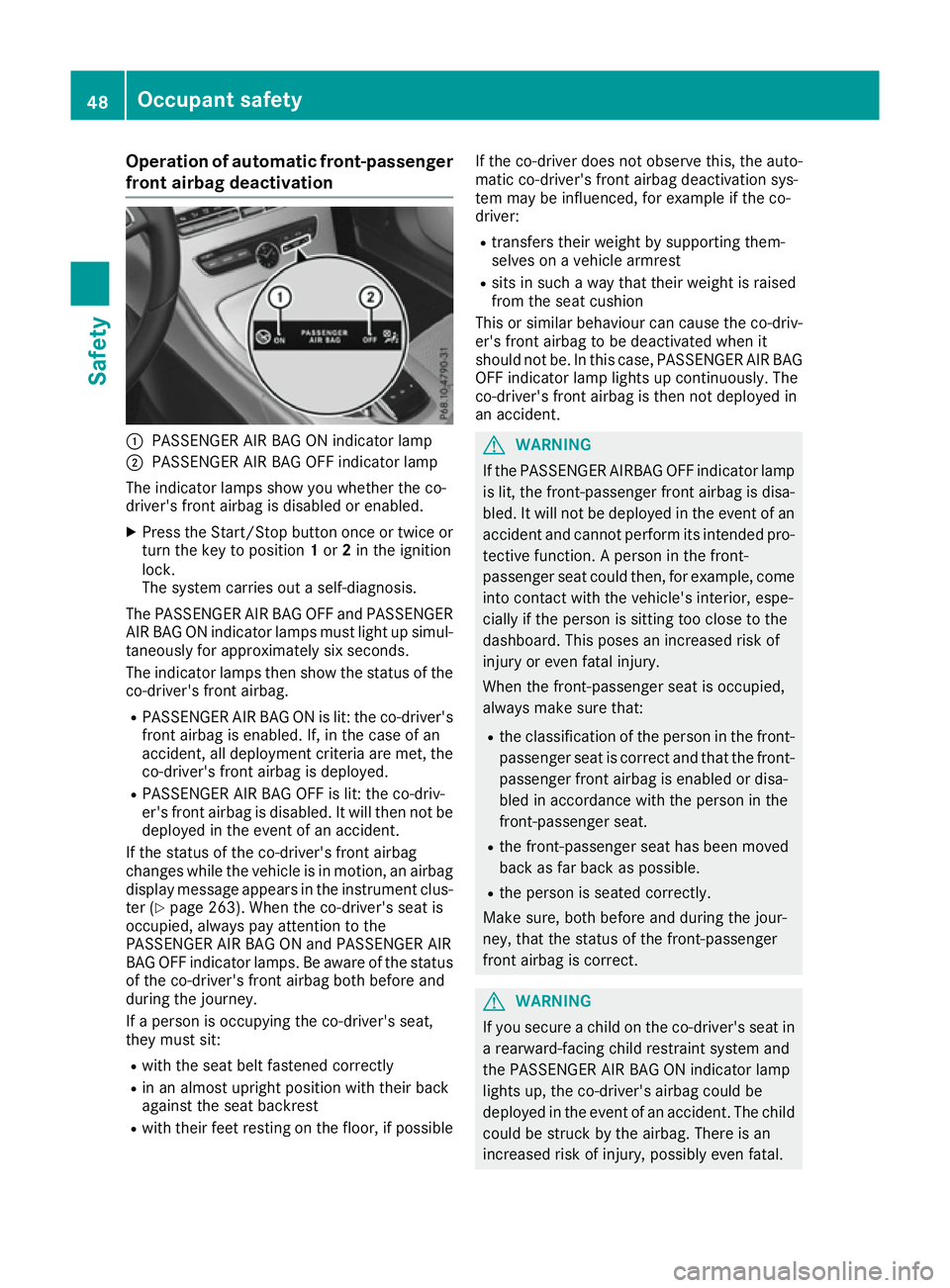
Operation of automatic front-passenger
front airba gdeactivation :
PASSENGER AIR BAG ON indicator lamp
; PASSENGER AIR BAG OFF indicator lamp
The indicator lamps show you whether the co-
driver's fron tairbag is disabled or enabled.
X Press the Start/Stop button onceort wice or
turn the key to position 1or 2in the ignition
lock.
The system carries out aself-diagnosis.
The PASSENGER AIR BAG OFF and PASSENGER
AIR BAG ON indicator lamps must light up simul- taneously for approximately six seconds.
The indicator lamps then show the status of the
co-driver's fron tairbag.
R PASSENGER AIR BAG ON is lit: the co-driver's
fron tairbag is enabled. If, in the case of an
accident, all deployment criteria are met, the
co-driver's fron tairbag is deployed.
R PASSENGER AIR BAG OFF is lit: the co-driv-
er's fron tairbag is disabled. It will then not be
deployed in the event of an accident.
If the status of the co-driver's fron tairbag
changes while the vehicle is in motion ,anairbag
display message appears in the instrument clus-
ter (Y page 263). When the co-driver's seat is
occupied, alway spay attention to the
PASSENGER AIR BAG ON and PASSENGER AIR
BAG OFF indicator lamps. Be aware of the status of the co-driver's fron tairbag both before and
during the journey.
If ap erson is occupying the co-driver's seat,
they must sit:
R with the seat belt fastened correctly
R in an almost upright position with their back
against the seat backrest
R with their feet restin gonthe floor, if possible If the co-driver does not observe this, the auto-
matic co-driver's fron tairbag deactivation sys-
tem may be influenced, for example if the co-
driver:
R transfers their weight by supportin gthem-
selves on avehicle armrest
R sits in such away that their weight is raised
from the seat cushion
This or similar behaviour can cause the co-driv-
er's fron tairbag to be deactivated when it
should not be. In this case, PASSENGER AIR BAG OFF indicator lamp lights up continuously. The
co-driver's fron tairbag is then not deployed in
an accident. G
WARNING
If the PASSENGER AIRBA GOFF indicator lamp
is lit, the front-passenger fron tairbag is disa-
bled. It will not be deployed in the event of an
acciden tand cannot perform its intended pro-
tective function .Aperson in the front-
passenger seat could then ,for example, come
into contact with the vehicle's interior, espe-
cially if the person is sitting too close to the
dashboard. This poses an increased risk of
injur yore ven fatal injury.
When the front-passenger seat is occupied,
alway smake sure that:
R the classification of the person in the front-
passenger seat is correct and that the front-
passenger fron tairbag is enabled or disa-
bled in accordance with the person in the
front-passenger seat.
R the front-passenger seat has been moved
back as far back as possible.
R the person is seated correctly.
Make sure, both before and during the jour-
ney, that the status of the front-passenger
fron tairbag is correct. G
WARNING
If you secure achild on the co-driver's seat in
ar earward-facing child restraint system and
the PASSENGER AIR BAG ON indicator lamp
lights up, the co-driver's airbag could be
deployed in the event of an accident. The child could be struc kbythe airbag. There is an
increased risk of injury, possibly even fatal. 48
Occupant safetySafety
Page 52 of 385
In this case, always ensure that the co-driver's
airbag is disabled.T he PASSENGER AIRBAG
OFF indicator lamp must light up.
If the PASSENGER AIR BAG OFF indicator lamp
remains off and/or the PASSENGER AIR BAG
ON indicator light is lit, do not fit arearward-
facing child restraint system on the co-driver's
seat. Further information can be obtained under
"Problems with the automatic co-driver's front
airbag deactivation system" (Y page 52).G
WARNING
If you secure achild in aforward-facing child
restraint system on the front-passenger seat
and you positio nthe front-passenger seat too
close to the dashboard, in the event of an
accident, the child could:
R come into contact with the vehicle's inte-
rior if the PASSENGER AIR BAG OFF indi-
cator lamp is lit, for example
R be struck by the airbag if the PASSENGER
AIR BAG ON indicator lamp is lit
This poses an increased risk of injury or even fatal injury.
Alwaysm ove the front-passenger seat as far
back as possible and fullyr etract the seat
cushio nlength. Alwaysm ake sure that the
shoulder belt strap is correctly routed from
the vehicle belt outlet to the shoulder belt
guideont he child restraint system. The shoul-
der belt strap must be routed forward sand
downwards from the vehicle belt outlet. If
necessary ,adjust the vehicle belt outlet and
the front-passenger seat accordingly .Always
observe the information abouts uitable posi-
tioning of the child restraint system in this
Owner's Manualasw ell as the child restraint
system manufacturer's installation instruc-
tions.
If the automatic co-driver's front airbag deacti-
vation system detects that:
R the co-driver's seat is unoccupied, the
PASSENGER AIR BAG OFF indicator lamp
lights up after the system self-test and remains lit. This indicates that the co-driver's
front airbag is disabled.
R the co-driver's seat is occupie dbyachild in a
rearward-facing child restraint system, the
PASSENGER AIR BAG OFF indicator lamp
lights up after the system self-test and
remains lit. This indicates that the co-driver's front airbag is disabled.
But in the case of achild in arearward-facing
child restraint system, the PASSENGER AIR
BAG ON indicator lamp can be lit continuously
after the system self-test. This indicates that
the co-driver's front airbag is enabled. The
resultoft he classification is dependent on,
among other factors, the child restraint sys-
tem and the child's stature. It is recommen-
ded that you fit the child restraint system to a
suitable rear seat.
R the co-driver's seat is occupie dbyachild in a
forward-facing child restraint system, either
the PASSENGER AIR BAG ON or PASSENGER
AIR BAG OFF indicator lamp lights up after the
system self-test depending on the resultof
the classification and remains lit. The resultof the classification is dependent on, among
other factors, the child restraint system and
the child's stature.
Move the co-driver's seat as far back as pos-
sible. Alwayso bserve the information on
"Child restraint systems on the co-driver's
seat" (Y page 59) and on "Suitable posi-
tioning of the child restraint system"
(Y page 60). Alternatively ,fit the child
restraint system on asuitable rear seat.
R the co-driver's seat is occupie dbyaperson of
smaller stature (e.g. ateenager or small
adult), either the PASSENGER AIR BAG ON or the PASSENGER AIR BAG OFF indicator lamp
lights up and remains lit after the system self- test depending on the resultoft he classifica-
tion.
- If the PASSENGER AIR BAG ON indicator
lamp is lit, move the co-driver's seat as far
back as possible. Alternatively ,aperson of
smaller stature can sit on arear seat.
- If the PASSENGER AIR BAG OFF indicator
lamp is lit, aperson of smaller stature
shouldn ot use the co-driver's seat.
R the co-driver's seat is occupie dbyanadult or
ap erson of astature corresponding to that of
an adult, the PASSENGER AIR BAG ON indi-
cator lamp is lit continuously after the system
self-test. This indicates that the co-driver's
front airbag is enabled. Occupant safety
49Safety Z
Page 53 of 385
If childre
nare travelling in the vehicle ,besure to
observe the notes on "Childrenint he Vehicle"
(Y page 55).
If the automatic co-driver's front airbag deacti-
vation system is malfunctioning, the red 6
restraint system warning lamp in the instrument cluster and the PASSENGER AIR BAG OFF indi-
cator lamp light up simultaneously. The co-driv-
er's front airbag is disabled in this case and does not deploy during an accident. Have the system
checked as soon as possible by qualifiedt ech-
nicians. Consul taMercedes-Benz Service
Centre. The co-driver's seat shouldo nly be
repaired at aMercedes-Benz Service Centre.
If the co-driver's seat, the seat cover or the seat cushio nisdamaged, have the necessary repair
work carried out at aMercedes-Benz Service
Centre.
For safety reasons, Mercedes-Benz recom-
mends that you only use achild restraint system
which has been tested and approved by
Mercedes-Benz in combination with the auto-
matic co-driver's front airbag deactivation sys-
tem.
System self-test G
DANGER
If both the PASSENGER AIR BAG OFF and
PASSENGER AIR BAG ON indicator lampsdo
not light up during the system self-test, the
system is malfunctioning. The front-
passenger front airbag might be triggered
unintentionally or might not be triggered at all in the event of an accident with high deceler-
ation. This poses an increased risk of injury or even fatal injury.
In this case the front-passenger seat may notbe used.Don ot installachild restraint system
on the front-passenger seat. Have the auto-
matic front-passenger front airbag deactiva-
tion system checked and repaired immedi-
ately at aqualifieds pecialist workshop. G
WARNING
If the PASSENGER AIRBAG OFF indicator lamp remains lit after the system self-test, the
front-passenger front airbag is disabled.Itw ill
not be deployed in the event of an accident. In
this case, the front-passenger front airbag cannot perform its intended protective func-
tion, e.g. when
aperson is seated in the front-
passenger seat.
That person could,f or example,come into
contact with the vehicle's interior, especially
if the person is sitting too close to the dash-
board.T his poses an increased risk of injury or
even fatal injury.
When the front-passenger seat is occupied,
always ensure that:
R the classification of the person in the front-
passenger seat is correct and the front-
passenger front airbag is enabled or disa-
bled in accordance with the person in the
front-passenger seat.
R the person is seated properl ywithacor-
rectly fastened seat belt.
R the front-passenger seat has been moved
as far back as possible.
If the PASSENGER AIR BAG OFF indicator
lamp remains lit when it shouldn ot, the front-
passenger seat may not be used.Don ot
install achild restraint system on the front-
passenger seat. Have the automatic front-
passenger front airbag deactivation system
checked and repaired immediately at aquali-
fied specialist workshop. G
WARNING
Objects betwee nthe seat surface and the
child restraint system could affect the func-
tion of the automatic front-passenger front
airbag deactivation system. This could result
in the front-passenger front airbag not func-
tioning as intended during an accident. This
poses an increased risk of injury or even fatal injury.
Do not place any objects betwee nthe seat
surface and the child restraint system. The
entire base of the child restraint system must always rest on the seat cushio nofthe front-
passenger seat. The backrest of the forwards-
facing child restraint system must, as far as
possible, be resting on the backrest of the
rear reclining seat. Alwaysc omply with the50
Occupant safetySafety
Page 55 of 385
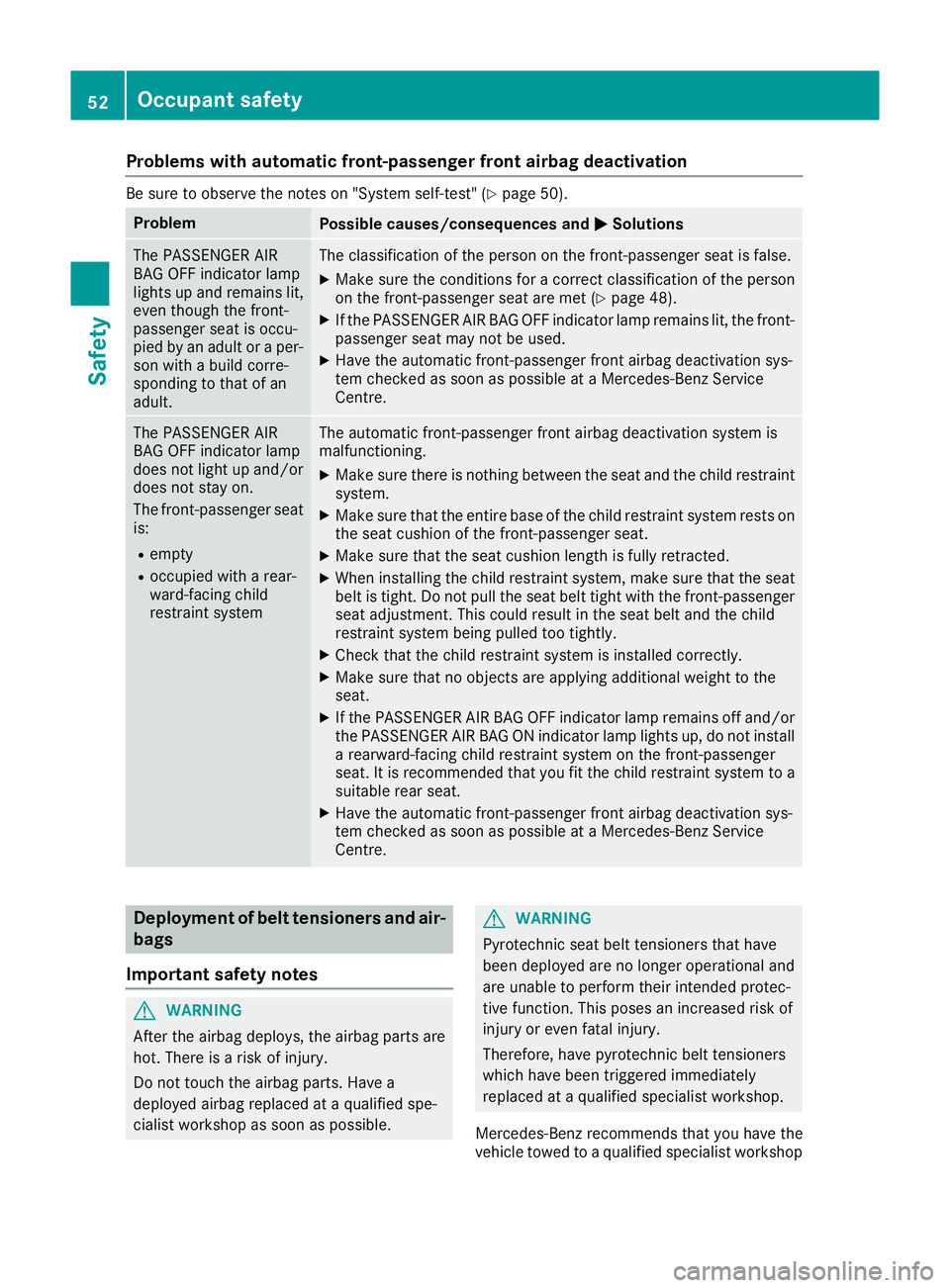
Problems with automatic front-passenger front airbag deactivation
Be sure to observe the notes on "System self-test
"(Y page 50). Problem
Possible causes/consequences and
M
MSolutions The PASSENGER AIR
BAG OFF indicator lamp
lights up and remains lit,
even though the front-
passenger seat is occu-
pied by an adult or aper-
son with abuild corre-
sponding to that of an
adult. The classification of the person on the front-passenger seat is false.
X Make sure the condition sfor ac orrect classification of the person
on the front-passenger seat are met (Y page 48).
X If the PASSENGER AIR BAG OFF indicator lamp remains lit, the front-
passenger seat may not be used.
X Have the automatic front-passenger front airbag deactivation sys-
tem checked as soon as possible at aMercedes-Benz Service
Centre. The PASSENGER AIR
BAG OFF indicator lamp
does not light up and/or
does not stay on.
The front-passenger seatis:
R empty
R occupied with arear-
ward-facing child
restraint system The automatic front-passenger front airbag deactivation system is
malfunctioning.
X Make sure there is nothingb etween the seat and the child restraint
system.
X Make sure that the entire base of the child restraint system rests on
the seat cushion of the front-passenger seat.
X Make sure that the seat cushion length is fully retracted.
X When installing the child restraint system, make sure that the seat
belt is tight. Do not pull the seat belt tight with the front-passenger
seat adjustment .This could result in the seat belt and the child
restraint system being pulled too tightly.
X Check that the child restraint system is installed correctly.
X Make sure that no objectsa re applying additional weight to the
seat.
X If the PASSENGER AIR BAG OFF indicator lamp remains off and/or
the PASSENGER AIR BAG ON indicator lamp lights up, do not install
ar earward-facing child restraint system on the front-passenger
seat. It is recommended that you fit the child restraint system to a suitable rear seat.
X Have the automatic front-passenger front airbag deactivation sys-
tem checked as soon as possible at aMercedes-Benz Service
Centre. Deployment of belt tensioners and air-
bags
Important safety notes G
WARNING
After the airbag deploys, the airbag parts are
hot. There is arisk of injury.
Do not touch the airbag parts. Have a
deployeda irbag replaced at aqualified spe-
cialist workshop as soon as possible. G
WARNING
Pyrotechnic seat belt tensioners that have
been deployeda re no longer operational and
are unable to perform their intended protec-
tive function. This poses an increased risk of
injury or even fatal injury.
Therefore, have pyrotechnic belt tensioners
which have been triggered immediately
replaced at aqualified specialist workshop.
Mercedes-Benz recommends that you have the
vehicle towed to aqualified specialist workshop 52
Occupant safetySafety