belt MERCEDES-BENZ C-CLASS COUPE 2015 Owner's Manual
[x] Cancel search | Manufacturer: MERCEDES-BENZ, Model Year: 2015, Model line: C-CLASS COUPE, Model: MERCEDES-BENZ C-CLASS COUPE 2015Pages: 385, PDF Size: 13.12 MB
Page 56 of 385
after an accident. Tak
ethisi ntoa ccount, par-
ticularly if aseat belt tensioner was triggered or
an airbag was deployed.
An electric motor is used by PRE-SAFE ®
to trig-
ger th etightening of th eseat belt in hazardous
situations .This procedure is reversible.
If th ebelt tensioners are triggered or an airbag is
deployed, you will hear abang ,and asmall
amoun tofpowder may also be released. The
6 restraint system warning lamp light sup.
Only in rar ecases will th ebang affect your hear-
ing .Ing eneral, th epowder released is no thaz-
ardous to healt hbut may caus eshort-term
breathin gdifficulties to person ssufferin gfrom
asthma or other pulmonar yconditions. Provided
it is safe to do so, you shoul dleave th evehicle
immediately or open th ewindow in orde rtopre-
ven tbreathin gdifficulties.
Operation During th
efirst stage of acollision ,the restraint
system control unit evaluates important physi-
cal dat arelating to vehicle deceleratio noraccel-
eration ,suc ha s:
R duration
R direction
R intensity
Based on th eevaluation of this data, the
restraint system control unit trigger sthe seat
belt tensioners in th eeven tofah ead-on or rear
collision.
As eat belt tensioner can only be triggered if:
R thei gnition is switched on
R thec omponent softherestraint system are
operational. You can fin dfurther information
under: "Restrain tsystem warning lamp"
(Y page 40)
R theb elt tongue has engaged in th ebelt buckle
of th erespectiv efront seat
The seat belt tensioners in th erear compart-
men tare triggered independently of th elock
status of th eseat belts.
If th erestraint system control unit detect sahigh
severit yaccident, in certain head-on collisions,
additional component softherestraint system
are deployed independently of each other:
R fron tairbag sand driver' skneebag
R windowbag, if th esystem determine sthat
deploymen tcan offer additional protection to
that provided by th eseat belt On vehicle
swith th eautomatic front-passenger
fron tairbag deactivatio nsystem: dependin gon
th ep erson in th efront-pa ssenger seat ,the
front-passenger fron tairbag is either disable dor
enabled. The front-passenger fron tairbag can
only be deployed in an acciden tifthe
PASSENGER AI RBAG ON indicator lamp is lit.
Observ ethe informatio nonthePASSENGER AIR
BA Gindicator lamps (Y page 40).
Your vehicle has two-stag efront airbags. In the
first deploymen tstage, th efront airbag is filled
with propellan tgas to reduc ethe risk of injuries.
The fron tairbag is fully deployed if th esecond
deploymen tstage is activated within afew mil-
liseconds.
The activation threshold for th eseat belt ten-
sioners and airbag sisdetermine dbased on the
evaluation of th evehicle's rat eofdeceleration
or acceleratio natvarious points in th evehicle.
This process is pre-emptive in nature. The trig-
gering/deployment process shoul dtakep lace
in good tim eatthestart of th ecollision.
The rat eofvehicle deceleratio noracceleration
and th edirection of th eforce are essentially
determine dby:
R thed istribution of forces durin gthe collision
R thec ollision angle
R thed eformatio ncharacteristics of th evehicle
R thec haracteristics of th eobject with which
th ev ehicle has collided
Factors whic hcan only be seen and measured
after acollision has occurre ddonotplay adeci-
sive role in th edeploymen tofanairbag,nor do
they provide an indication of airbag deployment.
The vehicle may be deformed significantly with-out an airbag bein gdeployed. This is th ecaseif
only part swhicha re relatively easily deformed
are affected and th erateofd eceleratio nisnot
high .Conversely, an airbag may be deployed
even though th evehicle suffers only minor
deformation. This is th ecasei f, for example,
ver yrigidv ehicle part ssuchasl ongitudinal body
members are hit ,and sufficient deceleration
occurs as aresult.
If th erestraint system control unit detect saside
impact, th eapplicable component softhe
restraint system are activated independently of
each other.
R Sidebags on th eside on whic hanimpact
occurs, independen tfromt heseat belt ten-
sioner and seat belt usage
Vehicle swith th eautomatic front-passenger
airbag deactivatio nsystem: th esidebag on Occupant safety
53Safety Z
Page 57 of 385
the front-passenge
rsided eploys under the
following conditions:
- an occupant is detecte donthe front-
passenge rseator
- the belt tongue is engaged in the belt
buckle of the front-passenge rseat
R Windowbag on the side on which an impact
occurs, independent of seat belt usag eand
regardles sofwhether the front-passenger
seat is occupied
R Fron tseatb eltt ensioners ,ifthe system
determine sthatd eployme nt can offer addi-
tional protection for the vehicl eoccupants in
thi ss ituation
i Not al
lairbags ar edeployed in an accident.
The different airba gsystems work independ-
entl yofe acho ther.
How the airba gsystemw orks is determined
by the severity of the accident detected,
especiall ythe vehicl edeceleratio noraccel-
eration, and the apparent typ eofaccident:
R frontal collision
R side impact PRE-SAFE
®
(anticipatory occupant
protection)
Introduction PRE-SAFE
®
take spre-emptive measures to pro-
tect occupants in certain hazardous situations.
Important safety notes !
Make sure tha
tthere ar enoobjects in the
footwell or behind the seats .There is arisk
tha tthe seats and/or the objects could be
damage dwhenP RE-SAFE ®
is activated.
Although your vehicl eisequippe dwithaP RE-
SAFE ®
system, the possibility of injury in the
event of an accident cannot be rule dout.A lways
adap tyou rd rivin gstyle to suit the prevailing
roa dand weather conditions and maintain a
safe distance fro mthe vehicl einfront. Drive
carefully. Function PRE-SAFE
®
intervenes:
R in emergency braking situations, e.g .when
BAS is activated
R in critica ldrivin gsituations, e.g .whenp hysi-
cal limits ar eexceeded and the vehicl eunder-
steers or oversteers severely
R vehicles with the Drivin gAssistance package:
when adriver assistance syste mintervenes
powerfull yorthe rada rsen sorsystemd etects
an imminent dange rofcollision in certai nsit-
uations
PRE-SAFE ®
take sthe following measures
depending on the hazardous situatio ndetected:
R the front seat belts ar epre-tensioned.
R if the vehicl eskids ,the side windows and the
panorama sliding sunroo fare closed.
R vehicles with the memory functio nfor the
front-passenge rseat: the front-passenger
seat is adjusted if it is in an unfavourable
position.
If the hazardous situatio npasse sw ithou tresult-
ing in an accident, PRE-SAFE ®
slackens the belt
pre-tensioning .All setting smadebyP RE-SAFE ®
can the nbereversed.
If the seat belt pre-tensioning is not reduced:
X Mov ethe seat backrest or seat back slightly
when the vehicl eisstationary.
Sea tbeltp re-tensioning is reduce dand the
locking mechanis misreleased.
The seat-bel tadjustment is an integra lpartof
the PRE-SAFE ®
convenience function. Informa-
tio na bout the convenience functio ncan be
found under "Belt adjustment" (Y page 44). PRE-SAFE
®
PLUS (anticipatory occu-
pant protection PLUS)
Introduction PRE-SAFE
®
PLU Siso nlya vailable in vehicles
with the Drivin gAssistance package.
Using the rada rsensors ystem, PRE-SAFE ®
PLU Sisa bletod etect tha tahead-o norrear-end
collision is imminent. In certai nhazardous sit-
uations, PRE-SAFE ®
PLU Stake spre-emptive
measures to protect the vehicl eoccupants. 54
Occupant safetySafety
Page 58 of 385
Important safety notes
The intervention of PRE-SAFE
®
PLU Scannot
preven tanimminent collision.
The driver is no twarned before th eintervention
of PRE-SAFE ®
PLUS.
PRE-SAFE ®
PLU Sdoes no tintervene:
R if th evehicl eisr eversing
R when th evehicl eist owingat railer and there
is ar iskofar ear-end collision
When driving ,orwhen parking or exiting apark-
ing spac ewitha ssistanc efromA ctiveParking
Assist ,PRE-SAFE ®
PLU Swill no tapply the
brakes.
Function PRE-SAFE
®
PLU Sintervenes in certain situa-
tion sift heradar sensor system detects an
imminent head-on or rear-end collision.
PRE-SAFE ®
PLU Stakes th efollowin gmeasures
depending on th ehazardous situation detected:
R if th eradar sensor system detects that a
head-on collision is imminent ,the seat belts
are pre-tensioned
R if th eradar sensor system detects that arear-
en dc ollision is imminent:
- ther ear hazard warning lamp sare activa-
te da nd flas hatah igher frequency
- theb rak epressur eisincreased if th edriver
applie sthe brakes when th evehicl eiss ta-
tionary
- thes eat belt sare pre-tensioned
The PRE-SAFE ®
PLU Sbraking application is can-
celled:
R if th eaccelerato rpedal is depressed when a
gear is engaged
R if th eriskofac ollision passes or is no longer
detected
R if DISTRONI CPLUSindicates an intention to
pull away
If th ehazardous situation passes without result-
ing in an accident, th eoriginal setting sare
restored. Automati
cmeasures after an acci-
dent
Immediately after an accident, th efollowing
measures are implemented, depending on the
typ eand severity of th eimpact:
R theh azard warning lamp sare activated
R thee mergenc ylighting is activated
R thev ehicl edoor sare unlocked
R thef ront side windows are lowered
R vehicles wit hamemory function :the electri-
call yadjustable steering whee lisraised
R thee ngineiss witched off and th efuel supply
is cut off
R vehicles wit hthe Mercedes-Ben zemergency
call system: automatic emergenc ycall Children in th
evehicle Important safety notes
Acciden tstatistics sho wthatc hildren secured
in th erear seat sare safer than children secured
in th efront seats. Fo rthisr eason ,Mercedes-
Ben zstrongly advises that you fit achild
restrain tsystem on arear seat .Children are
generally bette rprotected there.
If ac hild younger than twelve years old and
under 1.50 minh eight is travellin ginthe vehi-
cle:
R always secur ethe child in achild restraint
system suitable for Mercedes-Ben zvehicles.
The child restraint system must be appropri-
ate to the age, weight and size of the child.
R be sure to observe the instructions and safety
notes in this section in addition to the child
restraint system manufacturer' sinstallation
instructions.
R always pay attention to the instructions and
safet ynotes on the automatic co-driver's
front airbag deactivation system (Y page 47). Children in thev
ehicle
55Safety Z
Page 59 of 385
G
WARNING
If you leave children unattended in the vehi-
cle, they may be abletos et the vehiclein
motion if, for example, they:
R release the parking brake
R shift the automatic transmission out of park
position Por shift manua ltransmission into
neutral
R start the engine
In addition, they may operate vehicl eequip-
ment and become trapped. There is arisk of
an accident and injury.
When leaving the vehicle, alwayst ake the key
with you and lock the vehicle. Never leave
children unattended in the vehicle. G
WARNING
If persons (particularly children) are exposed
to heatorc old foraprolonged period, there is
ar isk of serious or even fatal injuries. Never
leave persons (particularly children) unatten-
ded in the vehicle. G
WARNING
If the child restraint system is placed in direct sunlight, the parts coul dbecome very hot.
Childre ncouldbes uffer burns by touching
these parts, in particular on the metallic parts
of the child restraint system. There is arisk of
injury.
If you and yourc hild leave the vehicle, always
make sure that the child restraint system is
not in direct sunlight. Cove ritwithablanket,
for example. If the child restraint system has
been expose dtodirect sunlight, leave it to
cool downb efore securing the child in it.
Never leave children unattended in the vehi-
cle.
Always ensure that all vehicl eoccupants have
their seat belts fastened correctly and are sitting
properly.P articular attention must be paidto
children.
Observe the safety notes on the seat belt
(Y page4 1) and the notes on how to use the seat
beltp roperly (Y page42). Chil
drestraint system
Observe the instructions for correct use of the
child restraint system (Y page60).
For safety reasons, Mercedes-Benz recom-
mends that you only use achild restraint system
recommende dbyMercedes-Benz
(Y page6 4). G
WARNING
If the child restraint system is incorrectly fit-
ted on the seat position suitable for this pur-
pose, it cannot perform its intended protec-
tive function. In the event of an accident,
sharp braking or asudden change in direction,
the child may not be held securely.T here is an
increased risk of serious or even fatal injuries.
Observe the manufacturer's installation
instructions and the correct use for the child
restraint system. Make sure that the entire
surface of the child restraint system is resting
on the seat surface. Never place objects
under or behind the child restraint system,
e.g. cushions. Only use child restraint sys-
tems with the original cover designed for
them. Only replace damaged covers with gen- uine covers. G
WARNING
If the child restraint system is fitted incor-
rectly or is not secured, it can come loos ein
the event of an accident, heav ybraking or a
sudden change in direction. The child
restraint system coul dbethrown about, strik-
ing vehicl eoccupants. There is an increased
risk of injury ,possibly even fatal.
Always fit child restraint systems properly,
even if they are not being used .Make sure
that you observe the child restraint system
manufacturer's installation instructions.
You willf ind further information on stowing
objects, luggage and loads securely under
"Loading guidelines" (Y page308). G
WARNING
Child restraint systems or their securing sys-
tems that have been damaged or subjected to al oa dinana ccident cannot perform their 56
Children in the vehicleSafety
Page 60 of 385
intended protective function
.Inthe even tof
an accident ,sharp braking or asudden
change in direction ,the child may not be held
securely. There is an increased risk of serious
or even fatal injuries.
Immediately replac echild restraint systems
that have been damaged or subjected to a
load in an accident .Have the child restraint
securing systems checked in aqualified spe-
cialist workshop befor efittin gac hild restraint
system again.
The securing systems of child restraint systems are:
R the seat belt system
R the ISOFIX or i-Size securing rings
R the Top Tether anchorages
If it is absolutely necessary to fit achild restraint
system on the front-passenge rseat, always
observe the information on "Child restraint sys-
tem sont he front-passenge rseat"
(Y page 59).
Observe the warnin glabels in the vehicle inte-
rior and on the child restraint system.
i It is advisable to use Mercedes-Ben
zcare
products to clean child restraint systems rec-
ommended by Mercedes-Benz. Further infor-
matio nisavailable at aqualified specialist
workshop. ISOFIX and i-Siz
echild seat securing
systems G
WARNING
ISOFIX child restraint systems or i-Size child
restraint systems do not offer sufficient pro-
tection for children whose weight is greater
than 22 kg ,who are secured using the safety
belt integrated in the child restraint system.
The child could, for example, not be restrained
correctly in the even tofanaccident.This
poses an increased risk of injury or even fatal
injury.
If the child weighs more than 22 kg ,only use
ISOFIX child restraint systems or i-Size child
restraint systems with which the child is also
secured with the vehicle seat belt. Also secure the child restraint system with the Top Tether
belt, if available.
When fittin gachild restraint system, be sure to
observe the manufacturer' sinstallation and
operating instructions and the instructions for
correc tuse of the child restraint system
(Y page 60).
Before ever ytrip, make sure that the ISOFIX
child restraint system or the i-Size child restraint system is engaged correctly in both ISOFIX
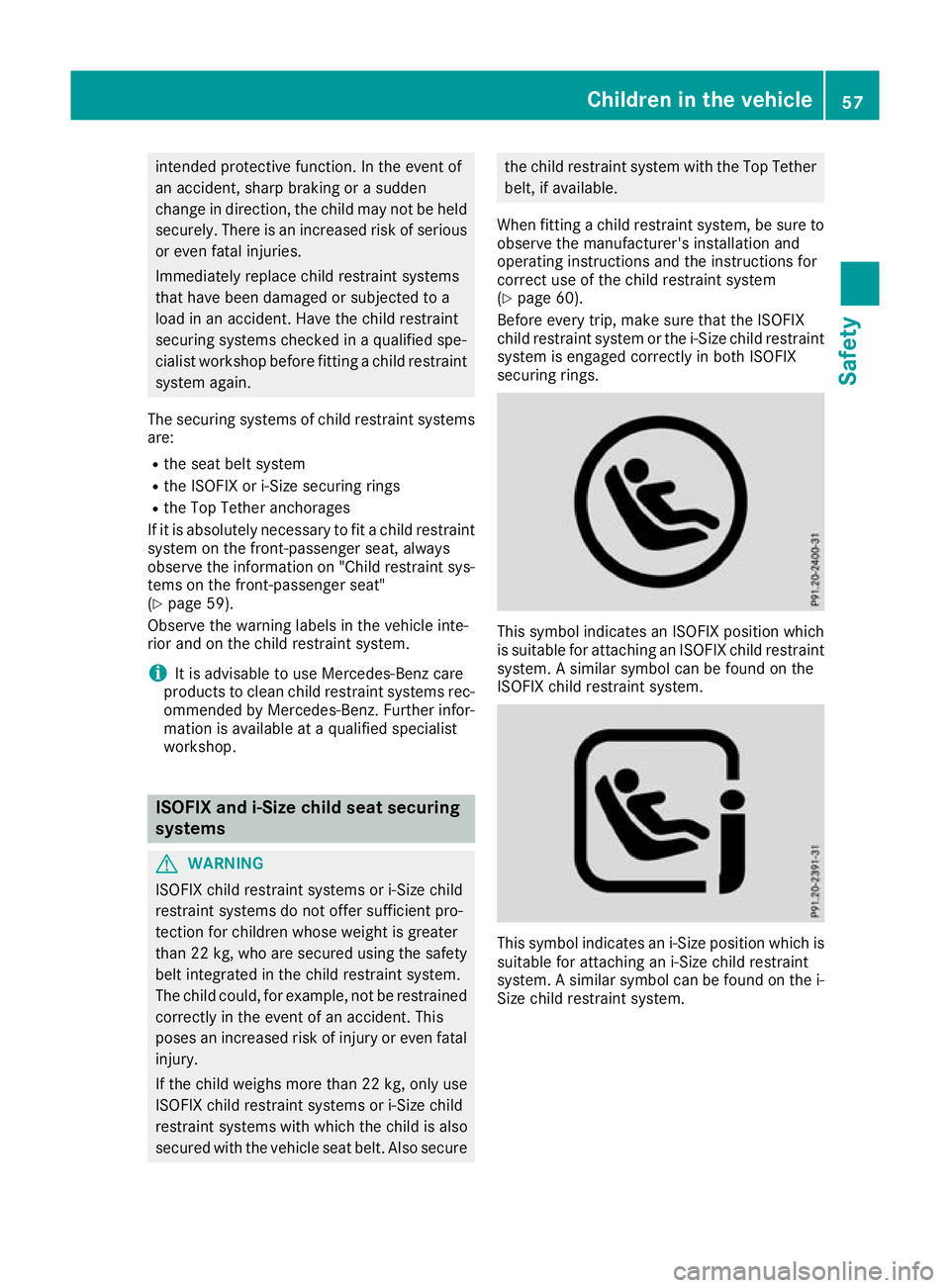
securing rings. This symbol indicates an ISOFIX position which
is suitable for attachin
ganISOFIX child restraint
system. Asimilar symbol can be foun donthe
ISOFIX child restraint system. This symbol indicates an i‑Siz
eposition which is
suitable for attachin gani-Size child restraint
system. Asimilar symbol can be foun donthe i-
Siz ec hild restraint system. Children in thev
ehicle
57Safety Z
Page 61 of 385
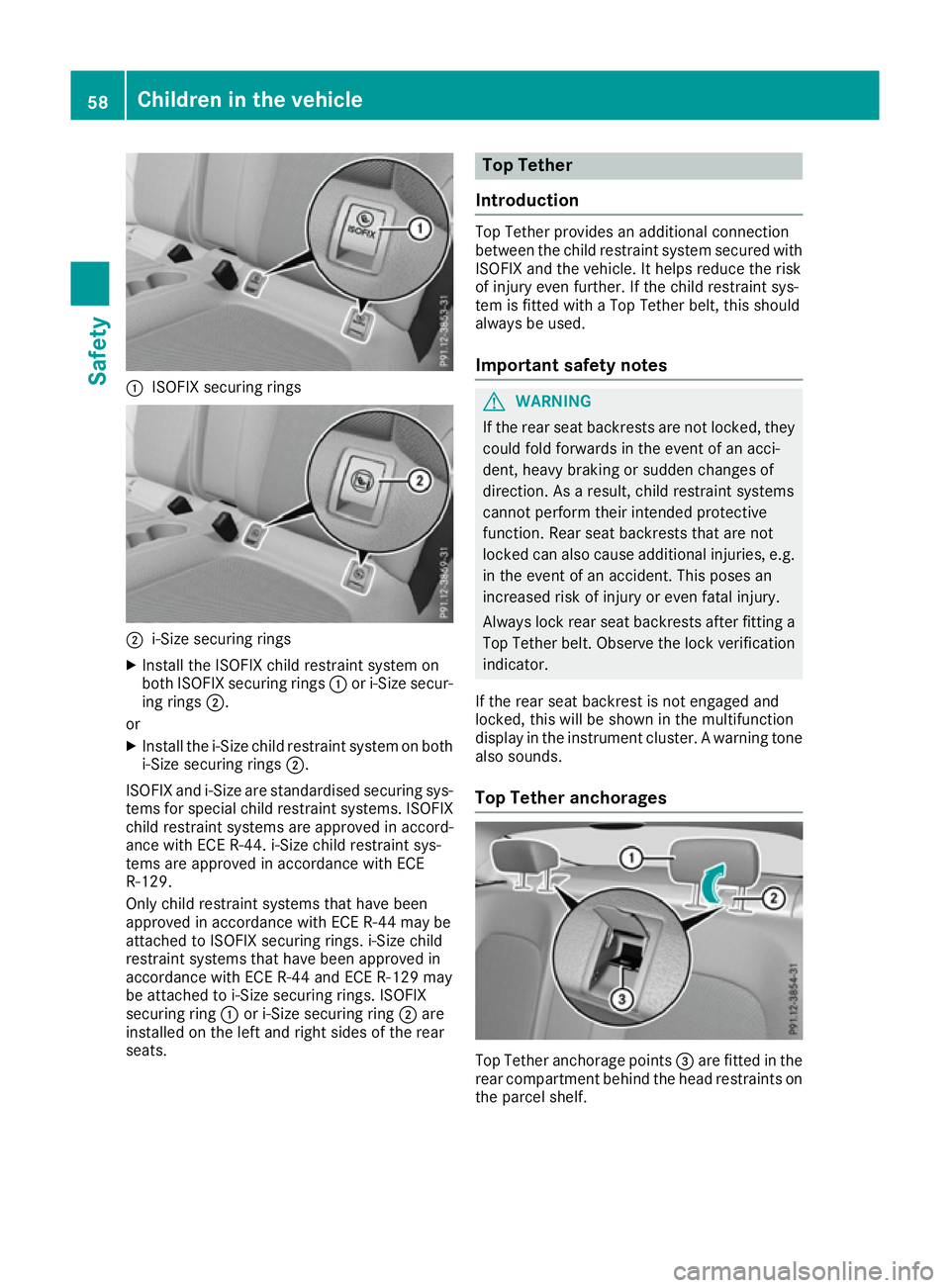
:
ISOFIX securing rings ;
i-Size securing rings
X Install the ISOFIX child restraint system on
both ISOFIX securing rings :or i-Size secur-
ing rings ;.
or
X Install the i-Size child restraint system on both
i-Size securing rings ;.
ISOFIX and i-Size are standardised securing sys-
tems for specia lchild restraint systems. ISOFIX
child restraint systems are approved in accord-
ance with ECE R-44. i-Size child restraint sys-
tems are approved in accordance with ECE
R-129.
Only child restraint systems that have been
approved in accordance with ECE R-44 may be
attached to ISOFIX securing rings. i-Size child
restraint systems that have been approved in
accordance with ECE R-44 and ECE R-129 may
be attached to i-Size securing rings. ISOFIX
securing ring :or i-Size securing ring ;are
installe donthe left and right sides of the rear
seats. Top Tether
Introduction Top Tether provide
sanadditional connection
between the child restraint system secured with
ISOFIX and the vehicle .Ithelps reduce the risk
of injury even further. If the child restraint sys-
tem is fitted with aTop Tether belt, this should
always be used.
Important safety notes G
WARNING
If the rear seat backrests are not locked, they
could fold forward sinthe event of an acci-
dent, heavy braking or sudden changes of
direction. As aresult, child restraint systems
cannot perform their intended protective
function. Rears eat backrests that are not
locked can also cause additional injuries, e.g. in the event of an accident. This poses an
increased risk of injury or even fatal injury.
Alwaysl ock rear seat backrests after fitting a
Top Tether belt. Observe the lock verification indicator.
If the rear seat backrest is not engaged and
locked, this willbes hown in the multifunction
display in the instrument cluster. Awarning tone
also sounds.
Top Tether anchorages Top Tether anchorage points
=are fitted in the
rear compartment behind the head restraints on
the parcel shelf. 58
Children in the vehicleSafety
Page 62 of 385
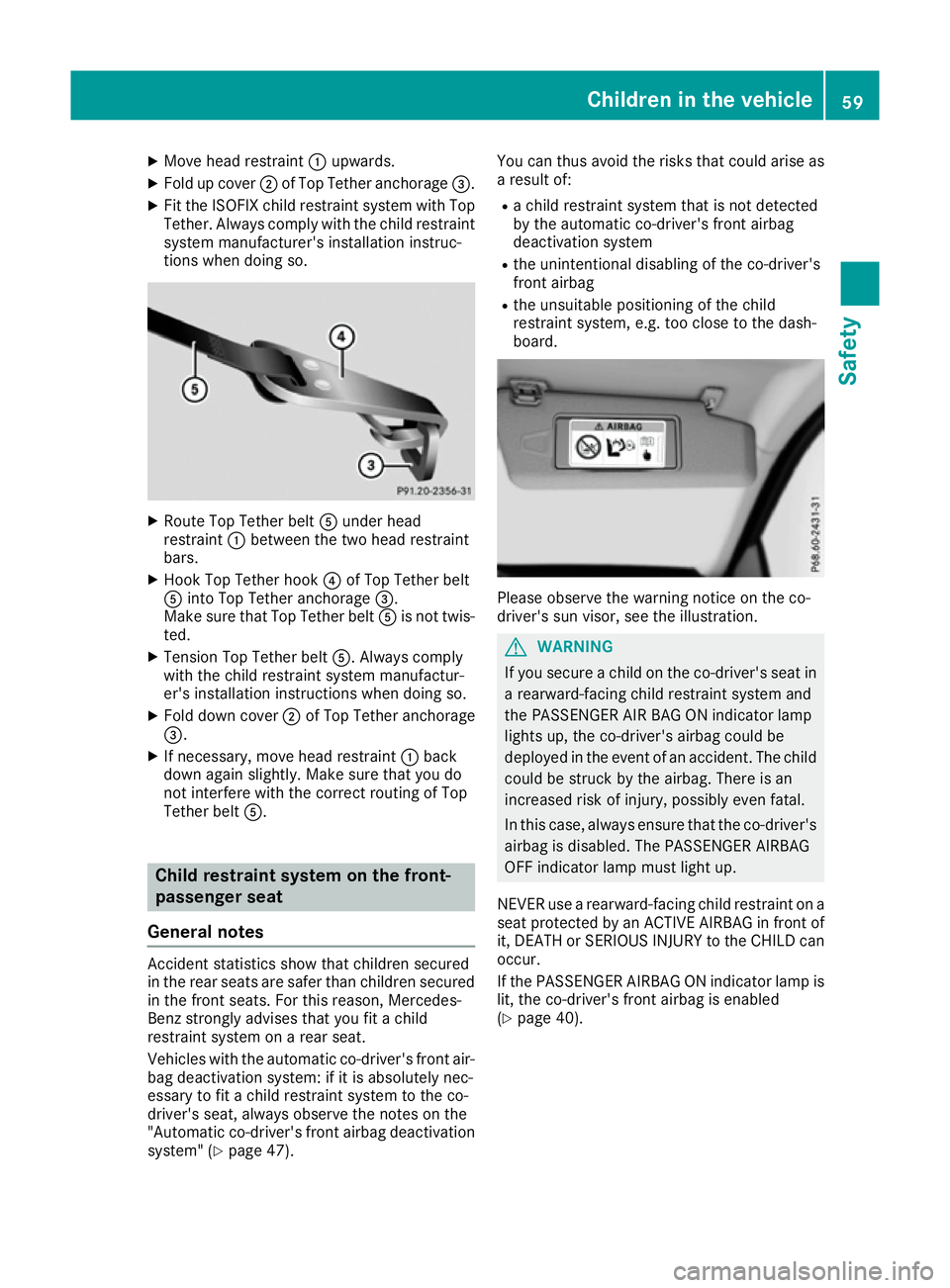
X
Move head restraint :upwards.
X Fold up cover ;of Top Tether anchorage =.
X Fit the ISOFIX child restraint system with Top
Tether. Always comply with the child restraint system manufacturer's installation instruc-
tions when doing so. X
Route Top Tether belt Aunder head
restraint :between the two head restraint
bars.
X Hook Top Tether hook ?of Top Tether belt
A into Top Tether anchorage =.
Make sure that Top Tether belt Ais not twis-
ted.
X Tension Top Tether belt A.Always comply
with the child restraint system manufactur-
er's installation instructions when doing so.
X Fold down cover ;of Top Tether anchorage
=.
X If necessary, move head restraint :back
down again slightly. Make sure that you do
not interferew ith the correct routing of Top
Tether belt A. Child restraint system on the front-
passenger seat
General notes Accident statisticss
how that children secured
in the rear seats are safer than children secured
in the front seats. For this reason, Mercedes-
Benz strongly advises that you fit achild
restraint system on arear seat.
Vehicles with the automatic co-driver's front air-
bag deactivation system: if it is absolutely nec-
essary to fit achild restraint system to the co-
driver's seat, always observe the notes on the
"Automatic co-driver's front airbag deactivation system" (Y page 47). You can thus avoid the risks that could arise as
ar esult of:
R ac hild restraint system that is not detected
by the automatic co-driver's front airbag
deactivation system
R the unintentional disabling of the co-driver's
front airbag
R the unsuitable positioning of the child
restraint system, e.g. too close to the dash-
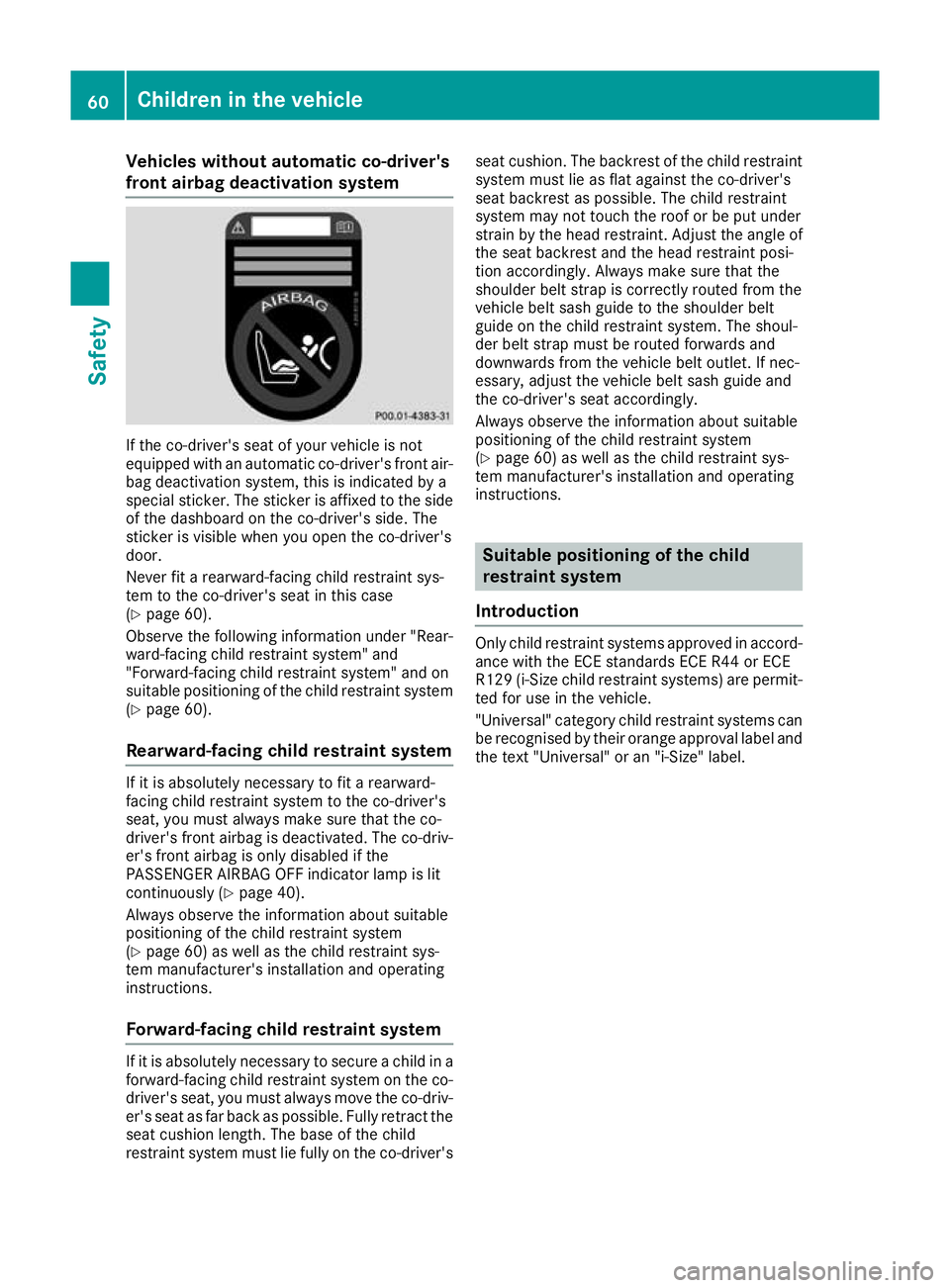
board. Please observe the warning notice on the co-
driver's sun visor, see the illustration. G
WARNING
If you secure achild on the co-driver's seat in
ar earward-facing child restraint system and
the PASSENGER AIR BAG ON indicator lamp
lights up, the co-driver's airbag could be
deployed in the event of an accident. The child could be struck by the airbag. There is an
increased risk of injury, possibly even fatal.
In this case, always ensure that the co-driver's
airbag is disabled. The PASSENGER AIRBAG
OFF indicator lamp must light up.
NEVERu searearward-facing child restraint on a
seat protected by an ACTIVE AIRBAG in front of
it, DEATH or SERIOUS INJURY to the CHILD can occur.
If the PASSENGER AIRBAG ON indicator lamp is
lit, the co-driver's front airbag is enabled
(Y page 40). Children in the vehicle
59Safety Z
Page 63 of 385
Vehicles withou
tautomatic co-driver's
fron tairbag deactivatio nsystem If the co-driver'
sseatofy ourv ehicl eisn ot
equipped with an automatic co-driver' sfront air-
ba gd eactivation system ,thisisi ndicated by a
specia lsticker. The sticker is affixe dtothe side
of the dashboard on the co-driver' sside. The
sticker is visible when yo uopent he co-driver's
door.
Never fit arearward-facing child restraint sys-
tem to the co-driver' sseatint hisc ase
(Y page 60).
Observe the following informatio nunder "Rear-
ward-facing child restraint system "and
"Forward-facing child restraint system "and on
suitabl epositioni ng of the child restraint system
(Y page 60).
Rearward-facin gchild restrain tsystem If it is absolutely necessary to fit
arearward-
facing child restraint system to the co-driver's
seat, yo umusta lway smakes uret hatthe co-
driver' sfront airba gisdeactivated. The co-driv-
er' sfront airba gisonlyd isable difthe
PASSENGER AIRBAG OFF indicator lamp is lit
continuously (Y page 40).
Alway sobserve the informatio nabout suitable
positioning of the child restraint system
(Y page 60 )asw ellast he child restraint sys-
tem manufacturer's installatio nand operating
instructions.
Forward-facin gchild restrain tsystem If it is absolutely necessary to secure
achild in a
forward-facing child restraint system on the co- driver' sseat, yo umusta lway smove the co-driv-
er' sseatasfar back as possible. Fully retract the
sea tcushion length. The base of the child
restraint system must li efully on the co-driver's sea
tcushion. The backres tofthe child restraint
system must li easflata gain st the co-driver's
sea tbackres tasp ossible. The child restraint
system ma ynot touch the roo forbeputunder
strain by the hea drestraint. Adjust the angle of
the sea tbackres tand the hea drestraint posi-
tio na ccordingly. Alway smakes uret hatthe
shoulde rbelts tra pisc orrectl yrouted from the
vehicl ebelts ashg uide to the shoulde rbelt
guid eont he child restraint system .The shoul-
de rb elts tra pm ustber outed forward sand
downward sfrom the vehicl ebelto utlet. If nec-
essary ,adjus tthe vehicl ebelts ashg uide and
the co-driver' sseata ccordingly.
Alway sobserve the informatio nabout suitable
positioning of the child restraint system
(Y page 60 )asw ellast he child restraint sys-
tem manufacturer' sinstallatio nand operating
instructions. Suitabl
epositionin gofthe child
restrain tsystem
Introduction Onl
ychild restraint system sapproved in accord-
ance with the ECE standards ECE R44 or ECE
R12 9(i-Size child restraint systems) are permit-
ted for us einthe vehicle.
"Universal" categor ychild restraint system scan
be recognised by thei rorange approval labe land
the text "Universal" or an "i-Size "label. 60
Children in the vehicleSafety
Page 64 of 385
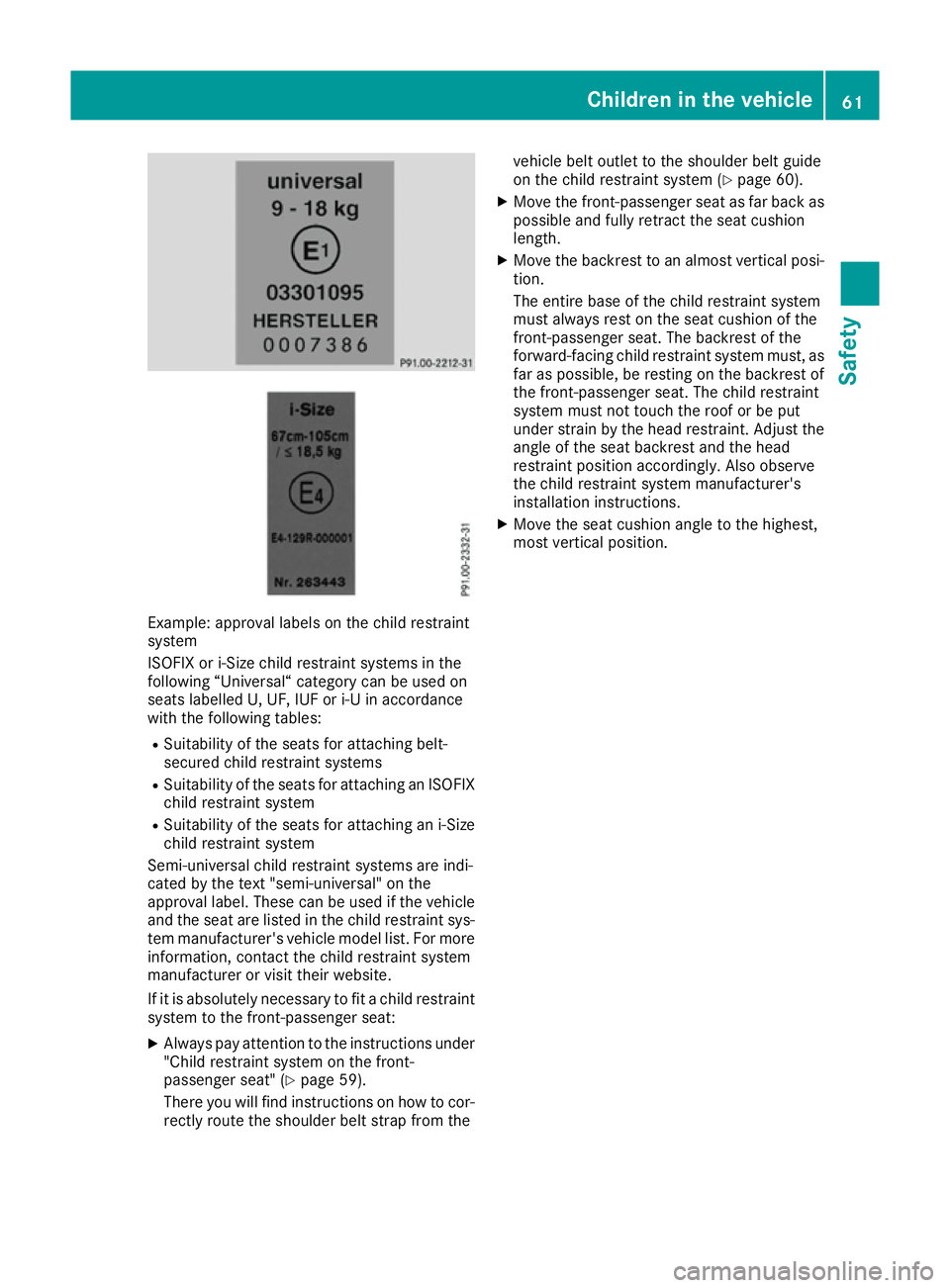
Example: approva
llabel sont he child restraint
system
ISOFI Xori-Size child restraint system sinthe
following “Universal“ category can be used on
seats labelled U, UF, IUF or i-U in accordance
with the following tables:
R Suitability of the seats for attaching belt-
secured child restraint systems
R Suitability of the seats for attaching an ISOFIX
child restraint system
R Suitability of the seats for attaching an i-Size
child restraint system
Semi-universa lchild restraint system sareindi-
cate dbyt he text "semi-universal" on the
approva llabel .These can be used if the vehicle
and the sea tare listed in the child restraint sys-
tem manufacturer's vehicl emodel list. For more
information, contact the child restraint system
manufacturer or visit their website.
If it is absolutely necessary to fit achild restraint
system to the front-passenge rseat:
X Alway spayattentio ntothe instructions under
"Child restraint system on the front-
passenge rseat" (Y page 59).
There yo uwillf ind instructions on how to cor-
rectl yroute the shoulde rbelts tra pfromt he vehicl
ebelto utlettot he shoulde rbeltg uide
on the child restraint system (Y page 60).
X Mov ethe front-passenge rseata sfar back as
possibl eand full yretract the sea tcushion
length.
X Mov ethe backres ttoanalmostv ertica lposi-
tion.
The entire base of the child restraint system
must always res tonthe sea tcushion of the
front-passenge rseat. The backres tofthe
forward-facing child restraint system must, as fa rasp ossible, be resting on the backres tof
the front-passenge rseat. The child restraint
system must not touch the roo forbeput
under strain by the head restraint. Adjust the
angle of the sea tbackres tand the head
restraint positio naccordingly .Alsoo bserve
the child restraint system manufacturer's
installatio ninstructions.
X Mov ethe sea tcushion angle to the highest,
mos tvertica lposit ion. Children in the vehicle
61Safety Z
Page 65 of 385
Suitability of the seats for attaching
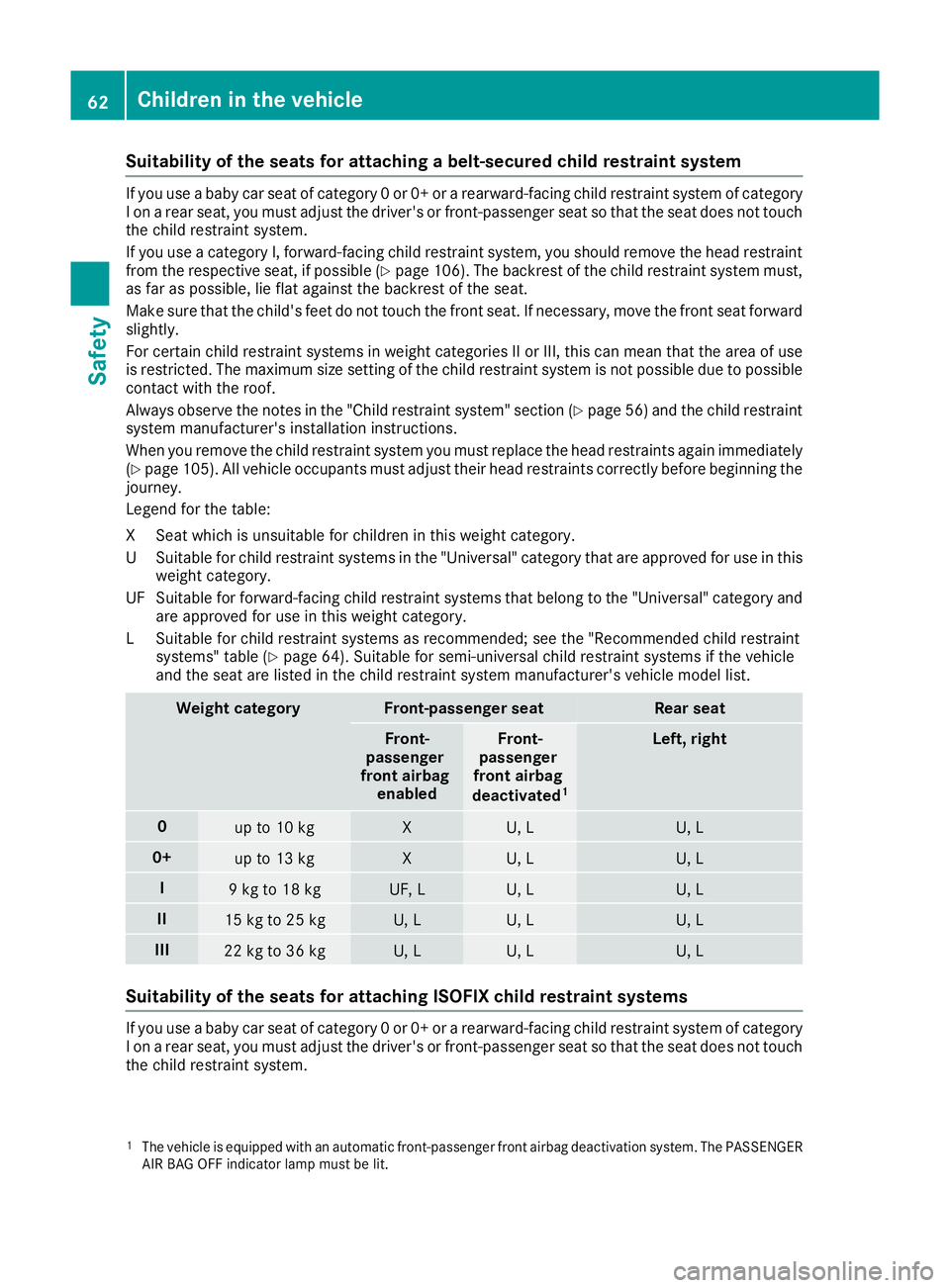
abelt-secured child restraint system If you use
ababy car seat of category 0or0+orarearward-facing child restraint system of category
Ionar ear seat, you must adjust the driver's or front-passenger seat so that the seat does not touch
the child restraint system.
If you use acategory I, forward-facing child restraint system, you should remove the head restraint
from the respective seat, if possible (Y page 106). The backrest of the child restraint system must,
as far as possible, lie flat against the backrest of the seat.
Make sure that the child's feet do not touch the front seat. If necessary, move the front seat forward slightly.
For certain child restraint systems in weight categories II or III, this can mean that the area of use is restricted. The maximum size settingoft he child restraint system is not possible due to possible
contact with the roof.
Always observe the notes in the "Childr estraint system" section (Ypage 56) and the child restraint
system manufacturer's installation instructions.
When you remove the child restraint system you must replace the head restraint sagain immediately
(Y page 105). All vehicle occupants must adjust their head restraint scorrectly before beginning the
journey.
Legend for the table:
XS eat which is unsuitable for children in this weight category.
US uitable for child restraint systems in th e"Universal" categor ytha ta re approve dfor use in this
weigh tcategory.
UF Suitable for forward-facing child restraint systems that belon gtothe"Universal" categor yand
are approve dfor use in this weigh tcategory.
LS uitable for child restraint systems as recommended; see th e"Recommended child restraint
systems "table (Y page 64). Suitable for semi-universal child restraint systems if th evehicle
and th eseat are listed in th echild restraint system manufacturer' svehicle model list. Weigh
tcategory Front-passenger seat Rea
rseat Front-
passenger
front airbag enabled Front-
passenger
front airbag
deactivated 1 Left
,right 0
up to 10 kg X U, L U, L
0+
up to 13 kg X U, L U, L
I
9kgto18kg UF
,L U, L U, L
II
15 kg to 25 kg U, L U, L U, L
III
22 kg to 36 kg U, L U, L U, L
Suitabilit
yoftheseat sfor attaching ISOFIX child restraint systems If you use
ababy car seat of categor y0or0+orarearward-facing child restraint system of category
Ionar ear seat ,you must adjust th edriver' sorfront-pa ssenger seat so that th eseat does no ttou ch
th ec hild restraint system.
1 The vehicle is equipped wit hanautomatic front-passenger fron tairba gdeactivation system. The PASSENGER
AI RB AG OFFindicator lamp must be lit. 62
Children in th
evehicleSafety