key MERCEDES-BENZ C-CLASS COUPE 2015 User Guide
[x] Cancel search | Manufacturer: MERCEDES-BENZ, Model Year: 2015, Model line: C-CLASS COUPE, Model: MERCEDES-BENZ C-CLASS COUPE 2015Pages: 385, PDF Size: 13.12 MB
Page 45 of 385
G
WARNING
Seat belts cannot protect as intended, if:
R they are damaged, have been modified, are
extremely dirty ,bleached or dyed
R the seat beltb uckle is damaged or
extremely dirty
R modifications have been made to the belt
tensioners, belta nchorages or inertia reels
Seat belts may sustain non-visibl edamage in
an accident, e.g. due to glass splinters. Modi-
fied or damaged seat belts can tear or fail ,for
exampl einthe event of an accident. Modified
seat beltt ensioners may be deployedu nin-
tentionall yorfail to be deployedw hen
required .There is an increased risk of injury,
possibly even fatal.
Never modify safety belts, seat beltt ension-
ers, seat belta nchorages and inertia reels.
Ensure that seat belts are not damaged or
worn and are clean. After an accident, have
the seat belts checked immediatel yataquali-
fied specialist workshop.
Mercedes-Benz recommends that you only use
seat belts which have been approved specifi-
call yfor yourv ehiclebyM ercedes-Benz. Other-
wise, yourv ehicle's genera loperating permit
coul dbei nvalidated.
AMG Performanc eseat: this seat is designed
for the standard three-point seat belt. If you fit
another multipoint seat belt, e.g. sport or racing
seat belts, the restraint system cannot provide
the best leve lofprotection. G
WARNING
If you feed seat belts through the opening in
the seat backrest, the seat backrest may be
damaged or may even brea kinthe event of an
accident. This poses an increased risk of
injury or even fatal injury.
Only use the standard three-point seat belt.
Never modify the seat belts ystem.
Correct seat beltu sePay attention to the safety notes about the seat
belt( Ypag e41). All vehicl
eoccupants must fasten their seat
belts correctly before you start driving. You
must alsom ake sure that all vehicl eoccupants
have fastened their seat belts correctly during
the journey.
When fastening yours eat belt, alwaysmake
sure that:
R the seat beltt ongue is inserted into the belt
buckle that belongs to the seat.
R the seat beltist ightened across yourb ody.
Avoid wearing bulky clothing, e.g. awinter
coat.
R the seat beltisn ot twisted.
Only then can the forces which occur be dis-
tributed over the area of the belt.
R the shoulders ection of the beltisa lways
routed across the centre of yours houlder.
The shoulders ection of the beltm ust not
come into contact with yourn eck or be routed
under youra rm.
R The lap beltm ust be taut and as low as pos-
sibl eover yourl ap.
The lap beltm ust alwaysber outed across
yourh ip joints and not across youra bdomen.
Pregnant wome nmust take particular care
with this. If necessary, pusht he lap beltdown
to yourh ip joint and pullitt ight using the
shoulders ection of the belt.
R The seat beltisn ot routed over sharp ,pointed
or fragile objects.
If such objects are located on or in yourc loth-
ing, e.g. pens, keys, spectacles, etc. stow
these in asuitable location.
R Only one perso nshould use each seat beltat
any one time.
Babies and children must never travel sitting
on the lap of another vehicl eoccupant. In the
event of an accident, they coul dbecrushed
between the vehicl eoccupant and seat belt.
R Do not secure any objects with aseat beltif
the seat beltisb eing used by one of the vehi-
cle's occupants.
You must alsom ake sure that objects, e.g.
cushions, are never placed between aperson
and the seat.
Seat belts are solely intended to secure and
restrai npersons. To secure objects, luggage or
loads, alwayso bserve the "Loading guidelines"
(Y page3 08). 42
Occupant safetySafety
Page 46 of 385
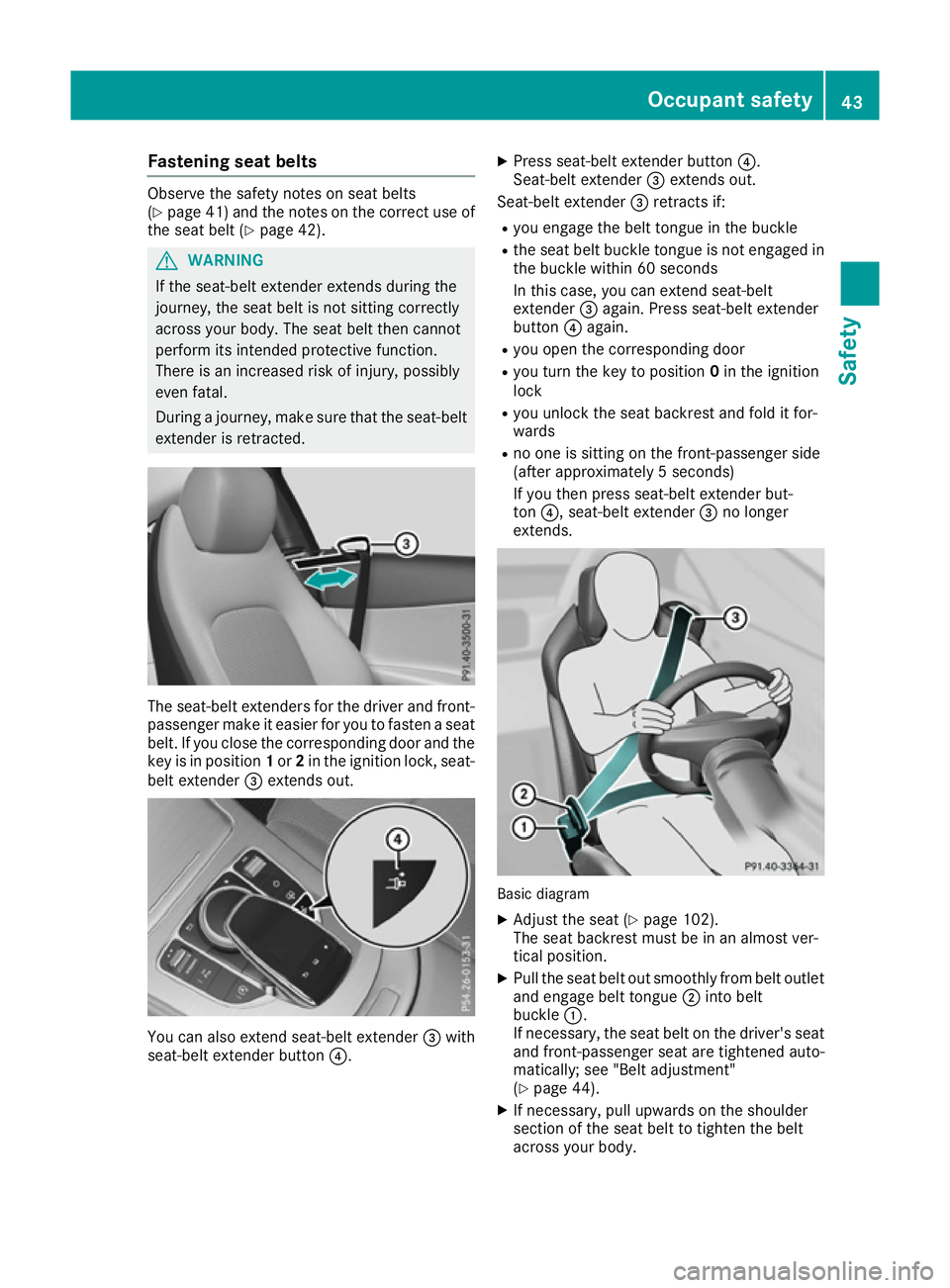
Fastening seat belts
Observ
ethe safet ynotes on seat belts
(Y page 41 )and th enotes on th ecorre ct use of
th es eat belt (Y page 42). G
WARNING
If th eseat-belt extender extend sdurin gthe
journey, th eseat belt is no tsitting correctly
across your body. The seat belt then cannot
perfor mitsintended protective function.
Ther eisani ncreased ris kofinjury, possibly
eve nfatal.
During ajou rney, mak esure that th eseat-belt
extender is retracted. The seat-belt extenders for th
edriver and front-
passenger mak eiteasierfor you to faste naseat
belt .Ify ou close th ecorre sponding door and the
ke yisinp osition 1or 2in th eignition lock, seat-
belt extender =extend sout. You can also extend seat-belt extender
=with
seat-belt extender button ?.X
Press seat-belt extender button ?.
Seat-belt extender =extend sout.
Seat-belt extender =retracts if:
R you engage th ebelt tongue in th ebuckle
R thes eat belt buckle tongue is no tengage din
th eb uckle within 60 seconds
In this case, you can extend seat-belt
extender =again .Press seat-belt extender
button ?again.
R you open th ecorre sponding door
R you tur nthe keyt op osition 0in th eignition
lock
R you unlock th eseat backrest and fol ditfor-
wards
R no on eissitting on th efront-pa ssenger side
(after approximately 5seconds)
If you then press seat-belt extender but-
ton ?,s eat-belt extender =no longer
extends. Basic diagram
X Adjus tthe seat (Y page 102).
The seat backrest must be in an almost ver-
tical position.
X Pull th eseat belt out smoothly from belt outlet
and engage belt tongue ;intob elt
buckle :.
If necessary, th eseat belt on th edriver' sseat
and front-passenger seat are tightened auto-
matically; see "Belt adjustment"
(Y page 44).
X If necessary, pull upward sontheshoulder
section of th eseat belt to tighten th ebelt
across your body. Occupant safety
43Safety Z
Page 51 of 385
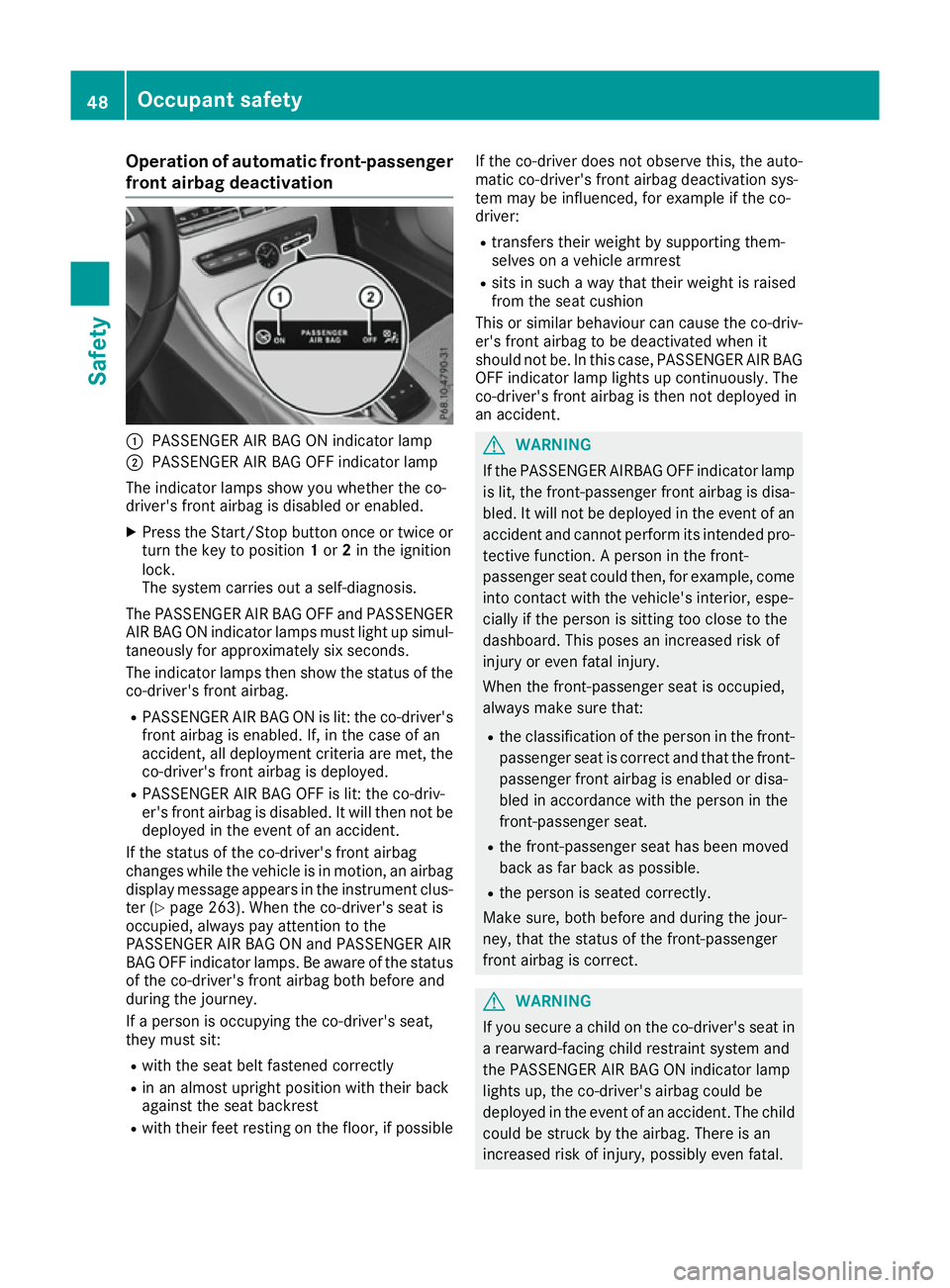
Operation of automatic front-passenger
front airba gdeactivation :
PASSENGER AIR BAG ON indicator lamp
; PASSENGER AIR BAG OFF indicator lamp
The indicator lamps show you whether the co-
driver's fron tairbag is disabled or enabled.
X Press the Start/Stop button onceort wice or
turn the key to position 1or 2in the ignition
lock.
The system carries out aself-diagnosis.
The PASSENGER AIR BAG OFF and PASSENGER
AIR BAG ON indicator lamps must light up simul- taneously for approximately six seconds.
The indicator lamps then show the status of the
co-driver's fron tairbag.
R PASSENGER AIR BAG ON is lit: the co-driver's
fron tairbag is enabled. If, in the case of an
accident, all deployment criteria are met, the
co-driver's fron tairbag is deployed.
R PASSENGER AIR BAG OFF is lit: the co-driv-
er's fron tairbag is disabled. It will then not be
deployed in the event of an accident.
If the status of the co-driver's fron tairbag
changes while the vehicle is in motion ,anairbag
display message appears in the instrument clus-
ter (Y page 263). When the co-driver's seat is
occupied, alway spay attention to the
PASSENGER AIR BAG ON and PASSENGER AIR
BAG OFF indicator lamps. Be aware of the status of the co-driver's fron tairbag both before and
during the journey.
If ap erson is occupying the co-driver's seat,
they must sit:
R with the seat belt fastened correctly
R in an almost upright position with their back
against the seat backrest
R with their feet restin gonthe floor, if possible If the co-driver does not observe this, the auto-
matic co-driver's fron tairbag deactivation sys-
tem may be influenced, for example if the co-
driver:
R transfers their weight by supportin gthem-
selves on avehicle armrest
R sits in such away that their weight is raised
from the seat cushion
This or similar behaviour can cause the co-driv-
er's fron tairbag to be deactivated when it
should not be. In this case, PASSENGER AIR BAG OFF indicator lamp lights up continuously. The
co-driver's fron tairbag is then not deployed in
an accident. G
WARNING
If the PASSENGER AIRBA GOFF indicator lamp
is lit, the front-passenger fron tairbag is disa-
bled. It will not be deployed in the event of an
acciden tand cannot perform its intended pro-
tective function .Aperson in the front-
passenger seat could then ,for example, come
into contact with the vehicle's interior, espe-
cially if the person is sitting too close to the
dashboard. This poses an increased risk of
injur yore ven fatal injury.
When the front-passenger seat is occupied,
alway smake sure that:
R the classification of the person in the front-
passenger seat is correct and that the front-
passenger fron tairbag is enabled or disa-
bled in accordance with the person in the
front-passenger seat.
R the front-passenger seat has been moved
back as far back as possible.
R the person is seated correctly.
Make sure, both before and during the jour-
ney, that the status of the front-passenger
fron tairbag is correct. G
WARNING
If you secure achild on the co-driver's seat in
ar earward-facing child restraint system and
the PASSENGER AIR BAG ON indicator lamp
lights up, the co-driver's airbag could be
deployed in the event of an accident. The child could be struc kbythe airbag. There is an
increased risk of injury, possibly even fatal. 48
Occupant safetySafety
Page 59 of 385
G
WARNING
If you leave children unattended in the vehi-
cle, they may be abletos et the vehiclein
motion if, for example, they:
R release the parking brake
R shift the automatic transmission out of park
position Por shift manua ltransmission into
neutral
R start the engine
In addition, they may operate vehicl eequip-
ment and become trapped. There is arisk of
an accident and injury.
When leaving the vehicle, alwayst ake the key
with you and lock the vehicle. Never leave
children unattended in the vehicle. G
WARNING
If persons (particularly children) are exposed
to heatorc old foraprolonged period, there is
ar isk of serious or even fatal injuries. Never
leave persons (particularly children) unatten-
ded in the vehicle. G
WARNING
If the child restraint system is placed in direct sunlight, the parts coul dbecome very hot.
Childre ncouldbes uffer burns by touching
these parts, in particular on the metallic parts
of the child restraint system. There is arisk of
injury.
If you and yourc hild leave the vehicle, always
make sure that the child restraint system is
not in direct sunlight. Cove ritwithablanket,
for example. If the child restraint system has
been expose dtodirect sunlight, leave it to
cool downb efore securing the child in it.
Never leave children unattended in the vehi-
cle.
Always ensure that all vehicl eoccupants have
their seat belts fastened correctly and are sitting
properly.P articular attention must be paidto
children.
Observe the safety notes on the seat belt
(Y page4 1) and the notes on how to use the seat
beltp roperly (Y page42). Chil
drestraint system
Observe the instructions for correct use of the
child restraint system (Y page60).
For safety reasons, Mercedes-Benz recom-
mends that you only use achild restraint system
recommende dbyMercedes-Benz
(Y page6 4). G
WARNING
If the child restraint system is incorrectly fit-
ted on the seat position suitable for this pur-
pose, it cannot perform its intended protec-
tive function. In the event of an accident,
sharp braking or asudden change in direction,
the child may not be held securely.T here is an
increased risk of serious or even fatal injuries.
Observe the manufacturer's installation
instructions and the correct use for the child
restraint system. Make sure that the entire
surface of the child restraint system is resting
on the seat surface. Never place objects
under or behind the child restraint system,
e.g. cushions. Only use child restraint sys-
tems with the original cover designed for
them. Only replace damaged covers with gen- uine covers. G
WARNING
If the child restraint system is fitted incor-
rectly or is not secured, it can come loos ein
the event of an accident, heav ybraking or a
sudden change in direction. The child
restraint system coul dbethrown about, strik-
ing vehicl eoccupants. There is an increased
risk of injury ,possibly even fatal.
Always fit child restraint systems properly,
even if they are not being used .Make sure
that you observe the child restraint system
manufacturer's installation instructions.
You willf ind further information on stowing
objects, luggage and loads securely under
"Loading guidelines" (Y page308). G
WARNING
Child restraint systems or their securing sys-
tems that have been damaged or subjected to al oa dinana ccident cannot perform their 56
Children in the vehicleSafety
Page 80 of 385
Following damag
etothe windscreen, hav ethe
configuration and operation of the camera sys-
tem checked at aquali fied specialist workshop.
Function X
To activate/deactivate: activate or deacti-
vate PRE-SAFE ®
Brake in the on-board com-
puter (Y page 245).
If the PRE-SAFE ®
Brake is not activated, the
æ symbol appears in the multifunction dis-
play.
Thi sfunction will issue awarning if:
R at as peed of around 30 km/h or more ,the
distance maintaine dtothe vehicle travelling
in front is insufficient for several seconds
The · distance warning lamp then lights
up in the instrument cluster.
R at as peed of around 7km/h or more ,you
rapidl yapproach avehicle in front or apedes-
trian
An intermittent warning tone will then sound
and the ·distance warning lamp lights up
in the instrument cluster.
X Brake immediately to defuse the situation.
or X Take evasive action provide ditissafetodo
so.
The PRE-SAFE ®
Brake function can also brake
the vehicle automaticall yunder the following
conditions:
R the driver and front passenger hav ethei rseat
belts fastened
and
R the vehicle speed is between approximately
7k m/h and 200 km/h
At as peed of up to approximately 70 km/h,
PRE-SAFE ®
Brake can also detect:
R stationar yobjects in the path of your vehicle,
e.g. stopped or parked vehicles
R pedestrians in the path of your vehicle
i If there is an increased risk of
acollision,
preventive passenger protection measures
(PRE-SAFE ®
PLUS) are triggered (Y page 54).
If the risk of acollision with the vehicle in front
remains and yo udonot brake, take evasive
action or accelerate significantly ,the vehicle
may perform automatic emergency braking up
to the point of ful lbrake application. Automatic emergency braking is not performe
duntil imme-
diately prior to an imminent accident.
You can prevent the intervention of PRE-SAFE ®
Brake at any time by:
R depressing the accelerator pedal further
R activating kickdown
R releasing the brake pedal
The braking action of PRE-SAFE ®
Brake is ended
automaticall yif:
R youm anoeuvre to avoid the obstacle
R there is no longer arisk of collision
R there is no longer an obstacl edetected in
front of your vehicle STEE
RCONTROL
General notes STEER CONTROL helps yo
ubytransmitting a
noticeable steering force to the steering wheel
in the directio nrequired for vehicle stabilisation.
Thi ssteering support is provide dinparticula rif:
R both right wheels or both lef twheels are on a
we tors lippery roa dsurface whe nyou brake
R the vehicle starts to skid
Important safety notes i
Observe the "Important safety notes" sec-
tion (Y page 66).
No steering support is provide dfrom STEER
CONTROL, if:
R ESP ®
is deactivated
R ESP ®
is malfunctioning
R the steering is faulty
If ESP ®
is malfunctioning ,you will be assisted
further by the electrica lpower steering. Protection against theft
Immobiliser
The immobilise rprevents your vehicle from
being starte dwithou tthe correct key. Protection against theft
77Safety Z
Page 81 of 385
X
To activate with the key: remove the key
from the ignition lock.
X To activate with KEYLESS-GO start-func-
tio norK EYLESS -GO:switch the ignition off
and open the driver's door.
X To deactivate: switch on the ignition.
Whe nleaving the vehicle, always take the key
with yo uand lock the vehicle. Anyone can start
the engine if avalid key ha sbeenleftinsid ethe
vehicle.
i The immobiliser is always deactivate
dwhen
yo us tart the engine. ATA (Anti-Theft Alarm system)
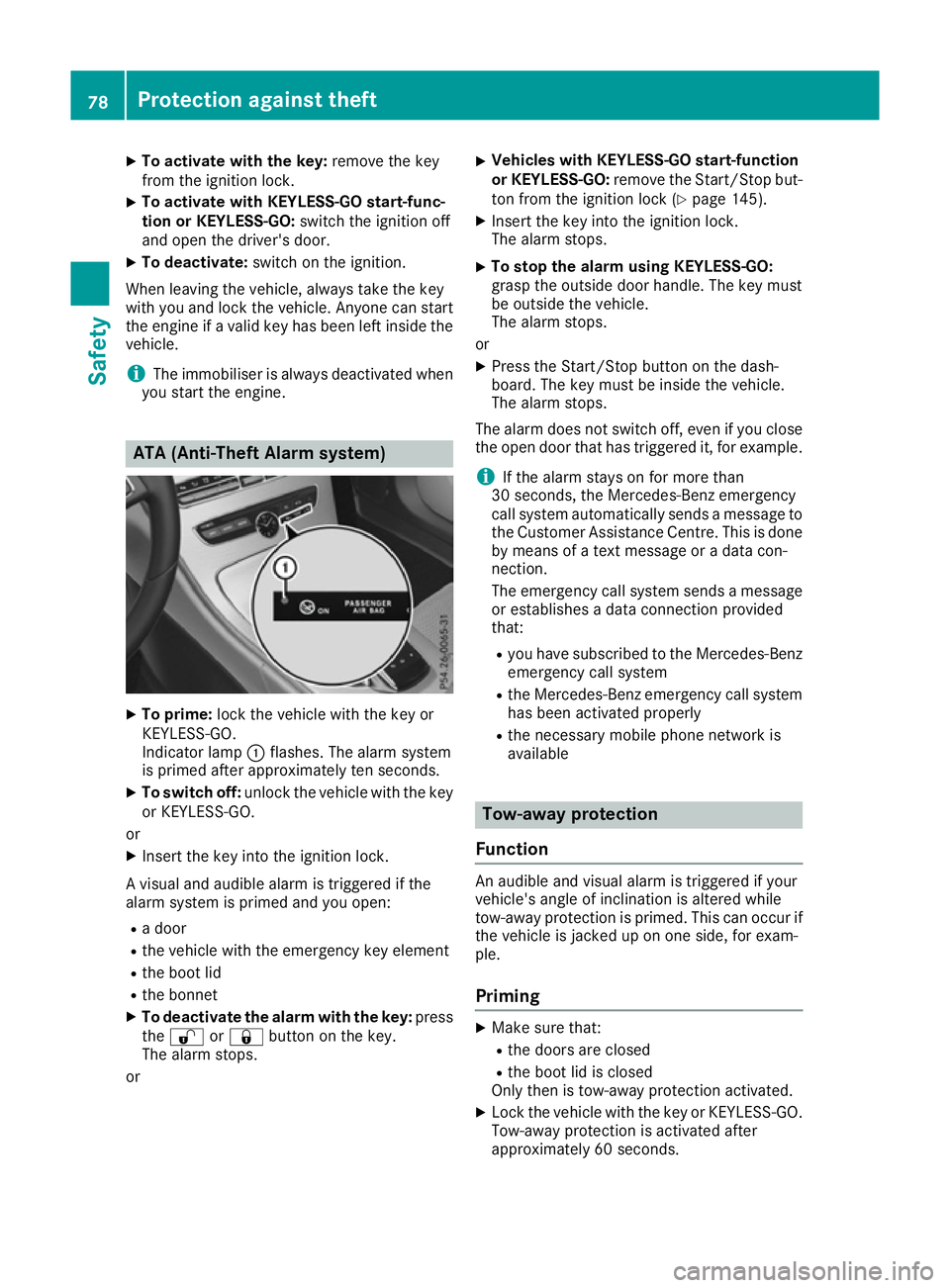
X
To prime: lock the vehicl ewitht he key or
KEYLESS-GO.
Indicato rlamp :flashes. The alarm system
is primed afte rapproximatel yten seconds.
X To switc hoff:unlock the vehicl ewitht he key
or KEYLESS-GO.
or X Insert the key into the ignition lock.
Av isua land audibl ealarm is triggered if the
alarm system is primed and yo uopen:
R ad oor
R the vehicl ewitht he emergency key element
R the boot lid
R the bonnet
X To deactivate the alarm with the key: press
the % or& button on the key.
The alarm stops.
or X
Vehicles with KEYLESS-GO start-function
or KEYLESS-GO: remove the Start/Stop but-
ton from the ignition lock (Y page 145).
X Insert the key into the ignition lock.
The alarm stops.
X To sto
pthe alarm using KEYLESS-GO:
grasp the outsid edoorh andle. The key must
be outsid ethe vehicle.
The alarm stops.
or X Press the Start/Stop button on the dash-
board .The key must be insid ethe vehicle.
The alarm stops.
The alarm does not switch off, eve nifyouclose
the open door tha thas triggered it, for example.
i If the alarm stays on for more than
30 seconds ,the Mercedes‑Be nz emergency
cal lsys tem automaticall ysend sam essage to
the Customer Assistance Centre. Thi sisdone
by means of atext message or adatac on-
nection.
The emergency cal lsystem send samessage
or establishes adatac onnectio nprovided
that:
R youh aves ubscribed to the Mercedes ‑Benz
emergency cal lsystem
R the Mercedes‑Be nz emergency cal lsys tem
ha sb eena ctivate dproperly
R the necessary mobil ephone network is
available Tow-away protection
Function An audibl
eand visua lalarm is triggered if your
vehicle's angle of inclinatio nisa ltere dw hile
tow-away protection is primed .Thisc an occu rif
the vehicl eisjacke dupono ne side,for exam-
ple.
Priming X
Make sure that:
R the doors are closed
R the boot li disclosed
Onl ythen is tow-away protection activated.
X Lock the vehicl ewitht he key or KEYLESS-GO.
Tow-away protection is activate dafter
approximatel y60s econds. 78
Protectio
nagains ttheftSafety
Page 82 of 385
Deactivating
X
Unloc kthe vehicle wit hthe keyorK EYLESS-
GO.
or X Inser tthe keyintot he ignition lock.
Tow-away protection is switched of fautomat-
ically.
Deactivating To preven
tafalsea larm, deactivat etow-a way
protection if you loc kyour vehicle and it:
R is bein gtransported
R is bein gloaded onto aferry or car transporter,
fo re xample
R is parke donam ovable surface, e.g. in asplit-
level garage
You can deactivat etow-a way protection via the
multimedia syste m(seet he Digital Owner's
Manual).
Tow-away protection remain sdeactivated until:
R thev ehicle is unlocke dagain and
R ad ooriso penedand close dagain and
R thev ehicle is locke dagain Interior motion sensor
Function Whe
nthe interio rmotion sensor is primed ,a
visual and audible alar mistriggere difm ove-
men tisd etecte dinthevehicle interior. Thi scan
occur if someon ereaches into th evehicle inte-
rior, fo rexample.
Priming X
Mak esuret hat:
R thes idew indows are closed
R thes lidin gsunroof or th epanorama sliding
sunroof is closed
R there are no objects ,e.g.m ascots ,hanging
on th erear-vie wmirrororont hegrab han-
dles on th erooftrim
Thi sw ill preven tfalse alarms.
X Mak esuret hat: R
thed oors are closed
R thes lidin gsunroof or th epanorama sliding
sunroof is closed
R theb ootlid is closed
Only then is th einterior motion sensor acti-
vated.
X Loc kthe vehicle wit hthe keyorK EYLESS-GO.
The interio rmotion sensor is primed after
approximately te nseconds.
Deactivating X
Unloc kthe vehicle wit hthe keyorK EYLESS-
GO.
or X Inser tthe keyintot he ignition lock.
or X Press th eStart/Sto pbutton.
The ke ymustbeint hevehicle.
The interio rmotion sensor is automatically
switched off.
Deactivating To preven
tafalsea larm, deactivat ethe interior
motion sensor if you loc kyour vehicle and:
R people or animals remain in th evehicle
R thes lidin gsunroof or panorama slidin gsun-
roof remain sopen
R thes idew indows remain open
You can deactivat ethe interio rmotion sensor
via th emultimedia syste m(seet he Digital Own-
er' sM anual).
The interio rmotion sensor remain sdeactivated
until:
R thev ehicle is unlocke dagain and
R ad ooriso penedand close dagain and
R thev ehicle is locke dagain Protection against theft
79Safety Z
Page 83 of 385
Key
Important safety notes
United Kingdom only: G
WARNING
Whe nthe doubl elocks are activated, the
door scan no longer be opened from the
inside. People in th evehicl ecan no longer get
out ,e.g.inh azardous situations. There is a
ris kofi njury.
Therefore ,donotleav eany people unsuper-
vised in th evehicle, particularly children ,eld-
erl yp eople or people in need of special assis-
tance .Don otactivat ethe doubl eloc kw hen
people are in th evehicle.
If th evehicl ehas been locke dfromt heoutside,
th ed oubl eloc kf unction is activated as stand-
ard. It is then no tpossibl etoopen th edoors
from inside th evehicle. You can deactivat ethe
doubl eloc kfunction by deactivating th einterior
motion sensor (see th eseparat emultimedia
system operating instructions). The door scan
then be opened from th einside after th evehicle
has been locke dfromt heoutside .The anti-theft
alarm system is triggered if th edoor is opened
from th einside. Switc hoff th ealarm
(Y page 78).
All countries: G
WARNING
If children are lef tunsupervised in th evehicle,
they could:
R open doors, thereby endangering other per-
son sorr oad users
R get out and be struc kbyoncomingt raffic
R operate vehicl eequipmen tand become
trapped ,for example
In addition ,the children could also set the
vehicl einm otion,for example, if they:
R release th eparking brake
R shift th eautomatic transmission out of park
position Porshift manual transmission into
neutral
R start th eengine
There is ariskofana ccidentand injury. Whe
nleaving th evehicle, always tak ethe key
wit hyou and loc kthe vehicle. Never leave
children and animals unattended in th evehi-
cle .Keept he keys out of th ereac hofc hildren. G
WARNING
If you attach heav yorlargeobjects to th ekey,
th ek eycould be unintentionally turne dinthe
ignition lock. This could caus ethe engin eto
be switched off .There is ariskofana ccident.
Do no tattach any heav yorlargeobjects to the
key. Remove any bulk ykeyrings before insert-
ing th ekeyintot he ignition lock.
! Kee
pthe keya way from stron gmagnetic
fields. Otherwise ,the remot econtro lfunction
could be affected.
Stron gmagnetic fields can occur in th evicin-
it yofp owerful electrical installations.
Do no tkeept he key:
R wit he lectronic devices, e.g. amobile phone
or another key
R wit hm etallic objects ,e.g.c oins or metal film
R inside metallic objects ,e.g.a metal case
This can affec tthe key's functionality.
Vehicles wit hKEYLESS-G Ostart function: do
no tk eept he keyo nthe parcel shelf or in the
boot .Otherwise ,the keym ay no tbed etected,
e.g. when starting th eengineu singthe Start/
Stop button.
Ac heck whichperiodically establishes aradio
connection between th evehicl eand th ekey
determine swhether avalid ke yisint hevehicle.
This occurs, for example:
R when starting th eengine
R whils tdriving
R when th eexternal door handles are touched
R during convenience closing 80
KeyOpening and closing
Page 84 of 385
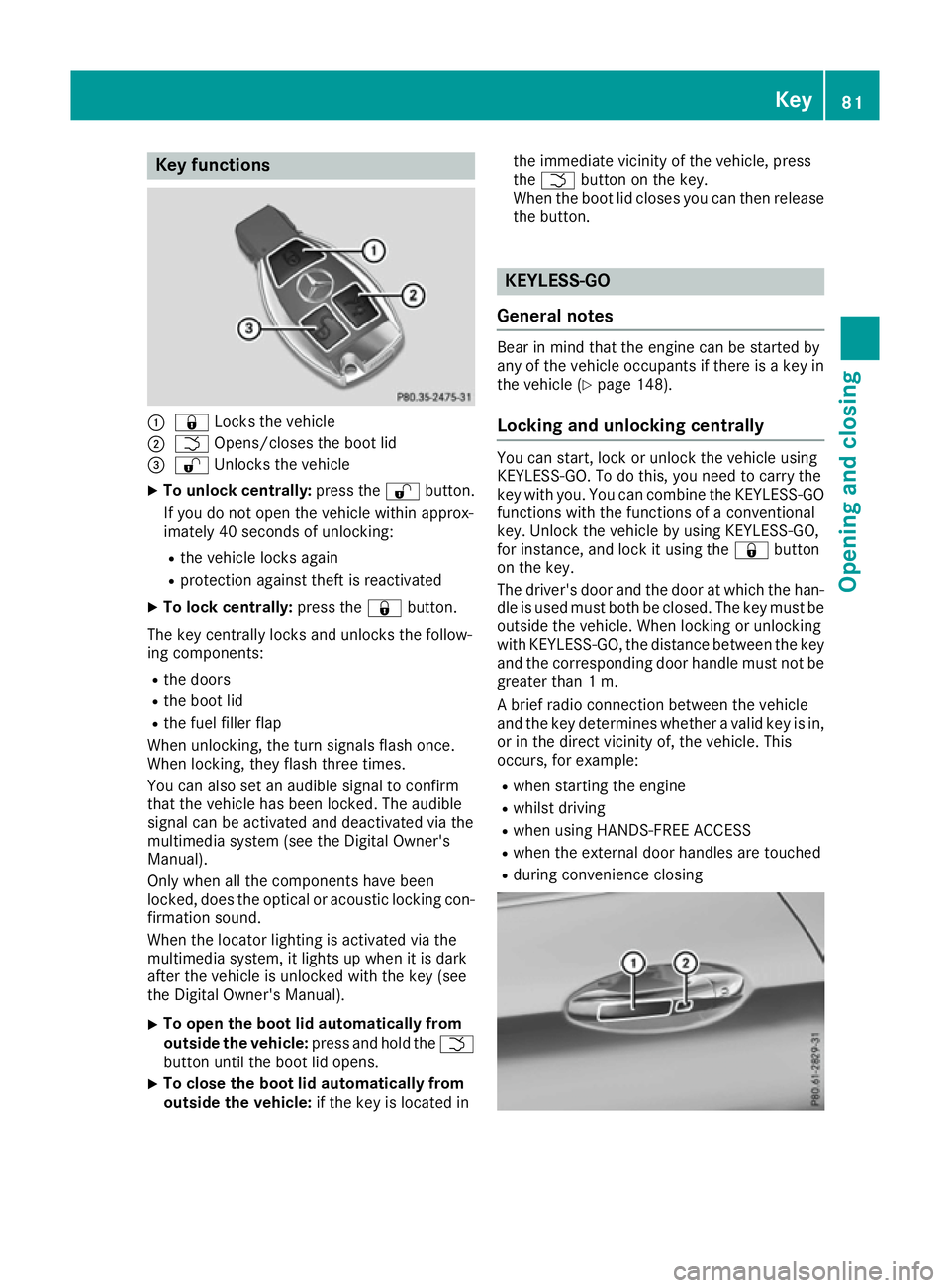
Key functions
:
& Locks th evehicle
; F Opens/close sthe boot lid
= % Unlocks th evehicle
X To unlock centrally: press the%button.
If you do no topen th evehicl ewithin approx-
imately 40 seconds of unlocking:
R thev ehicl elocks again
R protection against theft is reactivated
X To lock centrally: press the&button.
The ke ycentra lly locks and unlocks th efollow-
ing components:
R thed oors
R theb oot lid
R thef uel filler flap
Whe nunlocking ,the turns ignals flas honce.
Whe nlocking ,the yflas hthree times.
You can also set an audibl esignal to confirm
that th evehicl ehas been locked. The audible
signal can be activated and deactivated via the
multimedia system (see th eDigital Owner's
Manual).
Only when all th ecom ponent shaveb een
locked, does th eoptical or acoustic locking con-
firmation sound.
Whe nthe locato rlighting is activated via the
multimedia system, it lights up when it is dark
after th evehicl eisu nlocke dwitht he key( see
th eD igital Owner' sManual).
X To open th
eboot lid automatically from
outsid ethe vehicle: press and hold the F
butto nuntil th eboot lid opens.
X To close th
eboot lid automatically from
outsid ethe vehicle: if thekeyis locate din th
ei mmediat evicinity of th evehicle, press
the F buttonont hekey.
Whe nthe boot lid closes you can then release
th eb utton. KEYLESS-GO
Genera lnotes Bear in min
dthatthe engin ecan be started by
any of th evehicl eoccupant sifthere is akeyin
th ev ehicl e(Ypage 148).
Lockin gand unlockin gcentrally You can start
,loc koru nlockthe vehicl eusing
KEYLESS-GO .Todothis, you need to carry the
ke yw ithy ou. You can combine th eKEYLESS-GO
function switht he function sofaconventional
key. Unloc kthe vehicl ebyu singK EYLESS-GO,
for instance ,and loc kitusingthe & button
on th ekey.
The driver's door and th edoor at whic hthe han-
dle is used mus tbothbec losed.The ke ymustbe
outside th evehicle. Whe nlocking or unlocking
wit hK EYLESS-GO ,the distanc ebetween th ekey
and th ecorre spondin gdoor handle mus tnotbe
greate rtha n1m.
Ab rief radi oconnectio nbetween th evehicle
and th ekeydetermine swhether avalid ke yisin,
or in th edirec tvicinity of, th evehicle. This
occurs, for example:
R when starting th eengine
R whils tdriving
R when usin gHANDS-F REEA CCESS
R when th eexternal door handles are touched
R during convenience closing Key
81Opening and closing Z
Page 85 of 385
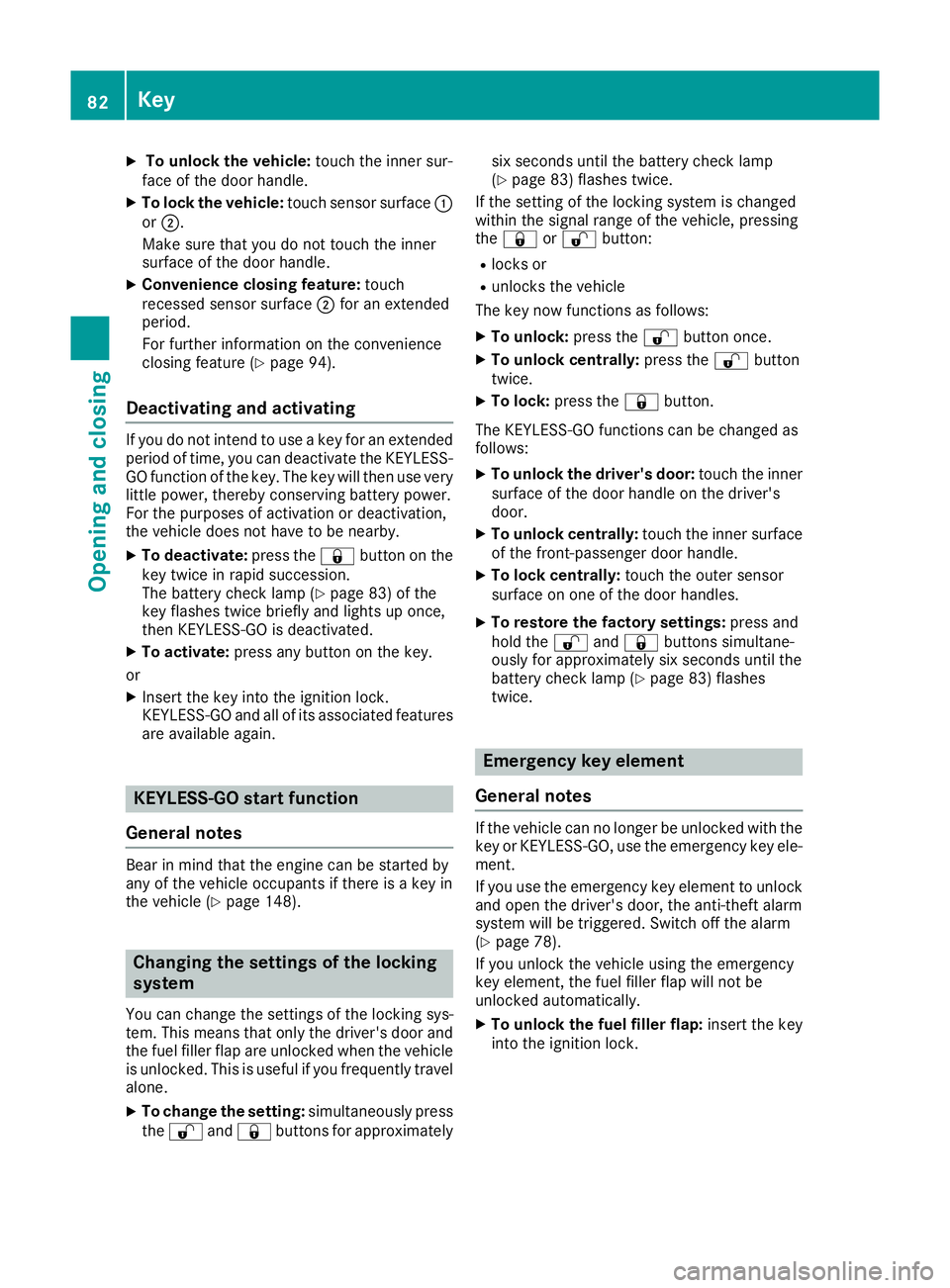
X
To unloc kthe vehicle: touch the inne rsur-
fac eoft he door handle.
X To lock the vehicle: touch sensor surface :
or ;.
Make sure tha tyou do not touch the inner
surface of the door handle.
X Convenience closin gfeature: touch
recesse dsensor surface ;for an extended
period.
For further informatio nonthe convenience
closing feature (Y page 94).
Deactivating and activating If yo
udon ot intend to us eakey for an extended
perio doftime,you can deactivate the KEYLESS-
GO functio nofthe key .The key will then us every
little power, thereb yconserving battery power.
For the purposes of activation or deactivation,
the vehicl edoesn ot have to be nearby.
X To deactivate: press the&button on the
key twice in rapid succession.
The battery check lamp (Y page 83)ofthe
key flashe stwice briefl yand lights up once,
then KEYLESS-GO is deactivated.
X To activate: press any button on the key.
or
X Insert the key into the ignition lock.
KEYLESS-GO and al lofits associate dfeatures
are available again. KEYLESS-GO start function
General notes Bea
rinm ind tha tthe engine can be started by
any of the vehicl eoccupants if ther eisakey in
the vehicl e(Ypage 148). Changin
gthe settings of the locking
system
Yo uc an change the settings of the locking sys-
tem. Thi smeans tha tonlyt he driver's door and
the fue lfille rflapa re unlocke dwhent he vehicle
is unlocked. Thi sisusefulify oufrequently travel
alone.
X To chang ethe setting: simultaneousl ypress
the % and& buttons for approximately si
xs econds unti lthe battery check lamp
(Y page 83) flashe stwice.
If the setting of the locking system is changed
withi nthe signa lrang eoft he vehicle, pressing
the & or% button:
R locks or
R unlocks the vehicle
The key now functions as follows:
X To unlock: press the%button once.
X To unloc kcentrally: press the %button
twice.
X To lock: press the &button.
The KEYLESS-GO functions can be changed as
follows: X To unloc kthe driver' sdoor: touch the inner
surface of the door handl eonthe driver's
door.
X To unloc kcentrally: touch the inne rsurface
of the front-passenger door handle.
X To lock centrally: touch the outer sensor
surface on one of the door handles.
X To restore the factory settings: press and
hol dthe % and& buttons simultane-
ousl yfor approximatel ysixseconds unti lthe
battery check lamp (Y page 83)flashes
twice. Emergenc
ykey element
General notes If the vehicl
ecan no longer be unlocke dwitht he
key or KEYLESS-GO ,use the emergency key ele-
ment.
If yo uusethe emergency key element to unlock
and open the driver' sdoor, the anti-thef talarm
system will be triggered .Switch off the alarm
(Y page 78).
If yo uunlock the vehicl eusing the emergency
key element, the fue lfille rflapw illn ot be
unlocke dautomatically.
X To unloc kthe fue lfille rflap: insert the key
into the ignition lock. 82
KeyOpening and closing