lights MERCEDES-BENZ C-CLASS COUPE 2015 User Guide
[x] Cancel search | Manufacturer: MERCEDES-BENZ, Model Year: 2015, Model line: C-CLASS COUPE, Model: MERCEDES-BENZ C-CLASS COUPE 2015Pages: 385, PDF Size: 13.12 MB
Page 32 of 385

These data memories temporarily or perma-
nently store technical information about:
R the vehicle's operating state
R events
R faults
In general, this technical information docu-
mentst he state of acomponent, amodule, a
system or the surroundings.
These include, for example:
R operating conditions of system components,
e.g. fluid levels
R the vehicle's status messages and those of its
individual components,e .g. number of wheel
revolutions/speed, deceleration in move-
ment,l ateral acceleration ,accelerator pedal
position
R malfunctions and defect sinimportant system
components,e .g. lights, brakes
R vehicle reaction sand operating conditions in
special driving situations, e.g. airbag deploy-
ment,i ntervention of stability control sys-
tems
R ambient conditions, e.g. outside temperature
This data is of an exclusively technical nature
and can be used to:
R assist in detecting and rectifying faults and
defects
R analyse vehicle functions, e.g. after an acci-
dent
R optimise vehicle functions
The data cannot be used to trace the vehicle's
movements.
When your vehicle is serviced, technical infor-
mation can be read from the event data memory
and fault data memory.
Services include, for example:
R repair services
R service processes
R warranty events
R quality assurance
The vehicle is read out by employees of the ser- vice network (including the manufacturer) using
special diagnostic testers. You can obtain more information there, if required.
After afault has been rectified, the information
is deleted from the fault memory or is continu-
ally overwritten.
When operating the vehicle, situations are con-
ceivable in which this technical data, in connec- tion with other information (if necessary, after
consultation with an authorised expert), could
be traced to aperson.
Examples include:
R accident reports
R damage to the vehicle
R witness statements
Further additional functions that have been con-
tractually agreed upon with the customer allow
certain vehicle data to be conveyed by the vehi-
cle as well. The additional functions include, for example, vehicle location in case of an emer-
gency. Copyright information
General notes
Information on licences for free and open-
source software used in your vehicle and its
electronic components is availabl eonthe fol-
lowing website:
http://www.mercedes-benz.com/opensource Copyright information
29Introduction Z
Page 43 of 385
Mercedes-Ben
zrecommends that you use a
Mercedes-Ben zService Centre for this. Restraint system warning lamp
The restraint systems functions are checked
after the ignition is switched on and at regular
intervals when the engine is running. This allows
malfunctions to be quickly identified.
The 6 restraint system warning lamp in the
instrumentc luster lights up when the ignition is
switched on. It goes out no later than afew sec-
onds after the vehicle is started. The compo-
nentsoft he restraint system are in operational
readiness.
Am alfunction has occurred if the 6restraint
system warning lamp:
R does not light up after the ignition is switched
on
R does not switch off after afew seconds when
the engine is running
R lights up again when the engine is running G
WARNING
If the restraint system is malfunctioning,
restraint system components may be trig-
gered unintentionally or might not be trig-
gered at all in the event of an accident with a high rate of vehicle deceleration. This can
effect belt tensionersora irbags, for example.
There is an increased risk of serious or even
fatal injuries.
Have the restraint system checked and
repaired immediately at aqualified specialist
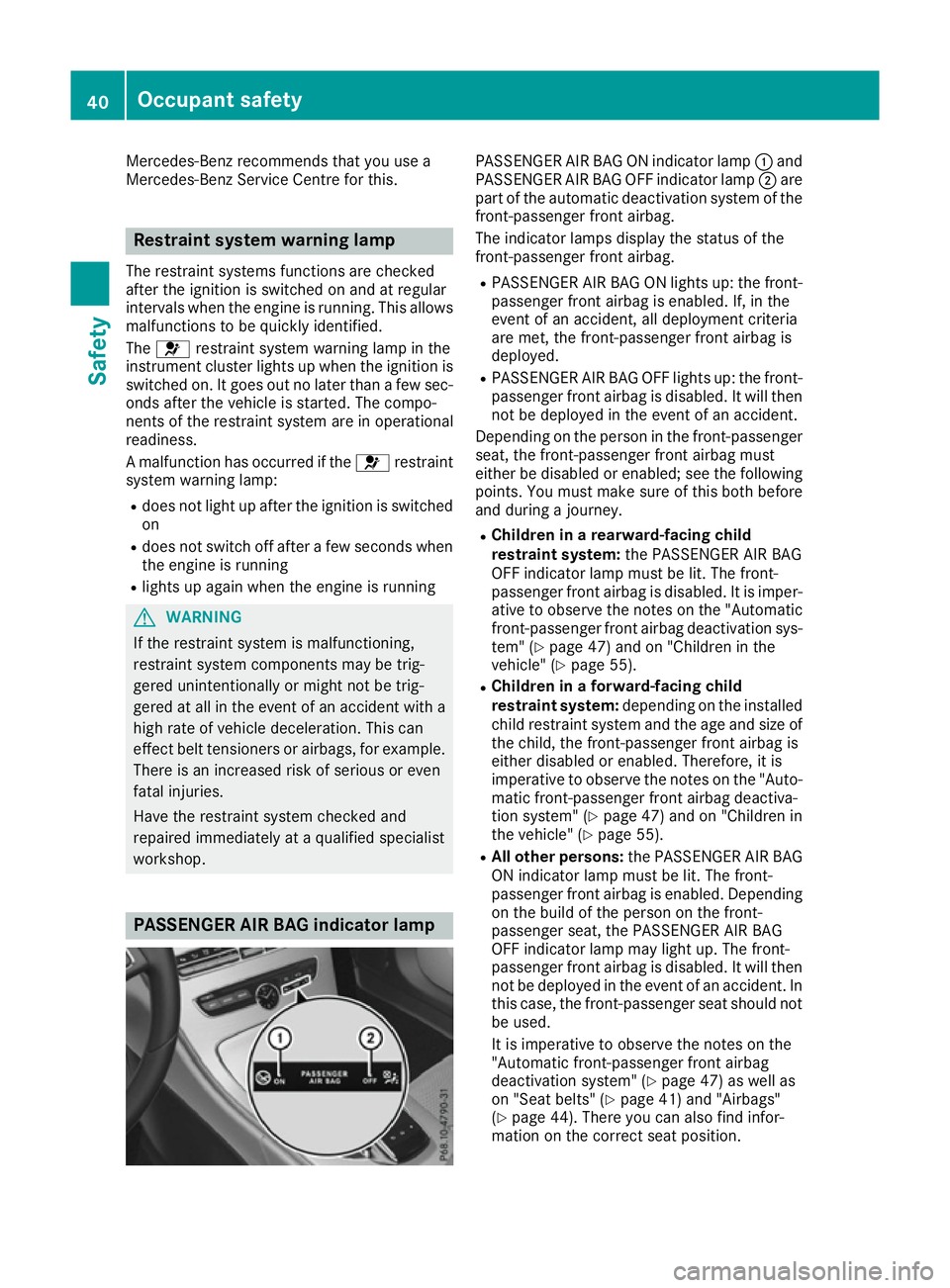
workshop. PASSENGER AIR BAG indicator lamp PASSENGER AIR BAG ON indicator lamp
:and
PASSENGER AIR BAG OFF indicator lamp ;are
part of the automatic deactivation system of the front-passenger front airbag.
The indicator lamps display the status of the
front-passenger front airbag.
R PASSENGER AIR BAG ON lights up: the front-
passenger front airbag is enabled. If, in the
event of an accident, all deployment criteria
are met, the front-passenger front airbag is
deployed.
R PASSENGER AIR BAG OFF lights up: the front-
passenger front airbag is disabled. It will then
not be deployed in the event of an accident.
Depending on the person in the front-passenger seat, the front-passenger front airbag must
either be disabledore nabled; see the following
points. You must make sure of this both before
and during ajourney.
R Children in arearward-facing child
restraint system: the PASSENGER AIR BAG
OFF indicator lamp must be lit. The front-
passenger front airbag is disabled. It is imper-
ative to observe the notes on the "Automatic front-passenger front airbag deactivation sys-
tem" (Y page 47) and on "Children in the
vehicle" (Y page 55).
R Children in aforward-facing child
restraint system: depending on the installed
child restraint system and the age and size of the child, the front-passenger front airbag is
either disabledore nabled. Therefore, it is
imperative to observe the notes on the "Auto-
matic front-passenger front airbag deactiva-
tion system" (Y page 47) and on "Children in
the vehicle" (Y page 55).
R All other persons: the PASSENGER AIR BAG
ON indicator lamp must be lit. The front-
passenger front airbag is enabled. Depending on the build of the person on the front-
passenger seat, the PASSENGER AIR BAG
OFF indicator lamp may light up. The front-
passenger front airbag is disabled. It will then
not be deployed in the event of an accident. In
this case, the front-passenger seat should not be used.
It is imperative to observe the notes on the
"Automatic front-passenger front airbag
deactivation system" (Y page 47) as well as
on "Seat belts" (Y page 41) and "Airbags"
(Y page 44). There you can also find infor-
mation on the correct seat position. 40
Occupant safetySafety
Page 51 of 385
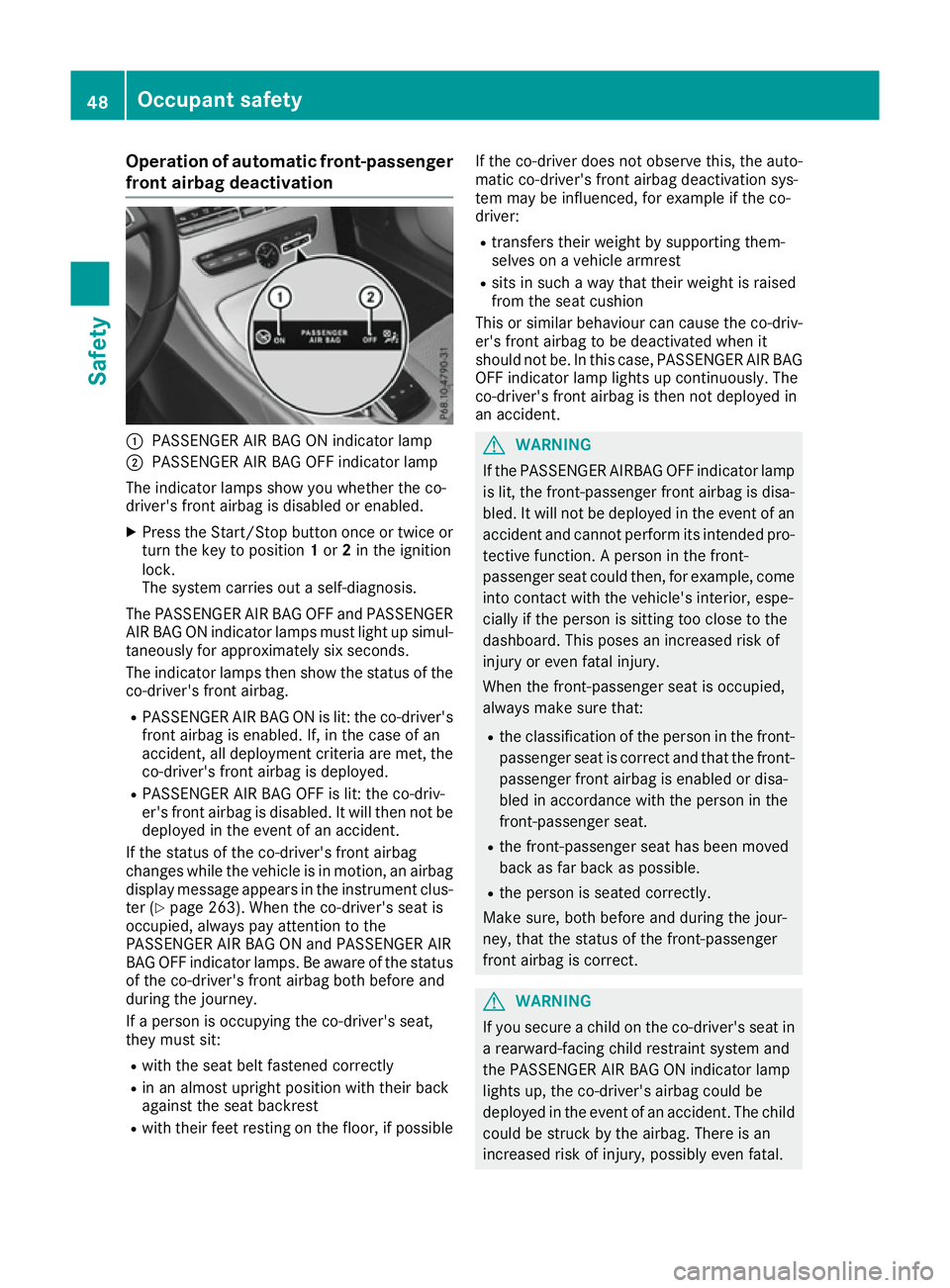
Operation of automatic front-passenger
front airba gdeactivation :
PASSENGER AIR BAG ON indicator lamp
; PASSENGER AIR BAG OFF indicator lamp
The indicator lamps show you whether the co-
driver's fron tairbag is disabled or enabled.
X Press the Start/Stop button onceort wice or
turn the key to position 1or 2in the ignition
lock.
The system carries out aself-diagnosis.
The PASSENGER AIR BAG OFF and PASSENGER
AIR BAG ON indicator lamps must light up simul- taneously for approximately six seconds.
The indicator lamps then show the status of the
co-driver's fron tairbag.
R PASSENGER AIR BAG ON is lit: the co-driver's
fron tairbag is enabled. If, in the case of an
accident, all deployment criteria are met, the
co-driver's fron tairbag is deployed.
R PASSENGER AIR BAG OFF is lit: the co-driv-
er's fron tairbag is disabled. It will then not be
deployed in the event of an accident.
If the status of the co-driver's fron tairbag
changes while the vehicle is in motion ,anairbag
display message appears in the instrument clus-
ter (Y page 263). When the co-driver's seat is
occupied, alway spay attention to the
PASSENGER AIR BAG ON and PASSENGER AIR
BAG OFF indicator lamps. Be aware of the status of the co-driver's fron tairbag both before and
during the journey.
If ap erson is occupying the co-driver's seat,
they must sit:
R with the seat belt fastened correctly
R in an almost upright position with their back
against the seat backrest
R with their feet restin gonthe floor, if possible If the co-driver does not observe this, the auto-
matic co-driver's fron tairbag deactivation sys-
tem may be influenced, for example if the co-
driver:
R transfers their weight by supportin gthem-
selves on avehicle armrest
R sits in such away that their weight is raised
from the seat cushion
This or similar behaviour can cause the co-driv-
er's fron tairbag to be deactivated when it
should not be. In this case, PASSENGER AIR BAG OFF indicator lamp lights up continuously. The
co-driver's fron tairbag is then not deployed in
an accident. G
WARNING
If the PASSENGER AIRBA GOFF indicator lamp
is lit, the front-passenger fron tairbag is disa-
bled. It will not be deployed in the event of an
acciden tand cannot perform its intended pro-
tective function .Aperson in the front-
passenger seat could then ,for example, come
into contact with the vehicle's interior, espe-
cially if the person is sitting too close to the
dashboard. This poses an increased risk of
injur yore ven fatal injury.
When the front-passenger seat is occupied,
alway smake sure that:
R the classification of the person in the front-
passenger seat is correct and that the front-
passenger fron tairbag is enabled or disa-
bled in accordance with the person in the
front-passenger seat.
R the front-passenger seat has been moved
back as far back as possible.
R the person is seated correctly.
Make sure, both before and during the jour-
ney, that the status of the front-passenger
fron tairbag is correct. G
WARNING
If you secure achild on the co-driver's seat in
ar earward-facing child restraint system and
the PASSENGER AIR BAG ON indicator lamp
lights up, the co-driver's airbag could be
deployed in the event of an accident. The child could be struc kbythe airbag. There is an
increased risk of injury, possibly even fatal. 48
Occupant safetySafety
Page 52 of 385
In this case, always ensure that the co-driver's
airbag is disabled.T he PASSENGER AIRBAG
OFF indicator lamp must light up.
If the PASSENGER AIR BAG OFF indicator lamp
remains off and/or the PASSENGER AIR BAG
ON indicator light is lit, do not fit arearward-
facing child restraint system on the co-driver's
seat. Further information can be obtained under
"Problems with the automatic co-driver's front
airbag deactivation system" (Y page 52).G
WARNING
If you secure achild in aforward-facing child
restraint system on the front-passenger seat
and you positio nthe front-passenger seat too
close to the dashboard, in the event of an
accident, the child could:
R come into contact with the vehicle's inte-
rior if the PASSENGER AIR BAG OFF indi-
cator lamp is lit, for example
R be struck by the airbag if the PASSENGER
AIR BAG ON indicator lamp is lit
This poses an increased risk of injury or even fatal injury.
Alwaysm ove the front-passenger seat as far
back as possible and fullyr etract the seat
cushio nlength. Alwaysm ake sure that the
shoulder belt strap is correctly routed from
the vehicle belt outlet to the shoulder belt
guideont he child restraint system. The shoul-
der belt strap must be routed forward sand
downwards from the vehicle belt outlet. If
necessary ,adjust the vehicle belt outlet and
the front-passenger seat accordingly .Always
observe the information abouts uitable posi-
tioning of the child restraint system in this
Owner's Manualasw ell as the child restraint
system manufacturer's installation instruc-
tions.
If the automatic co-driver's front airbag deacti-
vation system detects that:
R the co-driver's seat is unoccupied, the
PASSENGER AIR BAG OFF indicator lamp
lights up after the system self-test and remains lit. This indicates that the co-driver's
front airbag is disabled.
R the co-driver's seat is occupie dbyachild in a
rearward-facing child restraint system, the
PASSENGER AIR BAG OFF indicator lamp
lights up after the system self-test and
remains lit. This indicates that the co-driver's front airbag is disabled.
But in the case of achild in arearward-facing
child restraint system, the PASSENGER AIR
BAG ON indicator lamp can be lit continuously
after the system self-test. This indicates that
the co-driver's front airbag is enabled. The
resultoft he classification is dependent on,
among other factors, the child restraint sys-
tem and the child's stature. It is recommen-
ded that you fit the child restraint system to a
suitable rear seat.
R the co-driver's seat is occupie dbyachild in a
forward-facing child restraint system, either
the PASSENGER AIR BAG ON or PASSENGER
AIR BAG OFF indicator lamp lights up after the
system self-test depending on the resultof
the classification and remains lit. The resultof the classification is dependent on, among
other factors, the child restraint system and
the child's stature.
Move the co-driver's seat as far back as pos-
sible. Alwayso bserve the information on
"Child restraint systems on the co-driver's
seat" (Y page 59) and on "Suitable posi-
tioning of the child restraint system"
(Y page 60). Alternatively ,fit the child
restraint system on asuitable rear seat.
R the co-driver's seat is occupie dbyaperson of
smaller stature (e.g. ateenager or small
adult), either the PASSENGER AIR BAG ON or the PASSENGER AIR BAG OFF indicator lamp
lights up and remains lit after the system self- test depending on the resultoft he classifica-
tion.
- If the PASSENGER AIR BAG ON indicator
lamp is lit, move the co-driver's seat as far
back as possible. Alternatively ,aperson of
smaller stature can sit on arear seat.
- If the PASSENGER AIR BAG OFF indicator
lamp is lit, aperson of smaller stature
shouldn ot use the co-driver's seat.
R the co-driver's seat is occupie dbyanadult or
ap erson of astature corresponding to that of
an adult, the PASSENGER AIR BAG ON indi-
cator lamp is lit continuously after the system
self-test. This indicates that the co-driver's
front airbag is enabled. Occupant safety
49Safety Z
Page 55 of 385
Problems with automatic front-passenger front airbag deactivation
Be sure to observe the notes on "System self-test
"(Y page 50). Problem
Possible causes/consequences and
M
MSolutions The PASSENGER AIR
BAG OFF indicator lamp
lights up and remains lit,
even though the front-
passenger seat is occu-
pied by an adult or aper-
son with abuild corre-
sponding to that of an
adult. The classification of the person on the front-passenger seat is false.
X Make sure the condition sfor ac orrect classification of the person
on the front-passenger seat are met (Y page 48).
X If the PASSENGER AIR BAG OFF indicator lamp remains lit, the front-
passenger seat may not be used.
X Have the automatic front-passenger front airbag deactivation sys-
tem checked as soon as possible at aMercedes-Benz Service
Centre. The PASSENGER AIR
BAG OFF indicator lamp
does not light up and/or
does not stay on.
The front-passenger seatis:
R empty
R occupied with arear-
ward-facing child
restraint system The automatic front-passenger front airbag deactivation system is
malfunctioning.
X Make sure there is nothingb etween the seat and the child restraint
system.
X Make sure that the entire base of the child restraint system rests on
the seat cushion of the front-passenger seat.
X Make sure that the seat cushion length is fully retracted.
X When installing the child restraint system, make sure that the seat
belt is tight. Do not pull the seat belt tight with the front-passenger
seat adjustment .This could result in the seat belt and the child
restraint system being pulled too tightly.
X Check that the child restraint system is installed correctly.
X Make sure that no objectsa re applying additional weight to the
seat.
X If the PASSENGER AIR BAG OFF indicator lamp remains off and/or
the PASSENGER AIR BAG ON indicator lamp lights up, do not install
ar earward-facing child restraint system on the front-passenger
seat. It is recommended that you fit the child restraint system to a suitable rear seat.
X Have the automatic front-passenger front airbag deactivation sys-
tem checked as soon as possible at aMercedes-Benz Service
Centre. Deployment of belt tensioners and air-
bags
Important safety notes G
WARNING
After the airbag deploys, the airbag parts are
hot. There is arisk of injury.
Do not touch the airbag parts. Have a
deployeda irbag replaced at aqualified spe-
cialist workshop as soon as possible. G
WARNING
Pyrotechnic seat belt tensioners that have
been deployeda re no longer operational and
are unable to perform their intended protec-
tive function. This poses an increased risk of
injury or even fatal injury.
Therefore, have pyrotechnic belt tensioners
which have been triggered immediately
replaced at aqualified specialist workshop.
Mercedes-Benz recommends that you have the
vehicle towed to aqualified specialist workshop 52
Occupant safetySafety
Page 62 of 385
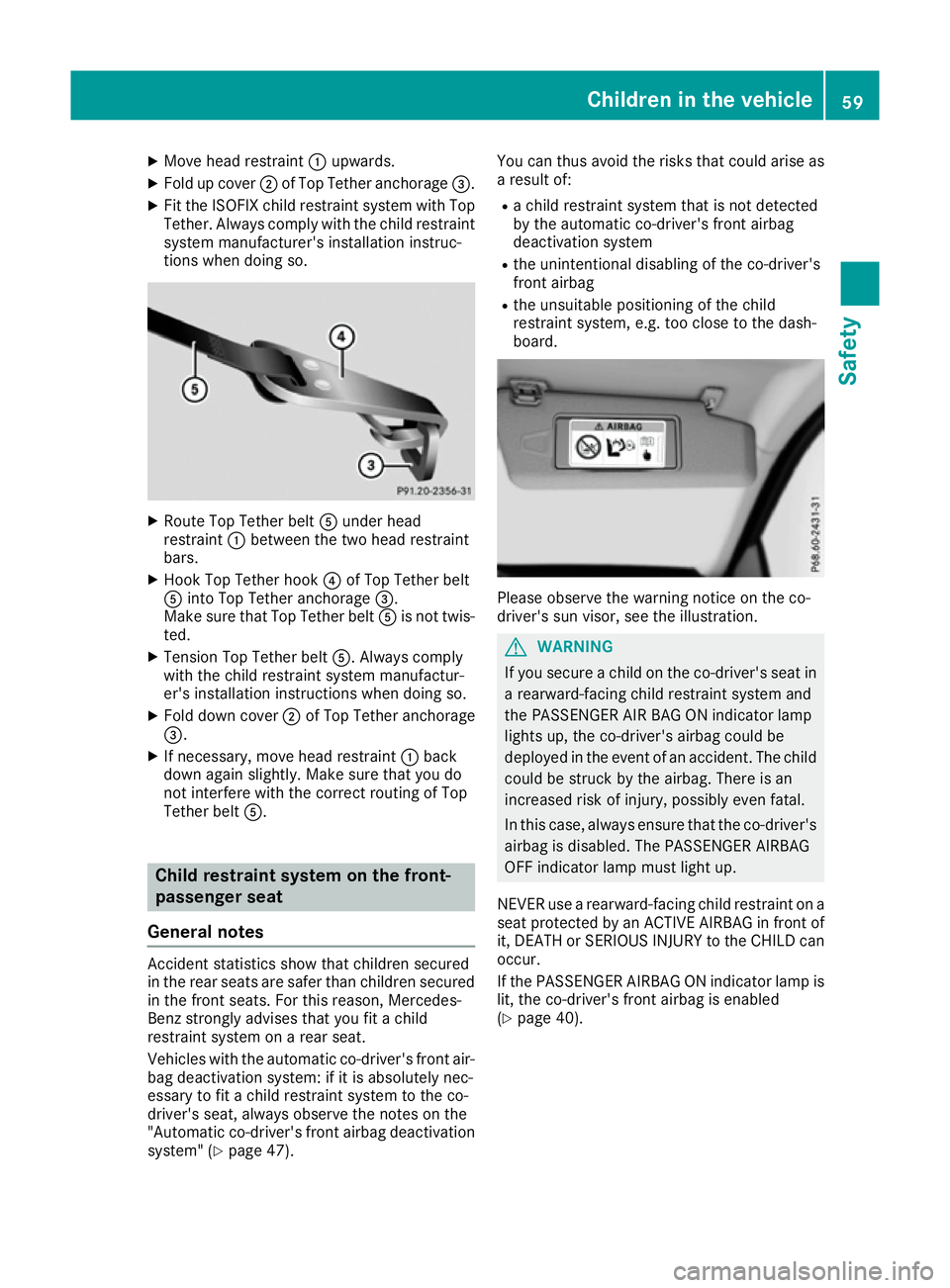
X
Move head restraint :upwards.
X Fold up cover ;of Top Tether anchorage =.
X Fit the ISOFIX child restraint system with Top
Tether. Always comply with the child restraint system manufacturer's installation instruc-
tions when doing so. X
Route Top Tether belt Aunder head
restraint :between the two head restraint
bars.
X Hook Top Tether hook ?of Top Tether belt
A into Top Tether anchorage =.
Make sure that Top Tether belt Ais not twis-
ted.
X Tension Top Tether belt A.Always comply
with the child restraint system manufactur-
er's installation instructions when doing so.
X Fold down cover ;of Top Tether anchorage
=.
X If necessary, move head restraint :back
down again slightly. Make sure that you do
not interferew ith the correct routing of Top
Tether belt A. Child restraint system on the front-
passenger seat
General notes Accident statisticss
how that children secured
in the rear seats are safer than children secured
in the front seats. For this reason, Mercedes-
Benz strongly advises that you fit achild
restraint system on arear seat.
Vehicles with the automatic co-driver's front air-
bag deactivation system: if it is absolutely nec-
essary to fit achild restraint system to the co-
driver's seat, always observe the notes on the
"Automatic co-driver's front airbag deactivation system" (Y page 47). You can thus avoid the risks that could arise as
ar esult of:
R ac hild restraint system that is not detected
by the automatic co-driver's front airbag
deactivation system
R the unintentional disabling of the co-driver's
front airbag
R the unsuitable positioning of the child
restraint system, e.g. too close to the dash-
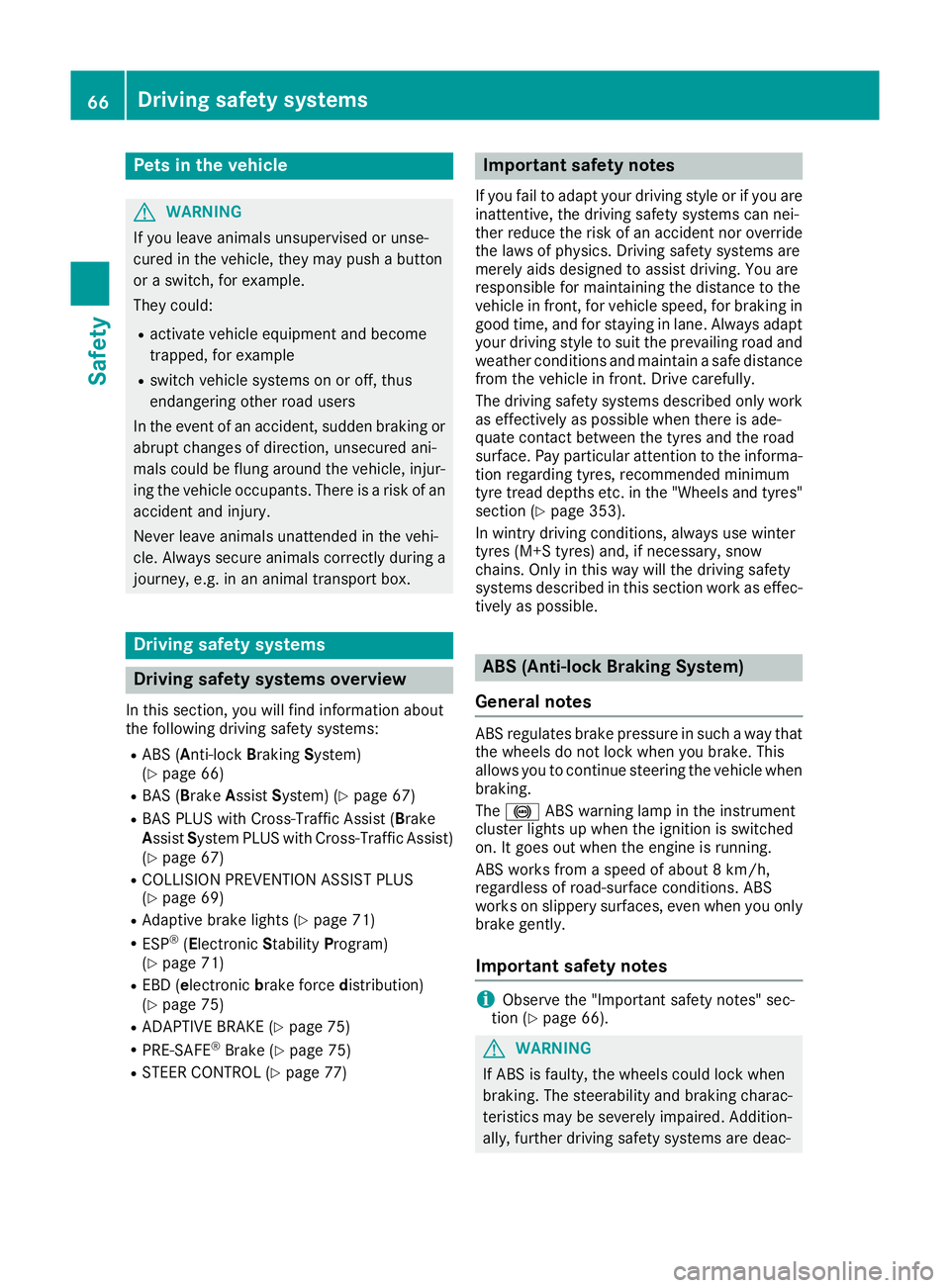
board. Please observe the warning notice on the co-
driver's sun visor, see the illustration. G
WARNING
If you secure achild on the co-driver's seat in
ar earward-facing child restraint system and
the PASSENGER AIR BAG ON indicator lamp
lights up, the co-driver's airbag could be
deployed in the event of an accident. The child could be struck by the airbag. There is an
increased risk of injury, possibly even fatal.
In this case, always ensure that the co-driver's
airbag is disabled. The PASSENGER AIRBAG
OFF indicator lamp must light up.
NEVERu searearward-facing child restraint on a
seat protected by an ACTIVE AIRBAG in front of
it, DEATH or SERIOUS INJURY to the CHILD can occur.
If the PASSENGER AIRBAG ON indicator lamp is
lit, the co-driver's front airbag is enabled
(Y page 40). Children in the vehicle
59Safety Z
Page 69 of 385
Pets in the vehicle
G
WARNING
If you leave animals unsupervised or unse-
cured in the vehicle, they may push abutton
or as witch, for example.
They could:
R activate vehicle equipment and become
trapped, for example
R switch vehicle systems on or off, thus
endangering other road users
In the event of an accident, sudden braking or
abrupt changes of direction, unsecured ani-
mals could be flung around the vehicle, injur-
ing the vehicle occupants. There is arisk of an
accident and injury.
Never leave animals unattended in the vehi-
cle. Always secure animals correctly during a
journey, e.g. in an animal transport box. Driving safety systems
Driving safety systems overview
In this section,y ou will find information about
the following driving safety systems:
R ABS (Anti-lock BrakingSystem)
(Y page 66)
R BAS ( Brake Assist System) (Y page 67)
R BAS PLUS with Cross-Traffic Assist ( Brake
Assist System PLUS with Cross-Traffic Assist)
(Y page 67)
R COLLISION PREVENTION ASSIST PLUS
(Y page 69)
R Adaptive brake lights (Y page 71)
R ESP ®
(Electronic StabilityProgram)
(Y page 71)
R EBD ( electronic brakeforce distribution)
(Y page 75)
R ADAPTIVE BRAKE (Y page 75)
R PRE-SAFE ®
Brake (Y page 75)
R STEERC ONTROL (Y page 77) Important safety notes
If you fail to adapt your driving style or if you are
inattentive, the driving safety systems can nei-
ther reduce the risk of an accident nor override the laws of physics. Driving safety systems are
merely aids designed to assist driving. You are
responsible for maintaining the distance to the
vehicle in front,f or vehicle speed, for braking in
good time, and for staying in lane. Always adapt your driving style to suit the prevailing road and
weather condition sand maintain asafe distance
from the vehicle in front.D rive carefully.
The driving safety systems described only work
as effectively as possible when there is ade-
quate contact between the tyres and the road
surface. Pay particular attention to the informa- tion regarding tyres, recommended minimum
tyre tread depths etc. in the "Wheels and tyres" section (Y page 353).
In wintry driving conditions, always use winter
tyres (M+S tyres) and, if necessary, snow
chains. Only in this way will the driving safety
systems described in this section work as effec-
tively as possible. ABS (Anti-loc
kBraking System)
General notes ABS regulates brake pressure in such
away that
the wheels do not lock when you brake. This
allowsy ou to continue steering the vehicle when
braking.
The ! ABS warning lamp in the instrument
cluster lights up when the ignition is switched
on. It goes out when the engine is running.
ABS works from aspeed of about 8km/h,
regardless of road-surface conditions. ABS
works on slippery surfaces, even when you only brake gently.
Important safety notes i
Observe the "Important safety notes" sec-
tion (Y page 66). G
WARNING
If ABS is faulty, the wheels could lock when
braking. The steerability and braking charac-
teristic smay be severely impaired. Addition-
ally,f urther driving safety systems are deac- 66
Driving safety systemsSafety
Page 73 of 385
G
WARNING
The distance warning function does not react:
R to people or animals
R to oncoming vehicles
R to crossing traffic
R when cornering
Thus ,the distance warning function cannot
provid eawarning in all critical situations.
There is arisk of an accident.
Always pay carefu lattention to the traffic sit-
uation and be read ytobrake. G
WARNING
The distance warning function cannot always
clearly identify objects and comple xtraffic
situations.
In such cases, the distance warning function
may:
R give an unnecessary warning
R not give awarning
There is arisk of an accident.
Always pay carefu lattention to the traffic sit-
uation; do not rely on the distance warning
function alone.
Function The distance warning function issues awarning
at speeds:
R of approximately 30 km/h or more, if, over
severa lseconds, the distance maintained to
the vehicl etravelling in front is insufficient.
The · distance warning lamp then lights
up in the instrument cluster.
R of approximately 7km/h or more, if you rap-
idlya pproach avehicl einf ront. An intermit-
tent warning tone willt hen sound,and the
· distance warning lamp willl ight up in the
instrument cluster.
X Brake immediatel yinorder to increas ethe
distance from the vehicl einfront.
or
X Take evasive action provided it is safe to do
so.
Due to the nature of the system, particularly
complicated but non-critical driving conditions
may alsoc ausethe system to display awarning. With the help of the rada
rsensor system, the
distance warning function can detect obstacles
that are in the path of yourv ehiclefor an exten-
ded period of time.
Up to aspee dofa pproximatel y70k m/h, the
distance warning function can alsor eact to sta-
tionary obstacles, such as stoppe dorparked
vehicles.
Autonomous braking function If the drive
rdoes not react to the distance warn-
ing signa linacritical situation, COLLISION PRE-
VENTION ASSIST PLUS can assist with the
autonomous braking function.
The autonomous braking function:
R gives the drive rmore time to react to critical
driving situations
R can help the drive rtoavoidana ccident or
R reduces the effects of an accident
Vehicles without DISTRONIC PLUS: the
autonomous braking function is available in the
following spee dranges:
R 7-1 05 km/h for moving objects
R 7-50k m/h for stationary objects
Vehicles with DISTRONIC PLUS: the autono-
mous braking function is available in the follow-
ing spee dranges:
R 7-2 00 km/h for moving objects
R 7-50k m/h for stationary objects
Due to the nature of the system, complicated
but non-critical driving situations may also
caus ethe autonomous braking function to inter-
vene.
If the autonomous braking function demands
particularl yhigh braking force, preventative
passenger protection measures (PRE-SAFE ®
)
are activated simultaneously (Y page54).
Adaptive Brake Assist General notes
i Observe the "Important safety notes" sec-
tion (Y page66).
With the help of Adaptive Brake Assist, the dis-
tance warning signa lcan detect obstacles that
are in the path of yourv ehiclefor an extended
period of time.
If Adaptive Brake Assist detects arisk of acol-
lision with the vehicl einfront, it calculates the 70
Driving safety systemsSafety
Page 74 of 385
brakin
gforc enecessary to avoid acollision. If
you apply the brakes forcefully, Adaptiv eBrake
Assist will automatically increase the braking
forc etoal evel suitable for the traffic conditions.
Adaptiv eBrakeA ssist provides brakin gassis-
tanc einh azardous situation satspeeds above
7k m/h. It uses radar sensor technology to
assess the traffic situation.
Up to aspeed of approximately 250 km/h,
Adaptiv eBrakeA ssist is capable of reacting to
movin gobjects that have already been detected
as such at least onc eover the period of obser-
vation.
Up to aspeed of approximately 70 km/h, Adap-
tive Brak eAssist react stostationary obstacles.
If Adaptiv eBrakeA ssist demands particularly
high brakin gforce, preventativ epassenger pro-
tection measures (PRE-SAFE ®
)a re activated
simultaneously (Y page 54).
X Keep the brake pedal depressed until the
emergency brakin gsituation is over.
ABSp revents the wheels from locking.
The brakes will work normally again if: R you release the brake pedal
R ther eisnol onger any danger of acollision
R no obstacle is detected in fron tofyour vehicle
Adaptiv eBrakeA ssist is then deactivated.
Important safet ynotes
i Observe the "Important safety notes" sec-
tion for driving safety systems (Y page 66).G
WARNING
Adaptiv eBrakeA ssist cannot always clearly
identify objects and complex traffic situa-
tions.
In such cases, Adaptiv eBrakeA ssist can:
R interven eunnecessarily
R not intervene
There is arisk of an accident.
Always pay careful attention to the traffic sit- uation and be ready to brake. Terminate the
intervention in anon-critical driving situation. G
WARNING
Adaptiv eBrakeA ssist does not react:
R to people or animals
R to oncoming vehicles
R to crossing traffic
R when cornering
As aresult, the Adaptiv eBrak eAssist may not
interven einall critical conditions. There is a
risk of an accident.
Always pay careful attention to the traffic sit- uation and be ready to brake.
Due to the natur eofthe system, particularly
complicated but non-critical driving conditions
may also cause Brak eAssist to intervene.
If Adaptiv eBrak eAssist is not available due to a
malfunction in the radar sensor system, the
brake system remains available with full brake
boostin geffec tand BAS. Adaptive brake lights
The adaptive brake lights warn following traffic
in an emergency brakin gsituation:
R by flashing brake lamps
R by activating the hazard warning lamps
If you brake sharply from aspeed of more than
50 km/ horifb raking is assisted by BAS or BAS
PLUS, the brake lamp sflashr apidly.Int his way,
traffic travelling behind you is warned in an even more noticeable manner.
If you brake sharply from aspee dofm ore than
70 km/h to astandstill, the hazard warning
lamp sare activated automatically. If the brakes
are applieda gain, the brake lamp slight up con-
tinuously.T he hazard warning lamp sswitch off
automatically if you travel faster than 10 km/h. You can alsos witch off the hazard warning
lamp susing the hazard warning button
(Y page1 20). ESP
®
(Electronic Stability Program)
General notes i
Observe the "Important safety notes" sec-
tion (Y page66). Driving safety systems
71Safety Z
Page 75 of 385
ESP
®
monitors drivin gstability and traction, i.e.
powe rtransmission between the tyres and the
roa dsurface.
If ESP ®
detects tha tthe vehicl eisdeviating from
the direction desired by the driver ,one or more
wheels ar ebraked to stabilise the vehicle. The
engine outpu tisa lsom odified to kee pthe vehi-
cle on the desired course withi nphysical limits.
ESP ®
assists the driver when pulling away on
we tors lipper yroads .ESP ®
can also stabilise
the vehicl eduringb raking.
ETS/4ETS (Electroni cTraction System) i
Observe the "Important safety notes" sec-
tio n(Ypage 66).
ETS tractio ncontro lispartofE SP®
.
Tractio ncontro lbrakes the drive wheels indi-
viduall yiftheys pin. Thi senables yo utopull
away and accelerate on slippery surfaces ,for
exampl eifthe roa dsurface is slippery on one
side .Ina ddition, mor edrive torque is transfer-
red to the whee lorwheelswitht raction.
Tractio ncontro lremains active if yo udeactivate
ESP ®
.
Important safety notes i
Observe the "Important safety notes" sec-
tio n(Ypage 66). G
WARNING
If ESP ®
is malfunctioning ,ESP ®
is unabl eto
stabilise the vehicle. In addition, othe rdriving
safety system sareswitched off .Thisi ncrea-
ses the ris kofskidding and an accident.
Driv eonc arefully. Hav eESP®
checked at a
qualified specialis tworkshop.
When towing your vehicl eawayw itht he rear
axl eraised, observe the note sonESP®
(Y page 349).
If the å ESP®
OFF warning lamp lights up
continuously ,ESP ®
is deactivated.
If the ÷ ESP®
warning lamp lights up contin-
uously ,ESP ®
is not availabl eduetoam alfunc-
tion.
Observe the informatio nonwarning lamps
(Y page 287 )and displa ymessage swhich may
be shown in the instrument cluster
(Y page 254). Onl
yusewheels with the recommende dtyre
sizes. Onl ythenw illE SP ®
functio nproperly.
Characteristics of ESP ® General notes
If the ÷ ESP warning lamp goes ou tbefore
beginning the journey ,ESP ®
is automatically
active.
If ESP ®
intervenes ,the ÷ ESP®
warning lamp
flashe sinthe instrument cluster.
If ESP ®
intervenes:
X Do not deactivate ESP ®
under any circum-
stances.
X When pulling away ,onlyd epress the acceler-
ato rpedal as farasisn ecessary.
X Adapt your drivin gstyle to suit the prevailing
roa dand weather conditions.
EC Os tart/sto pfunction
The ECO start/sto pfunctio nswitches the
engine off automaticall yifthe vehicl estops
moving .Whenp ulling away again, the engine
starts automatically. ESP ®
remains in its previ-
ousl yselecte dstatus. Example: if ESP®
was
deactivated befor ethe engine wa sswitched off,
ESP ®
remains deactivated when the engine is
switched on again.
Deactivating/activatin gESP®
(except
Mercedes‑ AMGvehicles) Important safety notes
i Observe the "Important safety notes" sec-
tio n(Ypage 66).
Yo uc an select between the following statuses
of ESP ®
:
R ESP ®
is activated
R ESP ®
is deactivated G
WARNING
If yo udeactivate ESP ®
,E SP ®
no longe rsta-
bilises the vehicle. There is an increased risk
of skidding and an accident.
Onl ydeactivate ESP ®
in the situations descri-
be dint he following. 72
Driving safet
ysystemsSafety