service MERCEDES-BENZ C-CLASS COUPE 2015 User Guide
[x] Cancel search | Manufacturer: MERCEDES-BENZ, Model Year: 2015, Model line: C-CLASS COUPE, Model: MERCEDES-BENZ C-CLASS COUPE 2015Pages: 385, PDF Size: 13.12 MB
Page 31 of 385
loose floormats and do not place several floor-
mats on top of one another.
! If the engin
eisswitched off and equipment
on the diagnostic sconnection is used, the
starter battery may discharge.
Connecting equipmen ttothe diagnostic scon-
nection can lead to emissions monitoring infor-
matio nbeing reset ,for example. This may lead
to the vehicle failing to meet the requirements of the nex temissions tes tdurin gthe main inspec-
tion. Qualified specialist workshop
Aq ualified specialist workshop has the neces-
sary special skills ,tools and qualifications to
correctly carr yout any necessary work on your
vehicle. This particularly applies to work rele-
vant to safety.
Observe the notes in the Service Booklet.
Always have the followin gwork carried out at a
qualified specialist workshop:
R work relevant to safety
R service and maintenance work
R repair work
R modifications ,installation sand conversions
R work on electronic components
Mercedes-Ben zrecommends that you use a
Mercedes-Ben zService Centre. Vehicle registration
Mercedes-Ben zmay ask its Service Centres to
carr yout technical inspections on certain vehi-
cles. The quality or safet yofthe vehicle is
improved as aresult of the inspection.
Mercedes-Ben zcan only inform you about vehi-
cle checks if it has your registratio ndata.
It is possible that your vehicle has not yet been
registered in your name in the followin gcases:
R if your vehicle was not purchased at an
authorised specialist dealer.
R if your vehicle has not yet been examined at a
Mercedes-Ben zService Centre.
It is advisable to register your vehicle with a
Mercedes-Ben zService Centre.
Inform Mercedes-Ben zassoon as possible
about any change in address or vehicle owner- ship. You can do this at
aMercedes-Ben zSer-
vice Centre, for example. Correct use
If you remove any warnin gstickers, you or oth-
ers could fail to recognise certain dangers.
Leave warnin gsticker sinposition.
Observe the followin ginformation when driving
your vehicle:
R the safet ynotes in this manual
R the vehicle technical data
R traffic rules and regulations
R laws and safet ystandards pertainin gtomotor
vehicles Implied warranty
! Follow the instructions in this manual about
the proper operation of your vehicle as well as
about possible vehicle damage. Damag eto
your vehicle that arises fro mculpable contra-
vention sagainst these instructions are not
covered either by Mercedes-Ben zimplied
warranty or by the New or Used-Vehicle War- ranty. QR code for rescu
ecard
The QR code is secured in the fuel filler flap and
on the opposit eside on the B-pillar. In the event
of an accident ,rescue services can use the QR
code to quickly fin dthe appropriate rescue card
for your vehicle. The current rescue card con-
tains, in acompact form, the most important
information about your vehicle, e.g. the routing
of the electric cables.
You can fin dmore information under http://
portal.aftersales.i.daimler.com/public/
content/asportal/en/communication/
informationen_fuer/QRCode.html. Data stored in th
evehicle
Aw ide rang eofelectronic component sinyour
vehicle contain data memories. 28
Data stored in thev
ehicleIntroduction
Page 32 of 385

These data memories temporarily or perma-
nently store technical information about:
R the vehicle's operating state
R events
R faults
In general, this technical information docu-
mentst he state of acomponent, amodule, a
system or the surroundings.
These include, for example:
R operating conditions of system components,
e.g. fluid levels
R the vehicle's status messages and those of its
individual components,e .g. number of wheel
revolutions/speed, deceleration in move-
ment,l ateral acceleration ,accelerator pedal
position
R malfunctions and defect sinimportant system
components,e .g. lights, brakes
R vehicle reaction sand operating conditions in
special driving situations, e.g. airbag deploy-
ment,i ntervention of stability control sys-
tems
R ambient conditions, e.g. outside temperature
This data is of an exclusively technical nature
and can be used to:
R assist in detecting and rectifying faults and
defects
R analyse vehicle functions, e.g. after an acci-
dent
R optimise vehicle functions
The data cannot be used to trace the vehicle's
movements.
When your vehicle is serviced, technical infor-
mation can be read from the event data memory
and fault data memory.
Services include, for example:
R repair services
R service processes
R warranty events
R quality assurance
The vehicle is read out by employees of the ser- vice network (including the manufacturer) using
special diagnostic testers. You can obtain more information there, if required.
After afault has been rectified, the information
is deleted from the fault memory or is continu-
ally overwritten.
When operating the vehicle, situations are con-
ceivable in which this technical data, in connec- tion with other information (if necessary, after
consultation with an authorised expert), could
be traced to aperson.
Examples include:
R accident reports
R damage to the vehicle
R witness statements
Further additional functions that have been con-
tractually agreed upon with the customer allow
certain vehicle data to be conveyed by the vehi-
cle as well. The additional functions include, for example, vehicle location in case of an emer-
gency. Copyright information
General notes
Information on licences for free and open-
source software used in your vehicle and its
electronic components is availabl eonthe fol-
lowing website:
http://www.mercedes-benz.com/opensource Copyright information
29Introduction Z
Page 43 of 385
Mercedes-Ben
zrecommends that you use a
Mercedes-Ben zService Centre for this. Restraint system warning lamp
The restraint systems functions are checked
after the ignition is switched on and at regular
intervals when the engine is running. This allows
malfunctions to be quickly identified.
The 6 restraint system warning lamp in the
instrumentc luster lights up when the ignition is
switched on. It goes out no later than afew sec-
onds after the vehicle is started. The compo-
nentsoft he restraint system are in operational
readiness.
Am alfunction has occurred if the 6restraint
system warning lamp:
R does not light up after the ignition is switched
on
R does not switch off after afew seconds when
the engine is running
R lights up again when the engine is running G
WARNING
If the restraint system is malfunctioning,
restraint system components may be trig-
gered unintentionally or might not be trig-
gered at all in the event of an accident with a high rate of vehicle deceleration. This can
effect belt tensionersora irbags, for example.
There is an increased risk of serious or even
fatal injuries.
Have the restraint system checked and
repaired immediately at aqualified specialist
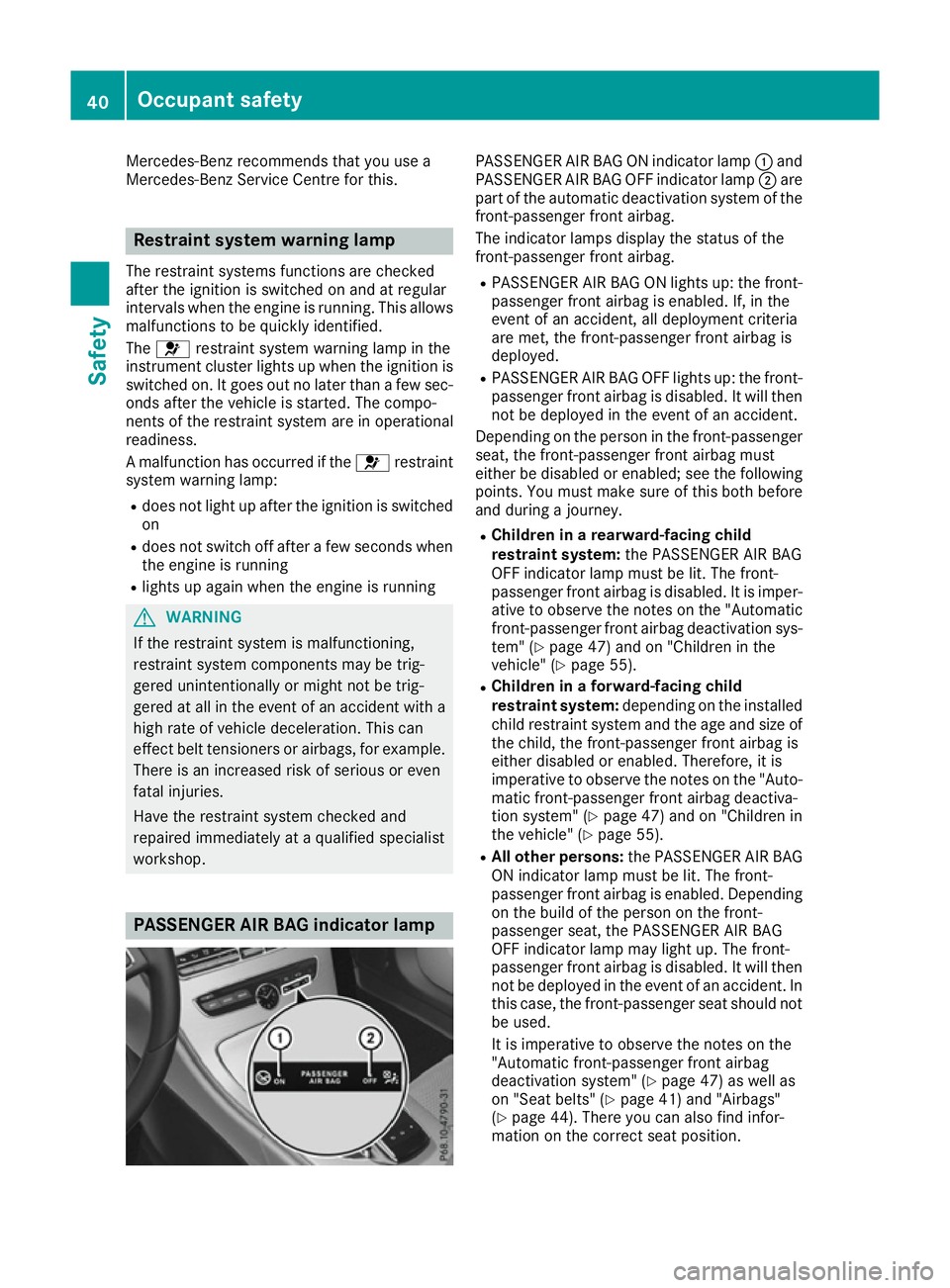
workshop. PASSENGER AIR BAG indicator lamp PASSENGER AIR BAG ON indicator lamp
:and
PASSENGER AIR BAG OFF indicator lamp ;are
part of the automatic deactivation system of the front-passenger front airbag.
The indicator lamps display the status of the
front-passenger front airbag.
R PASSENGER AIR BAG ON lights up: the front-
passenger front airbag is enabled. If, in the
event of an accident, all deployment criteria
are met, the front-passenger front airbag is
deployed.
R PASSENGER AIR BAG OFF lights up: the front-
passenger front airbag is disabled. It will then
not be deployed in the event of an accident.
Depending on the person in the front-passenger seat, the front-passenger front airbag must
either be disabledore nabled; see the following
points. You must make sure of this both before
and during ajourney.
R Children in arearward-facing child
restraint system: the PASSENGER AIR BAG
OFF indicator lamp must be lit. The front-
passenger front airbag is disabled. It is imper-
ative to observe the notes on the "Automatic front-passenger front airbag deactivation sys-
tem" (Y page 47) and on "Children in the
vehicle" (Y page 55).
R Children in aforward-facing child
restraint system: depending on the installed
child restraint system and the age and size of the child, the front-passenger front airbag is
either disabledore nabled. Therefore, it is
imperative to observe the notes on the "Auto-
matic front-passenger front airbag deactiva-
tion system" (Y page 47) and on "Children in
the vehicle" (Y page 55).
R All other persons: the PASSENGER AIR BAG
ON indicator lamp must be lit. The front-
passenger front airbag is enabled. Depending on the build of the person on the front-
passenger seat, the PASSENGER AIR BAG
OFF indicator lamp may light up. The front-
passenger front airbag is disabled. It will then
not be deployed in the event of an accident. In
this case, the front-passenger seat should not be used.
It is imperative to observe the notes on the
"Automatic front-passenger front airbag
deactivation system" (Y page 47) as well as
on "Seat belts" (Y page 41) and "Airbags"
(Y page 44). There you can also find infor-
mation on the correct seat position. 40
Occupant safetySafety
Page 53 of 385
If childre
nare travelling in the vehicle ,besure to
observe the notes on "Childrenint he Vehicle"
(Y page 55).
If the automatic co-driver's front airbag deacti-
vation system is malfunctioning, the red 6
restraint system warning lamp in the instrument cluster and the PASSENGER AIR BAG OFF indi-
cator lamp light up simultaneously. The co-driv-
er's front airbag is disabled in this case and does not deploy during an accident. Have the system
checked as soon as possible by qualifiedt ech-
nicians. Consul taMercedes-Benz Service
Centre. The co-driver's seat shouldo nly be
repaired at aMercedes-Benz Service Centre.
If the co-driver's seat, the seat cover or the seat cushio nisdamaged, have the necessary repair
work carried out at aMercedes-Benz Service
Centre.
For safety reasons, Mercedes-Benz recom-
mends that you only use achild restraint system
which has been tested and approved by
Mercedes-Benz in combination with the auto-
matic co-driver's front airbag deactivation sys-
tem.
System self-test G
DANGER
If both the PASSENGER AIR BAG OFF and
PASSENGER AIR BAG ON indicator lampsdo
not light up during the system self-test, the
system is malfunctioning. The front-
passenger front airbag might be triggered
unintentionally or might not be triggered at all in the event of an accident with high deceler-
ation. This poses an increased risk of injury or even fatal injury.
In this case the front-passenger seat may notbe used.Don ot installachild restraint system
on the front-passenger seat. Have the auto-
matic front-passenger front airbag deactiva-
tion system checked and repaired immedi-
ately at aqualifieds pecialist workshop. G
WARNING
If the PASSENGER AIRBAG OFF indicator lamp remains lit after the system self-test, the
front-passenger front airbag is disabled.Itw ill
not be deployed in the event of an accident. In
this case, the front-passenger front airbag cannot perform its intended protective func-
tion, e.g. when
aperson is seated in the front-
passenger seat.
That person could,f or example,come into
contact with the vehicle's interior, especially
if the person is sitting too close to the dash-
board.T his poses an increased risk of injury or
even fatal injury.
When the front-passenger seat is occupied,
always ensure that:
R the classification of the person in the front-
passenger seat is correct and the front-
passenger front airbag is enabled or disa-
bled in accordance with the person in the
front-passenger seat.
R the person is seated properl ywithacor-
rectly fastened seat belt.
R the front-passenger seat has been moved
as far back as possible.
If the PASSENGER AIR BAG OFF indicator
lamp remains lit when it shouldn ot, the front-
passenger seat may not be used.Don ot
install achild restraint system on the front-
passenger seat. Have the automatic front-
passenger front airbag deactivation system
checked and repaired immediately at aquali-
fied specialist workshop. G
WARNING
Objects betwee nthe seat surface and the
child restraint system could affect the func-
tion of the automatic front-passenger front
airbag deactivation system. This could result
in the front-passenger front airbag not func-
tioning as intended during an accident. This
poses an increased risk of injury or even fatal injury.
Do not place any objects betwee nthe seat
surface and the child restraint system. The
entire base of the child restraint system must always rest on the seat cushio nofthe front-
passenger seat. The backrest of the forwards-
facing child restraint system must, as far as
possible, be resting on the backrest of the
rear reclining seat. Alwaysc omply with the50
Occupant safetySafety
Page 55 of 385
Problems with automatic front-passenger front airbag deactivation
Be sure to observe the notes on "System self-test
"(Y page 50). Problem
Possible causes/consequences and
M
MSolutions The PASSENGER AIR
BAG OFF indicator lamp
lights up and remains lit,
even though the front-
passenger seat is occu-
pied by an adult or aper-
son with abuild corre-
sponding to that of an
adult. The classification of the person on the front-passenger seat is false.
X Make sure the condition sfor ac orrect classification of the person
on the front-passenger seat are met (Y page 48).
X If the PASSENGER AIR BAG OFF indicator lamp remains lit, the front-
passenger seat may not be used.
X Have the automatic front-passenger front airbag deactivation sys-
tem checked as soon as possible at aMercedes-Benz Service
Centre. The PASSENGER AIR
BAG OFF indicator lamp
does not light up and/or
does not stay on.
The front-passenger seatis:
R empty
R occupied with arear-
ward-facing child
restraint system The automatic front-passenger front airbag deactivation system is
malfunctioning.
X Make sure there is nothingb etween the seat and the child restraint
system.
X Make sure that the entire base of the child restraint system rests on
the seat cushion of the front-passenger seat.
X Make sure that the seat cushion length is fully retracted.
X When installing the child restraint system, make sure that the seat
belt is tight. Do not pull the seat belt tight with the front-passenger
seat adjustment .This could result in the seat belt and the child
restraint system being pulled too tightly.
X Check that the child restraint system is installed correctly.
X Make sure that no objectsa re applying additional weight to the
seat.
X If the PASSENGER AIR BAG OFF indicator lamp remains off and/or
the PASSENGER AIR BAG ON indicator lamp lights up, do not install
ar earward-facing child restraint system on the front-passenger
seat. It is recommended that you fit the child restraint system to a suitable rear seat.
X Have the automatic front-passenger front airbag deactivation sys-
tem checked as soon as possible at aMercedes-Benz Service
Centre. Deployment of belt tensioners and air-
bags
Important safety notes G
WARNING
After the airbag deploys, the airbag parts are
hot. There is arisk of injury.
Do not touch the airbag parts. Have a
deployeda irbag replaced at aqualified spe-
cialist workshop as soon as possible. G
WARNING
Pyrotechnic seat belt tensioners that have
been deployeda re no longer operational and
are unable to perform their intended protec-
tive function. This poses an increased risk of
injury or even fatal injury.
Therefore, have pyrotechnic belt tensioners
which have been triggered immediately
replaced at aqualified specialist workshop.
Mercedes-Benz recommends that you have the
vehicle towed to aqualified specialist workshop 52
Occupant safetySafety
Page 72 of 385
At speed
sofuptoa pproximatel y70km/h,BAS
PLU Scan react to:
R stationar yobjects in the path of your vehicle,
e.g .stoppe dorp arked vehicles
R pedestrians in the path of your vehicle
R obstacle scrossing your path, which move in
the detection range of the sensors and are
detected
i If BAS PLU
Sdeman ds particularly high brak-
ing force, preventative passenge rprotection
measures (PRE-SAFE ®
)a re activated simulta-
neously (Y page 54).
X Kee pthe brake peda ldep resse duntilthe
emergency braking situatio niso ver.
ABS prevents the wheels from locking.
BAS PLU Sisdeactivated and the brakes func-
tio na susual againif:
R your elease the brake pedal
R ther eisnol ongerar iskofc ollision
R no obstacle is detecte dinfront of your vehicle
R youd epress the accelerator pedal
R youa ctivate kickdown COLLISIO
NPREVENTION ASSIST
PLUS
General notes i
Observ
ethe "Important safety notes "sec-
tio n(Ypage 66).
COLLISION PREVENTION ASSIST PLU Sconsists
of ad istance warning functio nwithana utono-
mou sbraking functio nand Adaptive Brake
Assist.
COLLISION PREVENTION ASSIST PLU Scan help
yo utom inimisethe ris kofa collision with the
vehicl einfront or reduce the effects of such a
collision.
If COLLISION PREVENTION ASSIST PLUS
detects tha tther eisar iskofa collision, yo uwill
be warned visuall yand acoustically. If yo udonot
react to the visua land audibl ecollision warning,
autonomou sbraking can be initiated in critical
situations. If yo uapply the brake yoursel fina
critical situation, the COLLISION PREVENTION
ASSIST PLU SAdaptive Brake Assist assists you. Important safety notes In particular, the detection of obstacle
scan be
impaired in the cas eof:
R dirt on the sensors or obscured sensors
R snow or heavy rain
R interference by othe rradar sources
R strong rada rreflections, for example, in multi-
storey car parks
R an arrow vehicl etravelling in front, e.g .a
motorcycle
R av ehicl etravelling in front on adifferent line
R new vehicles or afte raservice on the COLLI-
SION PREVENTION ASSIST PLU Ssystem
Observ ethe important safety notes in the
"Running-i nnotes "sectio n(Ypage 144).
Following damage to the front end of the vehicle,
have the configuratio nand operatio nofthe
rada rsensor checked at aquali fied specialist
workshop .Thisa lsoa pplies to collisions at slow
speed swhere ther eisnov isible damage to the
front of the vehicle.
Activating/deactivating The COLLISION PREVENTION ASSIST PLU
Sis
automaticall yactive afte rswitching on the igni-
tion.
Yo uc an activate or deactivate COLLISION PRE-
VENTION ASSIST PLU Sinthe on-board com-
puter (Y page 245). Whe ndeactivated ,the dis-
tance warning functio nand the autonomous
braking functio narealso deactivated.
If COLLISION PREVENTION ASSIST PLU Sis
deactivated ,the æ symbo lappears in the
assistance graphics display.
Distance warning function General notes
The distance warning functio ncan hel pyou to
minimis ethe ris kofa collision with the vehicl ein
front or reduce the effects of such acollision. If
the distance warning functio ndetects tha tthere
is ar iskofa collision, yo uwillbew arned visually
and acoustically.
Important safety notes
i Observ
ethe "Important safety notes "sec-
tio nfor driving safety system s(Ypage 66). Driving safety systems
69Safety Z
Page 132 of 385
Overview of climat
econtrol systems General notes
Observe the settings recommended on the fol-
lowing pages. The windows could otherwise
mist up.
To preven tthe windows from mistin gup:
R switch off climate control only briefly
R activat eair-recirculation mode only briefly
R switch on "Cooling with air dehumidification"
R activat ethe windscreen demistin gfunction
briefly, if required
Climate control regulates the temperature and
air humidity in the vehicle interior. The interior
filter cleans the air, thus improvin gthe interior
climate.
The "Cooling with air dehumidification "function
is only available when the engine is running.
Optimum climate control is only achieved with
the side windows and roof closed.
The residual heat function can only be activated or deactivated with the ignition switched off
(Y page 136).
i Ventilate the vehicle for
abrief period during
warm weather, e.g. using the "Convenience
opening "feature (Y page 94). This will speed
up the cooling process and the desired inte-
rior temperature will be reached more
quickly.
i The integrated filter filters out most parti-
cles of dust and soot and completely filters
out pollen. It also reduces gaseous pollutants and odours. Aclogged filter reduces the
amount of air supplied to the vehicle interior.
For this reason, you should alway sobserve
the interval for replacing the filter, which is
specified in the Service Booklet. As this
depends on environmental conditions ,e.g.
heavy air pollution, the interval may be
shorter than stated in the Service Booklet.
i It is possible that the blower may be activa-
ted automatically 60 minutes after the key
has been removed depending on various fac-
tors ,e.g. the outside temperature. The vehi-
cle is then ventilated for 30 minutes to dry the automatic climate control. Overview of climat
econtrol systems
129Climatecontrol
Page 147 of 385
Running-i
nnotes Important safety notes
In certain driving and driving safety systems ,the
sensors adjust automaticall ywhile acertain dis-
tance is being driven afte rthe vehicl ehasbeen
delivered or afte rrepairs. Ful lsystem effective-
ness is not reached unti lthe end of this teach-in
process.
Brake pads/linings and discs that are either new or have bee nreplaced only achieve optimum
braking effect afte rsevera lhun dre dkilometres
of driving .Com pensate for the reduce dbraking
effect by applying greate rforce to the brake
pedal. The firs
t1,50 0km
If yo utrea tthe engine with sufficient care from
the very start, yo uwillber ewarded with excel-
lent performance for the remainder of the
engine's life.
R Drive at varying roa dspeeds and engine
speeds for the firs t1,500 km.
R Avoi doverstraining the vehicl eduring this
period, e.g. driving at ful lthrottle.
R Whe nchanging gears manually ,change up in
goo dtime ,before the rev counter needle rea-
ches Ôof the wa ytothe red are aofthe rev
counter.
R Do not shift dow nagearm anually in order to
brake.
R Vehicles with automatic transmission: try to
avoid depressing the accelerato rpedal
beyond the point of resistance (kickdown).
Additiona lnotes on running in Mercedes-AMG
vehicles:
R For the firs t1,500 km do not drive at speeds
above 140 km/h.
R Only allo wthe engine to reach amaximum
engine speed of 4,500 rpm briefly.
R Drive the vehicl emainly in drive program Cfor
the firs t1,500 km.
After 1,500 km ,you may gradually accelerate
the vehicl etofullr oa da nd engine speeds.
Yo us houl dalsoo bserve thes enotes on running-
in if the engine or parts of the drive trai nonyour
vehicl ehaveb eenr eplaced.
Alway sobserve the maximum permissible
speed. Self-lockin
grear axl edifferential
(Mercedes-AM Gvehicles)
Your vehicl eisequipped with aself-locking dif-
ferentia lonthe rea raxle.
Chang ethe oi ltoimprove protectio nofthe rear
axl ed ifferential:
R afte rar unning-in perio dof3,000 km
R every 50,00 0kmo r3y ears
These oi lchanges prolong the service life of the
differential. Have the oi lchange carrie doutat a
qualified specialist workshop. Driving
Important safety notes
G
WARNING
Objects in the driver' sfootwell may restrict
the clearance around the pedal sorblock a
depressed pedal .Thisj eopardise sthe oper-
ating and roa dsafety of the vehicle. There is a
ris kofana ccident.
Stow al lobjects securel yinthe vehicl esothat
they do not get into the driver' sfootwell.
Alway sfit the floormats securel yand as pre-
scribed in order to ensure that there is always sufficient roo mfor the pedals. Do not use
loose floormats and do not place severa lfloor-
mats on top of one another. G
WARNING
Unsuitabl efootwear can hinder correct usage
of the pedals, e.g.:
R shoes with thick soles
R shoes with hig hheels
R slippers
There is ariskofana ccident.
Wea rsuitabl efootwear to ensure correct
usag eoft he pedals. G
WARNING
If yo uswitch off the ignition whil edriving,
safety-relevant functions are only available
with limitations ,ornot at all. Thi scould affect,
for example, the power steering and the brake 144
DrivingDriving and parking
Page 173 of 385
Owner’s Manual
Owner’s Manual
message is shown in the mul-
tifunction display.
If you drive the vehicle faster than 15 km/h after
topping up, the Refill RefillAdBlue
AdBlueSee
SeeOwner’s
Owner’s
Manual
Manual message goes out after approximately
one minute.
When the AdBlue ®
supplyd rops toaminimum,
the Refill AdBlue No start in ... mi
Refill AdBlue No start in ... mi
message is shown in the multifunction display.
When the Refill
Refill AdBlue AdBlueNo
Nostart
start in
in...
...
mi
mi message is shown in the multifunction dis-
play,y ou can still drive the vehicle over the dis-
tance shown. If the AdBlue ®
is not topped up,
you will subsequently be unable to start the
engine.Ift heRefill AdBlue Start not
Refill AdBlue Start not
possible
possible message appears in the multifunction
displaya nd the engine does not start, you must
top up AdBlue ®
.
X Add at least 3.5 lofAdBlue ®
.
X Switch on the ignition for at least 60 seconds.
X Start the engine.
i You can also have the AdBlue ®
tank refilled
at aq ualified specialist workshop.
Before driving your vehicle outside Europe, have
the AdBlue ®
supplyc hecked at aqualified spe-
cialist workshop.
Further information aboutB lueTEC exhaust gas
aftertreatmenta nd aboutAdBlue®
can
be obtained from any Mercedes-Benz Service
Centre.
Important safety notes AdBlue
®
is aw ater-solublef luid for the exhaust
gas aftertreatmentofd iesel engines. It is:
R non-toxic
R colourless and odourless
R non-flammable
If you open the AdBlue ®
tank, small amounts of
ammonia vapour may be released.
Ammonia vapours have apungent odour and are
particularlyi rritating to the skin, to mucous
membranes and to the eyes. You may experi-
ence aburning sensation in your eyes, nose and
throat. You may also experience coughing and
watery eyes.
Do not inhale any ammonia vapours that may be
released.O nly fill the AdBlue ®
tank in well-ven-
tilated areas. Do not swallow AdBlue
®
or let it come into con-
tact with skin, eyes or clothing. Keep AdBlue ®
awayf rom children.
If you or others come into contact with AdBlue ®
,
observe the following:
R immediately rinse AdBlue ®
off your skin with
soap and water.
R if AdBlue ®
comes into contact with your eyes,
immediately rinse them thoroughly with clean water. Seek medical attention immediately.
R if AdBlue ®
is swallowed, immediately rinse
your mouth out thoroughly. Drink plenty of
water. Seek medical attention immediately.
R change immediately out of clothing that has
come into contact with AdBlue ®
.
! Only use AdBlue ®
in accordance with
ISO 22241. Do not mix any additives with
AdBlue ®
,a nd do not dilute AdBlue ®
with
water. This may destroy the BlueTEC exhaust
gas aftertreatments ystem.
! In order to fill the AdBlue ®
tank, the vehicle
must be parked on alevel surface. The
AdBlue ®
tank can only be filled as intended
with the vehicle parked on alevel surface.
Fluctuations in capacity will thus be avoided.
Filling avehicle standing on an uneven sur-
face is not permitted. There is adanger of
overfilling, which can cause damage to Blue-
TEC exhaust gas aftertreatmentc omponents.
! Surfaces which have come into contact with
AdBlue ®
while refilling should be rinsed
immediately with water, or remove AdBlue ®
with amoist cloth and cold water. If AdBlue ®
has already crystallised,u seasponge and
cold water to clean the area. AdBlue ®
residue
crystallises after acertain amount of time and
soils the affected surfaces.
! AdBlue ®
is not afuel additive and must not
be added to the fuel tank. If AdBlue ®
is added
to the fuel tank, this can lead to engine dam-
age.
Have the AdBlue ®
tank refilled at aqualified
specialist workshop. However, you can also top
up the AdBlue ®
tank:
R at afilling station with an AdBlue ®
filling pump
R with AdBlue ®
refill bottles
R with an AdBlue ®
refill canister 170
RefuellingDriving and parking
Page 175 of 385
X
Turn disposable hose :on the opening of
AdBlue ®
refill canister ;anti-clockwise and
remove it.
X Reseal AdBlue ®
refill canister ;with the cap.
AdBlue ®
refill canisters are availabl eatmany
filling station sorataMercedes-Benz Service
Centre. AdBlue ®
refill canisters are often sold
with afiller hose. Afiller hose that does not
exactly fit the vehicle's AdBlue ®
tank offers no
protection against overfilling. AdBlue ®
may leak
out as aresult of overfilling. Mercedes-Benz
offers aspecial disposable hose with overfill
protection. You can obtain this from any
Mercedes-Benz Servic eCentre. AdBlue ®
is
availabl einavariety of containers and recepta-
cles. Only use the disposable hose with the
Mercedes-Benz AdBlue ®
refill canisters.
AdBlue ®
refill bottle !
Only screw on the AdBlue ®
refill bottle so
that it is hand-tight. Otherwise, the thread of
the AdBlue ®
refill bottle could be damaged
and AdBlue ®
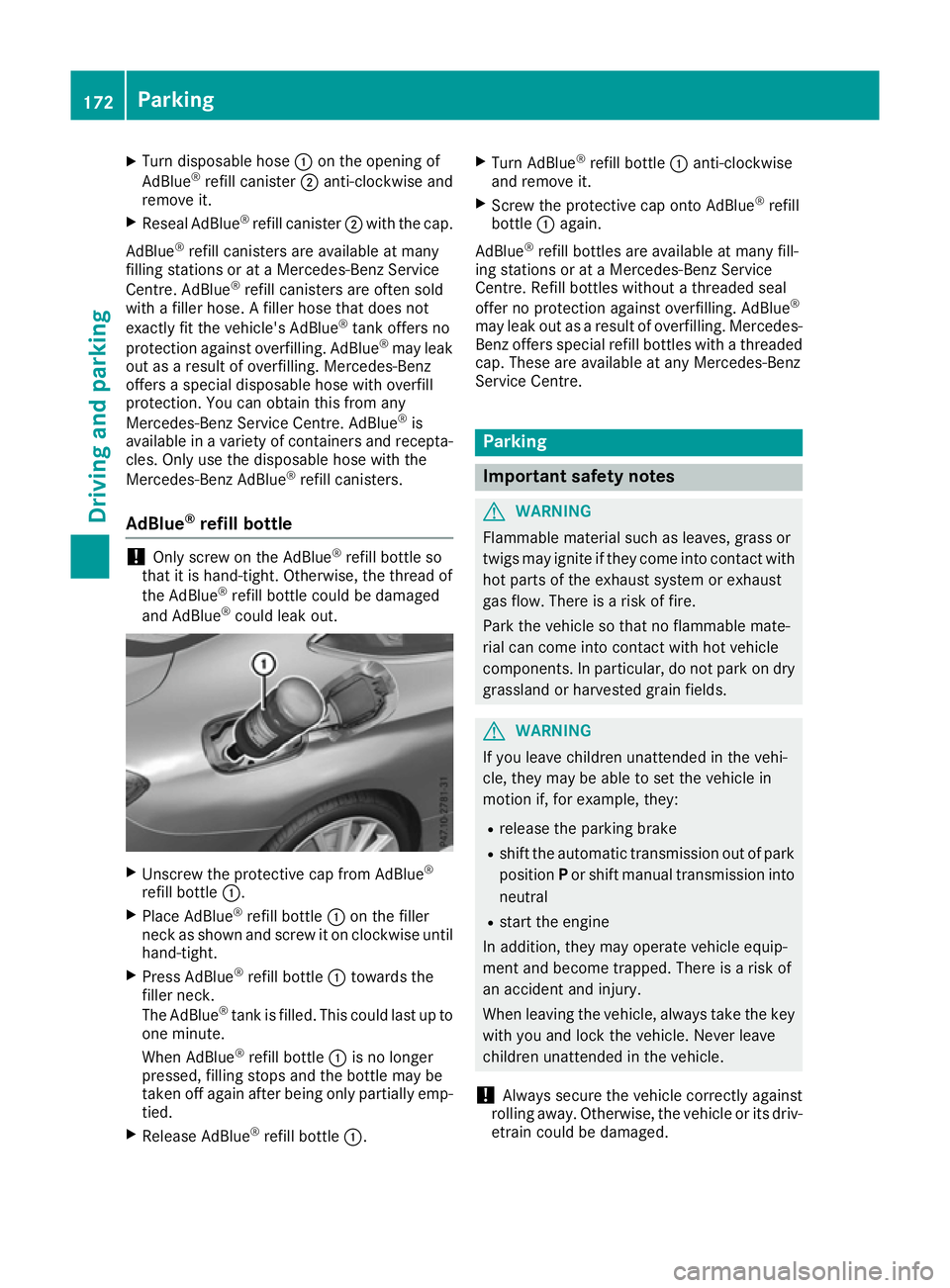
could leak out. X
Unscrew the protective cap from AdBlue ®
refill bottle :.
X Place AdBlue ®
refill bottle :on the filler
neck as shown and screw it on clockwise until hand-tight.
X Press AdBlue ®
refill bottle :towards the
filler neck.
The AdBlue ®
tank is filled. This could last up to
one minute.
When AdBlue ®
refill bottle :is no longer
pressed, filling stops and the bottle may be
taken off again after being only partially emp- tied.
X Release AdBlue ®
refill bottle :. X
Turn AdBlue ®
refill bottle :anti-clockwise
and remove it.
X Screw the protective cap ontoA dBlue®
refill
bottle :again.
AdBlue ®
refill bottles are available at many fill-
ing station sorataM ercedes-Benz Service
Centre. Refill bottles without athreaded seal
offer no protection against overfilling. AdBlue ®
may leak out as aresult of overfilling. Mercedes-
Benz offers special refill bottles with athreaded
cap. These are availabl eatany Mercedes-Benz
Servic eCentre. Parking
Important safety notes
G
WARNING
Flammable material such as leaves, grass or
twigs may ignite if they come into contact with hot parts of the exhaust system or exhaust
gas flow. There is arisk of fire.
Park the vehicle so that no flammable mate-
rial can come into contact with hot vehicle
components.Inp articular, do not park on dry
grassland or harvested grain fields. G
WARNING
If you leave children unattended in the vehi-
cle, they may be able to set the vehicle in
motion if, for example, they:
R release the parking brake
R shift the automatic transmission out of park
position Por shift manual transmission into
neutral
R start the engine
In addition, they may operate vehicle equip-
ment and become trapped. There is arisk of
an accident and injury.
When leaving the vehicle, alway stake the key
with you and lock the vehicle. Never leave
children unattended in the vehicle.
! Always secure the vehicle correctly against
rolling away.O therwise, the vehicle or its driv-
etrain could be damaged. 172
ParkingDriving and parking