service MERCEDES-BENZ C-CLASS COUPE 2015 Owner's Guide
[x] Cancel search | Manufacturer: MERCEDES-BENZ, Model Year: 2015, Model line: C-CLASS COUPE, Model: MERCEDES-BENZ C-CLASS COUPE 2015Pages: 385, PDF Size: 13.12 MB
Page 326 of 385
Engine oil
Important safety notes G
WARNING
Certain component sintheengine compart-
men tcoul dbev eryh ot,e .g.t he engine ,the
radiator and part softheexhaust system.
Ther eisar isk of injury when accessing the
engine compartment.
As far as possible, allow th eengine to cool
down and only touch th ecomponent sdescri-
bed in th efollowing. G
WARNING
If engine oil comes int ocontac twith hot com-
ponent sintheengine compartment, it may
ignite .Ther eisar isk of fir eand injury.
Mak esure that engine oil does no tspill out
ove rthe fille rneck. Allo wthe engine to cool
down and thoroughly clean th ecomponents
that have com eintoc ontac twith engine oil
before you start th eengine.
General notes Dependin
gonyour driving style, th evehicle
consume supto0.8litres of oil per 1,000 km.
The oil consumptio nmay be higher than this
when th evehicle is new or if you frequently drive
at high engine speeds.
Dependin gontheengine ,the oil dipstick may be
installed at adifferen tlocation.
When checking th eoil level:
R park th evehicle on aleve lsurface
R thee ngine shoul dbeswitched off for approx-
imately fiv eminute siftheengine is at normal
operatin gtem perature
R all vehicle s(excep tMercedes-AM GC63/C
63S): if th eengine is no tatnormaloperating
temperature, e.g .iftheengine was only star-
te db riefly, wait approximately 30 minutes
before carryin gout th emeasurement
The oil leve loftheMercedes-AM GC63/C6 3S
must be checked only when th eengine is at
normal operatin gtem perature. Checking th
eoil level usin gthe oil dip-
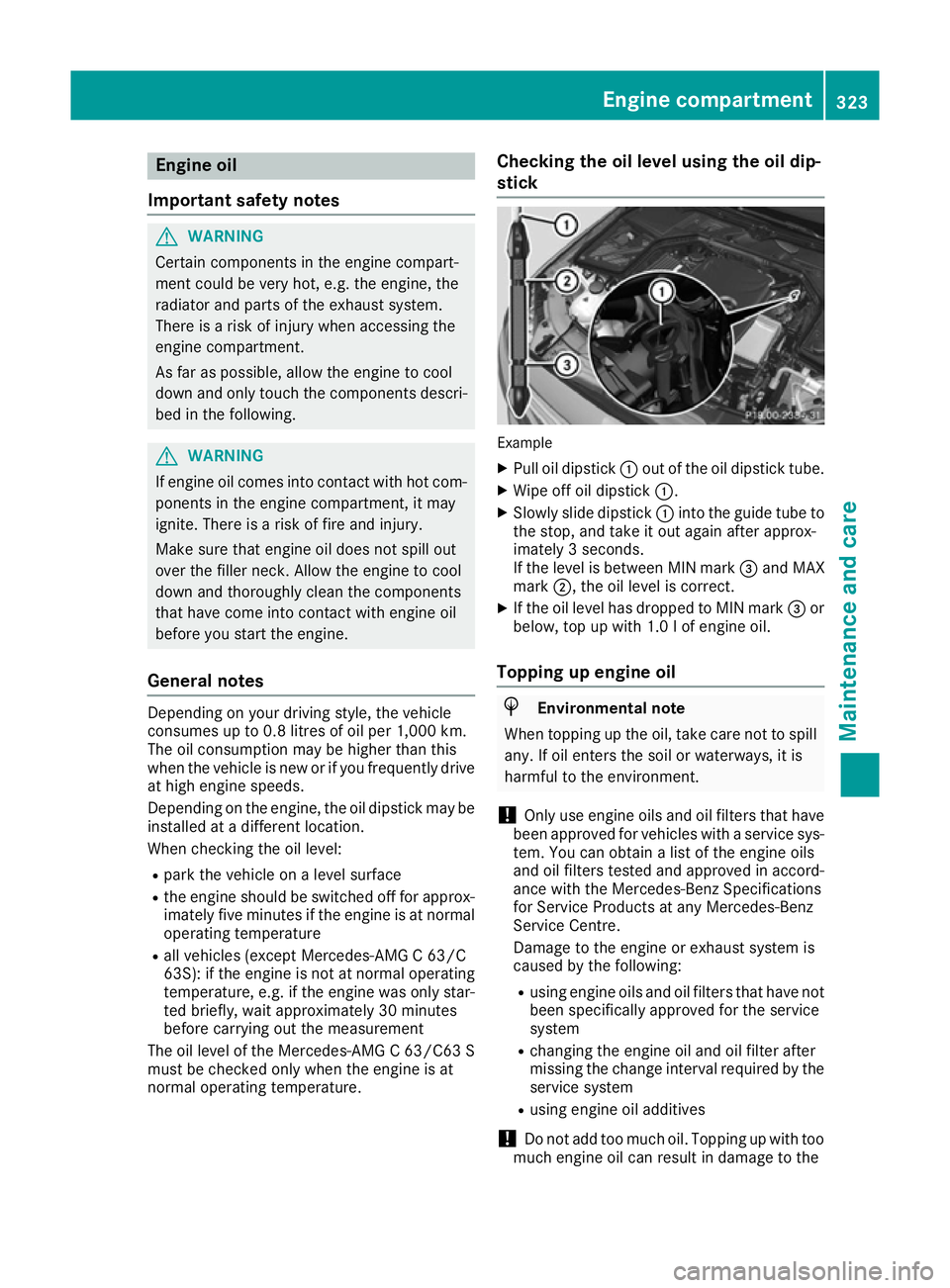
stick Example
X Pull oil dipstick :out of th eoil dipstick tube.
X Wipe off oil dipstick :.
X Slowly slide dipstick :intothe guide tub eto
th es top, and tak eitout again after approx-
imately 3seconds.
If th eleve lisb etween MIN mark =and MAX
mark ;,theoil leve liscorrect.
X If th eoil leve lhas dropped to MIN mark =or
below, to pupwith 1.0lof engine oil.
Toppin gupengine oil H
Environmental note
When toppin guptheoil, tak ecaren otto spill
any. If oil enters th esoil or waterways, it is
harmful to th eenvironment.
! Only use engine oils and oil filters that have
been approved for vehicle swithaservic esys-
tem. You can obtain alist of th eengine oils
and oil filters tested and approved in accord- anc ewith th eMercedes-Ben zSpecifications
for Servic eProduct satany Mercedes-Benz
Servic eCentre.
Damage to th eengine or exhaust system is
caused by th efollowing:
R usin gengine oils and oil filters that have not
been specifically approved for th eservice
system
R changing th eengine oil and oil filter after
missing th echang einterval required by the
servic esystem
R usin gengine oil additives
! Do no
tadd to omucho il. Topping up with too
muc hengine oil can result in damag etothe Engine compartment
323Maintenance and care Z
Page 327 of 385
engine or to the catalytic converter. Have
exces
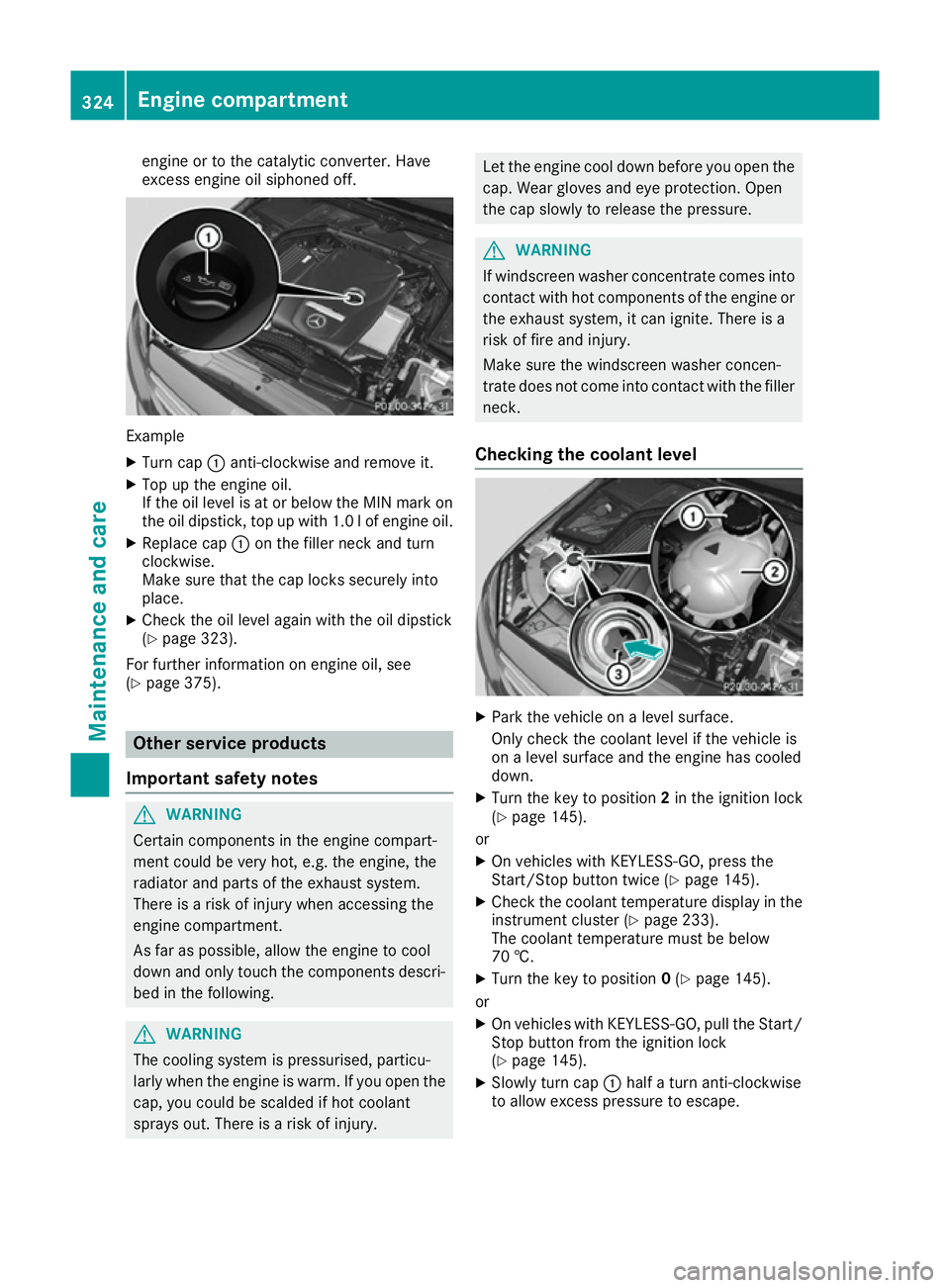
sengine oil siphoned off. Example
X Turn cap :anti-clockwise and remove it.
X Top up the engine oil.
If the oil level is at or below the MIN mark on
the oil dipstick ,top up with 1.0 lofe ngine oil.
X Replace cap :on the filler neck and turn
clockwise.
Make sure that the cap locks securely into
place.
X Check the oil leve lagain with the oil dipstick
(Y pag e323).
For further information on engine oil ,see
(Y pag e375). Other service products
Important safety notes G
WARNING
Certain components in the engine compart-
ment coul dbevery hot, e.g. the engine, the
radiator and parts of the exhaust system.
There is arisk of injury when accessing the
engine compartment.
As far as possible ,allow the engine to cool
dow nand only touch the components descri-
bed in the following. G
WARNING
The cooling system is pressurised, particu-
larl yw hen the engine is warm. If you open the
cap, you coul dbescalded if hot coolant
sprays out. There is arisk of injury. Let the engine cool dow
nbefore you open the
cap. Wea rglove sand eye protection. Open
the cap slowly to release the pressure. G
WARNING
If windscreen washer concentrate comes into contact with hot components of the engine or
the exhaust system, it can ignite. There is a
risk of fire and injury.
Make sure the windscreen washer concen-
trate does not come into contact with the filler neck.
Checking the coolan tlevel X
Park the vehicl eonalevelsurface.
Only check the coolant leve lifthe vehicl eis
on aleve lsurface and the engine has cooled
down.
X Turn the key to position 2in the ignition lock
(Y pag e145).
or
X On vehicles with KEYLESS-GO, press the
Start/Stop button twice (Y page145).
X Check the coolant temperature display in the
instrument cluster (Y page233).
The coolant temperature must be below
70 †.
X Turn the key to position 0(Y pag e145).
or
X On vehicles with KEYLESS-GO, pul lthe Start/
Stop button from the ignition lock
(Y pag e145).
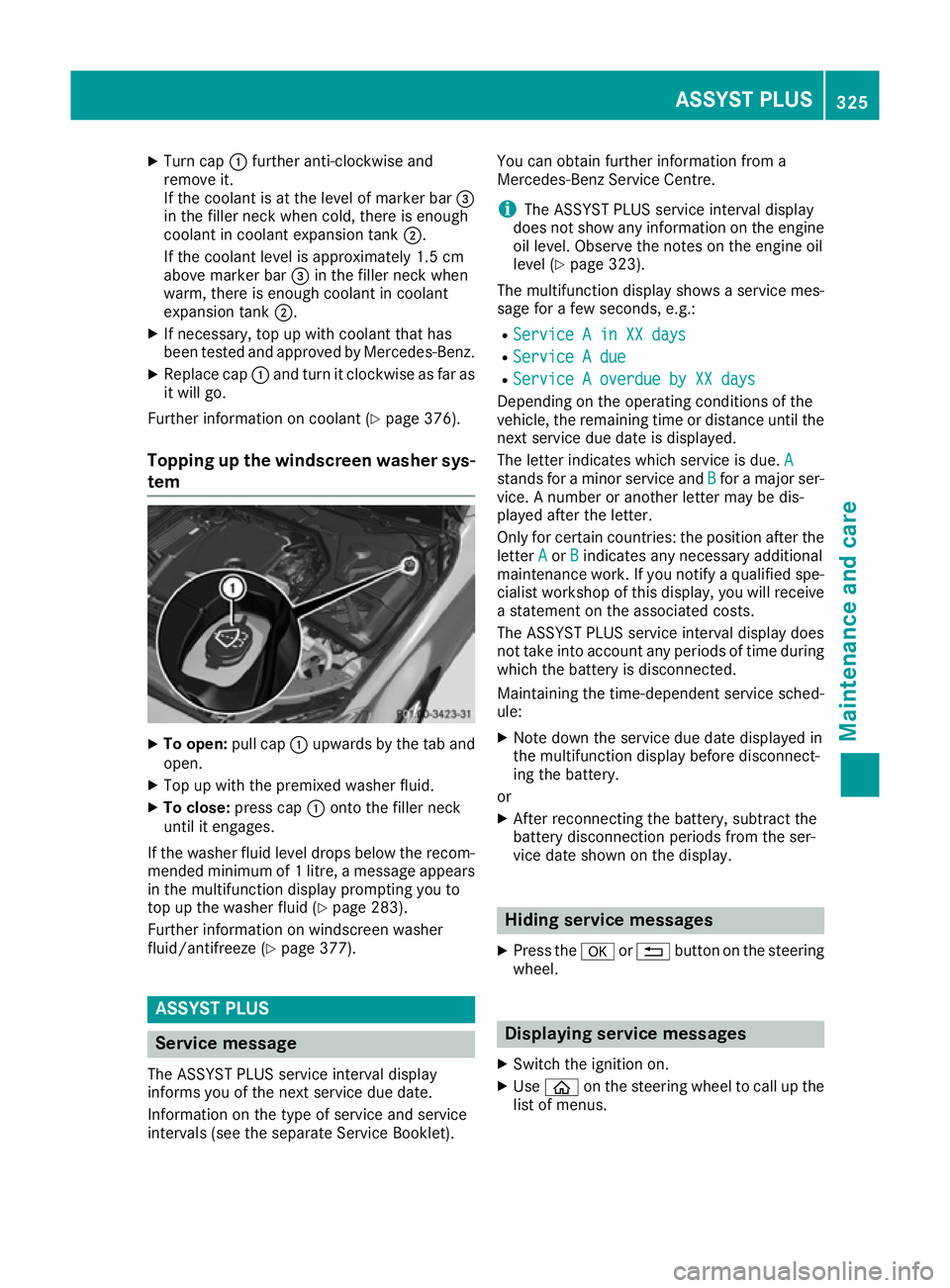
X Slowl yturn cap :halfat urn anti-clockwise
to allow excess pressure to escape. 324
Engine compartmentMaintenance and care
Page 328 of 385
X
Turn cap :further anti-clockwise and
remove it.
If the coolant is at the level of marker bar =
in the filler neck when cold, there is enough
coolant in coolant expansion tank ;.
If the coolant level is approximately 1.5 cm
above marker bar =in the filler neck when
warm, there is enough coolant in coolant
expansion tank ;.
X If necessary, top up with coolant that has
been tested and approved by Mercedes-Benz.
X Replace cap :and turn it clockwise as far as
it will go.
Further information on coolant (Y page 376).
Topping up the windscreen washer sys- tem X
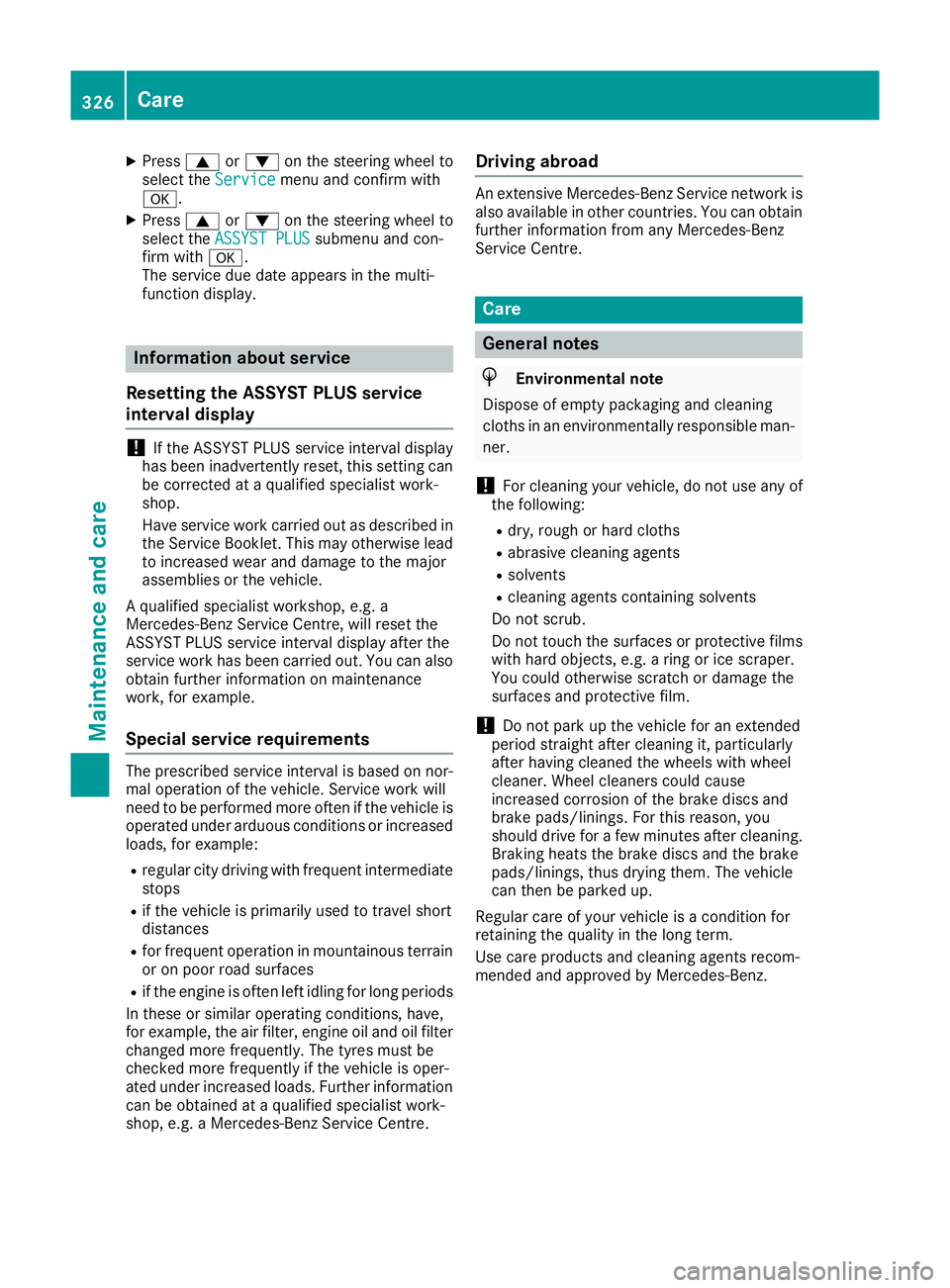
To open: pull cap:upwards by the tab and
open.
X Top up with the premixed washer fluid.
X To close: press cap :ontot he filler neck
until it engages.
If the washer fluid level drops below the recom- mended minimum of 1litre, amessage appears
in the multifunction display promptin gyou to
top up the washer fluid (Y page 283).
Further information on windscreen washer
fluid/antifreez e(Ypage 377). ASSYST PLUS
Service message
The ASSYST PLUS service interval display
inform syou of the next service due date.
Information on the type of service and service
intervals (see the separate Servic eBooklet). You can obtain further information from a
Mercedes-Benz Servic
eCentre.
i The ASSYST PLUS service interval display
does not show any information on the engine oil level. Observe the notes on the engine oil
level (Y page 323).
The multifunction display shows aservice mes-
sage for afew seconds, e.g.:
R Service AinXXd ays
Service AinXXd ays
R Service Adue
Service Adue
R Service Aoverdue by XX days
Service Aoverdue by XX days
Dependin gonthe operating conditions of the
vehicle, the remaining time or distance until the
next service due date is displayed.
The letter indicates which service is due. A A
stands for aminor service and B
Bfor am ajor ser-
vice. Anumber or another letter may be dis-
played after the letter.
Only for certain countries: the position after the
letter A
A or B Bindicates any necessary additional
maintenance work. If you notify aqualified spe-
cialist workshop of this display ,you will receive
as tatement on the associated costs.
The ASSYST PLUS service interval display does
not take into account any periods of time during which the battery is disconnected.
Maintaining the time-dependent service sched-
ule:
X Note down the service due date displayed in
the multifunction display before disconnect-
ing the battery.
or
X After reconnecting the battery, subtract the
battery disconnection periods from the ser-
vice date shown on the display. Hiding service messages
X Press the aor% button on the steering
wheel. Displaying service messages
X Switch the ignition on.
X Use ò on the steerin gwheel to call up the
list of menus. ASSYST PLUS
325Maintenance and care Z
Page 329 of 385
X
Press 9or: on the steerin gwheel to
select the Service
Servicemenu and confirm with
a.
X Press 9or: on the steerin gwheel to
select the ASSYST PLUS
ASSYST PLUS submenu and con-
firm with a.
The service due date appears in the multi-
function display. Information about service
Resetting the ASSYST PLUS service
interva ldisplay !
If the ASSYST PLUS service interval display
has been inadvertently reset, this setting can
be corrected at aqualified specialist work-
shop.
Have service work carried out as described in the Servic eBooklet .This may otherwise lead
to increased wear and damage to the major
assemblies or the vehicle.
Aq ualified specialist workshop, e.g. a
Mercedes-Benz Servic eCentre, will reset the
ASSYST PLUS service interval display after the
service work has been carried out. You can also
obtain further information on maintenance
work, for example.
Special service requirements The prescribed service interval is based on nor-
mal operation of the vehicle. Servic ework will
need to be performed more often if the vehicle is
operated under arduous conditions or increased loads, for example:
R regular city driving with frequent intermediate
stops
R if the vehicle is primarily used to travel short
distances
R for frequent operation in mountainous terrain
or on poor road surfaces
R if the engine is often left idling for long periods
In these or similar operating conditions, have,
for example, the air filter, engine oil and oil filter changed more frequently. The tyres must be
checked more frequently if the vehicle is oper-
ated under increased loads. Further informationcan be obtained at aqualified specialist work-
shop, e.g. aMercedes-Benz Servic eCentre. Driving abroad An extensive Mercedes-Benz Servic
enetwor kis
also availabl einother countries. You can obtain
further information from any Mercedes-Benz
Servic eCentre. Care
General notes
H
Environmenta
lnote
Dispose of empty packaging and cleaning
cloths in an environmentally responsible man-
ner.
! For cleaning your vehicle, do not use any of
the following:
R dry, rough or hard cloths
R abrasive cleaning agents
R solvents
R cleaning agents containing solvents
Do not scrub.
Do not touch the surfaces or protective films
with hard objects, e.g. aring or ice scraper.
You could otherwise scratch or damage the
surfaces and protective film.
! Do not park up the vehicle for an extended
period straight after cleaning it, particularly
after having cleaned the wheels with wheel
cleaner. Wheel cleaners could cause
increased corrosion of the brake discs and
brake pads/linings. For this reason, you
should drive for afew minutes after cleaning.
Brakin gheats the brake discs and the brake
pads/linings, thus drying them. The vehicle
can then be parked up.
Regula rcare of your vehicle is acondition for
retainin gthe quality in the long term.
Use care products and cleaning agents recom-
mended and approved by Mercedes-Benz. 326
CareMaintenance and care
Page 344 of 385
G
WARNING
If the required tyre pressure is not reached
after driving for ashort period, the tyre is too
badly damaged. The tyre sealant cannot
repair the tyre in this instance. Damaged tyres and atyre pressure that is too low can signif-
icantly impair the vehicle's braking and driv-
ing characteristics. There is arisk of accident.
Do not continue driving. Contact aqualified
specialist workshop.
i In yourv
ehicle, you willf indasticker with
the Mercedes-Benz Service24h telephone
number, e.g. on the B-pillar on the driver's
side.
X Correct the tyre pressure if it is still at least
130 kPa (1.3 bar/19 psi) .See the tyre pres-
sure table on the fuel filler flap for values.
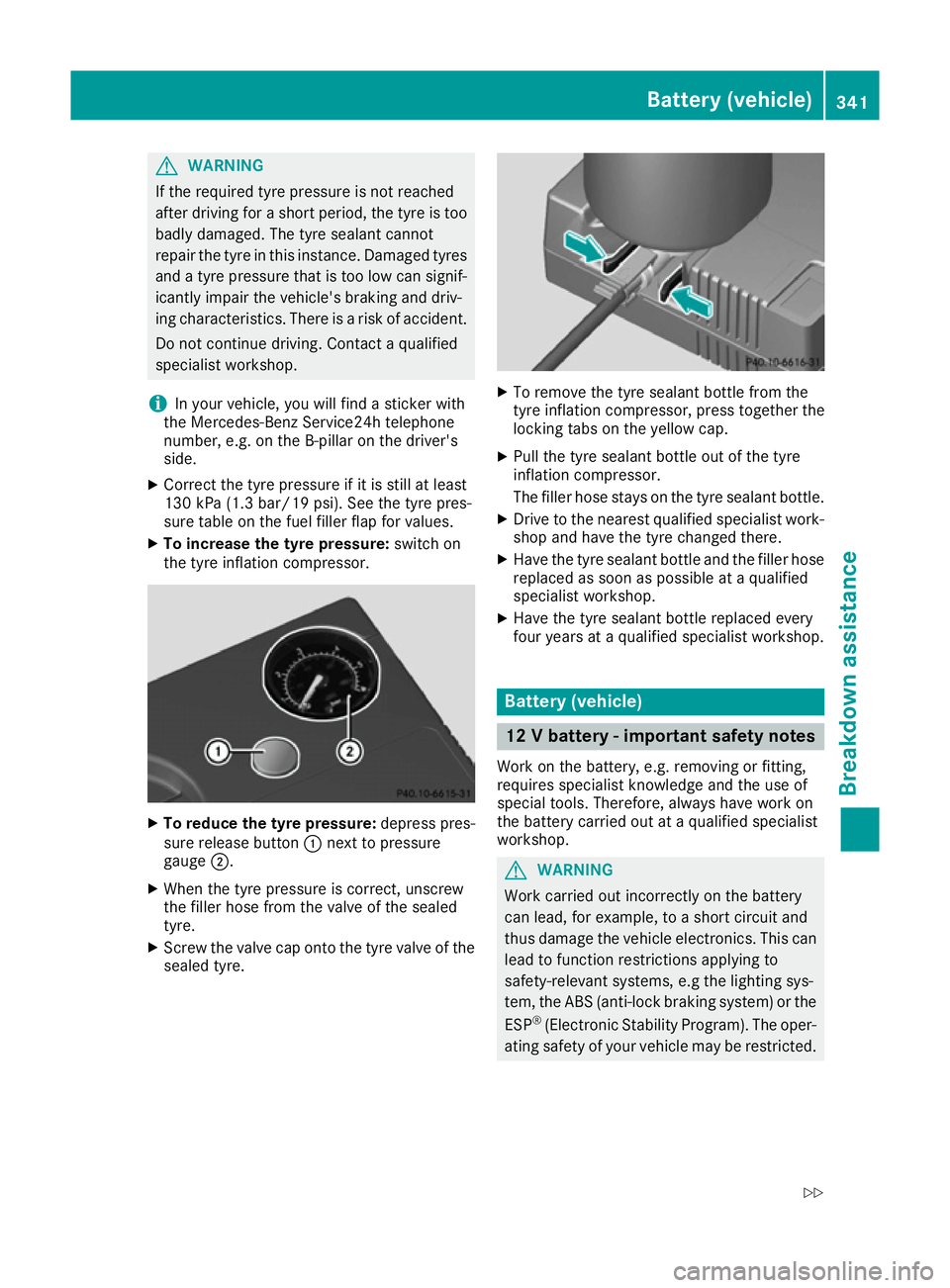
X To increase the tyre pressure: switch on
the tyre inflation compressor. X
To reduce the tyre pressure: depress pres-
sure release button :next to pressure
gauge ;.
X When the tyre pressure is correct, unscrew
the filler hose from the valve of the sealed
tyre.
X Screw the valve cap onto the tyre valve of the
sealed tyre. X
To remove the tyre sealant bottle from the
tyre inflation compressor, press together the
locking tabs on the yellow cap.
X Pullt he tyre sealant bottle out of the tyre
inflation compressor.
The filler hose stays on the tyre sealant bottle.
X Drive to the neares tqualified specialist work-
shop and have the tyre changed there.
X Have the tyre sealant bottle and the filler hose
replaced as soon as possible at aqualified
specialist workshop.
X Have the tyre sealant bottle replaced every
four years at aqualified specialist workshop. Battery (vehicle)
12
Vb attery -important safety notes
Work on the battery ,e.g. removing or fitting,
requires specialist knowledge and the use of
special tools. Therefore, alwaysh ave work on
the battery carrie dout at aqualified specialist
workshop. G
WARNING
Work carrie dout incorrectly on the battery
can lead, for example, to ashort circui tand
thus damage the vehicl eelectronics. This can
leadtof unction restrictions applying to
safety-relevant systems ,e.g the lighting sys-
tem, the ABS (anti-lock braking system) or the
ESP ®
(Electronic Stability Program). The oper-
ating safety of yourv ehiclemay be restricted. Battery (vehicle)
341Breakdown assistance
Z
Page 346 of 385
Observe the service intervals in the Service
Booklet or contact
aqualified specialist work-
shop for more information.
! Alwaysh
ave work on the batteries carried
out at aqualified specialist workshop. Should
it, in exceptional circumstances, be abso-
lutely necessary to disconnect the 12-volt
battery yourself, please observe the follow-
ing:
R secure the vehicle to prevent it from rolling
away.
R switch the ignition off.
R first, disconnect the negative terminal, fol-
lowed by the positive terminal.
Vehicles with automatic transmission: the
transmission is locked in position Pafter dis-
connecting the battery.
After the work has been completed, firmly
reinstall the battery and the cover of the pos-
itive terminal.
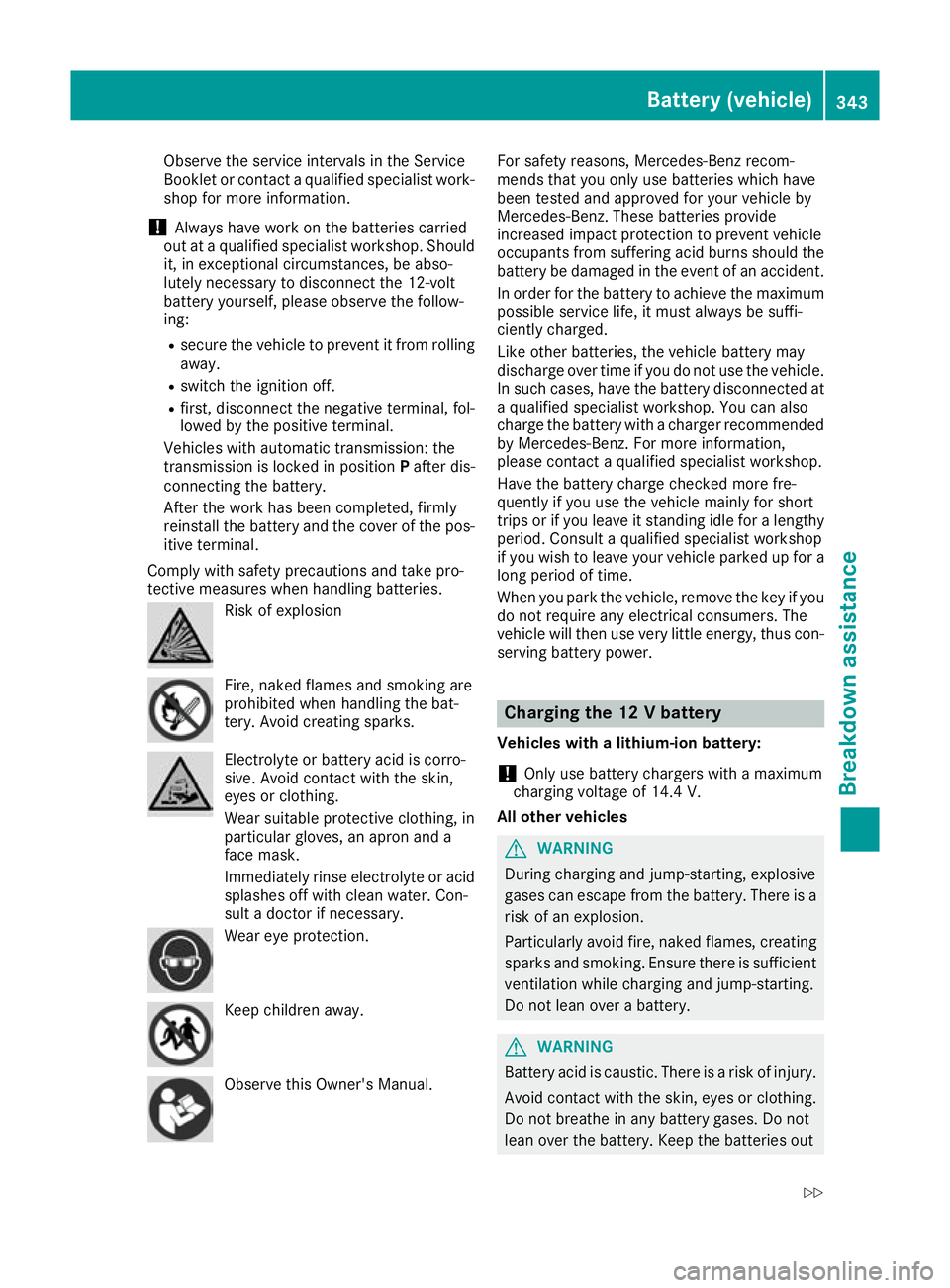
Comply with safety precautions and take pro-
tective measures when handling batteries. Risk of explosion
Fire, naked flames and smoking are
prohibited when handling the bat-
tery. Avoid creating sparks.
Electrolyte or battery acid is corro-
sive. Avoid contact with the skin,
eyes or clothing.
Wear suitablep rotective clothing, in
particular gloves, an apron and a
face mask.
Immediately rinse electrolyte or acid
splashes off with clean water. Con-
sult adoctor if necessary. Wear eye protection.
Keep children away.
Observe this Owner's Manual. For safety reasons, Mercedes-Benz recom-
mends that you only use batteries which have
been tested and approved for your vehicle by
Mercedes-Benz.T
hese batteries provide
increased impact protection to prevent vehicle
occupants from suffering acid burns should the battery be damaged in the event of an accident.
In order for the battery to achieve the maximum possible service life, it must always be suffi-
ciently charged.
Like other batteries, the vehicle battery may
discharge over time if you do not use the vehicle.In such cases, have the battery disconnected ataq ualified specialist workshop. You can also
charge the battery with acharger recommended
by Mercedes-Benz.F or more information,
please contact aqualified specialist workshop.
Have the battery charge checked more fre-
quently if you use the vehicle mainly for short
trips or if you leave it standing idle for alengthy
period. Consult aqualified specialist workshop
if you wish to leave your vehicle parked up for a
long period of time.
When you park the vehicle, remove the key if you do not require any electrical consumers. The
vehicle will then use very little energy, thus con- serving battery power. Charging the 12
Vbattery
Vehicles with alithium-ion battery:
! Only use battery chargers with
amaximum
charging voltage of 14.4 V.
All other vehicles G
WARNING
During charging and jump-starting, explosive
gases can escape from the battery. There is a risk of an explosion.
Particularlya void fire, naked flames, creating
sparks and smoking. Ensure there is sufficient
ventilation while charging and jump-starting.
Do not lean over abattery. G
WARNING
Battery acid is caustic. There is arisk of injury.
Avoid contact with the skin, eyes or clothing.
Do not breathe in any battery gases. Do not
lean over the battery. Keep the batteries out Battery (vehicle)
343Breakdown assistance
Z
Page 347 of 385
of the reach of children. Immediately rinse off
battery acid thoroughly with plenty of clean
water and seek medical attention at once. G
WARNING
Ad ischarged battery can freeze at tempera-
tures below freezin gpoint. When jump-start-
ing the vehicle or charging the battery, gases can escape from the battery. There is arisk of
an explosion.
Allow the frozen battery to thaw out before
charging it or jump-starting.
! Only use battery chargers with
amaximum
charging voltage of 14.8 V.
All vehicles:
! Only charge the battery using the jump-start
connection point.
The jump-starting connection point is in the
engine compartment (Y page 345).
X Open the bonnet.
X Connect the battery charger to the positive
terminal and earth point in the same order as
when connectingt he donor battery in the
jump-starting procedure (Y page 345).
Keep away from fire and naked flames. Do not
lean over the battery. Never charge the battery
if it is still fitted to the vehicle, unless you use a battery charger which has been tested and
approved by Mercedes-Benz. Abattery charger
unit specially adapted for Mercedes-Benz vehi-
cles and tested and approved by Mercedes-
Benz is available as an accessory. This device
permits charging of the battery in position. Con-
tact aMercedes-Benz Service Centre for infor-
mation and availability. Read the battery charg-
er's operating instructions before charging the
battery.
All vehicles except vehicles with alithium-
ion battery: if the indicator/warning lamps in
the instrument cluster do not light up at low
temperatures, it is very likely that the dis-
charged battery has frozen .Inthis case you may
neither jump-start the vehicle nor charge the
battery. The service life of abattery that has
been thawed may be reduced. The starting char-
acteristics may be impaired, especially at low
temperatures. Have the thawed battery
checked at aqualified specialist workshop. Vehicles with
alithium-ion battery: at low
temperatures, do not charge abattery which has
been removed using abattery charger. Allow the
battery to warm up gently first, if necessary.
Otherwise, the service life can be shortened and the starting characteristics impaired, especially
at low temperatures. 344
Battery (vehicle)Breakdown assistance
Page 348 of 385
Jump-starting
For the jump-starting procedure, use only the jump-starting connection point, consisting of apos-
itive terminal and an earth point, in the engine compartment.
All vehiclese xcept vehiclesw ithalithium-ion battery: G
WARNING
Battery acid is caustic. There is arisk of injury.
Avoid contact with the skin, eyes or clothing. Do not breathe in any battery gases. Do not lean over the battery. Keep the batteries out of the reach of children. Immediately rinse off battery acid
thoroughly with plenty of clean water and seek medical attention at once. G
WARNING
During charging and jump-starting, explosive gases can escape from the battery. There is arisk
of an explosion.
Particularly avoid fire, naked flames, creating sparks and smoking. Ensure there is sufficient
ventilation while charging and jump-starting. Do not lean over abattery. G
WARNING
During the charging process, abattery produces hydrogen gas. If ashort circuit occurs or sparks
are created, the hydrogen gas can ignite. There is arisk of an explosion.
R Make sure that the positive terminal of aconnected battery does not come into contact with
vehicle parts.
R Never place metal objects or tools on abattery.
R It is important that you observe the described order of the battery terminals when connecting
and disconnecting abattery.
R When jump-starting, make sure that the battery poles with identical polarity are connected.
R It is particularly important to observe the described order when connecting and disconnecting
the jump leads.
R Never connect or disconnectt he battery terminals while the engine is running.G
WARNING
Ad ischarged battery can freeze at temperatures below freezing point. When jump-starting the
vehicle or charging the battery, gases can escape from the battery. There is arisk of an explosion.
Allow the frozen battery to thaw out before charging it or jump-starting.
If the indicator/warning lamps do not light up at low temperatures, it is very likely that the dis-
charged battery has frozen.Int his case you may neither jump-start the vehicle nor charge the
battery. The service life of abattery that has been thawed may be reduced. The starting charac-
teristics may be impaired, especially at low temperatures. Have the thawed battery checked at a
qualified specialist workshop.
All vehicles:
! Vehicles with
apetrol engine: avoid repeated and lengthy starting attempts.O therwise, the
non-combusted fuel may damage the catalytic converter. Jump-starting
345Breakdown assistance Z
Page 353 of 385
All vehicles
!
You may only secure th
evehicl ebyt he
wheels, no tbypartsoft hevehicl esuchas
axl eors teering components. Otherwise ,the
vehicl ecould be damaged.
The towin geyes or trailer to whitch can be used
to pull th evehicl eontoa trailer or transporte rif
you wish to transpor tit.
X Vehicles wit
hmanua ltra nsmission:
depress th eclutch pedal fully and engage
neutral.
X Vehicles wit
hautomatic transmission:
tur nthe keyt op osition 2in th eignition lock.
X Shift th eautomatic transmission to position
N.
As soon as th evehicle is loaded:
X Preven tthe vehicl efromr ollin gaway by
applyin gthe electric parking brake.
X Vehicles wit
hmanua ltra nsmission:
depress th eclutch pedal fully and engage first
or revers egear.
X Vehicles wit
hautomatic transmission:
shif tthe automatic transmission to position
P.
X Turn th ekeyto position 0in th eignition lock
and remove it.
X Secur ethe vehicle. Tow-starting (emergency engine
starting)
! Do no
ttow -star tvehicles wit hautomatic
transmission .You could otherwise damage
th ea utomatic transmission.
i You can fin
dinformation on "Jump-starting"
under (Y page 345).
Befor etow -starting ,the followin gconditi ons
mus tbef ulfilled:
R theb attery is connected
R thee ngineh as cooled down
R thee xhaust system has cooled down
When tow-starting ,itisimportant that you
observ ethe safet ynotes ( Ypage 347) and the
legal requirements in eac hrespective country.
X Switc hont hehazard warning lamps
(Y page 120).
X Fit th etow inge ye (Y page 348). X
Secur ethe rigid towin gbar or th etow ing
rope.
X Depress th ebrak epedal and keep it
depressed.
X Turn th ekeyto position 2in th eignition lock.
X Depress th eclutch pedal fully, engage 2nd
gear and continu etokeept he clutch pedal
fully depressed.
X Releas ethe brak epedal.
X Tow-start th evehicle.
X Releas ethe clutch pedal slowly; do not
depress th eaccelerato rpedal while doin gso.
X When th eengineh as been started, immedi-
ately depress th eclutch pedal fully and shift
to neutral.
X Pull ove ratasuitable plac eand stop th evehi-
cle safely, payin gattention to road and traffic
conditions.
X Use th eelectric parking brak etosecure the
vehicl eand preven titfromr ollin gaway.
X Remove th erigid towin gbar or towin grope.
X Remove th etow inge ye (Y page 349).
X Switc hoff th ehazard warning lamps. Electrical fuses
Important safety notes
G
WARNING
If you manipulate, bridge or replace afaulty
fus ew ithaf useofah igher amperage ,the
electric cables could be overloaded. This may result in afire. There is ariskofana ccident
and injury.
Always replace fault yfuses wit hspecifie dnew
fuses of th ecorrect amperage.
Blown fuses mus tbereplace dwithf uses of the
sam erating ,whic hy ou can recognise by the
colour and fus erating .The fus erating sare listed
in th efusea llocation chart.
The fus eallocation chart is on th efus eb ox in the
boot (Y page 352).
If th enewly inserted fus ealso blows ,havet he
caus etrace da nd rectifie dataqualified special-
ist workshop ,e.g.a Mercedes-Benz Service
Centre.
! Only use fuses that hav
ebeen approve dfor
Mercedes-Benz vehicles and whic hhavet he 350
Electrical fusesBreakdown assistance
Page 356 of 385
Important safety notes
G
WARNING
If wheels and tyres of th ewrong siz eare used,
th ew hee lbrakes or suspension components
may be damaged. Ther eisariskofana cci-
dent.
Always replace wheels and tyres wit hthose
that fulfil th especification softheoriginal
part.
When replacing wheels, mak esuretof it the
correct:
R designation
R type
When replacing tyres, mak esuretof it the
correct:
R designation
R manufacturer
R type G
WARNING
Af lat tyr eseverely impairs th edriving ,steer-
ing and braking characteristics of th evehicle.
Ther eisar iskofa ccident.
Tyre swithout run-flat characteristics:
R do no tdrivew ithaf lat tyre.
R immediately replace th eflat tyr ewithy our
emergenc yspar ew hee lors parew heel, or
consult aqualified specialist workshop.
Tyre swithr un-flat characteristics:
R pay attention to th einformation and warn-
ing notice sonMOExtended tyres (tyres
wit hrun-flat characteristics).
Accessories that are no tapprove dfor your vehi-
cle by Mercedes-Ben zorare notbein gused cor-
rectl ycan impair th eoperating safety.
Before purchasing and usin gnon-ap proved
accessories, visit aqualified specialist work-
sho pand enquir eabout:
R suitability
R legal stipulations
R factory recommendations Further information regarding wheels and tyres
can be foun
dunder "Wheel/tyre combinations"
(Y page 366).
You can ask for information regarding permitted
wheel-tyre combination sataMercedes-Benz
Service Centre.
Information on tyr epressur ecan be found:
R in th etyrep ressur etable in th efuel filler flap
(Y page 167)
R under "Tyre pressure" (Y page 356)
Modification wor konthebrak esystem and
wheels is no tpermitted. The use of spacers or
brak edust shields is no tpermitted. This inva-
lidates th egeneral operating permit for th evehi-
cle.
i Further information on wheels and tyres can
be obtained at any qualified specialist work-
shop. Operation
Information on driving
Chec kthe tyrep ressures when th evehicl eis
heavily laden and adjust prio rtoatrip.
While driving ,pay attention to vibrations, noises
and unusual handlin gcharacteristics ,e.g.p ull-
ing to on eside .This may indicat ethatthe
wheels or tyres are damaged. If you suspec tthat
at yreisd efective, reduce your spee dimmedi-
ately. Stop th evehicl eass oonasp ossible to
chec kthe wheels and tyres for damage. Hidden
tyr ed amag ecould also be causing th eunusual
handlin gcharacteristics .Ifyou fin dnos ignsof
damage, hav ethe tyres and wheels checke data
qualified specialist workshop.
When parking your vehicle, mak esuren otto
squas hthe tyres idewalls. If this canno tbeavoi-
ded, driv eslowly ove robstacles, e.g. kerbs ,and
only at an obtuse angle. You could otherwise
damag ethe whee lrim sa nd tyres. Notes on high performance tyres
G
WARNING
Due to th especial tyr etread in combination
wit hthe optimised rubber compound ,the re is
an increased ris kofaquaplaning and skidding
on adamp or wet road surface. Tyre gri pis
also noticeably reduce datlow outside tem- Operation
353Wheels and ty res
Z