warning MERCEDES-BENZ C-CLASS COUPE 2015 Owners Manual
[x] Cancel search | Manufacturer: MERCEDES-BENZ, Model Year: 2015, Model line: C-CLASS COUPE, Model: MERCEDES-BENZ C-CLASS COUPE 2015Pages: 385, PDF Size: 13.12 MB
Page 359 of 385
Alway
sobserve the maximu mpermissible
speed specified for the M+S tyres yo uhavef it-
ted.
If yo ufit M+S tyres tha thaveal ower maximum
permissibl espeed tha nthatoft he vehicle, affix
an appropriate warning labe linthe driver's field
of vision. Thi scan be obtained at aquali fied
specialist workshop.
Unde rthes ecircumstances ,you shoul dalso
restrict the type-tested maximu mspeed of the
vehicl eusing permanent SPEEDTRONI Csothat
it does not exceed the maximu mpermissible
speed for the M+S tyres (Y page 184).
Whe nyou have fitte dthe M+S tyres:
X Check the tyr epressures (Y page 356).
X Restart the tyr epressure monitor
(Y page 360).
Informatio nondriving with an emergency spare
whee l(Y page 367). Sno
wchains G
WARNING
If yo uhavef itte dsnow chains to the front
wheels ,they ma yscrape against the vehicle
body or chassi scomponents. Thi scould
cause damage to the vehicl eorthe tyres.
There is ariskofana ccident.
To avoi dhazardou ssituations:
R neve rfit snow chains on the front wheels
R fit snow chains to the rea rwheel sinp airs.
For safety reasons ,Mercedes-Benz recom-
mend sthaty ou onlyusesnow chains tha thave
been specifically approved for your vehicl eby
Mercedes-Benz, or tha tare ofac orresponding
standard of quality .For more information,
please contact aquali fied specialist workshop.
If yo uintend to fit snow chains ,pleas ebearthe
following points in mind:
R snow chains canno tbefitte dtoa llwheel-tyre
combinations. Permissibl ewheel -tyre combi-
nations (Y page 366).
R onl yusesnow chains if the roa dsurface is
completel ysnow-covered .Rem ove the snow
chains as soo naspossibl ewheny ou come to
ar oadt hatisn ot snow-covered. R
local regulations ma yrestrict the us eofsnow
chains .Observ ethe appropriate regulations if
yo uw ishtof it snow chains.
R do not exceed the maximu mpermissible
speed of 50 km/h.
R on vehicles with AIRMATIC, yo umustd rive at
raised vehicl elevel if snow chains have been
fitte d(Ypage 195).
R when snow chains ar efitted, neve ruse Active
Parking Assist (Y page 201).
Yo um aywish to deactivate ESP ®
when pulling
away with snow chains fitted:
R allv ehicles (excep tMercedes‑AMG vehicles)
(Y page 72)
R Mercedes-AM Gvehicles (Y page 73)
Thi sw ayyouc an allo wthe wheels to spi nina
controlled manner, achieving increased driving
forc e(cutting action).
Informatio nabout driving with an emergency
spare whee l(Ypage 367). Tyre pressure
Tyre pressure specifications
G
WARNING
Underinflated or overinflated tyres pose the
following risks:
R the tyres ma yburst, especially as the load
and vehicl espeed increase.
R the tyres ma yweare xcessivel yand/or
unevenly, which ma ygreatl yimpai rtyre
traction.
R the driving characteristics, as well as steer-
ing and braking ,maybe greatl yimpaired.
There is ariskofana ccident.
Observ ethe recommende dtyrep ressure and
check the tyr epressure of al lthe tyres includ-
ing the spare wheel:
R at leas tevery two weeks
R when the load changes
R before embarking on alon gerjourney
R for change doperating conditions, e.g .off-
roa ddriving
If necessary ,correct the tyr epressure. 356
Tyre pressureWheel
sand tyres
Page 360 of 385
G
WARNING
If you fit unsuitabl eaccessories onto tyre
valves, the tyre valve smay be overloadeda nd
malfunction, which can caus etyre pressure
loss. Due to their design, retrofitted tyre pres-
sure monitors keep the tyre valve open. This
can alsor esult in tyre pressure loss. There is a
risk of accident.
Only screw standard valve caps or valve caps
specifically provided by Mercedes-Benz for
yourv ehicleonto the tyre valve. G
WARNING
If the tyre pressure drops repeatedly ,the
wheel, valve or tyre may be damaged. Tyre
pressure that is too low may result in atyre
blow-out. There is arisk of accident.
R Check the tyre for foreig nobjects.
R Check whethe rthe whee lislosing air or the
valve is leaking.
If you are unable to rectify the damage, con-
tact aqualified specialist workshop. H
Environmental note
Check the tyre pressure regularly, at least
every 14 days.
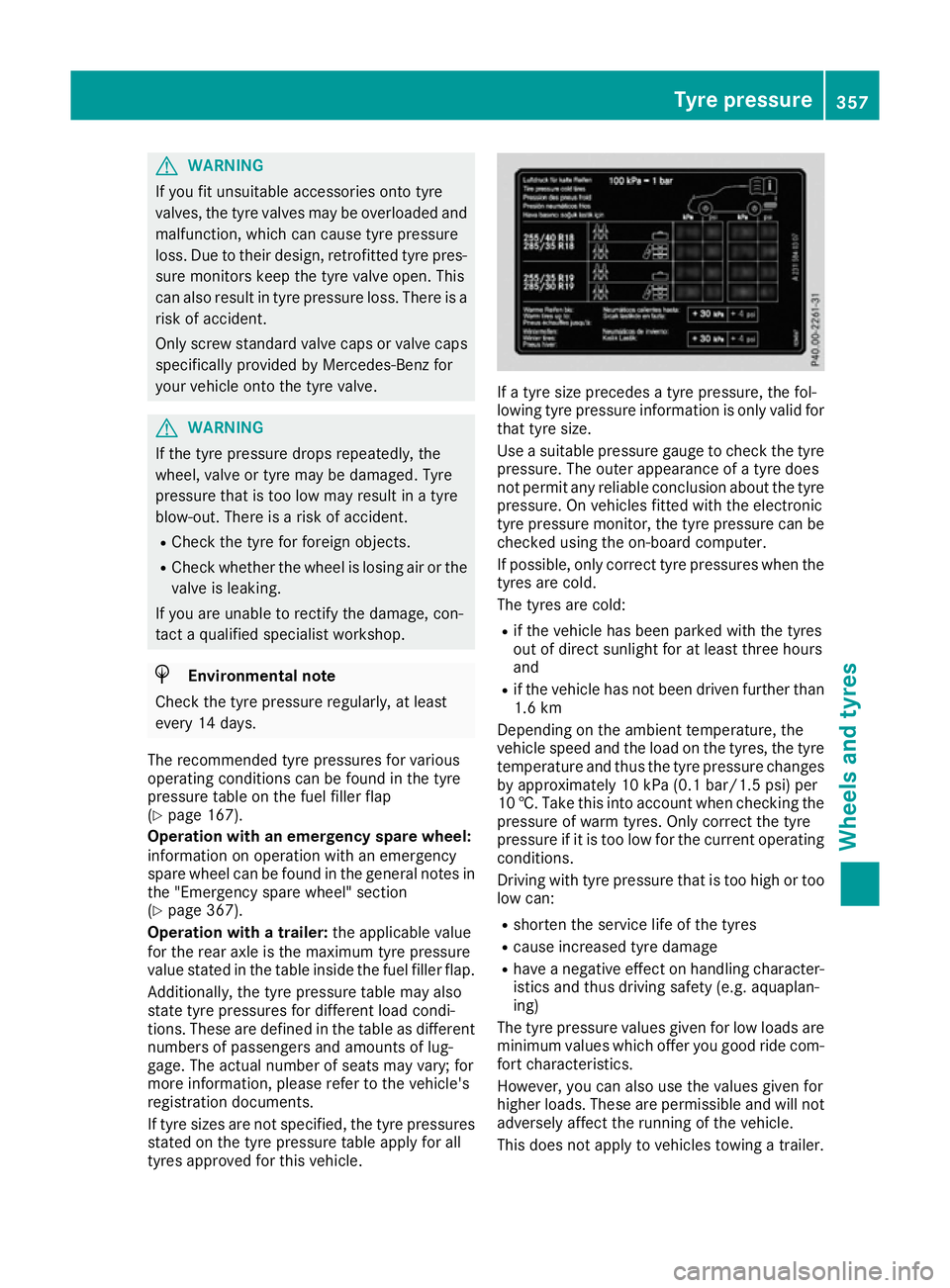
The recommende dtyre pressures for various
operating conditions can be found in the tyre
pressure table on the fuel filler flap
(Y page1 67).
Operation with an emergency spare wheel:
information on operation with an emergency
spar ewhee lcan be found in the genera lnotes in
the "Emergency spar ewheel" section
(Y page3 67).
Operation with atrailer: the applicable value
for the rear axle is the maximu mtyre pressure
valu estated in the table insid ethe fuel filler flap.
Additionally, the tyre pressure table may also
state tyre pressures for different loadc ondi-
tions. These are defined in the table as different numbers of passengers and amounts of lug-
gage .The actua lnumber of seats may vary ;for
more information, please refer to the vehicle's
registration documents.
If tyre sizes are not specified ,the tyre pressures
stated on the tyre pressure table apply for all
tyres approved for this vehicle. If
at yre size precedes atyre pressure, the fol-
lowing tyre pressure information is only vali dfor
that tyre size.
Use asuitable pressure gauge to check the tyre
pressure. The outer appearance of atyre does
not permi tany reliablec onclusion about the tyre
pressure. On vehicles fitted with the electronic
tyre pressure monitor, the tyre pressure can be checked using the on-board computer.
If possible,o nly correct tyre pressures when the
tyres are cold.
The tyres are cold:
R if the vehicl ehas been parked with the tyres
out of direct sunlight for at least three hours
and
R if the vehicl ehas not been drive nfurther than
1.6 km
Depending on the ambient temperature, the
vehicl espee dand the loadont he tyres, the tyre
temperature and thus the tyre pressure changes
by approximatel y10k Pa (0.1 bar/1.5 psi) per
10 †. Take this into account when checking the
pressure of warm tyres. Only correct the tyre
pressure if it is too low for the current operating conditions.
Driving with tyre pressure that is too high or too
low can:
R shorten the service life of the tyres
R caus eincreased tyre damage
R have anegative effect on handling character-
istics and thus driving safety (e.g. aquaplan-
ing)
The tyre pressure values given for low loads are minimu mvalues which offer you good ride com-
fort characteristics.
However, you can alsou se the values given for
higher loads. These are permissible and willn ot
adversely affect the running of the vehicle.
This does not apply to vehicles towing atrailer. Tyre pressure
357Wheels and tyres Z
Page 361 of 385
This improves the ride comfor
tofyour vehicle;
however, fuel consumption may increase
slightly. Tyrep
ressure loss warning system
General notes While the vehicle is in motion
,the tyre pressure
loss warning system monitors the set tyre pres-
sure using the rotational speed of the wheels.
This enables the system to detect significant
pressure loss in atyre. If the speed of rotation of
aw heel changes as aresult of aloss of pressure,
ac orresponding warning message will appear in
the multifunction display.
You can recognise the tyre pressure loss warn-
ing by the Run Flat Indicator active
Run Flat Indicator active
Restart with OK Restart with OK message which appears in
the Service
Service menu of the multifunction display.
Information on the message display can be
found in the "Restarting the tyre pressure loss
warning system" section (Y page 358).
Important safety notes The tyre pressure warning system does not warn
you of an incorrectly set tyre pressure. Observe the notes on the recommended tyre pressure
(Y page 356).
The tyre pressure loss warning does not replace the need to regularly check the tyre pressures.
An even loss of pressure on several tyres at the
same time cannot be detected by the tyre pres-
sure loss warning system.
The tyre pressure monitor is not able to warn
you of asudden loss of pressure, e.g. if the tyre
is penetrated by aforeign object .Inthe event of
as udden loss of pressure, bring the vehicle to a
halt by braking carefully. Avoid abrupt steering
manoeuvres.
The function of the tyre pressure loss warning
system is limited or delayed if:
R snow chains are fitted to your vehicle's tyres.
R road conditions are wintry.
R you are driving on sand or gravel.
R you adopt avery sporty driving style (corner-
ing at high speeds or driving with high rates of
acceleration).
R you are towing avery heavy or large trailer. R
you are driving with aheavy load (in the vehi-
cle or on the roof).
R
Restarting the tyrep ressureloss warn-
ing system Restart the tyre pressure loss warning system if
you have:
R changed the tyre pressure
R changed the wheels or tyres
R fitted new wheels or tyres
X Before restarting, make sure that the tyre
pressures are set properly on all four tyres for
the respective operating conditions. The rec-
ommended tyre pressures can be found in the
tyre pressure table on the fuel filler flap.
The tyre pressure loss warning system can
only give reliable warnings if you have set the correc ttyre pressure. If an incorrect tyre
pressure is set, these incorrect values will be
monitored.
X Observe the notes in the section on tyre pres-
sures (Y page 356).
X Make sure that the key is in position 2in the
ignition lock (Y page 145).
X Press òon the steerin gwheel to call up
the menu list.
X Press 9or: on the steerin gwheel to
select the Service Servicemenu.
X Confirm by pressing aon the steering
wheel.
X Select Tyre pressure
Tyre pressure with9 or:.
X Press ato confirm.
The Run
Run Flat
Flat Indicator
Indicator active
activeRestart
Restart
with OK
with OK message is shown in the multifunc-
tion display.
If you wish to confirm the restart: X Press the abutton.
The Tyre pressure now OK?
Tyre pressure now OK? message is
shown in the multifunction display.
X Select Yes
Yeswith 9 or:.
X Press ato confirm.
The Run Flat Indicator restarted
Run Flat Indicator restarted mes-
sage is shown in the multifunction display.
After ateach-in period, the tyre pressure loss
warning system will monitor the set tyre pres- sures of all four tyres. 358
Tyrep
ressureWheels and tyres
Page 362 of 385
If you wish to cancel th
erestart:
X Press the %button.
or X If the Tyrep ressure now OK?
Tyr ep ressure now OK? message
appears, press 9or: to select Can‐
Can‐
cel
cel .
X Press ato confirm.
The tyr epressure values store datthelast
restar twill continue to be monitored. Tyre pressure monitor
General notes If
at yrep ressure monito rsystem is fitted, the
vehicle's wheels have sensor sfitte dthatm oni-
to rt he tyrep ressure sinall four tyres. The tyre
pressure monito rwarn syou if th epressure
drops in on eormoreoft hetyres. The tyr epres-
sure monito ronlyf unction sifthecorresponding
sensor sare fitte dtoall wheels.
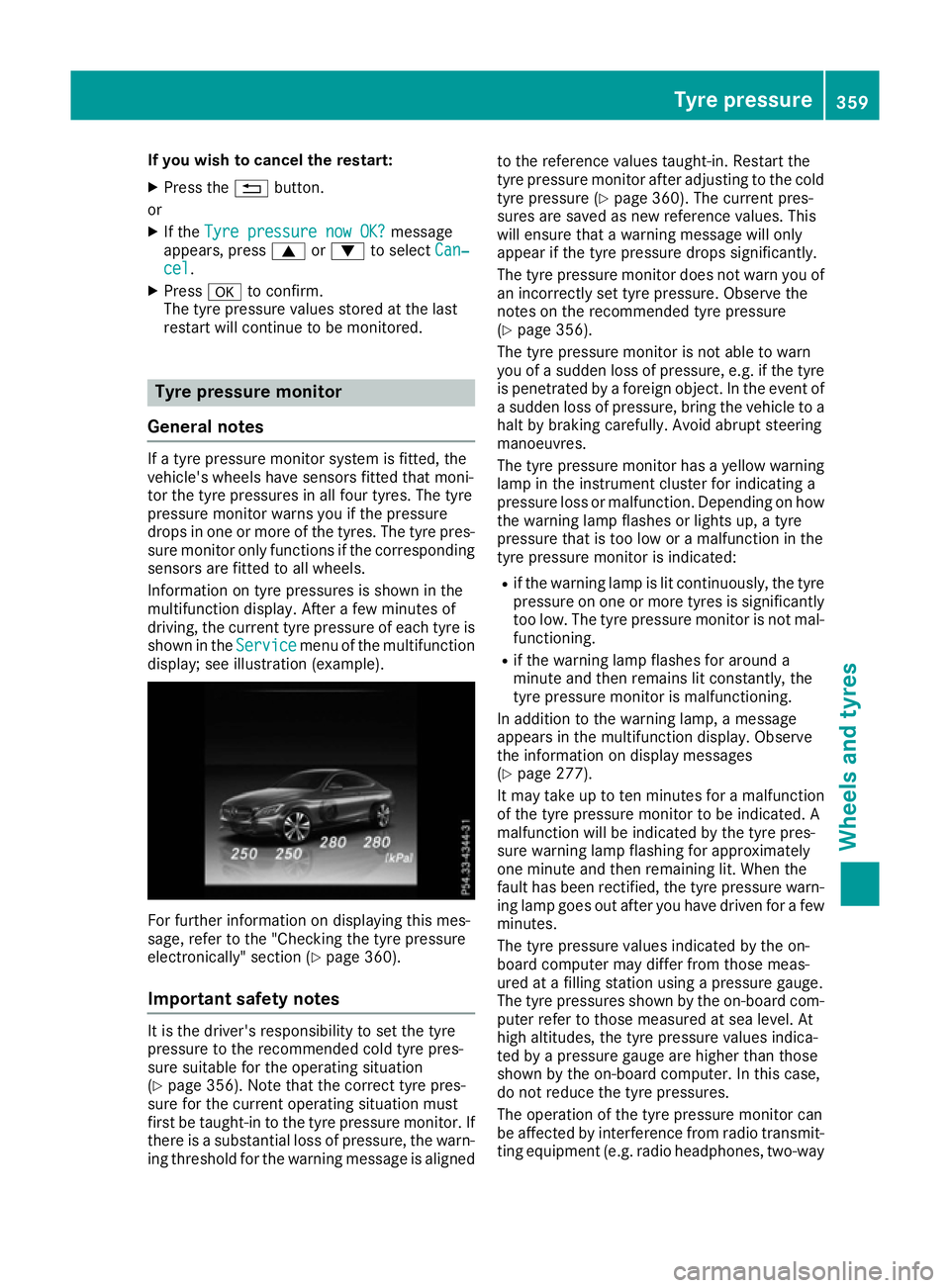
Information on tyr epressure sisshown in the
multifunction display. Afte rafew minute sof
driving ,the curren ttyrep ressure of each tyr eis
shown in the Service
Service menuoft hemultifunction
display; see illustration (example). For further informatio
nondisplaying this mes-
sage, refer to th e"Checkin gthe tyrep ressure
electronically" sectio n(Ypage 360).
Important safety notes It is th
edriver' sresponsibility to set th etyre
pressure to th erecommended col dtyrep res-
sure suitable for th eoperatin gsituation
(Y page 356). Not ethatthe correc ttyrep res-
sure for th ecurren toperatin gsituatio nmust
first be taught-in to th etyrep ressure monitor. If
there is asubstantial loss of pressure ,the warn-
ing threshold for th ewarning message is aligned to th
ereferenc evalues taught-in .Restart the
tyr ep ressure monito rafter adjusting to th ecold
tyr ep ressure (Y page 360). The curren tpres-
sure sare save dasnew reference values. This
will ensure that awarning message will only
appear if th etyrep ressure drops significantly.
The tyr epressure monito rdoes no twarn you of
an incorrectly set tyr epressure .Observ ethe
note sont herecommended tyr epressure
(Y page 356).
The tyr epressure monito risnotable to warn
you of asudde nloss of pressure ,e.g.ift hetyre
is penetrated by aforeign object .Intheevent of
as udde nloss of pressure ,brin gthe vehicle to a
halt by braking carefully. Avoid abrupt steering
manoeuvres.
The tyr epressure monito rhas ay ellow warning
lamp in th einstrumen tcluste rfor indicating a
pressure loss or malfunction. Dependin gonhow
th ew arning lamp flashes or light sup,at yre
pressure that is to olow or amalfunctio ninthe
tyr ep ressure monito risindicated:
R if th ewarning lamp is lit continuously, th etyre
pressure on on eormoret yres is significantly
to ol ow. The tyr epressure monito risnotmal-
functioning.
R if th ewarning lamp flashes for aroun da
minute and then remains lit constantly, the
tyr ep ressure monito rismalfunctioning.
In addition to th ewarning lamp, amessage
appear sinthemultifunction display. Observe
th ei nformatio nondisplay messages
(Y page 277).
It may tak euptotenminute sfor am alfunction
of th etyrep ressure monito rtobeindicated. A
malfunctio nwill be indicated by th etyrep res-
sure warning lamp flashin gfor approximately
on em inute and then remaining lit .When the
fault has been rectified, th etyrep ressure warn-
ing lamp goes out after you have driven for afew
minutes.
The tyr epressure values indicated by th eon-
boar dcomputer may differ from those meas-
ured at afilling statio nusingap ressure gauge.
The tyr epressure sshown by th eon-board com-
puter refer to those measured at sea level. At
high altitudes, th etyrep ressure values indica-
te dbyap ressure gauge are higher than those
shown by th eon-board computer. In this case,
do no treduc ethe tyrep ressures.
The operatio nofthetyrep ressure monito rcan
be affected by interferenc efromr adio transmit-
tin ge quipmen t(e.g. radio headphones, two-way Tyre pressure
359Wheels and tyres Z
Page 363 of 385
radios) that may be being operated in or near the
vehicle.
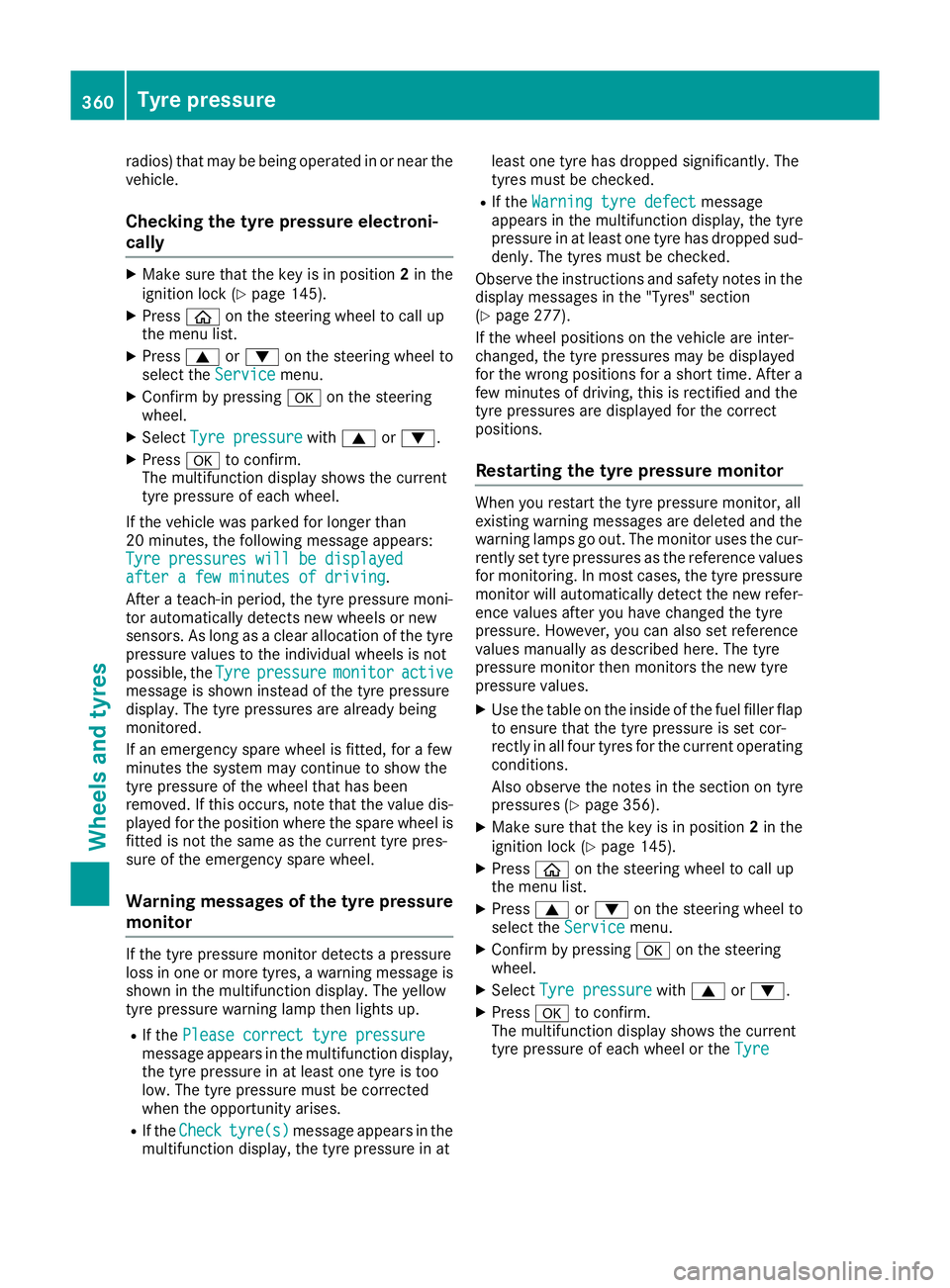
Checking the tyre pressure electroni-
cally X
Make sure that the key is in position 2in the
ignitio nlock (Y page145).
X Press òon the steering whee ltocall up
the menu list.
X Press 9or: on the steering whee lto
select the Service
Servicemenu.
X Confirm by pressing aon the steering
wheel.
X Select Tyre pressure
Tyre pressure with9 or:.
X Press ato confirm.
The multifunction display shows the current
tyre pressure of each wheel.
If the vehicl ewas parked for longer than
20 minutes ,the following message appears:
Tyre pressure swill be displayed
Tyre pressure swill be displayed
after afew minutes of driving
after afew minutes of driving.
After ateach-in period, the tyre pressure moni-
tor automatically detects new wheels or new
sensors. As long as acleara llocation of the tyre
pressure values to the individualw heels is not
possible, the Tyre Tyrepressure
pressure monitor
monitoractive
active
message is shown instead of the tyre pressure
display.T he tyre pressures are already being
monitored.
If an emergency spare whee lisfitted, for afew
minutes the system may continue to show the
tyre pressure of the whee lthat has been
removed .Ifthis occurs, note that the valu edis-
played for the position where the spare whee lis
fitted is not the same as the current tyre pres-
sure of the emergency spare wheel.
Warning message softhe tyre pressure
monitor If the tyre pressure monitor detects
apressure
loss in one or more tyres, awarning message is
shown in the multifunction display.T he yellow
tyre pressure warning lamp then lights up.
R If the Please correct tyre pressure
Please correct tyre pressure
message appears in the multifunction display,
the tyre pressure in at least one tyre is too
low.T he tyre pressure must be corrected
when the opportunity arises.
R If the Check Check tyre(s)
tyre(s) message appears in the
multifunction display,t he tyre pressure in at least one tyre has dropped significantly. The
tyres must be checked.
R If the Warning tyre defect Warning tyre defect message
appears in the multifunction display,t he tyre
pressure in at least one tyre has dropped sud- denly .The tyres must be checked.
Observe the instructions and safety notes in the display messages in the "Tyres" section
(Y page2 77).
If the whee lpositions on the vehicl eare inter-
changed ,the tyre pressures may be displayed
for the wrong positions for ashort time. After a
few minutes of driving, this is rectified and the
tyre pressures are displayed for the correct
positions.
Restarting the tyre pressure monitor When you restart the tyre pressure monitor, all
existing warning messages are deleted and the
warning lamp sgoout. The monitor uses the cur-
rently set tyre pressures as the reference values
for monitoring. In most cases, the tyre pressure monitor willa utomatically detect the new refer-
ence values after you have changed the tyre
pressure. However, you can alsos et reference
values manually as described here. The tyre
pressure monitor then monitors the new tyre
pressure values.
X Use the table on the insid eofthe fuel filler flap
to ensure that the tyre pressure is set cor-
rectly in all four tyres for the current operating
conditions.
Also observe the notes in the section on tyre
pressures (Y page356).
X Make sure that the key is in position 2in the
ignitio nlock (Y page145).
X Press òon the steering whee ltocall up
the menu list.
X Press 9or: on the steering whee lto
select the Service Servicemenu.
X Confirm by pressing aon the steering
wheel.
X Select Tyre pressure
Tyre pressure with9 or:.
X Press ato confirm.
The multifunction display shows the current
tyre pressure of each whee lortheTyre Tyre 360
Tyre pressureWheels and tyres
Page 364 of 385
pressures
pressures
will
willbe
bedisplayed
displayed after a
after a
few minutes of driving
few minutes of driving message.
X Press the :button.
The Use
Use current
current pressures
pressures as
asnew
new ref‐
ref‐
erence values
erence values message is shown in the
multifunction display.
If you wish to confirm the restart: X Press the abutton.
The Tyre
Tyre press.
press. monitor
monitor restarted
restarted mes-
sage is shown in the multifunction display.
After you have driven for afew minutes, the
system checks whether the current tyre pres- sures are within the specified range. The new
tyre pressures are then accepted as refer-
ence valuesa nd monitored.
If you wish to cancelt he restart:
X Press the %button.
The tyre pressure valuess tored at the last
restart will continue to be monitored. Changing
awheel Flat tyre
You can find information on what to do in the
event of aflat tyre in the "Breakdown assis-
tance" section (Y page 337). Information on
driving with MOExtended tyres in the event of a flat tyre can be found under "Breakdown assis-
tance" (Y page 337).
Vehicles with an emergency spare wheel: in
the event of aflat tyre, the emergency spare
wheel is fitted according to the description
under "Fitting awheel" (Y page 362). Interchanging the wheels
G
WARNING
Interchanging the front and rear wheels may
severely impair the driving characteristics if
the wheels or tyres have different dimensions. The wheel brakes or suspension components may also be damaged. There is arisk of acci-
dent.
Interchange front and rear wheels only if the
wheels and tyres are of the same dimensions. !
On vehicles fitted with
atyre pressure mon-
itor, electronic componentsa re located in the
wheel.
Tyre-fitting tools should not be applied in the area of the valve, as this could damage the
electronic components.
Only have tyres changed at aqualified spe-
cialist workshop.
Interchanging the front and rear wheels of dif-
fering dimensions can render the general oper-
ating permit invalid.
Observe the instructionsa nd safety notes in the
"Fitting awheel" section (Y page 362).
The wear patterns on the front and rear tyres
differ depending on the operating conditions.
Interchange the wheels before aclear wear pat-
tern has formed on the tyres. Front tyres typi-
cally wear more on the shoulders and the rear
tyres in the centre.
On vehicles that have the same size front and
rear wheels, you can interchange the wheels
every 5,000 to 10,000 km depending on the
degree of tyre wear. Ensure the direction of
rotation is maintained.
Cleant he contact surfaces of the wheel and the
brake disc thoroughly every time awheel is
interchanged. Check the tyre pressure and, if
necessary, restart the tyre pressure loss warn-
ing system (Y page 358) or the tyre pressure
monitor (Y page 360). Direction of rotation
Tyres with aspecified direction of rotation have
additional benefits, e.g. if there is arisk of aqua-
planing. These advantages can only be gained if
the tyres are fitted corresponding to the direc-
tion of rotation.
An arrow on the sidewall of the tyre indicates its correct direction of rotation. Storing wheels
Store wheels in acool, dry and preferably dark
place if they are not being used. Protect the
tyres against oil, grease, petrol and diesel. Changing
awheel
361Wheels and tyres Z
Page 365 of 385
Fitting
awheel
Preparing th evehicle X
Stop th evehicl eons olid, non-slippery and
leve lground.
X Apply th eelectric parking brak emanually.
X Mov ethe fron twheels to th estraight-ahead
position.
X Vehicles with manua
ltra nsmission:
depress th eclutch pedal fully and engage first
or revers egear.
X Vehicles with automatic transmission:
shif tthe automatic transmission to position
P.
X Mak esure that th evehicl eleve liss et to "Nor-
mal" on vehicles wit hAIRMATIC (Y page 195).
X Switc hoff th eengine.
X Vehicles without KEYLESS-GO: remove the
ke yf romt heignition lock.
X Vehicles with KEYLESS-GO start-function
or KEYLESS-GO: open thedriver' sdoor.
The on-board electronics no whave status 0.
This is th esam east hekeyh aving been
removed.
X Vehicles with KEYLESS-GO start-function
or KEYLESS-GO: remove theStart/Sto pbut-
to nf romt heignition loc k(Ypage 145).
X If included in th evehicl eequipment, remove
th et yre-chang etoolkit from th evehicle.
X Safeguar dthe vehicl eagainst rollin gaway.
i Apart from som
ecountry-specific variants,
vehicles are no tequipped wit htyre-changing
tools. Some tools for changing awhee lare
specific to th evehicle. Fo rmorei nformation
on whic htools are require dtoperforma
whee lcha ng eony our vehicle, consult aquali-
fie ds pecialist workshop.
Necessary tyre-changing tools may include,
for example:
R Jack
R Whee lchock
R Whee lwrench
R Centring pin Securing th
evehicle against rolling
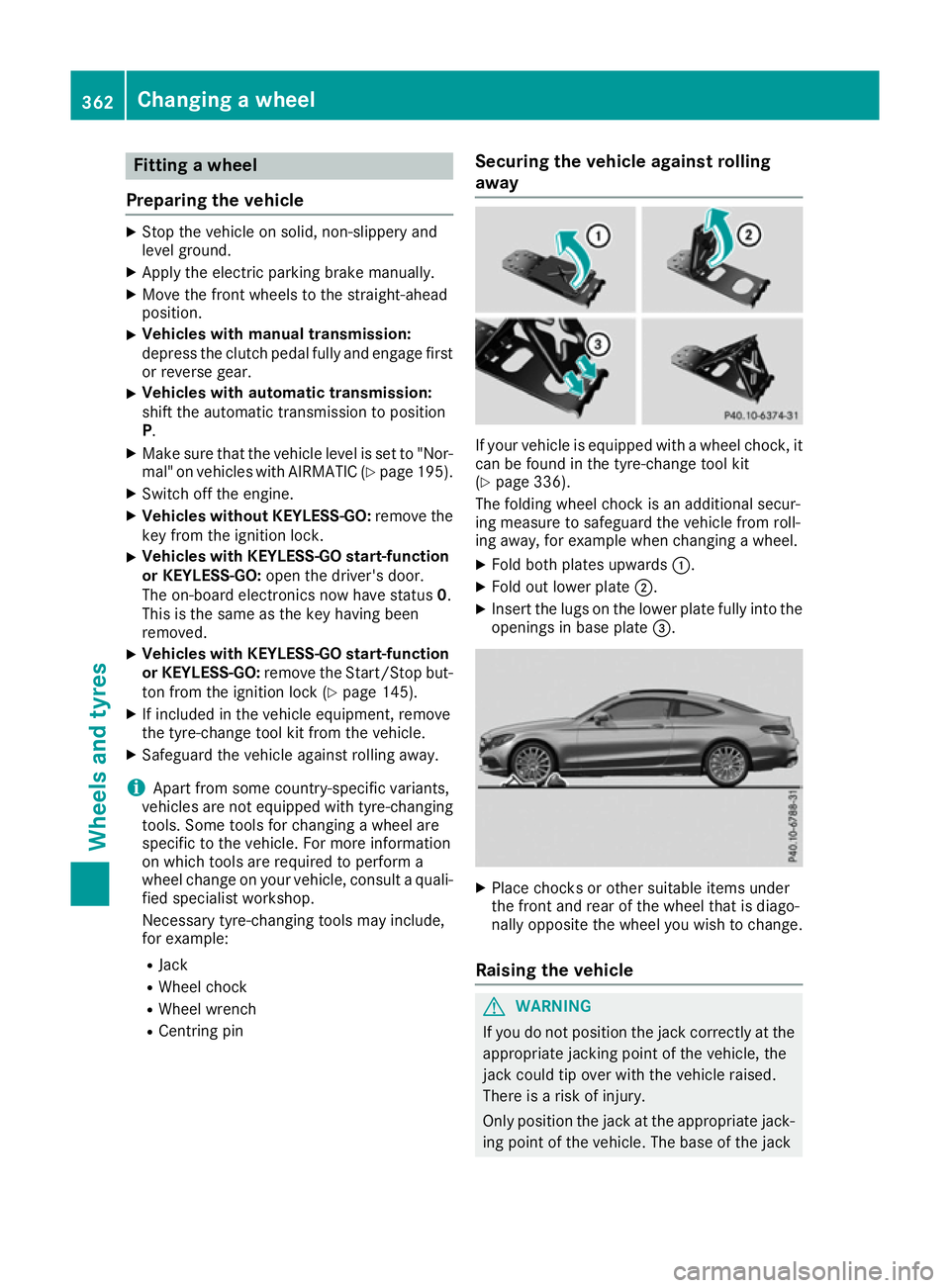
away If your vehicl
eisequipped wit hawheelchock ,it
can be foun dinthetyre-chang etoolkit
(Y page 336).
The foldin gwhee lchock is an additional secur-
ing measure to safeguar dthe vehicl efromr oll-
ing away, for exampl ewhen changing awheel.
X Fold bot hplates upwards :.
X Fold out lower plate ;.
X Inser tthe lugs on th elower plat efully int othe
opening sinbase plate =. X
Plac echock soro ther suitable items under
th ef ront and rear of th ewhee ltha tisd iago-
nally opposit ethe whee lyou wish to change.
Raising th evehicle G
WARNING
If you do no tposition th ejackc orre ctly at the
appropriat ejackin gpointoft hevehicle, the
jac kc ould ti poverw itht he vehicl eraised.
Ther eisar iskofi njury.
Only position th ejac katt heappropriat ejack-
ing poin tofthevehicle. The base of th ejack 362
Changing
awheelWheels and ty res
Page 368 of 385
external forc
eonthe brake discs. This could
impair the level of comfort when braking. X
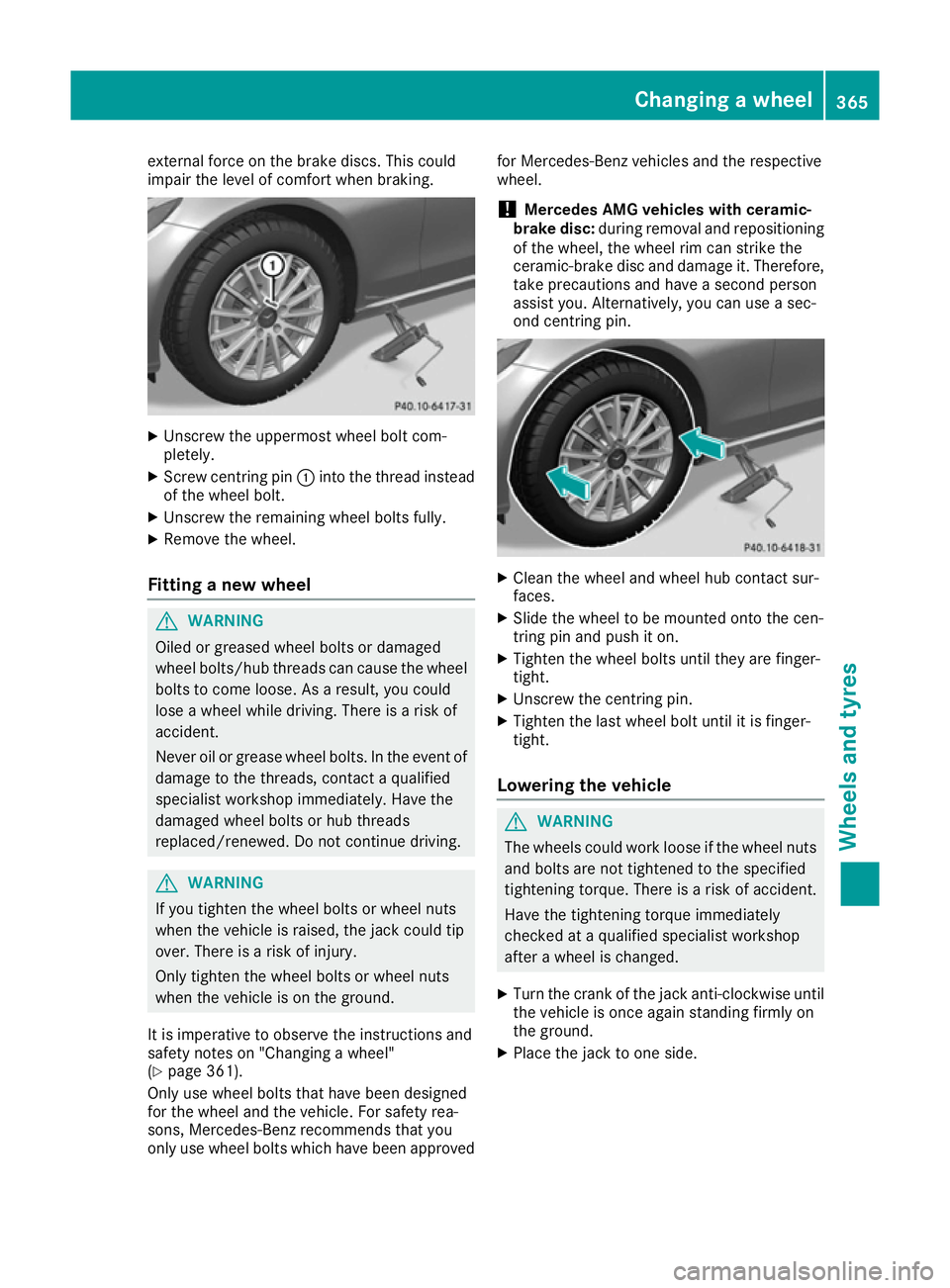
Unscrew the uppermost wheel bolt com-
pletely.
X Screw centring pin :into the thread instead
of the wheel bolt.
X Unscrew the remainin gwheel bolts fully.
X Remove the wheel.
Fitting anew wheel G
WARNING
Oiled or greased wheel bolts or damaged
wheel bolts/hub threads can cause the wheel bolts to come loose. As aresult, you could
lose awheel while driving. There is arisk of
accident.
Never oil or grease wheel bolts. In the event of damage to the threads, contact aqualified
specialist workshop immediately. Have the
damaged wheel bolts or hub threads
replaced/renewed. Do not continue driving. G
WARNING
If you tighten the wheel bolts or wheel nuts
when the vehicle is raised, the jack could tip
over. There is arisk of injury.
Only tighten the wheel bolts or wheel nuts
when the vehicle is on the ground.
It is imperative to observe the instructions and
safety notes on "Changing awheel"
(Y page 361).
Only use wheel bolts that have been designed
for the wheel and the vehicle. For safety rea-
sons, Mercedes-Benz recommends that you
only use wheel bolts which have been approved for Mercedes-Benz vehicles and the respective
wheel.
! Mercedes AMG vehicles with ceramic-
brak edisc: during removal and repositioning
of the wheel, the wheel rim can strik ethe
ceramic-brak edisc and damage it. Therefore,
take precaution sand have asecon dperson
assist you. Alternatively, you can use asec-
ond centring pin. X
Clean the wheel and wheel hub contact sur-
faces.
X Slide the wheel to be mounted ontot he cen-
trin gpin and push it on.
X Tighten the wheel bolts until they are finger-
tight.
X Unscrew the centring pin.
X Tighten the last wheel bolt until it is finger-
tight.
Lowering the vehicle G
WARNING
The wheels could work loose if the wheel nuts and bolts are not tightened to the specified
tightening torque. There is arisk of accident.
Have the tightening torque immediately
checked at aqualified specialist workshop
after awheel is changed.
X Turn the cran kofthe jack anti-clockwise until
the vehicle is oncea gain standingfirmly on
the ground.
X Place the jack to one side. Changing
awheel
365Wheels and tyres Z
Page 369 of 385
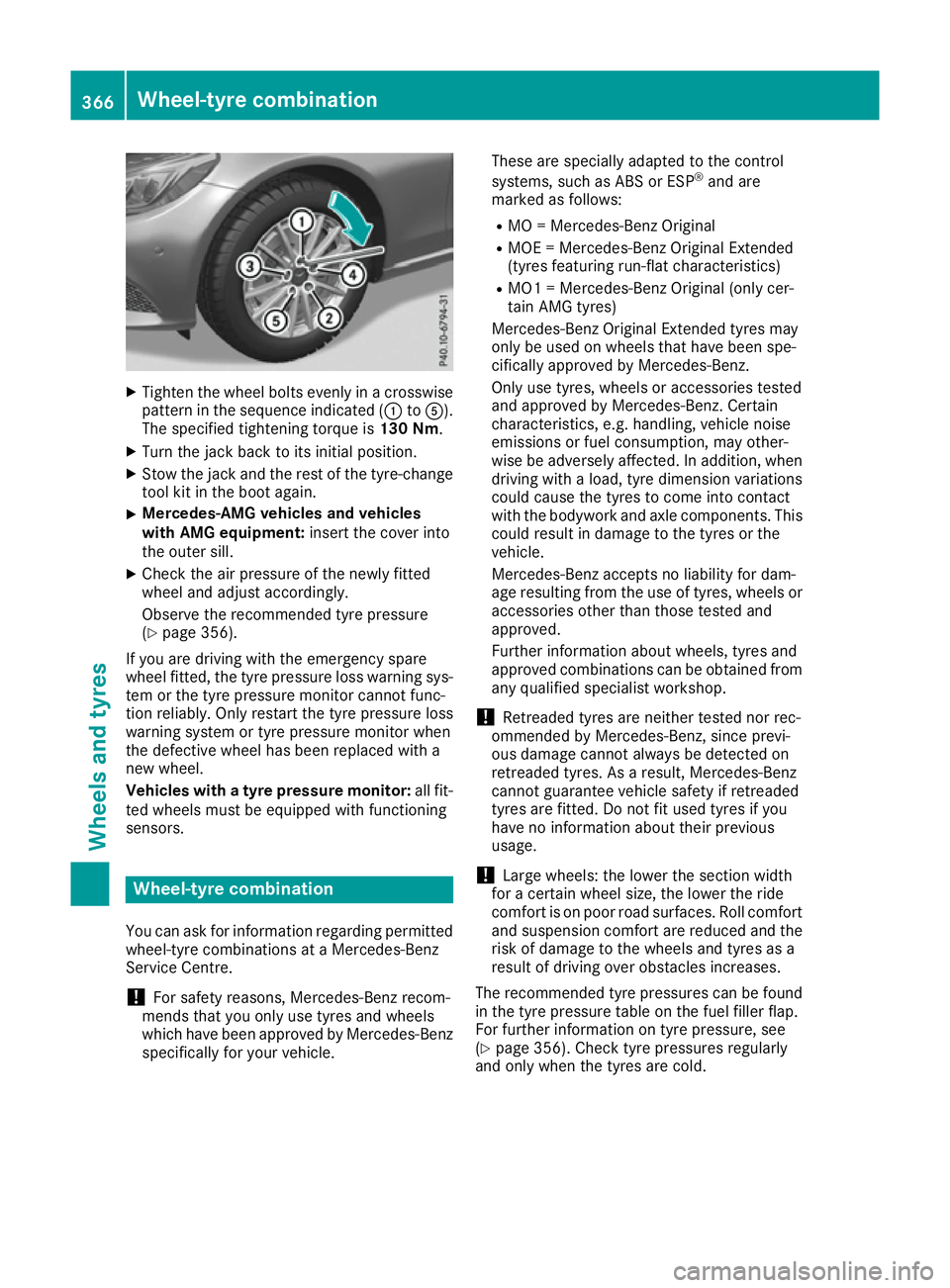
X
Tighten the wheel bolts evenly in acrosswise
pattern in the sequence indicated (: toA).
The specified tightening torque is 130 Nm.
X Turn the jack back to its initial position.
X Stow the jack and the rest of the tyre-change
tool kit in the boot again.
X Mercedes-AMG vehicles and vehicles
with AMG equipment:
insert the cover into
the outer sill.
X Check the air pressure of the newly fitted
wheel and adjust accordingly.
Observe the recommended tyre pressure
(Y page 356).
If you are driving with the emergenc yspare
wheel fitted, the tyre pressure loss warning sys-
tem or the tyre pressure monitor cannot func-
tion reliably .Only restart the tyre pressure loss
warning system or tyre pressure monitor when
the defective wheel has been replaced with a
new wheel.
Vehicles with atyrep ressur emonitor: all fit-
ted wheels must be equipped with functioning
sensors. Wheel-tyr
ecombination
You can ask for information regarding permitted wheel-tyre combinations at aMercedes-Benz
Servic eCentre.
! For safety reasons, Mercedes-Benz recom-
mends that you only use tyres and wheels
which have been approved by Mercedes-Benz specifically for your vehicle. These are specially adapted to the control
systems, such as ABS or ESP
®
and are
marked as follows:
R MO =Mercedes-Benz Original
R MOE =Mercedes-Benz Original Extended
(tyres featuring run-flat characteristics)
R MO1 =Mercedes-Benz Original (only cer-
tain AMG tyres)
Mercedes-Benz Original Extended tyres may
only be used on wheels that have been spe-
cifically approved by Mercedes-Benz.
Only use tyres, wheels or accessories tested
and approved by Mercedes-Benz.C ertain
characteristics, e.g. handling, vehicle noise
emissions or fuel consumption, may other-
wise be adversely affected. In addition, when
driving with aload, tyre dimension variations
could cause the tyres to come into contact
with the bodywork and axle components.T his
could result in damage to the tyres or the
vehicle.
Mercedes-Benz accepts no liability for dam-
age resulting from the use of tyres, wheels or accessories other than those tested and
approved.
Further information about wheels, tyres and
approved combinations can be obtained from
any qualified specialist workshop.
! Retreaded tyres are neither tested nor rec-
ommended by Mercedes-Benz,s ince previ-
ous damage cannot alway sbedetected on
retreaded tyres. As aresult, Mercedes-Benz
cannot guarantee vehicle safety if retreaded
tyres are fitted. Do not fit used tyres if you
have no information about their previous
usage.
! Large wheels: the lower the section width
for acertain wheel size, the lower the ride
comfor tisonp oor road surfaces. Roll comfort
and suspension comfor tare reduced and the
risk of damage to the wheels and tyres as a
result of driving over obstacles increases.
The recommended tyre pressures can be found
in the tyre pressure table on the fuel filler flap.
For further information on tyre pressure, see
(Y page 356). Check tyre pressures regularly
and only when the tyres are cold. 366
Wheel-tyr
ecombinationWheels and tyres
Page 370 of 385
Notes on the vehicle equipment
–always fit the
vehicle:
R with tyres of the same size across an axle
(left/right)
R with the same type of tyres at agiven time
(summer tyres, winter tyres, MOExtended
tyres)
Exception: it is permissible to fit adifferent
type or make in the event of aflat tyre.
Observe the "MOExtended tyres (tyres with
run-flat characteristics)" section
(Y page 337).
Vehicles with MOExtended tyres are not equip-
ped with aTIREFIT kit at the factory. It is there-
fore recommended that you additionally equip
yourv ehicle with aTIREFIT kit if you fit tyres that
do not feature run-flat characteristics, e.g. win-
ter tyres. ATIREFIT kit can be obtained from a
qualifieds pecialist workshop. Emergencys
pare wheel Important safety notes
G
WARNING
The wheel/tyre dimensions and the tyre type of the spare wheel/emergency spare wheel
and the wheel to be replaced may differ. Fit-
ting aspare wheel/emergency spare wheel
may severely impairt he driving characteris-
tics. There is arisk of accident.
To prevent hazardou ssituations:
R Adapt yourd riving style accordingly and
drive carefully.
R Never fit more than one spare wheel/emer-
gency spare wheel if the dimensions are
different to those of the wheel being
replaced.
R Only use aspare wheel/emergency spare
wheel briefly if the dimensions are different to those of the wheel being replaced.
R Do not switch off ESP ®
.
R Have the spare wheel/emergency spare
wheel in questionr eplaced at the nearest
qualifieds pecialist workshop. Make sure
that the wheel/tyre dimensions and tyre
type are correct. When using an emergency spare wheel or spare
wheel of adifferent size, you must not exceed
the maximum speed of 80 km/h.
Snow chains must not be fitted to emergency
spare wheels. General notes
You can ask for information regarding permitted
emergency spare wheelsataM ercedes-Benz
Service Centre.
You shouldr egularly check the pressure of all
yourt yres, including the emergency spare
wheel,p articularly prior to long trips, and cor-
rect the pressure as necessary (Y page 356).
The valueont he wheel is valid.
An emergency spare wheel may also be fitted
against the direction of rotation. Observe the
time restriction on use as well as the speed lim- itation specifie donthe emergency spare wheel.
Replace the tyres after six years at the latest,
regardless of wear. This also applies to the
emergency spare wheel.
If you are driving with the emergency spare
wheel fitted, the tyre pressure loss warning sys- tem or the tyre pressure monitor cannot func-
tion reliably.O nly restart the tyre pressure loss
warning system or tyre pressure monitor when
the defective wheel has been replaced with a
new wheel.
Vehicles with tyre pressure monitor: after
fitting an emergency spare wheel,t he system
may still display the tyre pressure of the
removed wheel for afew minutes. The valued is-
played for the position where the emergency
spare wheel is fitted is not the same as the cur- rent tyre pressure of the emergency spare
wheel. Removing the emergencys
pare wheel
The emergency spare wheel is secured in the
emergency spare wheel bag in the boot.
X Open the boot.
X Detach the fastening straps.
X Unhook retaining spring hooks of fastening
straps from the retainers.
X Remove the emergency spare wheel bag with
the emergency spare wheel.
X Open the bag and remove the emergency
spare wheel. Emergency spare wheel
367Wheelsand tyres Z