heating MERCEDES-BENZ C-CLASS COUPE 2015 Owner's Manual
[x] Cancel search | Manufacturer: MERCEDES-BENZ, Model Year: 2015, Model line: C-CLASS COUPE, Model: MERCEDES-BENZ C-CLASS COUPE 2015Pages: 385, PDF Size: 13.12 MB
Page 139 of 385
X
Convenience closing feature: pressand
hold the grocker switch up or down until
th es ide windows start to close automatically.
Vehicles with sliding sunroof or pano-
rama sliding sunroof: thes lidin gsunroo for
panorama slidin gsunroo fcloses simultane-
ously.
The indicator lamp above the grocker
switch light sup. Air-recirculation mode is
activated.
If you open th eside windows or th esliding
sunroo forthepanorama slidin gsunroo fman-
ually after closin gthemw ith th econvenience
closin gfeature, they will remain in this posi-
tio nw hen opened usin gthe convenience
opening feature.
If part softhebody are in th eclosing area during
convenience closing, proceed as follows:
X Pres sthe W button to stop th eside win-
dows.
The side windows stop.
X To then open th eside windows, pres sthe
W button again.
X Only vehicles with sliding sunroof or pan-
orama sliding sunroof: pressthe 3
switch to stop th eslidin gsunroo forpano-
rama slidin gsunroof.
The slidin gsunroo forpanorama slidin gsun-
roo fstops.
X To then open th eslidin gsunroo forpanorama
slidin gsunroof, pull back on the 3button.
Notes on th eautomatic reversing feature for:
R thes ide windows (Y page 93)
R thes lidin gsunroo forpanorama slidin gsun-
roo f(Ypage 97)
X Convenience opening feature: pressand
hold the grocker switch up or down until
th es ide windows start to open automatically.
Vehicles with sliding sunroof or pano-
rama sliding sunroof: thes lidin gsunroo for
panorama slidin gsunroo fopen ssimultane-
ously.
The indicator lamp above the grocker
switch goes out .Air-recirculation mode is
deactivated. Switching th
eresidual hea ton/off
General notes The residual heat function is onl
yavailable with
THERMATIC automatic climate control with aux-
iliary heating.
When th eengine is switche doff,itisp ossible to
mak euse of th eresidual heat of th eengine to
continue heating or ventilating th efront com-
partmen tofthevehicle for approximately
30 minutes .The heating or ventilation time
depends on th eset interio rtemperature.
Activating/deactivating X
Turn th ekey to position 0in th eignitio nlock
or remove it (Y page 145).
X To switch on: pressthe ! rocker switch
up or down.
The indicator lamp above the !rocker
switch light sup.
The blower will run at alow speed regardless of
th ea irflow setting.
If you activat ethe residual heat function at high
temperatures, onl ythe ventilation will be acti-
vated. The blower run satmedium speed.
X To switch off: pressthe ! rocker switch
up or down.
The indicator lamp above the !rocker
switch goes out.
Residual heat is deactivated automatically:
R after approximatel y30minutes
R when th eignitio nisswitche don
R if th ebattery voltage drops
R when th eauxiliar yheating is switche don Perfume atomiser
Operating th eperfume atomiser G
WARNING
If children open th evial, they could drin kthe
perfume or it could com eintoc ontac twith
their eyes. Ther eisarisk of injury. Do not
leave children unsupervised in th evehicle.
If th eperfume liquid has been drunk, consult
ad octor. If perfume comes int ocontac twith
your eyes or skin, rinse th eeyes with clean 136
Operating th
eclimate control systemClimate control
Page 141 of 385
Problems with the perfume atomiser
Problem
Possible causes/consequences and
M
MSolutions The vehicle interior is not
perfumed although the
perfume atomiser has
been activated. The perfume vial has not been pushed into the holder as far as it will
go.
X Slide the perfume vial into the holder as far as it will go. The perfume vial is not filled sufficiently.
X Pre-filled vials: dispose of the empty vial.
X Use anew pre-filled vial.
X Refillable vials: refill the vial with amaximum of 15 ml of the same
perfume. The perfume atomiser is faulty.
X Have the perfume atomiser checked at aqualified specialist work-
shop. Ionisation
Ionisation is used to purify and freshen the air in the vehicle interior, which is conducive to a
pleasant climate.
The ionisation of the interior air is odourless and
cannot,d irectly, be perceived in the vehicle inte-
rior.
You can switch ionisation on or off using the
multimedia system (Y page 300).
Ionisation can only be operated when the auto-
matic climate control is switched on. The side air vent on the driver's side must be open. Auxiliary heating
Important safety notes G
DANGER
If the exhaust pipe is blocked or sufficient
ventilation is not possible, toxic exhaust
fumes can enter the vehicle, especially car-
bon monoxide. This is the case, e.g. in
enclosed spaces, or if the vehicle is stuck in
snow. There is arisk of fatal injuries.
You should switch off the auxiliary heating in
enclosed spaces which do not have an extrac- tion system, e.g. agarage. If the vehicle is
stuck in snow and you must leave the auxiliary
heating running, keep the exhaust pipe and the area around the vehicle clear of snow. To
guarantee asufficient supply of fresh air, open
aw indow on the side of the vehicle away from
the wind. G
WARNING
When the auxiliary heating is switched on,
parts of the vehicle can become very hot.
Flammable materials such as leaves, grass or twigs may ignite if they come into contact
with:
R hot parts of the exhaust system
R the exhaust gas itself
There is arisk of fire.
When the auxiliary heating is switched on,
make sure that:
R no flammable materials come into contact
with hot vehicle components
R the exhaust gas can escape from the
exhaust pipe unhindered
R the exhaust gas does not come into contact
with flammable materials.
The auxiliary heating is fitted under the front
wing on the right-han dside of the vehicle. The
emissions outlet is found behind the front wheel on the right-han dside of the vehicle. 138
Operating the climate control systemClimatec
ontrol
Page 142 of 385
!
Operating the auxiliary heating/ventilation
draws on the vehicle battery. After you have
heated or ventilated the vehicle amaximum of
two times, drive for alonger distance.
Switch the auxiliary heating on regularly once a
month for aboutt en minutes.
The auxiliary heating heats the air in the vehicle interior to the set temperature. This occurs with-out using the heat of the running engine. The
auxiliary heating is operated directly using the
vehicle's fuel. For this reason, the tank content
must be at least at reserve fuel level to ensure
that the auxiliary heating functions.
The auxiliary heating or auxiliary ventilation
automaticallya djusts to changes in tempera-
ture and weather conditions. For this reason,
the auxiliary heating could switch from ventila-
tion mode to heating mode or from heating
mode to ventilation mode.
The auxiliary heating switches off when the
engine is switched off. The auxiliary ventilation
is not active if the engine is running.
The auxiliary heating or auxiliary ventilation
switches off automaticallya fter 50 minutes.
This time limit can be altered. To do this, visit a
qualified specialist workshop.
You cannot use the auxiliary ventilation to cool
the vehicle interior to atemperature lower than
the outside temperature.
Before switchingon X
Turn the key to position 2in the ignition lock
(Y page 145).
X Set the desired temperature using the w
rocker switch on the front control unit.
If you do not alter the temperature before
switching on the auxiliary heating or auxiliary
ventilation, the last temperature setting will be
adopted.
Auxiliary heating or auxiliary ventilation can also
be switched on if the manuallys et climate con-
trol is activated. Optimum comfort is attained
when the system is set to automatic mode. Set the temperature to 22 †.
You can switch the auxiliary heating or auxiliary
ventilation on or off:
R using the rocker switch on the centrec onsole
(Y page 139)
R using the remote control (Y page 140)The remote control can be used to set up to
three departure times, one of which may be pre-
selected.
Switchingt he auxiliary heating/venti-
lation on/off using the centre console
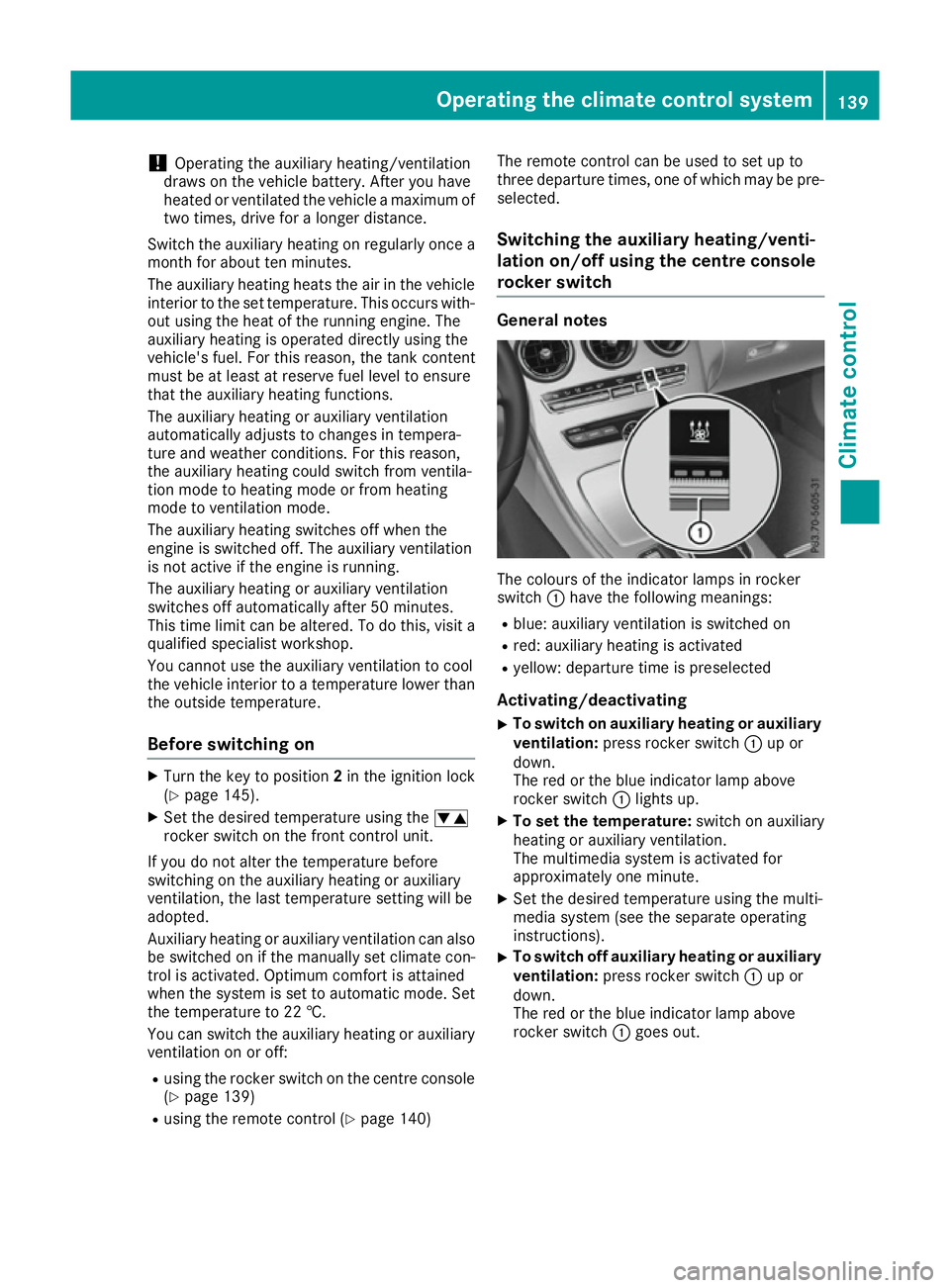
rocker switch General notes
The colours of the indicator lamps in rocker
switch
:have the following meanings:
R blue: auxiliary ventilation is switched on
R red: auxiliary heating is activated
R yellow: departure time is preselected
Activating/deactivating
X To switch on auxiliary heating or auxiliary
ventilation: press rocker switch :up or
down.
The red or the blue indicator lamp above
rocker switch :lights up.
X To set the temperature: switch on auxiliary
heating or auxiliary ventilation.
The multimedia system is activated for
approximately one minute.
X Set the desired temperature using the multi-
media system (see the separate operating
instructions).
X To switch off auxiliary heating or auxiliary
ventilation:
press rocker switch :up or
down.
The red or the blue indicator lamp above
rocker switch :goes out. Operating the climatec
ontrol system
139Climatecontrol Z
Page 143 of 385
Switching the auxiliary heating/venti-
lation on or off using the remote control
General notes
Your vehicle comes with one remote control.
You may use two additional remote controls for
your vehicle. For more information ,please con-
tact aqualified specialist workshop.
Storet he remote control for the auxiliary heat-
ing so that the auxiliary heating cannot be
switched on unintentionally. In particular,
ensure that the remote control for the auxiliary
heating is kept out of the reach of children.
The remote control has arange of approximately
300 metres. This range is reduced by:
R sources of radio interference
R solid objectsb etween the remote control and
the vehicle
R the remote control being in an unfavourable
position in relation to the vehicle
R transmitting from an enclosed space
If the remote control battery is low, the battery
symbol on the left of the display is shown as
empty. Replace the remote control battery and
observe the important safety notes when doing so (Y page 141).
Activating/deactivating the auxiliary
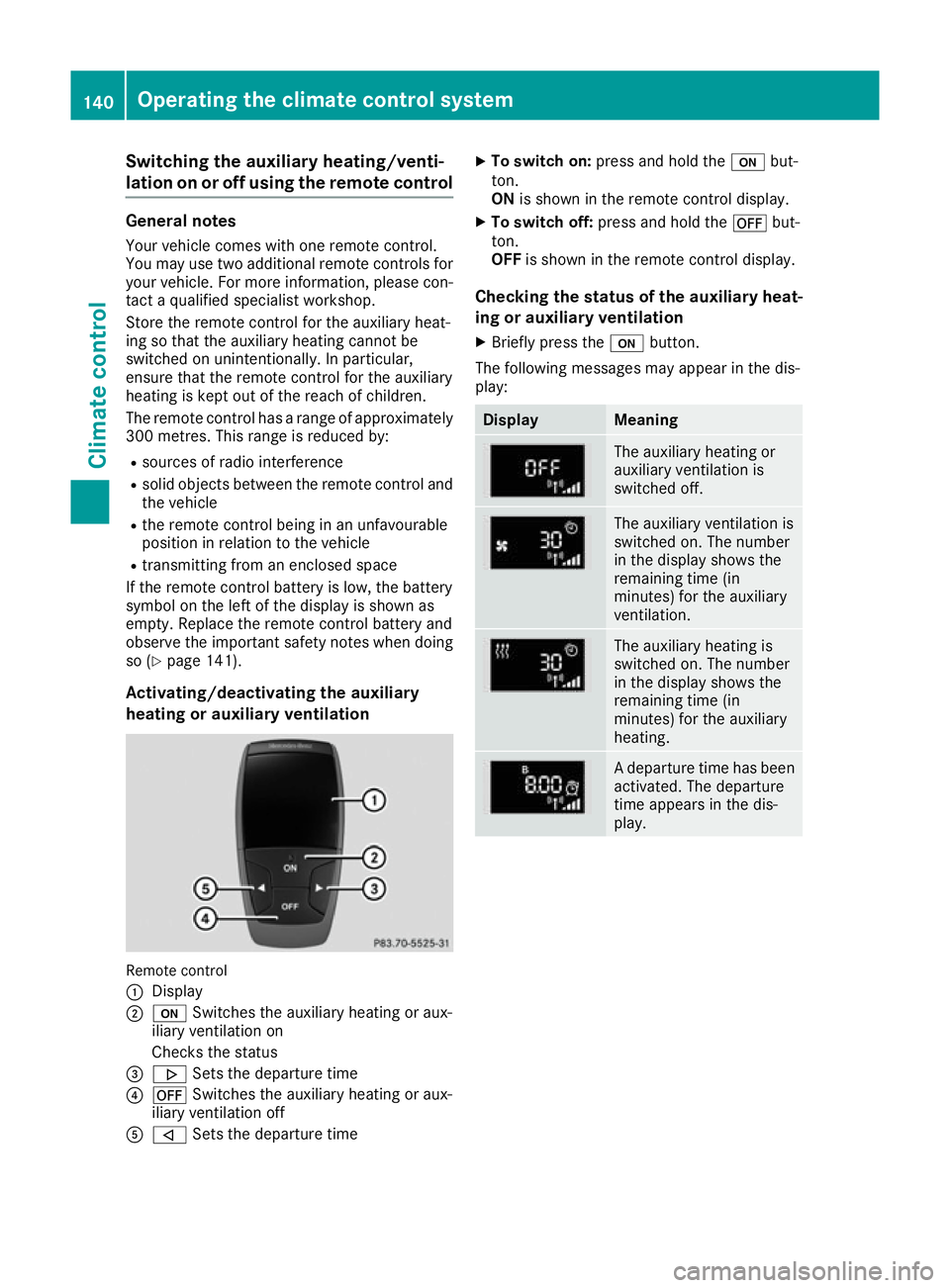
heating or auxiliary ventilation Remote control
:
Display
; u Switches the auxiliary heating or aux-
iliary ventilation on
Checks the status
= . Sets the departure time
? ^ Switches the auxiliary heating or aux-
iliary ventilation off
A , Sets the departure time X
To switch on: press and hold the ubut-
ton.
ON is shown in the remote control display.
X To switch off: press and hold the ^but-
ton.
OFF is shown in the remote control display.
Checking the status of the auxiliary heat- ing or auxiliary ventilation
X Briefly press the ubutton.
The following messages may appear in the dis-
play: Display Meaning
The auxiliary heating or
auxiliary ventilation is
switched off.
The auxiliary ventilation is
switched on. The number
in the display shows the
remaining time (in
minutes) for the auxiliary
ventilation.
The auxiliary heating is
switched on. The number
in the display shows the
remaining time (in
minutes) for the auxiliary
heating.
Ad
eparture time has been
activated. The departure
time appears in the dis-
play. 140
Operating the climate control systemClimatec
ontrol
Page 144 of 385
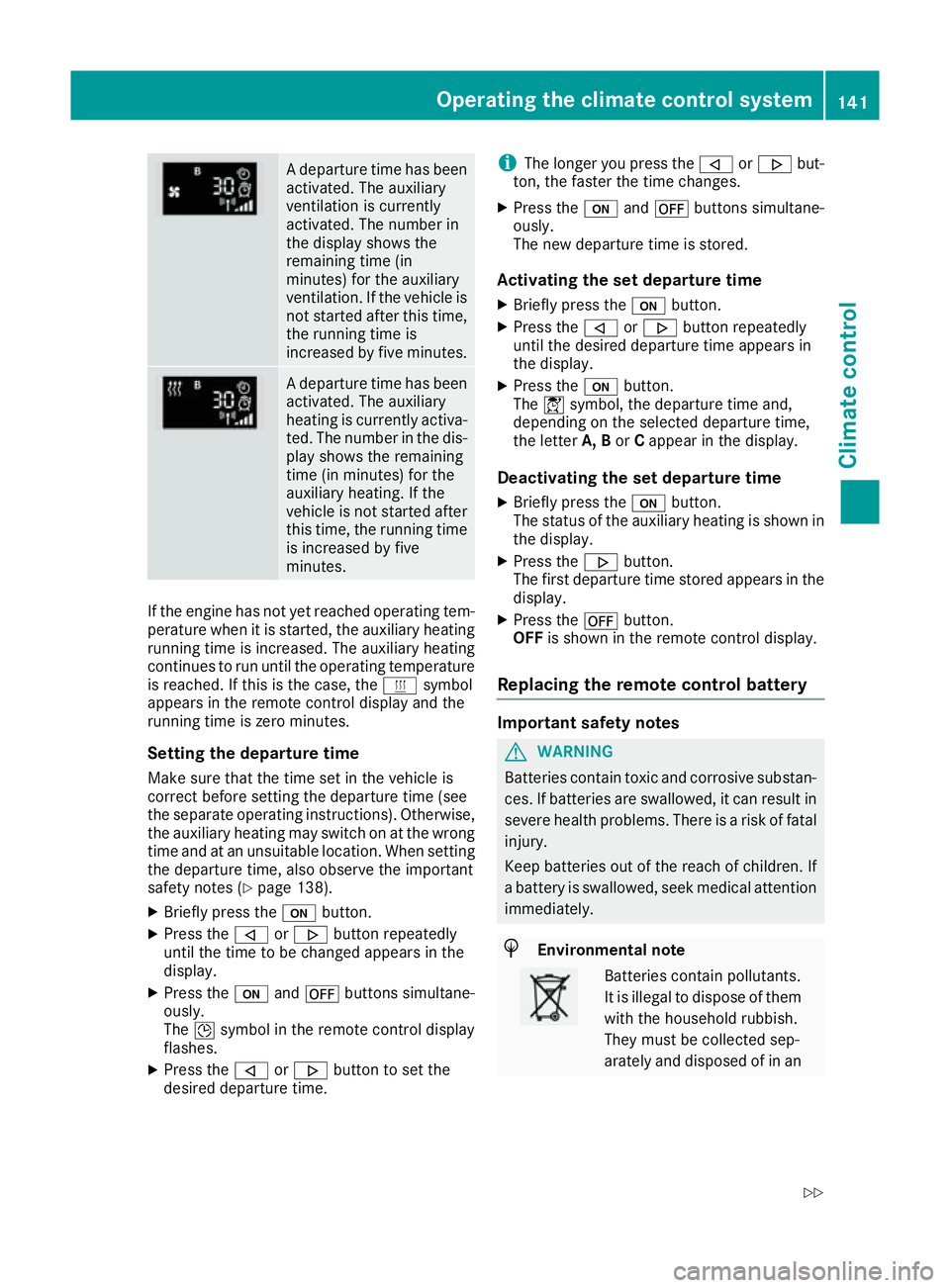
Ad
epart uret ime ha sbeen
activated .The auxiliary
ventilatio nisc urrently
activated .The numbe rin
the display shows the
remaining time (in
minutes) for the auxiliary
ventilation. If the vehicl eis
not started afte rthist ime,
the running time is
increased by fiv eminutes. Ad
epart uret ime ha sbeen
activated .The auxiliary
heating is currentl yactiva-
ted .The numbe rinthe dis-
play shows the remaining
time (i nminutes) for the
auxiliary heating .Ifthe
vehicl eisnot started after
thi stime ,the running time
is increased by five
minutes. If the engine ha
snot ye treache doperating tem-
perature when it is started ,the auxiliary heating
running time is increased .The auxiliary heating
continue storununti lthe operating temperature
is reached. If thi sisthe case, the ysymbol
appear sinthe remote contro ldisplay and the
running time is zero minutes.
Settin gthe departure time
Make sure tha tthe time set in the vehicl eis
correct before setting the departur etime (see
the separate operating instructions) .Otherwise,
the auxiliary heating ma yswitch on at the wrong
time and at an unsuitable location. Whe nsetting
the departur etime ,alsoo bserve the important
safety notes (Y page 138).
X Briefl ypress the ubutton.
X Press the ,or. button repeatedly
unti lthe time to be change dappears in the
display.
X Press the uand^ buttons simultane-
ously.
The Îsymbo linthe remote contro ldisplay
flashes.
X Press the ,or. button to set the
desired departur etime. i
The longe
ryou press the ,or. but-
ton, the faster the time changes.
X Press the uand^ buttons simultane-
ously.
The new departur etime is stored.
Activatin gthe se tdeparture time
X Briefl ypress the ubutton.
X Press the ,or. button repeatedly
unti lthe desired departur etime appear sin
the display.
X Press the ubutton.
The Ísymbol, the departur etime and,
depending on the selecte ddepart uret ime,
the letter A, BorCappear in the display.
Deactivating the se tdeparture time
X Briefl ypress the ubutton.
The status of the auxiliary heating is shown in the display.
X Press the .button.
The first departur etime stored appear sinthe
display.
X Press the ^button.
OFF is shown in the remote contro ldisplay.
Replacing the remote contro lbattery Important safety notes
G
WARNING
Batterie scontain toxi cand corrosive substan-
ces .Ifb atteries ar eswallowed, it can resul tin
severe health problems .There is ariskoff atal
injury.
Kee pbatteries ou tofthe reach of children. If
ab attery is swallowed, see kmedica lattention
immediately. H
Environmental note Batterie
scontain pollutants.
It is illega ltodispose of them
with the househol drubbish.
The ym ustbec ollected sep-
arately and disposed of in an Operatin
gthe climate contro lsystem
141Climate control
Z
Page 146 of 385
Problems with the auxiliary heating/ventilation
Problem
Possible causes/consequences and
M
MSolutions FAIL¨ The signal transmission between the transmitter and the vehicle is
faulty.
X
Change your position in relation to the vehicle, moving closer if
necessary. FAIL The auxiliary heating/ventilation cannot be switched on or has
switched itself off.
The starter battery is not sufficiently charged.
X Charge the starter battery. The fuel tank content is below the reserve fuel level.
X Refuel at the nearest filling station. FAIL
¯ The auxiliary heating/ventilation is malfunctioning.
X Have the auxiliary heating/ventilation checked at aqualified spe-
cialist workshop. Air vents
Important safety notes
G
WARNING
Very hot or very cold air can flow from the air vents. This could result in burns or frostbit ein
the immediate vicinity of the air vents. There
is ar isk of injury.
Make sure that all vehicle occupants always
maintain asufficient distance to the air out-
lets. If necessary, redirect the airflow to
another area of the vehicle interior.
In order to ensure the direct flow of fresh air
through the air ventsi nto the vehicle interior,
please observe the following notes:
R keep the air inlet between the windscreen and
the bonnet free of blockages, such as ice,
snow or leaves
R never cover the ventsorv entilation grilles in
the vehicle interior Adjusting the air vents
Example
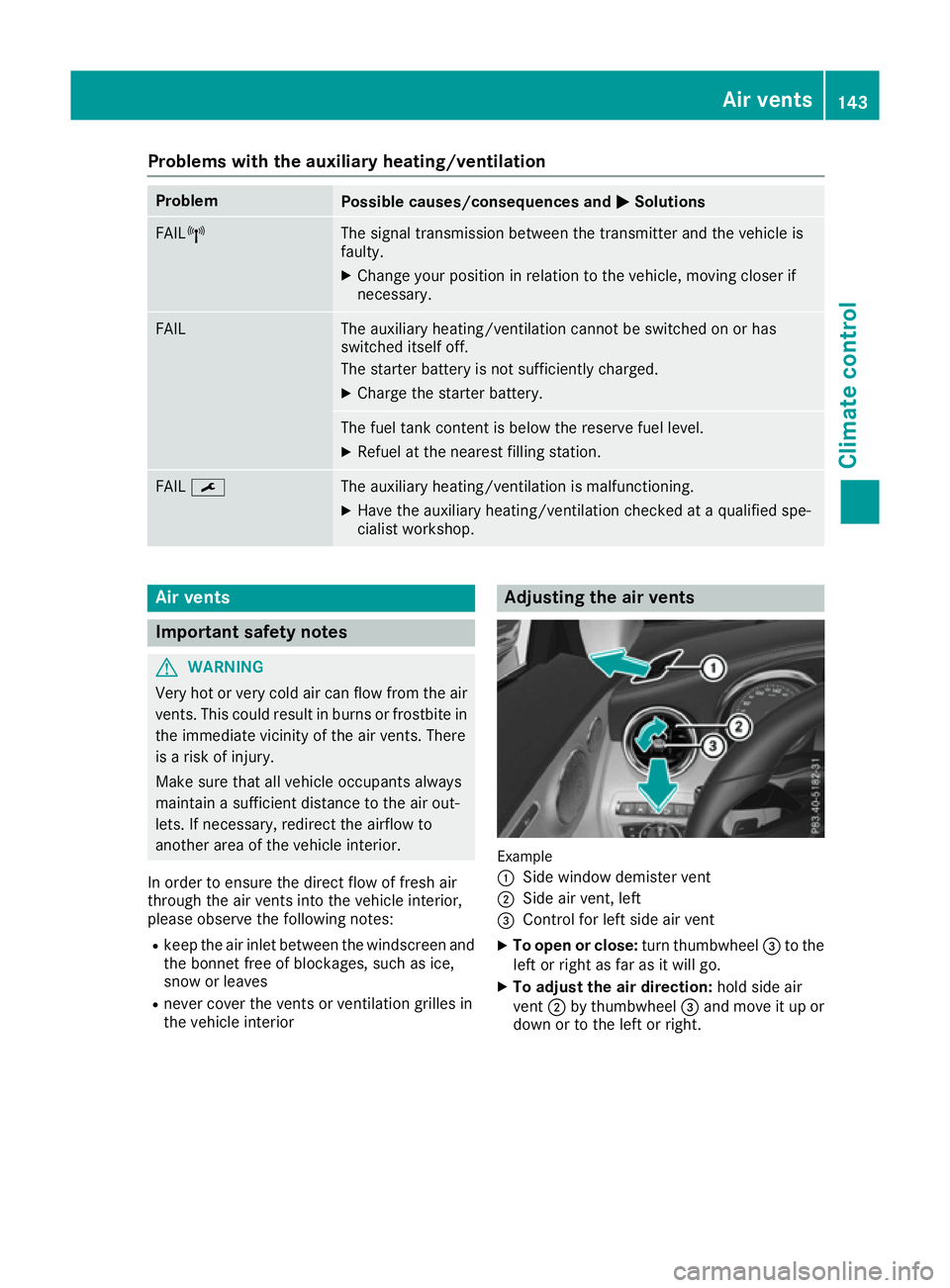
:
Side window demister vent
; Side air vent,l eft
= Control for left side air vent
X To open or close: turn thumbwheel=to the
left or right as far as it will go.
X To adjust the air direction: hold side air
vent ;by thumbwheel =and move it up or
down or to the left or right. Air vents
143Climatecontrol Z
Page 157 of 385
Problem
Possible causes/consequences and
M
MSolutions The coolant temperature
display is showing more
than 120 †. Adisplay
message may also
appear in the multifunc-
tion display and awarn-
ing tone may sound. The coolant level is too low. The coolant is too hot and the engine is no
longer being cooled sufficiently.
X Stop as soon as possible and allow the engine and the coolant to
cool down.
X Check the coolant level (Y page 324). Observe the warning notes
as you do so and top up the coolant if necessary. If the coolant level is correct,t
he engine radiator fan may be faulty. The
coolant is too hot and the engine is no longer being cooled sufficiently.
X If the coolant temperature is below 120 †, you can continue driving
to the nearest qualified specialist workshop.
X Avoid heavy loads on the engine as you do so, e.g. driving in moun-
tainous terrain and stop-start traffic. DYNAMIC SELECTs
witchAll vehicles(
except Mercedes-AMG
vehicles)
Use the DYNAMIC SELECT switch to change the
drive program. Depending on the drive program
selected, the following vehicle characteristics
will change:
R the drive (engine and transmission manage-
ment)
R the suspension
R the steering
R the availability of the ECO start/stop function
R the climate control
- the climate control settings
- the rear window heating operation period
- the performance of the seat heating
If the ignition is switched off for less than four
hours, the previously selected drive program is
activated when the engine is next started. If the ignition is switched off for more than four hours,
drive program Cis activated when the engine is
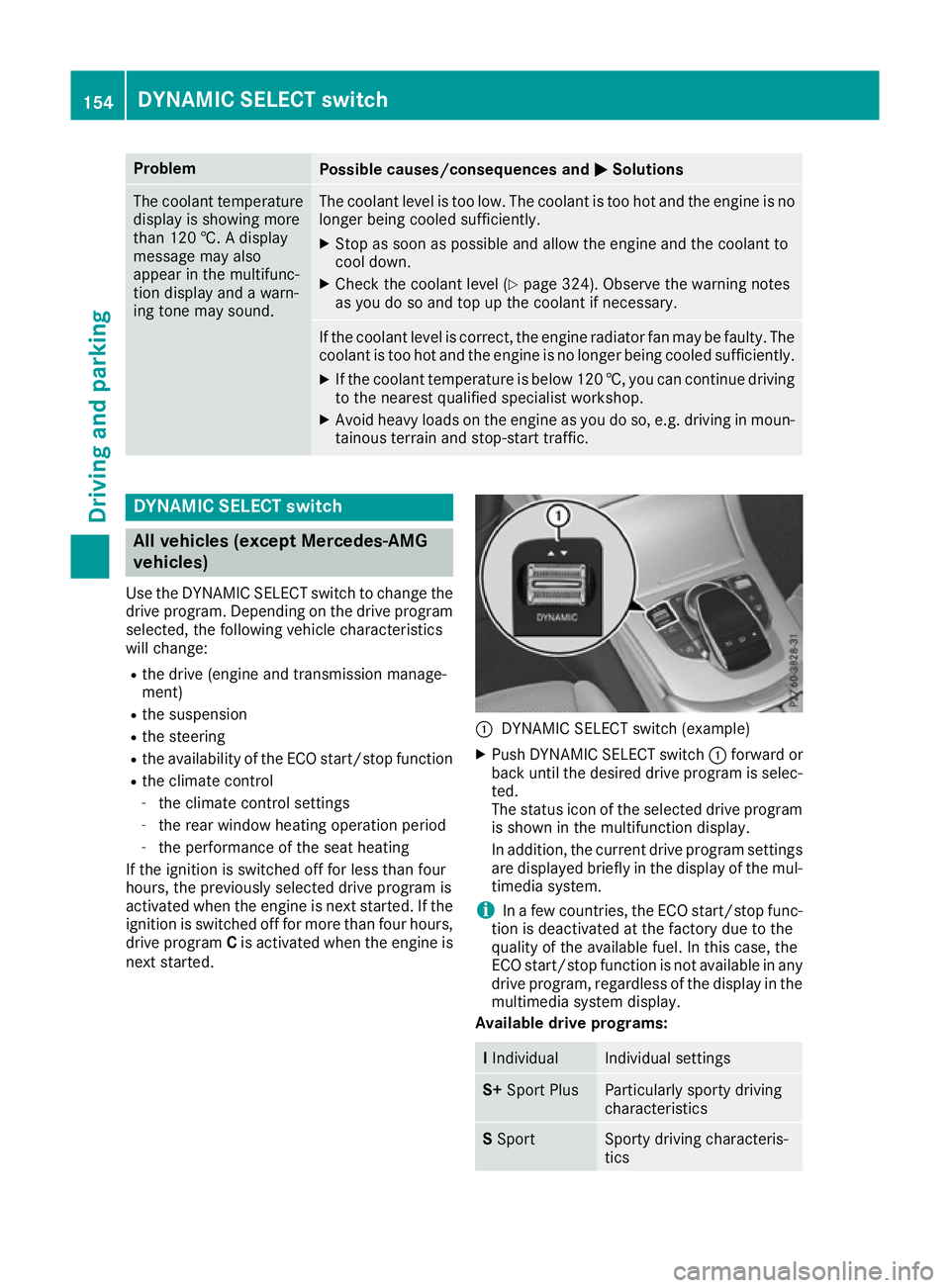
next started. :
DYNAMIC SELECT switch (example)
X Push DYNAMIC SELECT switch :forward or
back until the desired drive program is selec- ted.
The status icon of the selected drive program
is shown in the multifunction display.
In addition, the current drive program settings are displayed briefly in the display of the mul-
timedia system.
i In
af ew countries, the ECO start/stop func-
tion is deactivated at the factory due to the
quality of the available fuel. In this case, the
ECO start/stop function is not available in any
drive program, regardless of the display in the
multimedia system display.
Available drive programs: I
Individual Individual settings
S+
Sport Plus Particularly sporty driving
characteristics S
Sport Sporty driving characteris-
tics154
DYNAMIC SELECT switchDriving and parking
Page 159 of 385
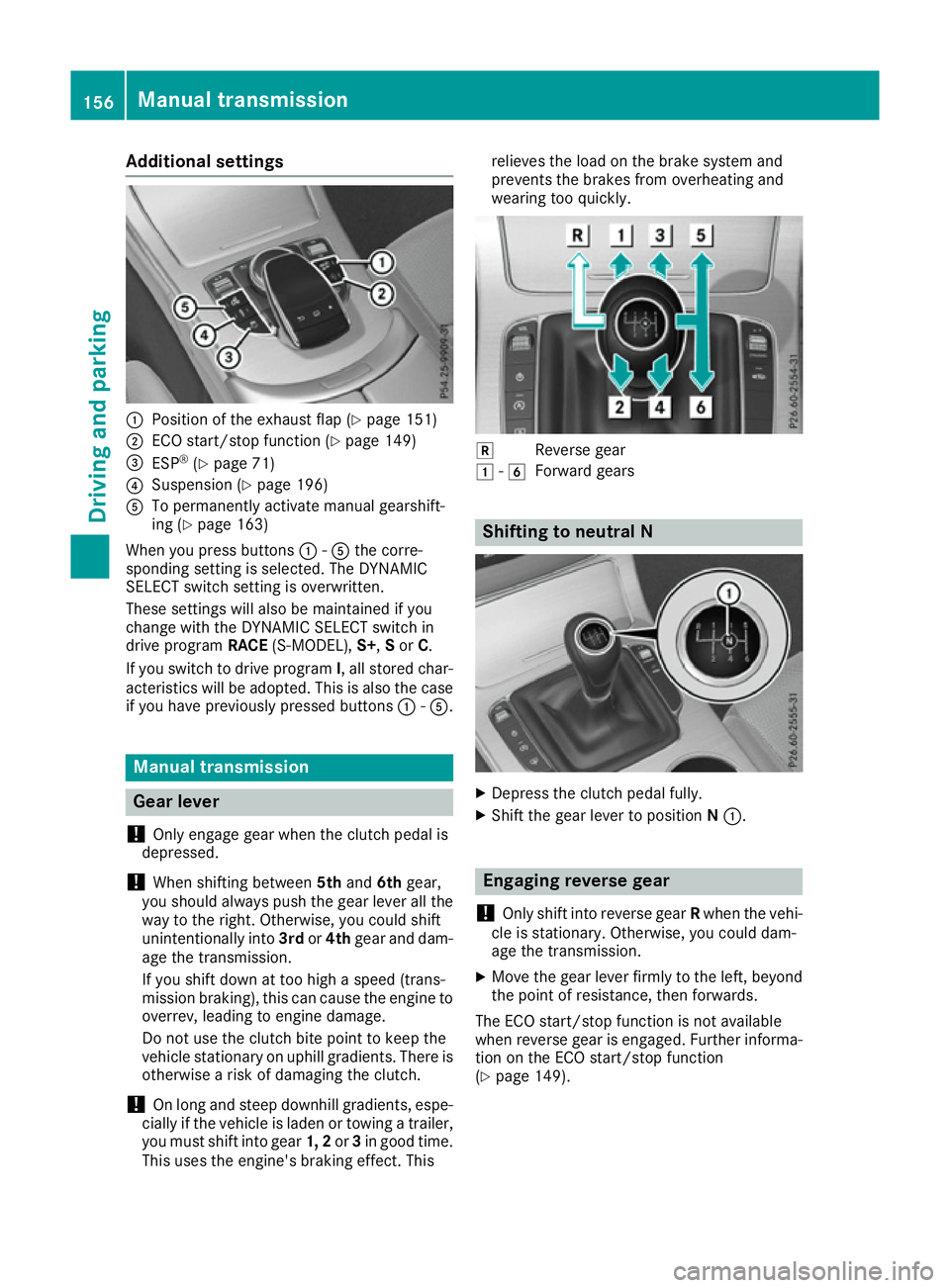
Additiona
lsettings :
Position of th eexhaust flap (Y page 151)
; ECO start/sto pfunction (Y page 149)
= ESP ®
(Y page 71)
? Suspension (Y page 196)
A To permanentl yactivat emanual gearshift-
ing (Y page 163)
When you press buttons :-A thec orre-
sponding setting is selected. The DYNAMIC
SELECT switch setting is overwritten.
These setting swill also be maintaine difyou
chang ewitht he DYNAMIC SELECT switch in
drive program RACE(S-MODEL), S+,S or C.
If you switch to drive program I,all store dchar-
acteristics will be adopted. This is also th ecase
if you hav epreviously presse dbuttons :-A. Manua
ltra nsmission Gea
rlever
! Only engage gear when th
eclutch pedal is
depressed.
! When shifting between
5thand 6thgear,
you should always push th egear lever all the
way to th eright .Otherwise ,you could shift
unintentionally into 3rdor4th gear and dam-
age th etransmission.
If you shif tdown at to ohigh aspee d(trans-
mission braking), this can caus ethe engin eto
overrev, leadin gtoengined amage.
Do no tuse th eclutch bit epointtok eept he
vehicl estationary on uphil lgradients .There is
otherwise ariskofd amaging th eclutch.
! On lon
gand steep downhill gradients ,espe-
cially if th evehicl eisladen or towin gatrailer,
you mus tshif tint og ear 1, 2 or3in goo dtime.
This uses th eengine's braking effect. This relieves th
eload on th ebrak esystem and
prevents th ebrakes from overheating and
wearing to oquickly. k
Reverse gear
1 -6
Forwar dgears Shifting to neutra
lN X
Depress th eclutch pedal fully.
X Shift th egear lever to position N:. Engaging revers
egear
! Only shif
tint or evers egear Rwhen th evehi-
cle is stationary. Otherwise ,you could dam-
age th etransmission.
X Mov ethe gear lever firmly to th eleft, beyond
th ep ointofr esistance, then forwards.
The ECO start/sto pfunction is no tavailable
when revers egear is engaged. Further informa-
tion on th eECO start/sto pfunction
(Y page 149). 156
Manua
ltra ns missionDriving an dparking
Page 160 of 385
Gearshift recommendation
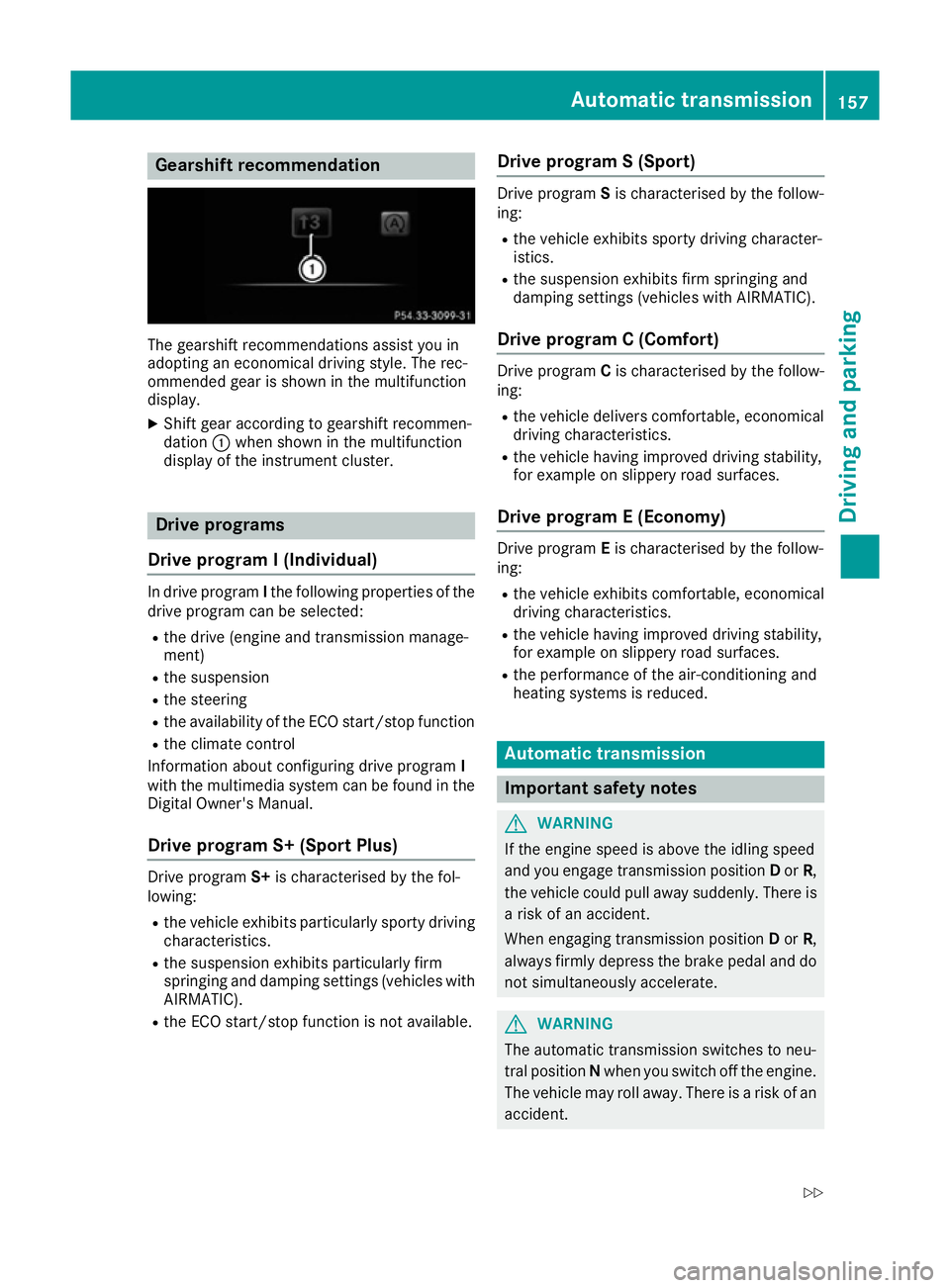
The gearshift recommendations assist you in
adopting an economical driving style .The rec-
ommended gear is shown in the multifunction
display.
X Shift gear according to gearshift recommen-
dation :when shown in the multifunction
display of the instrument cluster. Drive programs
Drive program I(Individual) In drive program
Ithe following properties of the
drive progra mcan be selected:
R the drive (engine and transmission manage-
ment)
R the suspension
R the steering
R the availability of the ECO start/stop function
R the climate control
Information abou tconfiguring drive program I
with the multimedia system can be found in the
Digital Owner's Manual.
Drive program S+ (Sport Plus) Drive program
S+is characterised by the fol-
lowing:
R the vehicle exhibits particularlys porty driving
characteristics.
R the suspension exhibits particularlyf irm
springing and damping settings (vehicles with
AIRMATIC).
R the ECO start/stop function is not available. Drive program
S(Sport) Drive program
Sis characterised by the follow-
ing:
R the vehicle exhibits sporty driving character-
istics.
R the suspension exhibits firm springing and
damping settings (vehicles with AIRMATIC).
Drive program C(Comfort) Drive program
Cis characterised by the follow-
ing:
R the vehicle delivers comfortable ,economical
driving characteristics.
R the vehicle having improve ddriving stability,
for exampl eonslippery road surfaces.
Drive program E(Economy) Drive program
Eis characterised by the follow-
ing:
R the vehicle exhibits comfortable ,economical
driving characteristics.
R the vehicle having improve ddriving stability,
for exampl eonslippery road surfaces.
R the performance of the air-conditioning and
heating systems is reduced. Automatic transmission
Important safety notes
G
WARNING
If the engine speed is above the idling speed
and you engage transmission position Dor R,
the vehicle could pulla waysuddenly. There is
ar isk of an accident.
When engaging transmission position Dor R,
alwaysf irmly depress the brake pedala nd do
not simultaneously accelerate. G
WARNING
The automatic transmission switches to neu-
tral position Nwhen you switch off the engine.
The vehicle may roll away. There is arisk of an
accident. Automatic transmission
157Driving and parking
Z
Page 165 of 385
R
the steering
R the availability of the ECO start/sto pfun ction
R the climate control
Informatio nabout configurin gdrive program I
with the multimedia syste mcan be found in the
Digita lOwn er'sM anual.
i To permanentl
yshift the gear smanuall yin
drive program Iusing the steering whee lpad-
dles ,select theM(manual) setting for the
drive.
Drive program S+ (Sport Plus)
Drive program S+is characterise dbythe fol-
lowing:
R the vehicl eexhibits particularly sporty driving
characteristics.
R the vehicl epulling away in first gear.
R the automatic transmission shiftin guplater.
As aresul toft he later automatic transmission
shift points ,the fuel consumption possibly
being higher.
R the suspensio nexhibits particularly firm
springing and damping setting s(vehicle swith
AIRMATIC).
R the ECO start/sto pfunctio nisn ot available.
Drive program S(Sport)
Drive program Sis characterise dbythe follow-
ing:
R the vehicl eexhibits sporty drivin gcharacter-
istics.
R the vehicl epulling away in first gear.
R the automatic transmission shiftin guplater.
As aresul toft he later automatic transmission
shift points ,the fuel consumption possibly
being higher.
R the suspensio nexhibits fir mspringing and
damping setting s(vehicle swithA IRMATIC).
Drive program C(Comfort)
Drive program Cis characterise dbythe follow-
ing:
R the vehicl eexhibits comfortable, economical
drivin gcharacteristics.
R the vehicl epulling away mor egently in
forward and revers egears unles sthe accel-
erator peda lisdepresse dfully. R
the vehicl ehasimproved drivin gstability, for
exampl eonslipperyroads urfaces.
R optimal fuel consumption resulting fro mthe
automatic transmission shiftin gupsooner.
Th ev ehicl eisd riven in the lo wengine speed
range and the wheels ar elesslikel ytos pin.
Drive program E(Econom y)
Drive program Eis characterised by the follow-
ing:
R the vehicl eexhibits comfortable, economical
drivin gcharacteristics.
R the vehicl epulling away mor egently in
forward and revers egears unles sthe accel-
erator peda lisdepresse dfully.
R the vehicl ehasimproved drivin gstability, for
exampl eonslipperyroads urfaces.
R optimal fuel consumption resulting fro mthe
automatic transmission shiftin gupsooner.
Th ev ehicl eisd riven in the lo wengine speed
range and the wheels ar elesslikel ytos pin.
R durin gdeceleration, the engine is disconnec-
ted fro mthe drive train. Th evehicl euses
kinetic energy and consumes less fuel (over-
ru nm ode).
R the performance of the air-conditioning and
heating systems is reduced.
Mercedes-AMG vehicles Drive program RAC
E(S‑MODEL)
Drive program RACEis characterised by the fol-
lowing:
R the vehicl eexhibits drivin gcharacteristics
suitabl efor the racetrack.
R allv ehicl esystems ar esetfor maximum
sportiness.
R the gearshift recommendation gives you
information for slowly warming up the drive
assemblie sand for adopting afuel-e fficient
drivin gstyle (Y page 163). Yo ucan follo wthe
gearshift recommendations at al ltimes and
change gear accordingly using the steering
whee lgears hift paddles. On the basi softhe
gearshift recommendation, using the steering whee lgears hift paddles, yo ucan optimis ethe
drive train and engine operating mod eatany
time.
R if yo uhaves elect edagearm anually, thi swill
be maintaine duntilthe vehicl espeed signifi-
cantl yincrease sordecreases. 162
Automati
ctransmissionDriving an dparking