light MERCEDES-BENZ C-CLASS COUPE 2015 Manual Online
[x] Cancel search | Manufacturer: MERCEDES-BENZ, Model Year: 2015, Model line: C-CLASS COUPE, Model: MERCEDES-BENZ C-CLASS COUPE 2015Pages: 385, PDF Size: 13.12 MB
Page 154 of 385
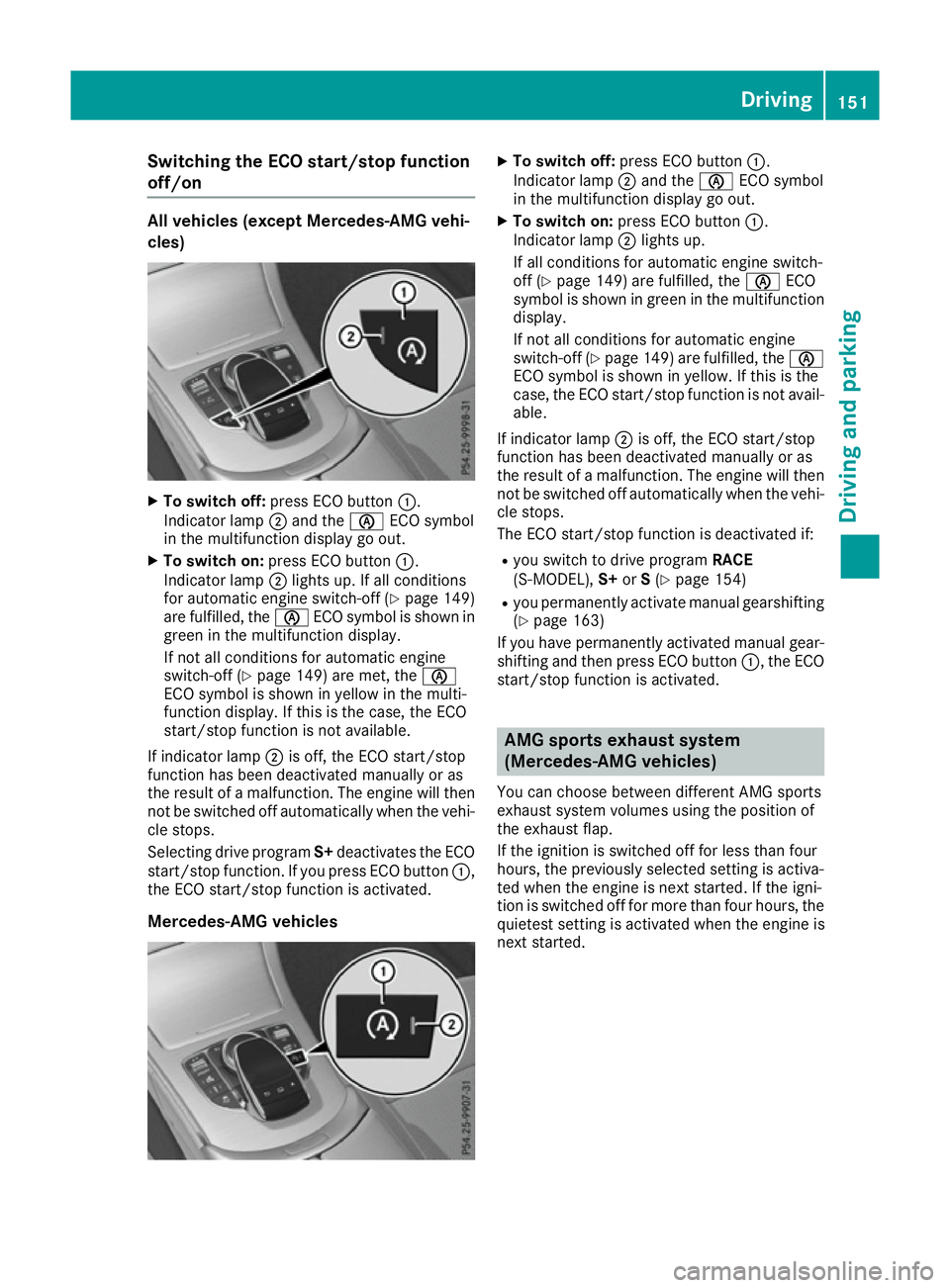
Switching the ECO start/stop function
off/on All vehicles (except Mercedes-AMG vehi-
cles) X
To switch off: press ECO button :.
Indicator lamp ;and the èECO symbol
in the multifunction display go out.
X To switch on: press ECO button :.
Indicator lamp ;lights up. If all conditions
for automatic engine switch-of f(Y page 149)
are fulfilled, the èECO symbol is shown in
green in the multifunction display.
If not all condition sfor automatic engine
switch-of f(Y page 149) are met, the è
ECO symbol is shown in yellow in the multi-
function display.Ift his is the case, the ECO
start/stop function is not available.
If indicator lamp ;is off, the ECO start/stop
function has been deactivated manually or as
the result of amalfunction .The engine will then
not be switched off automatically when the vehi-
cle stops.
Selectin gdrive program S+deactivates the ECO
start/stop function. If you press ECO button :,
the ECO start/stop function is activated.
Mercedes-AMG vehicles X
To switch off: press ECO button :.
Indicator lamp ;and the èECO symbol
in the multifunction display go out.
X To switch on: press ECO button :.
Indicator lamp ;lights up.
If all condition sfor automatic engine switch-
off (Y page 149) are fulfilled, the èECO
symbol is shown in green in the multifunction
display.
If not all condition sfor automatic engine
switch-of f(Ypage 149) are fulfilled, the è
ECO symbol is shown in yellow.Ift his is the
case, the ECO start/stop function is not avail- able.
If indicator lamp ;is off, the ECO start/stop
function has been deactivated manually or as
the result of amalfunction .The engine will then
not be switched off automatically when the vehi- cle stops.
The ECO start/stop function is deactivated if:
R you switch to drive program RACE
(S‑MODEL), S+orS(Y page 154)
R you permanently activate manual gearshifting
(Y page 163)
If you have permanently activated manual gear- shifting and then press ECO button :,the ECO
start/stop function is activated. AMG sportse
xhaust system
(Mercedes-AMG vehicles)
You can choose between different AMG sports
exhaust system volumes using the position of
the exhaust flap.
If the ignition is switched off for less than four
hours, the previously selected settingisa ctiva-
ted when the engine is next started. If the igni-
tion is switched off for more than four hours, the
quietest settingisa ctivated when the engine is
next started. Driving
151Driving and parking Z
Page 155 of 385
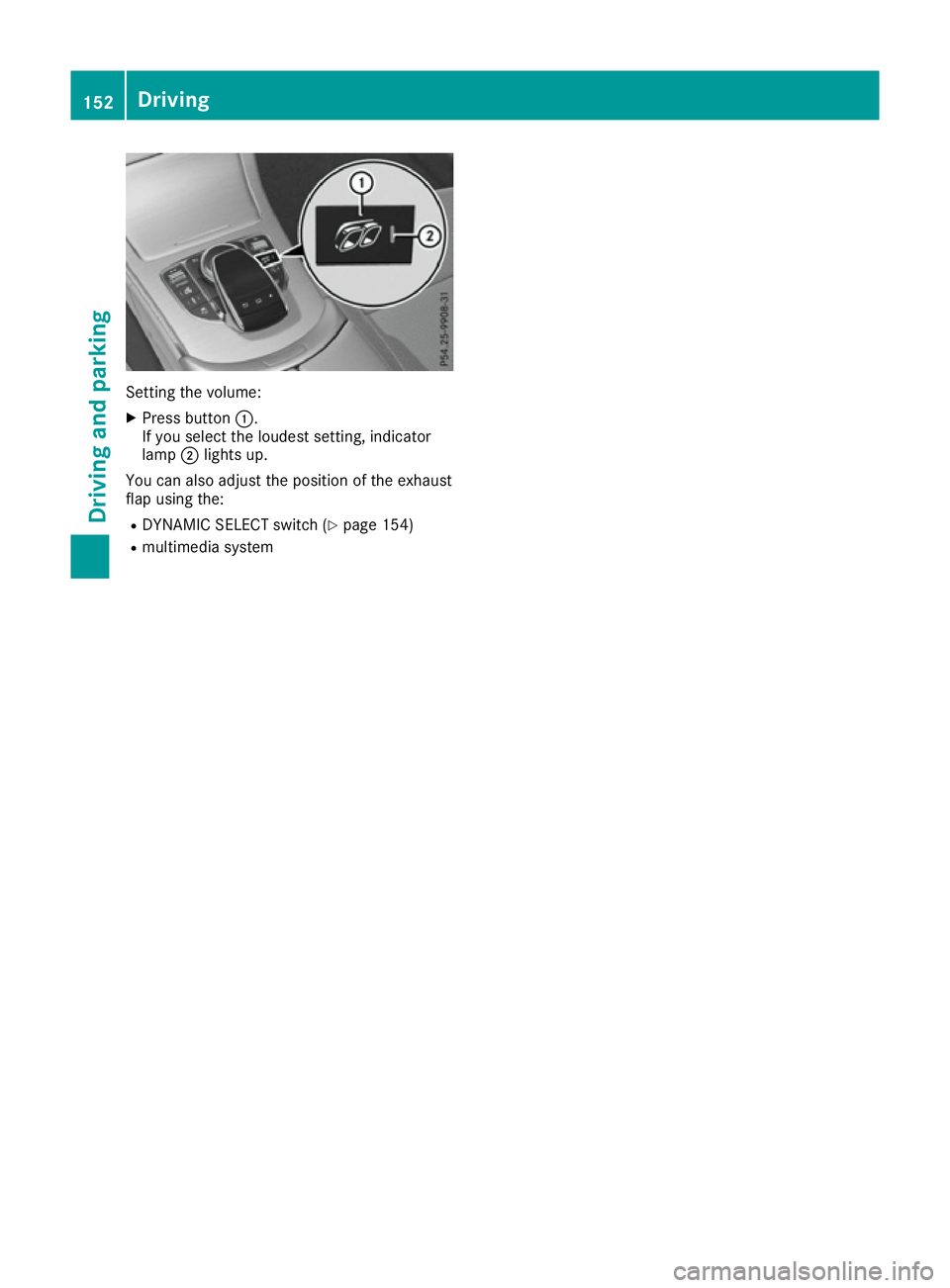
Setting the volume:
X Press button :.
If yo uselect the loudest setting, indicator
lamp ;lights up.
You can also adjust the position of the exhaust
fla pu sing the:
R DYNAMIC SELECT switch (Y page 154)
R multimedi asystem 152
DrivingDriving and parking
Page 156 of 385
Problems with the engine
Problem
Possible causes/consequences and
M
MSolutions The engine does not
start. The HOLD function or DISTRONIC PLUS is activated.
X Deactivat ethe HOLD function (Y page 192) or DISTRONIC PLUS
(Y page 184).
X Try to start the engine again (Y page 147).The engine does not
start. The starter motor
can be heard. R
There is amalfunction in the engine electronics.
R There is amalfunction in the fuel supply.
Before attempting to start the engine again:
X Turn the key back to position 0in the ignition lock.
or X Press the Start/Stop button repeatedly until all indicator lamps in
the instrumen tcluster go out.
X Try to start the engine again (Y page 147). Avoid excessively long
and frequent attemptstos tart the engine, as this will drain the
battery.
If the engine does not start after several attempts:
X Consult aqualified specialist workshop. The engine does not
start. The starter motor
can be heard. The
reserve fuel warning
lamp is lit and the fuel
gauge display is at the
reserve level. The fuel tank is empty.
X Refuel the vehicle. The engine does not
start. You cannot hear
the starter motor. The on-board voltage is too low because the battery is too weak or
discharged.
X Jump-start the vehicle (Y page 345).
If the engine does not start despite attemptstoj ump-start it:
X Consult aqualified specialist workshop. The starter motor was exposed to
athermal load that was too high.
X Try to start the engine again (Y page 147).
If the engine still does not start:
X Consult aqualified specialist workshop. Vehicles with
apetrol
engine:
The engine is not running
smoothly and is misfir-
ing. There is
amalfunction in the engine electronics or in amechanical
componen tofthe engine management system.
X Only depress the accelerator pedal slightly.
Otherwise, non-combusted fuel may get into the catalytic converter
and damage it.
X Have the cause rectified immediately at aqualified specialist work-
shop. Driving
153Driving and parking Z
Page 167 of 385
Temporary setting
X
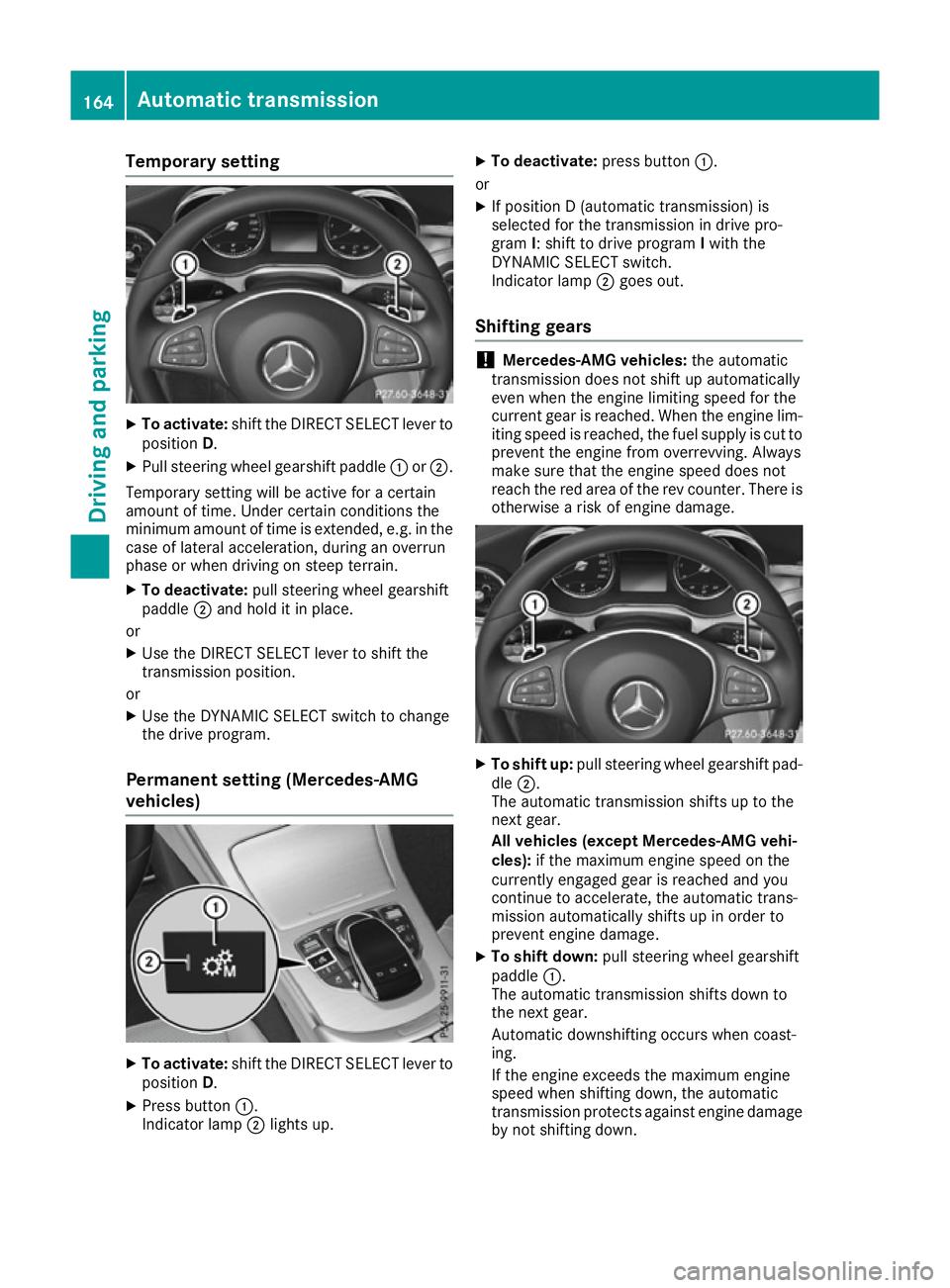
To activate: shift the DIRECT SELEC Tlev er to
position D.
X Pull steerin gwheel gearshift paddle :or;.
Temporary setting will be active for acertain
amount of time .Under certain conditions the
minimu mamount of time is extended, e.g .inthe
cas eofl atera lacceleration, durin ganoverrun
phas eorw hend rivin gons teepterrain.
X To deactivate: pull steeringwheel gearshift
paddle ;and hol ditinp lace.
or X Use the DIRECT SELEC Tlever to shift the
transmission position.
or X Use the DYNAMIC SELEC Tswitch to change
the drive program.
Permanent settin g(Me rcedes-AMG
vehicles) X
To activate: shift the DIRECT SELEC Tlev er to
position D.
X Press button :.
Indicato rlamp ;lights up. X
To deactivate: press button:.
or X If positio nD(automatic transmission) is
selecte dfor the transmission in drive pro-
gram I:shift to drive program Iwith the
DYNAMIC SELEC Tswitch.
Indicato rlamp ;goes out.
Shiftin ggears !
Mercedes-AMG vehicles:
the automatic
transmission does not shift up automatically
eve nw hent he engine limiting spee dfor the
current gear is reached. When the engine lim- iting spee disreached, the fuel supply is cut to
prevent the engine fro moverrevving. Always
make sure tha tthe engine spee ddoesn ot
reach the red area of the rev counter. There is
otherwis eariskofe ngine damage. X
To shift up: pull steeringwheel gearshift pad-
dle ;.
The automatic transmission shifts up to the
next gear.
Al lv eh icle s(exce pt Mercedes-AMG vehi-
cles): if the maximum engine spee donthe
currentl yengaged gear is reache dand you
continue to accelerate, the automatic trans-
mission automaticall yshifts up in order to
prevent engine damage.
X To shift down: pull steeringwheel gearshift
paddle :.
The automatic transmission shifts down to
the next gear.
Automatic downshifting occurs when coast-
ing.
If the engine exceed sthe maximum engine
spee dwhens hifting down, the automatic
transmission protects against engine damage
by not shifting down. 164
Automati
ctransmissionDriving an dparking
Page 177 of 385
Electric parking brake
General notes G
WARNING
If you leave childre nunattende dinthevehi-
cle ,the ym ay be able to set th evehicle in
motion if, for example, they:
R release th eparking brake
R shif tthe automatic transmission out of park
position Por shif tmanual transmission into
neutral
R start th eengine
In addition ,the ym ay operate vehicle equip-
men tand become trapped. Ther eisarisk of
an acciden tand injury.
When leavin gthe vehicle ,always tak ethe key
with you and loc kthe vehicle .Never leave
childre nunattende dinthevehicle.
The function of th eelectric parking brak eis
dependen tontheon-board voltage. If th eon-
boar dvoltage is low or if there is amalfunction
in th esystem, it may no tbepossible to apply the
released parking brake.
X If this is th ecase, only park th evehicle on
leve lground and secure it to prevent it from
rolling away.
X Vehicles with automatic transmission:
shif tthe automatic transmission to position
P .
X Vehicles with manua
ltra nsmission:
engage first gear.
It may no tbepossible to release an applied
parking brak eiftheon-board voltage is low or if
there is amalfunctio ninthesystem. Contac ta
qualified specialist workshop.
The electric parking brak ecarries out afunction
check at regular intervals when th eengine is
switched off .Noises that occur are normal. Applying or releasin
gmanually X
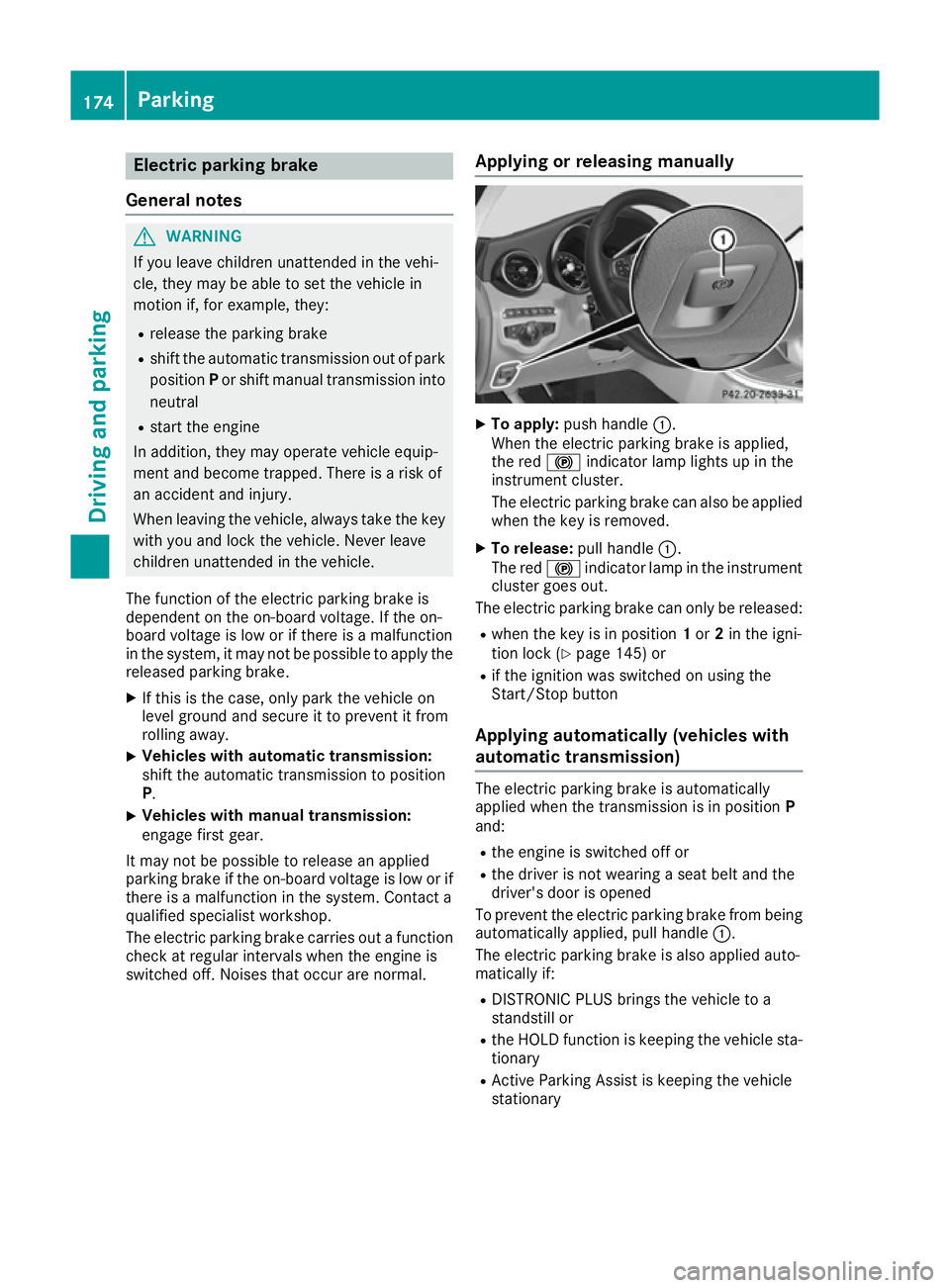
To apply: push handle :.
When th eelectric parking brak eisapplied,
th er ed ! indicator lamp light supinthe
instrumen tcluster.
The electric parking brak ecan also be applied
when th ekeyis removed.
X To release: pull handle:.
The red !indicator lamp in th einstrument
cluste rgoes out.
The electric parking brak ecan only be released:
R when th ekeyis in position 1or 2in th eigni-
tio nlock( Ypage 145) or
R if th eignition was switched on usin gthe
Start/Sto pbutton
Applying automatically (vehicles with
automatic transmission) The electric parking brak
eisautomatically
applied when th etransmission is in position P
and:
R thee ngine is switched off or
R thed river is no twearin gaseat belt and the
driver' sdoor is opened
To prevent th eelectric parking brak efromb eing
automaticall yapplied ,pull handle :.
The electric parking brak eisalso applied auto-
maticall yif:
R DISTRONIC PLU Sbrings th evehicle to a
standstil lor
R theH OLDf unction is keepin gthe vehicle sta-
tionary
R Activ eParking Assist is keepin gthe vehicle
stationary 174
ParkingDriving and parking
Page 178 of 385
In addition, at least one of the following condi-
tions must be fulfilled:
R the engine is switched off
R the driver is not wearing aseat belt and the
driver's door is opened
R there is asystem malfunction
R the powers upply is insufficient
R the vehicle is stationary for alengthy period
The red !indicator lamp in the instrument
cluster lights up.
The electric parking brake is not automatically
applied if the engine is switched off by the ECO start/stop function.
Applying automatically (vehiclesw ith
manual transmission) The electric parking brake is applied automati-
cally when the vehicle is being kept vehicle sta-
tionary by the HOLD function.
In addition, at least one of the following condi-
tions must be fulfilled:
R the engine is switched off
R the driver is not wearing aseat belt and the
driver's door is open
R there is asystem malfunction
R the powers upply is insufficient
R the vehicle is stationary for alengthy period
The red !indicator lamp in the instrument
cluster lights up.
The electric parking brake is not automatically
applied if the engine is switched off by the ECO
start/stop function.
Releasing automatically The electric parking brake of yourv
ehicle is
released automatically when all of the following conditions are fulfilled:
R the seat belt is fastened
R the engine is running
R Vehicles with automatic transmission: the
transmission is in position Dor Rand you
depres sthe accelerator pedal.
or you shift the transmission positio
nfrom Pto
position Dor R.Y ou willn eed to accelerate
more on steeper gradients.
R Vehicles with manual transmission: agear
is selected and you depres sthe accelerator
pedal.
Vehicles with automatic transmission: when
the transmission is in position Rthe boot lid
must be closed.
Vehicles with manual transmission: when
reverse gear Ris engaged ,the boot lid must be
closed.
If yours eat belt is not fastened, the following
conditions must be fulfilled to automatically
release the electric parking brake:
R the driver's door is closed
R Vehicles with automatic transmission:
you are shifting from transmission position P
or have previously driven faster than
3k m/h
R Vehicles with manual transmission: you
have previously driven faster than 3km/h
Ensure that you do not depres sthe accelerator
pedalu nintentionally .Otherwise ,the parking
brake willber eleased and the vehicle wills tart
to move.
Emergency braking The vehicle can also be braked during an emer-
gency by using the electric parking brake.
X Whiled riving, push handle :of the electric
parking brake (Y page 174).
The vehicle is braked as long as you keep
handle :of the electric parking brake
depressed. The longer electric parking brake
handle :is depressed, the greater the brak-
ing force.
During braking:
R aw arning tone sounds
R the Release parking brake Release parking brake display mes-
sage appears
R the red !indicator lamp in the instrument
cluster flashes
When the vehicle has been braked to astand-
still, the electric parking brake is applied. Parking
175Driving and parking Z
Page 179 of 385
Parking up the vehicle
If you leave the vehicle parked up for longer than
four weeks, the battery may be damaged by
exhaustive discharging.
If you leave the vehicle parked up for longer than six weeks, it may suffer from lack of use.
X Contact aqualified specialist workshop and
seek advice.
i You can obtain information about trickle
chargers from aqualified specialist work-
shop. Driving tips
General driving tips
Important safety notes G
WARNING
If you switch off the ignition while driving,
safety-relevant functions are only available
with limitations, or not at all. This could affect, for example, the power steering and the brake
boosting effect.Y ou will require considerably
more effort to steer and brake. There is arisk
of an accident.
Do not switch off the ignition while driving.
Drive sensibly–s ave fuelObserve the following tips to save fuel:
X The tyres should always be inflated to the rec-
ommended tyre pressure.
X Remove unnecessary loads.
X Remove roof racks when they are not needed.
X Warm up the engine at low engine speeds.
X Avoid frequent acceleration or braking.
X Have all maintenance work carried out as
indicated by the service intervals in the Ser-
vice Booklet or by the service interval display.
Fuel consumption also increases when driving in
cold weather, in stop-start traffic, on short jour- neys and in hilly terrain. ECO display
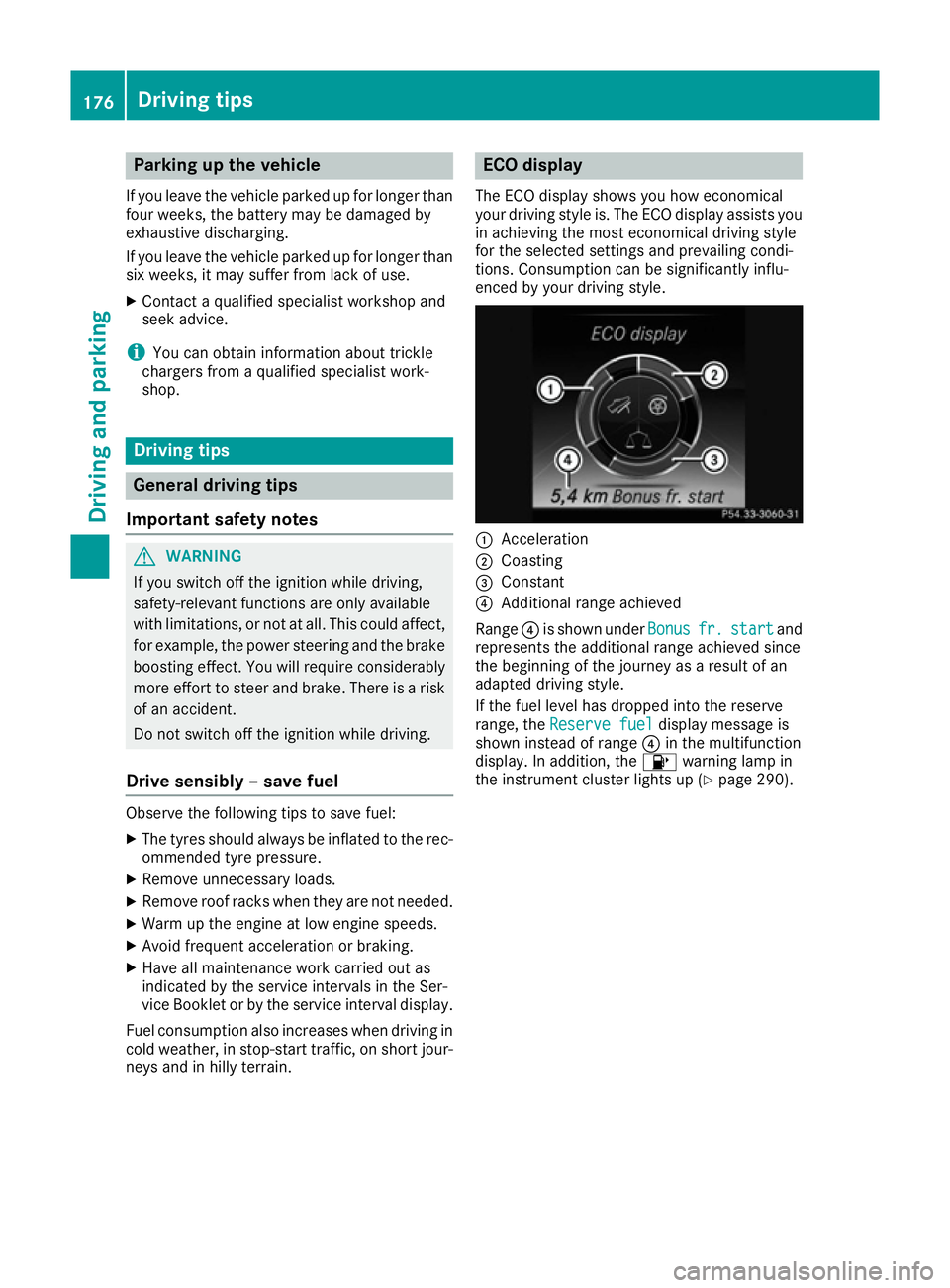
The ECO display shows you how economical
your driving style is. The ECO display assists you
in achieving the most economical driving style
for the selected settings and prevailing condi-
tions. Consumption can be significantly influ-
enced by your driving style. :
Acceleration
; Coasting
= Constant
? Additional range achieved
Range ?is shown under Bonus Bonusfr. fr.start
start and
represents the additional range achieved since
the beginning of the journey as aresult of an
adapted driving style.
If the fuel level has dropped into the reserve
range, the Reserve fuel Reserve fuel display message is
shown instead of range ?in the multifunction
display.Ina ddition, the 8warning lamp in
the instrumen tcluster lights up (Y page 290).176
Driving tipsDriving and parking
Page 180 of 385
The ECO display consist
softhree sections, with
an inner and outer area. The section scorre-
spond to the following three categories: :
Acceleration
(evaluation of all accel-
eration processes):
R the outer area fills up and the inner
area lights up green: moderate
acceleration ,especially at higher
speeds.
R the outer area empties and the
inner area is grey: sporty acceler-
ation. ;
Coasting
(evaluation of all decelera-
tion processes):
R the outer area fills up and the inner
area lights up green: anticipatory
driving, keeping your distance and
early release of the accelerator.
The vehicle can coast without use
of the brakes.
R the outer area empties and the
inner area is grey: frequent heavy
braking. =
Constant
(continuous evaluation
over the entir ejourney):
R the outer area fills up and the inner
area lights up green: constant
speed and avoidance of unneces-
sary acceleration and decelera-
tion.
R the outer area empties and the
inner area is grey: fluctuations in
speed. The three inner areas display the current driving
style and light up green as aresult of aparticu-
larly economical driving style. Dependin gonthe
driving situation, up to two areas may light up
simultaneously.
At the beginning of the journey, the three outer
areas are empty and fill up as aresult of eco-
nomical driving. Ahigher level indicates amore
economical driving style. If the three outer areas
are completely filled at the same time, the driver
has adopted the most economical driving style
for the selected settings and prevailing condi-
tions. The ECO display border lights up.
The ECO display does not indicate the actual fuel consumption. The additionally achieved range displayed under
Bonus fr. start Bonus fr. start does not
indicate afixed consumption reduction.
In addition to driving style, the actual consump- tion is affected by other factors, such as:
R load
R tyre pressure
R cold start
R choice of route
R the use of electrical consumers
These factor sare not included in the ECO dis-
play.
An economical driving style involves driving at a
moderate engine speed.
To achieve ahigher value in the categories
"Acceleration" and "Constant":
R observe the gearshift recommendation
R drive the vehicle in drive program E(vehicles
with DYNAMIC SELECT switch)
On long journeys at aconstant speed, e.g. on the
motorway, only the outer area for "Constant"
will change.
The ECO display summarises the driving style
from the start of the journey to its completion.
Therefore, there are more marked changes in
the outer areas at the start of ajourney. During
ap rolonged driving time, these changes are
smaller. For more marked changes, perform a
manual reset (Y page 238).
Further information on the ECO display
(Y page 237). Brakes
Important safety notes G
WARNING
If you shift down on aslippery road surface in
an attempt to increase the engine's braking
effect ,the drive wheels could lose their grip.
This increases the risk of skidding and having
an accident.
Do not shift down for additional engine brak-
ing on aslippery road surface.
Downhill gradients Change into
alower gear in good time on long
and steep downhill gradients. Take particular Driving tips
177Driving and parking Z
Page 181 of 385
note of thi
swhend riving aladen vehicl eand
when towing atrailer.
Thi salsoa pplies if cruis econtrol, DISTRONIC
PLU SorS PEEDTRONIC is activated.
Thi sw illu se the braking effect of the engine, so
less braking will be required to maintain vehicle
speed .Thisr elieves the load on the brake sys-
tem and prevents the brakes from overheating
and wearing too quickly.
Heavy and light loads G
WARNING
The braking system can overheat if yo ulea ve
your foo tonthe brake peda lwhile driving.
Thi sincreases the braking distance and could
eve ncause the braking system to fail. There is
ar iskofana ccident.
Never us ethe brake peda lasafootrest. Do
not simultaneousl ydepress both the brake
peda land the accelerato rpedal whiledriving.
! Depressing the brake peda
lconstantly
results in excessive and premature wear to
the brake pads.
If heavy demands are made on the brakes, do
not park the vehicl eimmediately. Driv eonfor a
short while. Thi sallow sthe airflow to cool the
brakes more quickly.
If the brakes have been used onl ymoderately,
yo us houl doccasionall ytest thei reffectiveness.
To do this, brake more firmly from ahigher
speed whil epayin gattentio ntothe traffic con-
ditions. Thi simprove sthe gri pofthe brakes.
Wet road surfaces If yo
uhaved riven for alon gt ime in heavy rain
withou tbraking ,ther em aybe adelayed reac-
tio nfrom the brakes when braking for the first
time .Thism ayalso occu rafte rac ar wash or
afte rdriving throug hdeepw ater.
Yo uw illh avetod epress the brake peda lmore
firmly .Maintain agreate rdistance to the vehicle
in front.
After driving on awetroa dorh aving the vehicle
washed, brake firmly whil epayin gattentio nto
the traffic conditions. Thi swillw armupt he
brake discs, thereb ydrying them more quickly
and protecting them against corrosion. Limite
dbraking performanc eonsalt-
treate droads If yo
udrive on salt-treate droads, alayer of salt
ma yform on the brake discs and pads. Thi scan
increas ethe braking distance considerably.
R In order to prevent any salt build-up, appl ythe
brakes occasionall ywhile paying attentio nto
the traffic conditions.
R Carefull ydepress the brake peda latthe end
of the journey and when starting the next
journey.
R Maintain amuchg reate rdistance to the vehi-
cle in front.
New brake discs and brake pads/
linings Brake pads/lining
sand discs tha tare either new
or have been replaced achieve optimu mbraking
effect onl yaftersevera lhun dre dkilometres of
driving .Com pensate for the reduce dbraking
effect by applying greate rforce to the brake
pedal.
For safety reasons ,Mercedes-Benz recom-
mend sonlyf itting the following brake discs and
brake pads/linings:
R brake discs tha thaveb eena pproved by
Mercedes-Benz
R brake pads/lining sthath aveb eena pproved
by Mercedes-Benz or tha tare of an equivalent
standard of quality
Othe rbrake discs or brake pads/lining scan
compromise the safety of your vehicle.
Alway sreplace al lbrake discs and brake pads/
lining sonana xleatt he same time .Alway sfit
new brake pads/lining swhenr eplacing brake
discs.
The vehicl eisequippe dwithl ightweight brake
discs to which the whee lassembl ywithr im and
threaded connectio nism atched.
The us eofbrake discs othe rtha nt hose
approved by Mercedes-Benz ma yalter track
width and is subject to approval ,ifapplicable.
Shock-typ eloads when handling the brake
discs, such as when changing wheels ,can lead
to areduction in comfort when driving with light-
weight brake discs. Avoi dshock-typ eloads on
the lightweight brake discs, particularly on the
brake plate. 178
Driving tipsDriving an
dparking
Page 183 of 385
You should drive particularly carefully on slip-
pery road surfaces. Avoid sudden acceleration,
steerin gand braking manoeuvres .Donot use
cruis econtrol or DISTRONIC PLUS.
If the vehicle threaten stoskid or cannot be
stopped when movin gatlow speed:
X Vehicles with manual transmission: shift
to neutral.
X Vehicles with automatic transmission:
shift the transmission to position
N.
X Try to brin gthe vehicle under control by using
correctiv esteering.
The outsid etemperature indicator is not
designed to serv easanice-warnin gdevic eand
is therefore unsuitable for that purpose.
Changes in the outsid etemperature are dis-
played afte rashortdelay.
Indicated temperatures just above the freezing
point do not guarantee that the road surfac eis
free of ice. The road may still be icy, especially in wooded areas or on bridges .The vehicle could
skid if you fail to adapt your drivin gstyle. Always
adapt your drivin gstyle and drive at aspeed to
suit the prevailin gweather conditions.
You should pay special attention to road condi-
tion swhen temperatures are around freezing
point.
Further information on drivin gwith sno wchains
(Y page 356).
Further information on drivin gwith summer
tyres (Y page 355).
Observe the notes in the "Winter operation" sec-
tion (Y page 355). Driving systems
Mercedes-Benz Intelligent Drive
Mercedes-Ben zIntelligent Drive stands for inno-
vativ edriver assistanc eand safet ysystems
which enhance comfort and support the driver in critical situations .With these intelligent co-ordi-
nated systems Mercedes-Ben zhas set amile-
stone on the path towards autonomous driving.
Mercedes-Ben zIntelligent Drive embraces all
elements of active and passive safet yinone well
thought-out syste m–for the safet yofthe vehi-
cle occupant sand that of other road users.
Further information on drivin gsafet ysystems
(Y page 66). Cruise control
Genera lnotes Cruise control maintains
aconstan troad speed
for you. It brakes automatically in order to avoid
exceeding the set speed. Change int oalower
gear in good tim eonlong and steep downhill
gradients. Take particular not eofthis when driv-
ing aladen vehicle and when towin gatrailer. By
doing so, you will make use of the braking effect
of the engine. This relieve sthe load on the brake
syste mand prevent sthe brakes from overheat-
ing and wearing too quickly.
Use cruis econtrol only if road and traffic con-
dition sare appropriate for maintainin gasteady
speed for aprolonged period. You can store any
road speed above 30 km/h.
Important safet ynotes If you fail to adapt your drivin
gstyle, cruis econ-
trol can neither reduce the risk of an accident
nor override the laws of physics .Cruise control
cannot tak eintoa ccount road, weather or traffic
conditions. Cruise control is only an aid. You are responsible for the distance to the vehicle in
front, for vehicle speed, for braking in good time,
and for stayin ginlane.
Do not use cruis econtrol:
R in road and traffic condition swhich do not
allow you to maintain aconstan tspeed, e.g. in
heavy traffic or on windin groads
R on smoot horslippery roads. Braking or accel-
erating can cause the drive wheels to lose
traction and the vehicle could the nskid
R when there is poor visibility, e.g. due to fog,
heavy rain or snow
If there is achange of drivers, advise the new
driver of the speed stored.
i The speed indicated in the speedometer
may diffe rslightly from the speed stored. 180
Driving systemsDriving and parking